

Note: This article contains affiliate links. If you click on these links and make a purchase, I may earn a small commission at no extra cost to you. This helps support my research and content. Read my full affiliate disclosure here.
Selecting the right Honda Civic EG radiator matters because the cooling system affects engine life, driveability, and roadside reliability. A radiator that fits precisely and delivers consistent heat rejection reduces the risk of overheating on hot days or under heavy load, and it limits the chance of sudden coolant loss that can strand you.This guide highlights the top shortlisted radiators for the Civic EG and walks through practical evaluation points such as cooling performance, construction quality, and fitment compatibility. Use the quick picks below and the buying guidance that follows to choose a radiator that addresses leaking, overheating, and long-term maintenance concerns.
Looking for other parts? See all Honda Civic parts & accessories.
Top Picks at a Glance
| Best Overall The best all-around choice for most situations | BLACKHORSE-RACING 2-Row Full Aluminum Racing Radiator with Fan Shroud |  |
| Best Quality Built to a higher standard if you want something more solid | DNA Motoring T-6061 Aluminum 2-Row Radiator for 1992–2000 Honda Civic/1994–2001 Acura Integra (Manual) |  |
| Best Value The sweet spot between price and what you get | Auto Dynasty 2-Row 42mm Full-Aluminum Radiator with 10" Slim Cooling Fan |  |
| Best Budget The cheapest option that still gets the job done reliably | DWVO Aluminum Radiator compatible with 1992–2000 Honda Civic |  |
| Highest Rated A top-rated pick with lots of positive feedback | G-PLUS 3-Row Full Aluminum Racing Radiator for 1992–2000 Honda Civic EG/EK B16A B18C |  |
| Most Popular A crowd favorite that many people choose with confidence | Auto Dynasty Full Aluminum 2-Row Radiator, 42mm (fits 1992–2001 Civic/Del Sol/Integra) |  |
| Best Seller A high-volume bestseller chosen again and again | DNA Motoring 2-Row Aluminum Radiator with Fan Shroud (RA+FS-HC92-42-2) |  |
1. BLACKHORSE-RACING 2-Row Full Aluminum Racing Radiator with Fan Shroud

| Core type | 2-row high-density multi-louvered aluminum |
|---|---|
| Construction | Full T-6061 aluminum |
| Includes | Aluminum fan shroud |
| Compatible models | 1992–2000 Civic; 1993–1997 Del Sol; 1994–2001 Integra (manual) |
This Blackhorse-Racing radiator is a direct-fit, performance-oriented replacement for mid-90s Civics, Del Sols, and Integras with manual transmissions. Built from full T-6061 aluminum and a high-density multi-louvered fin core, the 2-row design increases cooling capacity compared with stock units and is meant to lower operating temperatures for spirited driving or track use. It ships preassembled with an aluminum fan shroud so installation is simpler than fitting separate components. Buyers report solid cooling gains and use on race cars and off-road rigs, though some customers noted variability in long-term durability and advised pressure testing before installation. Practical benefits include improved heat rejection during heavy use and a lighter, corrosion-resistant construction; limitations are the simpler 2-row core versus thicker performance radiators and occasional quality-control issues that can require warranty support or inspection on arrival.
Best for: Drivers who want a step up in cooling for spirited street driving or occasional track days and need a direct-fit replacement that is relatively simple to install.
Less Ideal for: Owners seeking a heavy-duty, long-duration racing radiator or those who prefer factory dealer parts and extended factory-backed support.
- Full T-6061 aluminum construction resists corrosion and sheds heat faster than many stock radiators
- High-density multi-louvered fin core improves cooling efficiency for demanding driving
- Preassembled with aluminum fan shroud reduces fitment work and simplifies installation
- Compatible with specified 1992–2000 Civic, 1993–1997 Del Sol, and 1994–2001 Integra manual-transmission models
- Some buyers reported occasional leaks or pinholes indicating inconsistent quality control
- Two-row core is less heavy-duty than larger aftermarket multi-row performance radiators
Verdict: Choose this radiator if you want a lightweight, higher-capacity aluminum replacement that lowers engine temperatures for spirited driving while keeping installation straightforward.
2. DNA Motoring T-6061 Aluminum 2-Row Radiator for 1992–2000 Honda Civic/1994–2001 Acura Integra (Manual)

| Core material | T-6061 aluminum |
|---|---|
| Core type | 2-row, high-density louvered fins |
| Fitment | 1992-2000 Honda Civic MT; 1993-1997 Del Sol MT; 1994-2001 Acura Integra MT (half size) |
| Inlet/outlet | 1.25 in diameter |
| Transmission oil cooler | No |
This DNA Motoring radiator replaces the factory unit with a lightweight T-6061 aluminum 2-row core aimed at improving cooling for modified or stock B- and D-series engines. It is typically used as a direct replacement in 1992–2000 Honda Civic MT, 1993–1997 Del Sol MT, or 1994–2001 Acura Integra MT (half size). The high-density louvered fin construction increases heat dissipation and the aluminum core makes it more resistant to corrosion than plastic-end radiators. Users report noticeably lower engine temperatures and better thermal performance under higher loads or spirited driving. Fitment is mostly straightforward but expect some adjustment: several installers noted slightly misaligned mounting tabs, larger inlet/outlet diameters than some stock hoses, and tight hose fit that can require stronger clamps or hose adapters. Build quality appears good for the price, though a few buyers found cosmetic imperfections and occasional leaks. Professional installation is recommended to verify proper mount alignment and hose compatibility before road use.
Best for: Drivers who push their EG-generation Civics harder than stock and need improved cooling under spirited or track use will appreciate the stronger aluminum core and higher heat rejection.
Less Ideal for: If you expect a guaranteed bolt-in, perfect cosmetic finish and zero fitting work, or prefer OEM-exact hose locations without adaptation, this may not meet those expectations.
- Full T-6061 aluminum core improves corrosion resistance compared with plastic-end radiators
- High-density louvered fins increase heat dissipation and cooling efficiency
- Lightweight 2-row design reduces weight while providing better cooling than many stock units
- Compatible with specified manual-transmission Civic/Del Sol/Integra fitments and lists common interchange part numbers
- Some units require minor modification to mounting tabs or hoses for a secure fit
- Inlet and outlet diameters are larger than some stock hoses which may need different clamps or adapters
- Occasional cosmetic weld marks or paint and rare reports of leaks have been reported
Verdict: Choose this aluminum 2-row radiator when you need stronger, more efficient cooling for performance-oriented Civic EG builds while accepting minor fitment adjustments.
3. Auto Dynasty 2-Row 42mm Full-Aluminum Radiator with 10" Slim Cooling Fan

| Cooling Method | Air, Water |
|---|---|
| Voltage | 12 Volts |
| Wattage | 80 watts |
| Maximum Rotational Speed | 2500 RPM |
| Air Flow Capacity | 1730 Cubic Feet Per Minute |
This Auto Dynasty bundle replaces the factory half-size radiator with a 2-row, T-6061 aluminum core and includes a slim 10-inch electric fan and basic mounting hardware. It is intended as a direct bolt-in for manual-transmission half-size radiator models and is useful for street-driven Civics, Del Sols, and Integras that need a lighter, corrosion-resistant radiator. The slim fan offers high airflow (rated up to 1730 CFM) while drawing about 12.7 amps and running up to roughly 2250 RPM, which helps clear heat from the radiator and adjacent components in tight engine bays. The lightweight racing-style design reduces mass compared with heavier factory units and the aluminum construction resists rust. Important limits are that this is a 2-row, half-size core so cooling capacity will be less than larger multi-row radiators; professional installation is recommended because instructions are not included and the unit is aftermarket. Expect a solid replacement for everyday driving and modest performance needs rather than for heavy-duty towing or high-boost track use.
Best for: Buyers who prioritize a lighter, corrosion-resistant factory-replacement radiator for daily-driven EG-series Honda Civics or similar cars and want an included slim fan to improve airflow without major modification.
Less Ideal for: Not a good choice for drivers needing maximum cooling reserve for track days, heavy towing, or heavily upgraded high-horsepower engines where a thicker or multi-row radiator is required.
- Full T-6061 aluminum construction for corrosion resistance and lighter weight than cast alternatives
- Includes a slim 10-inch electric cooling fan rated up to 1730 CFM to improve airflow in confined engine bays
- Direct bolt-on fitment for half-size manual-transmission models with included mounting kit
- Racing-style 2-row core reduces mass while maintaining adequate cooling for street and light performance use
- 2-row half-size core provides less cooling margin than larger multi-row radiators for extreme or track-focused applications
Verdict: A lightweight, full-aluminum 2-row radiator bundle with a slim high-flow fan that suits street-driven EG Honda Civics needing a reliable, corrosion-resistant factory-style replacement.
4. DWVO Aluminum Radiator compatible with 1992–2000 Honda Civic

| Model fit | 1992-2000 Honda Civic |
|---|---|
| Core size | 13.8 x 13.7 inches |
| OEM part numbers | 19010P03505, 19010P07024, 19010P07014 |
| Material | Aluminum core with PA66 GF30 tanks |
This DWVO aluminum radiator is a direct-fit replacement made to match the OEM part numbers for Civic models from 1992 through 2000. It is a complete radiator with a high-density multi-louvered aluminum core and TIG-welded inlet/outlet tanks intended to improve cooling efficiency and resist leaks. Typical use is a full radiator swap when the original is leaking, clogged, or damaged; the unit ships with foam padding and a user manual but does not include a radiator cap. Practical benefits include factory-style fitment, a treated coating for corrosion resistance, and a built-in brass transmission oil cooler for automatic transmissions. Installation is straightforward for someone comfortable with radiator work, though professional installation is recommended if you lack experience. Expect decent value for money, but note variations in manufacturing details reported by some buyers such as plastic versus brass threaded fittings and occasional blemishes, so inspect the part on arrival. Replacing the thermostat and pressure cap during installation is advised to ensure proper system performance.
Best for: Buyers prioritizing a low-cost, factory-style replacement for an aging Civic who want a straightforward radiator swap that restores cooling performance without expensive aftermarket upgrades.
Less Ideal for: Shoppers seeking a performance or high-capacity racing radiator or those who need a guaranteed flawless cosmetics finish should consider higher-end or upgraded options instead.
- Direct-fit design matching listed OEM part numbers for 1992–2000 Civic models
- High-density multi-louvered aluminum core for improved heat dissipation
- TIG-welded inlet/outlet tanks and treated coating to reduce leak risk and corrosion
- Includes brass transmission oil cooler for automatic transmission models
- Radiator cap is not included so a separate purchase may be required
- Some units show inconsistent fittings or minor blemishes out of the box, requiring inspection before installation
Verdict: A budget-focused, factory-compatible aluminum radiator that restores cooling for 1992–2000 Honda Civics with solid value for everyday driving.
5. G-PLUS 3-Row Full Aluminum Racing Radiator for 1992–2000 Honda Civic EG/EK B16A B18C

| Compatibility | 1992–2000 Honda Civic EG/EK B16A B18C DOHC |
|---|---|
| Construction | Full T-6061 aluminum |
| Core design | 3-row tube-and-fin |
| Inlet/Outlet | 1.25 inches |
| Fitment | Direct bolt-on OEM-style |
This G-PLUS 3-row full aluminum radiator is a direct-fit replacement for 1992–2000 Honda Civic EG and EK models with B16A/B18C DOHC engines, intended to lower operating temperatures compared with the stock unit. Its T-6061 aluminum construction and tube-and-fin 3-row core increase coolant capacity and heat transfer, which the listing claims can reduce temperatures by roughly 35 to 45 percent. The inlet and outlet are 1.25 inches and the unit is packaged as a bolt-on replacement that uses factory mounting points and fan connections, so installation is straightforward for anyone with basic mechanical skills or a shop. Practical benefits include better high-load cooling for spirited driving or older engines with marginal cooling systems, lighter weight than cast-iron or plastic tanks, and a durable all-aluminum build ready for paint. Limitations to note are that the radiator is an aftermarket racing-style design that may show cosmetic imperfections on arrival and could require careful handling during installation; professional installation is recommended if you are unsure about coolant system bleeding or hose fitment. Overall it is a performance-minded replacement that focuses on stronger cooling capacity and longevity compared with many stock radiators.
Best for: Buyers who prioritize a reliable, long-lasting cooling solution for an older Civic and want a unit that improves heat control during spirited driving or heavier use while fitting with factory mounting points.
Less Ideal for: If you prioritize a cosmetically flawless showpiece radiator or need vehicle-specific dealer-sourced factory parts for warranty reasons, this aftermarket racing-style unit is not the best match.
- Full T-6061 aluminum 3-row construction for improved heat transfer and corrosion resistance
- Direct bolt-on fitment for 1992–2000 Honda Civic EG/EK B16A B18C for straightforward replacement
- Higher coolant capacity and tube-and-fin core designed to lower engine operating temperature under load
- Lightweight design compared with heavier stock-style radiators
- Aftermarket racing finish may have cosmetic scratches or blemishes on delivery
Verdict: Choose this radiator when you want a durable, higher-capacity aluminum replacement that noticeably improves cooling for a 1992–2000 Civic EG/EK with B16A or B18C engines.
6. Auto Dynasty Full Aluminum 2-Row Radiator, 42mm (fits 1992–2001 Civic/Del Sol/Integra)

| Core rows | 2-row |
|---|---|
| Core thickness | 42mm |
| Inlet/Outlet | 1.25 inch |
| Material | T-6061 Aluminum |
| Compatible years | Civic 1992-2000; Del Sol 1993-1997; Integra 1994-2001 |
This Auto Dynasty radiator is a full-aluminum, 2-row cooling unit designed as a replacement for select 1992–2001 Civic, 1993–1997 Del Sol, and 1994–2001 Integra models. It provides improved heat transfer over older or damaged stock radiators thanks to its T-6061 aluminum construction and a relatively slim 42mm core profile. Typical use is as a direct replacement or half-size mod for projects where clearance or aftermarket headers are a concern. Buyers report a generally straightforward bolt-on installation when measurements and transmission line needs match, and the lightweight build makes handling easier during install. Practical benefits include corrosion resistance, better cooling capacity for spirited driving, and an upgraded appearance under the hood. Important limitations are inconsistent fitment details: inlet/outlet diameters and mount points can differ from factory parts, so hose stretching, shims, minor trimming of the radiator support, or transmission line adapters may be required for some cars, and instructions are not included. For vehicles with automatic transmissions expect to verify transmission cooler fittings before purchase.
Best for: Buyers who prioritize verified user experience and a budget-friendly aluminum upgrade for older Civics or project cars and who will check fitment carefully before installing.
Less Ideal for: Drivers who want a guaranteed drop-in, no-modification replacement for automatic-transmission cars or those who prefer a fully plug-and-play OEM-style part without any fitment work.
- Full 6061 aluminum construction for improved heat transfer and corrosion resistance
- Lightweight 2-row design simplifies handling during install and reduces hood load
- Direct-replacement mounting points for many Civic/Del Sol/Integra setups when dimensions match
- Inlet/outlet diameters and some mount holes can differ from factory, requiring hose stretching or shims
- May need trimming or radiator support modification for a proper fit in some installations
- No installation instructions included and transmission line fittings are not supplied
Verdict: A cost-effective full-aluminum cooling upgrade for EG-series Civics and similar projects if you verify measurements and accept minor fitment work up front.
7. DNA Motoring 2-Row Aluminum Radiator with Fan Shroud (RA+FS-HC92-42-2)
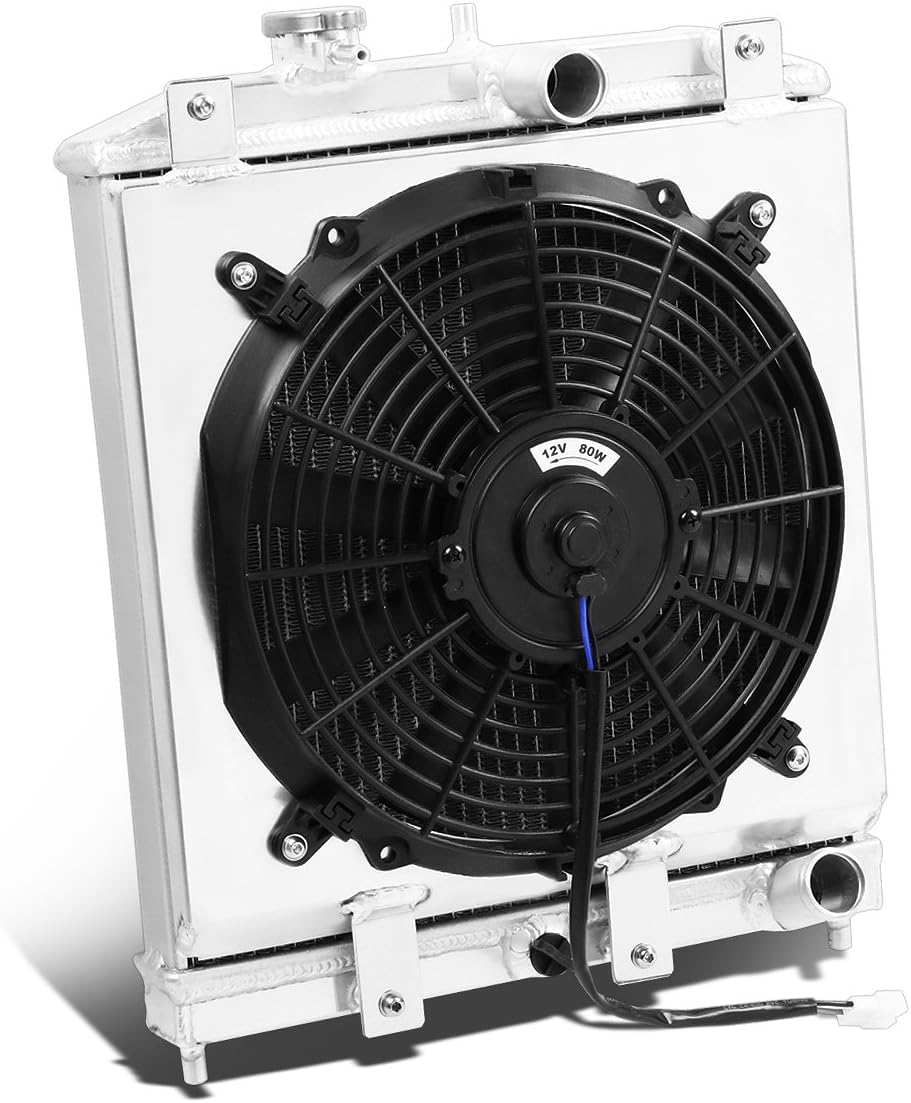
| Voltage | 12 Volts |
|---|---|
| Wattage | 80 watts |
| Power Connector Type | 3-Pin |
| Maximum Rotational Speed | 5500 RPM |
This DNA Motoring radiator is a preassembled two-row aluminum core with an integrated low-profile 12V electric fan and plastic fan shroud intended as a direct bolt-on replacement for manual-transmission Civic EG cars and compatible Del Sol and Integra half-size applications. In use it replaces the stock unit to improve cooling capacity; the manufacturer claims a 35 to 45 percent improvement in heat dissipation and customers report lower operating temperatures with the fan engaged. The unit is lightweight and arrives ready to mount, but several owners noted the fan wiring may require splicing to match factory harnesses and some reported bent fins or occasional leaks out of the box. Fan quality appears mixed across reviews, so expect to verify fan operation before installation and keep basic spares or a replacement shroud on hand for long-term reliability. Professional installation is recommended if you are not comfortable trimming or minor adjustments during fitment.
Best for: Buyers who want a budget-oriented, higher-capacity replacement radiator for a Civic EG project and value straightforward bolt-in fitment plus improved cooling over stock.
Less Ideal for: If you need a guaranteed factory-quality fan assembly or a no-modification, long-term reliability upgrade for heavy track use, consider higher-end radiators or separate high-quality fan kits instead.
- Aluminum two-row core offers higher cooling capacity than many stock radiators
- Ships preassembled with the fan shroud and a low-profile 12V electric fan for simpler installation
- Lightweight construction simplifies handling and mounting
- Compatible with manual-transmission Civic EG (and specified Del Sol/Integra half-size) fitments
- Fan wiring is not always plug-and-play and may require splicing or adapter work
- Some buyers reported bent fins, leaks, or early fan failures indicating quality variability
Verdict: A ready-to-install, budget-friendly aluminum radiator that reliably improves cooling for Civic EG manual-transmission builds when you accept occasional fan wiring or fitment tinkering.
Choosing the Right Honda Civic EG Radiator: Key Factors to Consider
Cooling Capacity and Core Design
Cooling capacity determines how effectively a radiator moves heat away from the engine. Look for core designs with sufficient surface area and good fin density; these increase heat exchange without forcing the engine to run hotter under load. Multi-row cores typically offer higher thermal capacity, which helps when you do highway driving, towing, or spirited driving that raises coolant temperatures.
Core thickness affects packaging and airflow. Thicker cores can hold more coolant and improve heat rejection, but they may restrict airflow if paired with a weak fan. For the Civic EG, balance core rows and thickness against available fan shroud space so you keep effective airflow and avoid fitment interference.
Fitment and Mounting Accuracy
A radiator that matches OEM mounting points, inlet and outlet locations, and hose diameters saves installation time and reduces the risk of leaks. Misaligned mounts or nonstandard hose fittings often require adapters or custom brackets, which add complexity and potential failure points. Confirm the radiator aligns with the Civic EG's fan shroud, sensor ports, and transmission cooler passages if applicable.
Accurate fitment also matters for airflow. Proper clearance to the grille and existing ducting preserves the designed airflow path. For owners who want a direct swap, prioritize units specified for the EG configuration to avoid trimming or modifications.
Material and Construction Quality
Radiators are commonly built from aluminum or brass/copper; choices affect weight, heat transfer, and corrosion behavior. High-quality aluminum cores with robust welds or brazing provide good heat rejection and lighter weight, while brass/copper cores are repairable and resist certain types of damage. Inspect for reinforced tanks, quality seam joints, and even weld beads, because workmanship often predicts leak resistance over time.
Plastic tanks are common on replacement units; prefer designs with durable polymer, solid tank-to-core joins, and well-supported mounting points to reduce stress cracks. Corrosion-resistant finishes and protective coatings extend service life in regions that use road salt or where electrolysis is a concern.
Leak Resistance and Durability
Radiator leakage is a primary failure mode. Choose units with proven sealing methods, sturdy end tanks, and crimp or welded joints that resist vibration and thermal cycling. Reinforced necks and well-engineered hose connections reduce the chance of stress fractures where hoses attach.
Consider the expected operating environment. If you drive in stop-and-go traffic, extreme temperatures, or on salted roads, prioritize radiators with thicker cores, corrosion protection, and robust mounting to withstand repeated thermal expansion and contraction without developing hairline leaks.
Serviceability and Maintenance
A radiator that makes routine servicing easier lowers long-term ownership hassle. Look for accessible drain ports, clearly placed sensor or coolant temperature switch locations, and designs that allow straightforward routing for heater hoses and overflow lines. Units that preserve OEM access to fan assemblies and shrouds simplify fan replacement or fan-clutch service.
Also consider compatibility with standard coolant types and whether the radiator design complicates a coolant flush. If you prefer to perform regular coolant maintenance, pick a radiator that enables complete draining and refilling without removing other components.
Compatibility With Cooling System Upgrades
Many Civic EG owners may fit an upgraded fan, thermostat, or an oil cooler. Choose a radiator that accommodates common upgrades without extensive modification. That means checking clearance for electric fan assemblies, availability of transmission cooler ports if needed, and whether the inlet and outlet locations allow routing upgraded hoses.
Planning for future upgrades preserves flexibility. A radiator that fits now but blocks access to fan hardware or restricts space for an oil cooler can complicate later improvements, so evaluate how the unit performs in upgrade scenarios before committing.
Signs Your Civic EG Radiator Needs Replacement
Pay attention to early warning signs like persistent coolant loss, frequent topping off, or visible coolant pooling under the car. Overheating episodes, especially under load or in slow traffic, indicate the radiator may no longer be rejecting heat efficiently.
Look for visual symptoms such as dents, clogged fins, bulging plastic tanks, or greenish crust that indicates dried coolant and seepage. Also monitor temperature gauge behavior and heater performance; a failing radiator can produce inconsistent cabin heat or rapidly rising engine temperatures.
Regular pressure testing and visual inspection during routine maintenance catch small leaks before they become catastrophic. If you find a slow leak at a seam or the core, replacement is often more reliable than spot repairs for long-term reliability on the Civic EG.
- Visible coolant stains around seams or hose connections
- Frequent overheating during idling or heavy traffic
- Clogged or flattened fins reducing airflow
- Swollen or cracked plastic tanks
Preparing Your EG for Radiator Replacement
Before you begin, cool the engine fully and relieve system pressure by removing the radiator cap only after the engine is cold. Drain coolant into a sealed container and dispose of or recycle it according to local regulations. Gather the correct replacement hoses, clamps, and a compatible coolant to complete the job.
Take note of hose routing, clamp locations, and the position of any sensors or overflow connections. Photographing the setup before removal helps when reinstalling the new radiator. If the Civic EG has an attached transmission cooler, verify whether the replacement unit includes matching ports or whether the cooler lines must be disconnected and reconnected.
- Allow the engine to cool fully before starting
- Collect tools, replacement hoses, and new clamps
- Label or photograph hose and sensor locations
- Have coolant ready that matches Honda recommendations
How To Perform a Coolant Flush on an EG
A complete coolant flush removes sediment and old inhibitor chemistry that can accelerate radiator corrosion. After draining the old coolant, use a recommended flush fluid or plain water to circulate and drain until the runoff is clear. Refill with the proper ratio of coolant and distilled water to maintain freeze and boil protection.
Bleed the system to remove air pockets by running the engine with the radiator cap off until the thermostat opens and the coolant level stabilizes. Check for leaks and top off as needed. Regular coolant changes extend radiator life and maintain consistent cooling performance on the Civic EG.
- Drain old coolant into a container for disposal
- Flush until runoff runs clear, then refill with correct mixture
- Start engine and run to operating temperature to burp air
- Recheck coolant level after a short drive
Common Installation Pitfalls and How To Avoid Them
One frequent issue is misrouting hoses or pinching them when reinstalling. Ensure hoses have gentle curves and that clamps do not sit on weakened hose material. Use new clamps rather than reusing old, stretched clamps to guarantee a tight seal.
Another pitfall is improper torque on mounting hardware that can stress plastic tanks or cause vibration. Follow torque specs where available and use rubber isolators or correctly sized bushings to prevent hard contact against sheetmetal. Finally, do not skip pressure testing after installation; a short road test followed by a pressure check will reveal leaks before you commit to longer drives.
- Avoid pinched or kinked hoses during installation
- Replace clamps and use proper torque on mounts
- Ensure fan shroud clearance and correct sensor placement
- Pressure-test the system after refilling
When To Consider Professional Service
If the radiator leak is from the core or multiple seams, professional replacement in a shop can ensure proper brazing, coolant system pressure testing, and safe disposal of coolant. Complex issues like corrosion that affects the mounting structure or radiator contact with other components are also reasons to consult a technician.
Professional service is recommended if you lack access to a pressure tester, lift, or the tools required to route transmission cooler lines safely. A shop can also confirm whether additional cooling system components, such as the water pump or thermostat, should be replaced simultaneously to avoid repeat work.
- Multiple leak sites or core damage
- Lack of tools for pressure testing
- Corrosion affecting mounting points
- Unfamiliarity with transmission cooler line handling
Still looking for the perfect fit?
Select your Honda Civic configuration to see the most relevant Radiators recommendations
How We Chose the Best Honda Civic EG Radiator
We focused on criteria specific to replacing the cooling core in a Honda Civic EG chassis to ensure the shortlisted radiators deliver durable, effective service on this vehicle. Key evaluation dimensions included cooling efficiency under typical driving and higher-load scenarios, thermal capacity and core design, and whether the radiator maintains OEM mounting and hose placements for straightforward fitment.We examined construction materials and manufacturing quality, such as brass-versus-aluminum cores, brazing quality, and reinforcement at mounting points, because these aspects affect leak resistance and longevity. Corrosion protection and finish were considered to assess resistance to electrolysis and road salts that accelerate failure. Ease of installation and compatibility with stock fan shrouds, transmission cooler integration where applicable, and inlet/outlet locations were evaluated to minimize modification needs.Serviceability and maintenance factors were also applied, including how accessible drain and fill points are for routine coolant flushes and how straightforward sensor or hose routing remains. We excluded radiators that required major chassis or fan modifications, ones with unclear fitment information, or options lacking demonstrated build-quality indicators. The result is a curated set that balances durability, cooling performance, and direct compatibility for the Civic EG.
Our full evaluation process is outlined in our review methodology.
FAQ
How long does a typical Civic EG radiator last?
It often depends on driving conditions and maintenance. With proper coolant changes and corrosion prevention, a radiator can last many years, but neglect, road salt, or repeated overheating episodes shorten service life.
Can I repair a small radiator leak on my Civic EG?
Minor leaks at hose connections or small pinhole leaks can sometimes be repaired temporarily, but permanent fixes often require soldering or core replacement. For long-term reliability on the EG, replacement is usually the more dependable option if the core is compromised.
Do I need any special tools to replace the radiator myself?
Basic hand tools, pliers for hose clamps, and a drain pan are usually sufficient for a DIY swap. A pressure tester and appropriate torque tools are helpful for validation and secure installation, especially if you want to avoid a return visit for leaks.
Should I replace the thermostat when installing a new radiator?
It often makes sense to replace the thermostat at the same time because it is inexpensive relative to the cooling system labor. A new thermostat ensures proper temperature control and can prevent issues that might otherwise be blamed on a new radiator.
What coolant is recommended after installing a replacement radiator?
Use the coolant type and concentration recommended for Honda vehicles and the Civic EG specifically. Mixing incompatible coolant chemistries can reduce corrosion protection, so follow manufacturer guidance or use a compatible long-life coolant.
Will upgrading to a thicker or multi-row radiator cause fitment issues?
It depends on the specific dimensions. A thicker or multi-row core can improve cooling but may restrict clearance with the fan shroud or grille. Confirm physical measurements and fan clearance before choosing an upgraded core for the Civic EG.
Final Verdict
Prioritize fitment accuracy, cooling capacity, and robust construction when selecting a radiator for your Honda Civic EG. Balancing thermal performance with correct mounting locations and durable materials reduces the chance of leaks and minimizes future labor.If you plan modest performance upgrades or tow occasionally, choose a radiator that increases thermal capacity without compromising fan clearance. For routine driving, focus on a unit that replicates OEM fitment, offers reliable leak resistance, and simplifies maintenance so you can return to driving with confidence.
Explore More:
- Check out all Honda Civic parts & accessories
- Explore Radiators Maintenance & Repair Guides
- Explore Cooling System
- Browse all Auto Parts
