

Note: This article contains affiliate links. If you click on these links and make a purchase, I may earn a small commission at no extra cost to you. This helps support my research and content. Read my full affiliate disclosure here.
Choosing the right engine oil for a Honda Civic 1.8L matters more than many owners expect. The wrong viscosity or formulation can affect oil pressure, fuel economy, and long-term wear, especially in daily-driven Civics that see both highway miles and short trips. This guide gathers the top shortlisted engine oils suited to the Civic 1.8L, covering conventional and synthetic options, viscosity choices, and formulations tailored to different mileages.Below you will find our picks and concise notes on what makes each option appropriate for the Civic 1.8L. We evaluated oils based on real-world performance factors such as viscosity at operating temperature, deposit control, and compatibility with the engine's design.
Looking for other parts? See all Honda Civic parts & accessories.
Top Picks at a Glance
| Best Overall Engine Oil A balanced, top-performing motor oil that fits most Civic needs | Valvoline Advanced Protection Full Synthetic SAE 0W-20 Motor Oil, 5 qt |  |
| Best Budget Engine Oil An affordable motor oil that meets basic protection standards without breaking the bank | Castrol EDGE 0W-20 Full Synthetic Motor Oil, 5 Quart Jug |  |
| Best Full-Synthetic Engine Oil A fully synthetic formulation focused on maximum thermal and wear protection | Mobil 1 Extended Performance Full Synthetic Motor Oil 0W-20, 5 Quart |  |
| Best High-Mileage Engine Oil Formulated with conditioners and additives for engines with many miles on them | Valvoline Full Synthetic High Mileage with MaxLife Technology SAE 0W-20, 5 qt |  |
| Best 0W-20 Engine Oil A low-viscosity 0W‑20 option optimized for cold start flow and fuel economy | Royal Purple SAE 0W-20 High Performance Synthetic Motor Oil, 5 qt. |  |
| Best OEM Honda Engine Oil Genuine or factory-formulated oil engineered to Honda's specifications and approvals | Honda Ultimate Full Synthetic SAE 0W-20 Motor Oil (1 Quart, 6-Quart Pack) |  |
| Best Engine Oil Change Kit Complete oil-change packs that include oil, filter, and hardware for one service | Factory Racing Parts 0W-20 Full Synthetic Oil Change Kit (3.5 qt) |  |
1. Valvoline Advanced Protection Full Synthetic SAE 0W-20 Motor Oil, 5 qt
Best Overall Engine Oil

| Viscosity grade | 0W-20 |
|---|---|
| Size | 5 QT |
| Meets | ILSAC GF-7A, API SP |
| Flash point | 200 Degrees Celsius |
Valvoline Advanced Protection 0W-20 is a full synthetic motor oil designed for modern gasoline engines and daily DIY maintenance. In practice it serves as a drop-in factory-quality replacement for vehicles specifying 0W-20, flowing readily at cold temperatures to reduce start-up wear and supporting better fuel economy compared with heavier grades. The formula emphasizes protection: Valvoline cites stronger wear resistance, improved deposit control, and higher heat tolerance than industry baselines, which helps keep combustion chambers and rings cleaner over multiple oil changes. For Civic 1.8L owners this translates to smoother cold starts, steadier idle, and reduced risk of thermal breakdown during regular driving or occasional high-load conditions. It meets ILSAC GF-7A and API SP and includes several OEM-related approvals, so it fits factory service intervals when 0W-20 is specified. The main trade-off is cost compared with basic synthetics, and any restorative cleaning benefits will appear over several change cycles rather than instantly.
Best for: A DIYer who wants a reliable, factory-quality 0W-20 oil for routine maintenance on a Honda Civic 1.8L and prioritizes long-term engine protection and smoother cold starts.
Less Ideal for: Drivers who always follow extended high-mileage change intervals without intermediate maintenance or those who need a different viscosity than 0W-20 should consider other oils.
- Full synthetic 0W-20 for strong low-temperature flow and reduced cold-start wear
- Claims enhanced wear protection, deposit control, and heat resistance over industry baselines
- Meets modern specifications including ILSAC GF-7A and API SP for compatibility with current engines
- Formulation can improve fuel economy versus heavier viscosity oils
- Restorative or deposit-cleaning effects require multiple oil-change cycles to be noticeable
Verdict: The all-around pick for DIYers who want a dependable, well-rounded motor oil that balances wear protection, cold‑start flow, and fuel economy.
2. Castrol EDGE 0W-20 Full Synthetic Motor Oil, 5 Quart Jug
Best Budget Engine Oil

| Viscosity Level | 0W-20 |
|---|---|
| Container Type | Jug |
| Liquid Volume | 5 Quarts |
| Automotive Fit Type | Universal Fit |
Castrol EDGE 0W-20 is a widely used full synthetic oil aimed at drivers who want solid protection without premium pricing. It is typically used for regular oil changes in modern small-displacement engines and is compatible with vehicles that call for 0W-20 viscosity and current API and ILSAC specifications. Notable features include a low-viscosity 0W-20 grade for easy cold starts, additive chemistry targeting sludge control and wear protection, and claims of extended endurance between changes when following manufacturer guidance. For a Honda Civic 1.8L this oil provides easy cold flow, helps maintain engine cleanliness, and supports fuel economy targets that smaller engines benefit from. Practical benefits are straightforward: reliable protection during normal daily driving, reduced friction for marginal MPG improvement, and wide availability in a 5-quart jug for home servicing. Limitations include that it is a general-purpose, cost-conscious option rather than a model-specific performance formulation and you should follow Honda service intervals and approved specifications for extended drain recommendations.
Best for: Drivers who prioritize a balance of affordability and factory-quality protection for routine maintenance on a Honda Civic 1.8L and who perform regular oil changes themselves or follow dealer-recommended intervals.
Less Ideal for: Owners looking for specialized high-mileage, performance, or extended-drain oils tailored to unusual duty cycles or significant towing and track use should consider purpose-built alternatives.
- Meets current API and ILSAC specifications for modern gasoline engines
- 0W-20 viscosity offers excellent cold-start flow for small-displacement engines
- Formulated for sludge control and wear protection to keep the engine cleaner
- Sold in a 5-quart jug suitable for DIY oil changes
- Not a vehicle-specific or high-mileage formulation tailored to unique Civic needs
Verdict: Choose this if you want a cost-conscious oil that still meets API/ILSAC specs and offers acceptable protection for routine oil changes.
3. Mobil 1 Extended Performance Full Synthetic Motor Oil 0W-20, 5 Quart
Best Full-Synthetic Engine Oil

| SAE Viscosity Grade | 0W-20 |
|---|---|
| Volume | 5 Quarts |
| Vehicle Type | Car |
| Viscosity Level | Low to Medium |
| Flash Point | 500 Degrees Fahrenheit |
Mobil 1 Extended Performance 0W-20 is a full-synthetic motor oil formulated to protect modern gasoline engines for extended drain intervals. Mechanics will recognize its Triple Action+ chemistry that focuses on cleanliness, protection, and maintaining power; in practice that means reduced sludge and deposits, strong oxidation resistance at high temperatures, and reliable low-temperature flow for cold starts. It meets ILSAC GF-6 and includes additives to help limit LSPI and timing chain wear, which is useful in many small-displacement engines. For a Honda Civic 1.8L this weight helps preserve fuel economy and fast cold starts while offering robust thermal stability up to 500 degrees F. The advertised 20,000-mile protection is aimed at controlled extended-service schedules and may be attractive for low-contamination, regularly maintained cars; shops that prefer shorter intervals or that see heavy contamination may choose more frequent changes. The product ships in a sturdy bottle and is the same spec recommended by many manufacturers and technicians for modern Civic engines that call for 0W-20.
Best for: Mechanics who want a factory-quality full-synthetic 0W-20 that emphasizes deposit control, thermal stability, and extended protection for regularly maintained small gasoline engines like the Honda Civic 1.8L.
Less Ideal for: Owners or shops that perform frequent track, heavy towing, or severe-duty service where shorter, conservative oil-change intervals are required.
- Full-synthetic formulation designed to resist oxidation and viscosity breakdown at high temperatures
- Meets ILSAC GF-6 and includes protections that help reduce LSPI and timing chain wear
- 0W-20 viscosity supports quick cold starts and helps preserve fuel economy in small gasoline engines
- Manufacturer claims up to 20,000 miles between oil changes under recommended conditions
- Extended 20,000-mile drain recommendation depends on driving conditions and maintenance and may not suit high-contamination or severe-use vehicles
Verdict: For mechanics who prefer full-synthetic chemistry to reduce deposits, resist viscosity breakdown, and extend protection under higher stress and mileage.
4. Valvoline Full Synthetic High Mileage with MaxLife Technology SAE 0W-20, 5 qt
Best High-Mileage Engine Oil

| SAE J300 Viscosity Grade | 0W-20 |
|---|---|
| Container Type | Bottle |
| Compatible with Vehicle Type | Car |
| Liquid Volume | 160 Fluid Ounces |
Valvoline Full Synthetic High Mileage with MaxLife Technology is designed for engines that have seen significant miles and for drivers who want to slow wear and reduce common age-related issues. It is used like any 0W-20 motor oil at oil changes and combines synthetic base oils with extra anti-wear additives, detergents, and seal conditioners intended to minimize leaks and oil consumption. Practical benefits include improved cold starts from a stable 0W-20 viscosity, reduced sludge and deposit formation thanks to detergent chemistry, and targeted protection for hardened seals that can cut down on leak-related oil loss. The bottle is a standard 5 qt container sized for a single oil change on most four-cylinder cars and includes an anti-glug pour design for cleaner filling. Limitations are typical of grade-specific oils: 0W-20 is best where the vehicle manufacturer recommends that weight, so check the Civic 1.8L owner specifications before switching, and high-mileage formulations cannot reverse major mechanical wear but can help slow further degradation.
Best for: Drivers with high-mileage cars who prioritize preserving engine life and reducing leaks and oil consumption through a targeted high-mileage full synthetic formula.
Less Ideal for: Drivers who must use a different viscosity than 0W-20 per their vehicle manual or those seeking oils formulated for extreme performance or racing conditions.
- Formulated with seal conditioners to help reduce and treat oil leaks in aging engines
- Full synthetic base oils and extra anti-wear additives for improved wear protection
- Detergent chemistry that helps resist sludge and deposits for cleaner internals
- 0W-20 viscosity provides good cold-start protection and stable flow in modern four-cylinder engines
- Viscosity limited to 0W-20 so not suitable where a different grade is specified
Verdict: Intended for cars with significant mileage — this oil includes seal conditioners and detergents to reduce leaks, lower oil consumption, and keep older engines cleaner.
5. Royal Purple SAE 0W-20 High Performance Synthetic Motor Oil, 5 qt.
Best 0W-20 Engine Oil
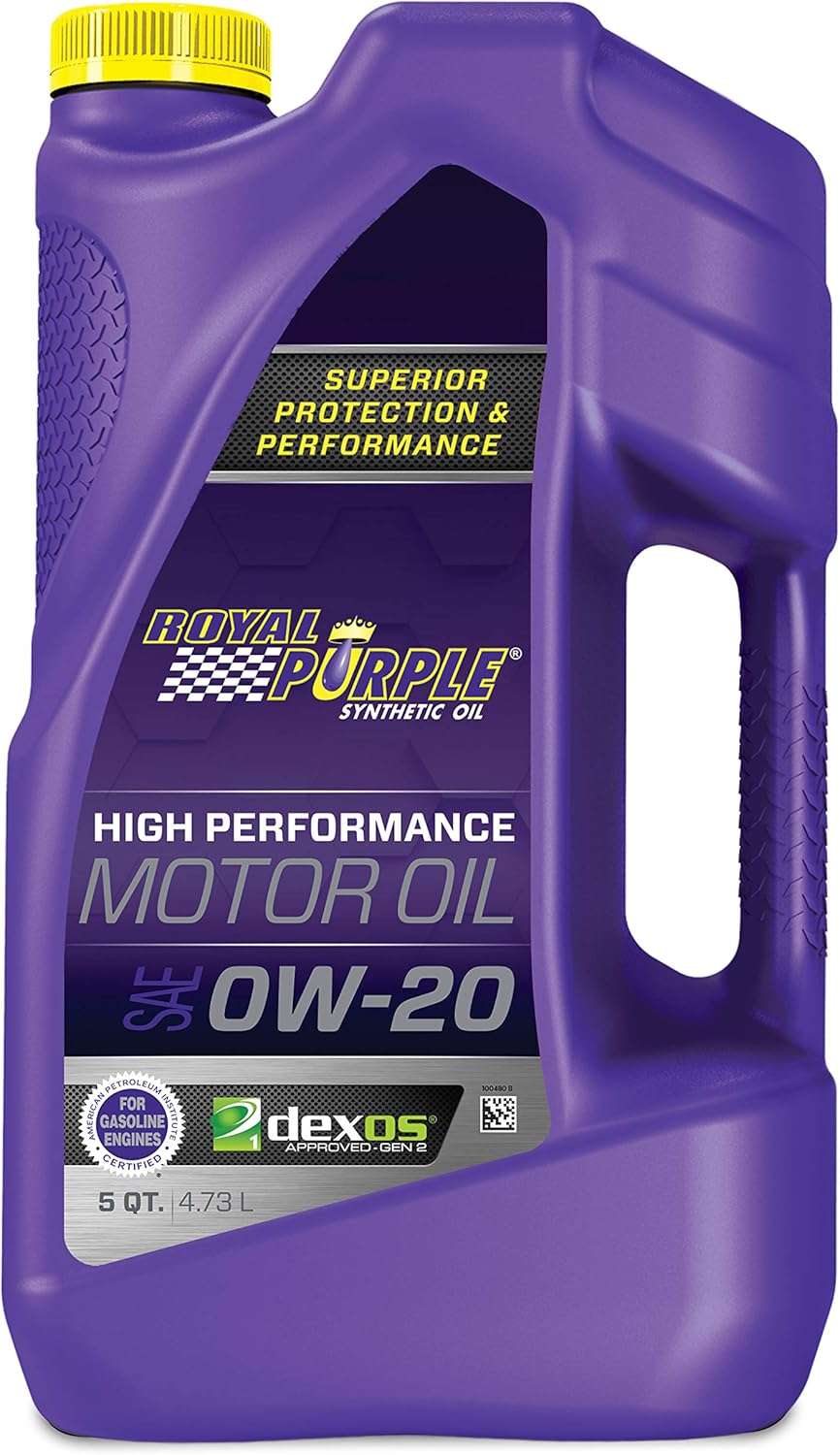
| Viscosity | SAE 0W-20 |
|---|---|
| Liquid Volume | 4.73 Liters |
| Brand Name | Royal Purple |
| Automotive Fit Type | Vehicle Specific Fit |
Royal Purple 0W-20 is a full synthetic motor oil designed to circulate quickly at cold start and keep thin-viscosity protection under normal and light-load driving. For a Honda Civic 1.8L, this oil helps the oil pump and galleries reach bearings and valvetrain faster on startup, which reduces initial wear and can improve city fuel economy. The blend carries Royal Purple additive chemistry that targets reduced friction, corrosion protection, and control of deposits and sludge over time. It is compatible with conventional or other synthetic oils so switching at a scheduled change is straightforward. Practical benefits include better cold-start lubrication, potential MPG gains during mixed driving, and strong long-term cleanliness for older Civics that accept 0W-20. Limitations are cost versus generic brands and that the thin 0W-20 viscosity can lead to slightly higher measurable oil consumption in some engines compared with thicker grades, so monitor levels between changes. Follow Honda 1.8L service intervals and use the factory-recommended oil capacity and filter when using this product.
Best for: Drivers who prioritize quickest cold lubrication and small fuel-economy gains for daily-driven Honda Civic 1.8L engines and want a performance-focused synthetic that maintains engine cleanliness.
Less Ideal for: Those looking for the cheapest routine oil or owners who prefer a thicker viscosity for older engines with high oil consumption should consider other grades.
- Fast cold-start circulation for quick bearing and valvetrain protection
- Low-viscosity formula that can improve fuel economy in city and highway driving
- Additive package aimed at reducing deposits, corrosion, and mechanical wear
- Higher retail cost compared with many standard 0W-20 brands
Verdict: Pick this low-viscosity oil when you want the fastest cold-start circulation and improved fuel economy while maintaining manufacturer-recommended protection.
6. Honda Ultimate Full Synthetic SAE 0W-20 Motor Oil (1 Quart, 6-Quart Pack)
Best OEM Honda Engine Oil

| SAE J300 Viscosity Grade | 0W-20 |
|---|---|
| Viscosity Level | Low to Medium |
| Compatible with Vehicle Type | Car |
| Liquid Volume | 6 Quarts |
| Included Components | SAE 0W-20 Ultimate Full Synthetic |
This Honda Ultimate Full Synthetic 0W-20 motor oil is formulated and tested by Honda R&D for use in Honda engines. It is a full synthetic oil designed to circulate quickly at low temperatures for improved cold-start protection while resisting varnish, corrosion, and foam that lead to deposits. The 0W-20 viscosity helps maximize fuel efficiency and reduces oil consumption through lower volatility and stability at high temperatures. Typical use is scheduled oil changes in Honda passenger cars where 0W-20 is specified; the product comes in one-quart bottles and is offered as a 6-quart pack for multiple services. Practical benefits include factory-verified compatibility with Honda tolerances and confidence that the chemistry meets Honda testing standards. Limitations are that it is a vehicle-specific grade, so it only applies where 0W-20 is the recommended viscosity, and buyers should follow the vehicle service schedule rather than assuming extended drain intervals beyond Honda guidance.
Best for: Buyers who prioritize factory-approved chemistry and want Honda-tested oil for regular maintenance on Honda vehicles to preserve performance and compliance with manufacturer specifications.
Less Ideal for: Drivers who need a different viscosity grade for non-Honda engines or who prefer specialty performance or extended-drain synthetic oils outside Honda recommendations.
- Formulated and tested by Honda R&D for compatibility with Honda engines
- Full synthetic 0W-20 composition for fast cold-flow and high-temperature stability
- Helps reduce engine deposits, oil consumption, and foam for cleaner operation
- Packaged in one-quart bottles with a multi-quart option for convenient servicing
- Only suitable where 0W-20 is the manufacturer-recommended viscosity
Verdict: Choose OEM-rated oil when you want Honda‑approved chemistry and testing for compatibility, warranty peace of mind, and exact spec compliance.
7. Factory Racing Parts 0W-20 Full Synthetic Oil Change Kit (3.5 qt)
Best Engine Oil Change Kit
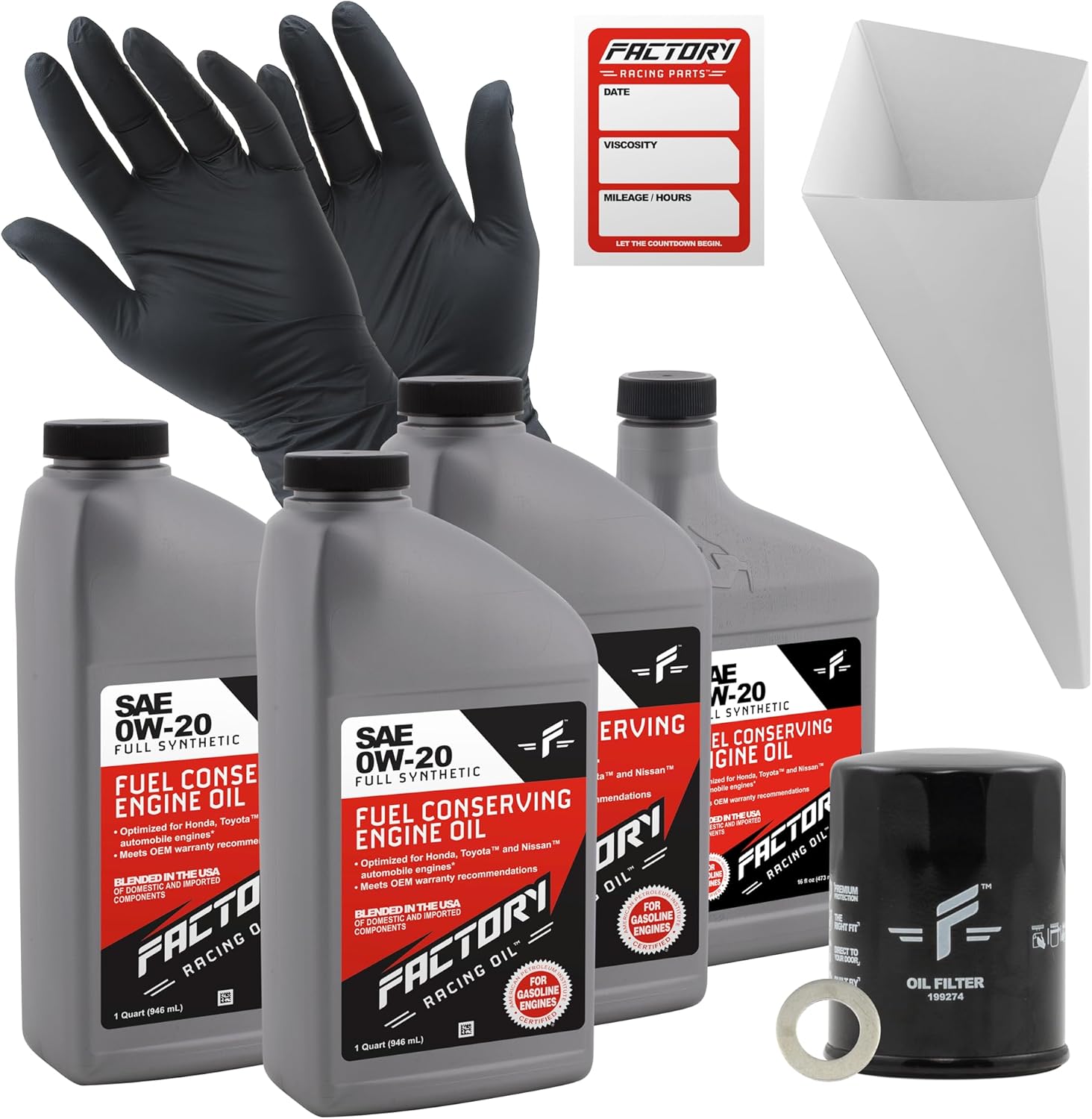
| SAE Viscosity | 0W-20 |
|---|---|
| Certifications | API SP; ILSAC GF-6A |
| Liquid Volume | 3.5 Quarts |
| Included Components | oil, filter, washer, funnel, gloves, sticker |
This oil change kit bundles everything a DIYer needs to service Hondas that require 0W-20 oil. It supplies 3.5 quarts of Factory Racing Parts SAE 0W-20 full synthetic oil rated API SP and ILSAC GF-6A, plus an oil filter matched to replace OEM 15400-PLM-A02, a crush washer, funnel, gloves, and an oil change sticker. The oil is formulated for fuel conserving performance, LSPI protection, and start-stop durability, so it is suited to modern 1.8L and small turbo Honda engines. The included filter and washer remove guesswork about parts compatibility, and the funnel and gloves make a single DIY change more convenient. Limitations are the fixed fluid quantity and the specific filter included, so it is intended for Honda fills that need about 3.5 quarts; buyers with higher-capacity pans or who prefer a different filter brand will need extras. Overall, the kit simplifies a one-off oil change and pairs a factory-quality filter with a fully certified synthetic oil optimized for fuel economy and engine protection.
Best for: DIY Honda owners who want a single, vehicle-matched oil change kit that removes guesswork by supplying the correct oil grade and a compatible filter for one service.
Less Ideal for: People planning multiple back-to-back changes or working on vehicles that require more than 3.5 quarts of oil should consider bulk oil or a larger kit instead.
- Complete kit includes oil, matched oil filter, crush washer and basic tools for a single DIY change
- 0W-20 full synthetic oil certified API SP and ILSAC GF-6A for modern Honda engines
- Oil formulation targets fuel economy, LSPI protection, and start-stop durability
- Filter claimed to meet or exceed factory specifications for proper fitment
- Supplied volume is 3.5 quarts which may be insufficient for vehicles requiring more oil without buying additional quarts
- Kit contains a single filter and consumables only suitable for one change
Verdict: This slot is for bundled kits that supply the right oil quantity plus filters and drain washers so DIYers can perform a single, convenient oil change with matched parts.
Choosing the Right Honda Civic 1.8L Engine Oil: Key Factors to Consider
Viscosity Grade and Climate Fit
Viscosity grade, such as 0W-20 or 5W-30, determines how the oil flows at cold start and at operating temperature, and it directly affects oil pressure and fuel economy in the Civic 1.8L. In colder climates a lower cold-start viscosity helps ensure quick lubrication on startup, while in hotter regions a slightly thicker hot viscosity can sustain the lubricating film under higher temperatures.
Choose a grade that matches the owner's typical driving conditions and ambient temperatures. Using the manufacturer-recommended range maintains proper oil pressure and can prevent excess wear from inadequate film strength. Deviating from recommended grades may be acceptable in certain climates but should be done with an understanding of tradeoffs between cold-start protection, fuel economy, and high-temperature film strength.
Synthetic Vs Conventional Formulation
Synthetic motor oil generally offers better thermal stability, lower volatility, and improved cold-start flow compared with conventional oils, which benefits the Civic 1.8L across a wide temperature range. Synthetics tend to resist breakdown and form more consistent protective films, extending effective drain intervals when matched to the car's service schedule.
Conventional oils can still be suitable for low-mileage, lightly used vehicles when changed at appropriate intervals, but modern Civics often benefit from synthetic or synthetic-blend formulations that better maintain viscosity and deposit control under mixed driving conditions.
Deposit Control and Engine Cleanliness
Detergent and dispersant additives control varnish and sludge buildup on piston rings, valve trains, and oil passages. For the high-revving, small-displacement Civic 1.8L, keeping combustion byproducts and soot in suspension is important to maintain oil flow and prevent ring sticking over time.
Prioritize oils with strong detergent chemistry and good piston-cleaning performance in industry tests. Better deposit control helps preserve compression and fuel economy, reduces the risk of oil sludge-related oil starvation, and keeps the engine running smoothly between services.
Wear Protection and Film Strength
Wear protection measures how well an oil keeps moving parts separated under pressure, reducing metal-to-metal contact. For the Civic 1.8L, which can see frequent short trips and occasional spirited driving, an oil with high film strength and anti-wear additives helps protect bearings, cam lobes, and piston skirts.
Look for oils that perform well in standardized wear tests and that specify anti-wear additive packages. Enhanced film strength is particularly valuable for engines operating at higher temperatures or under boost, and it contributes to long-term engine durability.
Volatility and Oil Consumption
Volatility affects how much oil evaporates at high operating temperatures. Oils with high volatility can lead to higher consumption and more frequent top-offs, which is important to consider for the Civic 1.8L if you prefer longer drain intervals or drive in warmer climates.
Low-volatility oils help maintain consistent oil levels and reduce the formation of deposits. For higher-mileage engines, lower volatility also lessens the pace of oil thinning, helping preserve viscosity and protective properties between changes.
Compatibility With High-Mileage Engines
As mileage rises, engine clearances and seal conditions change, and some oils include seal conditioners or higher-viscosity base stocks to help reduce leaks and oil burn. For a Civic 1.8L with significant miles, consider formulations designed for high-mileage use that balance thicker film where needed without overly compromising cold-start flow.
High-mileage formulations may also contain additives to rejuvenate seals and limit external leaks, but they should still match the recommended viscosity range for safe operation. Choosing a high-mileage oil can help extend service life and manage minor oil consumption typical of older engines.
Recommended Viscity Choices for Different Climates
Selecting the right viscosity grade helps the Honda Civic 1.8L start reliably in cold weather and maintain adequate film strength at operating temperature. For regions with prolonged cold seasons, a 0W-20 grade provides easier cold starts and reduces wear during the first crucial seconds after ignition. In moderate climates the manufacturer-recommended grade balances fuel economy and protection.
Where summers are consistently hot or the car is subject to heavy loads, considering a slightly higher hot-end viscosity can preserve film strength during sustained high-temperature operation. Always weigh the tradeoff between improved high-temperature protection and potential impacts on cold-start flow and fuel consumption.
- 0W-20: best for cold starts and max fuel economy in temperate to cold climates
- 5W-30: useful in hotter climates or for higher-mileage engines needing thicker hot film
- Synthetic blends: provide a middle ground for mixed driving conditions
When to Choose Synthetic Versus Conventional
Synthetic oils give the Civic 1.8L better protection during hard driving and longer stable performance between changes. If you perform extended drain intervals or drive frequently in stop-and-go traffic, synthetics resist oxidation and deposit formation more effectively.
Conventional oils can be appropriate for very low-mileage or infrequently used cars, but for most owners a synthetic or synthetic blend offers more consistent protection and fewer performance surprises across temperature extremes.
- Synthetic: better thermal stability, lower volatility, better cold-start flow
- Conventional: acceptable with conservative drain intervals and light use
- Synthetic blend: compromise between cost and performance benefits
High-Mileage Considerations for Older Civic 1.8L Engines
Older 1.8L engines commonly show increased oil consumption and slight loss of compression. High-mileage formulations can help by offering slightly enhanced viscosity retention and seal-conditioning additives that reduce external leaks. These oils aim to support worn components without drastically changing required cold-start behavior.
When switching to a high-mileage oil, monitor for changes in consumption, leak behavior, and engine noise. Any noticeable differences should be assessed over a few hundred miles to confirm the effect.
- Look for seal conditioners in high-mileage formulas
- Avoid dramatic jumps in viscosity that impair cold starts
- Monitor oil levels more frequently after switching
How Viscosity Affects Fuel Economy and Emissions
Thinner cold-start viscosities reduce parasitic drag on internal components and can yield measurable fuel economy gains, which is relevant for commuters using the Civic 1.8L. However, extremely thin oils may trade some high-temperature film strength for economy, so balance is key.
Maintaining the right viscosity also supports stable combustion and cleaner exhaust operation. Oils formulated to modern industry specifications help minimize deposits that can indirectly affect emissions-related components.
- Lower cold viscosity improves short-trip fuel economy
- Proper film strength preserves engine efficiency and emission behavior
- Follow recommended drain intervals to avoid degraded oil harming efficiency
Practical Tips for Oil Changes and Maintenance
Regular oil changes using the correct viscosity and formulation are one of the most effective preventive maintenance steps for the Civic 1.8L. Check oil level monthly and top up as needed, especially after long highway runs or during high-temperature operation.
Use the proper oil filter and follow the vehicle's service schedule. When changing viscosity or switching to a high-mileage formulation, record the change and monitor engine performance over the next few service intervals to ensure compatibility.
- Check oil level at the same engine temperature and on level ground
- Replace the oil filter with every oil change
- Record oil type and change intervals for reference
Still looking for the perfect fit?
Select your Honda Civic configuration to see the most relevant Engine Oils recommendations
How We Chose the Best Honda Civic 1.8L Engine Oil
We shortlisted engine oils for the Honda Civic 1.8L using a set of practical, car-specific filters that reflect how owners actually use these cars. Priority criteria included viscosity suitability for the 1.8L engine across expected climate ranges, detergent and dispersant chemistry to limit deposits and sludge, and wear protection ratings from standardized industry tests. We also assessed thermal stability and resistance to oxidation to ensure oil longevity between changes, plus compatibility with emissions-related components such as catalytic converters.Additional criteria included suitability for higher-mileage engines, where seal conditioning and volatility control matter, and compatibility with recommended drain intervals to avoid oil breakdown. We favored oils with clear OEM or industry viscosity and performance ratings that match the Civic 1.8L requirements and that provide stable film strength under typical driving loads.Excluded from consideration were specialty race-only lubricants, oils that require engine modifications, and products without verifiable industry performance data. The result is a focused list emphasizing real-world protection, longevity, and daily drivability for Honda Civic 1.8L owners.
Our full evaluation process is outlined in our review methodology.
FAQ
How often should I change the engine oil in a Honda Civic 1.8L?
It depends on the oil type and driving conditions. For synthetic oils, many owners follow manufacturer intervals, often around 7,500 to 10,000 miles, while conventional oils typically require more frequent changes. Severe driving like frequent short trips or stop-and-go traffic may justify shorter intervals.
Can I switch from 5W-30 to 0W-20 in my Civic 1.8L?
Switching is possible if the new viscosity falls within the manufacturer's recommended range for your car and climate. Expect improved cold-start flow with 0W-20, but monitor for any changes in oil consumption or oil pressure, especially in older engines.
Does using synthetic oil prevent engine sludge in the 1.8L Civic?
Synthetic oils resist sludge and varnish formation better than conventional oils due to superior detergent packages and thermal stability. However, proper maintenance, regular oil changes, and addressing coolant issues are also important to prevent sludge.
What oil viscosity is best for high-mileage Civic 1.8L engines?
High-mileage engines often benefit from oils that retain slightly thicker hot viscosity while still offering acceptable cold-start flow. A high-mileage formulation in the recommended viscosity range can help reduce leaks and consumption without compromising start-up protection.
Will a thicker oil reduce oil consumption in an older Civic?
A thicker hot viscosity can sometimes reduce consumption by maintaining a fuller lubricating film and limiting seepage past worn rings and seals. The effect varies by engine condition, so monitor levels after any viscosity change.
Should I use 0W-20 for better fuel economy in the Civic 1.8L?
Using a lower cold-start viscosity like 0W-20 can yield modest fuel economy benefits, particularly on short trips. Make sure the grade is appropriate for your climate and does not compromise high-temperature protection for the engine's operating conditions.
Final Verdict
Prioritize an oil that matches the Civic 1.8L's recommended viscosity for your climate while balancing synthetic benefits and deposit control. For most drivers, a modern synthetic or synthetic-blend formulation tuned to the correct cold-start and hot operating viscosities provides the best combination of protection, fuel economy, and longevity. If the engine has high mileage, consider a formulation that supports seals and reduces consumption, but avoid large jumps in viscosity that could harm cold-start behavior. With those tradeoffs in mind, you can choose an oil that keeps the Civic 1.8L running reliably between services.
Explore More:
- Check out all Honda Civic parts & accessories
- Explore Fluids & Chemicals
- Browse all Accessories
