

Note: This article contains affiliate links. If you click on these links and make a purchase, I may earn a small commission at no extra cost to you. This helps support my research and content. Read my full affiliate disclosure here.
Picking the right engine oil for your Honda Civic 1.6L matters more than many owners realize. The correct oil keeps internal components lubricated, reduces wear, supports fuel efficiency, and helps the engine respond predictably in different temperatures.This guide presents the seven shortlisted options that suit the Civic 1.6L, explaining why each made the list and which conditions they are best for. We evaluate oil viscosity, additive chemistry, longevity under typical driving, and impact on maintenance intervals to help you choose the best fit for your priorities. Read on for practical guidance before your next oil change.
Looking for other parts? See all Honda Civic parts & accessories.
Top Picks at a Glance
| Best Overall Engine Oil A balanced, top-performing motor oil that fits most Civic engines | Valvoline Advanced Protection Full Synthetic 0W-20 Motor Oil, 5 qt |  |
| Best Budget Engine Oil A low-cost motor oil that still meets basic API/ILSAC standards | Pennzoil High Mileage 5W-30 Synthetic Blend Motor Oil, 1 Quart |  |
| Best OEM Honda Engine Oil Genuine Honda-formulated oil sold as OEM bottles or multi-packs | Honda Ultimate Full Synthetic SAE 0W-20 Motor Oil (1 Quart) |  |
| Best Full-Synthetic 0W-20 Oil A full-synthetic 0W‑20 formulation optimized for cold starts and efficiency | Valvoline Extended Protection Full Synthetic Motor Oil 0W-20, 1 qt |  |
| Best High-Mileage Engine Oil Formulated with seal conditioners and additives for older engines | Valvoline MaxLife Full Synthetic High Mileage Motor Oil 5W-20, 5 qt |  |
| Best 5‑Quart Value Pack Five-quart jug(s) offering the best per-quart cost and convenience | Mobil 1 High Mileage Full Synthetic Motor Oil 0W-20, 5 Quart |  |
| Best Oil Change Kit Complete oil-change bundle that includes oil, filter, and drain hardware | Factory Racing Parts 0W-20 Full Synthetic Oil Change Kit (3.5 qt) |  |
1. Valvoline Advanced Protection Full Synthetic 0W-20 Motor Oil, 5 qt
Best Overall Engine Oil

| Viscosity | 0W-20 |
|---|---|
| Size | 5 QT |
| Meets | ILSAC GF-7A, API SP |
| Flash Point | 200 Degrees Celsius |
Valvoline Advanced Protection 0W-20 is a full synthetic engine oil designed as a broad, routine service choice for modern gasoline engines. It meets ILSAC GF-7A and current API categories and claims stronger wear, deposit, and heat protection than industry reference oils. In use it provides easy cold-start flow, which reduces metal-to-metal contact at startup, and is engineered to help maintain fuel economy compared with thicker grades. The formula includes additives aimed at keeping combustion deposits down and improving engine cleanliness over multiple oil changes, which is useful for maintaining long-term performance. For someone doing DIY changes on a Civic 1.6L, it covers manufacturer-level specs and offers peace of mind across daily driving and highway use. The main limitations are that benefits like deposit cleaning require several cycles to appear and the choice of 0W-20 should match Honda’s recommended viscosity for the specific year and operating conditions.
Best for: DIYers who want a single, manufacturer-spec 0W-20 oil that balances cold-start protection, fuel economy, and long-term engine cleanliness for routine oil changes on a Civic 1.6L.
Less Ideal for: Drivers who need a different viscosity for severe high-load or extreme-temperature service, or those who prefer specialty formulations for racing or nonstandard engines.
- Full synthetic base oils for improved cold-start protection and consistent viscosity
- Meets ILSAC GF-7A and modern API categories including API SP for broad manufacturer acceptance
- Claims enhanced wear and heat protection versus industry standards
- Formulated to help reduce deposits and improve engine cleanliness over multiple oil changes
- Deposit-removal and "restore" effects are gradual and typically need several oil changes to show results
Verdict: Choose this slot for the best all-around oil that offers broad protection, fuel‑economy benefits, and manufacturer-level specs for routine DIY oil changes.
2. Pennzoil High Mileage 5W-30 Synthetic Blend Motor Oil, 1 Quart
Best Budget Engine Oil

| SAE J300 Viscosity Grade | 5W-30 |
|---|---|
| Compatible with Vehicle Type | Car, Truck, UTV |
| Viscosity Level | Low to Medium |
| Liquid Volume | 32 Fluid Ounces |
Pennzoil High Mileage 5W-30 is a synthetic blend motor oil aimed at vehicles with higher mileage that need help reducing leaks and oil consumption. In practice you use it like any conventional oil at scheduled changes; it is suitable for modern gasoline engines and meets API SP and ILSAC GF-6A, so it aligns with current service intervals for many late-model Hondas. Notable features include a formulation tailored to engines over 75,000 miles to help condition seals and limit sludge buildup, and proven wear protection that supports longevity in older engines. The 1-quart bottle makes topping off straightforward and the product lists OEM-equivalent specifications from major manufacturers. Trade-offs are minimal for a budget-focused pick: it is a synthetic blend rather than a full synthetic, so it offers less ultimate thermal and shear protection than premium full synthetics under extreme conditions, but for routine driving and cost-conscious maintenance it provides a solid balance of protection and value.
Best for: Buyers who prioritize keeping maintenance costs down on higher-mileage Civic 1.6L engines and want a product that meets modern industry specs while addressing oil consumption and seal conditioning.
Less Ideal for: Drivers seeking maximum high-temperature protection for heavily modified engines or extended oil-change intervals should consider a full synthetic instead.
- Formulated for high-mileage engines to help reduce leaks and oil consumption.
- Meets API SP and ILSAC GF-6A industry specifications for broad compatibility.
- Helps prevent sludge and deposits to maintain engine cleanliness.
- Available in a convenient 1-quart bottle for topping off between changes.
- Synthetic blend rather than full synthetic, so less extreme-temperature and shear resistance than premium full synthetics.
Verdict: Pick this when you need a reliable, inexpensive oil that passes industry specs and keeps maintenance costs down without major performance tradeoffs.
3. Honda Ultimate Full Synthetic SAE 0W-20 Motor Oil (1 Quart)
Best OEM Honda Engine Oil

| SAE J300 Viscosity Grade | 0W-20 |
|---|---|
| Compatible with Vehicle Type | Car |
| Container Type | Bottle |
| Liquid Volume | 6 Quarts |
This Honda Ultimate Full Synthetic 0W-20 is a factory-grade motor oil engineered for Honda engines and typical service intervals. It is used as a direct replacement when the vehicle manufacturer specifies 0W-20, circulating quickly at cold starts and resisting viscosity breakdown at high operating temperatures. Notable features include full synthetic base stocks, formulation tuned to minimize varnish and deposits, and testing and approval by Honda R&D. In practice that means smoother cold starts, reduced long-term deposit formation, and potentially lower oil consumption compared with higher-volatility oils. The product comes in quart bottles and is available in multi-quart packs for easier servicing. Limitations are that it is a single viscosity grade intended for vehicles calling for 0W-20 and does not cover applications that require different grades; also fluids and consumables are not covered by the manufacturer warranty. For routine maintenance on Honda engines this oil simplifies spec compliance and gives confidence that the formulation matches factory recommendations.
Best for: Buyers who prioritize using factory-approved fluids to match Honda specifications and maintain warranty-friendly service on their Civic 1.6L.
Less Ideal for: Drivers who need a different viscosity grade or who prefer a budget aftermarket oil with broader multi-vehicle use should consider alternatives.
- Factory-formulated and tested by Honda R&D for compatibility with Honda engines
- Full synthetic 0W-20 formulation for faster cold circulation and high-temperature stability
- Designed to minimize deposits, varnish, and corrosion for long-term engine cleanliness
- Only available in the 0W-20 viscosity grade so not suitable for engines requiring other grades
Verdict: Use this slot if you prefer factory-formulated, Honda-approved oil for exact spec matching and warranty-friendly maintenance.
4. Valvoline Extended Protection Full Synthetic Motor Oil 0W-20, 1 qt
Best Full-Synthetic 0W-20 Oil

| Viscosity Grade | 0W-20 |
|---|---|
| Volume | 1 Quarts |
| Approvals | ILSAC GF-7A, API SP, API SN with SN PLUS |
| Manufacturer Specs | Ford WSS-M2C962-A1, GM dexos1 Gen 3 |
This 0W-20 full synthetic from Valvoline is designed for modern small-displacement and turbocharged gasoline engines and is a good fit when you prioritize cold-start flow and long-term engine protection. It uses Dual Defense Additive Technology to reduce wear and fight deposits, and the brand claims stronger wear and heat protection versus industry baselines. In practice you can expect easier starting and faster lubrication on cold mornings, plus cleaner internals under stop-and-go or high-temperature driving. The product meets ILSAC GF-7A, API SP and other common manufacturer specifications including GM dexos1 Gen 3 and Ford WSS-M2C962-A1 which helps with compatibility concerns. Limitations are the single-quart bottle size for DIYers who need larger volumes and that mileage or fuel economy gains will vary by vehicle and driving habits rather than being guaranteed. For routine oil changes it serves as a factory-quality, low-viscosity synthetic aimed at maximizing engine life in small modern engines.
Best for: Buyers who want a low‑viscosity full synthetic that prioritizes cold-start lubrication, cleaner internals, and wear protection for modern small gasoline engines such as the Civic 1.6L.
Less Ideal for: Drivers who prefer bulk packaging or service shops that need multi-quart containers for frequent oil changes should look for larger sizes.
- Low 0W-20 viscosity aids cold-start flow and quicker oiling at low temperature
- Additive package targets wear reduction and deposit control for cleaner engines
- Meets current industry specs and several manufacturer requirements for broad compatibility
- Sold as 1 quart bottles which may require buying multiple units for full oil changes
Verdict: Select this when you want the lowest-viscosity full‑synthetic for best cold-start flow, wear protection, and improved fuel economy in modern engines.
5. Valvoline MaxLife Full Synthetic High Mileage Motor Oil 5W-20, 5 qt
Best High-Mileage Engine Oil

| SAE Viscosity Grade | 5W-20 |
|---|---|
| Liquid Volume | 5 Quarts |
| Compatible Vehicle Type | Car, Truck |
| Viscosity Level | Low to Medium |
| Flash Point | 390 Degrees Fahrenheit |
Valvoline MaxLife Full Synthetic 5W-20 is a high‑mileage motor oil designed to help older engines keep running cleaner and longer. It is typically used as a direct replacement during routine oil changes in vehicles with significant mileage; the formula includes added anti‑wear additives and seal conditioners aimed at reducing oil leaks and consumption. Notable features called out by the manufacturer include stronger wear protection, improved sludge defense, and enhanced heat resistance compared with industry baselines. In practice that translates to smoother cold starts, steadier viscosity under temperature extremes, and less deposit buildup in the long term. For a Honda Civic 1.6L with high miles this oil provides a full synthetic option that targets common age‑related issues without changing service procedures. Limitations are that you must choose the correct viscosity and meet the engine maker’s specs—5W‑20 is appropriate for many Civics but owners should confirm factory recommendations first—and benefits from seal conditioners are gradual rather than immediate fixes for large leaks.
Best for: Drivers of high‑mileage Honda Civic 1.6L who prioritize extending engine life and reducing leak and oil‑consumption issues while keeping routine oil change procedures unchanged.
Less Ideal for: Owners whose Civic requires a different viscosity or specification than 5W‑20 should choose a product that matches the factory recommendation or a specialist formulation for their engine type.
- Formulated specifically for high‑mileage engines to address wear and sludge.
- Includes seal conditioners to help reduce oil leaks and oil consumption over time.
- Full synthetic base offers better heat and viscosity stability than conventional oils.
- Meets current API and ILSAC performance categories for gasoline engines.
- Only available in set viscosity grades so you must confirm 5W‑20 compatibility with your specific Civic model year.
Verdict: Choose this if the engine has higher miles and you want oil that reduces leaks, controls consumption, and protects worn components.
6. Mobil 1 High Mileage Full Synthetic Motor Oil 0W-20, 5 Quart
Best 5‑Quart Value Pack

| Viscosity | 0W-20 |
|---|---|
| Brand | Mobil |
| Vehicle Service Type | Car |
| Size | 5 Quart |
| Model | Extended Performance |
Mobil 1 High Mileage 0W-20 is a full-synthetic motor oil aimed at engines with more than 75,000 miles and packaged in a 5-quart jug that suits do-it-yourself oil changers. It uses Mobil 1’s Triple Action Formula to clean deposits, reduce friction, and resist oxidation so the oil can protect up to 10,000 miles between changes under recommended conditions. The formula also helps control engine temperatures and meets ILSAC GF-6 specifications to address LSPI and timing chain wear concerns in modern small engines. In practice the 5-quart size is convenient for two standard oil changes on many Civics or one change plus a spare, improving per-quart value and reducing trips to buy single quarts. Limitations: it is targeted at higher-mileage engines so newer-engine-specific blends might be unnecessary for low-mileage cars, and extended drain claims depend on driving style and service intervals. For a homeowner who does their own maintenance this jug balances performance and economy while delivering factory-quality protection.
Best for: Buyers who do their own maintenance and want a factory-quality synthetic oil in a larger container to cover multiple oil changes and lower per-quart cost.
Less Ideal for: Drivers who never perform oil changes themselves or who prefer single-quart purchases for occasional top-ups should consider smaller pack sizes or shop service options instead.
- Full-synthetic formula designed to clean deposits and reduce friction
- 5-quart container supports multiple DIY oil changes and better per-quart value
- Meets ILSAC GF-6 for modern-engine concerns like LSPI and timing chain wear protection
- Formulation claims extended protection up to 10,000 miles between oil changes under recommended conditions
- Extended drain mileage depends on driving conditions and may not apply to all owners
Verdict: Pick this when you prefer buying larger containers for multiple oil changes or better per‑quart value for home servicing.
7. Factory Racing Parts 0W-20 Full Synthetic Oil Change Kit (3.5 qt)
Best Oil Change Kit
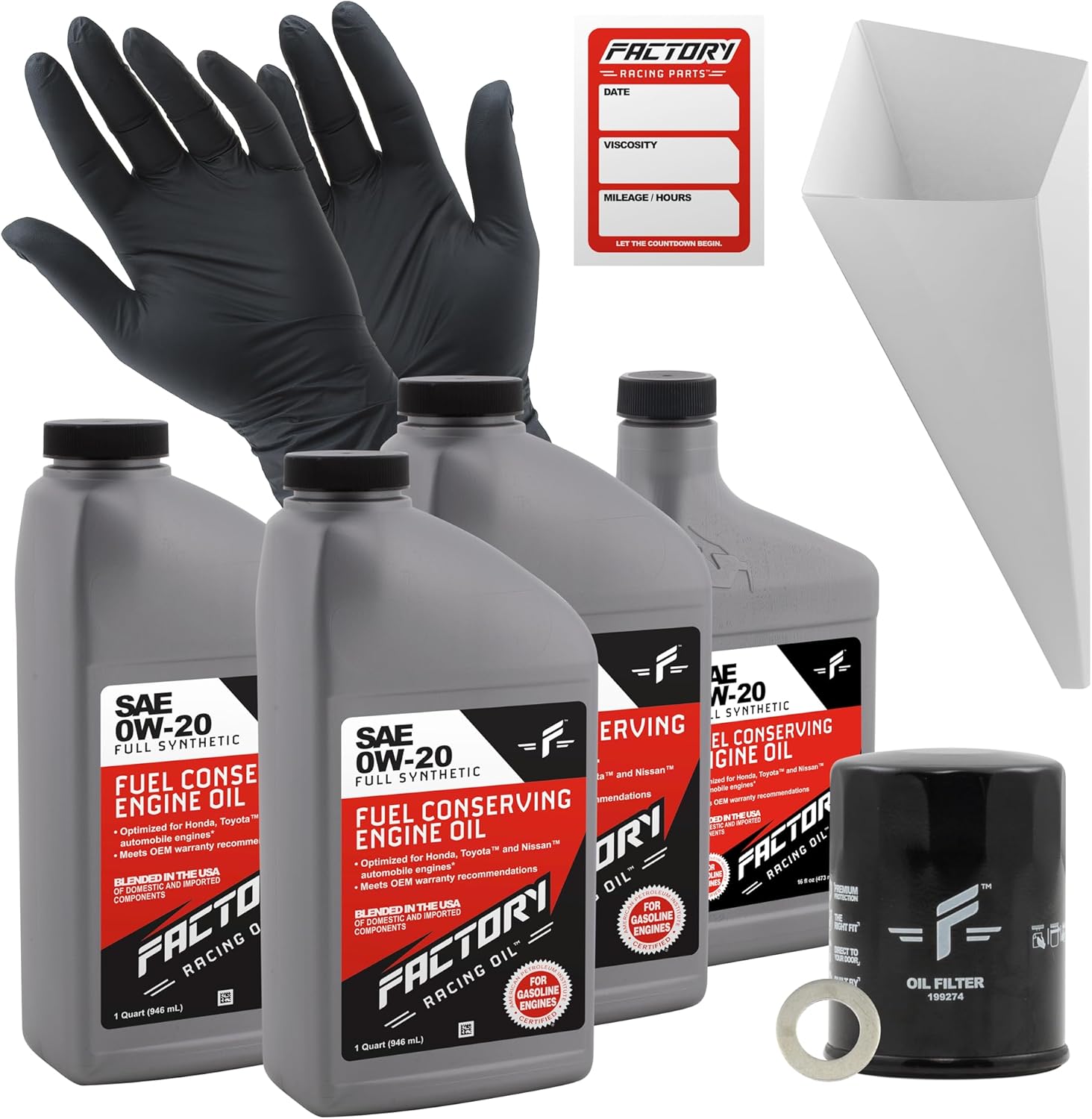
| SAE J300 Viscosity Grade | 0W-20 |
|---|---|
| Liquid Volume | 3.5 Quarts |
| API Rating | API SP Resource Conserving |
| ILSAC | GF-6A |
This Factory Racing Parts kit bundles everything needed for a single DIY oil change on compatible Honda Civics and other listed Honda models. It contains 3.5 quarts of SAE 0W-20 full synthetic oil rated API SP and ILSAC GF-6A, a matching oil filter, a crush washer, funnel, gloves, and an oil change reminder sticker. The oil is formulated for fuel conservation, protection against low-speed pre-ignition, and durability in start-stop driving, so it suits daily-driven small-displacement engines. The filter is specified to replace the OEM reference listed in the kit, simplifying parts matching. Practical benefits include fewer trips to buy parts, a single matched oil/filter combo sized for the Civic drain capacity, and added extras that make a garage change cleaner. Limitations are the 3.5 quart volume, which may be slightly short if you plan a full drain and fill plus filter capacity beyond the listed Civic engine fill; confirm required capacity before starting. Also this kit is vehicle-specific so fit must match the Civic engine variants noted by the maker.
Best for: DIY Honda owners who want a single-package oil change solution that matches factory requirements and minimizes parts guessing and extra shopping.
Less Ideal for: Shops or owners who change oil on multiple vehicles at once or who need larger bulk oil quantities for frequent service intervals.
- All-in-one kit contains oil, filter, crush washer and basic installation supplies for a single DIY change.
- Full synthetic SAE 0W-20 oil with API SP and ILSAC GF-6A certifications for modern small engines.
- Formulated to reduce LSPI risk and support fuel-conserving performance in turbo and start-stop engines.
- 3.5 quart oil volume may require topping up for some Civic drain and fill scenarios.
- Kit is vehicle-specific so it only fits the Honda applications listed by the manufacturer.
Verdict: Use this slot when you want a single purchase that supplies oil plus the filter and fittings needed to complete a DIY oil change in one stop.
Choosing the Right Honda Civic 1.6L Engine Oil: Key Factors to Consider
Viscosity and Climate Fit
Viscosity is the single most important specification for routine engine operation. It determines how quickly oil circulates at startup and how well it maintains a lubricating film at operating temperature. For the Civic 1.6L you should choose a viscosity grade that matches local temperatures and the manufacturer's guidance. Lighter grades like 0W-20 flow more readily at low temperatures and can improve fuel economy, while 5W-30 or similar grades offer thicker films at high load or elevated heat.
Selecting the proper viscosity affects wear during cold starts and high-load cruising. Using a grade too thin for hot climates or heavy use can increase wear, while a grade too thick in cold climates can impair oil flow at startup. Consider seasonal conditions and typical driving patterns when picking the right grade.
Base Stock and Additive Chemistry
The base oil type and additive package determine protection against wear, oxidation, and deposit formation. Full synthetic base stocks generally offer better thermal stability and shear resistance than conventional oils, helping maintain viscosity over longer drain intervals. Additives such as anti-wear agents, detergents, dispersants, and antioxidants help control sludge, neutralize acids, and reduce friction.
For the Civic 1.6L, an oil with a balanced additive suite will protect valve train components and piston rings under normal commuting and occasional highway trips. Too aggressive an additive load can harm older seals, while too weak a package may allow carbon and varnish buildup. Choose oils whose specifications align with gasoline engine requirements and that list the necessary performance approvals.
Shear Stability and Viscosity Retention
Shear stability measures an oil's ability to resist mechanical breakdown under high-shear conditions inside the engine. Poor shear stability leads to thinning of the oil, reducing film thickness and protection. Viscosity retention is especially relevant if you extend oil change intervals beyond very short spans or if the vehicle sees repeated high-load operation.
For the Civic 1.6L, an oil that retains its rated viscosity under stress helps maintain consistent clearances, reduces metal-to-metal contact, and supports predictable oil pressure. Look for oils with documented shear-resistance performance or those based on higher-quality synthetic chemistries when longer stability is a priority.
Engine Cleanliness and Deposit Control
Detergent and dispersant performance affects how well an oil prevents sludge, varnish, and carbon deposits. Clean oil passages and ring grooves preserve compression and reduce oil consumption over time. For engines like the Civic 1.6L, which may see extended idling and short trips, deposit control is critical to avoid buildup that reduces efficiency and increases emissions.
An oil with strong cleansing properties helps dissolve combustion byproducts and keeps them suspended for removal at the next oil change. Consistent use of such oils limits the need for deep cleaning interventions and keeps the PCV and oil passages functioning normally.
Compatibility With Seals and Emissions Systems
Oil formulations can affect gasket and seal materials differently. Some additives cause hardening or swelling that may lead to leaks, while others are formulated to be seal-friendly. Additionally, oil volatility and ash-content affect emissions systems and catalytic converter life if not matched to engine design.
When selecting oil for the Civic 1.6L, ensure the product is suitable for modern gasoline engines and compatible with any emissions control and PCV arrangements in your engine. Seal compatibility reduces the risk of leaks, and appropriate volatility levels limit oil consumption and deposit formation in the exhaust system.
Maintenance Interval and Cost Considerations
How often you plan to change the oil influences which formulation makes sense. Oils rated for extended drains can lower service frequency but require confidence in shear and oxidation resistance. If you perform regular shorter-interval changes, you may prioritize lower-viscosity oils that optimize fuel economy.
Factor in typical mileage, driving style, and whether you perform frequent short trips or highway driving. Also consider manufacturer recommendations for drain intervals and warranty requirements. The best choice balances performance needs with realistic maintenance habits for the Civic 1.6L.
Recommended Viscity Options For Different Driving Conditions
Different driving patterns call for different viscosity choices for the Civic 1.6L. For predominantly short-trip urban driving and cold starts, a lower cold-crank viscosity such as 0W-20 helps ensure rapid oil circulation and reduced engine drag. For drivers who regularly combine city and highway driving or tow light loads, a slightly higher operating viscosity such as 5W-30 can provide extra film strength at higher temperatures.
- 0W-20: Best for cold climates and maximizing fuel economy.
- 5W-30: Better for higher-load driving or hot ambient temperatures.
When To Use Full Synthetic Vs Conventional Blends
Full synthetic oils offer superior thermal stability, oxidation resistance, and shear retention compared with conventional oils. For Civic 1.6L owners who want longer drain intervals, better cold-start performance, or consistent protection under varied conditions, full synthetic is often the prudent choice. Conventional blends may be acceptable for drivers who stick to short intervals and normal commuting, but they usually provide less margin under stress.
- Full synthetic: Better stability and longevity.
- Conventional blend: Lower cost with acceptable protection for frequent changes.
Oil Change Best Practices For The Civic 1.6L
Performing proper oil changes extends engine life beyond selecting the right oil. Always use the correct viscosity and replace the oil filter with a high-quality unit designed for the Civic 1.6L to maintain filtration efficiency. Warm the engine briefly before draining to help mobilize particles, then refill to the correct level and check after a short run to confirm proper oil pressure and no leaks.
- Replace the oil filter every oil change.
- Warm engine to normal temperature before draining when possible.
- Torque drain plug and filter per specifications to avoid leaks.
Signs Your Civic 1.6L Needs A Different Oil Approach
Watch for symptoms that suggest the current oil choice is not optimal. Increased oil consumption, persistent oil smell in the cabin, low oil pressure at idle, or accelerated wear noises can indicate the need for a different viscosity or a formulation with better detergency. Likewise, frequent short trips with lots of idle time may require an oil with stronger deposit control to keep the PCV and intake passages clean.
- Rising oil consumption may mean high volatility or worn rings.
- Visible sludge on the oil cap suggests deposit issues.
- Low pressure at idle can indicate thinned oil or an incorrect grade.
Storage And Handling Tips For Motor Oil
Store motor oil in a cool, dry place away from direct sunlight and temperature extremes to preserve additives and prevent contamination. Keep containers sealed until use and avoid mixing different oil types unless they are compatible by specification. When topping off, use the correct grade and pour slowly to avoid overfilling and spillage that can attract dirt into the filler neck.
- Keep containers sealed and stored upright.
- Do not mix unmatched oil chemistries without confirming compatibility.
- Clean the filler cap area before adding oil to prevent contamination.
Still looking for the perfect fit?
Select your Honda Civic configuration to see the most relevant Engine Oils recommendations
How We Chose the Best Honda Civic 1.6L Engine Oil
Our selection process focused on what actually affects longevity and daily performance in the Honda Civic 1.6L. We prioritized oils with proven base-stock quality and additive packages that address wear, deposits, and oxidation. Viscosity options were chosen to match the Civic 1.6L's tolerances and common climate ranges, including lower-viscosity blends for modern fuel efficiency and mid-viscosity grades for broader temperature stability.We evaluated compatibility with manufacturer-recommended service intervals and looked for oils that support cold starts, protect valve train components, and minimize sludge under stop-and-go commuting. Longevity and shear stability were considered to determine how well an oil maintains viscosity between changes. Corrosion protection, detergent/dispersant balance, and compatibility with common gasket and seal materials were also factored in.Excluded from consideration were oils lacking clear specification data, poorly documented testing, or formulations not intended for passenger gasoline engines. We did not include specialty racing or industrial oils that fall outside normal Civic service recommendations.
Our full evaluation process is outlined in our review methodology.
FAQ
What viscosity should I use in cold winter months?
In cold winter months you will often benefit from a lower cold-crank viscosity such as 0W-20, which circulates quickly at low temperatures and reduces start-up wear. Confirm that the chosen grade meets the Civic 1.6L specifications before switching seasonally.
Can I extend oil change intervals with synthetic oil?
Synthetic oils are more resistant to oxidation and shear, which can allow longer intervals, but extension depends on driving conditions and manufacturer guidelines. If you plan longer drains, choose an oil with proven stability and follow inspection intervals for oil condition.
How do I know if oil is causing increased consumption?
Look for steady drops on the dipstick between services, blue smoke on startup, or frequent need to top off oil. These signs can indicate high volatility oil, worn rings, or leaks. Rule out leaks first, then consider switching grades or formulations if consumption persists.
Is it okay to switch between 0W-20 and 5W-30?
Switching between compatible grades is acceptable if both meet the engine's specifications, but make changes thoughtfully based on climate and driving load. Sudden frequent changes are not advisable because differing viscosities influence oil pressure and film thickness.
Should I change the oil filter every time I change oil?
Yes. Replacing the oil filter at each oil change ensures effective particle removal and prevents contaminants from circulating in fresh oil. Using the right filter for the Civic 1.6L helps maintain oil pressure and flow.
Final Verdict
Prioritize viscosity that matches your climate and driving habits, and choose oils with stable base stocks and balanced additive packages for deposit control and wear protection. Regular, correct oil changes and proper filtration matter as much as the oil itself; they preserve compression and limit consumption.When deciding, weigh tradeoffs between fuel economy gains from lower-viscosity oils and the thicker-film protection available from higher-viscosity grades. Use the guidance above to pick an oil that aligns with your maintenance routine and driving demands so you can keep your Honda Civic 1.6L running reliably.
Explore More:
- Check out all Honda Civic parts & accessories
- Explore Fluids & Chemicals
- Browse all Accessories
