

Note: This article contains affiliate links. If you click on these links and make a purchase, I may earn a small commission at no extra cost to you. This helps support my research and content. Read my full affiliate disclosure here.
Picking the right engine oil for a Honda Civic 1.7L matters for reliability, fuel economy, and engine life. With varying viscosities, additive packages, and synthetic blends available, the wrong choice can cost you performance or increase wear over time. This guide focuses on the top shortlisted oils suited to the Civic 1.7L and explains why each type may be a good fit for different driving habits and mileages.We evaluated candidate oils across cold-start behavior, high-temperature protection, and compatibility with the Civic 1.7L's tolerances. Below are our best options and the practical considerations that will help you pick the right oil before your next oil change.
Looking for other parts? See all Honda Civic parts & accessories.
Top Picks at a Glance
| Best Overall Engine Oil A dependable, widely recommended motor oil that balances protection and price | Mobil 1 High Mileage Full Synthetic Motor Oil 0W-20, 5 Quart |  |
| Best Budget Engine Oil A low-cost motor oil that still meets API/ILSAC specs for everyday use | Castrol GTX High Mileage 5W-30 Synthetic Blend Motor Oil, 5 Quart Bottle |  |
| Best High-Mileage Engine Oil Formulated for older engines with seal conditioners to reduce leaks and wear | Valvoline MaxLife Full Synthetic High Mileage 5W-20 Motor Oil, 5 qt |  |
| Best Honda OEM Engine Oil Genuine manufacturer-formulated oil sold as OEM stock for exact-spec protection | Honda Genuine Full Synthetic Engine Oil 08798-9137 |  |
| Best 0W-20 Full Synthetic Engine Oil A modern full-synthetic 0W-20 formulation prioritizing cold starts and fuel economy | Valvoline Advanced Full Synthetic 0W-20 Motor Oil, 5 qt |  |
| Best Oil Change Kit (engine Oil) A bundled kit that includes oil, filter, drain washer, and change accessories | Factory Racing Parts 0W-20 Full Synthetic Oil Change Kit (3.5 qt) |  |
1. Mobil 1 High Mileage Full Synthetic Motor Oil 0W-20, 5 Quart
Best Overall Engine Oil

| Viscosity | 0W-20 |
|---|---|
| Size | 5 Quart |
| Vehicle Service Type | Car |
| Model | Extended Performance |
| SAE J300 Viscosity Grade | 0W-20 |
Mobil 1 High Mileage 0W-20 is designed for older, higher-mileage car engines and is typically used in routine DIY oil changes. The formula emphasizes engine cleanliness and protection with Mobil 1’s Triple Action approach to reduce deposits, control oxidation, and lower operating temperatures. For a DIY mechanic working on a Civic 1.7L, the low-viscosity 0W-20 grade offers easy cold starts and efficient circulation, and Mobil 1 states protection up to 10,000 miles between changes under recommended conditions. The product meets modern SAE and ILSAC viscosity standards to address LSPI and timing chain wear concerns relevant to modern small engines. Practical benefits include factory-quality protection, strong temperature range performance, and wide availability in 5-quart packs that simplify at-home changes. Limitations are that the 10,000-mile interval depends on driving conditions and manufacturer guidance, so owners should follow Honda’s service recommendations rather than rely solely on the marketing interval. Also this specific formulation is pitched at engines with higher mileage, so newer engines may opt for other Mobil 1 variants depending on warranty or dealer guidance.
Best for: DIY mechanics who prioritize broad, proven protection and want a widely available full-synthetic 0W-20 oil that supports longer intervals and cleaner operation for a high-mileage Civic 1.7L.
Less Ideal for: Drivers strictly following dealership warranty schedules or those who prefer shorter, time-based oil change intervals regardless of product claims may prefer dealer-recommended oils or service.
- Full-synthetic formula that helps reduce deposits and oxidation
- Rated 0W-20 for good cold-start flow and fuel economy in small engines
- Formulated to lower engine temperatures and help protect timing chains and LSPI-prone engines
- Available in a 5-quart container convenient for DIY oil changes
- Recommended extended oil-change interval depends on real-world conditions and may not match Honda service schedules
Verdict: The top pick for most DIY mechanics seeking broad protection, proven performance, and easy availability for routine oil changes.
2. Castrol GTX High Mileage 5W-30 Synthetic Blend Motor Oil, 5 Quart Bottle
Best Budget Engine Oil

| SAE Grade | 5W-30 |
|---|---|
| Compatible Vehicle Type | Vehicles with over 75,000 miles, passenger cars, trucks, SUVs |
| Container Type | Bottle |
| Liquid Volume | 160 Fluid Ounces |
| Meets Specs | API SP; ILSAC GF-6 |
Castrol GTX High Mileage 5W-30 is a synthetic blend motor oil designed for cars with higher mileage and everyday driving. It is used like any standard engine oil replacement during routine oil changes and aims to help reduce sludge, protect against corrosion, and limit wear on pistons, rings, and timing components. Notable features include Castrol's dispersant and additive package, a phosphorus-reduction technology intended to be gentler on catalytic converters, and seal conditioners that can help reduce minor leaks. For a Civic 1.7L this oil provides the basic protections you need for regular use without the cost of a full synthetic; it meets common industry specifications such as API SP and ILSAC GF-6. Expect straightforward performance, improved cleanliness versus low-end conventional oils, and decent volatility resistance so you do not top off as often. Limitations are that it is a synthetic blend rather than a full synthetic, so it does not offer the maximum thermal stability or longest drain intervals available from premium full-synthetic oils.
Best for: Buyers who prioritize dependable, cost-conscious engine protection for routine driving and want an oil tuned for engines with significant mileage.
Less Ideal for: Drivers seeking maximum high-temperature stability, longest possible oil-change intervals, or race and heavy-duty towing applications should choose a premium full-synthetic oil instead.
- Formulated specifically for higher-mileage engines to help reduce sludge and deposits
- Phosphorus Replacement Technology helps protect the catalytic converter and emissions system
- Meets current industry specs (API SP, ILSAC GF-6) so it fits common service requirements
- Includes seal conditioners that can reduce minor oil leaks
- Synthetic blend rather than full synthetic, so not as thermally stable for extreme conditions
Verdict: Choose this if you want a reliable, inexpensive oil that covers basic protection and maintenance without premium additives.
3. Valvoline MaxLife Full Synthetic High Mileage 5W-20 Motor Oil, 5 qt
Best High-Mileage Engine Oil

| SAE J300 Viscosity Grade | 5W-20 |
|---|---|
| Compatible with Vehicle Type | Car, Truck |
| Liquid Volume | 5 Quarts |
| Flash Point | 390 Degrees Fahrenheit |
Valvoline MaxLife Full Synthetic 5W-20 is a high-mileage motor oil formulated to help extend the life of older engines by addressing common age-related issues. It is designed for vehicles with 75,000 miles or more and includes added anti-wear additives, seal conditioners to reduce leaks, and detergents to fight sludge and deposits. In everyday use it replaces conventional or blend oils at oil changes and provides improved wear protection and heat resistance compared with standard industry formulations. For a Honda Civic 1.7L this 5W-20 grade offers the right low-viscosity flow for cold starts while helping limit oil consumption and soften aging seals that often cause drips. Notable features include its full synthetic base for stability across temperatures and Valvoline's MaxLife technology targeted at high-mileage engines. The product is focused on engine protection rather than performance racing, so it is best for longevity and maintenance; drivers seeking specialized performance or a different viscosity should choose an oil matched to the engine maker's manual instead.
Best for: Owners prioritizing long-term engine health who want an oil that targets seal conditioning and reduced oil consumption for an aging Honda Civic 1.7L.
Less Ideal for: Drivers who need a different SAE grade for their engine, who prioritize track/performance additives, or who prefer oils specified solely by their dealer.
- Formulated specifically for high-mileage engines with seal conditioners to help reduce leaks.
- Full synthetic base provides improved thermal stability and consistent viscosity at operating temperature.
- Adds extra anti-wear additives for stronger protection against friction and engine wear.
- Claims improved sludge and deposit control compared with industry standards, helping keep internals cleaner.
- Only available in SAE 5W-20 for this listing, so not suitable if the Civic manual calls for a different viscosity.
- Marketing claims reference percentage improvements versus industry standards but lab conditions may differ from real-world use.
Verdict: This pick is for owners looking to protect aging engines by reducing oil consumption and conditioning seals to limit leaks.
4. Honda Genuine Full Synthetic Engine Oil 08798-9137
Best Honda OEM Engine Oil

| Container Type | Bottle |
|---|---|
| Compatible with Vehicle Type | Honda |
| Automotive Fit Type | Universal Fit |
| Liquid Volume | 70.86 Milliliters |
This genuine Honda full synthetic engine oil is packaged as a single small bottle meant for top-up or small-capacity service tasks. It is a factory-branded fluid designed to match Honda's formulations and fitment guidance, so it is useful when you want a manufacturer-recommended fluid for maintenance. Typical use is for emergency top-ups, valve cover or small-sump additions, or when a technician needs a short service fill; the bottle size is too small for a full oil change on most engines. Notable features include universal fit labeling for Honda vehicles and a full synthetic formulation that supports modern engine protection. The practical benefit is confidence in compatibility with Honda engines and their warranty and service expectations when using a brand-approved fluid. The main limitation is the 70.86 milliliter volume, which restricts this product to topping off rather than replacing a full engine oil fill, so plan for a full-size container for complete oil changes.
Best for: Buyers who prioritize using manufacturer-recommended fluids and need a small, factory-branded bottle for topping off or for following Honda service guidance.
Less Ideal for: Anyone planning to perform a complete oil change or who needs multiple quarts of oil should choose a full-size service container instead.
- Factory-branded formulation tuned for Honda engines
- Full synthetic base for better high-temperature and wear protection
- Compact single-bottle packaging convenient for top-ups or small jobs
- Labeled as universal fit for Honda vehicle types, simplifying selection
- Very small 70.86 milliliter volume makes it unsuitable for full oil changes
Verdict: Buy this when you prefer factory-approved fluids tuned to the manufacturer's viscosity and additive recommendations for optimal compatibility.
5. Valvoline Advanced Full Synthetic 0W-20 Motor Oil, 5 qt
Best 0W-20 Full Synthetic Engine Oil

| Viscosity | 0W-20 |
|---|---|
| Size | 5 QT |
| Flash Point | 200 Degrees Celsius |
| SAE J300 Viscosity Grade | 0W-20 |
Valvoline Advanced Full Synthetic 0W-20 is a factory-quality motor oil designed to flow quickly at low temperatures and provide long-term engine protection. In use it replaces conventional oils for routine oil changes and is aimed at drivers who prioritize cold-start protection and improved fuel economy. The formula claims stronger wear protection, better deposit control, and enhanced heat resistance compared with industry baselines, which translates to smoother cold starts, reduced metal-to-metal contact when the engine is cold, and cleaner internals over multiple oil changes. It meets modern API and ILSAC specifications and several manufacturer requirements, so it fits the service needs of many gasoline engines. Trade-offs are typical for a premium synthetic: benefits like cleaning and reduced wear occur over several change cycles rather than instantly, and the product may cost more than basic full synthetics. For a Civic 1.7L seeking quicker low-temperature lubrication and marginal fuel-economy gains, this oil is a practical choice.
Best for: Drivers who prioritize fast cold-start protection and incremental fuel-economy improvements in a modern gasoline engine, and who plan routine oil-change intervals to realize cleaning benefits.
Less Ideal for: Drivers who change oil infrequently or who want immediate, noticeable engine rejuvenation after a single fill should consider alternatives focused on instant rejuvenation or different viscosities.
- Flows well at cold temperatures for reduced startup wear
- Formulated to reduce wear, deposits, and thermal breakdown compared with industry baselines
- Meets current API and ILSAC specs plus several manufacturer service requirements
- Full synthetic base oils that support fuel-economy improvements
- Cleaning and "restore" benefits develop over multiple oil changes rather than immediately
Verdict: Ideal for drivers who want the fastest cold-flow protection and the fuel-economy advantages of a full-synthetic 0W-20 oil.
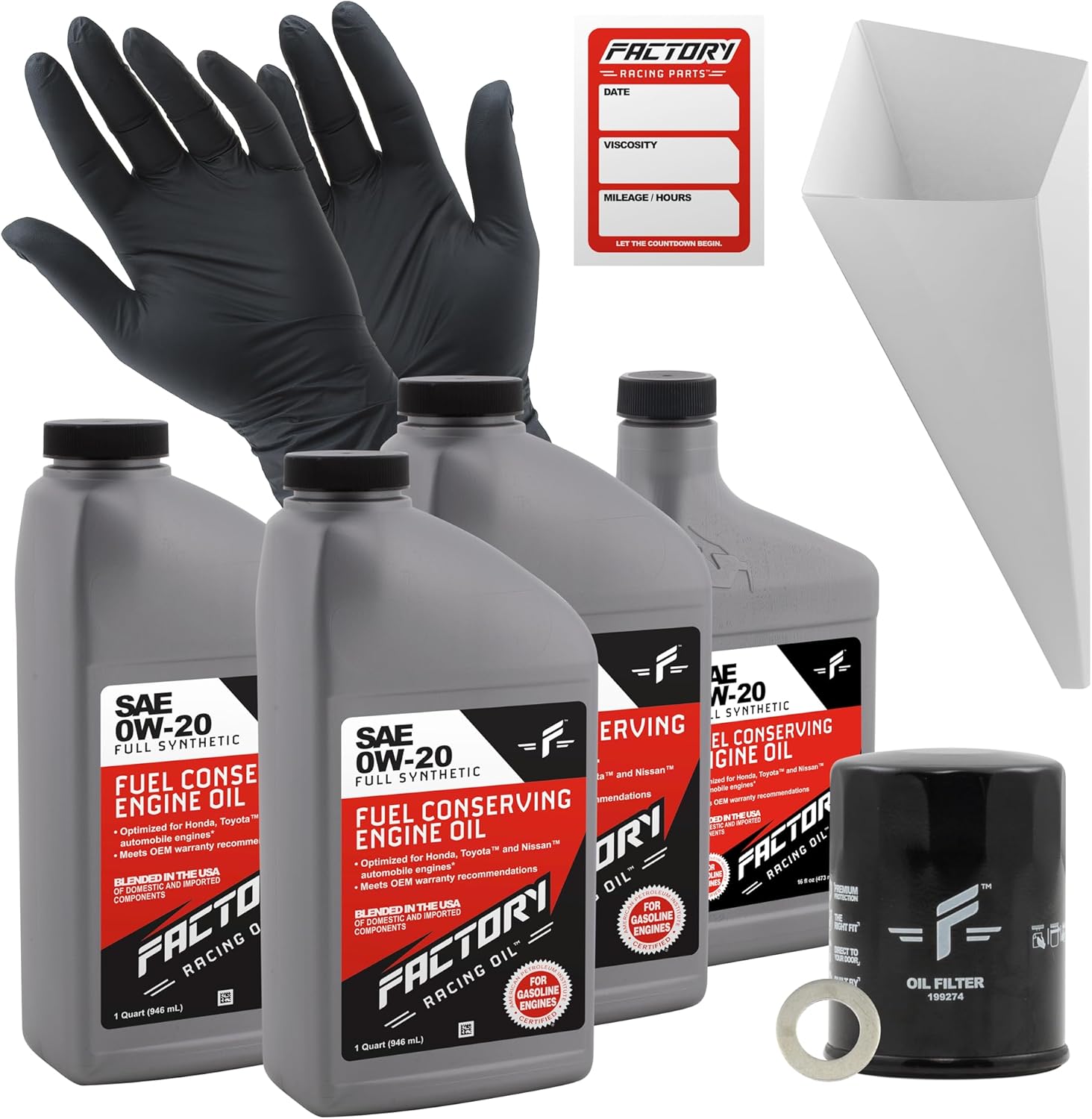
6. Factory Racing Parts 0W-20 Full Synthetic Oil Change Kit (3.5 qt)
Best Oil Change Kit (Engine Oil)
| SAE J300 Viscosity Grade | 0W-20 |
|---|---|
| Liquid Volume | 3.5 Quarts |
| Certification | API SP, ILSAC GF-6A |
| Included Components | oil, filter, washer, funnel, gloves, oil change stickers |
This Factory Racing Parts kit bundles everything you need for a single DIY oil change on compatible Honda models that call for SAE 0W-20. It contains 3.5 quarts of full synthetic 0W-20 engine oil certified to API SP and ILSAC GF-6A, a replacement oil filter matched to the listed Honda part, a crush washer, funnel, gloves, and an oil change sticker. In practice the kit simplifies routine maintenance: the included filter and crush washer remove the guesswork about fitment and the funnel and gloves keep the job cleaner. The oil is marketed for fuel conserving performance and protection against low-speed pre-ignition, making it suitable for modern small-displacement engines and turbocharged variants. The main limitation is the 3.5 quart volume, which is sized for specific Honda 4-cylinder drain capacities and may not cover models with larger oil capacity without an additional bottle. Also this kit is focused on one service at a time so frequent DIYers will want multipacks or bulk oil for cost efficiency.
Best for: DIY Honda owners who want a one-pack, ready-to-use oil change solution that supplies the correct oil grade and matching filter for a single service.
Less Ideal for: Drivers who perform frequent oil changes, work on multiple vehicles, or prefer to buy oil in bulk to lower per-change cost should consider larger packs or standalone oil and filters instead.
- Complete single-change package with oil, correct oil filter, crush washer, funnel and gloves
- Uses full synthetic SAE 0W-20 oil certified API SP and ILSAC GF-6A
- Designed to meet factory fitment for listed Honda applications so filter and parts fit without modification
- Includes an oil change sticker to track service interval
- 3.5 quart oil quantity may be insufficient for Honda engines with larger drain capacities requiring more than the kit provides
Verdict: Choose a kit when you want everything needed for a single DIY oil change—oil, correct filter, and small parts—in one purchase.
Choosing the Right Honda Civic 1.7L Engine Oil: Key Factors to Consider
Viscosity Grade and Cold-Start Performance
Viscosity grade determines how the oil flows at low and high temperatures and matters directly for a Civic 1.7L that may see varied climates. Thinner grades like 0W-20 circulate quickly at startup to reduce wear during cold starts, while thicker grades such as 5W-30 maintain film strength at higher operating temperatures. Choosing the right viscosity affects fuel economy, oil pressure, and engine protection across daily commuting and longer drives.
Consider seasonal conditions and driving patterns. If you do many short trips in cold weather, prioritize an oil with strong low-temperature flow. If you frequently tow, carry heavy loads, or drive long highway distances where engine temps stay high, pick a grade with proven shear resistance so it retains protective thickness over time.
Synthetic Vs Conventional Formulations
Synthetic and synthetic-blend oils offer improved thermal stability, lower volatility, and better resistance to breakdown compared with conventional oils. For the Civic 1.7L, those properties translate to more consistent protection during hot summer driving and longer drain intervals when recommended by the manufacturer. Synthetics also reduce deposit formation, which helps preserve engine cleanliness and efficiency.
Conventional oils can still be acceptable for lower-mileage vehicles with gentle driving patterns, but they often require shorter service intervals. Evaluate whether your driving style, expected service schedule, and long-term engine goals justify upgrading to a synthetic formulation.
Wear Protection and Additive Packages
Additive chemistry determines how well an oil prevents wear, controls corrosion, and keeps internal components clean. Anti-wear additives, detergents, and dispersants are especially important for the Civic 1.7L because they help protect valve train parts and bearings during variable operating conditions. Oils with robust anti-wear packages reduce metal-to-metal contact and slow component degradation.
Look for oils that offer balanced detergency to prevent sludge and deposits without being overly harsh on seals. The right additive mix supports longevity and consistent performance between service intervals.
High Mileage Considerations
High-mileage formulations include conditioners that help maintain flexible seals and reduce oil consumption in older engines. For a Civic 1.7L with significant miles, those seal-friendly additives can limit leaks and lower burn-off rates. High-mileage oils also often contain enhanced detergents to tackle accumulated deposits and protect worn surfaces.
If your Civic is past the 100,000-mile mark or shows increased oil consumption, consider a high-mileage-specific oil. It can improve drivability and reduce symptoms associated with age, but it is not a cure for mechanical wear and should be part of a broader maintenance plan.
Manufacturer Specifications and Approvals
Following Honda's published specifications and API or ILSAC approvals helps ensure compatibility with the Civic 1.7L's engineering tolerances. Using an oil that meets or exceeds the recommended standards reduces the risk of warranty or service issues and ensures the oil includes the necessary performance attributes the engine was designed around.
Always check the owner's manual for the recommended viscosity and spec. Oils lacking clear specification claims or industry approvals should be avoided since they may not deliver predictable protection.
Oil Consumption and Long-Term Maintenance
Different oils influence consumption rates differently due to volatility and seal-conditioning effects. For the Honda Civic 1.7L, consistent oil consumption can signal seal or ring wear; selecting an oil that balances low volatility with appropriate seal conditioning can help manage consumption between services. Regular monitoring after any oil change is important to detect changes quickly.
Maintenance practices such as timely oil changes, correct filter selection, and using the specified oil grade play a large role in long-term engine health. Choose an oil that supports those maintenance goals while matching your driving profile.
Choosing the Right Viscosity for Your Driving Climate
Viscosity choice should reflect the temperatures you normally drive in. For milder climates, a mid-range grade provides a good balance between startup protection and high-temperature film strength. In colder regions, a lower cold-start rating improves circulation immediately after startup and reduces wear during short trips.
Also factor in how often you reach highway speeds. Sustained high-speed driving keeps the engine at elevated temperatures, where maintaining adequate film thickness is critical. Check the owner manual guidance and match that to your typical seasonal temperatures.
- Cold climates favor lower W-rated grades for fast circulation.
- Hot climates need oils with strong high-temperature shear stability.
- Drive patterns affect whether fuel economy or protection is the priority.
When to Consider High Mileage Formulations
High mileage oils are formulated to address the aged engine's common issues, such as seal hardening and higher deposit loads. If your Civic 1.7L has accumulated substantial miles, these formulations can help reduce leaks and keep deposits in suspension until the next change.
They are not a repair for worn mechanical parts, but they can improve day-to-day drivability and reduce the rate of incremental deterioration when used consistently.
- Look for seal conditioners to limit minor leaks.
- Enhanced detergents help with engines that have seen some sludge buildup.
Synthetic Blends Vs Full Synthetic: Practical Tradeoffs
Synthetic blends provide many of the benefits of full synthetics at a lower cost and can be a pragmatic choice for owners wanting better protection than conventional oil. Full synthetic oils offer the highest thermal stability and lowest volatility, which benefits engines that operate at higher temperatures or are kept for the long term.
Consider budget, driving intensity, and how long you intend to keep the vehicle when choosing between blend and full synthetic options.
- Full synthetics: better stability and longer potential drain intervals.
- Blends: compromise between performance and cost with notable benefits over conventional oils.
Oil Change Intervals and Monitoring
Adhere to the oil change interval recommended for the Civic 1.7L based on the chosen oil type and your driving conditions. Severe driving, frequent short trips, or dusty environments often justify shorter intervals. When switching oil types, monitor oil level and color over the following few services to ensure there are no unexpected consumption or deposit changes.
Regular checks help catch leaks or abnormal consumption early and preserve engine life.
- Use the correct oil filter and proper drain/fill procedures.
- Check oil level after a few hundred miles following any oil change.
Environmental and Disposal Considerations
Used engine oil must be handled responsibly. Many service centers and collection points accept used oil and filters for proper recycling. Choosing an oil with lower volatility can reduce evaporative losses and marginally lower environmental impact during operation.
Proper disposal minimizes environmental contamination and is often regulated, so follow local guidelines when changing oil at home.
- Store used oil in a sealed container before drop-off.
- Recycle filters and packaging where facilities exist.
Still looking for the perfect fit?
Select your Honda Civic configuration to see the most relevant Engine Oils recommendations
How We Chose the Best Honda Civic 1.7L Engine Oil
We used vehicle-specific performance needs and real-world service concerns to narrow the field. Evaluation prioritized viscosity grades that match the Honda Civic 1.7L's tolerances and modern engine demands, focusing on how oils protect during cold starts and under sustained highway loads. Thermal and shear stability were considered to estimate long-term film protection at operating temperatures. Compatibility with seals and gaskets, and the tendency to cause sludge or deposits under recommended service intervals, were part of our selection criteria.We also weighed additive chemistry relevant to wear control, oxidation resistance, and detergency since these affect engine cleanliness over time. For owners with higher mileage Civics we considered formulations targeted for seal conditioning and anti-leak properties. Oils were filtered for API and OEM compatibility levels and whether they meet the viscosity ranges commonly recommended for the 1.7L engine.Exclusions: we excluded specialty racing-only oils and products that do not meet standard motor vehicle specifications or lack published performance data. The list focuses on practical, road-oriented oils that fit the Civic 1.7L's service needs.
Our full evaluation process is outlined in our review methodology.
FAQ
What viscosity is best for a Honda Civic 1.7L in cold climates?
A lower cold-start rating such as 0W-class improves circulation at startup and reduces wear during short trips. Confirm the specific viscosity recommendations in your owner's manual and consider a 0W-20 or 5W-20 equivalent if listed.
Can I switch from conventional oil to full synthetic in my Civic 1.7L?
Yes, switching to full synthetic is generally acceptable and can improve thermal stability and deposit control. After the change, monitor oil level and engine behavior over a few services to ensure there is no unexpected consumption or leaks.
Do high-mileage oils actually help older Civic 1.7L engines?
High-mileage oils include additives that condition seals and bolster detergency, which often helps reduce minor leaks and manage deposits. They support drivability but do not reverse mechanical wear.
How often should I check oil level after an oil change?
Check the oil level after a few hundred miles following an oil change to confirm there are no leaks or abnormal consumption. Thereafter, inspect monthly or before long trips to maintain proper levels.
Is synthetic oil better for fuel economy in the Civic 1.7L?
Synthetic oils can reduce internal friction and volatility, which may yield modest fuel economy gains under some conditions. Actual improvement depends on driving habits and should not be the only reason to choose a formulation.
Will a thicker oil protect an older Civic 1.7L better?
A thicker oil can offer stronger film strength at operating temperature but may harm cold-start protection or oil pressure if it departs from manufacturer recommendations. Balance protection needs with the prescribed viscosity range.
Final Verdict
Prioritize viscosity that matches your climate and driving habits, and choose a formulation that provides strong wear protection and detergency for the Honda Civic 1.7L. For higher-mileage engines, consider high-mileage formulations that help condition seals and manage deposits. Maintain consistent oil checks and follow recommended service intervals to preserve engine life.Weigh the tradeoffs between fuel economy and film strength when selecting a grade, and favor oils that meet the appropriate specifications for the Civic 1.7L. With those priorities in mind you can select an oil that keeps the engine running reliably for years.
Explore More:
- Check out all Honda Civic parts & accessories
- Explore Fluids & Chemicals
- Browse all Accessories
