

Note: This article contains affiliate links. If you click on these links and make a purchase, I may earn a small commission at no extra cost to you. This helps support my research and content. Read my full affiliate disclosure here.
If your Toyota Camry is showing emission issues or a persistent check engine light, the manifold catalytic converter is often the component to inspect first. Picking the right manifold catalytic converter matters because fitment, durability, and emissions performance directly affect drivability, sensor operation, and whether the car passes inspections.This guide highlights the six top manifold catalytic converters shortlisted for the Toyota Camry and explains the evaluation criteria used. You will get practical advice on what to prioritize when replacing the manifold catalytic converter, common symptoms that indicate failure, and how different installation or fitment choices affect long-term results.
Looking for other parts? See all Toyota Camry parts & accessories.
Top Picks at a Glance
| Best Overall The best all-around choice for most situations | SPEEDFusion Front Catalytic Converter for Toyota Camry 2012–2017 2.5L |  |
| Best Quality Built to a higher standard if you want something more solid | Dorman 673-811 Manifold Converter (Made in USA) |  |
| Best Value The sweet spot between price and what you get | SAROTIN Exhaust Manifold Catalytic Converter for Toyota Camry 2.4L (2002–2006) |  |
| Best Budget The cheapest option that still gets the job done reliably | PTPDRH Catalytic Converter Kit for 2002–2006 Toyota Camry/Solara 2.4L (EPA Compliant) |  |
| Highest Rated A top-rated pick with lots of positive feedback | SPEEDFusion Front Catalytic Converter for Toyota Camry/Solara 2.4L (2002–2006) |  |
| Most Popular A crowd favorite that many people choose with confidence | DNA MOTORING Factory-Style Catalytic Converter Exhaust Manifold (OEM-CONV-035) |  |
SPEEDFusion Front Catalytic Converter for Toyota Camry 2012–2017 2.5L
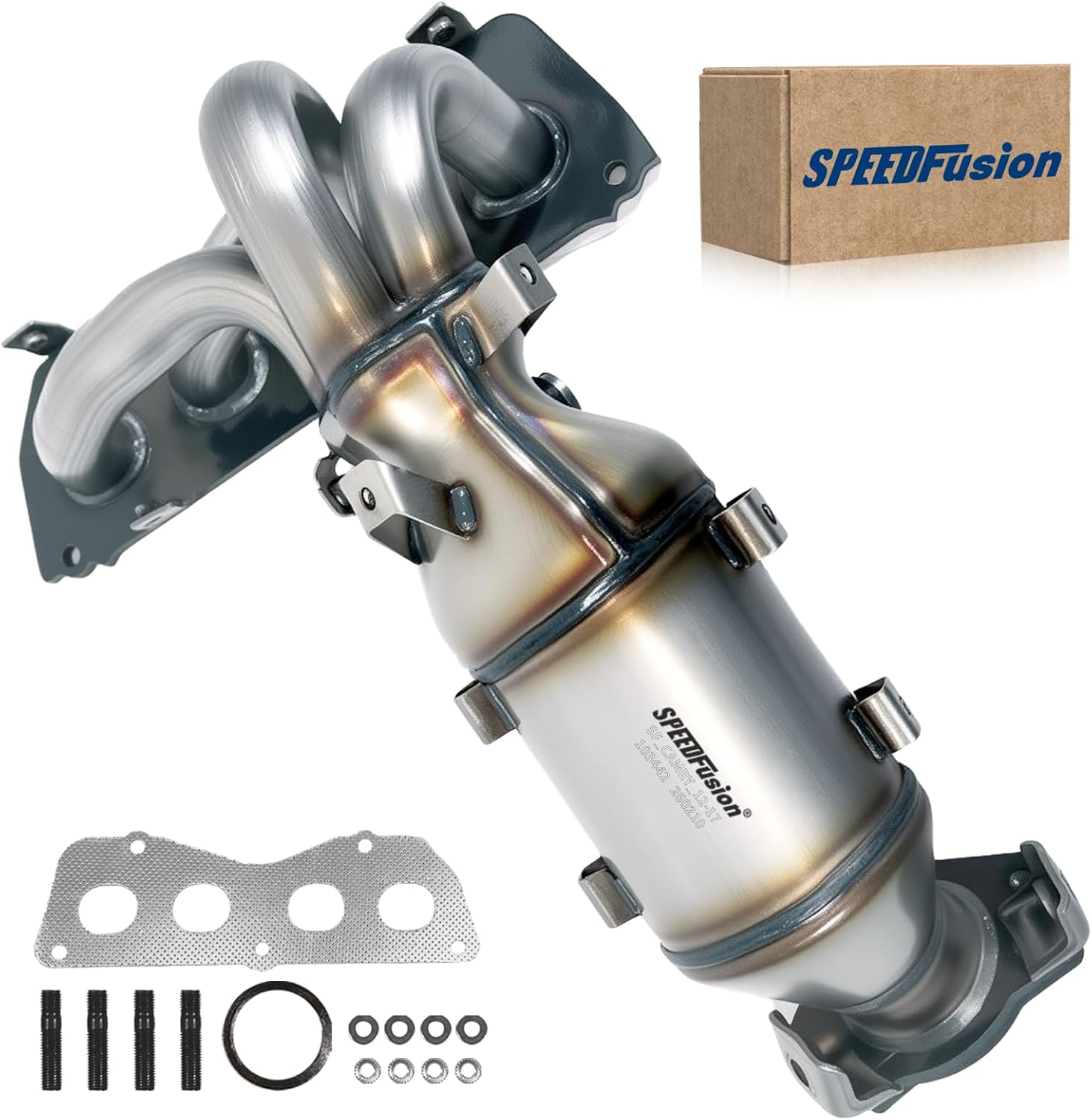
| Vehicle fitment | Toyota Camry 2012-2017 2.5L (front, non-hybrid) |
|---|---|
| Certification | EPA compliant (not CARB) |
| Construction material | 409L stainless steel shell |
| Substrate | 400-hole ceramic with Pt/Rh/Pd coating |
| Manufacturer | SPEEDFusion |
This SPEEDFusion front catalytic converter replaces the factory unit on Toyota Camry 2.5L models from 2012 through 2017 and is sold as a direct-fit, EPA-compliant manifold converter. It uses a stainless steel shell and an OEM-style ceramic substrate plated with platinum, rhodium and palladium to restore emissions control and help keep the check engine light from triggering fault codes. Installation is straightforward for a shop or a competent DIYer since it is produced to match factory attachment points and includes hardware in many cases. Practical benefits include improved catalytic efficiency over a worn unit and lower long-term repair cost compared with dealer replacement. Limitations to note are regional restrictions because it is not CARB-approved, so it cannot be used where California-style regulations apply, and fitment quality has varied in user reports so careful inspection of flanges and welds at installation is advised.
Best for: Buyers looking for a cost-conscious, factory-style replacement that restores emissions function without upgrading to a high-performance unit; suited to owners who prioritize a reliable, emissions-legal repair for everyday driving.
Less Ideal for: Drivers in states that require CARB-approved parts or owners seeking a performance-oriented converter with freer exhaust flow should look elsewhere.
- Direct-fit design intended to match factory mounting points for easier installation
- EPA compliant for vehicles meeting federal emission standards
- Stainless steel construction and OEM-style ceramic substrate with precious-metal coating for effective catalytic performance
- Designed to prevent common fault codes related to catalytic efficiency
- Not CARB-compliant and therefore illegal for use in states with California-style emissions rules
- Some buyers report inconsistent flange fitment and welding quality on arrival
Verdict: A budget-friendly, direct-fit front catalytic converter that restores emissions control for 2012–2017 Camry 2.5L models while meeting federal standards.
Dorman 673-811 Manifold Converter (Made in USA)

| Manufacturer | Dorman Products |
|---|---|
| Model | 673-811 |
| Exterior | Machined |
| Compatible vehicles | Toyota Camry 2002-2003; Toyota Solara 2002-2003 |
This Dorman manifold converter combines the exhaust manifold and catalytic converter into a single direct-replacement unit intended for select 2002–2003 Toyota Camry and Solara models. It is supplied as a kit with gaskets and downpipe hardware to simplify installation and is manufactured to match factory fit and emissions for the listed applications. In real-world use it fixes common downstream O2 sensor codes and restores smooth drivability when a failed converter was causing limp or poor acceleration. Buyers should note mixed installation reports: many users install it without issues, but some have found misaligned brackets, ill-fitting gaskets, or damaged threads that required extra work or replacement fasteners. The part is CARB-compliant for strict emissions regions and is made under U.S. quality control, offering a cost-saving alternative to a new factory item. If you prioritize a one-piece repair and emissions compliance for the specified Camry/Solara years, this unit can be a practical performance-minded replacement, but allow time for careful fit checks and potential hardware swaps during installation.
Best for: Drivers who want a single-piece, emissions-compliant replacement to restore engine performance and clear catalytic-related fault codes on early-2000s Camry/Solara models and are willing to do careful fit verification during installation.
Less Ideal for: People seeking a guaranteed bolt-in, flawless OEM fit without any installation adjustments or those who prefer a brand-new factory converter with strictly matched hardware alignment.
- Integrated manifold and converter simplifies repair by replacing two components with one unit
- Includes gaskets and downpipe hardware to reduce parts sourcing and speed installation
- CARB-compliant design suitable for emissions-controlled states
- Manufactured and quality-controlled in the United States
- Some units show fitment issues such as misaligned brackets, improper gasket fit, or damaged threaded holes
- Variable build quality reported by installers, which can require additional fasteners or corrective work
Verdict: A cost-conscious, CARB-compliant integrated manifold converter that restores emissions function and drivability for the specified early-2000s Camry and Solara when fitted carefully.
SAROTIN Exhaust Manifold Catalytic Converter for Toyota Camry 2.4L (2002–2006)
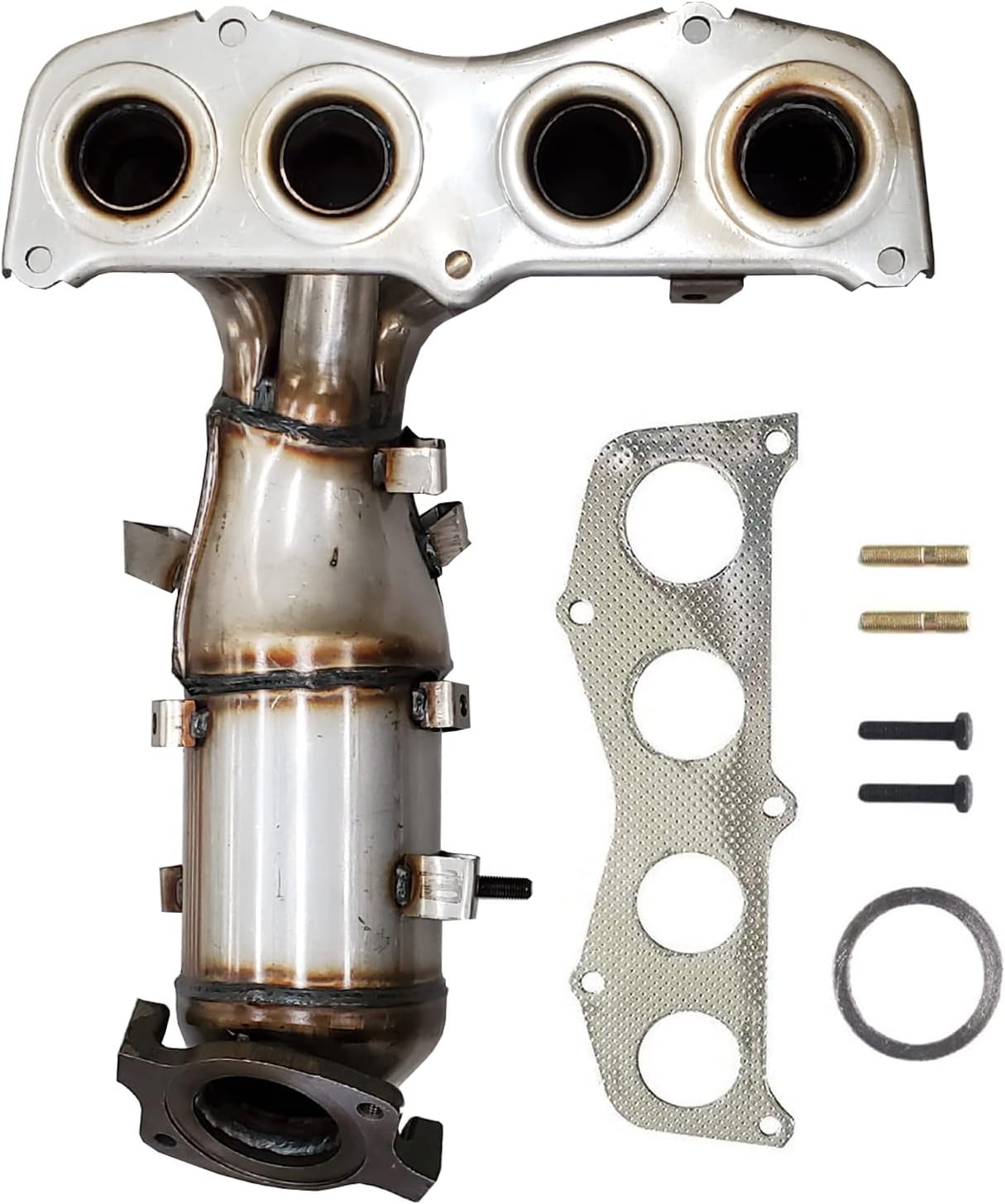
| Fitment | Toyota Camry 2.4L 2002-2006; Solara 2.4L 2004-2006 |
|---|---|
| Body Material | 409 stainless steel |
| Substrate | Cordierite ceramic carrier |
| O2 Sensor Ports | 1 O2 sensor port |
| Outlet Type | 2-bolt welded flange |
This SAROTIN unit replaces the front exhaust manifold and catalytic converter in a single piece for the 2.4L Camry 2002–2006 (2AZ-FE) and is intended as a direct factory-quality replacement. It installs without cutting or welding on most cars and includes hardware and an O2 sensor port to simplify fitment. The converter uses a cordierite ceramic substrate and a higher precious-metal catalyst load which aims to improve emissions control and resolve P0420 codes. With a stainless steel housing it resists heat and should last under normal driving. Practical notes: some buyers needed to remove a heat shield and the supplied gaskets are mixed quality so plan to have better gaskets on hand for a high-heat application. It is EPA and OBD2 compliant but not CARB approved so it is only suitable where federal converters are allowed. Professional installation is recommended for correct torque and sealing.
Best for: Buyers who want a practical, one-piece replacement to restore emissions function on a 2.4L Camry with minimal modifications and who prioritize matching factory fit and reducing installation steps.
Less Ideal for: Drivers who need a CARB-certified converter or who prefer separate manifold and cat components for custom exhaust work should look elsewhere.
- Integrated manifold and front catalytic converter simplifies replacement and reduces labor vs separate parts
- Designed specifically for Toyota Camry 2.4L 2002–2006 for close fit and direct-replacement installation
- Higher precious-metal catalyst content aims to improve emission conversion and address P0420 codes
- Stainless steel housing provides heat resistance and durability compared with cheaper housings
- Not CARB compliant so it cannot be used where California-style certification is required
- Included gaskets and some hardware may be lower quality and could require replacement for reliable sealing
Verdict: A practical direct-replacement manifold catalytic converter built to restore emissions control on 2.4L Camry models with minimal modification.
PTPDRH Catalytic Converter Kit for 2002–2006 Toyota Camry/Solara 2.4L (EPA Compliant)

| Vehicle compatibility | 2002–2006 Toyota Camry/Solara 2.4L |
|---|---|
| Exterior | Stainless Steel |
| Model | PTPDRH78694 |
| EPA status | EPA-certified (not for CA, WA, VT, OR) |
This PTPDRH catalytic converter is a budget-focused direct-fit replacement designed for 2002–2006 Toyota Camry and Solara 2.4L engines. It installs as a drop-in manifold replacement without programming or calibration, and the manufacturer says it uses a three-way catalytic process with ceramic substrate and stainless steel housing to control emissions to EPA standards. Practical benefits include straightforward fitment to factory interfaces, included hardware, and claims of improved thermal resistance compared with lower-grade parts. Real-user feedback shows it generally bolts up cleanly, does not trigger check engine lights, and performs acceptably for routine driving. Limitations to expect are mixed hardware quality on the supplied fasteners and some uncertainty about long-term durability versus higher-end OE-style units. It is not approved for use in certain states with their own emissions rules, so confirm local compliance before installing. For a cost-conscious repair where you need a compatible, emissions-certified manifold converter, this kit covers the basics without added complexity.
Best for: Buyers repairing an older Camry or Solara who want an affordable, emissions-certified manifold converter that installs with minimal fuss and prioritizes immediate, budget-friendly restoration over long-term premium durability.
Less Ideal for: Drivers in states with stricter emissions programs or owners seeking a top-tier OEM-equivalent lifetime solution should consider higher-end factory-quality replacements or state-approved parts instead.
- EPA-certified for federal emissions compliance
- Designed as a direct-fit drop-in manifold replacement for 2002–2006 Camry/Solara 2.4L
- Stainless steel exterior and ceramic substrate intended for improved thermal resistance
- Includes hardware and tailored interfaces for straightforward installation
- Included fasteners have mixed quality and may need replacement during installation
- Not approved for use in certain states with stricter emissions regulations
Verdict: A budget-minded, EPA-certified direct-fit manifold catalytic converter that gets your 2002–2006 Camry or Solara 2.4L back to emissions-compliant operation with minimal installation hassle.
SPEEDFusion Front Catalytic Converter for Toyota Camry/Solara 2.4L (2002–2006)

| Position | Front |
|---|---|
| Compatible Engines | 2002–2006 Toyota Camry/Solara 2.4L L4 |
| Substrate | 400-hole ceramic, plated with Pt/Rh/Pd |
| Exterior | Polished stainless steel |
| EPA Compliance | Meets federal emission standards |
This SPEEDFusion front catalytic converter is a direct-fit replacement for 2002–2006 Toyota Camry and Solara 2.4L applications intended to restore exhaust emissions control and engine operation. It uses a stainless steel housing and an OEM-grade 400-hole ceramic substrate plated with precious metals to convert harmful gases while promising EPA compliance for federal-regulated vehicles. Typical use is as a factory-style manifold catalytic replacement during exhaust repair or when a failed converter triggers emissions codes. Notable features include a polished stainless shell, claimed anti-core-detachment welding, and an installation-friendly direct-fit design that reduces modification during replacement. In practice those elements mean easier installation at a shop, a return to proper catalytic function, and the potential to keep the check engine light related to catalyst efficiency off. Limitations are that it is not CARB compliant so it cannot be used in some states, and there are mixed long-term durability reports among users so professional installation and inspection are recommended to maximize service life.
Best for: Buyers who prioritize restoring reliable emissions control and want a factory-style replacement that installs cleanly with professional fitment and keeps the vehicle running and emissions-compliant under federal rules.
Less Ideal for: Drivers in states that require CARB-certified parts or those seeking a lifetime-guaranteed OEM converter should look for a certified alternative or dealer-supplied unit.
- Designed as a direct-fit replacement for Camry/Solara 2002–2006 for easier installation
- EPA compliant for federal emission standards
- Stainless steel shell with welded construction aimed at resisting harsh underbody conditions
- OEM-grade 400-hole ceramic substrate with precious metal coating to improve catalytic conversion
- Not CARB compliant so illegal to install in CARB states
- Some user reports note premature failures on a small number of units
Verdict: A practical, direct-fit front catalytic converter that restores emissions control for 2002–2006 Camry/Solara while meeting federal EPA standards.
DNA MOTORING Factory-Style Catalytic Converter Exhaust Manifold (OEM-CONV-035)

| Fitment | Compatible with 02-06 Toyota Camry 2.4 and 02-06 Solara (does NOT fit PZEV models) |
|---|---|
| Manufacturer | DNA MOTORING |
| Model | OEM-CONV-035 |
| EPA Status | EPA OBD-II approved for federal emissions models |
| Exterior | Bare |
This DNA MOTORING catalytic converter replaces the front manifold/downpipe assembly on compatible 2002–2006 Camry and Solara models and is intended as a factory-style, direct-fit replacement for vehicles not using PZEV systems. It installs between the exhaust manifold and the rest of the exhaust system and includes a preformed pipe and welded catalytic core to restore exhaust routing and emissions control. The unit is stainless steel with mandrel bends to maintain flow and is marketed as meeting EPA OBD-II standards for federal emissions, which helps when replacing a failed OEM converter on non-California cars. Expect practical benefits like reasonably good fitment for many applications and a lower cost alternative to dealer parts, but be prepared to supply or replace gaskets, bolts, and possibly adjust flange alignment during installation. Some buyers report inconsistent flange and O2 sensor weld quality, and this part is explicitly not legal for California, New York, or Maine emissions models, so it is best used where federal-compliant replacements are acceptable and installed by a professional to ensure proper sealing and sensor placement.
Best for: Buyers who value social proof and want a budget-friendly, federal-compliant replacement that generally fits without heavy modification and are comfortable relying on other owners and installers for fitment reassurance.
Less Ideal for: Do not choose this if you need a California-compliant catalytic converter, want a guaranteed exact factory-fit without any adjustment, or prefer a fully plug-and-play dealer unit with OEM support.
- Designed as a direct-fit factory-style replacement for specified 2002–2006 Toyota Camry and Solara applications.
- Stainless steel construction with computerized mandrel bends for consistent exhaust flow and durability.
- EPA OBD-II approved for federal emissions models, making it suitable where federal compliance is required.
- Lower-cost alternative to dealer catalytic assemblies for repairing damaged front converters.
- Not legal for sale or use in California, New York, or Maine emissions models.
- Some customers report inconsistent flange alignment and poor O2 sensor weld placement requiring rework.
- Installation does not include instructions and may require additional gaskets, bolts, or professional fitting.
Verdict: A cost-conscious, factory-style front catalytic converter for 2002–2006 Camry and Solara owners who need a federal-compliant replacement and are willing to handle minor fitment adjustments.
Choosing the Right Toyota Camry Manifold Catalytic Converter: Key Factors to Consider
Exact Fitment and Mounting Geometry
Correct fitment is the most important factor for a manifold catalytic converter on a Toyota Camry. Manifold geometry, flange orientation, and oxygen sensor bung placement must match the vehicle's original harness and exhaust routing to avoid exhaust leaks and complicated rework.
A converter that fits without modification reduces installation time and preserves factory sensor readings. If the mating surfaces do not align, you may introduce exhaust leaks that trigger diagnostic trouble codes or create noise. Always verify bolt pattern, flange thickness, and the position of any heat shields or brackets to ensure a straightforward swap.
Emissions Efficiency and Substrate Type
The core catalyst substrate determines how effectively the unit converts hydrocarbons, carbon monoxide, and oxides of nitrogen. Substrate cell density, washcoat composition, and precious metal loading affect conversion efficiency across temperature ranges common to Camry operation.
Higher-quality substrates reach light-off temperature faster and maintain conversion rates during city and highway driving, reducing the chance of failed emissions tests and helping oxygen sensors operate within normal parameters. Consider the emissions performance claims relative to expected operating conditions rather than only peak conversion numbers.
Thermal Durability and Heat Management
Manifold catalytic converters are exposed to extreme temperatures from combustion and fluctuating loads. Materials used for the shell, internal supports, and welds must withstand repeated thermal expansion without cracking or collapsing the substrate.
Good heat management reduces the risk of internal breakage and maintains long-term conversion efficiency. Look for designs with reinforced flanges, quality welding, and heat-resistant coatings where metal-on-metal contact is common. These features reduce the likelihood of thermal fatigue that leads to failure signs such as rattling or loss of conversion capability.
Oxygen Sensor Compatibility
The Camry's engine management depends on accurate oxygen sensor signals to control fuel trim and emissions. A manifold catalytic converter must provide properly placed sensor bungs and maintain the correct distance from the exhaust port to ensure accurate readings.
Incorrect sensor placement can cause lean or rich trim responses and illuminate the check engine light, even if the substrate is functioning. Ensure that the replacement unit supports the same number of sensors and housing type as the original equipment to avoid ECU confusion and unnecessary diagnostics.
Corrosion Resistance and Environmental Protection
Rust and corrosion are common failure accelerants for exhaust components, especially on vehicles exposed to road salt or frequent moisture. The converter's shell, flanges, and fasteners should resist corrosion to maintain a leak-free seal and prevent structural failure.
Protective finishes or stainless steel construction extend service life and reduce the chance of flange warpage or bolt seizure during future maintenance. Prioritizing corrosion resistance simplifies future repairs and preserves emissions performance over time.
Serviceability and Future Maintenance
Consider how easy the manifold catalytic converter will be to service if sensors or downstream components need attention. Clear access to sensor bungs, standard bolt patterns, and provision for replacement fasteners make routine work faster and less costly.
Units designed with common fastener sizes and accessible heat shields reduce labor during installation and future diagnostics. Also think about the availability of replacement gaskets or studs; compatible hardware reduces the risk of leaks after installation.
Common Symptoms of Manifold Catalytic Converter Problems
Recognizing failure signs early helps you address issues before they affect drivability or emissions compliance. Typical symptoms on a Toyota Camry include a persistent check engine light, reduced fuel economy, rough idle, or an unusual exhaust smell. These symptoms often stem from reduced catalytic conversion efficiency or a physically damaged substrate.
Sometimes the converter causes increased exhaust backpressure that feels like sluggish acceleration or reduced throttle response. You may also hear rattling from the front of the exhaust system if the substrate has fractured. Use symptom patterns together with diagnostic trouble codes to pinpoint whether the manifold converter is likely the source.
- Persistent check engine light with oxygen sensor or catalyst-related codes
- Noticeable drop in fuel economy or engine responsiveness
- Rattling noises from the manifold area during idle or acceleration
- Strong sulfuric or rotten-egg exhaust odors under acceleration
Diagnostic Steps Before Replacing the Converter
Start with an OBD-II scan to capture any stored trouble codes and freeze-frame data. Codes that reference catalyst efficiency or upstream oxygen sensor performance provide a useful starting point. Next, perform a live-data check of the oxygen sensors to see how they respond to throttle changes; sluggish or identical readings from both sensors can indicate conversion problems.
A visual inspection of the manifold and exhaust flanges for cracks, leaks, or corrosion is also essential. When possible, a temperature comparison upstream and downstream of the converter using an infrared thermometer reveals whether the unit is heating and functioning as expected. These non-invasive checks often confirm whether replacement is necessary.
- Scan and document any related OBD-II codes
- Compare upstream and downstream oxygen sensor readings
- Inspect manifold and flange areas for leaks or visible damage
- Check inlet and outlet temperatures for expected heat differential
Installation Considerations for Toyota Camry Owners
Proper installation preserves fitment and prevents post-repair issues. Use torque specs that align with factory recommendations for manifold and exhaust flanges to avoid warping. Replace gaskets and any rusted studs or bolts rather than reusing compromised hardware to ensure a tight seal.
When installing, confirm oxygen sensor engagement and wiring routing to prevent strain or heat damage. After installation, clear trouble codes and perform a drive cycle to allow the engine control unit to relearn sensor baselines. A post-installation check for leaks and vibration will help ensure the repair solved the symptoms.
- Use correct torque values and fresh gaskets
- Replace corroded studs and fasteners
- Ensure oxygen sensors are seated and wiring is protected
- Clear codes and complete a drive cycle to confirm repair
How Emissions Performance Affects Long-Term Camry Operation
Maintaining proper emissions conversion has impacts beyond passing inspections. Effective catalytic conversion helps the engine control unit maintain proper fuel trims, which supports consistent performance and fuel economy. A failing converter can cause persistent compensation that stresses other engine components over time.
Long-term negligence of emissions problems may allow soot and deposits to accumulate in downstream components, increasing repair complexity. Choosing a manifold catalytic converter with stable emissions performance reduces the risk of recurring codes and promotes predictable engine behavior.
- Stable conversion supports accurate fuel trim control
- Prevents downstream deposit buildup and related failures
- Reduces likelihood of recurring emissions-related codes
- Helps sustain fuel economy and engine responsiveness
Legal and Inspection Considerations
Emissions components are often subject to regulatory requirements. For the Toyota Camry, select a manifold catalytic converter that meets local emissions regulations and inspection standards. Using a unit that alters emissions baseline or omits required sensor provisions can result in failed inspections or renewed diagnostics.
Keep records of the replacement, including hardware used and any calibration steps performed. Documentation helps during inspections and when diagnosing future emissions-related events.
- Verify the unit meets applicable local emissions requirements
- Confirm appropriate oxygen sensor accommodations
- Keep installation records for inspection or diagnostic needs
When to Consider Professional Installation
Some repairs involve rusted hardware, seized studs, or access limitations that make a professional installation sensible. If you lack the tools to remove manifold studs or to address exhaust flange distortion, a qualified technician can perform the swap while ensuring proper sealing and torque.
Professional installers can also validate emissions performance post-replacement with diagnostic tools and test drives. For owners who need a documented inspection-ready repair, professional installation provides an added layer of verification.
- Consider pro installation for seized studs or flange repair
- Technicians can validate oxygen sensor operation after replacement
- Professional work provides documentation for inspections
Still looking for the perfect fit?
Select your Toyota Camry configuration to see the most relevant Catalytic Converters recommendations
How We Chose the Best Toyota Camry Manifold Catalytic Converter
We shortlisted manifold catalytic converters that meet common Toyota Camry fitment and emissions expectations using a focused editorial process. Selection prioritized units with correct flange and manifold geometry, appropriate oxygen sensor bungs and mounting points, and substrate formulations designed for consistent emissions reduction under typical Camry operating conditions. Durability factors included high-temperature tolerance of the shell and internal supports, corrosion-resistant coatings on mating surfaces, and welded joints that withstand thermal cycling. We also considered how well each option preserves exhaust backpressure characteristics to avoid drivability impacts.Excluded items included universal or generic designs that require custom fabrication, components lacking proper sensor accommodation for the Camry, and converters designed for off-road or racing use that sacrifice emissions performance. Our evaluation dimensions emphasized physical fitment, emissions effectiveness, thermal reliability, and serviceability for routine sensor and manifold access. The end result is a focused set of options that suit standard Toyota Camry exhaust layout and regulatory expectations.
Our full evaluation process is outlined in our review methodology.
FAQ
What warning lights indicate a problem with the manifold catalytic converter on a Camry?
The most common indicator is the check engine light, often accompanied by codes related to catalyst efficiency or oxygen sensor performance. Other warning indicators are uncommon, so a scan and live-data review are recommended to interpret symptoms accurately.
Can a failing manifold catalytic converter cause poor fuel economy on my Camry?
Yes. A degraded converter can affect oxygen sensor readings and cause the engine control unit to alter fuel trims, which often leads to decreased fuel economy. Addressing conversion issues typically restores normal fuel trim behavior.
How long does a manifold catalytic converter typically last on a Toyota Camry?
Lifespan varies with driving conditions and environmental exposure. Under normal driving and with proper maintenance, converters last many years, but exposure to road salt, oil contamination, or thermal shock can shorten service life. Regular inspections help catch early signs of failure.
Will replacing the manifold catalytic converter fix a persistent check engine light?
It often will when the stored codes specifically point to catalyst efficiency or related oxygen sensor readings. However, similar codes can be caused by upstream issues such as sensor faults or exhaust leaks, so diagnostics should confirm the converter as the root cause before replacement.
Is it necessary to replace oxygen sensors when changing the manifold catalytic converter?
Not always. If the sensors show expected operation and have adequate service life, they can remain in use. But if sensors are old, provide erratic readings, or have been contaminated, replacing them during the converter swap reduces the chance of repeat codes and simplifies post-installation diagnosis.
Can I install a manifold catalytic converter myself on a Camry?
Many owners can perform the swap with the right tools and mechanical experience, especially when fasteners are in good condition. For seized studs, corrosion, or welding needs, professional help is advisable to avoid flange damage and ensure proper sealing.
Final Verdict
When choosing a manifold catalytic converter for your Toyota Camry, prioritize exact fitment, proper oxygen sensor accommodation, and a substrate designed for reliable emissions conversion across typical driving conditions. Balance thermal durability and corrosion resistance to reduce the chance of premature failure and to preserve exhaust sealing.Decide based on the symptoms you observe and the diagnostic data available. If you need documented inspection compliance or encounter installation complications, professional installation is reasonable. Focus on units that minimize installation modification and support long-term sensor accuracy to achieve the best outcomes.
Explore More:
- Check out all Toyota Camry parts & accessories
- Explore Catalytic Converters Maintenance & Repair Guides
- Explore Exhaust & Emissions
- Browse all Auto Parts
