

Note: This article contains affiliate links. If you click on these links and make a purchase, I may earn a small commission at no extra cost to you. This helps support my research and content. Read my full affiliate disclosure here.
If your Toyota Camry V6 is showing reduced power, a persistent check engine light, or failing an emissions test, the catalytic converter may be the source. Choosing the right catalytic converter matters because fitment, substrate type, and build quality directly affect drivability, emissions output, and how long the repair will last. This guide presents six shortlisted catalytic converters selected for the Camry V6 and explains the factors that influence fitment and performance. We focus on installation fit, emissions compatibility, and long-term reliability so you can pick the option that best meets your maintenance goals.Read on for the evaluation criteria and practical buying tips before the product list.
Looking for other parts? See all Toyota Camry parts & accessories.
Top Picks at a Glance
| Best Overall The best all-around choice for most situations | PHILTOP Stainless Steel Direct-Fit Catalytic Converter (Rear) |  |
| Best Quality Built to a higher standard if you want something more solid | BDFHYK Catalytic Converter Exhaust Manifold for Toyota Camry 3.5L V6 |  |
| Best Value The sweet spot between price and what you get | ZAIGANMA Direct-Fit Catalytic Converter for 2002–2006 Toyota Camry V6 |  |
| Best Budget The cheapest option that still gets the job done reliably | ZCATAPARTS Catalytic Converter for Toyota Camry / Lexus ES300 V6 3.0L |  |
| Highest Rated A top-rated pick with lots of positive feedback | ABysmauto Direct-Fit Catalytic Converter for Toyota Camry / Lexus ES300 (3.0L V6) |  |
| Most Popular A crowd favorite that many people choose with confidence | CatFlowFixer Catalytic Converter for Toyota Camry V6 (2002–2006) |  |
PHILTOP Stainless Steel Direct-Fit Catalytic Converter (Rear)

| Position | Rear |
|---|---|
| Manufacturer Part Number | 9367EXP03F9US |
| Material | Stainless steel body |
| Vehicle Fitment | Toyota Camry 3.0L 2002-2006, Lexus ES300 2002-2003 |
| EPA Compliance | Federal emissions model |
This PHILTOP catalytic converter is a direct-fit replacement intended for rear exhaust positions on select Toyota Camry 3.0L and Lexus ES300 V6 model years. It uses a stainless body and a double-layer ceramic carrier with a high-flow honeycomb substrate to reduce backpressure, restore catalytic efficiency, and help correct rattling or loud exhaust caused by a damaged original. The unit ships with OE-style gaskets and hardware for a bolt-on installation that most independent shops or competent DIYers can complete in a few hours without cutting or welding. Buyers should expect improved exhaust flow and potential modest gains in drivability where a clogged converter was the issue. Some customers report fitment or clamp quality issues that may require additional clamps or slight adjustments during installation, so careful fit verification against your vehicle and basic exhaust clamps/welding tools on hand is wise. This part is EPA-compliant for federal states but is not legal for vehicles requiring California emissions standards.
Best for: A practical Camry V6 owner who wants a cost-conscious, factory-replacement style converter to restore emissions function and normal exhaust behavior while avoiding dealer-level repair complexity.
Less Ideal for: Drivers who must meet California or other state-specific emissions requirements or those seeking a high-performance aftermarket converter tuned for power gains should look elsewhere.
- Direct-fit design with OE-style gaskets and hardware for straightforward replacement
- Stainless steel body and high-flow double-layer ceramic substrate aimed at improved flow and longevity
- EPA-compliant federal emissions model suitable for non-California states
- Includes necessary mounting hardware to avoid custom modifications for most installations
- Not legal for use in states that require California emissions compliance
- Some users reported fitment variance or weak clamp hardware requiring aftermarket clamps or minor adjustments
Verdict: A practical direct-fit replacement that restores exhaust and emissions function for V6 Camry/ES300 owners who need a straightforward, federally compliant converter.
BDFHYK Catalytic Converter Exhaust Manifold for Toyota Camry 3.5L V6

| Vehicle fitment | Toyota Camry, Avalon, Venza, Lexus ES350 3.5L V6 |
|---|---|
| Material | 409 stainless steel |
| Catalyst | Ceramic core with Pt Rh Pd |
| Includes | 2 gaskets, studs, washers, nuts |
| EPA compliance | Federal emission compliant (not legal in certain states) |
This BDFHYK one-piece catalytic converter exhaust manifold replaces the factory unit on 3.5L V6 Toyota Camry-family engines to clear low-efficiency codes and restore drivability. It is built from 409 stainless steel with a ceramic core loaded with platinum, rhodium, and palladium, and ships with gaskets, studs, washers, and nuts so you have the hardware needed for installation. In practice the part installs like a factory replacement on compatible V6 engines and is intended to eliminate P0420/P0430 codes, improve fuel economy, and recover lost acceleration from a clogged converter. Buyers should note it lacks heat shielding and some mounting holes found on OEM manifolds, so minor modifications or additional fasteners may be needed on certain vehicles. The unit is federal EPA compliant but not legal for sale in some states, and while it restores emissions function it is not a performance-tuned high-flow race part—expect OEM-like fit and improved efficiency rather than big horsepower gains.
Best for: A buyer who wants a direct replacement to fix emissions-related performance issues and clear check-engine light while keeping the car close to factory behavior and emissions compliance.
Less Ideal for: Drivers seeking a high-flow performance converter for racing or large horsepower gains should look at purpose-built performance units instead.
- Direct one-piece design engineered for factory-type fit on Toyota 3.5L V6 engines
- Internal ceramic core coated with platinum, rhodium, and palladium to restore catalytic efficiency
- Constructed from heavy-duty 409 stainless steel for corrosion resistance
- Includes gaskets and mounting hardware for a more complete replacement kit
- Designed to address P0420/P0430 codes and improve fuel economy and throttle response
- Missing OEM-style heat shield and some factory mounting points may require minor modifications or extra fasteners
Verdict: Choose this BDFHYK direct-fit converter manifold to reliably clear low-efficiency codes and restore factory-like emissions performance on the Toyota 3.5L V6.
ZAIGANMA Direct-Fit Catalytic Converter for 2002–2006 Toyota Camry V6
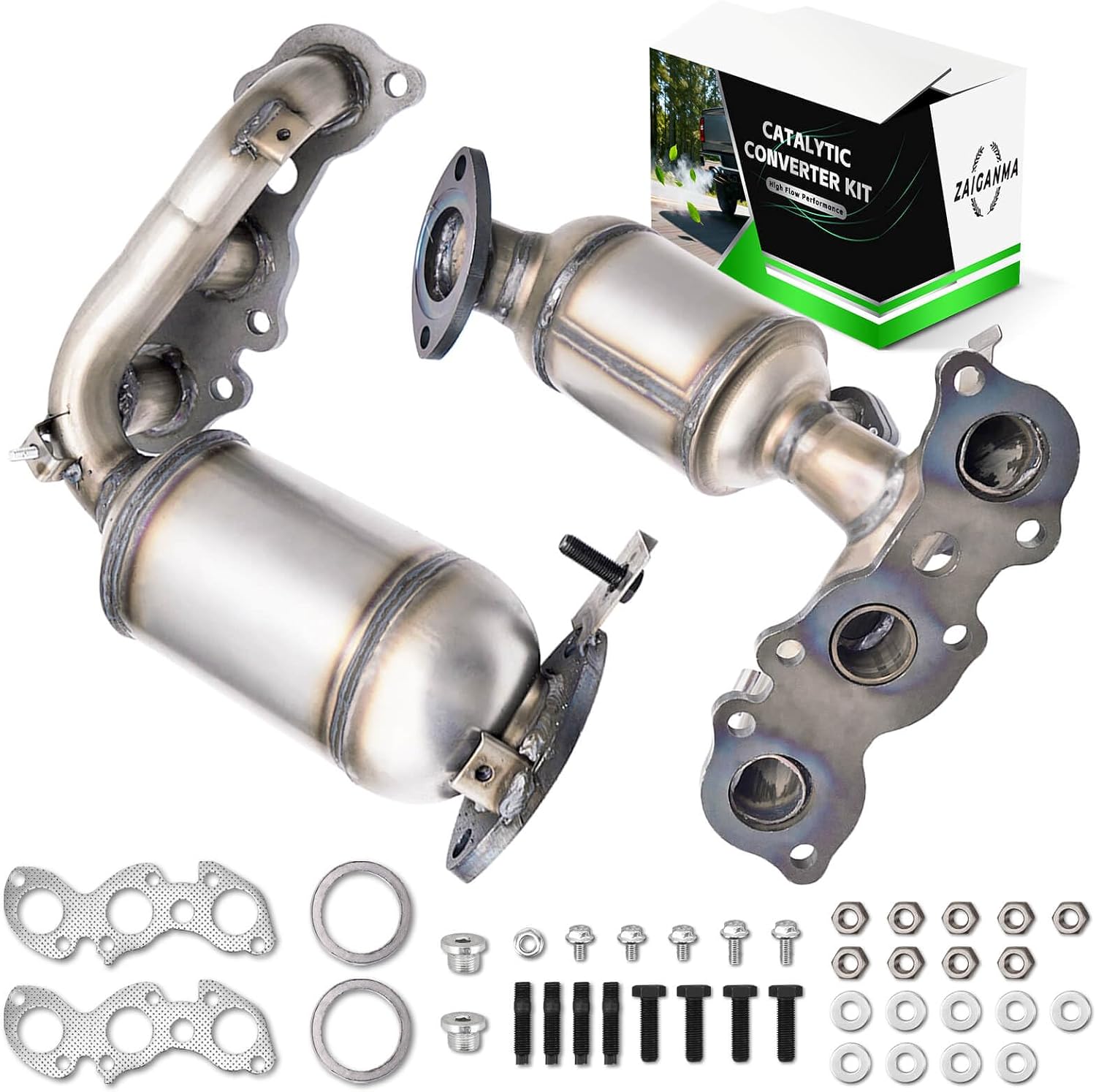
| Brand | ZAIGANMA |
|---|---|
| Model | 02-06 camry cat 3.0L |
| Compatible Vehicles | 2002–2006 Toyota Camry V6; select Lexus ES300/ES330 and Solara V6 years |
| Exterior | Polished |
This ZAIGANMA catalytic converter is a direct-fit replacement for 2002–2006 Toyota Camry V6 applications and compatible Lexus ES300/ES330 and Solara V6 models in the listed years. It is built with a stainless steel housing and an internal ceramic substrate coated with platinum, rhodium, and palladium to help reduce exhaust emissions. Installation is intended to be straightforward because the unit is shaped to match the factory converter and bolts in place without major modification for most users. The polished exterior and high-deformation substrate design increase contact area for catalytic reactions, which should improve purification efficiency compared with a plain substrate. Practical benefits include a ready-to-install replacement that avoids custom fabrication and a construction aimed at durability under high exhaust temperatures. Limitations to note are fitment variability reported by some buyers and the product not being permitted for sale in certain states, so double-check vehicle fit and local regulations before ordering.
Best for: Buyers who want a practical, ready-to-install replacement to restore emissions function on an older Camry V6 without paying for dealer parts or custom fabrication.
Less Ideal for: Drivers in states with strict emissions rules or anyone who needs a certified emissions component or guaranteed exact factory fit without any adjustment.
- Direct-fit design intended to replace the factory converter without major modifications
- Stainless steel body built to withstand high-temperature exhaust conditions
- Ceramic substrate coated with Pt, Rh, and Pd to improve emission purification
- Polished finish and formed substrate increase contact area for catalytic reactions
- Not legal for sale in California, New York, Colorado, or Maine
- Some buyers report fitment and welding/alignment issues requiring adjustment
Verdict: A practical, stainless-steel direct-fit replacement that restores catalytic function for 2002–2006 Camry V6 owners looking to avoid custom work.
ZCATAPARTS Catalytic Converter for Toyota Camry / Lexus ES300 V6 3.0L

| Vehicle fit | Toyota Camry 2002–2006 V6 3.0L; Lexus ES300 2002–2003 |
|---|---|
| Compliance | EPA compliant for federal emissions-equipped OBDII vehicles |
| Manufacturer | ZCATAPARTS |
| Model | LKSSES300-ZY |
| Reference numbers | 641525, 674882, 1646640663, 641307, 674873, 17140-20080, 25052-20170 |
This ZCATAPARTS catalytic converter is a budget-focused direct replacement for 3.0L V6 Camry and ES300 models that restores exhaust emissions control without major modification. It is made from stainless steel for corrosion and heat resistance and comes pre-assembled with the flanges and pipes that match the referenced factory connection points, so installation is usually a bolt-in or minor-weld job depending on factory variation. The unit is advertised as EPA compliant for OBDII federal emissions-equipped vehicles but not legal for sale in several states with stricter rules. Users report a mix of experiences on fitment which means some vehicles may require minor trimming or welding to align flanges. For buyers prioritizing cost over brand-name OEM parts, this converter provides a practical emissions solution and reasonable durability, though those seeking guaranteed perfect fit or state-specific compliance should verify local rules and vehicle references before buying.
Best for: Buyers looking to replace a failed catalytic converter on a Camry V6 or ES300 while keeping costs low and accepting minor installation adjustments to save money.
Less Ideal for: Drivers who need a guaranteed perfect-fit, dealer-level factory replacement or who must meet stricter state emissions regulations should consider higher-end or certified local options.
- Made from stainless steel for corrosion and heat resistance
- Ships as a mostly complete assembly to minimize parts sourcing
- EPA compliant for federal emissions-equipped OBDII vehicles
- Fits the listed Toyota Camry V6 and Lexus ES300 reference numbers when dimensions align
- Not legal for sale or use in certain states with stricter emissions laws
- Some buyers reported fitment variances requiring cutting or welding to align flanges
Verdict: A cost-conscious, stainless-steel replacement catalytic converter that restores emissions control for Camry V6 and ES300 drivers willing to accept occasional minor fitment work.
ABysmauto Direct-Fit Catalytic Converter for Toyota Camry / Lexus ES300 (3.0L V6)

| Vehicle fitment | Toyota Camry 2002-2006 3.0L V6; Lexus ES300 2002-2003 3.0L V6 |
|---|---|
| Construction | Stainless steel |
| Certification | EPA compliant (not CARB) |
| Manufacturer | ABysmauto |
This ABysmauto direct-fit catalytic converter replaces the left and right units on 3.0L V6 Camry and Lexus ES300 models and is built as a practical service replacement. It is constructed from stainless steel with welded joints and a high-flow catalyst designed to restore exhaust flow, clear emissions-related fault codes, and return throttle response to normal on a daily-driven vehicle. The kit is validated for fitment to the listed model years so installation typically bolts in without fabrication, and many users report the check engine light cleared after replacement. It is EPA compliant but not CARB approved, so it is intended for states that accept EPA-standard parts. The product focuses on durability and correct fit rather than performance tuning, and while hardware and gaskets may or may not be included depending on the variation, a professional or experienced DIY mechanic can install it without major mods. If long-term durability under extreme conditions is critical, consider higher-end OEM-equivalent or CARB-certified alternatives for stricter emissions rules.
Best for: Buyers who prioritize a reliable, factory-style replacement to restore emissions function and drivability on older Camry and ES300 V6 daily drivers. They want a practical part that installs without fabrication and returns the vehicle to normal operation.
Less Ideal for: Drivers who need a CARB-compliant or aftermarket performance-focused converter should look at certified alternatives or OEM units that meet stricter state regulations.
- Direct-fit design validated for Toyota Camry 2002–2006 3.0L V6 and Lexus ES300 2002–2003 for straightforward installation
- Stainless steel construction and clean welds improve heat resistance and durability compared with low-quality replacements
- High-flow catalyst design restores exhaust flow and helps clear emissions-related check engine lights
- EPA compliant for use in states that accept EPA-standard replacement converters
- Not CARB compliant and therefore not legal for use on vehicles registered in California, New York, Maine, or Colorado
Verdict: A practical, durable direct-fit replacement that reliably restores emissions function and drivability for Camry/ES300 V6 owners in EPA-only states.
CatFlowFixer Catalytic Converter for Toyota Camry V6 (2002–2006)

| Vehicle fitment | Toyota Camry 2002-2006 V6; Solara 2004-2008; Lexus ES300/ES330 V6 |
|---|---|
| Substrate | 400-cell ceramic |
| Compliance | EPA-compliant (federal) |
| Manufacturer | CatFlowFixer |
| Part number | CA-Camry-02-06 |
This CatFlowFixer catalytic converter is a bolt-in replacement intended for V6 Camry, Solara and Lexus ES300/ES330 models in the specified year range. It uses a 400-cell ceramic substrate with platinum, rhodium and palladium coating to support emissions conversion while aiming to keep exhaust flow efficient and backpressure low. Typical use is as a one-to-one replacement when a damaged or failed converter triggers emissions faults or a check-engine light. The product is sold as EPA-compliant and reportedly passed a 25,000-mile durability test for federal applications. Practical benefits include a factory-style flow design and a multi-year structural and emissions warranty to reduce buyer risk. Limitations to expect are fitment variability across different vehicles and occasional quality-control issues reported by some buyers that required welding or modification during installation. Installation at a professional shop is recommended to ensure correct alignment and to avoid installation-related faults.
Best for: Buyers who prioritize verified emissions performance and want a factory-style replacement with warranty protection and documentation supporting compliance for federal standards.
Less Ideal for: Drivers in states with stricter local emissions rules or anyone unwilling to have a professional shop handle installation and any minor fitment adjustments.
- Designed for specified Toyota Camry V6 and related Lexus/Solara applications for direct replacement fitment.
- OEM-grade 400-cell ceramic substrate with precious-metal coating to support emissions conversion.
- EPA-compliant for federal emissions standards and reported to pass a long-term durability road test.
- Includes multi-year structural and emissions warranties for added buyer protection.
- Some buyers report fitment and welding issues requiring modification rather than a perfect bolt-on install.
- Not legal for sale or use in certain states with stricter emissions rules where it is restricted.
Verdict: A warranty-backed, EPA-compliant factory-style replacement catalytic converter aimed at Camry V6 owners who want verified emissions performance and a close OEM fit.
Choosing the Right Toyota Camry V6 Catalytic Converter: Key Factors to Consider
Fitment and Flange Compatibility
Correct fitment is the single most important factor for the Camry V6. The converter must match the OEM flange type, inlet and outlet diameters, and overall length to mate cleanly with the vehicle's exhaust sections. Poor fitment can require cutting, welding, or adapter pieces that complicate installation and introduce leak risk.
Matching sensor bung locations is also critical because the Camry V6 relies on upstream and downstream oxygen sensor readings to regulate fuel trim and emissions. A converter with sensors in nonstandard positions can trigger persistent check engine lights or force sensor relocation. Always verify the physical dimensions and sensor ports against your vehicle's factory layout before purchasing.
Emissions Compliance and Substrate Type
Emissions compatibility matters for passing inspections and maintaining proper engine management. Verify whether the converter uses a ceramic or metallic (metal foil) substrate and whether its washcoat loading and precious metal content are specified. Ceramic substrates are common and offer good filtration when intact, while metallic cores can heat up faster and tolerate thermal cycling differently.
A converter designed to meet the same emissions standards as the original unit will more reliably allow the Camry V6 to pass regulatory testing. If you live in an area with strict emissions control laws, confirm local legal requirements and choose a unit with documented emissions performance that aligns with those rules.
Oxygen Sensor Integration
The Camry V6 relies on oxygen sensors for closed-loop fuel control and catalyst monitoring. A replacement must provide properly positioned sensor bungs and maintain signal integrity. If the converter lacks correct sensor ports, your vehicle may display a check engine light catalytic converter-related code and run poorly until sensors are relocated or reconfigured.
Consider whether the unit includes welded or threaded bungs, and whether they match the OEM sensor types. Proper sensor integration minimizes diagnostic trouble codes and ensures accurate downstream monitoring of catalyst efficiency.
Durability and Thermal Management
Catalytic converters operate under high temperatures and face thermal cycling from engine operation and environmental conditions. Shell thickness, weld quality, and internal mounting or matting of the substrate influence resistance to cracking and collapse. A sturdier construction reduces the chance of internal failure or rattling over time.
Thermal management features, such as heat shields or insulation, help maintain optimal catalyst temperatures and reduce heat soak to nearby components. For the Camry V6, choose a unit that shows robust construction and attention to thermal durability to avoid premature failure signs such as rattles, reduced conversion efficiency, or substrate breakage.
Backpressure and Engine Performance
Catalyst substrate cell density and internal flow design affect exhaust backpressure and thus engine response. Too restrictive a converter can reduce throttle response and lower overall power, while a very low-cell-density unit may not provide adequate conversion efficiency.
Selecting a converter that balances flow and conversion efficiency is especially important for the Camry V6, which expects a certain exhaust flow characteristic. Consider units that specify cell density and are designed to maintain similar backpressure to the original equipment to preserve drivability and fuel efficiency.
Installation and Maintenance Considerations
Practical installation details influence total repair time and cost. Check whether the converter is a direct-fit unit or requires welding. Direct-fit options that match OE bolt patterns and include gaskets or hardware reduce labor and risk. Also consider accessibility under the vehicle; the Camry V6 configuration may make some sections easier or harder to reach.
Maintenance considerations include ease of replacing oxygen sensors and whether the converter has provisions for heat shields or brackets that secure it to the chassis. Opt for designs that simplify future work and allow technicians to access sensors without removing the entire exhaust section.
How Catalytic Converters Affect Camry V6 Performance
The catalytic converter does more than reduce emissions. It influences exhaust flow, backpressure, and the heat profile of the exhaust system, all of which can change how the Camry V6 breathes and responds. A properly functioning converter maintains the balance between adequate conversion of pollutants and minimal restriction to flow, preserving throttle response and fuel economy.
- Converter cell density impacts flow and conversion efficiency
- Sensor placement affects fuel trim and engine management
- Thermal behavior influences warm-up emissions and long-term durability
Common Symptoms of Catalytic Converter Problems on Camry V6
Owners typically notice progressive symptoms rather than a single sudden failure. Early signs include lingering check engine light catalytic converter codes and a slight loss of midrange torque. As problems worsen, you may detect a rotten-egg odor, reduced fuel economy, or a noticeable drop in power under load.
- Persistent engine codes related to catalyst efficiency
- Decreased acceleration or sluggishness at highway speeds
- Unusual exhaust odors or rattling noises from undercarriage
Preparing for Replacement: Tools and Workplace Tips
Before attempting a catalytic converter replacement, gather the right tools and prepare the vehicle. Ensure the car is securely lifted with jack stands or on a lift, and that exhaust components have cooled. Common helpful tools include penetrating lubricant, proper-sized sockets, a torque wrench, safety glasses, and a backup cutting tool if minor trimming is needed for non-welded installs.Document the factory sensor locations and take photos to ensure proper reinstallation. Label any nuts or hardware removed so reassembly matches original torque and orientation. If you lack experience with exhaust work, plan for professional installation to avoid leaks or sensor misalignment.
- Penetrating oil for seized bolts
- OEM-spec torque values for exhaust fasteners
- Proper safety stands and eye protection
Legal and Emissions Inspection Considerations
Emissions regulations vary by region, and the Camry V6 may be subject to periodic inspections. Replacing a catalytic converter with a unit that does not meet local emissions standards can cause inspection failure. Verify whether modified or aftermarket units are permissible in your jurisdiction and whether documentation is required for compliance.Also confirm that the replacement maintains the necessary sensor functions used by the vehicle's emissions monitoring system. Choosing a certified or documented converter can simplify inspections and reduce the risk of regulatory issues.
- Check local rules on aftermarket catalytic converters
- Ensure downstream monitoring is preserved for inspection tests
- Keep installation records and any compliance documentation
When to Repair Vs Replace the Catalytic Converter
Deciding whether to repair or replace depends on the failure mode. Minor external damage or surface rust may be addressable with cleaning or repair of adjacent exhaust components. However, internal substrate collapse, severe clogging, or contamination by engine coolant or oil typically require full replacement.Diagnostics such as backpressure testing, temperature differentials across the unit, and interpreting oxygen sensor readings help determine the extent of the problem. If the converter is the root cause of performance or emissions failures, replacement is often the most reliable long-term solution.
- Use temperature readings to check for clogged sections
- Inspect for physical damage or rattling indicating substrate breakage
- Consider converter age and mileage when choosing replacement
Still looking for the perfect fit?
Select your Toyota Camry configuration to see the most relevant Catalytic Converters recommendations
How We Chose the Best Toyota Camry V6 Catalytic Converter
Our selection process prioritized fitment accuracy, emissions performance, and durability specific to the Toyota Camry V6. We filtered candidates for exact physical and flange compatibility with the Camry V6 exhaust layout and confirmed construction details that influence longevity, such as core material, honeycomb substrate type, and shell thickness. Emissions compatibility was judged by whether the unit supports the original emissions control strategy and sensor locations necessary for the Camry V6 to meet inspection standards.We also weighed expected longevity under typical driving conditions, considering substrate robustness and thermal management features. Installation practicality was another key filter: inlet/outlet sizes, flange type, and whether the unit integrates oxygen sensor bungs in the stock locations were assessed. Units lacking clear fitment data or those requiring substantial exhaust modification were excluded. Finally, we prioritized options that balance reliable emissions control and dependable engine performance for Camry V6 owners seeking a long-term fix.
Our full evaluation process is outlined in our review methodology.
FAQ
How can I tell if my Camry V6 catalytic converter is failing?
Symptoms often include a check engine light catalytic converter-related code, reduced engine power, and unusual exhaust odors. Rattling under the vehicle or a drop in fuel economy are common signs that warrant further inspection.
Will replacing the catalytic converter reset the check engine light?
Replacing a faulty catalytic converter can clear catalyst-efficiency-related codes, but the light may remain if other engine or sensor issues exist. The vehicle's computer may require a few drive cycles to confirm the new unit's performance before the light resets.
Is a direct-fit converter necessary for the Camry V6?
A direct-fit unit simplifies installation and preserves OEM sensor positions, which reduces the chance of leaks and diagnostic trouble codes. However, a properly installed universal or weld-in unit can work if it matches dimensions and sensor locations.
Can a clogged catalytic converter cause poor fuel economy on my Camry V6?
Yes. A restricted converter increases backpressure, forcing the engine to work harder and often reducing fuel efficiency. Addressing the root cause of clogging is important to avoid repeated issues.
How long does a catalytic converter typically last on a Camry V6?
Lifespan varies with driving conditions and maintenance but often lasts many years under normal use. Exposure to engine misfires, coolant leaks, or oil contamination can shorten life, so addressing underlying engine issues extends converter longevity.
Are there legal restrictions on replacing the catalytic converter for my Camry V6?
Regulations differ by location. Some areas require certified or emissions-equivalent replacements and may prohibit certain aftermarket modifications. Check local emissions laws and testing requirements before selecting a replacement.
Final Verdict
Prioritize fitment, emissions compatibility, and sensor integration when choosing a catalytic converter for your Toyota Camry V6. Address underlying engine issues before installing a new unit to avoid repeat failures. Balance durability and flow characteristics to maintain engine performance and pass inspections. With attention to these factors, you can select a converter that restores emissions control and preserves drivability for the long term.
Explore More:
- Check out all Toyota Camry parts & accessories
- Explore Catalytic Converters Maintenance & Repair Guides
- Explore Exhaust & Emissions
- Browse all Auto Parts
