

Note: This article contains affiliate links. If you click on these links and make a purchase, I may earn a small commission at no extra cost to you. This helps support my research and content. Read my full affiliate disclosure here.
If you own a Toyota Camry 3.0L and are facing emission test failures, rough idle, or a persistent check engine light, selecting the right catalytic converter matters. A correct unit restores exhaust treatment, helps the engine run smoothly, and keeps your Camry within local emissions limits.This guide shortlists six carefully vetted catalytic converters for the Toyota Camry 3.0L and explains the practical differences that affect fitment, durability, and emissions performance. Read on for the key factors we used to evaluate each option and what to consider when choosing a replacement for your vehicle.
Looking for other parts? See all Toyota Camry parts & accessories.
Top Picks at a Glance
| Best Overall The best all-around choice for most situations | ECHO AUTOMILES Catalytic Converter for Toyota Camry 3.0L/3.3L (Left & Right) |  |
| Best Quality Built to a higher standard if you want something more solid | ABysmauto Direct-Fit Catalytic Converter for Toyota Camry / Lexus ES300 (3.0L V6) |  |
| Best Value The sweet spot between price and what you get | PTPDRH Catalytic Converter for 3.0L V6 Toyota Camry and Compatible Models |  |
| Highest Rated A top-rated pick with lots of positive feedback | CAT CLEAN Catalytic Converter for Toyota Camry/Lexus ES300 3.0L (2002–2006) |  |
| Most Popular A crowd favorite that many people choose with confidence | KAC Catalytic Converter Kit for Camry/ES300 3.0L (Direct-Fit) |  |
| Best Seller A high-volume bestseller chosen again and again | PHILTOP Stainless Steel Direct-Fit Catalytic Converter for Toyota Camry 3.0L (2002–2006), Rear, EPA Compliant |  |
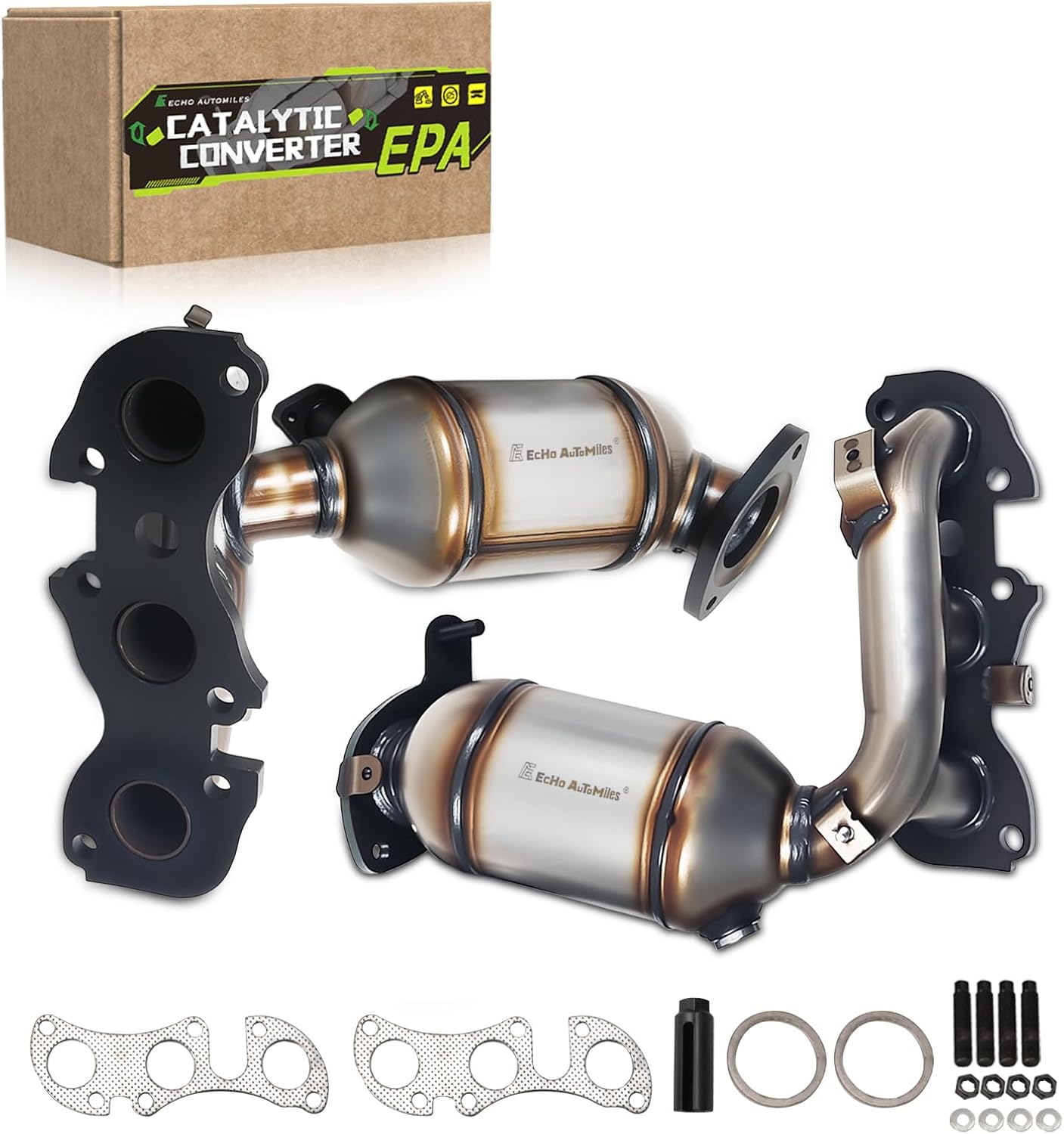
ECHO AUTOMILES Catalytic Converter for Toyota Camry 3.0L/3.3L (Left & Right)
| Position | Left, Right |
|---|---|
| Manufacturer | ECHO AUTOMILES |
| Exterior | Polished |
| Model | 1 |
| Interchange | 641525 |
This ECHO AUTOMILES catalytic converter kit supplies left and right units intended as direct replacements for Toyota Camry 3.0L and 3.3L V6 applications and similar Lexus and Solara models. It uses a 400-cell honeycomb substrate designed to balance filtration efficiency with flow, which reduces backpressure compared with denser cores and helps preserve engine performance and fuel economy. The listing states EPA-compliant catalyst loading and includes the gaskets and hardware needed for installation, so most repairs are straightforward for a shop or a competent DIYer with basic exhaust tools. Customers report generally good fitment though minor adjustments may be required in some cases. It is not available for sale or installation in certain states, and buyers should confirm local emissions rules before ordering. The kit aims to restore emissions control and pass inspections while keeping exhaust restriction low for everyday driving.
Best for: Buyers who want a balanced, factory-style replacement that restores emissions control without sacrificing everyday drivability and who prefer an all-in-one kit for shop or DIY installation.
Less Ideal for: Drivers in states with strict local emissions regulations where this converter is restricted or installers who need a guaranteed bolt-on fit with zero modification on every vehicle.
- Designed to match specific Toyota Camry 3.0/3.3L V6 fitment for direct replacement
- EPA-compliant catalyst loading intended to meet emissions requirements
- 400-cell honeycomb substrate balances filtration and exhaust flow to limit backpressure
- Includes gaskets and hardware for a complete replacement installation
- Not eligible for sale or installation in California and Colorado and restricted in some other states
- Some buyers reported minor fitment adjustments required during installation
Verdict: A practical, EPA-compliant replacement catalytic converter kit that balances emissions performance and exhaust flow for Toyota Camry 3.0L/3.3L V6 models.
ABysmauto Direct-Fit Catalytic Converter for Toyota Camry / Lexus ES300 (3.0L V6)

| Vehicle fitment | Lexus ES300 2002-2003; Toyota Camry 2002-2006 3.0L V6 |
|---|---|
| Compliance | EPA compliant (not CARB) |
| Material | Stainless steel |
| Manufacturer | ABysmauto |
This ABysmauto direct-fit catalytic converter is built as a factory-replacement unit for Toyota Camry 3.0L V6 and Lexus ES300 3.0L V6 applications. It installs in place of the original unit with matching bolt locations and flange geometry so a shop or experienced DIYer can swap it without fabrication. Constructed from stainless steel with welded joints and a high-flow catalyst, the converter is intended to restore proper exhaust flow and clear emissions-related fault codes while offering EPA compliance for non-CARB states. Users report the check engine light often clears and drivability returns to normal after installation. The high-flow design can slightly improve throttle response relative to a clogged unit, but this is a replacement part rather than a performance upgrade for racing. Important limitations are legal: it is not CARB-compliant and cannot be used on vehicles registered in California, New York, Maine, or Colorado, and long-term durability will depend on local road and climate conditions.
Best for: Drivers who want a reliable, bolt-on replacement to restore emissions control and engine responsiveness on a 3.0L V6 Camry or Lexus ES300 while prioritizing straightforward installability over racing-level performance.
Less Ideal for: Enthusiasts seeking a dedicated performance racing catalyst or vehicle owners in CARB-restricted states should look for a certified alternative or a purpose-built performance unit.
- Direct-fit design with matching bolt holes for straightforward installation
- Stainless steel construction and welded joints for heat resistance and durability
- EPA-compliant for use outside CARB-restricted states
- High-flow catalyst design helps restore engine breathing and can improve throttle response over a clogged converter
- Not CARB-compliant so cannot be used in California, New York, Maine, or Colorado
Verdict: A practical direct-fit replacement that restores emissions function and exhaust flow for 3.0L V6 Camry and Lexus ES300 models outside CARB states.
PTPDRH Catalytic Converter for 3.0L V6 Toyota Camry and Compatible Models

| Brand | PTPDRH |
|---|---|
| Model | PTPDRH22985 |
| Exterior | Stainless Steel |
| EPA Compliance | Certified (not for CA/WA/VT/OR) |
This PTPDRH catalytic converter is a drop-in replacement designed for 3.0L V6 Toyota Camry, Avalon, Sienna, Solara and certain Lexus models in the listed year ranges. It uses a three-way catalytic process and a ceramic substrate inside a stainless steel body to reduce NOx, CO, and hydrocarbons while resisting thermal stress. Installation is straightforward: the unit bolts to the exhaust and requires no tuning or programming, making it suitable for a DIY swap or quick shop install. Notable features include EPA certification for federal emissions compliance and hardware included for installation, though several users report the supplied fasteners are lower quality and some chose to reuse factory bolts. The converter aims to reproduce factory fit and flow; buyers should verify the exact year and engine fitment before ordering and note it is not approved for sale in California, Washington, Vermont, or Oregon. For drivers focused on restoring emissions function on an older Camry V6, this provides a practical, durable solution with generally good fitment reports.
Best for: Buyers who want a straightforward, budget-conscious repair that restores emissions control and fits without special tools or programming. Ideal for owners prioritizing reliable, ready-to-install replacements to keep an older 3.0L V6 Camry or compatible vehicle road-legal under federal rules.
Less Ideal for: Drivers who must meet state-specific emissions rules in restricted states or who want premium OEM-level fasteners and hardware should consider alternatives or plan to source stronger bolts separately.
- EPA certified for federal emissions compliance
- Stainless steel construction with ceramic substrate for thermal resistance
- Designed as a direct-fit drop-in replacement requiring no calibration
- Includes installation hardware and reproduces factory exhaust flow
- Not approved for sale in California, Washington, Vermont, or Oregon
- Included fasteners have inconsistent quality according to multiple user reports
Verdict: A practical, EPA-certified direct-fit catalytic converter that restores emissions control and installs easily on 3.0L V6 Camry-family vehicles.
CAT CLEAN Catalytic Converter for Toyota Camry/Lexus ES300 3.0L (2002–2006)

| Vehicle fitment | Toyota Camry 2002–2006, Lexus ES300 2002–2003 3.0L V6 |
|---|---|
| Material | 409L stainless steel |
| Catalyst composition | Pt, Rh, Pd loaded honeycomb ceramic |
| Position | Left, Right |
This CAT CLEAN catalytic converter is built as a direct bolt-in replacement for 3.0L V6 Toyota Camry (2002–2006) and Lexus ES300 (2002–2003) applications and is intended to restore catalytic efficiency and stop check-engine codes related to low converter performance. It uses a high-density honeycomb ceramic substrate loaded with precious metals to improve conversion of pollutants while the 409L stainless steel shell and a high-temperature pad protect the carrier for longer service life. The unit is designed for straightforward installation with bolt connections so a competent DIYer or a shop can fit it without welding. It is EPA compliant for federal emissions states and comes with a multi-year performance warranty. Expect improved emissions, quieter running, and a component that resists corrosion under normal road conditions, but note it is not legal for sale or use in certain states with stricter rules and occasional reports show minor fitment adjustments may be needed on some vehicles.
Best for: Buyers who prioritize a durable, emissions-compliant replacement to reliably clear efficiency-related engine codes and restore factory-like operation.
Less Ideal for: Drivers in states with stricter emissions laws where this unit is not approved or those seeking converters certified for state-specific programs should look for a region-approved alternative.
- EPA-compliant design with high-density honeycomb substrate for effective emissions conversion
- 409L stainless steel construction and internal high-temperature pad for corrosion and heat resistance
- Direct bolt-on connection reduces need for welding or extensive fabrication during installation
- Intended to resolve low-efficiency codes such as P0420/P0430 and reduce exhaust noise
- Not legal for sale or use in California, Colorado, New York, or Maine
- Some buyers report minor fitment differences that required adjustments during installation
Verdict: A practical, EPA-compliant direct-fit converter aimed at restoring emissions performance and long-term durability for 3.0L Camry/ES300 V6 applications.
KAC Catalytic Converter Kit for Camry/ES300 3.0L (Direct-Fit)

| Compatible vehicles | 2002–2006 Camry 3.0L; 2002–2003 ES300 3.0L |
|---|---|
| Position | Front, Rear |
| Manufacturer | KAC |
| Exterior | Machined |
This KAC converter kit is a direct-fit replacement intended for the 3.0L Camry (2002–2006) and ES300 (2002–2003). It uses a fully encased ceramic carrier inside a machined metal housing and claims EPA compliance and factory-quality fit. In use it functions like a standard replacement converter: bolt-on installation to the exhaust with the goal of restoring catalytic function, silencing exhaust rasp, and clearing P0420-style codes. Reported advantages include high-flow carrier geometry that can help maintain power and an aluminized stainless body that resists corrosion. Several buyers note easy installs on driveways though some mention misaligned heat-shield tabs, incorrect fasteners, or hanger contact that required minor bending or extra washers. A few reports describe early failures, so expect variable long-term durability. This unit is practical for DIY or shop replacement when you need a factory-style catalytic replacement for the specified Camry/ES300 engines, but verify fastener compatibility and be prepared for minor fitment tweaks during installation.
Best for: Buyers who prioritize a straightforward, factory-style replacement for a Camry or ES300 3.0L and who prefer products supported by visible user feedback before committing.
Less Ideal for: Drivers in states with stricter emissions rules or those unwilling to make small fitment corrections during installation should consider alternative options.
- Direct-fit design for specified Camry and ES300 3.0L applications for simplified replacement
- Encased ceramic carrier with high-flow geometry intended to restore catalytic conversion and reduce P0420 codes
- Aluminized stainless housing improves corrosion resistance for longer service life
- EPA-compliant construction and factory-quality fit claims
- Some units require minor modifications during install due to heat shield, hanger, or fastener misalignment
- Not legal for sale or use in certain states with stricter emissions regulations
Verdict: A practical, EPA-compliant direct-fit catalytic converter kit for Camry/ES300 3.0L owners who want a factory-style replacement with mostly easy installation.
PHILTOP Stainless Steel Direct-Fit Catalytic Converter for Toyota Camry 3.0L (2002–2006), Rear, EPA Compliant

| Position | Rear |
|---|---|
| Manufacturer | PHILTOP |
| Model | Catalytic Converters |
| Manufacturer Part Number | 9367EXP03F9US |
This PHILTOP catalytic converter is a direct-fit replacement for the rear converter on 2002–2006 Toyota Camry 3.0L models and is intended to restore emissions control and reduce exhaust noise caused by a failed unit. It uses a stainless/aluminized housing and a double-layer ceramic honeycomb substrate designed for higher flow and improved oxygen storage, which can lower backpressure and help the engine run closer to factory performance. The kit includes OE-style gaskets and hardware for a bolt-on installation that most independent shops or experienced DIYers can complete in a few hours without cutting or welding. It is EPA-compliant for federal emissions but not legal in states that require California standards. Fitment reports in reviews are mostly positive, though a few buyers found clamps or mating surfaces needed minor adjustment or heavier clamps to seal. If you want a straightforward factory-replacement style converter to get a Camry back to emissions compliance and normal exhaust sound, this unit delivers the expected benefits with mostly plug-and-play installation.
Best for: Buyers seeking a conservative, factory-replacement solution to restore emissions compliance and normal exhaust behavior on a 2002–2006 Camry 3.0L without major modification.
Less Ideal for: Owners who need a California-spec converter or those wanting a high-performance or custom exhaust upgrade should look at alternatives designed for those requirements.
- Direct-fit design with OE-style gaskets and hardware for bolt-on installation
- Stainless steel/aluminized housing resists corrosion for longer service life
- Double-layer ceramic honeycomb substrate aimed at higher flow and improved catalytic efficiency
- EPA-compliant for federal emissions so it restores emissions function in most states
- Not legal for sale in states that require California emissions standards
- Some buyers reported fitment or clamp fit issues that required heavier clamps or minor adjustments
Verdict: A direct-fit, EPA-compliant replacement that restores emissions function and exhaust behavior on 2002–2006 Camry 3.0L models with largely plug-and-play installation.
Choosing the Right Toyota Camry 3.0L Catalytic Converter: Key Factors to Consider
Fitment and Mounting Points
Correct fitment is the first priority for the Toyota Camry 3.0L because many units either bolt into the factory manifold or to the underbody flange. A direct-fit converter preserves oxygen sensor locations and prevents exhaust leaks that can trigger a check engine light.
If a converter needs modification, installation complexity and labor time increase significantly. Ensuring flange alignment, hanger position, and pipe diameter match the factory exhaust avoids exhaust geometry changes that can affect backpressure and drivability. Always verify whether the unit is described as an exact fit for the Camry 3.0L to reduce the chance of additional fabrication.
Emissions Performance and Substrate Type
The core job of a catalytic converter is to reduce harmful exhaust components. Substrate construction, washcoat chemistry, and precious metal loading determine conversion efficiency for hydrocarbons, carbon monoxide, and nitrogen oxides. Higher-quality substrates tend to reach operating temperature more predictably and provide more consistent emissions performance under typical driving conditions.
For owners needing to pass emissions testing, choose a converter whose design supports rapid light-off and sustained conversion rates. While performance claims vary, focusing on engineering features that assist heat retention and effective catalyst exposure is helpful when evaluating options.
Sensor Compatibility and Electronics
Oxygen sensors are critical for the engine control unit to monitor catalyst performance. On the Toyota Camry 3.0L, maintaining the factory sensor locations and harness access avoids triggering diagnostic trouble codes tied to catalyst efficiency.
A replacement that preserves upstream and downstream sensor ports allows the vehicle's monitoring systems to function as designed. If a unit relocates sensors or omits the downstream bung, you may need additional adapters or risk false error codes that affect drivability and emissions diagnostics.
Durability and Corrosion Resistance
Exhaust components face heat cycling, moisture, and road salt that accelerate corrosion. For the Camry 3.0L, selecting a converter with robust stainless steel construction, quality welding, and protective coatings extends service life.
Durability also affects long-term conversion performance since substrate damage or shell corrosion can lead to rattles, leaks, or reduced catalyst contact. Consider units with thicker shell walls, proven welding techniques, and corrosion-resistant finishes to minimize premature replacement.
Backpressure and Engine Performance
A replacement converter must balance emissions control with acceptable backpressure for the Camry 3.0L engine. Excessive restriction can reduce throttle response and fuel economy, while too little can compromise conversion efficiency.
Manufacturers design catalyst cell density and flow paths to limit unwanted pressure while still providing effective substrate surface area. When choosing, consider user reports or technical specs that mention flow resistance to avoid negatively affecting everyday drivability and engine load characteristics.
Installation and Serviceability
The ease of installation impacts total ownership cost and downtime. Direct-bolt units that match factory flanges and hangers typically need less labor and avoid welding. For the Toyota Camry 3.0L, a converter that allows straightforward access to sensor ports and uses common fasteners is preferable.
Serviceability also covers replacement of mounting hardware and provision for heat shields or brackets. If cutting and welding are unavoidable, ensure qualified installation to maintain exhaust alignment and sealing, and to prevent future leaks or misalignment issues.
Legal and Emissions Considerations for the Camry 3.0L
Local emissions regulations dictate what catalytic converters are acceptable for on-road use. For the Toyota Camry 3.0L, ensure your replacement meets any regional certification requirements and does not alter emissions beyond permitted tolerances. Noncompliant units can lead to failed inspections and potential fines.
Documentation such as part certification numbers or compliance labels can be required during testing. Retaining records of the replacement and installer details can simplify inspections and address questions from testing authorities.
- Verify regional certification or compliance documentation before installation
- Keep installation receipts and part paperwork handy for inspections
- Avoid altered or modified converters that sacrifice emissions control
Symptoms That Suggest a Converter Needs Replacement
Several signs commonly indicate the catalytic converter in a Toyota Camry 3.0L may be failing. Persistent check engine light codes related to catalyst efficiency, unusual exhaust smells, reduced performance, or failing an emissions test are typical indicators.
Some failures are gradual and manifest as poorer fuel economy or slightly rougher idle. Other issues like rattling noises under acceleration suggest internal substrate deterioration. Use these symptoms to prioritize inspection and possible replacement.
- Check engine light with catalyst-related codes
- Noticeable drop in fuel economy or engine power
- Rattling from underbody at idle or acceleration
- Strong sulfur or rotten-egg odor from exhaust
Installing a Direct-Fit Converter on the Camry 3.0L
A direct-fit replacement simplifies installation by matching existing flanges, hangers, and sensor ports. For Toyota Camry 3.0L owners, plan for lift or ramp access, appropriate exhaust gaskets, and replacement hardware since bolts and flanges may be corroded.
During installation, check oxygen sensor wiring and connectors for wear and secure all hangers to prevent stress on the new unit. After installation, inspect for leaks and clear any diagnostic codes; allow the vehicle to complete a drive cycle so onboard monitors can re-evaluate catalyst performance.
- Inspect and replace exhaust gaskets and hardware as needed
- Ensure oxygen sensor ports align without stretching wiring
- Test drive and allow the engine computer to complete a readiness cycle
Maintaining Converter Longevity
Proper engine maintenance reduces the risk of catalytic converter damage. For the Camry 3.0L, timely ignition and fuel system maintenance prevents unburned fuel from reaching the converter and causing overheating or substrate poisoning.
Avoid prolonged oil or coolant leaks into the exhaust stream, as these contaminants can coat the catalyst and impair its function. Regular inspections for exhaust leaks and prompt attention to engine running issues will extend converter life.
- Address misfires and rich-running conditions promptly
- Fix oil and coolant leaks that reach the exhaust
- Follow scheduled maintenance for ignition and fuel systems
Preparing for an Emissions Test After Replacement
After installing a new catalytic converter on the Toyota Camry 3.0L, allow the vehicle a normal warm-up and several varied driving cycles so the catalyst reaches operating temperature and onboard diagnostics re-evaluate system readiness. Some inspections check monitor readiness; ensuring the ECU has completed its checks improves the chance of passing.
If the check engine light was previously active, confirm codes are cleared but also that the vehicle completes its readiness routines prior to testing. If you are unsure about readiness status, a diagnostic scan tool can show whether the catalyst monitors are reporting complete and within normal parameters.
- Drive varied routes including highway speeds to reach light-off temperature
- Use a scan tool to confirm readiness monitors if available
- Avoid submitting the vehicle for testing until monitors report complete
Still looking for the perfect fit?
Select your Toyota Camry configuration to see the most relevant Catalytic Converters recommendations
How We Chose the Best Toyota Camry 3.0L Catalytic Converter
Our selection process focused on real-world fitment, emissions performance, durability, and serviceability for the Toyota Camry 3.0L. We prioritized units that match factory manifold and underbody connection points to avoid costly modifications and that use substrate and washcoat formulations known to support catalytic conversion efficiency across typical operating temperatures. Flow characteristics and backpressure were considered to preserve engine drivability and avoid triggering fault codes. Durability criteria included materials, welding quality, and corrosion protection suitable for varied road conditions. We also assessed installability, including flange compatibility and whether the unit allows for bolt-on replacement or requires cutting and welding.We excluded universal or highly modified converters that require extensive fabrication or are intended for high-performance tuning, since those options often change emissions output and may not meet inspection standards. Our filters focused on direct-fit solutions that retain stock sensor locations and meet common emissions control expectations for this engine configuration. The final list balances legal compliance, dependable conversion efficiency, and ease of installation specific to the Toyota Camry 3.0L.
Our full evaluation process is outlined in our review methodology.
FAQ
What are common catalytic converter symptoms on a Toyota Camry 3.0L?
Common symptoms include a persistent check engine light with catalyst-related codes, reduced engine power, lower fuel economy, unusual exhaust odors, and rattling noises from the exhaust area. These signs often prompt inspection of the converter.
Will a bad catalytic converter cause the check engine light to stay on?
Yes. The vehicle's diagnostics monitor catalyst efficiency and oxygen sensor readings. If the converter is not performing, the engine control unit often stores a fault code that illuminates the check engine light.
Can I install a replacement catalytic converter myself on the Camry 3.0L?
If you have mechanical experience and the right tools, a direct-fit unit can be installed at home using proper safety equipment and lifting support. However, corroded bolts or welding needs may require professional service to ensure a correct, leak-free installation.
How does converter fitment affect emissions testing for the Camry 3.0L?
Proper fitment preserves sensor locations and exhaust geometry, which helps the converter reach operating temperature and be accurately monitored. Poor fitment can cause leaks or sensor misreads that lead to failed emissions tests despite a functioning core.
What maintenance helps prevent premature catalytic converter failure?
Address engine misfires, fuel system issues, and oil or coolant leaks promptly. Regular tune-ups and timely replacement of worn ignition components reduce the chance of unburned fuel entering the converter and causing damage.
How soon should I expect to pass an emissions test after replacing the converter?
It often takes a few warm-up and drive cycles for the new converter to reach optimal operating conditions and for the ECU monitors to reset. Depending on the vehicle's readiness cycle, this can range from the same day to a few hundred miles of normal driving.
Final Verdict
When replacing a catalytic converter on a Toyota Camry 3.0L, prioritize direct-fit units that preserve sensor locations and match factory mounting points. Focus on converters that support rapid light-off, resist corrosion, and maintain acceptable backpressure to protect drivability.Weigh the tradeoffs between installation complexity and long-term durability. Choosing a unit that meets emissions expectations and installs cleanly will minimize downtime and reduce the chance of future failures, helping you restore reliable exhaust performance with confidence.
Explore More:
- Check out all Toyota Camry parts & accessories
- Explore Catalytic Converters Maintenance & Repair Guides
- Explore Exhaust & Emissions
- Browse all Auto Parts
