

Note: This article contains affiliate links. If you click on these links and make a purchase, I may earn a small commission at no extra cost to you. This helps support my research and content. Read my full affiliate disclosure here.
If your Civic EX is showing reduced power or a persistent check engine light, the catalytic converter is often a key suspect. Choosing the right Honda Civic EX catalytic converter matters because fitment, emissions performance, and durability all affect drivability and legal compliance. This guide narrows the field to seven top options selected for correct fitment with the Civic EX and for how well they manage exhaust emissions and backpressure.Below you will find shortlisted catalytic converters with clear notes on fitment, construction, and emission-related performance, followed by practical buying guidance so you can pick the best unit for your Civic EX and driving habits.
Looking for other parts? See all Honda Civic parts & accessories.
Top Picks at a Glance
| Best Overall The best all-around choice for most situations | Walker Ultra Direct-Fit Catalytic Converter (fits Honda Civic) |  |
| Best Quality Built to a higher standard if you want something more solid | SPEEDFusion Front Catalytic Converter for 2001–2005 Honda Civic 1.7L |  |
| Best Value The sweet spot between price and what you get | KAX Front Catalytic Converter for 2001–2005 Honda Civic EX |  |
| Best Budget The cheapest option that still gets the job done reliably | PHILTOP Catalytic Converter Compatible with 2001–2005 Honda Civic 1.7L, Direct-Fit Stainless Steel |  |
| Highest Rated A top-rated pick with lots of positive feedback | maXpeedingrods Catalytic Converter for Honda Civic L4 1.7L 2001–2005 (EPA Compliant) |  |
| Most Popular A crowd favorite that many people choose with confidence | DNA MOTORING Factory-Style Bolt-On Catalytic Converter for 2006–2011 Honda Civic (DX/LX/EX) |  |
| Best Seller A high-volume bestseller chosen again and again | A-Premium Catalytic Converter, EPA Compliant, Direct-Fit for Honda Civic/Acura EL 2001–2005 1.7L |  |
1. Walker Ultra Direct-Fit Catalytic Converter (fits Honda Civic)

| Brand | Walker |
|---|---|
| Warranty Description | 25K Miles |
| Included Components | Catalytic Converter |
| Material Type | aluminum coated |
The Walker Ultra direct-fit catalytic converter is a bolt-on replacement aimed at restoring emissions control without fabrication. It installs using OE-style hangers, flanges, brackets and heat shields so a shop or experienced DIYer can swap it in place of a worn converter on 1996-and-newer OBDII vehicles. Walker highlights an EPA-compliant washcoat and precious metal loading intended to meet required emissions reductions, and the aluminized heat shield and thick flanges add durability and underbody protection. Buyers should plan to source gaskets and hardware separately since the part ships alone and some customers needed a different gasket shape than the factory piece. A few reviewers reported check-engine light diagnostics that traced to other sensors rather than the converter itself, and one buyer noted shipping protection issues on arrival. For someone replacing a failing converter on the specified Civic applications, this is a straightforward, cost-effective factory-style option that keeps the installation simple compared with universal converters that require welding.
Best for: Buyers who want a straightforward, factory-style replacement to restore emissions performance on an affected Civic and prefer a bolt-on solution over welding or custom work.
Less Ideal for: If you need a complete hardware kit or want an OEM-branded original part for long-term peace of mind, consider alternatives that include gaskets and bolts or purchase through a dealer.
- Direct-fit design with factory-style hangers and flanges for bolt-on installation
- EPA-compliant washcoat and precious metal load intended to restore emissions control
- Aluminized heat shields and thick flanges for durability and underbody protection
- Does not include gaskets or mounting hardware so additional parts may be required
- Some fitments require a non-factory gasket shape which can mean extra parts sourcing or minor adjustments
- Occasional reports of shipping/protection issues on arrival
Verdict: A direct-fit, EPA-compliant replacement that gets a Civic back to factory-style emissions performance without welding.
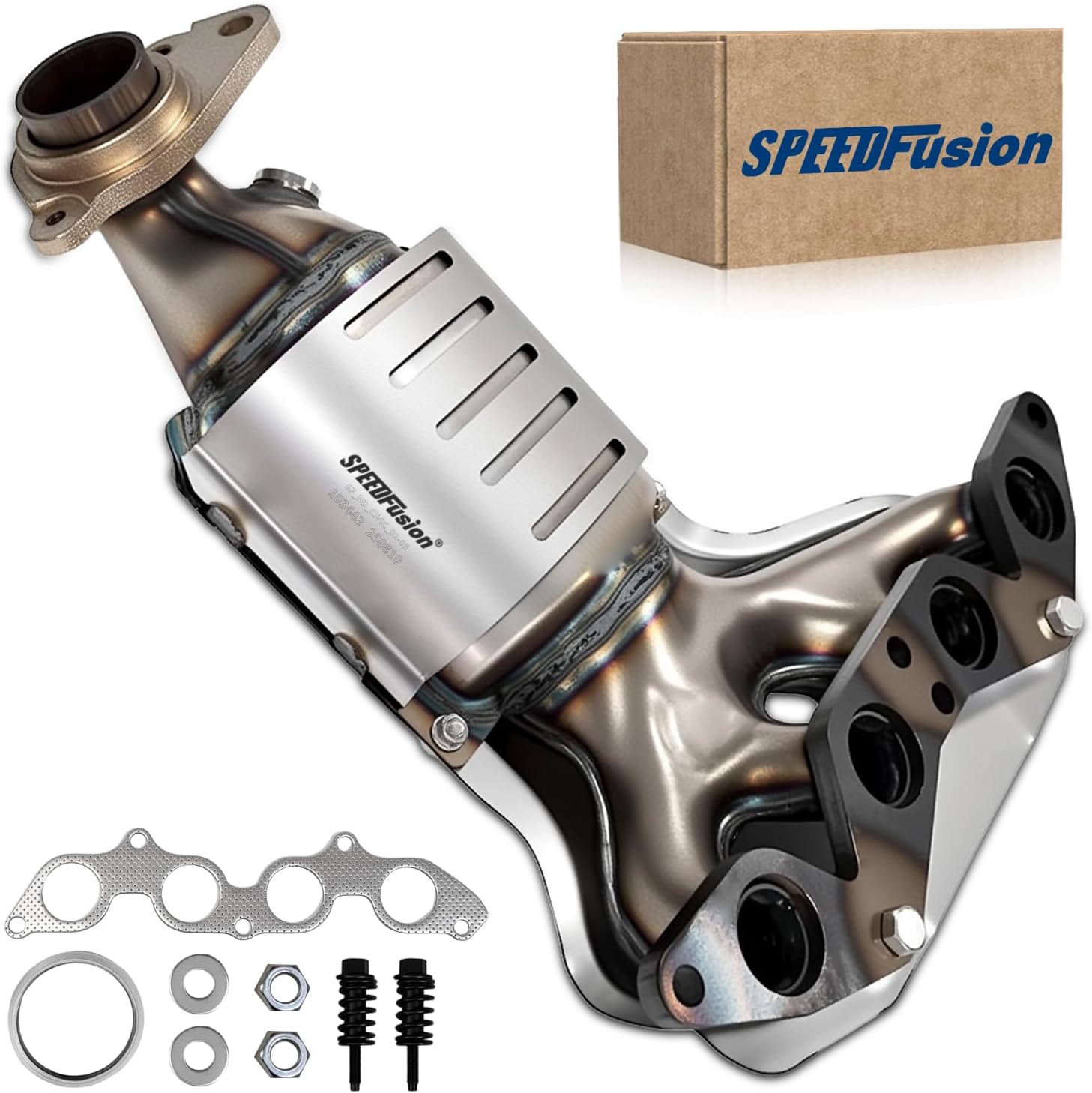
2. SPEEDFusion Front Catalytic Converter for 2001–2005 Honda Civic 1.7L
| Position | Front |
|---|---|
| Manufacturer | SPEEDFusion |
| EPA certification | EPA compliant |
| Compatible engines | 2001–2005 Honda Civic 1.7L L4 |
This SPEEDFusion front catalytic converter replaces the factory unit on 2001–2005 Honda Civic 1.7L models and is intended as a direct-fit emissions component. It uses a stainless steel shell and an OEM-style ceramic substrate plated with platinum, rhodium and palladium to boost conversion rates and keep the check engine light from triggering P0420/P0430 fault codes. Installation is straightforward for a professional shop because the part is sold as a positioned front converter designed to match factory mounting points. For drivers focused on performance, the manufacturer describes this as a high-flow unit which can reduce exhaust restriction compared with a heavily clogged old converter while still meeting federal EPA standards. Important limitations are regional: the unit is not CARB compliant and cannot be legally used in several states with stricter emissions rules. Also, claims about precious-metal loading and flow gains are manufacturer provided so expect variable real-world improvements depending on vehicle condition and tuning.
Best for: A Civic owner who wants a factory-style replacement that restores emissions performance and may improve exhaust flow after a tired converter, prioritizing reliability over full race-spec modification.
Less Ideal for: Do not choose this if you live in a state that requires CARB-approved parts or if you need a dedicated race-only high-flow aftermarket converter for track use.
- Direct-fit front replacement for 2001–2005 Honda Civic 1.7L for simpler installation
- Stainless steel construction and anti-core-detachment welding for durability in exhaust conditions
- OEM-grade ceramic substrate with platinum, rhodium and palladium for strong catalytic activity
- EPA compliant for use in federal-emission states, helping avoid check engine light related to catalyst efficiency
- Not CARB compliant so it is illegal for sale or installation in states with California-equivalent rules
Verdict: A direct-fit, EPA-compliant front converter that restores emissions performance and can offer improved flow for 2001–2005 Civic 1.7L owners seeking a reliable factory-style replacement.
3. KAX Front Catalytic Converter for 2001–2005 Honda Civic EX

| Fitment | 2001–2005 Civic EX/EX Special Edition |
|---|---|
| Position | Front |
| EPA compliance | Federal emissions (not CARB) |
| Includes | OE-style gaskets and hardware |
This KAX front catalytic converter replaces the factory front unit on 2001–2005 Civic EX and is intended to restore emissions performance and quiet a damaged or failing converter. It uses a high-flow ceramic honeycomb substrate with a rare-earth CeO2 stabilizer and a fully enclosed stainless steel shell to improve catalytic efficiency and resist corrosion. The listing says it is EPA-compliant and not CARB-approved, so it is suitable for vehicles outside states with CARB rules. Installation is designed to match factory mounting points and comes with OE-style gaskets and hardware so a competent DIYer or an independent shop can complete the swap in a few hours. Practical benefits include reduced backpressure for smoother running and a likely fix for P0457-style emissions codes and rattling noise caused by internals. Limitations are the lack of CARB compliance for restricted states and the usual uncertainty with aftermarket converters about exact fit and long-term catalyst longevity compared with factory replacements.
Best for: Buyers who want a practical, direct-fit replacement to restore emissions function and reduce exhaust noise on a 2001–2005 Civic EX without paying dealer prices, and who prioritize straightforward installation and EPA compliance.
Less Ideal for: Drivers in states that require CARB-compliant parts or those who want a factory-sourced OEM converter with guaranteed long-term catalyst performance should consider other options.
- Made with stainless steel shell and fully enclosed ceramic carrier for improved corrosion and heat resistance
- High-flow honeycomb substrate with CeO2 stabilizer to reduce backpressure and support emissions cleanup
- Includes OE-style gaskets and hardware to match factory mounting points for straightforward installation
- EPA-compliant for federal emissions so it restores regulatory function on non-CARB vehicles
- Not CARB-approved so it cannot be used in California, New York, or other CARB states
Verdict: A budget-friendly, EPA-compliant front replacement that restores emissions control and reduces exhaust noise for 2001–2005 Civic EX models while fitting like the factory unit.
4. PHILTOP Catalytic Converter Compatible with 2001–2005 Honda Civic 1.7L, Direct-Fit Stainless Steel

| Position | Front |
|---|---|
| Compatible models | 2001-2005 Honda Civic 1.7L |
| EPA compliance | Federal emissions (not for some states with stricter rules) |
| Manufacturer | PHILTOP |
This PHILTOP catalytic converter is a direct-fit replacement for 2001–2005 Honda Civic 1.7L models and is intended to restore emissions function and reduce exhaust noise from a failing unit. It installs flange-to-flange using the included OE-style gaskets and hardware, so most DIYers or independent shops can complete the swap in a few hours without cutting or modifying the exhaust. The stainless steel outer shell and welded connections aim to resist heat and corrosion better than cheaper stamped parts, and the internal high-flow ceramic substrate is designed to lower backpressure while still meeting federal EPA standards for emissions. Practical benefits include straightforward fitment for the specified Civic engines and fewer dealership labor costs if you install it yourself. Reported limitations include inconsistent hardware quality and occasional fitment mismatches that required welding or adapters, so plan to have basic exhaust tools and a few spare fasteners or a clamp on hand.
Best for: Buyers looking to replace a failing catalytic converter on a 2001–2005 Civic 1.7L while keeping costs down and who are comfortable doing their own install or using an independent shop.
Less Ideal for: Shoppers who want dealer-level plug-and-play certainty or who cannot tolerate sourcing replacement hardware if fitment or clamps are imperfect.
- Direct-fit flange-to-flange design for 2001–2005 Honda Civic 1.7L that simplifies installation
- Stainless steel outer shell with welded connections for improved durability compared with cheap assemblies
- Includes OE-style gaskets and basic hardware so you get the mounting pieces needed out of the box
- High-flow ceramic substrate designed to reduce backpressure and help engine breathing
- Included clamps and bolts are reported as low quality and may need replacement
- Some buyers encountered fitment issues requiring welding or adapters
Verdict: A budget-friendly, direct-fit stainless steel catalytic converter that restores emissions function and is a practical DIY replacement for 2001–2005 Civic 1.7L owners willing to swap hardware if needed.
5. maXpeedingrods Catalytic Converter for Honda Civic L4 1.7L 2001–2005 (EPA Compliant)

| Compatibility | Honda Civic L4 1.7L 2001-2005 |
|---|---|
| Part numbers | 18160-PLM-A50, 18160-PLM-A00 |
| Material | Stainless steel housing |
| Certification | EPA compliant (not for CA/ME/CO/NY registered vehicles) |
This maXpeedingrods catalytic converter is a direct-fit replacement for the 2001–2005 Honda Civic 1.7L and is built to restore emissions performance and clear P0420 codes. It installs using the existing mounting points and includes gaskets and hardware so no modifications are needed for typical factory exhaust systems. The unit uses a stainless steel housing and a ceramic substrate loaded with platinum, rhodium, and palladium to reduce exhaust pollutants and withstand high temperatures and corrosion. Because it is EPA compliant it should pass federal emissions tests outside of California, Maine, Colorado, and New York registered vehicles. For a reliability-focused buyer this converter offers a straightforward path to get an older Civic back to factory-quality emissions performance without complex tuning. Buyers should note it is not listed for certain states with stricter regulations and professional installation is recommended to ensure proper sealing and sensor operation.
Best for: Buyers who prioritize restoring reliable emissions performance on a 2001–2005 Honda Civic 1.7L and want a direct replacement that uses factory mounting points.
Less Ideal for: Drivers who need a catalytic converter certified for California or other strict state programs or those seeking a high-performance aftermarket exhaust upgrade.
- Direct-fit design with included gaskets and hardware for straightforward installation
- EPA compliant for federal emissions testing outside restricted states
- Stainless steel construction resists rust and high heat for longer service life
- Ceramic substrate with Pt, Rh, and Pd catalysts to reliably reduce emissions
- Not approved for sale in some states with stricter emissions rules
- May require professional installation to ensure proper sensor alignment and sealing
Verdict: A dependable direct-fit catalytic converter to restore factory-level emissions performance for 2001–2005 Honda Civic 1.7L owners focused on reliability.
6. DNA MOTORING Factory-Style Bolt-On Catalytic Converter for 2006–2011 Honda Civic (DX/LX/EX)

| Fitment | 2006-2011 Honda Civic DX, LX, EX |
|---|---|
| Compliance | Federal EPA compliant (not for CA, ME, NY) |
| Installation | Bolt-on direct fit, no welding required |
| Construction | Stainless steel body with aluminized piping |
This DNA MOTORING catalytic converter is a direct-fit, bolt-on replacement intended to restore emissions control on compatible 2006–2011 Civic DX, LX, and EX models. It uses a premium substrate with a high-technology washcoat to improve oxygen storage capacity and meet federal EPA requirements outside restricted states. The unit is constructed with a stainless steel body and aluminized piping for corrosion resistance and durability, and it installs without welding or fabrication for a straightforward shop or professional installation. Because it matches factory-style specifications, it is a practical repair for cars with a failed converter or check-engine light related to emissions. Important limitations are that it is not legal for sale or use in California, Maine, or New York and it does not fit GX, Hybrid, or Si variants, so verify your exact model before buying. Professional installation is recommended to ensure correct fit and emissions performance.
Best for: Buyers who want a tested, factory-style replacement to resolve emissions faults on 2006–2011 Civic DX/LX/EX models and who value clear compliance with federal standards and peer-reviewed performance.
Less Ideal for: Owners in states with strict emissions laws where this part is not legal, and drivers of GX, Hybrid, or Si Civics should look for a compatible unit instead.
- Direct bolt-on design that installs without welding or fabrication
- EPA-compliant for federal emissions so it addresses regulatory requirements outside restricted states
- Stainless steel body with aluminized piping for longer corrosion resistance
- Factory-style fit intended to match original part specifications for straightforward replacement
- Not legal for sale or use in California, Maine, or New York and excluded from those markets
Verdict: A straightforward factory-style, bolt-on EPA-compliant replacement for 2006–2011 Civic DX/LX/EX owners who need a reliable emissions fix.
7. A-Premium Catalytic Converter, EPA Compliant, Direct-Fit for Honda Civic/Acura EL 2001–2005 1.7L

| Vehicle fitment | Honda Civic 2001–2005 EX L4 1.7L; Acura EL 2001–2005 L4 1.7L |
|---|---|
| Material | Stainless Steel |
| Oxygen sensor ports | 1 |
| Emissions compliance | EPA compliant (federal) |
This A-Premium catalytic converter is a direct-fit replacement intended for Honda Civic 2001–2005 EX models and Acura EL 2001–2005 with the 1.7L SOHC engine. It installs in place of the factory unit and includes a single oxygen sensor port and gasket hardware in many listings, making it suitable for routine repairs after a failed converter or emissions inspection. Constructed from stainless steel and labeled EPA-compliant for federal emissions, the part aims to restore exhaust flow and emissions control to factory-spec performance. Buyers report generally good fitment on sedan models and solid material quality, though several owners noted hanger placement and flange alignment issues on coupe or different submodels so careful fit verification is advised before installation. The unit carries a one-year unlimited-mileage guarantee and is not legal for sale or use in certain states with stricter emissions rules. Expect a straightforward replacement for matching Civic EX sedans but plan for minor adjustments if your vehicle has nonstandard hardware or a VTEC header setup.
Best for: Buyers who prioritize a straightforward, factory-style replacement for a 2001–2005 Civic EX sedan or Acura EL with the 1.7L SOHC engine and want a durable, emissions-compliant unit that installs with minimal modification.
Less Ideal for: Do not choose this if your vehicle is registered in a restricted emissions state or if you have a Civic coupe, modified exhaust, or nonstandard header hardware that may require custom fitting.
- Direct-fit design for specified 2001–2005 Honda Civic EX and Acura EL 1.7L applications
- Stainless steel construction for corrosion resistance and durability
- Includes one oxygen sensor port to match factory sensor location
- EPA-compliant for federal emissions when used in allowed states
- Backed by a one-year unlimited-mileage guarantee
- Not legal for sale or use in California, Colorado, New York, and Maine due to state emissions rules
- Some buyers reported hanger and flange misalignment on coupe and nonstandard models
Verdict: A practical, factory-style EPA-compliant replacement for 2001–2005 Honda Civic EX sedans that restores emissions control and durability with minimal fuss.
Choosing the Right Honda Civic EX Catalytic Converter: Key Factors to Consider
Fitment and Mounting
Correct physical fit matters more than any single spec. A catalytic converter that matches the Civic EX flange pattern and pipe diameter reduces the need for cutting, welding, or adapters. Proper fit also ensures the O2 sensor ports line up with factory sensor positions, which helps the engine computer read exhaust conditions accurately.
Poor fitment can introduce exhaust leaks, rattles, or misaligned hangers that stress the exhaust system. When a replacement seats cleanly, installation time is shorter and the risk of future leaks or breakage at the joints is lower. For Civic EX owners, confirm the unit's inlet and outlet diameters, bolt pattern, and hanger locations before purchase.
Emissions Performance
The catalyst substrate and washcoat determine how effectively the converter reduces hydrocarbons, carbon monoxide, and NOx. Higher-quality substrates with proper precious metal loading and a well-applied washcoat will convert more pollutants across a broader temperature range.
For street-driven Civic EX vehicles that must meet inspection standards, prioritize converters rated for efficient light-off at typical operating temperatures. Units that struggle to reach operating temperature quickly can allow elevated emissions during cold starts and may trigger inspection failures or persistent diagnostic trouble codes.
Substrate Material and Cell Density
Substrate construction affects flow, durability, and conversion efficiency. Ceramic honeycomb substrates are common and effective, while metallic substrates can offer faster light-off and better thermal shock resistance. Cell density (cells per square inch) balances conversion surface area with backpressure.
A very high cell density increases conversion surface but also raises backpressure, which can reduce engine responsiveness. Civic EX owners should look for a substrate that balances conversion efficiency with acceptable exhaust flow to maintain normal throttle response and fuel economy.
Backpressure and Engine Performance
Catalytic converters introduce some restriction by design. Excessive backpressure can cause reduced power, higher fuel consumption, and sometimes overheating of upstream components. The right unit minimizes restriction while still providing effective emissions conversion.
Consider your driving style: city-heavy driving and commuting favor converters that reduce emissions efficiently at lower speeds, while drivers who demand responsiveness should select units engineered for lower backpressure. Pay attention to stated flow ratings or design notes indicating low restriction for Civic EX applications.
Oxygen Sensor Compatibility
Modern engines rely on upstream and downstream O2 sensors to monitor catalyst performance and control air-fuel ratios. A replacement must provide the correct sensor bung locations and threads so the factory sensors function without modification.
Incorrect sensor placement or missing bungs can cause false check engine light catalytic converter codes or poor engine management. Ensure the converter supports the Civic EX sensor setup and that sensor wiring can reach without strain.
Durability and Corrosion Resistance
Exhaust components face heat cycles, road moisture, and salt exposure. Materials and coatings that resist corrosion will extend service life. Look for corrosion-resistant shells, quality welds, and substrates designed to withstand thermal cycling.
Durability matters especially if you drive in regions with winter salt or frequent short trips that subject the converter to repeated cold starts. A robust unit reduces the likelihood of premature failure signs and the need for another replacement soon after installation.
Common Symptoms That Point to the Catalytic Converter
Several drivability and warning signs commonly indicate catalytic converter problems on the Civic EX. A persistent check engine light catalytic converter-related code, reduced acceleration, a noticeable drop in fuel economy, or a rotten-egg smell from the exhaust are typical early indicators. Intermittent misfires or a rough idle can also lead to substrate overheating and damage.
Differentiating catalyst issues from upstream engine faults is essential. A systematic approach that checks O2 sensor data, exhaust backpressure, and any misfire codes will help confirm whether the converter itself is the root cause rather than another engine problem.
- Reduced engine performance or sluggish acceleration
- Persistent check engine light catalytic converter related trouble codes
- Drop in fuel efficiency
- Sulfur or rotten-egg odor from the exhaust
- Rattling noises from the exhaust area indicating loose substrate
Emissions Testing and Legal Considerations
Catalytic converters play a direct role in whether a vehicle passes emissions testing. For the Civic EX, using a converter that restores proper conversion efficiency is necessary to meet local inspection standards. Some regions also have regulations on the type of replacement parts allowed, so confirm local requirements before choosing a unit.
Keep documentation of the replacement part's specifications and installation, since inspection stations often evaluate both emissions output and the presence of tamper-evident features. Choosing a converter designed to meet emissions standards for the Civic EX reduces the risk of inspection failure.
- Verify local emissions rules before purchase
- Retain installation records and part specifications for inspections
- Ensure the converter allows factory O2 sensor operation
Installation Tips for Civic EX Owners
Even with proper fitment, correct installation matters. Use new gaskets and replacement hardware where required to ensure a leak-free join. Torque bolts to the manufacturer's specifications and inspect hangers to confirm the exhaust is securely supported without undue stress on the converter.
If the old converter shows seized bolts, penetrating lubricant and patient removal techniques reduce the risk of damaging flanges. For owners doing the work themselves, a jack and stands or a lift that provides safe access are essential. If sensor wiring is tight after installing the new unit, reroute slightly to avoid chafing but do not create sharp bends that can strain connectors.
- Always replace gaskets and mounting hardware as needed
- Torque bolts to spec and support the exhaust to avoid misalignment
- Check O2 sensor wiring for adequate slack and protection
Maintenance and Preventing Premature Failure
Preventive steps can extend converter life. Address engine misfires, oil consumption, and coolant leaks promptly because raw fuel or contaminants can poison the catalyst. Regular engine tune-ups and maintaining the ignition and fuel systems reduce the likelihood of catalytic converter failure signs developing.
Avoid prolonged idling with a rich-running condition and correct any fueling or sensor issues quickly. Keeping the exhaust system free of leaks and ensuring the engine runs within normal temperature ranges will help the catalyst maintain its effectiveness over time.
- Fix misfires and fueling issues immediately to prevent catalyst contamination
- Maintain regular tune-ups and monitor O2 sensor performance
- Inspect the exhaust for leaks and ensure hangers are intact
Options for Sensor Replacement and Upgrades
When replacing a catalytic converter, consider the condition of the O2 sensors. Aging sensors can report incorrect readings that mimic catalyst failure. Replacing sensors at the same time as the converter can be sensible when sensor age or mileage suggests impending failure.
If you choose to replace sensors, use units compatible with the Civic EX's engine management system. Proper sensor calibration and placement are key to restoring correct feedback to the engine control unit and avoiding spurious diagnostic trouble codes.
- Assess O2 sensor age and performance when swapping the converter
- Use sensor bungs that match factory locations to maintain ECU readings
- Consider replacing sensors if they show slow response or high mileage
Still looking for the perfect fit?
Select your Honda Civic configuration to see the most relevant Catalytic Converters recommendations
How We Chose the Best Honda Civic EX Catalytic Converter
Our selection focused on components that provide reliable emissions control and fitment for the Honda Civic EX. We favored units that match factory flange dimensions, sensor ports, and exhaust routing to avoid installation complications. Durability was judged by substrate material and internal cell density, which affect longevity under typical driving conditions and resistance to thermal shock. Emissions performance was evaluated by catalyst composition and washcoat quality because those determine conversion efficiency for hydrocarbons, carbon monoxide, and nitrogen oxides.We also assessed backpressure characteristics to reduce the risk of drivability loss, and we checked for proper O2 sensor compatibility to avoid false codes. Ease of installation and availability of replacement gaskets or hardware were considered to minimize workshop time. Units that require extensive modification, that lack necessary sensor ports, or that do not match Civic EX flange profiles were excluded. The final list balances correct fitment, emissions reliability, and build quality to suit Civic EX owners looking for a dependable replacement.
Our full evaluation process is outlined in our review methodology.
FAQ
How can I tell if my Civic EX catalytic converter is failing or if the issue is an O2 sensor?
Symptoms like reduced power and a check engine light can come from either. Check for misfire codes, inspect O2 sensor live data for sluggish or erratic readings, and measure backpressure. If sensors report normal values but performance suffers, the converter itself may be degrading.
Will a clogged catalytic converter cause poor fuel economy on my Civic EX?
Yes. Excessive restriction raises backpressure and can force the engine to work harder, leading to lower fuel efficiency. Addressing fueling issues and replacing a restrictive converter typically restores normal mileage.
Can I drive the Civic EX with a failing catalytic converter until I get a replacement?
You can often drive short distances, but prolonged driving with a damaged converter risks further engine or exhaust damage and may fail emissions tests. If the converter causes extreme restriction or overheating, avoid long trips until repaired.
How important is it to match the Civic EX's O2 sensor locations when installing a new converter?
Very important. Correct sensor placement ensures the engine computer receives accurate feedback for fuel control and catalyst monitoring. Misplaced or missing sensor ports can trigger diagnostic codes and impair drivability.
What maintenance helps prevent catalytic converter failure signs on a Civic EX?
Timely tune-ups, fixing misfires, addressing oil or coolant leaks, and keeping the ignition and fuel systems in good condition all help. Preventing contamination from unburned fuel or oil preserves catalyst life.
Is it necessary to replace gaskets and hardware when swapping the catalytic converter on a Civic EX?
Yes. Using new gaskets and correct mounting hardware ensures a leak-free connection and proper exhaust alignment. Reusing old hardware increases the risk of leaks and uneven stress on the replacement converter.
Final Verdict
When choosing a catalytic converter for a Honda Civic EX, prioritize correct fitment, O2 sensor compatibility, and a substrate that balances conversion efficiency with acceptable backpressure. Addressing engine issues like misfires before replacing the converter protects the new unit and improves long-term performance.Focus on units that restore emissions performance and maintain normal drivability. By weighing fitment, emissions credentials, and durability, you can pick a converter that meets inspection requirements and keeps your Civic EX running smoothly.
Explore More:
- Check out all Honda Civic parts & accessories
- Explore Catalytic Converters Maintenance & Repair Guides
- Explore Exhaust & Emissions
- Browse all Auto Parts
