

Note: This article contains affiliate links. If you click on these links and make a purchase, I may earn a small commission at no extra cost to you. This helps support my research and content. Read my full affiliate disclosure here.
If you own a Honda Civic 1.7L and are facing reduced performance, noisy exhaust, or persistent check-engine lights, the exhaust manifold can often be the root cause. Picking the right exhaust manifold matters because it affects exhaust flow, engine temperature management, and long-term durability under heat and vibration. The shortlist below focuses on manifolds that deliver correct fitment for the Civic 1.7L, reliable gasket sealing, and materials and coatings that resist cracking and leaks.These picks are the top options for owners who need a direct-fit replacement or a durable upgrade. We evaluated each candidate for real-world factors such as fit and finish, heat handling, flange alignment, and ease of installation to help you make a practical choice for your Civic 1.7L. Read on for the criteria we used and the guidance to pick the right manifold for your needs.
Looking for other parts? See all Honda Civic parts & accessories.
Top Picks at a Glance
| Best Overall The best all-around choice for most situations | DNA MOTORING Factory Style Catalytic Converter for 2001–2005 Honda Civic 1.7L |  |
| Best Quality Built to a higher standard if you want something more solid | Dorman 673-608 Manifold Converter (Center) |  |
| Best Value The sweet spot between price and what you get | A-Premium Exhaust Manifold Catalytic Converter with Gasket Kit, Front Side, 1.7L |  |
| Best Budget The cheapest option that still gets the job done reliably | Weonefit Exhaust Manifold with Catalytic Converter for Honda Civic 1.7L (2001–2005) |  |
| Highest Rated A top-rated pick with lots of positive feedback | SPEEDFusion Front Catalytic Converter for 2001–2005 Honda Civic 1.7L |  |
| Most Popular A crowd favorite that many people choose with confidence | MOSTPLUS Exhaust Manifold with Catalytic Converter for 2001–2005 Honda Civic 1.7L |  |
1. DNA MOTORING Factory Style Catalytic Converter for 2001–2005 Honda Civic 1.7L

| Fitment | 2001-2005 Civic 1.7L (DX LX CX VX HX) |
|---|---|
| EPA | OBD-II approved (federal models) |
| Material | Stainless steel |
| Manufacturer | DNA MOTORING |
This DNA MOTORING catalytic converter is a direct-fit replacement built to match factory specifications for 2001–2005 Honda Civic 1.7L models. It uses a stainless steel shell with a preloaded catalyst core and mandrel-bent piping intended to preserve exhaust flow and resist premature fatigue. Typical use is as a replacement when the original converter has failed or been damaged; the unit is EPA OBD-II approved for federal emissions applications and is sold bare for professional installation. In practice the converter restores emissions control and should maintain factory-like backpressure and drivability, while the stainless construction and computer-mandrel bends improve strength versus patched or generic bent-pipe repairs. Limitations to keep in mind are that instructions and hardware are not included and the part is not CARB legal for use in California, New York, or Maine emissions-controlled vehicles. Buyers should plan on a shop installation and confirm emissions applicability for their state before ordering.
Best for: Buyers who want a straightforward, factory-style replacement to restore emissions control and maintain stock drivability on a 2001–2005 Civic 1.7L and prioritize durability over DIY installation convenience.
Less Ideal for: People in states with stricter emissions rules or those seeking a plug-and-play kit with hardware and step-by-step instructions should look elsewhere.
- Direct-fit factory-style design matches original specifications for easy replacement
- Stainless steel construction with mandrel bends for improved durability and exhaust flow
- EPA OBD-II approved for federal emissions models
- Designed to restore emissions control and factory-like drivability
- Not legal for sale or use in California, New York, or Maine emissions models
- Ships without installation instructions or mounting hardware
Verdict: A durable, factory-style direct replacement catalytic converter tailored to restore emissions compliance and stock performance on 2001–2005 Civic 1.7L models.
2. Dorman 673-608 Manifold Converter (Center)

| Position | Center |
|---|---|
| Bolt Pattern (Number of Holes) | 8 |
| Manufacturer Part Number | 673-608 |
| OEM Part Number | 452030; 670001; 82450; 18160-PLM-A00; 18160-PLM-A50 |
This Dorman manifold converter combines the exhaust manifold and catalytic converter into a single direct-replacement unit for select 2001–2005 Honda Civic and 2001–2005 Acura EL applications. It is supplied as a kit with gaskets and downpipe hardware so installers can complete the repair in one job rather than sourcing multiple parts. In practice the part installs like a factory item and is aimed at mechanically inclined owners or shops repairing the common cracked-manifold problem on these 1.7L engines. Notable features are factory-matched flange locations, included mounting hardware, and CARB-compliant designs for states that require it. Practical benefits include faster repairs, fewer parts orders, and a lower cost than a factory assembly. Limitations to expect are some variability in quality control based on user reports—missing or substandard bolts and occasional weld or thread defects have been reported—so inspect the unit and hardware before installation and be prepared to reuse some original fasteners if needed.
Best for: Buyers who want a lower-cost, performance-reliable replacement to fix the known cracked-manifold issue on 1.7L Civics and prefer a single-part repair that restores exhaust flow and emissions compliance.
Less Ideal for: Shoppers who expect perfectly finished, plug-and-play factory hardware every time or who do not want to inspect and possibly swap fasteners during installation.
- Integrated manifold and catalytic converter reduces parts and simplifies installation.
- Includes gaskets and downpipe hardware for a one-order repair.
- Engineered to match factory mounting points for straightforward fitment.
- CARB-compliant option available for emissions-regulated states.
- Some buyers report missing or low-quality hardware out of the box requiring reuse of original bolts.
- Occasional quality-control failures reported such as bad welds or bad threads that can force returns.
Verdict: Choose this Dorman manifold converter when you need a cost-effective, CARB-compliant single-piece replacement that restores exhaust function on early‑2000s 1.7L Civics while saving time and parts sourcing.
3. A-Premium Exhaust Manifold Catalytic Converter with Gasket Kit, Front Side, 1.7L

| Vehicle Fitment | 2001–2005 Honda Civic & Acura EL 1.7L L4 |
|---|---|
| EPA Compliant | Yes (restricted states apply) |
| Position | Front |
| Body Material | Stainless Steel |
| Inlet Type | 6 Bolt Welded Flange |
This A-Premium unit replaces the front exhaust manifold and catalytic converter as a single direct-fit assembly for 2001–2005 Honda Civic and Acura EL 1.7L engines. It is intended for owners who need to clear a check-engine code, stop exhaust leaks, or pass an emissions test without swapping multiple parts. The kit ships with gaskets, bolts and springs so most DIY mechanics can complete the swap without sourcing extras, and the welded stainless steel construction targets corrosion resistance. Several buyers report straightforward installs and restored engine performance or passed emissions after installation. Fitment has been good for many, but a handful of users needed minor modifications or replacement of long springs and worn studs during install. The part is EPA compliant for federal emissions but cannot be used in some restricted states, and the one-year guarantee may not cover all long-term failures. Expect typical challenges of undercar work such as stubborn bolts and occasional fitment checking before final torque.
Best for: Buyers who want a practical, cost-conscious repair that restores emissions function and fixes exhaust leaks with a mostly plug-and-play replacement they can install themselves or hand to a local shop.
Less Ideal for: Drivers in states with stricter aftermarket converter rules or anyone who needs a part covered by a longer or more comprehensive warranty should consider other options or dealer-level replacements.
- Direct-fit assembly combining manifold and catalytic converter simplifies replacement
- Includes gasket and mounting hardware to reduce parts sourcing
- Stainless steel body aimed at improved corrosion resistance
- EPA-compliant for federal emissions and built to pass emissions tests in allowed regions
- Not legal for use in certain restricted states which limits compatibility
- Some units may require minor on-vehicle adjustments or replacement of springs/studs during installation
Verdict: A practical, mostly direct-fit manifold and catalytic converter kit that gets 1.7L Civics back to emissions compliance and running cleanly without a dealer-level replacement.
4. Weonefit Exhaust Manifold with Catalytic Converter for Honda Civic 1.7L (2001–2005)

| Fitment | Honda Civic 4-cylinder 1.7L 2001-2005 |
|---|---|
| Material | Stainless steel |
| Manufacturer | Weonefit |
| Manufacturer Part Number | Weonefit 18160-PLM-A50 18160-PLM-A00 |
This Weonefit exhaust manifold replaces the front exhaust manifold and integrated catalytic converter on 2001–2005 Honda Civic 1.7L 4-cylinder models. It is built from stainless steel for corrosion and heat resistance and ships with basic hardware and thin gaskets intended to recreate the factory connection. Typical use is a like-for-like repair when the original manifold or converter is cracked, clogged, or missing. Buyers report straightforward installation and good fitment on stock Civics, with the unit restoring exhaust flow and reducing noise. Notable features include full manifold plus converter design that simplifies replacement and stainless construction for longer life than mild steel alternatives. Limitations to be aware of are emissions compliance and durability: this part is not legal for sale in California and several reviews mention check engine light or catalyst efficiency codes after installation, so it may not match factory catalytic performance or long-term reliability in every car. For budget repairs it is a cost-effective replacement but those needing guaranteed emissions compliance or long-term OEM-level durability should consider higher-end or dealer options.
Best for: Drivers repairing a 2001–2005 Honda Civic 1.7L who need an affordable, direct-replacement manifold and converter and prioritize lowering repair cost over guaranteed emissions certification.
Less Ideal for: Drivers who must meet strict state emissions regulations or who want a factory-certified catalytic solution for long-term trouble-free operation should look at certified dealer or higher-end aftermarket converters.
- Integrated manifold and catalytic converter simplifies replacement and reduces labor compared with separate parts
- Stainless steel construction offers improved resistance to rust and heat versus untreated steel
- Reports of accurate fitment and straightforward installation on compatible 2001–2005 Civic 1.7L models
- Includes necessary mounting hardware and gaskets to get the job done without sourcing many extra parts
- Not CARB-legal and cannot be sold for California vehicles
- Several users reported check engine light or catalyst efficiency codes after installation indicating emissions performance may differ from factory unit
Verdict: A budget-friendly, stainless steel direct-replacement manifold with integrated converter for 2001–2005 Civic 1.7L owners who need a low-cost repair option.
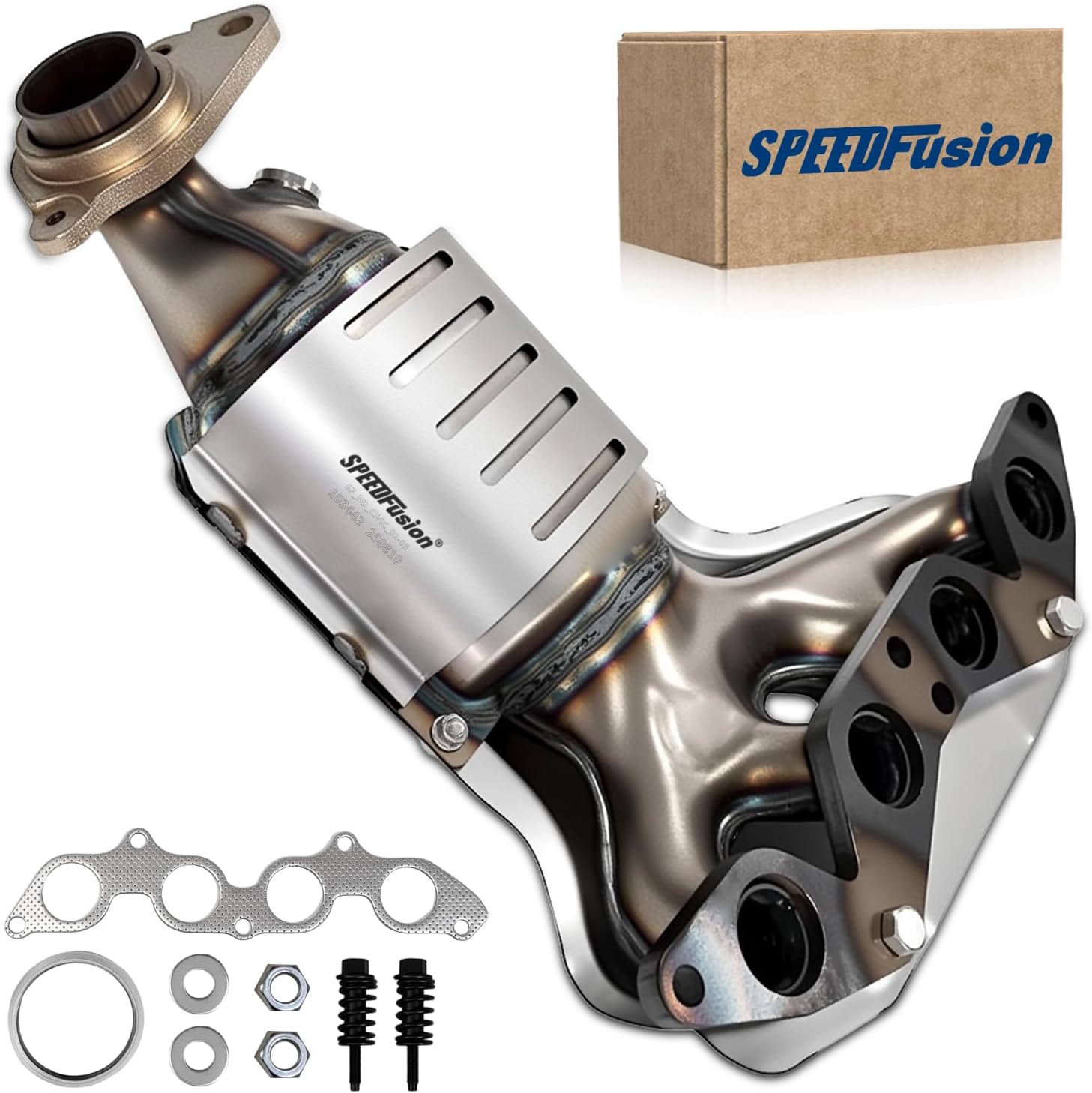
5. SPEEDFusion Front Catalytic Converter for 2001–2005 Honda Civic 1.7L
| Position | Front |
|---|---|
| Manufacturer | SPEEDFusion |
| Material | 409L stainless steel |
| EPA compliance | Federal emission standards |
| Manufacturer Part Number | SF_HD_CIVIC_01-05 |
This SPEEDFusion front catalytic converter is a direct-fit replacement for 2001–2005 Honda Civic 1.7L models intended to restore emissions control and keep the check engine light from triggering. It installs in place of the original front converter and is built from 409L stainless steel with anti-core-detachment welding for durability under road and heat exposure. The unit uses an OEM-style 400-hole ceramic substrate plated with platinum, rhodium and palladium to improve catalytic conversion efficiency and meets federal EPA requirements for vehicles subject to those standards. In practice it will be used when the original converter has failed, clogged, or triggered P0420/P0430 codes; professional installation is recommended to ensure fit and correct operation. Limitations include lack of CARB approval, so it cannot be used in states that require California standards, and buyers should confirm exact part-number fitment before purchasing. The product comes with a structural and emissions warranty that offers added peace of mind for long-term reliability.
Best for: Buyers who prioritize a reliable, factory-replacement emissions component for a 2001–2005 Civic 1.7L and want a durable unit that restores proper catalytic function and prevents emission fault codes.
Less Ideal for: Do not choose this if you need a California-compliant converter or if you plan to fit the part to any vehicle other than the specified 2001–2005 Civic 1.7L models.
- Direct-fit design for 2001–2005 Honda Civic 1.7L that simplifies installation
- 409L stainless steel construction and anti-core-detachment welding for improved durability
- OEM-style 400-hole ceramic substrate with platinum, rhodium and palladium for effective catalytic conversion
- EPA compliant for federal emission standards and designed to avoid P0420/P0430 fault codes
- Not CARB compliant so it cannot be used in states with California emission requirements
Verdict: If you need a robust, direct-fit replacement to restore emissions performance on a 2001–2005 Honda Civic 1.7L, this SPEEDFusion catalytic converter is a reliable EPA-compliant choice.
6. MOSTPLUS Exhaust Manifold with Catalytic Converter for 2001–2005 Honda Civic 1.7L

| Fitment | 2001–2005 Honda Civic 1.7L 4-cylinder |
|---|---|
| OEM Part Numbers | 18160-PLM-A50, 18160-PLM-A00, 674-608 |
| Special Features | Includes heat shield |
| Exterior | Painted |
This MOSTPLUS unit combines the exhaust manifold and catalytic converter into a single direct-fit assembly intended for 2001–2005 Honda Civic 1.7L four-cylinder engines (not for 2005 EX). It installs without welding and uses factory-style flanges so a mechanic can bolt it in place; the listing notes it includes a heat shield and comes with necessary gaskets and bolts. In real-world use the part gives a low-cost way to clear check engine codes and restore exhaust routing, and many owners report straightforward installs with only minor trimming or adjustment of the heat shield. Build quality is mixed across reviews: some buyers praise fit and value while others report premature internal deterioration or tight clearances that required minor grinding or filing during installation. Important to know is that this is non-CARB compliant and therefore unsuitable where California emission certification is required. If you prioritize a budget replacement and are comfortable making small fitment tweaks, this unit delivers convenience and parts included; if longevity and strict emissions compliance are top priorities, consider higher-end, certified alternatives.
Best for: Buyers who want an affordable, ready-to-install manifold/catalytic assembly for a 2001–2005 Civic 1.7L and value social proof from many user installs over factory-certification or premium longevity.
Less Ideal for: Drivers who must meet California emissions rules or who need a long-term, certified catalytic solution without any fitment adjustments should look at higher-grade, compliant replacements.
- Direct-fit design with factory-spec flanges for bolt-on installation without welding
- Includes heat shield, gaskets and bolts needed for installation
- Designed specifically for 2001–2005 Honda Civic 1.7L four-cylinder engines
- Lower-cost option that can clear exhaust-related check engine codes when fitted correctly
- Not CARB compliant so not legal for vehicles requiring California emissions certification
- Mixed long-term durability reported, with some users experiencing internal failure after break-in
- Occasional fitment tweaks required such as grinding or filing the heat shield or flange alignment
Verdict: A budget-friendly, bolt-on manifold-plus-catalytic assembly that works well for routine repairs on 2001–2005 Civic 1.7L cars if you accept some fitment tweaking and it is not required to be CARB compliant.
Choosing the Right Honda Civic 1.7L Exhaust Manifold: Key Factors to Consider
Material and Heat Resistance
The material used for the manifold determines how well it handles prolonged high temperatures and thermal cycling. Cast iron is common for durability and thermal mass, while certain stainless steel alloys offer better corrosion resistance but may expand differently under heat. For the Civic 1.7L, material choice affects susceptibility to cracking at welds and flanges.
Heat resistance also influences coating options and whether the manifold will transfer excessive heat into the engine bay. Consider whether the manifold has protective coatings or ceramic finishes that reduce surface temperature and slow corrosion. A thermally stable material reduces the chance of warping or flange distortion that causes exhaust leaks over time.
Flange Alignment and Dimensional Accuracy
Proper flange flatness and accurate port spacing are essential to achieve a gas-tight seal with the cylinder head. Poorly machined flanges or misaligned ports lead to exhaust leaks, poor idle quality, and accelerated gasket failure. For the Civic 1.7L, small deviations can be the difference between a straightforward swap and hours of trial-and-error fitting.
Check whether the manufacturer machines or mills the flange surface and whether bolt hole locations match OEM specifications precisely. A correctly aligned flange reduces stress on fasteners and the gasket, improving long-term sealing and reducing the chance of manifold crack propagation at stress concentration points.
Gasket Compatibility and Sealing Surface
Gasket type and the sealing surface finish determine how well the manifold mates to the head. Many Civic 1.7L repairs fail because of reused or incompatible gaskets. Some manifolds include or are designed for multi-layer steel gaskets that tolerate heat cycles better than thin paper gaskets.
Examine whether the manifold deck is prepped for a specific gasket style and whether additional surface finish work is recommended before installation. Good sealing features reduce exhaust leaks that cause noise, poor emissions readings, and potential engine performance issues.
Weld Quality and Manufacturing Consistency
For welded stainless or fabricated manifolds, weld quality is a major predictor of long-term durability. Inconsistent welds, undercutting, or porous beads can be initiation points for cracks, especially around sharp bends or where tubes meet the flange. The Civic 1.7L sees constant thermal cycling, so robust welding and consistent production tolerances matter.
Inspect whether welds are continuous and smooth and whether the design avoids sharp internal transitions. Consistency across units and visible quality controls in manufacturing minimize early failure risk and reduce warranty-related concerns.
Fitment to Factory Sensors and Routing
Modern engines rely on specific sensor placements and exhaust routing to maintain emissions and engine management. A replacement manifold must accommodate the factory oxygen sensor location and maintain clearance for heat shields and adjacent components. For the Civic 1.7L, improper sensor bung placement or altered routing can trigger fault codes or complicate installation.
Confirm that the manifold retains the OEM sensor bungs or provides clearly documented locations. Also consider whether the manifold interferes with heat shields, steering components, or accessory mounts. Correct fitment minimizes the need for additional parts and reduces installation time.
Ease of Installation and Hardware
Installation difficulty affects labor time and the risk of bolt or stud damage. Some manifolds come with necessary hardware, new bolts, or studs and torque specifications; others rely on reusing old components. For the Civic 1.7L, access to bolts can be limited, so a manifold designed for straightforward bolt-up and compatible with common tools reduces frustration.
Consider whether the design requires removal of additional components, special tools, or heat shield trimming. Included hardware and clear torque guidance help ensure correct installation and reduce the likelihood of leaks from improperly torqued fasteners.
Common Signs Your Civic 1.7L Manifold Needs Service
A few telltale symptoms indicate an exhaust manifold problem on the Civic 1.7L. A ticking or tapping noise that changes with engine load and temperature often signals an exhaust leak at the manifold flange or a cracked runner. You may also notice decreased throttle response or a rough idle if exhaust scavenging is compromised.
Other warning signs include a persistent check-engine light linked to O2 sensor readings, visible soot or black streaks around the flange, and unusual smells of exhaust fumes in the engine bay. Early detection helps avoid heat damage to nearby components and prevents emissions or performance issues from worsening.
- Ticking noise that varies with RPM and load
- Poor idle or reduced acceleration
- Check-engine light related to oxygen sensor values
- Soot or exhaust staining around the head-manifold joint
- Burning smells in the engine compartment
Diagnosing Leaks and Cracks
Start with a visual inspection when the engine is cool, looking for visible cracks, broken studs, and soot accumulation at the interface to the head. When the engine is running, a mechanic can use a smoke test or carefully listen with a mechanic's stethoscope to pinpoint a leaking runner. Be cautious around hot components.
Another practical approach is to monitor live O2 sensor data and compare short-term fuel trim values; consistent lean readings on certain cylinders can suggest an upstream leak. Pressure or vacuum-assisted tests and dye solutions can also help locate otherwise hidden leaks around flanges or gasket failures.
- Visual inspection for cracks, soot, and broken hardware
- Use of smoke testing or stethoscope while running
- Monitoring O2 sensor and fuel trim data for lean conditions
- Confirming leaks with pressure or dye-based tests
Installation Tips for a Smooth Swap
Prepare by replacing exhaust gaskets and any rusty or stretched hardware during the manifold swap. Clean the mating surfaces thoroughly and check flange flatness before tightening. Applying anti-seize to bolts that go into stainless or dissimilar metals helps prevent future removal issues.
Torque fasteners in the recommended sequence and to the manufacturer torque values when available. If access is limited on the Civic 1.7L, use appropriate extensions and take care not to over-torque studs that are recessed or heat-damaged. Re-check torque after the first heat cycle to ensure a consistent seal.
- Replace gaskets and corroded hardware at installation
- Clean and verify flange flatness before assembly
- Use anti-seize on appropriate fasteners
- Follow torque sequence and re-check after initial heat cycle
When to Repair Versus Replace
Minor surface cracks or small flange warpage can sometimes be welded or machined back into service, but repairs depend on access, material, and location of the damage. Welding cast iron requires specialized techniques and may not be durable on parts that experience repeated heating and cooling. For stainless fabricated manifolds, repairs are more straightforward if the damage is limited and the weld area is accessible.
Replacement is often the prudent choice when cracks are near bolt holes or where welds join high-stress sections, or when flange distortion is severe. A full replacement restores correct port alignment and sealing surfaces, reducing the risk of repeat failures and avoiding the uncertainty that comes with an extensive repair.
- Minor, accessible cracks may be repairable
- Cast iron repairs are specialized and may not be long-lasting
- Replace if flange distortion or cracks are near fasteners
- Replacement ensures correct alignment and long-term sealing
Heat Management and Engine Bay Considerations
Exhaust manifolds radiate significant heat into the engine bay. On the Civic 1.7L, excessive heat can affect wiring, plastics, and nearby sensors. Some manifolds are designed with coatings or thermal wraps in mind to reduce surface temperature and protect surrounding components. Consider whether a heat shield or additional thermal barrier will be needed after installation.
Retaining factory heat shields where possible and routing wiring away from the manifold reduces heat-related failures. If you plan to use thermal wrap or ceramic coatings, be aware they change the manifold's external temperature profile and may affect nearby components differently than an uncoated unit.
- Consider heat shielding or thermal coatings to protect nearby parts
- Retain or reinstall factory heat shields when possible
- Route wiring and hoses away from high-heat zones
- Be mindful that wraps and coatings alter external temperature behavior
Long-Term Maintenance and Inspection Schedule
Inspect the manifold and flange area during routine maintenance intervals, especially after high-heat events or track use. Look for new soot streaks, loose bolts, or signs of gasket creep. Early detection of seal degradation allows for gasket replacement before cracks develop.
Periodically check torque on accessible bolts and observe sensor performance for signs of upstream exhaust issues. Establishing a maintenance rhythm that includes manifold inspection helps extend the life of the part and prevents secondary failures caused by sustained leaks.
- Visual checks at regular service intervals
- Inspect after any overheating events or extreme use
- Check bolt torque where accessible
- Monitor O2 sensor data for upstream anomalies
Still looking for the perfect fit?
Select your Honda Civic configuration to see the most relevant Exhaust Manifolds recommendations
How We Chose the Best Honda Civic 1.7L Exhaust Manifold
Our selection process prioritized attributes that directly affect fitment, longevity, and engine performance for the Honda Civic 1.7L. We concentrated on concrete, measurable criteria rather than brand popularity or marketing claims. Key evaluation dimensions included material and heat resistance, flange alignment and dimensional accuracy, gasket compatibility and sealing surfaces, manufacturing quality and weld integrity, and compatibility with stock exhaust routing and sensors. We also considered ease of installation, including bolt access and whether the manifold requires special hardware, and whether the design reduces stress points that lead to cracks.Exclusions: we excluded units that required extensive modification to the cylinder head or exhaust piping, manifolds that do not accept the factory O2 sensor locations, and any designs clearly intended for forced-induction swaps or major engine modifications. We focused on direct-fit and near-direct-fit options suitable for routine replacement or mild upgrades.This framework ensured the list favors parts that minimize installation hassle, control heat and vibration, and restore proper exhaust sealing for long-term reliability on the Civic 1.7L.
Our full evaluation process is outlined in our review methodology.
FAQ
What causes an exhaust manifold to crack on the Civic 1.7L?
Cracking typically arises from repeated thermal cycling, stress concentrations at welds or flange corners, and weakened material from corrosion. Poor flange alignment or over-torqued fasteners can also introduce stresses that lead to cracks over time.
Can I replace the exhaust manifold gasket without removing the manifold?
In many cases you must remove the manifold to access and properly clean the mating surfaces for a reliable gasket seal. Attempting to replace the gasket with the manifold in place often risks an incomplete seal and recurring leaks.
How do I know if an exhaust manifold leak is affecting my engine performance?
Look for a combination of symptoms such as ticking noises, rough idle, reduced throttle response, and diagnostic codes related to O2 sensor readings. Monitoring short-term fuel trims and O2 data can reveal lean conditions caused by upstream leaks.
Is welding a cracked manifold a reliable long-term fix?
Welding can be a viable repair for certain materials and crack locations, but effectiveness depends on the manifold material and the quality of the weld. Cast iron repairs require specialized procedures and may not be as durable as replacing the unit in many cases.
Do I need to reuse the original exhaust hardware when installing a new manifold?
It is usually better to replace corroded or stretched bolts and gaskets during installation. Reusing compromised hardware increases the risk of leaks and can make future removal more difficult.
Will a different manifold change my Civic 1.7L fuel economy?
A manifold that restores proper exhaust flow and prevents leaks can improve drivability and may marginally affect fuel economy. Major design changes that alter backpressure significantly could influence engine tuning, but direct-fit replacements typically produce only small differences.
Final Verdict
When selecting an exhaust manifold for your Honda Civic 1.7L, prioritize correct flange alignment, durable materials, and proper gasket compatibility to avoid leaks and premature failure. Consider repair only for minor, accessible damage; otherwise a direct-fit replacement will restore sealing, maintain sensor function, and reduce the chance of repeat problems.Balance ease of installation against long-term durability and heat management. Focus on parts that accept the factory sensor locations and provide solid flange mating surfaces so you can achieve a reliable, long-lasting repair with minimal fuss.
Explore More:
- Check out all Honda Civic parts & accessories
- Explore Exhaust Manifolds Maintenance & Repair Guides
- Explore Exhaust & Emissions
- Browse all Auto Parts
