

Note: This article contains affiliate links. If you click on these links and make a purchase, I may earn a small commission at no extra cost to you. This helps support my research and content. Read my full affiliate disclosure here.
If your 2001-2005 Honda Civic is showing emissions problems or a persistent check engine light, the catalytic converter is a common culprit. Choosing the right catalytic converter matters because fitment, emissions performance, and durability all affect how reliably the car runs and whether it passes inspections.This guide covers our six shortlisted catalytic converters for the 2001-2005 Honda Civic (ES, EM, and EP), explaining why each type made the list and what to expect in terms of fit, emissions impact, and installation considerations. Below we summarize the evaluation criteria and practical tradeoffs to help you pick the right unit for road use or inspection.
Looking for other parts? See all Honda Civic parts & accessories.
Top Picks at a Glance
| Best Overall The best all-around choice for most situations | CAT CLEAN Catalytic Converter for Honda Civic 2001–2005 / Acura EL 2001–2005 1.7L |  |
| Best Quality Built to a higher standard if you want something more solid | AISIN Front Catalytic Converter CCTH-00644 for Honda Civic/Acura EL 1.7L (2001–2005) |  |
| Best Value The sweet spot between price and what you get | maXpeedingrods Catalytic Converter for Honda Civic L4 1.7L (2001–2005) |  |
| Best Budget The cheapest option that still gets the job done reliably | PHILTOP Catalytic Converter Compatible with 2001–2005 Honda Civic (Front, Stainless Steel) |  |
| Highest Rated A top-rated pick with lots of positive feedback | SPEEDFusion Front Catalytic Converter for 2001–2005 Honda Civic 1.7L |  |
| Most Popular A crowd favorite that many people choose with confidence | DNA MOTORING Factory-Style Catalytic Converter for 2001–2005 Civic (Federal Emissions) |  |
1. CAT CLEAN Catalytic Converter for Honda Civic 2001–2005 / Acura EL 2001–2005 1.7L

| Vehicle fitment | Honda Civic 2001-2005, Acura EL 2001-2005 1.7L L4 |
|---|---|
| Material | 409L stainless steel |
| Catalyst composition | Platinum, Rhodium, Palladium |
| Warranty | 6 years / 50,000 miles performance warranty |
This CAT CLEAN catalytic converter is a direct-bolt replacement made for 2001–2005 Honda Civic and Acura EL 1.7L engines and is designed to restore catalytic efficiency and clear P0420/P0430 codes. It uses a high-density honeycomb ceramic substrate loaded with precious metals (Pt, Rh, Pd) to improve conversion of harmful exhaust gases, and the body is fabricated from 409L stainless steel with an internal high-temperature pad to protect the carrier. Installation is intended to be straightforward thanks to the direct-bolt design, so most professional shops can swap it in without welding or modifying the exhaust. The unit is EPA compliant for federal emission states and aims to reduce emissions, lower engine check-light triggers, and quiet exhaust noise compared with a failing OEM converter. Buyers should note it is not legal for sale or use in certain states with stricter rules and that included hardware may be minimal, so expect to supply or confirm bolts and gaskets during installation. A 6-year/50,000-mile performance warranty is offered by the manufacturer.
Best for: Drivers seeking a reliable, factory-style replacement to restore emissions performance and silence a failing converter on a 2001–2005 Civic or Acura EL who prioritize straightforward installation and federal emissions compliance.
Less Ideal for: Drivers in states with stricter in-state emission regulations or anyone who needs a high-performance or race-oriented exhaust solution.
- Direct bolt-on design avoids cutting or welding on compatible 2001–2005 Civic and Acura EL exhausts
- High-density ceramic substrate with Pt, Rh, and Pd for improved catalytic conversion
- 409L stainless steel body and high-temperature internal pad for corrosion and heat resistance
- EPA-compliant for federal emission states and aimed at resolving check-engine codes
- Not approved for sale or use in states with stricter emission rules such as California
- Installation hardware may be limited and could require buying additional bolts or gaskets
Verdict: A direct-fit, EPA-compliant replacement that restores emissions performance and is practical for owners who want a factory-style swap for 2001–2005 Honda Civic and Acura EL 1.7L cars.
2. AISIN Front Catalytic Converter CCTH-00644 for Honda Civic/Acura EL 1.7L (2001–2005)

| Manufacturer | AISIN |
|---|---|
| Manufacturer Part Number | CCTH-00644 |
| OEM Part Number | 18160PLMA50, 18160PLMA00 |
| Special Features | Located at the Front Side |
| EPA Compliance | Federal OBDII (not CARB) |
This Aisin front catalytic converter replaces the factory unit on 2001–2005 Honda Civic and Acura EL 1.7L engines to restore emissions performance and pass OBDII monitoring. It installs in the front section of the exhaust and is built to match factory fit and mounting points for a straightforward swap without major modifications. Notable features include EPA compliance for federal emissions, manufacturer part number references for direct fit, and a design aimed at durability and consistent flow. For performance-minded owners it returns catalytic function so the engine can run cleanly and avoid limp modes or check-engine lights tied to converter faults. Limitations include its federal-only emissions compliance and explicit exclusions for some states with stricter standards, so it is not suitable where California-spec parts are required. Expect a part that prioritizes reliable emissions control and fitment over any claim of increased horsepower or modified flow characteristics.
Best for: Buyers who need a reliable, factory-quality replacement to restore emissions function and OBDII readiness on 2001–2005 Civic/Acura EL 1.7L vehicles, and who prioritize correct fit and long-term durability.
Less Ideal for: Owners who require California-spec emissions parts or who want a catalytic converter tuned for increased power or aftermarket performance gains.
- Factory-style fitment for direct swap into the front exhaust section
- EPA compliant for federal OBDII vehicles to meet emissions requirements
- Made by an established OEM supplier with factory-focused engineering
- Clear reference part numbers for matching to original equipment
- Not legal for sale or use in California, Colorado, New York, or Maine due to state emissions rules
Verdict: Choose this Aisin front catalytic converter when you want a factory-quality, EPA-compliant direct replacement to reliably restore emissions control on 2001–2005 Civic/Acura EL 1.7L cars.
3. maXpeedingrods Catalytic Converter for Honda Civic L4 1.7L (2001–2005)

| Fitment | 2001–2005 Honda Civic L4 1.7L |
|---|---|
| EPA compliance | Yes (not for certain states) |
| Manufacturer | maXpeedingrods |
| Manufacturer Part Number | MP22YW |
This maXpeedingrods catalytic converter is a factory-style replacement for the 2001–2005 Honda Civic with the 1.7L L4 engine. It installs into the stock exhaust path using the supplied gaskets and hardware so no cutting or custom welding is needed for standard fitment. The housing is stainless steel for improved corrosion and heat resistance while the internal ceramic substrate is coated with precious metals including platinum, rhodium, and palladium to help reduce emissions and address codes like P0420. Because it is advertised as EPA compliant, it is intended to pass federal emissions checks outside of states with stricter rules. Expect the unit to restore emissions performance and keep the check engine light off when fitted correctly. Limitations include ineligibility for use in certain states with tighter rules and the usual restriction that non-exact factory variants can differ slightly in fit or flow characteristics from original equipment parts.
Best for: Buyers who want a practical, ready-to-install replacement to restore emissions performance on a 2001–2005 Civic 1.7L without pursuing OEM parts and who prioritize straightforward installation and corrosion resistance.
Less Ideal for: Drivers in states with stricter emissions rules or those who require a factory-certified state-specific converter should look for a converter explicitly approved for their jurisdiction.
- Direct-fit design with included gaskets and hardware for bolt-on installation
- Stainless steel construction resists rust and handles high exhaust temperatures
- Internal ceramic substrate with platinum, rhodium, and palladium for effective emissions reduction
- Advertised EPA compliance to help pass federal emissions tests outside specified restricted states
- Not approved for use in certain states with stricter emissions regulations
- May have minor fit or flow differences compared with factory replacement parts
Verdict: A bolt-on stainless-steel catalytic converter that restores emissions performance for 2001–2005 Honda Civic 1.7L owners seeking a practical, install-ready replacement.
4. PHILTOP Catalytic Converter Compatible with 2001–2005 Honda Civic (Front, Stainless Steel)

| Fitment | 2001-2005 Honda Civic 1.7L (front) |
|---|---|
| Material | Stainless steel outer shell |
| Emissions compliance | EPA federal emissions model (not for CA/NY/ME/CO where restricted) |
| Includes | OE-style gaskets and basic mounting hardware |
This PHILTOP catalytic converter is a direct-fit front converter designed to replace factory units on 2001–2005 Honda Civic 1.7L models. It ships with OE-style gaskets and basic hardware and uses a stainless steel outer shell and a high-flow ceramic honeycomb substrate intended to reduce backpressure while keeping emissions control within EPA federal standards. In practice that means it can restore catalytic function, quiet rattling or noisy exhaust caused by a failing converter, and may help the engine breathe a bit better compared with a clogged unit. Installation is meant to be bolt-on and straightforward for a home mechanic with common tools and takes roughly 3 to 4 hours according to the seller, though several customer reports note the included clamps and bolts are low quality and some buyers needed welding or adapters for an exact fit. The part is not legal for use in states that require California emissions models. For a budget-minded replacement that aims to match factory fit and function, this unit is a reasonable option, but plan to check fitment carefully and have upgraded hardware or welding available if needed.
Best for: Buyers prioritizing a lower-cost, factory-style replacement for a failing catalytic converter who want a mostly bolt-on part they can fit themselves or have fitted affordably.
Less Ideal for: Drivers in states that require California emissions certification or those who need a guaranteed plug-and-play replacement with high-quality hardware and exact factory heat shield compatibility.
- Direct-fit design for 2001–2005 Honda Civic 1.7L front position simplifies installation
- Stainless steel shell and welded joints for improved durability over thin stamped parts
- High-flow ceramic substrate reduces backpressure compared with a clogged converter
- Includes OE-style gaskets and basic mounting hardware for a mostly bolt-on replacement
- Included clamps and bolts are reported as low quality by multiple buyers and may need replacement or welding
- Not CARB-compliant so cannot be used in states that require California emissions compliance
Verdict: A cost-conscious, direct-fit stainless steel replacement that restores emissions function and reduces backpressure for 2001–2005 Civic 1.7L owners who can swap hardware or weld if needed.
5. SPEEDFusion Front Catalytic Converter for 2001–2005 Honda Civic 1.7L
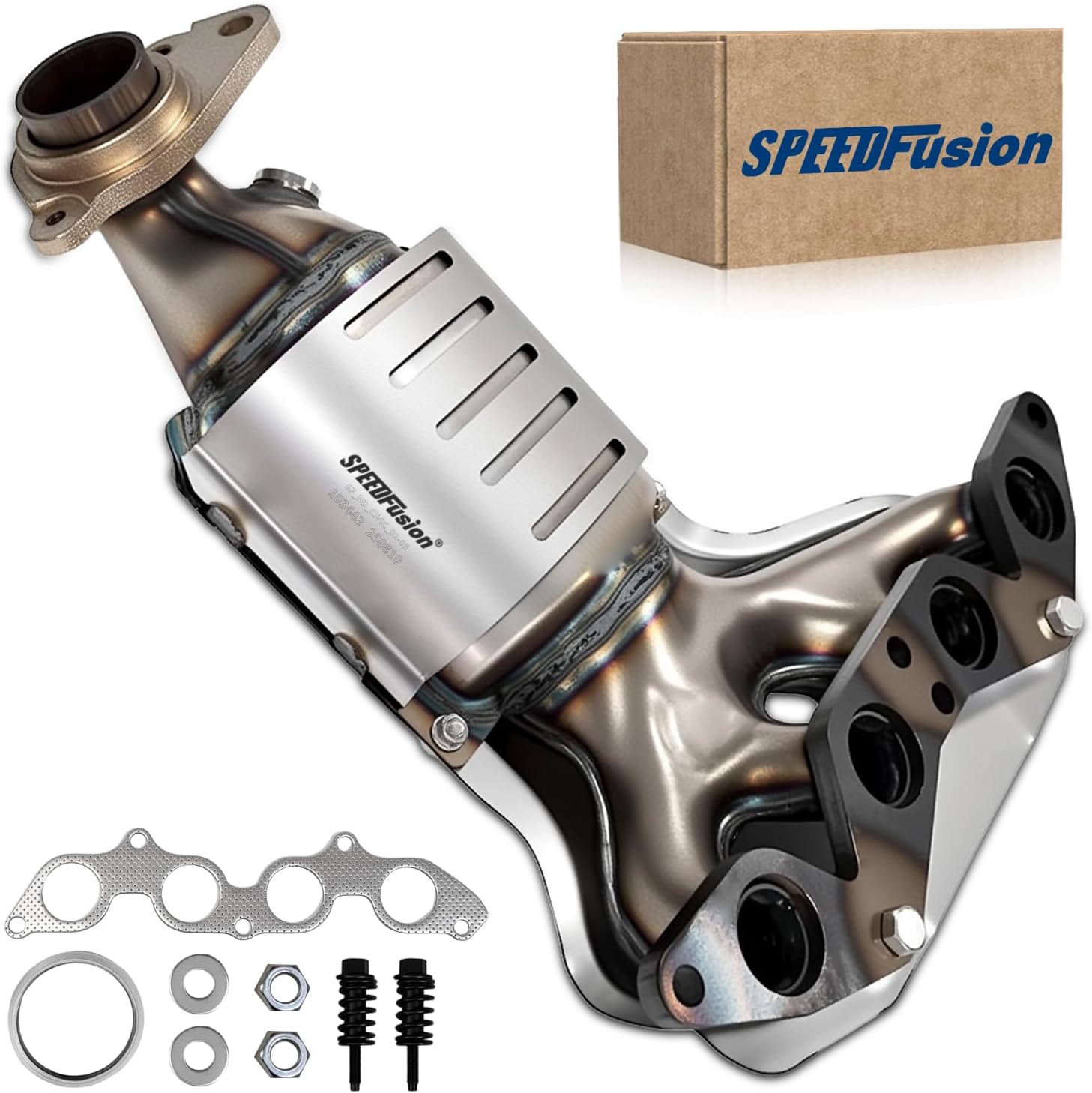
| Position | Front |
|---|---|
| Manufacturer | SPEEDFusion |
| Manufacturer Part Number | SF_HD_CIVIC_01-05 |
| EPA Certification | Yes |
| Compatible Engines | 2001-2005 Honda Civic 1.7L L4 |
This SPEEDFusion front catalytic converter is a direct-replacement unit for 2001–2005 Honda Civic 1.7L models intended to restore emissions control and keep the check engine light from triggering codes like P0420/P0430. It uses a stainless steel shell and an OEM-grade ceramic substrate plated with platinum, rhodium, and palladium to deliver high conversion efficiency. Installation is straightforward for a shop or experienced DIYer because it is sold as a direct fit for the specified Civic years and mounts in the factory position. The EPA compliance makes it legal for use on federal-emission vehicles, and the listed construction and anti-core-detachment welds aim to improve durability under road conditions. Limitations to note are that it is not CARB compliant so it cannot be used in states with California-equivalent rules, and buyers should have a professional install it to ensure sensor alignment and avoid exhaust leaks. For reliability-focused buyers this unit prioritizes factory-like fit and longevity over high-performance modifications.
Best for: Buyers who want a reliable, factory-style replacement to restore emissions performance and avoid check engine light issues on a 2001–2005 Civic while prioritizing durability and correct fitment.
Less Ideal for: Do not choose this if you need a CARB-approved converter for California-equivalent states or if you are seeking a high-flow performance unit for increased exhaust flow beyond stock.
- Direct-fit design for 2001–2005 Honda Civic 1.7L simplifies installation
- Stainless steel construction with anti-core-detachment welding for durability
- OEM-grade ceramic substrate with precious metal coating for effective emissions conversion
- EPA compliant for federal-emission vehicles
- Not CARB compliant so illegal for use in California and some states
Verdict: A durable, EPA-compliant direct-fit replacement built to reliably restore emissions control on 2001–2005 Honda Civic 1.7L models.
6. DNA MOTORING Factory-Style Catalytic Converter for 2001–2005 Civic (Federal Emissions)

| Fitment | 2001–2005 Civic EX GX, Federal emissions only |
|---|---|
| Position | Rear |
| Construction | Stainless steel with catalytic substrate |
| Certification | EPA OBD-II approved |
This DNA MOTORING catalytic converter replaces a worn rear unit on 2001–2005 Civic EX and GX models that use federal emissions. It is a direct-fit factory-style replacement built from stainless steel with a catalytic substrate and mandrel-bent tubing intended to match the original part’s shape and routing. Typical use is a like-for-like replacement after failure, rust, or damage to restore emissions control and drivability. The unit is EPA OBD-II approved for federal emissions, so it should pass emissions checks in applicable regions and restore converter function without custom fabrication. Installation requires standard exhaust work and usually a professional installer because no instructions or hardware are included. Practical benefits are straightforward fitment, corrosion-resistant material, and a design aimed at preserving engine power and conversion efficiency. Limitations are regional legality—the part is not legal for sale or use in California, New York, or Maine emissions programs—and buyers should verify the exact part number and local emissions rules before purchasing.
Best for: Buyers who want a tested, factory-style replacement to restore emissions function and drivability on a 2001–2005 Civic federal-emissions vehicle and who prioritize proven fit and compliance with federal rules.
Less Ideal for: Anyone who needs a converter legal for CARB-controlled states or who prefers a plug-and-play kit with installation hardware and instructions.
- Direct-fit factory-style design for straightforward replacement on the specified Civic models
- Constructed from stainless steel with mandrel bends for strength and better exhaust flow
- EPA OBD-II approved for federal emissions models to restore emissions control functionality
- Designed to match original routing and conversion efficiency to preserve drivability
- Not legal for sale or use in California, New York, or Maine emissions programs
Verdict: A straightforward, EPA-approved factory-style rear catalytic converter for 2001–2005 Civic federal-emissions models when you need a reliable like-for-like replacement.
Choosing the Right 2001-2005 Honda Civic Catalytic Converter: Key Factors to Consider
Exact Fitment and Flange Type
Exact fitment is critical because the 2001-2005 Honda Civic has limited underbody clearance and specific exhaust hangers. A converter that matches the original flange pattern and mounting points reduces labor time and avoids exhaust leaks. Incorrect fitment can require cutting and welding, which increases cost and can alter exhaust geometry.
Pay attention to sensor boss locations for the upstream and downstream oxygen sensors. If the sensor ports are in the wrong place you may get inaccurate readings that trigger a check engine light. Also confirm hanger positions and pipe diameter so the converter mates cleanly to the existing piping without excessive stress on joints.
Emissions Certification and Substrate Type
Emissions certification indicates whether a converter is intended to meet regulatory standards or to restore an emissions system to legal operation. For vehicles in inspection states, choosing a certified unit can be the difference between a pass and a fail. Substrate type, such as metallic or ceramic honeycomb, affects how quickly the converter heats up and how it tolerates thermal cycling.
Ceramic substrates often provide high conversion efficiency but can be brittle under shock and rapid temperature change. Metallic substrates tolerate thermal shock better and can be more durable in frequent start/stop driving. Consider local inspection requirements and typical driving patterns when weighing substrate choices.
Backpressure and Engine Performance
A catalytic converter changes exhaust flow resistance. Excessive backpressure can reduce engine efficiency and throttle response, while a too-permissive unit may inadequately treat emissions. For the Civic's smaller engine displacement, maintaining an appropriate balance is especially important to preserve drivability and fuel economy.
Look for converters designed to match the factory flow characteristics for the Civic. Some replacement units incorporate optimized cell density and flow paths to limit added restriction while still providing sufficient surface area for catalytic reactions.
Durability and Corrosion Resistance
Underbody components are exposed to road salt, water, and debris. A converter with corrosion-resistant casing, thick gauge steel, or protective coatings will generally last longer. Weld quality and mounting hardware corrosion resistance are practical considerations when you expect long-term service life.
Also consider interior substrate support and matting methods. Poorly supported substrates can crack over time from vibration. For a Civic that sees mixed weather and occasional rough roads, prioritize units with robust construction and corrosion-resistant finishes.
Sensor Compatibility and Wiring Access
Oxygen sensors are critical to engine control and emissions diagnostics. A replacement converter should have the correct number of sensor ports in OEM locations or provide clearly located bosses for sensor installation. If the converter requires sensor relocation, ensure wiring harness lengths and connector types are compatible.
Incorrect sensor placement can cause false sensor readings, triggering the check engine light and affecting fuel trims. Verify that the replacement allows proper sensor heat and exposure so the sensors operate within intended temperature ranges.
Installation Complexity and Serviceability
Installation complexity impacts total cost and how quickly you get back on the road. Direct-fit converters that use existing hangers and bolt patterns minimize labor. Consider whether gaskets, bolts, or additional hangers are included or need replacement. Some converters require partial exhaust disassembly or lifting the engine for clearance on the Civic, which increases labor time.
Serviceability also matters if you plan to replace it yourself. Units that allow sensor access and do not require cutting make routine replacement or maintenance simpler and reduce the chance of leaks forming at repaired joints.
Common Catalytic Converter Symptoms
Recognizing the common signs of catalytic converter issues helps prioritize repair. Typical symptoms on the 2001-2005 Civic include a persistent check engine light with related trouble codes, reduced engine power, or a rotten-egg smell from the tailpipe. A visibly rattling unit under the car suggests internal substrate breakage.
In addition to these direct symptoms, you may notice higher exhaust temperatures or a drop in fuel economy. Addressing early signs limits secondary damage to oxygen sensors and the exhaust system.
- Check engine light with OBD-II codes indicating catalyst efficiency or oxygen sensor anomalies
- Noticeable loss of acceleration or hesitation under load
- Strong sulfur or rotten-egg odor from exhaust
- Rattling noises from under the vehicle indicating a broken substrate
- Failed emissions inspection or unusually high tailpipe readings
Diagnosing Problems on the 2001-2005 (ES, EM, and EP) Civic
Start diagnosis with OBD-II trouble codes to see if the issue is related to catalyst efficiency or upstream sensors. A scan tool can provide short- and long-term fuel trims and oxygen sensor response times, which help narrow whether the converter or upstream components are responsible.
Visual inspection is important. Look for external damage, dents, or exhaust leaks at flanges. If the converter is physically damaged or the substrate is loose, replacement is often required. When testing further, use temperature differential checks across the converter or consult measured upstream/downstream oxygen sensor lag to assess conversion efficiency.
- Scan for catalyst and oxygen sensor-related OBD-II codes
- Inspect for external damage, dents, and flange leaks
- Measure temperature difference between inlet and outlet during steady driving
- Observe oxygen sensor response speeds with a scan tool
Fitment Tips Specific to the 2001-2005 Honda Civic
The Civic in the 2001-2005 model years has compact underbody space and particular hanger placements that affect converter choice. Confirm pipe diameters and ensure the replacement's inlet/outlet sizes match the factory piping. When a converter lists fitment for the ES, EM, and EP chassis, it usually indicates alignment with these Civic undercarriage dimensions.
If you plan to use the original oxygen sensors, check that the replacement has sensor bosses in the correct positions. For installations that require new gaskets or hardware, use OEM-spec materials to maintain seal integrity and prevent exhaust leaks.
- Confirm inlet/outlet diameters match factory piping
- Verify hanger positions and clearance to heat shields
- Check sensor boss locations for plug-and-play sensor reuse
- Replace gaskets and bolts with OEM-grade hardware when possible
Maintenance and Longevity Best Practices
To maximize converter life, keep the engine tuned and address misfires, fuel system issues, or oil consumption promptly. Unburned fuel and oil entering the exhaust can damage the substrate and shorten service life. Regular inspection for exhaust leaks and mounting hardware corrosion helps catch problems before they escalate.
Avoid frequent harsh driving conditions that produce extreme thermal cycling, and limit prolonged idling that can alter exhaust temperatures. When storing the vehicle or driving in heavy road-salt regions, consider additional underbody corrosion protection to shield the converter casing.
- Address misfires and rich-running conditions promptly
- Inspect exhaust hangers and flange bolts annually
- Use corrosion-resistant hardware and coatings in salty climates
- Avoid extended idling and repeated extreme temperature swings
Installation Options: DIY Vs Professional Service
Simple direct-fit replacements for the Civic can sometimes be completed at home with basic tools if you have mechanical experience. Expect to work under the vehicle on ramps or jack stands, and have proper safety equipment. You may need penetrating oil for seized bolts and a torque wrench for proper flange assembly.
Professional installation is worthwhile when fitment is marginal, when welding is required, or when you lack tools or a safe workspace. A shop can also verify correct sensor operation after installation and clear any emission-related codes. Factor in the convenience and diagnostic support when choosing between DIY and professional service.
- DIY is feasible for direct-fit units with accessible bolts
- Use proper safety stands and tools when working under the car
- Professional shops handle welding, clearance issues, and diagnostics
- Have replacement gaskets and anti-seize on bolts ready before starting
Still looking for the perfect fit?
Select your Honda Civic configuration to see the most relevant Catalytic Converters recommendations
How We Chose the Best 2001-2005 Honda Civic Catalytic Converter
We applied a focused editorial filter to identify catalytic converters that suit the 2001-2005 Honda Civic (ES, EM, and EP) chassis. First, fitment accuracy was a primary screen. We prioritized direct-fit units and exact flange patterns to avoid extra fabrication. Second, regulatory and emissions performance mattered. We considered converter core design and certifications relevant to restoring exhaust emissions performance for affected Civics. Third, durability and construction were assessed by looking at substrate material, weld quality, and heat-resistant casing designs that affect long-term function. Fourth, thermal and flow characteristics were considered to balance backpressure and catalytic efficiency for street-driven Civics. Finally, installation practicality was evaluated, including bolt-on compatibility and clearances specific to the 2001-2005 Civic undercarriage.We excluded universal or heavily modified converters that require significant cutting, custom flanges, or re-routing of exhaust components. Units lacking clear fitment data for the ES, EM, and EP chassis or without documented emissions performance were not considered. The final list reflects products that meet fitment, emissions restoration, durability, thermal handling, and installability criteria for this Civic generation.
Our full evaluation process is outlined in our review methodology.
FAQ
How can I tell if the catalytic converter on my 2001-2005 Civic is failing?
Common signs include a persistent check engine light with catalyst-related codes, reduced acceleration, a noticeable sulfur smell, or rattling from under the car. Visual damage or a large temperature difference across the unit during a road test also indicate failure.
Will replacing the catalytic converter clear the check engine light?
Replacing a faulty converter often clears catalyst-efficiency related codes, but the light may persist if upstream sensors or engine issues remain. After replacement, a scan tool can confirm sensor readings and allow the vehicle to complete readiness cycles.
Can I reuse the oxygen sensors when installing a new converter?
Often you can reuse properly functioning sensors if the replacement has correctly positioned sensor bosses. Inspect sensor condition and wiring; if sensors show slow response or stored codes, replacing them at the same time is advisable to ensure accurate engine control.
Is a universal catalytic converter a good option for my Civic?
Universal converters may require cutting and welding and can introduce fitment and clearance issues on the 2001-2005 Civic. They are generally less desirable unless a direct-fit unit is unavailable or a custom installation is planned.
How long should a replacement catalytic converter last on a Civic?
Lifespan varies with driving conditions and maintenance. With proper engine tune and corrosion protection, converters often last many years, but exposure to road salt, frequent short trips, or persistent engine faults can shorten service life.
What codes should I expect if the catalytic converter is the problem?
You may see OBD-II codes related to catalyst efficiency or oxygen sensor performance. Codes that indicate slow oxygen sensor response, low converter efficiency, or severe downstream oxygen sensor variance are commonly associated with converter issues.
Final Verdict
When replacing the catalytic converter on a 2001-2005 Honda Civic, prioritize units that match OEM fitment, provide the appropriate balance of flow versus conversion efficiency, and offer durable construction for local driving conditions. Address any engine or sensor issues before installing a new converter to avoid premature failure. In most cases, choosing a direct-fit converter with correct sensor bosses and corrosion-resistant materials delivers the most reliable long-term outcome for emissions compliance and drivability.
Explore More:
- Check out all Honda Civic parts & accessories
- Explore Catalytic Converters Maintenance & Repair Guides
- Explore Exhaust & Emissions
- Browse all Auto Parts
