

Note: This article contains affiliate links. If you click on these links and make a purchase, I may earn a small commission at no extra cost to you. This helps support my research and content. Read my full affiliate disclosure here.
If you own a Honda Civic 1.8L and are facing emissions trouble or a check engine light, choosing the right catalytic converter matters for drivability and compliance. The wrong unit can cause poor fitment, trigger engine management faults, or fail emissions testing. This guide shortlists the top options for the Civic 1.8L, focusing on units that restore exhaust function and meet fitment needs.We evaluated converters for build quality, substrate type, installation compatibility, and emissions performance to help you pick the best replacement for your Civic 1.8L. Below are the recommended options and the criteria we used to evaluate them before the detailed buying guidance.
Looking for other parts? See all Honda Civic parts & accessories.
Top Picks at a Glance
| Best Overall The best all-around choice for most situations | VAVICARS Stainless Steel Catalytic Converter Direct-Fit for 2012–2013 Honda Civic 1.8L |  |
| Best Quality Built to a higher standard if you want something more solid | MagnaFlow Direct-Fit Catalytic Converter 5671452 (2014–2015 Honda Civic 1.8L) |  |
| Best Value The sweet spot between price and what you get | CAT CLEAN Front Catalytic Converter for Honda Civic 2006–2011 1.8L |  |
| Best Budget The cheapest option that still gets the job done reliably | Blzprty Front Catalytic Converter for Honda Civic 1.8L (2006–2011) |  |
| Highest Rated A top-rated pick with lots of positive feedback | SPEEDFusion Front Catalytic Converter for Honda Civic 2006–2011 1.8L |  |
| Most Popular A crowd favorite that many people choose with confidence | DNA MOTORING Factory-Style Bolt-On Catalytic Converter for 2006–2011 Honda Civic 1.8L |  |
1. VAVICARS Stainless Steel Catalytic Converter Direct-Fit for 2012–2013 Honda Civic 1.8L

| Fitment | 2012–2013 Honda Civic 1.8L |
|---|---|
| Material | 409L stainless steel shell |
| Certifications | EPA approved (Federal emissions only) |
This VAVICARS catalytic converter is a direct-fit replacement intended for the 2012–2013 Honda Civic 1.8L and is made with a 409L stainless steel shell and an internal ceramic substrate. It installs using the original mounting points so a professional can bolt it in without major modification, and it is sold for federal-emissions vehicles only with an EPA certification. In use the unit fixes exhaust leaks, clears related engine codes when matched correctly to sensors, and restores quieter, smoother exhaust flow compared with a cracked manifold. Buyer reports show generally straightforward installation and good fitment, though quality control varies: some users praise fit and improved drivability while others report early catalyst degradation or weld issues. That means this converter is a practical, lower-cost replacement if you need a functioning, factory-style unit now, but it may not match long-term durability of higher-end factory-quality parts.
Best for: Buyers who want an affordable, drop-in replacement to restore exhaust function and clear emissions-related codes on a 2012–2013 Civic 1.8L without custom work.
Less Ideal for: Drivers seeking a long-term, dealer-grade or premium OEM replacement for high-mileage vehicles should consider higher-end factory-quality converters instead.
- Direct-fit design that uses original mounting points for straightforward installation
- 409L stainless steel shell offers corrosion and heat resistance compared with cheaper coatings
- EPA-approved for federal emissions models so it meets federal certification requirements
- Internal ceramic substrate provides immediate catalytic function to clear exhaust leaks and related codes
- Some buyers report short-term catalyst failure or P0420 codes indicating inconsistent internal catalyst quality
- Several reviews note poor welds or early surface rust, suggesting variable manufacturing quality
Verdict: A budget-friendly, EPA-certified direct-fit replacement that gets a 2012–2013 Civic 1.8L back to working exhaust performance quickly.
2. MagnaFlow Direct-Fit Catalytic Converter 5671452 (2014–2015 Honda Civic 1.8L)

| Compatible vehicle | 2014-2015 Honda Civic 1.8L |
|---|---|
| Compliance | CARB compliant |
| Material | Stainless steel tubing |
| Installation | Direct-fit with included hardware |
This MagnaFlow direct-fit catalytic converter replaces the factory unit on 2014–2015 Honda Civic 1.8L cars while retaining CARB compliance for use in California and other restricted states. It is built with mandrel-bent, 16-gauge stainless steel tubing and a spun-body design that MagnaFlow says matches factory fit and function, letting you install it without cutting or welding using the included hardware. The laser fusion weld and compact, low-mass body aim to reduce leak risk and improve thermal efficiency compared with bulkier aftermarket units. For drivers focused on performance, the free-flowing internals should reduce backpressure relative to some OEM converters, which can help exhaust scavenging and throttle response when combined with other bolt-on upgrades. Expect a straightforward bolt-on replacement with durable corrosion resistance, though this is still a replacement emission device rather than a high-flow race-only unit, so gains will be modest unless paired with further exhaust modifications.
Best for: Drivers who want a legal, durable replacement that preserves emissions compliance while offering modest performance improvements when combined with other exhaust upgrades and tuning.
Less Ideal for: Enthusiasts seeking maximum unrestricted flow for race use should choose a non-compliant high-flow or race-specific converter instead.
- CARB compliant for legal use in California and CARB states
- Direct-fit design with included hardware for bolt-on installation without cutting or welding
- Mandrel-bent 16-gauge stainless steel tubing and machined spun body for corrosion resistance and durability
- Free-flowing internal design aimed at reducing backpressure compared to some factory converters
- Not a dedicated high-flow racing converter so performance gains are limited unless combined with other exhaust upgrades
- Heavier and more restrictive than competition that uses ultra-high-flow substrates
Verdict: A CARB-legal direct-fit replacement that gives Civic owners a durable, lower-backpressure alternative to the factory converter without sacrificing emissions compliance.
3. CAT CLEAN Front Catalytic Converter for Honda Civic 2006–2011 1.8L

| Vehicle fitment | Honda Civic 2006–2011 1.8L L4 |
|---|---|
| OEM reference | 16641, 641322, 674986 |
| Material | 409L stainless steel body |
| Compliance | EPA compliant |
| Warranty | 6-year/50,000-mile performance warranty |
This CAT CLEAN front catalytic converter replaces the factory unit on 2006–2011 Honda Civic 1.8L engines and is built for bolt-on installation without welding or modification. It uses a high-density honeycomb ceramic substrate loaded with platinum, rhodium, and palladium to improve conversion efficiency and address check-engine codes like P0420/P0430. The unit is housed in 409L stainless steel for improved corrosion and heat resistance and includes a high-temperature pad to protect the ceramic carrier. In practice this means smoother emissions performance, reduced likelihood of CEL recurrence due to low catalyst efficiency, and a quieter exhaust note compared with a heavily degraded converter. It is sold as EPA compliant and not for sale in certain states with stricter rules. Installation should be straightforward for a DIYer with basic tools or a shop, but confirm fitment against the listed OEM reference numbers before buying. The product includes a 6-year/50,000-mile performance warranty from the maker.
Best for: Buyers who want a practical, factory-style replacement that restores emissions performance and clears low-efficiency catalyst codes with minimal installation hassle.
Less Ideal for: Drivers located in states that require California-specific certified converters or customers seeking a universal or performance-oriented catalytic upgrade.
- Direct bolt-on design for installation without welding or additional fabrication
- EPA-compliant catalyst with high-density honeycomb and precious-metal loading for efficient emissions conversion
- 409L stainless steel body offers improved corrosion and heat resistance
- Includes high-temperature padding to protect the ceramic substrate and extend service life
- 6-year/50,000-mile performance warranty from the manufacturer
- Not legal for sale or use in states with California-style emissions rules
Verdict: A direct-fit, EPA-compliant replacement that restores factory-level emissions performance on 2006–2011 Civic 1.8L engines with straightforward bolt-on installation.
4. Blzprty Front Catalytic Converter for Honda Civic 1.8L (2006–2011)

| Compatible models | Honda Civic 2006–2011 1.8L L4 |
|---|---|
| Position | Front |
| Material | Stainless steel |
| Replacement part numbers | 674-986, 16641, 57140 |
This Blzprty front catalytic converter is a budget-friendly direct replacement for 2006–2011 Honda Civic 1.8L (L4) applications. Sold as a direct-fit part, it arrives with gaskets and hardware intended to simplify installation without major modifications. Constructed from stainless steel and described as upgraded for corrosion and high-heat resistance, it should resist bending or surface corrosion better than cheap stamped units. In practice the unit is best for owners who need a low-cost, serviceable replacement to restore exhaust routing and emissions equipment functionality in non-California emissions states. Some users report remaining exhaust odor after installation, which suggests internal substrate quality may vary compared with higher-end branded converters. The listing notes legal and shipping restrictions for several states, so confirm local rules before buying. Overall this unit provides a practical, low-cost way to replace a failed front catalytic converter when you want a straightforward swap rather than an expensive OEM-level rebuild.
Best for: Buyers seeking the lowest-cost, simple replacement to get a 2006–2011 Honda Civic 1.8L back on the road without expensive dealer parts, and who prioritize upfront value over premium durability.
Less Ideal for: Drivers in California, New York, Maine, Colorado, or Michigan or anyone who needs a high-end, long-life emissions module for strict state inspections should look at higher-spec or OEM options.
- Direct-fit design with included gaskets and hardware for easier installation
- Stainless steel construction aimed at improved corrosion and heat resistance
- Marketed as EPA-compliant for use in most states outside restricted markets
- Illegal for use or shipment to several states and restricted for emissions-model vehicles in some regions
- Some buyers reported lingering exhaust odor after installation, indicating variable filtering performance
Verdict: A cost-focused direct-fit front catalytic converter that gives 2006–2011 Honda Civic 1.8L owners an affordable, easy-to-install replacement when OEM-level performance is not required.
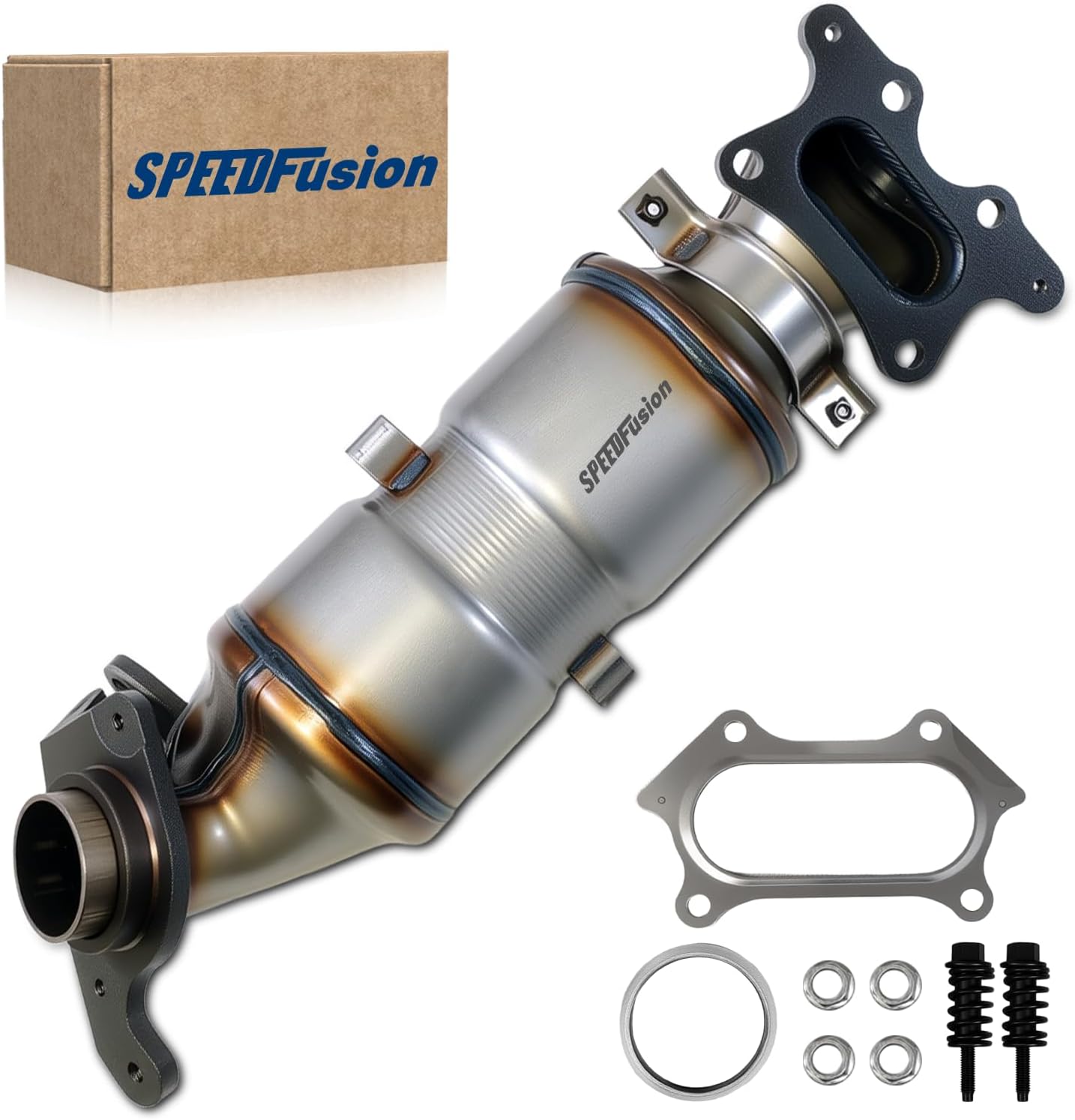
5. SPEEDFusion Front Catalytic Converter for Honda Civic 2006–2011 1.8L
| Position | Front |
|---|---|
| Manufacturer | SPEEDFusion |
| Exterior | Polished |
| Manufacturer Part Number | SF_HD_CIVIC_06-11 |
| ASIN | B0F1DCYDVD |
This SPEEDFusion front catalytic converter replaces the factory unit on 2006–2011 Honda Civic 1.8L engines and is intended as a direct-fit, EPA-compliant replacement. It uses a 409L stainless steel shell and an OEM-grade ceramic substrate plated with platinum, rhodium, and palladium to increase conversion efficiency and help keep the check engine light from triggering codes like P0420/P0430. The construction and anti-core-detachment welding process aim to resist corrosion and handle typical road conditions. Installation is straightforward for a professional shop because it is sized to match the original position and inlet/outlet locations. Important limitations are that it is approved for federal emissions only and not CARB-compliant, so it cannot be used in states that require CARB certification, and warranty coverage focuses on structural and emissions performance for limited terms. For buyers prioritizing a reliable, direct replacement that restores emissions control and avoids fault codes, this unit is a practical option.
Best for: Buyers who want a dependable, factory-style replacement to restore emissions performance and prevent catalytic-related fault codes should consider this unit. It fits owners who prioritize long-term reliability and a direct-fit install rather than aftermarket performance gains.
Less Ideal for: Drivers in states that require CARB-certified parts or those seeking a high-performance or modified exhaust solution should look elsewhere.
- Direct-fit design made for 2006–2011 Honda Civic 1.8L for simpler installation
- 409L stainless steel shell and anti-core-detachment welding for enhanced durability
- OEM-grade ceramic substrate with precious metal plating for improved catalytic conversion
- EPA compliant for vehicles meeting federal emission standards to avoid federal noncompliance issues
- Not CARB-compliant so it is illegal to sell or install in states that require CARB certification
Verdict: A reliable, EPA-compliant direct-fit replacement designed to restore emissions control and prevent check-engine codes on 2006–2011 Honda Civic 1.8L cars.
6. DNA MOTORING Factory-Style Bolt-On Catalytic Converter for 2006–2011 Honda Civic 1.8L

| Fitment | 2006–2011 Honda Civic DX/LX/EX (1.8L) |
|---|---|
| Compliance | Federal EPA compliant (not for CA/ME/NY) |
| Installation | Bolt-on direct fit |
| Construction | Stainless steel body with aluminized piping |
This DNA MOTORING catalytic converter is a factory-style, bolt-on replacement aimed at restoring emissions control on 2006–2011 Honda Civic 1.8L DX, LX, and EX models. It installs without welding or fabrication, so a professional or experienced DIYer can swap it into the existing exhaust flange and hardware. The unit uses a premium substrate with a high-technology washcoat to improve oxygen storage capacity and meet federal EPA compliance outside restricted states. Construction blends a stainless steel body with aluminized piping for corrosion resistance and durability in everyday driving. Because it is a direct-fit replacement, it aligns with factory mounting points and original part references, which simplifies sourcing and fitment. Limitations to note are regulatory restrictions: it is not legal for sale or use in California, Maine, and New York, and it will not fit GX, Hybrid, or Si variants, so confirm exact vehicle application before buying.
Best for: Buyers who prioritize a like-for-like, professionally engineered replacement that restores emissions function and fitment for a 2006–2011 Civic 1.8L while relying on real-world reviews and compliance assurances.
Less Ideal for: Do not choose this if your Civic is a GX, Hybrid, or Si variant or if you need a CARB-compliant converter for use in California, Maine, or New York.
- Direct bolt-on design that requires no welding or fabrication for replacement.
- EPA-compliant federal unit with a high-technology washcoat for improved oxygen storage.
- Engineered to match factory fitment and original part mounting for simpler installation.
- Stainless steel body and aluminized piping increase corrosion resistance and durability.
- Not CARB-legal and therefore not for sale or use in California, Maine, or New York.
Verdict: A straightforward factory-style bolt-on replacement that reliably restores emissions performance for 2006–2011 Honda Civic 1.8L DX/LX/EX models.
Choosing the Right Honda Civic 1.8L Catalytic Converter: Key Factors to Consider
Fitment And Mounting
Accurate fitment is critical for the Honda Civic 1.8L because mismatched flanges, incorrect pipe diameters, or wrong center-to-center measurements create exhaust leaks and stress on hangers. A converter designed to match the Civic 1.8L exhaust layout reduces the need for cutting, welding, or adapter pieces and preserves original hanger locations.
When fitment is correct, you lower the risk of oxygen sensor misreads and check engine light triggers caused by leaks or shifted components. Consider bolt pattern, inlet and outlet diameters, and whether the unit aligns with the factory catalytic heat shields and underbody clearances.
Substrate Type And Cell Density
The internal substrate—typically ceramic or metallic—determines conversion efficiency and backpressure characteristics. For the Civic 1.8L, substrate choice affects how quickly the converter reaches operating temperature and how it handles the engine's exhaust pulse frequency.
Cell density, measured in cells per square inch (CPSI), influences surface area for catalytic coating and exhaust flow resistance. Higher cell density can improve conversion but may increase backpressure. Choose a substrate and CPSI balance that maintains engine responsiveness while meeting emissions needs for the 1.8L engine.
Emissions Performance And Certification
Catalytic converters are fundamentally emissions-control devices, so documented performance and any applicable certifications matter. For the Honda Civic 1.8L, verify whether a unit is designed to meet or help maintain local emissions standards and whether it supports proper oxygen sensor operation for accurate closed-loop fuel control.
Units with clear claims about conversion efficiency, reduction of hydrocarbons, CO, and NOx, or that reference test data give better confidence they will help with inspections. Absence of performance data increases risk of failing an emissions test after installation.
Durability And Materials
The converter will be exposed to thermal cycling, road debris, and corrosive conditions. Materials such as stainless steel housings, robust internal mounting, and corrosion-resistant flanges extend service life on a Civic 1.8L that may see varied climates and road salt.
Pay attention to weld quality, flange thickness, and heat protection features. Durable construction reduces the chance of premature cracking, broken hangers, or exhaust leaks that can reintroduce emissions and drivability problems.
Compatibility With Oxygen Sensors And Exhaust Hardware
Modern Hondas rely on pre- and post-converter oxygen sensors for fuel trim control and emissions monitoring. A replacement converter must preserve sensor port locations and thread types to avoid harness relocations or sensor extension needs. Incorrect sensor placement can trigger check engine lights and prevent the engine from reaching closed-loop operation.
Also consider whether the converter integrates with existing heat shields, hangers, and resonance components. Maintaining the original sensor and hardware geometry keeps emissions diagnostics functioning as intended.
Installation Complexity And Serviceability
Some converters are direct-fit while others require cutting, welding, or using clamps. For owners of a Honda Civic 1.8L weighing shop labor against DIY capability, installation complexity can materially affect total time and cost. Units that use factory-style flanges and bolt holes are typically quicker to install and easier to service later.
Consider access to fasteners, potential rusted bolts, and whether replacement hangers or gaskets are needed. Also evaluate whether the unit allows future sensor replacement without removing the entire assembly.
Signs Your Civic 1.8L Needs A New Converter
Several symptoms commonly indicate catalytic converter trouble on the Honda Civic 1.8L. Persistent check engine light codes related to catalyst efficiency, a notable drop in fuel economy, or a rotten egg smell from the exhaust are practical red flags to inspect the converter.
Power loss and hesitation under load can also be related to a clogged or failing converter that increases backpressure. Visual inspection for external damage, dents, or heat-discolored areas can help confirm whether the unit has suffered impact or overheating.
- Check engine light codes for catalyst efficiency reduction
- Reduced acceleration or unusual hesitation under load
- Noticeable decrease in fuel economy
- Sulfur or rotten egg odor from the exhaust
- Rattling noises indicating broken internal substrate
How Converter Condition Affects Engine Diagnostics
The catalytic converter is integrated into the emissions and engine management strategy for the Civic 1.8L. If the converter is not functioning, oxygen sensors will report abnormal readings and the engine control unit may set diagnostic trouble codes. That affects closed-loop fuel control and can lead to persistent check engine lights.
Understanding this interaction helps diagnose whether a code points to the converter itself or upstream issues such as a misfire, oil burning, or faulty oxygen sensors. Addressing the root cause before replacing the converter can prevent repeated failures.
- Faulty converter alters pre- and post-sensor readings
- Engine control unit may enter limp modes or store codes
- Replacing sensors or fixing misfires may be necessary before converter replacement
Fitment Tips For A Smooth Installation
Before installing a replacement on the Honda Civic 1.8L, confirm flange types, pipe diameters, and sensor port positions. Measure center-to-center distances and check hanger locations against the factory underbody layout to avoid surprises at installation.
Use proper gaskets and torque specifications for flange bolts and consider anti-seize on sensor threads to aid future service. If the old mounting hardware is badly corroded, replacing gaskets and bolts at the same time will make the job more reliable.
- Match inlet/outlet diameters and flange patterns
- Verify oxygen sensor port location and thread size
- Replace gaskets and corroded bolts during installation
When To Seek Professional Diagnosis
If you see intermittent check engine lights, experience drivability issues that vary with temperature, or encounter emissions testing failures, professional diagnostic tools can pinpoint whether the converter is failing or another system is causing the issue. Shops can perform backpressure tests, temperature differentials, and live sensor-data logging tailored to the Civic 1.8L.
Professional inspection is especially useful when the converter shows external heat damage or when prior repairs have not resolved persistent fault codes. Technicians can also advise on whether a direct-fit replacement or a more robust unit is appropriate for your usage pattern.
- Use professionals for intermittent or unclear diagnostic codes
- Backpressure and temperature tests help confirm internal blockage
- Technicians can verify sensor operation and overall exhaust integrity
Maintaining Converter Health Over Time
Practices that reduce converter stress include keeping the engine tuned, addressing oil consumption, and fixing misfires promptly. Unburned fuel, oil, or coolant entering the exhaust can overheat or contaminate the catalytic substrate, shortening its service life on the Civic 1.8L.
Regular inspection of the exhaust system for leaks, loose hangers, and damage reduces the risk of mechanical impact and facilitates earlier detection of potential problems.
- Tune and maintain ignition and fuel systems to avoid unburned fuel
- Monitor oil consumption and coolant leaks that could contaminate the converter
- Inspect underbody for impacts, rust, and loose hangers
Still looking for the perfect fit?
Select your Honda Civic configuration to see the most relevant Catalytic Converters recommendations
How We Chose the Best Honda Civic 1.8L Catalytic Converter
We selected candidates for this list using criteria aimed at real-world reliability and legal compliance for the Honda Civic 1.8L. First, we prioritized fitment and flange compatibility so components align with the Civic 1.8L exhaust geometry and mounting points. Second, we considered internal substrate and cell density because these directly affect conversion efficiency and flow characteristics relevant to this engine size. Third, we examined construction materials and weld quality to assess durability against road corrosion and thermal stress. Fourth, we evaluated emissions performance metrics and whether units are engineered to help the vehicle maintain or pass standard emissions testing. Fifth, ease of installation and whether the design requires minimal modification for the Civic 1.8L were factored in.We excluded universal or heavily modified converters that demand extensive fabrication or non-standard exhaust routing. Units lacking documentation on substrate type, flow characteristics, or compatibility with the Civic 1.8L were not considered. The final picks balance conversion effectiveness, longevity, fitment accuracy, and installation practicality for everyday owners and independent shops.
Our full evaluation process is outlined in our review methodology.
FAQ
How will I know if the catalytic converter is causing the check engine light?
Often a diagnostic code referencing catalyst efficiency or oxygen sensor readings points to the converter. However, similar codes can result from faulty sensors or engine issues. Using a scanner to view live sensor data and comparing upstream and downstream oxygen sensor voltages helps determine whether the converter itself is the root cause.
Can a clogged converter cause poor acceleration in a Civic 1.8L?
Yes, a clogged or restricted converter can raise backpressure and reduce engine power, especially under acceleration. If the vehicle hesitates or lacks throttle response and other causes are ruled out, the converter is a plausible source.
Is it necessary to replace oxygen sensors when installing a new catalytic converter?
Not always, but it is often advisable to verify sensor condition during installation. Worn or contaminated sensors can produce inaccurate readings that mask converter performance. If sensors show slow response or are out of specification, replacing them at the same time reduces the chance of persistent diagnostics after the swap.
Will a direct-fit converter always bolt in without modifications?
Direct-fit units are designed to match factory flanges and hanger locations to minimize modifications. However, age-related corrosion, aftermarket exhaust changes, or previous repairs can require minor adjustments. Confirm measurements and inspect the existing hardware before assuming a bolt-in installation.
What maintenance helps extend the life of a catalytic converter on the Civic 1.8L?
Keeping ignition components in good condition, repairing oil or coolant leaks promptly, and addressing misfires prevents unburned or contaminated material from damaging the substrate. Regular underbody inspections for impacts and rust also help preserve the unit over time.
Can I drive with a failing catalytic converter until I can replace it?
It depends on the failure mode. A partially degraded converter may allow driving for a short period but could lead to reduced performance, increased emissions, and possible engine management issues. A physically broken substrate or severe restriction can cause drivability problems that make immediate repair advisable.
Final Verdict
When replacing the catalytic converter on a Honda Civic 1.8L, prioritize units that match factory fitment, preserve oxygen sensor geometry, and offer proven emissions performance. Balance substrate type and cell density with the need to avoid excessive backpressure for the 1.8L engine. Durable materials and proper flange compatibility reduce the likelihood of repeat service.Address underlying engine issues like misfires or oil burning before swapping the converter to prevent premature failure. With those tradeoffs considered, choose the replacement that best aligns with your installation capability and emissions requirements to restore reliable operation and diagnostics.
Explore More:
- Check out all Honda Civic parts & accessories
- Explore Catalytic Converters Maintenance & Repair Guides
- Explore Exhaust & Emissions
- Browse all Auto Parts
