

Note: This article contains affiliate links. If you click on these links and make a purchase, I may earn a small commission at no extra cost to you. This helps support my research and content. Read my full affiliate disclosure here.
Picking the right catalytic converter for a Honda Civic LX matters for emissions compliance, engine performance, and long-term reliability. Whether you are fixing a failed unit or replacing a worn original, the correct converter affects exhaust flow, oxygen sensor readings, and how often you see the check engine light.This guide covers seven shortlisted catalytic converters that suit the Honda Civic LX and explains the evaluation criteria used to narrow the field. You will find practical guidance on fitment, emissions performance, and installation considerations so you can choose a durable, properly matched replacement. Next we review the top options and then dig into the buying factors that matter for this car.
Looking for other parts? See all Honda Civic parts & accessories.
Top Picks at a Glance
| Best Overall The best all-around choice for most situations | NutsCata Direct-Fit Catalytic Converter for 2016–2021 Honda Civic 1.5L L4 |  |
| Best Quality Built to a higher standard if you want something more solid | Walker Ultra Direct-Fit Catalytic Converter (Model 54399) |  |
| Best Value The sweet spot between price and what you get | SPEEDFusion Front Catalytic Converter for Honda Civic 2006–2011 1.8L |  |
| Best Budget The cheapest option that still gets the job done reliably | PHILTOP Front High-Flow Catalytic Converter for Honda Civic 1.7L (2001–2005) |  |
| Highest Rated A top-rated pick with lots of positive feedback | Walker Ultra 15863 Direct-Fit Catalytic Converter |  |
| Most Popular A crowd favorite that many people choose with confidence | DNA MOTORING Factory-Style Bolt-On Catalytic Converter for 2006–2011 Honda Civic DX/LX/EX |  |
| Best Seller A high-volume bestseller chosen again and again | MAYASAF 2.5" Universal Catalytic Converter with O2 Port |  |
1. NutsCata Direct-Fit Catalytic Converter for 2016–2021 Honda Civic 1.5L L4

| Fitment | 2016-2021 Honda Civic 1.5L L4; 2017-2022 Honda CR-V 1.5L L4 |
|---|---|
| Compliance | EPA compliant (federal) — not for sale/use in CA, CO, NY, ME |
| Installation | Direct-fit bolt-on design |
| Precious metals | Platinum, rhodium, palladium loaded substrate |
| Manufacturer | NutsCata |
This NutsCata catalytic converter is a bolt-on replacement intended to restore emissions control and clear P0420-style codes on compatible Honda 1.5L L4 models. It uses a honeycomb ceramic substrate loaded with high-content precious metals and ships with hardware for installation so a mechanic can usually bolt it in without welding or machining. In real use buyers report the part can bring O2 sensor readings and emissions monitors back into range and pass inspections when installed and adjusted correctly. Several customers praise the fitment and note the heat shield and flange align without major modification, but others found inconsistent manufacturing tolerances around the header and fasteners that required hands-on correction or replacement of supplied hardware. The unit is EPA compliant for federal markets but is explicitly not for sale in some states with stricter rules. Expect a cost-effective, factory-replacement style option if you are comfortable checking fitment, verifying hardware, and addressing minor fit issues during installation.
Best for: Buyers who want an affordable, factory-style replacement to restore emissions performance on a compatible Honda 1.5L L4 and who are willing to inspect and adjust the part during installation.
Less Ideal for: Avoid this if you need a guaranteed drop-in part with perfect factory tolerances out of the box or if you must meet specific state-only emissions requirements.
- Direct bolt-on design eliminates the need for welding or machining in most installs
- Honeycomb ceramic substrate with high-content precious metals for emissions conversion
- Included hardware and heat shield support straightforward installation in many cases
- Reports from installers indicate it can clear check-engine codes and allow vehicles to pass emissions tests
- Some units show manufacturing tolerance issues at the flange/header that may need bending, shimming, or replacement hardware to seal
- Not legal for sale or use in certain states with stricter emissions laws
Verdict: A cost-effective, direct-fit replacement that restores emissions performance for Honda 1.5L L4 owners who will verify fitment and tighten up minor manufacturing issues during installation.
2. Walker Ultra Direct-Fit Catalytic Converter (Model 54399)

| Compatibility | Fits 2001-2005 Honda Civic (confirm year/engine/trim before purchase) |
|---|---|
| EPA compliance | For OBDII vehicles 1996 and newer |
| Material Type | Aluminum coated |
| Included Components | Catalytic Converter |
| Manufacturer | Tenneco (Walker) |
The Walker Ultra direct-fit catalytic converter is built as a bolt-on replacement for compatible Honda Civic models and is intended to meet EPA emissions standards on OBDII vehicles. It installs using OE-style hangers, flanges, brackets and heat shields so a mechanic can swap it in place of the factory converter without welding or major modification. The unit uses a high-technology washcoat and a calibrated precious-metal load to restore catalytic efficiency and reduce tailpipe emissions, and the aluminized heat shields help protect underbody components from exhaust heat. Walker’s thicker flanges and brackets aim to improve durability versus cheap universal converters. Expect to buy additional gaskets and spring bolts for the flange connections since hardware is not included and some owners reported flange/gasket fit differences compared with factory parts. This is a practical, cost-effective replacement for Civic owners who want a compliant, ready-to-install converter but it is an aftermarket part so buyers seeking a factory-original component may prefer an OEM unit.
Best for: Buyers who prioritize restoring catalytic efficiency and passing emissions checks while keeping installation straightforward and affordable; suitable for Civic owners wanting a performance-minded aftermarket replacement rather than an OEM part.
Less Ideal for: Drivers looking for a factory-original converter or a plug-and-play kit that includes all gaskets and bolts should consider an OEM part or a bundled kit instead.
- Direct-fit design with OE-style hangers and flanges for bolt-on installation without welding
- EPA-compliant for use on 1996 and newer OBDII vehicles
- High-technology washcoat and factory-style precious metal load to restore emissions performance
- Aluminized heat shields and thicker flanges/hangers improve durability and heat protection
- Does not include installation hardware or gaskets so additional parts may be required
- Some purchasers reported flange/gasket differences versus factory mating surfaces which can require alternate gaskets or minor adjustments
Verdict: A ready-to-install, EPA-compliant direct-fit converter that restores emissions performance for Honda Civic owners wanting a durable aftermarket replacement.
3. SPEEDFusion Front Catalytic Converter for Honda Civic 2006–2011 1.8L
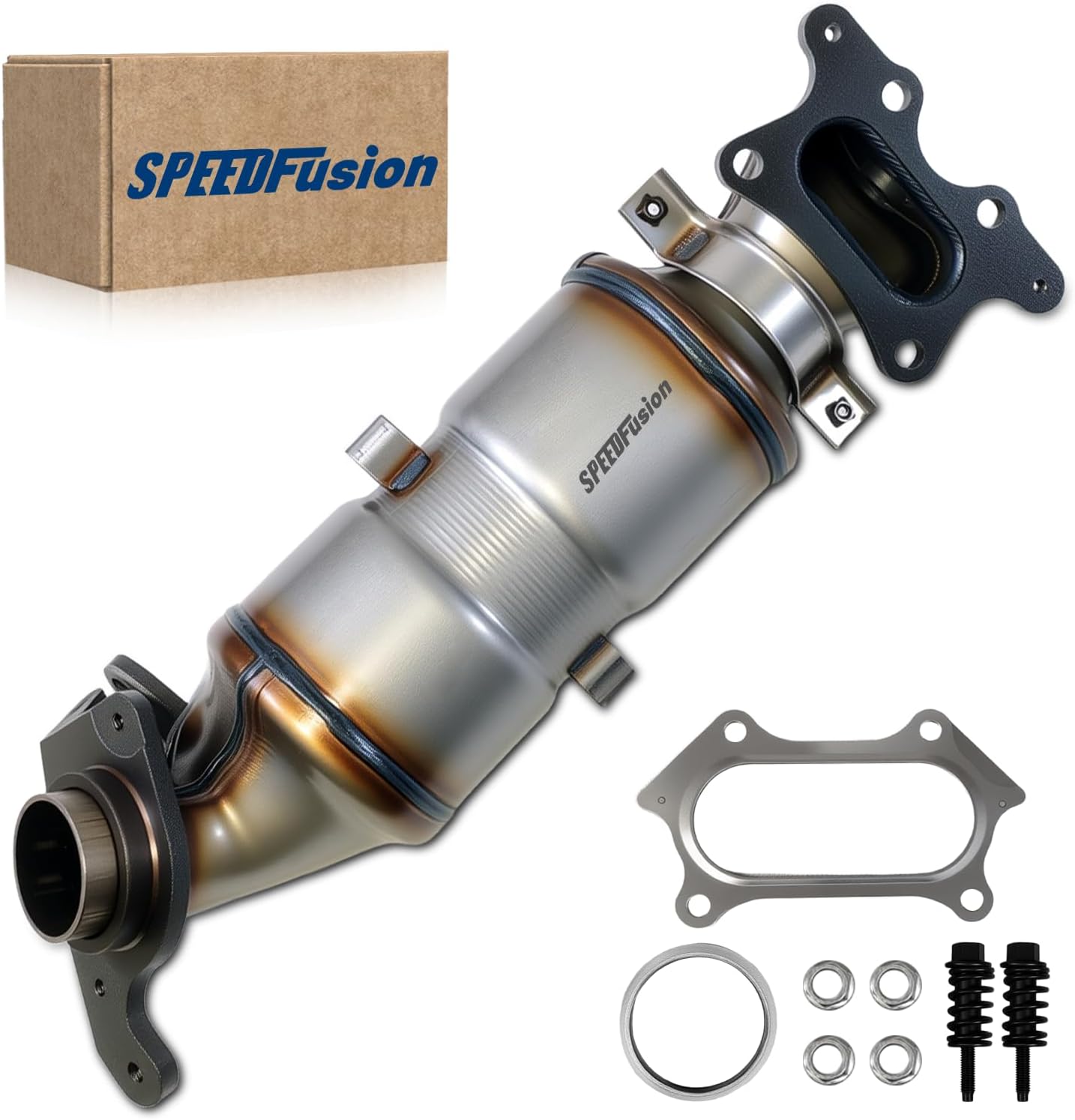
| Position | Front |
|---|---|
| Material | 409L stainless steel |
| Substrate | 400-hole ceramic, OEM-grade |
| EPA Compliance | Meets federal emission standards |
| Fitment years | 2006-2011 Honda Civic 1.8L |
This SPEEDFusion front catalytic converter replaces the failed unit on 2006–2011 Honda Civic 1.8L engines with a direct-fit assembly intended for bolt-in installation. It uses a 409L stainless steel shell and an OEM-grade 400-hole ceramic substrate plated with platinum, rhodium and palladium to accelerate exhaust cleaning and reduce emissions for vehicles meeting federal standards. The unit is marketed as EPA compliant and aims to keep check-engine lights related to catalyst efficiency from triggering when installed correctly. For a practical owner this offers a factory-replacement style solution without extensive modification and is suitable for installation at a professional shop. Note it is not CARB compliant so it cannot be used in states that require California standards, and any fitment must be confirmed against the listed OEM part numbers. The seller provides a structural and emissions warranty, but buyers should expect professional installation and occasional sensor or exhaust hardware matching to ensure a trouble-free swap.
Best for: Buyers who want a cost-effective, factory-style replacement that restores emissions function on a 2006–2011 Civic 1.8L and prefer a component designed to fit without major modifications.
Less Ideal for: Drivers in states that require California emissions certification or anyone needing a universal or multi-vehicle aftermarket converter.
- Direct-fit design for 2006–2011 Civic 1.8L simplifies installation
- Constructed from 409L stainless steel for corrosion resistance
- OEM-grade 400-hole ceramic substrate with plated precious metals for effective emissions conversion
- EPA compliant for vehicles meeting federal emission standards
- Not CARB compliant so illegal to install in states with California emission rules
Verdict: A practical, factory-style front catalytic converter for 2006–2011 Civic 1.8L owners who need an EPA-compliant direct-fit replacement.
4. PHILTOP Front High-Flow Catalytic Converter for Honda Civic 1.7L (2001–2005)
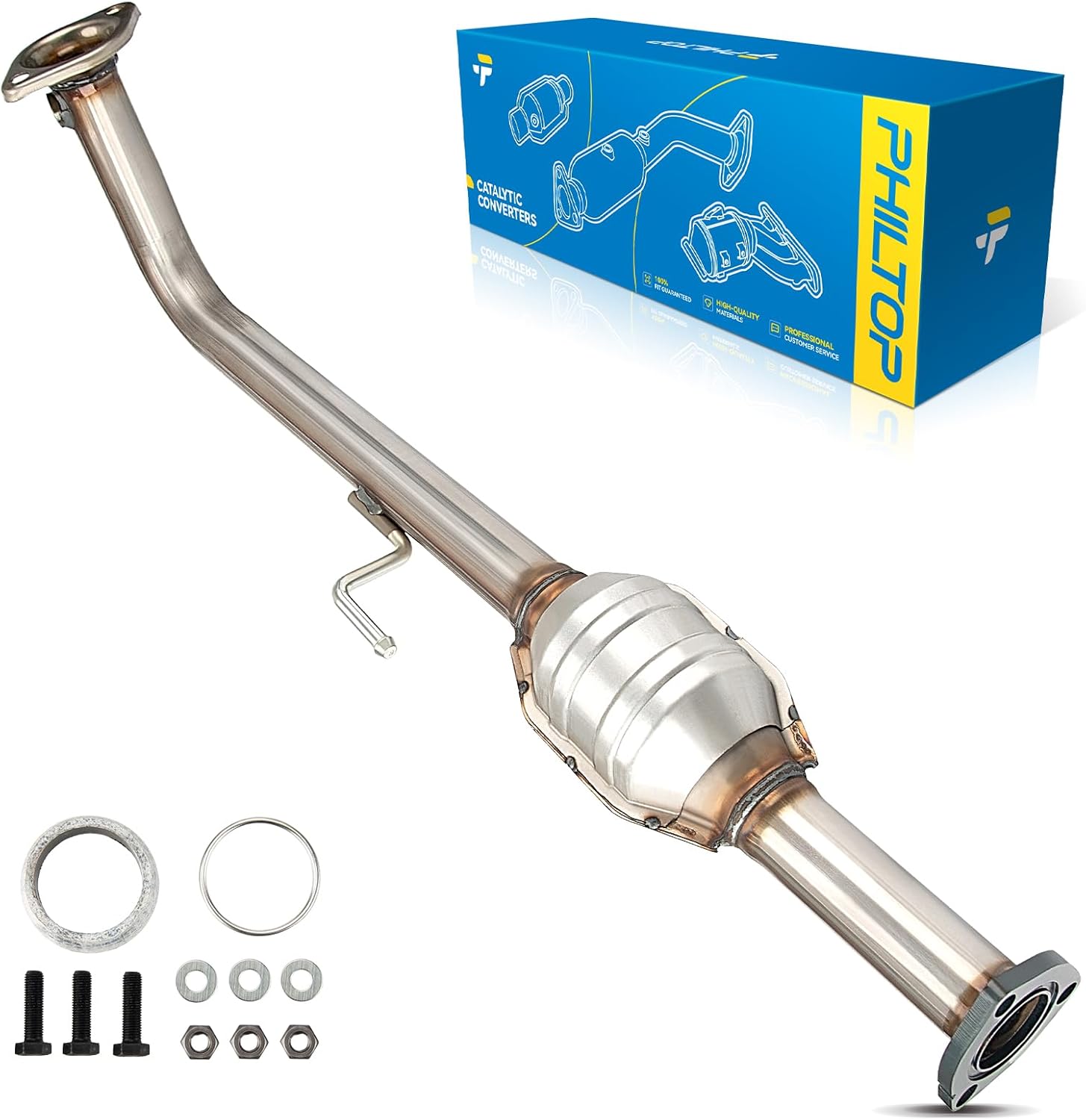
| Vehicle fitment | 2001-2005 Honda Civic 1.7L |
|---|---|
| Position | Front |
| Manufacturer | PHILTOP |
| EPA status | EPA-compliant |
This PHILTOP front catalytic converter is a bolt-on, flange-to-flange replacement built to restore emissions control and improve exhaust flow on 2001–2005 Honda Civic 1.7L cars. Its stainless/aluminized steel shell and double-layer ceramic carrier are intended to resist corrosion while offering a higher flow honeycomb substrate that can reduce backpressure and help recover a bit of lost power or fuel efficiency. The unit arrives with OE-style gaskets and mounting hardware so installation typically takes a few hours and no cutting or welding is required when fitment matches. Because it is EPA-compliant it is legal in most states but it is not approved for California, New York, or Maine. For budget-focused repairs this converter provides a practical balance of durability and performance compared with buying a dealer part, though it is an aftermarket unit rather than a factory part. Buyers should verify fitment against their vehicle reference numbers before installation.
Best for: Buyers needing an affordable, ready-to-install replacement to restore emissions function and improve exhaust flow on a 2001–2005 Civic 1.7L who prioritize cost and straightforward installation over buying a dealer unit.
Less Ideal for: Drivers in states with stricter emissions rules or owners who require a factory-brand OEM converter for warranty or regulatory reasons should look elsewhere.
- Direct-fit flange-to-flange design with included gaskets and hardware for straightforward installation
- High-flow double-layer ceramic substrate aimed at reducing backpressure and improving efficiency
- Stainless/aluminized steel body resists rust for longer service life
- EPA-compliant for use in most U.S. states
- Not approved for emissions-restricted states such as California, New York, or Maine
Verdict: A budget-friendly, direct-fit high-flow converter that restores emissions control and improves exhaust flow on 2001–2005 Civic 1.7L cars without complex installation.
5. Walker Ultra 15863 Direct-Fit Catalytic Converter

| Vehicle Service Type | Car |
|---|---|
| Automotive Fit Type | Vehicle Specific Fit |
| Manufacturer | Tenneco (Dynomax, Walker, Thrush) |
| Exterior | Machined |
The Walker Ultra 15863 is a vehicle-specific catalytic converter built as a direct bolt-on replacement for compatible late-1990s Civic models. It is intended for professional or DIY installation without cutting or fabrication thanks to OE-style hangers, flanges, brackets and heat shields that match factory routing. Walker specifies an EPA-compliant washcoat and precious metal loading to restore emissions control on OBDII vehicles while maintaining exhaust flow. The stainless-steel construction and thick flanges aim to resist corrosion and provide durable attachment points, though some long-term buyers have reported weld-area rust on older installations. In practice this unit simplifies getting a compliant replacement in place and reduces installation time compared with universal converters that require welding. If you prioritize a ready-to-install, factory-quality replacement that returns your Civic to proper emissions operation, this part delivers; if ultimate longevity in very corrosive climates is your top concern, plan to inspect welds and consider protective coating at install.
Best for: Buyers who want a ready-to-install, factory-style replacement to restore emissions compliance and normal exhaust flow without fabrication and who value a straightforward, professional-fit solution.
Less Ideal for: People seeking an ultra-long-life performance converter in extremely salty or highly corrosive climates without additional rust protection or welding reinforcements.
- Direct-fit design with factory-style hangers and flanges for bolt-on installation
- EPA-compliant washcoat and precious metal load for OBDII emissions control
- Stainless-steel construction and thick OE-style components improve durability
- Includes aluminized heat shields where originally equipped to protect undercarriage
- Some users report corrosion developing at weld joints over extended use in corrosive environments
Verdict: Choose this Walker direct-fit converter when you need a factory-style, EPA-compliant replacement that installs without welding and restores proper emissions control quickly.
6. DNA MOTORING Factory-Style Bolt-On Catalytic Converter for 2006–2011 Honda Civic DX/LX/EX

| Fitment | 2006–2011 Honda Civic DX, LX, EX |
|---|---|
| Compliance | Federal/EPA compliant (not for CA, ME, NY) |
| Installation | Bolt-on replacement, no welding required |
| Construction | Stainless steel body with aluminized piping |
This DNA MOTORING catalytic converter is built as a bolt-on factory-style replacement for 2006–2011 Honda Civic DX, LX, and EX models and installs without cutting or welding. It uses a stainless steel body with aluminized piping and a premium substrate with a high-technology washcoat to deliver EPA-compliant emissions performance and improved oxygen storage capacity compared with worn units. Typical use is a direct swap when the original converter is clogged, damaged, or failing emissions tests; professional installation is recommended to ensure correct fit and sensor alignment. The unit is marketed as design-validated to match factory fitment and lists matching part numbers for straightforward cross-referencing. Important limitations are legal: it is not for sale or use in California, Maine, or New York, and it may not match specialized Si, Hybrid, or GX variants, so confirm model fit before purchasing. For drivers who need a compliant federal replacement that bolts in like the original, this provides a practical, repair-focused option.
Best for: Buyers who want a straightforward, factory-style replacement that restores emissions performance and fits like the original, and who prioritize documented fitment and proven construction over aftermarket performance tuning.
Less Ideal for: Drivers in states with stricter local emissions rules or owners of hybrid, GX, or Si Civic variants should look for state-legal or model-specific converters instead.
- Direct bolt-on design that does not require welding or fabrication for faster replacement
- Built to match factory-style fitment and cross-references common OEM part numbers for easier verification
- Stainless steel body and aluminized piping for improved durability over heavily corroded originals
- EPA-compliant federal design with a high-technology washcoat and premium substrate for reliable emissions control
- Not legal for sale or use in California, Maine, or New York which limits where it can be used
- Does not fit Civic GX, Hybrid, or Si variants so confirm exact model compatibility before ordering
Verdict: A practical, bolt-on federal replacement that restores emissions function and fits like the factory unit for 2006–2011 Civic DX/LX/EX owners.
7. MAYASAF 2.5" Universal Catalytic Converter with O2 Port

| Inlet/Outlet ID | 2.5 inches |
|---|---|
| Overall length | 11 inches |
| O2 sensor port | Included |
| Exterior | Machined |
This MAYASAF universal catalytic converter is a compact, 11-inch unit built for 2.5-inch exhaust piping and includes a bung for an oxygen sensor. It is intended as a direct-replacement style part for systems with matching pipe diameter and is typically cut-and-welded or clamped into place by a muffler shop. The machined exterior and stamped description suggest a serviceable internal substrate that reduces emissions and can help restore proper engine behavior when a failing converter triggers check-engine lights or poor driveability. Installation may require professional fitting and welding; the seller recommends confirming local aftermarket regulations before purchase. Some buyers report tight fit tolerances and inconsistent marking of inlet versus outlet, and material claims vary across reviews, so expect to verify fit and construction when you receive it. For a risk-averse Honda Civic LX owner this unit can be a low-cost option to replace a worn converter when the vehicle uses a 2.5-inch exhaust diameter and you want a simple emissions-capable fix.
Best for: A Honda Civic LX owner who needs an affordable, emissions-capable replacement and prefers a simple part that a muffler shop can install quickly to clear emission faults and restore normal running.
Less Ideal for: If you want a guaranteed direct factory-spec replacement engineered specifically for Civic LX fitment or you need a part compliant with stricter state aftermarket rules, choose a vehicle-specific certified converter instead.
- Built for standard 2.5-inch inlet/outlet so it fits common aftermarket pipes
- Integrated O2 sensor port for retaining factory sensor monitoring
- Compact 11-inch overall length suitable for tight underbody locations
- Machined exterior finish that aids corrosion resistance and fit-up
- Universal design may need cutting and welding for a proper, leak-free installation
- Seller states stainless construction but some reviewers dispute actual material grade
Verdict: A straightforward, low-cost universal converter with an O2 port that works as a quick emissions-focused repair when a Civic LX uses 2.5-inch exhaust piping.
Choosing the Right Honda Civic LX Catalytic Converter: Key Factors to Consider
Fitment And Flange Compatibility
Exact fitment to the Civic LX exhaust geometry matters because misaligned flanges or incorrect pipe diameter lead to exhaust leaks, increased vibration, and potential accelerated wear on hangers and joints. Verify flange bolt pattern, pipe outer diameter, and overall unit length so the converter mates cleanly with the existing midpipe and manifold. A direct-fit unit minimizes the need for cutting or welding and reduces installation time.
Fit also affects oxygen sensor placement. Many Civic LX exhausts have specific upstream and downstream sensor bungs. A replacement that preserves the sensor locations avoids sensor relocation that could alter air-fuel readings and trigger diagnostic trouble codes. Confirm whether the converter includes pre-drilled sensor ports or requires you to transfer sensors from the original unit.
Catalyst Substrate And Cell Density
The substrate type and cell density determine how effectively the converter processes hydrocarbons, carbon monoxide, and nitrogen oxides. Higher cell densities can increase conversion efficiency but may also increase backpressure if not matched to engine output. For the Civic LX, choose a substrate designed for passenger-car exhaust flow to balance emissions reduction with minimal performance impact.
Substrate construction and washcoat quality influence longevity and resistance to thermal degradation. Ceramic monolith substrates are common and provide predictable performance, while metallic substrates heat up faster and tolerate thermal shocks better. Consider the typical driving conditions for the Civic LX when evaluating substrate choice.
Emissions Performance And Compliance
The primary purpose of a catalytic converter is to reduce tailpipe pollutants to meet regulatory standards. Look for units specified to meet federal or state emissions requirements applicable to the vehicle's registration area. Documents or specifications that cite emissions reduction rates, compliance certification, or compatibility with standard onboard diagnostics give confidence the unit will support inspection and maintenance regimes.
Compliance also ties into sensor compatibility and the vehicle's ability to pass emissions testing. A converter that interferes with oxygen sensor signals can cause failed inspections even if the catalyst itself is functional. Prioritize converters that explicitly note emissions compliance for passenger cars or provide test data.
Backpressure And Engine Performance
Catalytic converters inherently create some backpressure. Excessive backpressure can reduce engine efficiency, throttle response, and fuel economy—attributes Civic LX owners often prioritize. Choose a converter engineered to balance conversion efficiency with low flow restriction so normal driving performance remains unaffected.
Manufacturers may publish flow or pressure-drop data; when available, compare those figures against the Civic LX engine characteristics. A correctly matched unit should not alter drivability or cause limp-home modes on acceleration.
Durability And Corrosion Resistance
Exhaust components face high heat cycles and exposure to road salt and moisture. Materials, welding quality, and protective coatings determine how long the converter will last before rust or cracks compromise integrity. Look for stainless steel shells, high-quality welds, and heat shields where appropriate to extend service life on the Civic LX.
Consider regional climate and driving patterns. Short trips that keep the converter cooler can encourage condensation and premature corrosion, so heavy-duty construction is especially valuable if the vehicle sees frequent stop-and-go use.
Installation And Maintenance Practicalities
Ease of installation affects total ownership cost and downtime. Direct-fit converters that include necessary gaskets, hardware, and clear instructions reduce the need for shop labor. Check whether the unit comes with replacement flanges, gaskets, or pre-tapped sensor ports, or whether you must reuse parts from the original unit.
Maintenance considerations include availability of replacement hardware, ease of accessing oxygen sensors, and whether the design allows for future repairs without full unit replacement. These practical details influence long-term convenience for Civic LX owners.
Identifying Catalytic Converter Symptoms
Recognizing symptoms early helps you address converter issues before they cause broader engine or emissions problems. Common signs include a persistent check-engine light, noticeably reduced engine performance, or a rotten-egg sulfur smell from the exhaust. Some symptoms are subtle, such as slightly poorer fuel economy or a rough idle that comes and goes.
When you see a check-engine light catalytic converter-related code, it often points to oxygen sensor readings that indicate inefficient conversion. Distinguish converter symptoms from sensor or fuel system problems by correlating codes with driving behavior and performing visual inspections for rust, damage, or rattling internal substrates.
- Rotten-egg or sulfur odor
- Reduced acceleration or fuel economy
- Rattling noises from the exhaust area at idle
- Persistent check-engine light with downstream O2 sensor codes
Preparing Your Civic LX For Replacement
Before starting a catalytic converter replacement, gather the correct gasket and flange hardware for the Civic LX to prevent exhaust leaks. Allow the exhaust to cool and lift the car safely on jack stands or a lift. Inspect hangers and surrounding piping for rust so you can address adjacent issues while the vehicle is accessible.
If you plan to transfer oxygen sensors, label the upstream and downstream sensors and inspect their connectors and wiring. Replacing worn bolts or sensor plugs during the job reduces the chance of seized fasteners during future service.
- Confirm direct-fit part numbers and flange dimensions
- Have replacement gaskets and anti-seize compound on hand
- Check and, if needed, replace exhaust hangers and bolts
How Converter Choice Affects Emissions Testing
A correctly specified catalytic converter helps the Civic LX meet local emissions standards by effectively reducing hydrocarbons, carbon monoxide, and nitrogen oxides. Units explicitly designed for passenger cars and that preserve oxygen sensor function are most likely to support successful emissions test results.
If a replacement alters sensor signals or raises backpressure significantly, the vehicle may trip diagnostic trouble codes or fail tailpipe measurements. Verify compliance claims and sensor compatibility before purchase to avoid test-day surprises.
- Ensure sensor bung placement matches the original
- Look for units with stated emissions compliance or certifications
Installation Options: DIY Versus Professional Service
Some Civic LX owners with basic tools and a safe workspace can perform a direct-fit catalytic converter replacement. Direct-fit units that preserve bolt patterns and sensor locations generally require moderate mechanical skill and common tools. Plan for safe lifting, proper torque on flange bolts, and correct sealing to avoid leaks.
Professional installation is advisable if the replacement requires cutting, welding, or modification of exhaust components. A shop can also verify emissions readiness with diagnostic testing and ensure oxygen sensors are functioning within expected parameters.
- DIY is feasible for direct-fit swaps with available hardware
- Professional service recommended for welded or universal conversions
Maintaining Long-Term Converter Health
To prolong the life of a catalytic converter, address engine misfires, rich-running conditions, or oil consumption promptly since unburned fuel and contaminants can overheat and damage the substrate. Regularly inspect for exhaust leaks, damaged hangers, or corrosion that can accelerate failure.
Use recommended engine maintenance intervals for the Civic LX and resolve check-engine codes early. Proper maintenance prevents many causes of premature converter failure and helps preserve emissions performance over the vehicle's life.
- Repair misfires and fuel system issues quickly
- Keep exhaust system components in good condition to prevent stress on the converter
Still looking for the perfect fit?
Select your Honda Civic configuration to see the most relevant Catalytic Converters recommendations
How We Chose the Best Honda Civic LX Catalytic Converter
We focused on components and attributes that directly affect emissions control and driveability on the Honda Civic LX. Our selection criteria emphasized fitment accuracy to OEM flange and pipe dimensions, catalyst substrate type and cell density, and tested effectiveness at reducing key emissions. Durability factors included substrate mounting, heat shielding, and corrosion-resistant materials suitable for typical road salt and humidity conditions. We also weighed impact on oxygen sensor readings and downstream diagnostic stability to minimize false check engine triggers.Additional filters required units to be direct-fit or clearly specified for Honda Civic LX configurations so installation does not require extensive exhaust modification. We excluded universal converters that demand welding without clear fitment guidance and any options lacking documented emissions performance or substrate specifications. Finally, we considered ease of installation, availability of replacement gaskets or hardware, and manufacturer warranty or coverage terms as tiebreakers when technical specs were comparable.
Our full evaluation process is outlined in our review methodology.
FAQ
How can I tell if my Honda Civic LX catalytic converter is failing?
Common indicators are decreased acceleration, a rotten-egg sulfur smell, rattling noises from the converter area, and a check engine light with related oxygen sensor codes. Visual inspection for rust or damage and diagnostic trouble codes help confirm the issue.
Will replacing the catalytic converter reset the check engine light?
Replacing the converter can stop codes related to inefficient conversion if the underlying cause was the converter itself. However, the light may remain if oxygen sensors, wiring, or unrelated engine issues are still present. Clearing codes and completing a drive cycle helps confirm the repair.
Is a direct-fit catalytic converter necessary for the Civic LX?
A direct-fit unit reduces installation complexity and preserves sensor placement and flange compatibility, making it the preferred choice for most Civic LX owners. Universal converters may require welding and additional fabrication, increasing labor and potential fitment issues.
Can a bad catalytic converter affect fuel economy on the Civic LX?
Yes. Excessive backpressure or a partially clogged catalyst can reduce engine efficiency and lower fuel economy. Conversely, a properly functioning converter maintains correct exhaust flow and supports normal fuel consumption.
How long does a replacement catalytic converter typically last on a Civic LX?
Lifespan depends on driving conditions, maintenance, and build quality. Under normal driving and with proper engine maintenance, a well-constructed converter can last many years, but exposure to corrosion, engine issues, or frequent short trips can shorten service life.
Final Verdict
When replacing a catalytic converter on a Honda Civic LX, prioritize a unit that matches OEM fitment and preserves oxygen sensor locations to avoid diagnostic problems and ensure emissions compliance. Balance substrate type and cell density against expected driving conditions so you reduce pollutants without introducing excessive backpressure. Finally, address any underlying engine or fuel system faults before replacement to protect the new converter and maximize its service life.By focusing on fitment, emissions performance, and durability, you can choose a converter that restores proper exhaust function and keeps the Civic LX running cleanly and reliably.
Explore More:
- Check out all Honda Civic parts & accessories
- Explore Catalytic Converters Maintenance & Repair Guides
- Explore Exhaust & Emissions
- Browse all Auto Parts
