

Note: This article contains affiliate links. If you click on these links and make a purchase, I may earn a small commission at no extra cost to you. This helps support my research and content. Read my full affiliate disclosure here.
If your 2012-2015 Honda Civic is showing emissions problems or running rough, a correct catalytic converter can restore proper exhaust flow and emissions control. For Civic owners of the FB and FG chassis years, choosing a converter that matches factory fitment and emission standards matters for drivability and inspection compliance.This guide shortlists the top seven converters suited to the 2012-2015 Civic, explains what to watch for during selection, and outlines the performance and durability attributes that matter. Below you will find clear evaluation criteria and straightforward guidance to help you pick the right converter for your specific Civic configuration.
Looking for other parts? See all Honda Civic parts & accessories.
Top Picks at a Glance


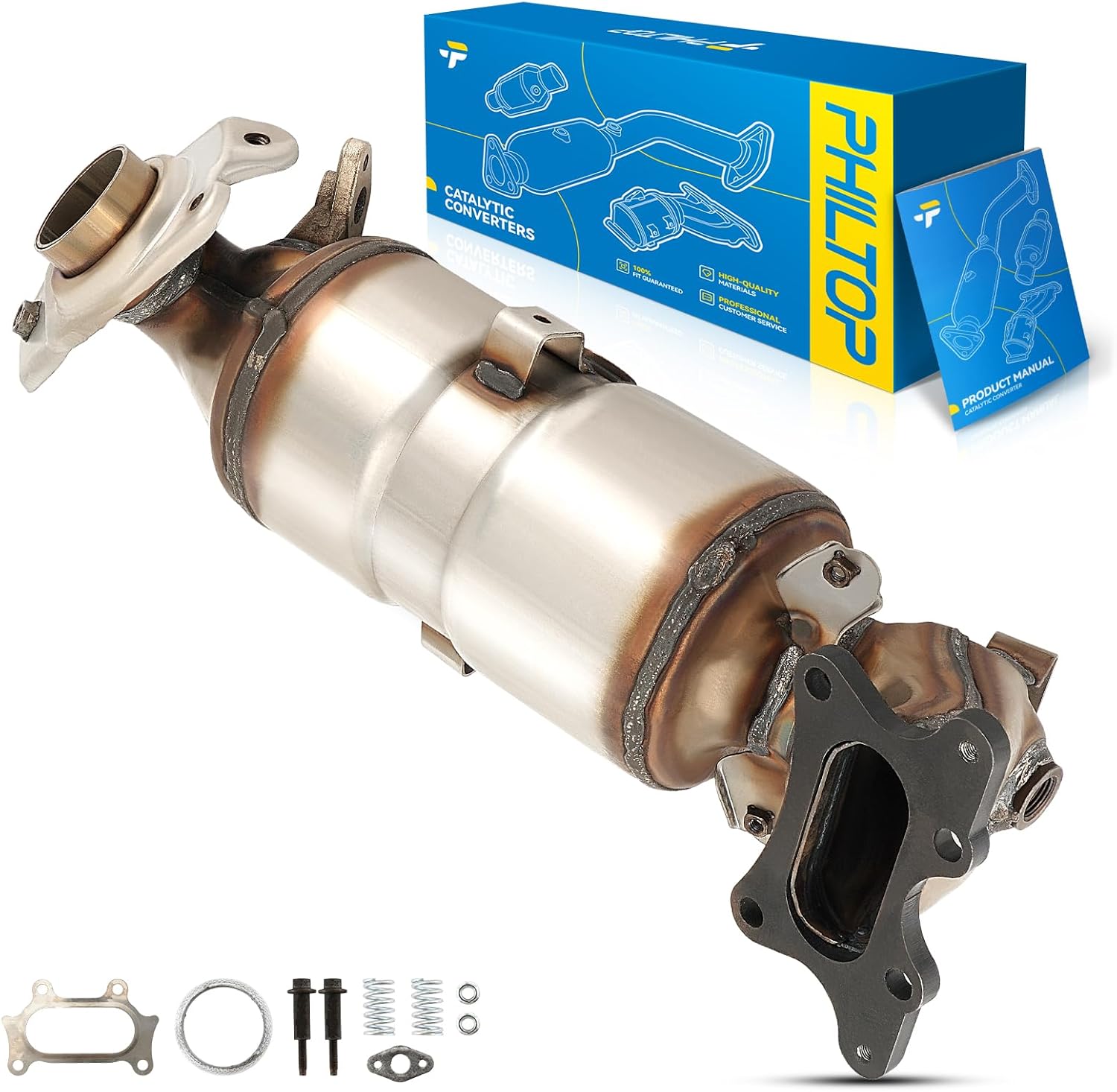
1. PHILTOP Front Catalytic Converter Compatible with Honda Civic 1.8L 2012–2013 and Acura ILX 2.0L 2013–2014
| Position | Front |
|---|---|
| Compatible engines | Honda Civic 1.8L (2012–2013); Acura ILX 2.0L (2013–2014) |
| Material | Stainless steel |
| EPA status | EPA compliant (federal) |
This PHILTOP front catalytic converter is a direct-replacement style unit intended for Honda Civic 1.8L (2012–2013) and Acura ILX 2.0L (2013–2014) applications. It uses a stainless-steel housing and a honeycomb ceramic substrate; PHILTOP says the internal design aims for higher flow to reduce backpressure and restore catalytic efficiency. The kit includes OE-style gaskets and mounting hardware so installation can usually be completed in a few hours without modifications. In real-world use buyers reported generally good fitment and quieter operation when replacing damaged converters, though a minority experienced misaligned brackets or flange gaps that required adjustment or shop help. EPA compliance makes it a legal federal replacement outside states with stricter rules. Expect the unit to return emissions function and clear related codes when it fits correctly, but be prepared to address bolt alignment or minor exhaust leaks during installation on some vehicles.
Best for: Buyers seeking a budget-conscious, factory-replacement style catalytic converter that restores emissions function and drivability while keeping installation straightforward.
Less Ideal for: Drivers in states with stricter aftermarket converter rules or those who want a guaranteed drop-in fit without any adjustment should consider other options or professional fitment checks first.
- Made from stainless steel for corrosion and heat resistance
- Includes OE-style gaskets and hardware for bolt-on installation
- EPA-compliant federal emissions unit suitable where allowed
- High-flow ceramic substrate intended to reduce backpressure and improve catalytic efficiency
- Some users reported bracket or flange alignment issues leading to exhaust leaks
Verdict: A practical, budget-friendly factory-replacement catalytic converter that restores emissions function for the specified Civic and ILX models when installed and adjusted properly.
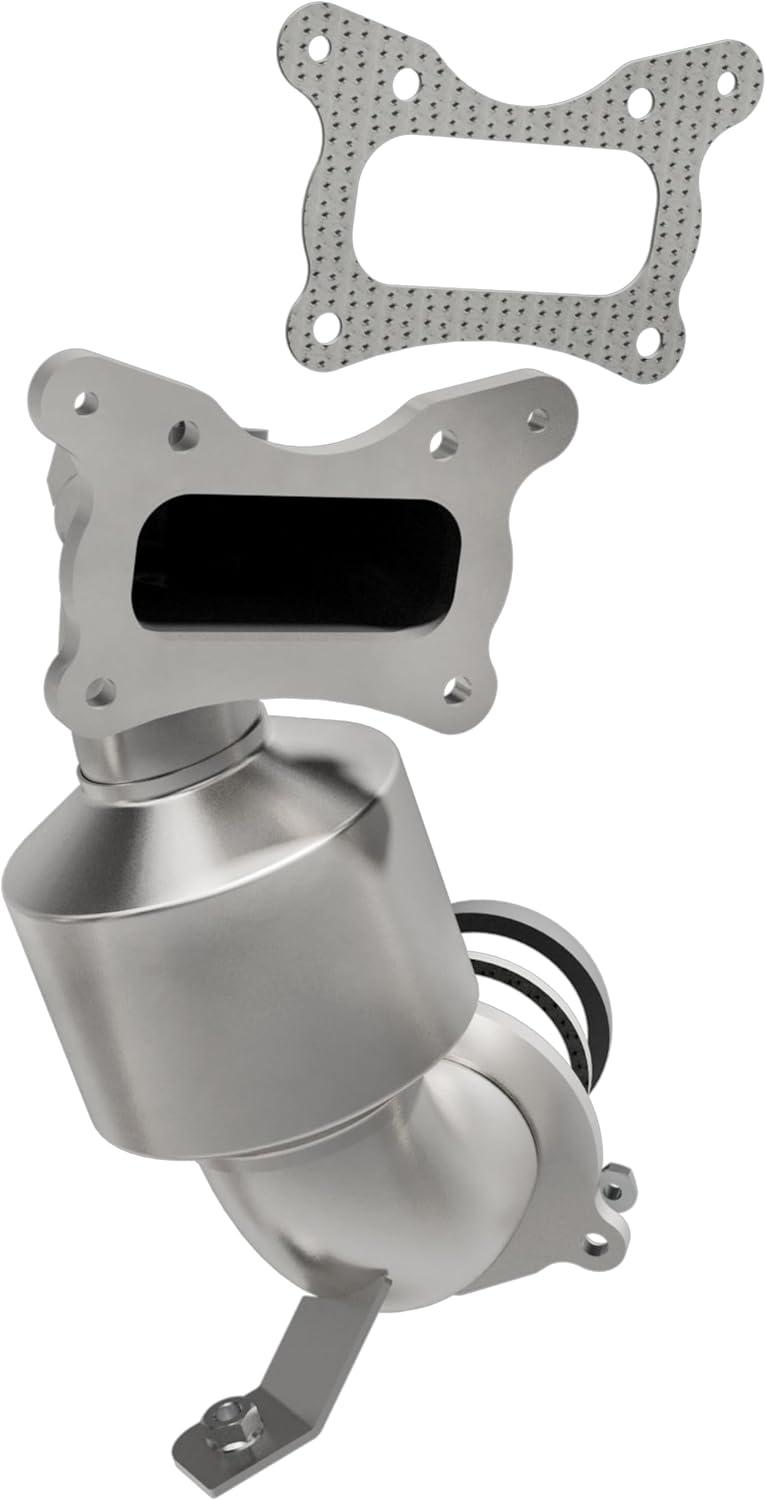
2. MagnaFlow 52032 Manifold Catalytic Converter (2012–2015 Honda Civic, 2013–2015 Acura ILX)
| Brand | MagnaFlow Exhaust Products |
|---|---|
| Model | 52032 |
| Exterior | Stainless Steel |
| OEM Part Number | 18190-R1Y-L00 |
This MagnaFlow manifold catalytic converter replaces the factory unit with a direct-fit component built from stainless steel and a spun-body design to resist corrosion. It installs using included gaskets and hardware and keeps original oxygen sensor port locations so it integrates with the existing exhaust and engine management system. The unit is intended for do-it-yourself or shop installation on the listed Civic and ILX years and trades a compact, low-mass body for quicker thermal efficiency and reduced leak risk thanks to a single laser fusion weld. Practical benefits include OEM-grade fitment, vibration-reducing flex piping, and a design that complies with federal EPA emissions rules for OBDII-registered vehicles. Limitations to note are legal restrictions on use in certain states and that the product is intended only for the specific model years listed; it is not a universal converter. Buyers seeking verified state-specific compliance should confirm local regulations before purchase.
Best for: Buyers focused on reliable, performance-minded replacements who want a factory-quality direct-fit catalytic converter that preserves engine management and exhaust characteristics on the specified Civic or ILX models.
Less Ideal for: People who need a universal or multi-vehicle converter or who live in states where this unit is restricted should look for alternatives that meet local legal requirements.
- Direct-fit design with included gaskets and hardware simplifies installation.
- Stainless-steel spun-body and laser fusion weld reduce corrosion and leak risk.
- Maintains factory O2 sensor port locations for straightforward integration.
- Designed to meet federal EPA emissions requirements for the specified vehicles.
- Not legal for use or sale in some states, check local regulations before installing.
- Fitment limited to listed 2012–2015 Civic and 2013–2015 ILX models, not universal.
Verdict: Choose this MagnaFlow direct-fit converter when you want a corrosion-resistant, OEM-grade replacement that preserves factory fitment and emissions compliance for the specified Civic/ILX years.
3. SAROTIN Catalytic Converter Direct Replacement for Honda Civic 1.8L 2014–2015

| Fitment | Honda Civic 1.8L L4 2014-2015 |
|---|---|
| Body Material | 409 stainless steel |
| Substrate Material | Cordierite ceramic carrier |
| O2 Sensor Ports | 1 O2 Sensor Port |
| Fitment Type | Direct Replacement |
This SAROTIN catalytic converter is a factory-style direct replacement for the Honda Civic 1.8L (2014–2015) designed to restore emissions function and clear P0420 codes. It installs without cutting or welding and includes a single O2 sensor port plus the required flanges for bolt-up mounting, which makes it straightforward for professional or experienced DIY installation. The unit uses a cordierite ceramic carrier and is coated with precious metal catalysts to perform the chemical conversion of exhaust gases while meeting federal EPA and OBD2 requirements. Practical benefits include a stock-like fit, included hardware in many cases, and the potential to remove drivability issues and reduce exhaust noise. Limitations are its lack of CARB approval, making it illegal in some states, and mixed long-term reliability reports across user installs, so expect variability compared with higher-end or dealer options. Overall it is a cost-effective option if you need a direct replacement that restores emissions function on compatible Civics.
Best for: Buyers who want a practical, budget-focused replacement that restores emissions performance and clears malfunction codes with minimal installation hassle.
Less Ideal for: Drivers in states that require CARB-compliant parts or owners who prioritize longest-possible factory-level longevity over upfront cost should choose a different option.
- Direct-fit design for 2014–2015 Honda Civic 1.8L that avoids cutting or welding
- Constructed from 409 stainless steel with a cordierite ceramic carrier and precious metal coating for emission conversion
- Includes a single O2 sensor port and welded flange connections for bolt-on installation
- EPA and OBD2 compliant for federal emissions requirements
- Typically ships with installation hardware and gaskets to simplify replacement
- Not CARB compliant and therefore not legal for use in certain states
- Some users report variable long-term durability compared with OEM units
Verdict: A cost-conscious, direct-fit replacement that restores emissions function and clears P0420 codes on 2014–2015 Honda Civic 1.8L without cutting or welding.
4. SCITOO Front Catalytic Converter Kit for Honda Civic 2014–2015 1.8L

| Position | Front |
|---|---|
| Vehicle fit | 2014-2015 Honda Civic 1.8L |
| Material | Stainless Steel |
| Inlet type | 6 Bolt Welded Flange |
| Outlet type | 4 Bolt Welded Flange |
This SCITOO front catalytic converter is a direct-fit replacement for 2014–2015 Honda Civic 1.8L models and comes with all gaskets and mounting hardware for a no-cut, bolt-on installation. It uses a stainless steel construction with a welded 6-bolt inlet flange and 4-bolt outlet flange, and the unit is marketed as EPA compliant for federal applications. In practice the converter is intended to restore emissions control, clear P0420/P0430 codes, and return your exhaust flow and engine efficiency to factory-like levels. The included hardware keeps installation straightforward for a home mechanic or independent shop. Limitations to note are state restrictions listed for certain states and the one-year replacement support rather than a longer warranty, so buyers who want extended coverage should consider that. For budget-focused repairs it offers a practical, lower-cost alternative to dealer parts while matching the necessary fitment and mounting features for the specified Civic models.
Best for: Buyers looking to replace a failed front catalytic converter on a 2014–2015 Civic 1.8L who prioritize a lower-cost, direct-fit repair that can be installed without cutting or welding.
Less Ideal for: Owners seeking long-term manufacturer-backed coverage or permitted parts for restricted state installations should consider alternatives with broader certification or extended warranties.
- Direct-fit design with included gaskets and mounting hardware for bolt-on installation
- Stainless steel construction with welded flanges for durability
- EPA compliant for federal applications and aimed to resolve common P0420/P0430 error codes
- Designed to match factory fitment for 2014–2015 Honda Civic 1.8L models
- Restricted for sale in some states which may limit legal fitment in certain regions
- Limited one-year replacement support instead of a longer warranty period
Verdict: A budget-friendly, direct-fit front catalytic converter that restores emissions control and bolts into 2014–2015 Honda Civic 1.8L cars with included hardware.
5. SPEEDFusion Front Catalytic Converter Compatible with Honda Civic 2012–2013

| Fitment | Honda Civic 2012-2013 L4 1.8L; Acura ILX 2013-2014 L4 2.0L |
|---|---|
| Material | 409L stainless steel |
| Certification | U.S. EPA compliant |
| Manufacturer | SPEEDFusion |
This SPEEDFusion front catalytic converter replaces the factory unit on compatible 2012–2013 Honda Civic and 2013–2014 Acura ILX four-cylinder models. It is a direct-fit part made from 409L stainless steel with a welded core-retention process, so installation is straightforward for a professional installer and no custom fabrication should be required. The converter uses an OEM-style ceramic substrate plated with platinum, rhodium, and palladium to meet federal emissions requirements and help prevent the check engine light from triggering codes like P0420 or P0430. Practical benefits include corrosion resistance from the stainless shell and the manufacturer warranty that covers structural and limited emissions performance. Limitations are that the unit is EPA compliant but not CARB approved, so it cannot legally be used in states that require CARB parts; buyers should also confirm the exact OEM reference number before ordering to ensure fitment. For reliability-focused repairs this converter offers a close match to factory performance when installed correctly.
Best for: Buyers who prioritize a reliable, durable factory-style replacement to restore emissions performance and avoid recurring check-engine codes after a failed converter.
Less Ideal for: Drivers in states that require CARB-compliant parts or those seeking a universal or modified high-performance converter should look elsewhere.
- Direct-fit design simplifies replacement and reduces need for modifications
- 409L stainless steel shell and anti-core-detachment welding for durability in tough underbody conditions
- OEM-grade ceramic substrate with precious metal plating to restore emissions control and reduce trigger of fault codes
- EPA certification for use on vehicles meeting federal emission standards
- Not CARB compliant so it is not legal for use in CARB states
Verdict: A durable, direct-fit EPA-compliant replacement that restores factory-style emissions control and reduces the risk of recurring fault codes for 2012–2013 Civic owners.
6. SAROTIN Catalytic Converter Compatible with Honda Civic 1.8L 2012–2013 / Acura ILX 2.0L 2013–2014 (EPA Compliant)

| Fitment | Honda Civic L4 1.8L 2012–2013; Acura ILX 2.0L 2013–2014 |
|---|---|
| Body Material | 409 stainless steel |
| Substrate Material | Cordierite ceramic carrier |
| O2 Sensor Ports | 2 O2 Sensor Ports |
| Outlet Type | 2-bolt welded flange |
This SAROTIN catalytic converter is a bolt-on direct replacement for the front inner position on Honda Civic 1.8L 2012–2013 and Acura ILX 2.0L 2013–2014 models and is intended to restore emission control and clear P0420 codes. It installs using the vehicle's existing 4-bolt inlet and 2-bolt outlet flange and includes two O2 sensor ports so your sensors can be retained. Constructed from 409 stainless steel with a cordierite ceramic substrate and a higher concentration of palladium, platinum, and rhodium in the catalyst, it aims to improve conversion efficiency and lifespan versus basic aftermarket units. EPA and OBD2 compliant, it is designed for legal use outside of CARB states and comes with a stated structural warranty and emission service life figure. Expect mostly bolt-on fitment but be prepared for minor heat-shield or bracket adjustments on some cars and plan professional installation if you are not experienced with exhaust work. This unit is a practical choice when you need a compliant replacement that balances catalyst quality and ease of installation.
Best for: Buyers who want a proven, compliant replacement to fix a P0420 or failing converter on 2012–2014 Civic or 2013–2014 ILX and who value products with documented customer feedback and warranty backing.
Less Ideal for: Drivers in CARB-regulated states or those who require a California-compliant converter should look for a CARB EO-certified unit instead.
- Direct bolt-on design with 4-bolt inlet and 2-bolt outlet for straightforward replacement
- Includes two O2 sensor ports so factory sensors can be reused
- Made from 409 stainless steel with an OEM-standard cordierite substrate for corrosion resistance
- Higher precious-metal catalyst content claimed to improve emissions conversion and service life
- Meets federal EPA and OBD2 requirements for non-CARB states and targets P0420 fault resolution
- Not CARB compliant so it cannot be used in California or Colorado
Verdict: A bolt-on, EPA-compliant replacement that focuses on higher precious-metal catalyst content to reliably fix emissions faults on 2012–2014 Civics and 2013–2014 ILX models.
7. VAVICARS Stainless Steel Catalytic Converter Direct-Fit for 2012–2013 Honda Civic 1.8L (EPA Approved)

| Fitment | 2012–2013 Honda Civic 1.8L (federal emissions) |
|---|---|
| Material | 409L stainless steel shell |
| Certification | EPA approved (federal models) |
| Installation | Direct fit, uses original mounting points |
This VAVICARS catalytic converter is a direct-fit replacement designed to bolt in without modifying the exhaust or mounting points on 2012–2013 Civic 1.8L federal-emissions cars. It uses a 409L stainless steel shell and a ceramic substrate with metal catalysts, and the listing states it carries an EPA approval number for federal models. In practice the unit addresses exhaust leaks, restores flow and can clear catalyst-related engine codes when installed with existing O2 sensors and heat shields transferred over. Installation is straightforward for a professional shop or a competent DIYer with basic tools. Buyers should note mixed user reports about internal catalyst longevity and weld quality; some owners saw reliable service while others reported early P0420 codes or corrosion at welds. This makes the part a budget-friendly, functional replacement for restoring emissions function and drivability, but not a premium long-term OE-level option in every case.
Best for: A conservative buyer looking to replace a failed catalytic converter on a 2012–2013 Civic 1.8L who prioritizes a straightforward fit and EPA compliance over a factory-level part.
Less Ideal for: Those seeking a long-term OEM-equivalent or high-end performance catalyst should consider higher-tier or dealer options instead of a budget aftermarket unit.
- Direct-fit design that uses factory mounting points for an easier bolt-in installation
- EPA-approved for federal emissions models which helps meet regulatory requirements outside restricted states
- 409L stainless steel shell offers improved corrosion and heat resistance compared with mild steel
- Many buyers report resolved exhaust leaks, improved flow, and compatibility with existing O2 sensors and hardware
- Some customers report early catalyst degradation or P0420 codes, indicating variable long-term internal catalyst durability
- Reports of inconsistent weld quality and surface rust out of the box suggest quality control can vary
Verdict: A budget-friendly, EPA-approved direct-fit replacement for 2012–2013 Civic 1.8L owners who need a quick, compliant fix for a failed catalytic converter.
Choosing the Right 2012-2015 Honda Civic Catalytic Converter: Key Factors to Consider
Direct Fit and Flange Compatibility
Direct-fit compatibility ensures the converter mates to the Civic's existing exhaust flanges, minimizing installation time and the need for fabrication. On 2012-2015 (FB and FG) Civics, flange type and bolt pattern vary by engine and exhaust trim, so confirm that mounting surfaces and gasket interfaces align.
A mismatch can cause exhaust leaks, which trigger check engine lights and degrade emissions performance. Choosing a part that replicates factory flange geometry preserves sensor positions and keeps the exhaust path consistent with the vehicle's calibrated backpressure, which helps maintain idle smoothness and throttle response.
Oxygen Sensor and Port Location
The converter must accommodate the upstream and downstream oxygen sensors in the exact locations used on the 2012-2015 Civic chassis. Sensor boss placement affects the engine control unit's readings and the converter's ability to meet emission thresholds.
Incorrect sensor placement can produce false feedback to the engine management system, causing long-term fuel trim issues or triggering the check engine light. Verify the number of sensor ports and their thread size to avoid re-drilling or welding additional bosses, which can compromise the unit's structural integrity.
Substrate Type and Catalyst Loading
Substrate composition—typically ceramic or metallic—affects how quickly the converter reaches operating temperature and how it tolerates thermal shock. Ceramic substrates often offer high surface area for catalyst coating but can be more brittle, while metallic substrates resist impact and heat cycling better.
Catalyst loading and washcoat quality determine conversion efficiency for hydrocarbons, CO, and NOx. For regulatory inspections and real-world emissions on the Civic, prioritize converters with adequate precious metal loading and uniform coating to ensure effective pollutant reduction across the typical driving temperature range.
Exhaust Flow and Backpressure
An appropriately designed converter balances emissions control with exhaust flow. Excessive backpressure from an overly restrictive unit can reduce engine power, decrease fuel economy, and increase exhaust gas temperatures. Conversely, a unit with insufficient catalytic volume may not meet emissions targets.
On the 2012-2015 Civic, where engine response and fuel economy are key owner concerns, choose a converter that preserves factory flow characteristics while delivering the necessary conversion efficiency. Look for units with optimized internal channels that minimize restriction without sacrificing catalyst surface area.
Durability and Corrosion Resistance
Materials and protective coatings determine how well a converter survives road conditions and temperature cycles. Stainless steel housings, quality welds, and corrosion-resistant coatings extend service life in climates with moisture and road salt exposure.
Heat-resistant mounting brackets and robust flanges reduce the likelihood of cracks and leaks. For a Civic you'll drive daily, prioritize converters with proven corrosion resistance and construction details that limit vibration-induced fatigue at weld joints and mounts.
Legal Compliance and Emissions Standards
Ensure the converter meets local emissions regulations applicable to your 2012-2015 Civic. Compliance affects inspection success and can influence whether the unit is acceptable for street use. Some converters are designed to meet federal or state-level certification standards; confirm which standards apply in your area.
Noncompliant replacements can cause failed inspections and potential legal issues. When selecting a converter, check documentation regarding emissions performance and whether the unit is advertised for on-road use for the Civic chassis years in question.
Common Symptoms That Point to a Failing Converter
Recognizing failure signs early helps you avoid secondary damage to sensors and the exhaust system. Owners of 2012-2015 Civics often notice a sulfur or rotten-egg smell, which can indicate a catalyst that is no longer converting hydrogen sulfide effectively.
Other common symptoms include reduced fuel economy, a noticeable drop in power or acceleration, and an audible rattling under the vehicle when the substrate has become disintegrated. Persistent check engine light illumination tied to oxygen sensor or catalyst efficiency codes is also a frequent indicator.
- Sulfur or rotten-egg odors from the exhaust
- Rattling noise under acceleration or during idling
- Reduced throttle response or acceleration
- Lower fuel economy than normal
- Check engine lamp illuminated with catalyst-related codes
Inspection Steps Before Replacing the Converter
Before deciding on replacement, perform a few diagnostic checks to confirm the converter is the root cause. Start with a visual inspection of the exhaust system for visible damage, leaks at flange joints, or detached heat shields, which can create similar symptoms.
Use live oxygen sensor data if available to look for abnormal upstream or downstream sensor readings. A downstream sensor that closely tracks the upstream sensor across all loads often suggests reduced catalyst efficiency. Also check for excessive exhaust backpressure and engine misfire history, since these can load and damage the catalyst over time.
- Visual check for external damage, dents, and leaks
- Compare upstream and downstream oxygen sensor readings
- Check for stored misfire or rich-running fault codes
- Measure exhaust backpressure if symptoms point to restriction
Fitment Tips for 2012-2015 (FB and FG) Civic Owners
When selecting a converter, verify whether your Civic is equipped with the smaller or larger exhaust routing used across engine and trim variations in the FB and FG years. Confirm the passenger-side and driver-side sensor locations, flange types, and any heat shield or bracket attachment points.
If you are unsure about exact fitment, compare physical measurements such as inlet and outlet diameters, overall length, and distance between flange centers. Ensuring these match your vehicle's exhaust geometry reduces the chance of modification and preserves factory mounting points.
- Confirm inlet/outlet diameters and overall unit length
- Match flange bolt pattern and sensor boss locations
- Check for included brackets or heat shield attachments
- Account for factory hanger positions to avoid stress
Installation Considerations and Common Shop Procedures
Most direct-fit converters for the 2012-2015 Civic install using existing flanges and oxygen sensors, but rusted bolts and seized nuts are common obstacles. Plan for penetrating fluid and occasional bolt extraction or replacement. Use proper torque values on flanges to prevent exhaust leaks without warping gasket surfaces.
Gasket condition and sensor thread sealing are important for a reliable installation. Replace exhaust gaskets and use anti-seize on oxygen sensor threads in accordance with manufacturer recommendations to simplify future service. If welding is necessary, confirm the shop understands the factory sensor placement and does not alter backpressure geometry.
- Carry new exhaust gaskets and replacement hardware to the shop
- Use anti-seize on oxygen sensor threads sparingly and correctly
- Be prepared for bolt extraction if fasteners are corroded
- Confirm torque specs and avoid overtightening flange bolts
How Proper Converter Choice Impacts Emissions Testing
A correctly sized and loaded converter helps the Civic meet tailpipe test thresholds for hydrocarbons, CO, and NOx. Converter efficiency at normal operating temperatures directly affects whether the vehicle passes inspections that monitor tailpipe concentrations or rely on onboard diagnostics.
Choosing a unit with the right substrate and catalyst loading reduces the likelihood of false failure results and repeated test attempts. For areas with strict emissions testing, prioritize converters documented to meet the applicable inspection requirements for the 2012-2015 Civic chassis.
- Proper substrate and loading improve cold-start and warmed-up conversion
- Correct sensor placement ensures accurate OBD-II monitoring
- Compliance documentation can reduce inspection ambiguity
- Avoid units that require system modifications to pass tests
Still looking for the perfect fit?
Select your Honda Civic configuration to see the most relevant Catalytic Converters recommendations
How We Chose the Best 2012-2015 Honda Civic Catalytic Converter
We prioritized converters that match the 2012-2015 Honda Civic's factory mounting points, oxygen sensor locations, and emissions calibration. Fitment accuracy was a primary filter because differences in flange type, piping diameter, and sensor boss placement directly affect installation time and leak risk. We also evaluated materials and construction quality to estimate long-term durability against road salts and heat cycling.Emissions performance and honeycomb substrate type were considered to gauge how effectively each unit reduces NOx, CO, and hydrocarbons. Flow characteristics were reviewed to balance backpressure and engine response, since overly restrictive units can harm drivability on these Civics. Heat management features, such as thermal wraps and robust welding, were included as a proxy for reliability under daily driving.We excluded units that required extensive custom fabrication or significant modification to the exhaust or oxygen sensor wiring. Converters that did not specifically support the FB and FG 2012-2015 Civic fitment or that lacked clear sensor boss locations were removed from consideration. Final selections reflect a mix of direct-fit options that prioritize correct geometry, emissions compliance, and service life.
Our full evaluation process is outlined in our review methodology.
FAQ
How can I tell if my 2012-2015 Civic needs a catalytic converter replacement?
Signs often include a persistent rotten-egg smell, rattling from under the car, reduced acceleration, or a check engine light with catalyst-related trouble codes. Perform a visual inspection and check oxygen sensor data before deciding on replacement.
Will replacing the catalytic converter clear a check engine light?
Replacing a failed converter can clear catalyst-efficiency codes, but the ECU may require several drive cycles to reset readiness monitors. Also address any upstream issues like misfires or rich-running conditions that could have damaged the converter.
Can I install a converter myself on a 2012-2015 Civic?
If you have basic mechanical skills and the right tools, a direct-fit converter can be installed at home, though corrosion may complicate bolt removal. For welded-in units or complex sensor locations, professional installation is often recommended.
Does the converter affect fuel economy on my Civic?
Yes, a heavily restricted or damaged converter can reduce fuel economy by increasing backpressure and altering engine efficiency. Restoring proper flow with a correctly matched unit typically returns fuel consumption to normal levels.
What should I check to ensure correct CAT converter fitment?
Confirm inlet and outlet diameters, flange bolt pattern, overall length, and sensor boss positions match your Civic's exhaust. Also verify any bracket or heat shield attachment points to prevent stress on the exhaust system.
Are there quick checks to identify catalytic converter failure signs?
Listen for rattling noises, note unusual exhaust odors, and scan for OBD-II codes referencing catalyst efficiency. Comparing upstream and downstream oxygen sensor responses during a test drive can also indicate reduced catalytic activity.
Final Verdict
When choosing a catalytic converter for a 2012-2015 Honda Civic, prioritize direct-fit geometry, correct sensor locations, and a substrate suited to the vehicle's typical driving conditions. Balance emissions performance with flow characteristics to avoid harming drivability or fuel economy.Focus on parts that match the Civic's flange and sensor layout, offer durable construction, and carry clear emissions documentation. That approach helps you select a converter that restores compliance and reliable operation without unnecessary modification or compromise.
Explore More:
- Check out all Honda Civic parts & accessories
- Explore Catalytic Converters Maintenance & Repair Guides
- Explore Exhaust & Emissions
- Browse all Auto Parts
