

Note: This article contains affiliate links. If you click on these links and make a purchase, I may earn a small commission at no extra cost to you. This helps support my research and content. Read my full affiliate disclosure here.
If you own a 2002-2005 Ford Explorer, choosing the right engine oil matters for drivability, longevity, and leak prevention as mileage climbs. This guide looks at the top oil options suited to the Explorer's engines and common service needs, focusing on viscosity choices, synthetic versus conventional formulations, and high-mileage considerations.We shortlisted seven engine oils that meet the typical operating expectations for this model range. Below we explain the evaluation criteria used, outline important buying factors specific to the Explorer, and answer common owner questions to help you pick the right oil for routine service or extended-interval use.
Looking for other parts? See all Ford Explorer parts & accessories.
Top Picks at a Glance
| Best Overall Engine Oil Top pick for balanced protection, performance, and broad compatibility | Mobil 1 Advanced Full Synthetic Motor Oil 5W-30, 5 Quart |  |
| Best Budget Engine Oil Affordable jug that still meets key API/ILSAC specifications | HAVOLINE 5W-20 Conventional Motor Oil, 1 qt. |  |
| Best 5W-20 Engine Oil Formulated to the 5W-20 viscosity spec for recommended engines | Castrol EDGE 5W-20 Advanced Full Synthetic Motor Oil, 5 Quart Jug |  |
| Best 5W-30 Engine Oil 5W-30 viscosity grade offering broader temperature and wear protection | Castrol EDGE 5W-30 Advanced Full Synthetic Motor Oil, 5 qt |  |
| Best Long‑Drain / Extended Performance Oil Formulated for longer service intervals and extra thermal stability | Castrol EDGE Extended Performance 5W-20 Full Synthetic Motor Oil, 5 Quart |  |
| Best Motorcraft / OEM‑Spec Engine Oil Genuine OEM or factory‑approved oil meeting manufacturer specs | Motorcraft SAE 5W-20 Synthetic Blend Motor Oil, 5-Quart Jug |  |
| Best Bulk / Value Pack Engine Oil Multi‑quart packs or cases that lower per‑quart cost for frequent use | Motorcraft 5W-20 Synthetic Blend Motor Oil, 12-Quart Case |  |
1. Mobil 1 Advanced Full Synthetic Motor Oil 5W-30, 5 Quart
Best Overall Engine Oil

| Size | 5 Quart |
|---|---|
| Viscosity Level | Low to Medium |
| Liquid Volume | 5 Liters |
| Container Type | Bottle |
Mobil 1 Advanced 5W-30 is a full-synthetic motor oil designed to give everyday drivers reliable wear protection and engine cleanliness between service intervals. It is typically used as a replacement in oil changes for gasoline engines where 5W-30 is recommended, delivering low-temperature flow for quicker cold starts and high-temperature stability to resist breakdown and deposits. Notable features include synthetic molecule uniformity for reduced friction, thermal protection up to about 500°F, and a formulation meeting ILSAC GF-6 standards aimed at reducing low-speed pre-ignition and timing chain wear. For a 2002–2005 Ford Explorer, this oil supports extended drain intervals up to the product guidance and helps maintain engine temperatures and cleanliness under normal driving and occasional towing. The main limitation is that viscosity choice must match the Explorer engine's specified requirement and local climate, since some engines in that model range may call for different viscosities or service intervals under heavy-duty use.
Best for: DIY owners of 2002–2005 Ford Explorer seeking a dependable, factory-quality synthetic oil that prioritizes wear protection, deposit control, and broad compatibility with common gasoline engines.
Less Ideal for: Owners planning extreme towing, heavy duty commercial use, or those whose engine manual specifies a different viscosity or specialized oil should consider alternatives tailored to those conditions.
- Full synthetic formulation for improved high-temperature stability and low-temperature flow
- Meets ILSAC GF-6 standards to help with LSPI and timing chain wear protection
- Designed to reduce deposits and help keep engines clean over extended intervals
- Proven thermal protection to help control oxidation and oil breakdown
- 5W-30 viscosity may not be optimal for every 2002–2005 Explorer engine or for extreme climates
Verdict: The one-engine-oil choice for DIYers who want reliable wear protection, deposit control, and wide compatibility across common gasoline engines.
2. HAVOLINE 5W-20 Conventional Motor Oil, 1 qt.
Best Budget Engine Oil

| SAE J300 Viscosity Grade | 5W-20 |
|---|---|
| Compatible with Vehicle Type | Car |
| Container Type | Bottle |
| Liquid Volume | 32 Fluid Ounces |
This Havoline 5W-20 is a straightforward conventional motor oil intended for routine maintenance on cars that call for a 5W-20 viscosity. It is typically used at each oil change to lubricate engine components, resist thermal breakdown, and limit deposit formation under everyday driving and stop-and-go conditions. The formula emphasizes deposit control and anti-wear protection suitable for older or low-mileage engines that do not require synthetic blends. Benefits include easy availability in single-quart bottles for top-offs and compatibility with vehicles specifying 5W-20. Limitations are that it is a conventional oil without premium synthetic additives, so it will not match the long-change intervals, cold-start performance, or extreme-temperature stability of synthetic or synthetic-blend oils. For owners sticking to regular service intervals and looking to save on oil costs, this delivers acceptable protection; drivers who want maximum longevity and high-stress performance should consider higher-grade options.
Best for: Buyers who prioritize low cost and need a serviceable 5W-20 for routine oil changes or occasional top-offs on compatible vehicles.
Less Ideal for: Drivers seeking extended oil-change intervals, high-performance protection, or better cold-start viscosity should choose a synthetic or synthetic-blend alternative.
- Matches SAE 5W-20 viscosity commonly required by many engines
- Formulated to reduce deposit and sludge formation under normal driving
- Provides basic anti-wear protection for routine maintenance
- Sold in single-quart bottles convenient for top-offs and small jobs
- Conventional formula lacks synthetic additives for extended drain intervals or extreme-temperature performance
Verdict: A cost-conscious oil that meets required specifications and provides acceptable protection for routine maintenance without premium additives.
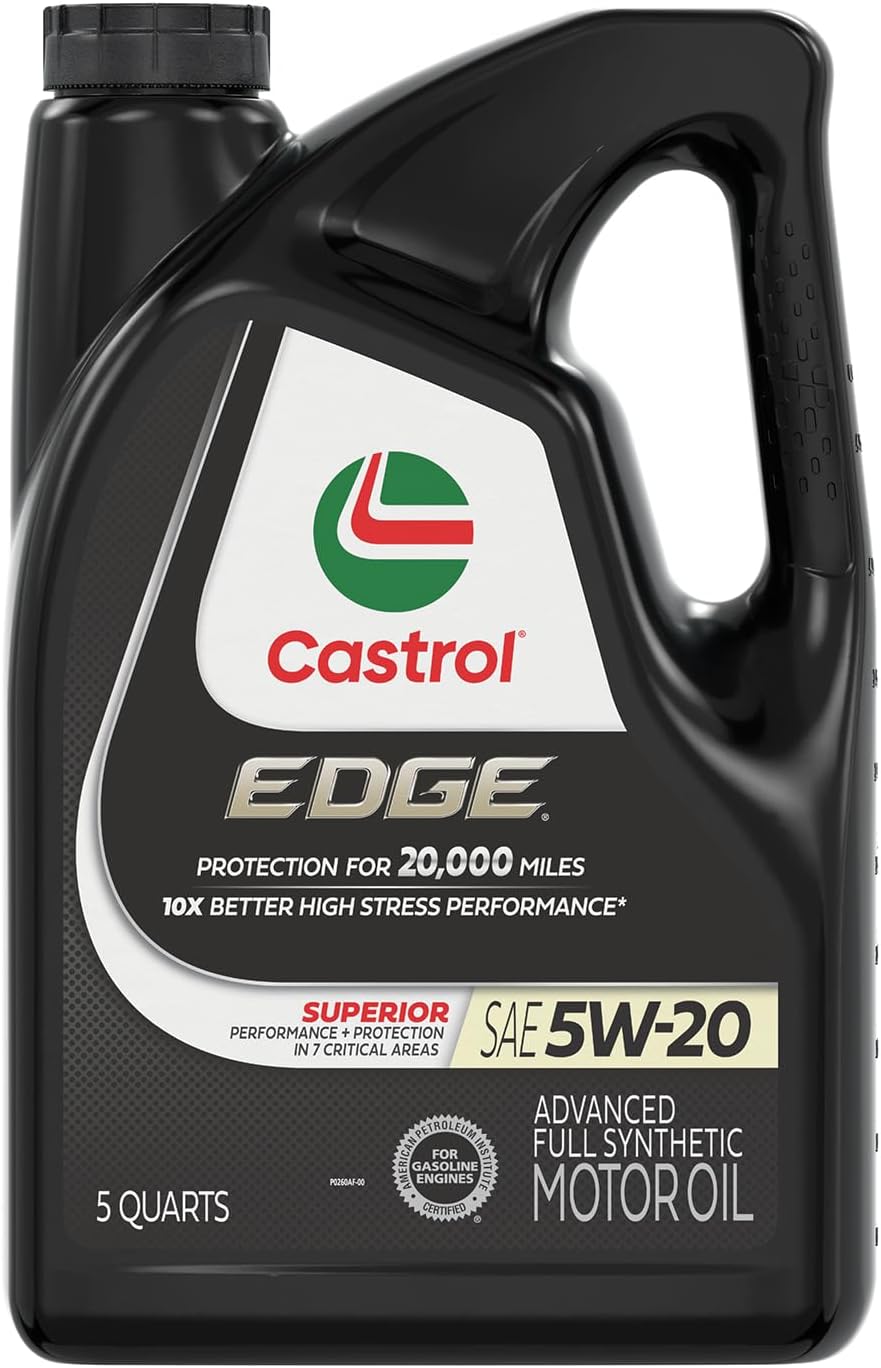
3. Castrol EDGE 5W-20 Advanced Full Synthetic Motor Oil, 5 Quart Jug
Best 5W-20 Engine Oil
| SAE Viscosity Grade | 5W-20 |
|---|---|
| Type | Full Synthetic |
| Container Type | Jug |
| Liquid Volume | 5 Quarts |
| Compatible with Vehicle Type | Car, Truck |
Castrol EDGE 5W-20 is a full synthetic engine oil designed for vehicles that specify 5W-20 and for owners who want improved cold-start flow and high-temperature durability. It is used like any conventional oil change fill but is formulated with proprietary additives that aim to reduce wear, control sludge, and maintain viscosity under pressure. The product highlights endurance at high temperatures and longer oil life compared with conventional oils, which can translate to cleaner internals and steadier engine performance over extended intervals. It is packaged in a 5 quart jug that covers most single oil changes for V6 four-cylinder engines common in mid 2000s SUVs. Important limitations are that compatibility must be checked against Ford specifications for the 2002-2005 Explorer and that some manufacturers limit extended oil change intervals, so follow your vehicle service recommendations rather than relying solely on the product's longer-life claims.
Best for: Drivers whose engines require 5W-20 and who prioritize strong cold-start protection, reduced engine wear, and stable high-temperature performance.
Less Ideal for: Owners who prefer to follow strictly short OEM oil change intervals or who need a different viscosity or performance spec than 5W-20 should choose an alternative.
- Full synthetic formulation improves cold-start flow and viscosity control at 5W-20
- Engineered additives aim to reduce sludge and metal-to-metal wear
- Designed for high-temperature stability to help maintain performance under stress
- 5 quart jug size suits a typical single oil change without needing multiple containers
- Manufacturer claims about extended change intervals may conflict with vehicle service schedules
Verdict: Choose this slot if your engine calls for 5W‑20 oil and you want a product optimized for that viscosity and cold-start flow.
4. Castrol EDGE 5W-30 Advanced Full Synthetic Motor Oil, 5 qt
Best 5W-30 Engine Oil

| SAE Viscosity Grade | 5W-30 |
|---|---|
| Liquid Volume | 5 Quarts |
| Licensing | API SP, ILSAC GF-7 |
This Castrol EDGE 5W-30 jug is a full synthetic motor oil designed to protect engines under higher heat and load. For drivers of a 2002–2005 Ford Explorer using 5W-30, it delivers stable viscosity at operating temperature, helps control sludge, and includes additive chemistry aimed at reducing metal-to-metal wear. Typical use is routine oil changes where you want improved high-temperature performance and cleaner internals compared with conventional oils. Notable features include Castrol's advanced additive system, claimed extended oil life properties, and industry licensing such as API SP and ILSAC GF-7, which support compatibility with modern engine requirements. Practical benefits for the Explorer include better resistance to breakdown during highway driving or towing and potential fuel economy consistency through reduced friction. Limitations to note are that extended drain claims should be followed only if you confirm with your engine condition and service history, and this product is a universal 5W-30 option rather than a vehicle-specific formulation, so always check your owner's manual or dealer guidance for any factory-recommended oil specifications for your Explorer's engine variant.
Best for: Drivers of 2002–2005 Ford Explorers who choose 5W-30 to improve high-temperature protection and maintain cleaner engine internals during regular highway or towing use.
Less Ideal for: Owners who must strictly follow a different factory oil specification for a modified or heavily worn engine or who prefer non-synthetic oils for older engines.
- Full synthetic formulation for stronger high-temperature stability and cleaner engine internals
- Formulated to reduce wear and control sludge for longer engine life
- Meets API SP and ILSAC GF-7 licensing for modern gasoline engine protection
- 5 quart jug provides a practical quantity for a single oil change on most V6 and V8 Explorer engines
- Extended drain interval claims depend on vehicle condition and should not replace scheduled maintenance
Verdict: This pick is for buyers who prefer or require a 5W‑30 viscosity for improved high-temperature protection and versatile performance.
5. Castrol EDGE Extended Performance 5W-20 Full Synthetic Motor Oil, 5 Quart
Best Long‑Drain / Extended Performance Oil

| SAE Viscosity Grade | 5W-20 |
|---|---|
| Volume | 5 Quarts |
| Compatible Vehicle Type | Car, Gasoline and Light Duty Diesel, Hybrids, Truck |
| Viscosity Level | Low to Medium |
| Approvals | Exceeds API SP/SN+, ILSAC GF-7, ACEA C5, GM dexos1 Gen 3 |
Castrol EDGE Extended Performance 5W‑20 is a premium full‑synthetic motor oil designed to extend oil change intervals while protecting modern engines. It is typically used in vehicles that specify 5W‑20 viscosity and where longer drain intervals are desired; the formulation claims resistance to oxidation and thermal breakdown so it maintains protective film strength at high temperatures. Notable features include Castrol’s proprietary additive technology, claimed compliance with GM dexos1 Gen 3 and ACEA C5 specifications, and a stated extended drain capability up to 25,000 miles or one year. In practical use this oil should reduce wear, help control deposits and preserve engine performance between services, but the extended drain claim depends on following manufacturer maintenance guidance and monitoring oil condition. It is best for drivers seeking a high‑stability synthetic when a 5W‑20 is recommended, though owners should confirm the long‑drain interval is appropriate for their 2002–2005 Ford Explorer engine and driving conditions before extending service intervals.
Best for: Buyers who prioritize extended oil life and strong high‑temperature protection in a 5W‑20 synthetic for routine driving and highway miles, and who will verify service practices before lengthening intervals.
Less Ideal for: Drivers who prefer strictly factory‑recommended oil change intervals, those with heavily worn engines, or owners who operate under severe duty cycles without oil analysis.
- Full synthetic formulation for better thermal stability and oxidation resistance
- Engineered additive system aimed at improved wear protection
- Meets/delivers modern specifications including GM dexos1 Gen 3 and ACEA C5
- Marketed for extended drain capability to reduce service frequency
- Extended 25,000‑mile drain interval is a manufacturer claim that may not suit older engines or severe operating conditions
Verdict: Select this category if you want a full‑synthetic oil engineered for extended drain intervals and stronger resistance to oxidation and shear.
6. Motorcraft SAE 5W-20 Synthetic Blend Motor Oil, 5-Quart Jug
Best Motorcraft / OEM‑Spec Engine Oil

| SAE J300 Viscosity Grade | 5W-20 |
|---|---|
| Container Type | Jug |
| Liquid Volume | 5 Quarts |
| Compatible with Vehicle Type | Car, SUV, Truck, Van |
This Motorcraft 5W-20 is a factory-formulated synthetic blend intended as a direct fit for many Ford, Lincoln, and Mercury gasoline engines. It is sold as a single 5-quart jug and is used for routine oil changes where the vehicle maker specifies 5W-20 viscosity and WSS-M2C960-A1 or equivalent performance. The oil is built from high-viscosity-index base stocks and performance additives to limit deposits, protect against oxidation and turbocharger residues, and resist low-temperature gelling. Motorcraft also highlights friction-reducing technology that can help improve fuel economy compared with heavier grades like 5W-30. Practical benefits include manufacturer-recommended fitment for covered model years, broad compatibility across common Ford powertrains, and reduced risk of oil-related low-speed pre-ignition thanks to spec conformance. The main limitation is that it is a synthetic blend rather than a full synthetic, so some buyers seeking maximum thermal stability or extended drain intervals may prefer a full synthetic alternative.
Best for: Buyers who want an engine oil that matches Ford's recommended formulation and fitment for covered model years and prefer using factory-specified fluids for routine maintenance.
Less Ideal for: Drivers who plan long extended oil-change intervals, demand the highest-temperature stability, or require a viscosity other than 5W-20 should consider alternative full synthetic or different-grade oils.
- Factory-formulated to meet Ford performance specification WSS-M2C960-A1
- Targets deposit control and wear protection with specially designed additives
- Friction-reducing chemistry can improve fuel economy versus heavier grades
- Sold in a 5-quart jug convenient for a single oil change
- Synthetic blend rather than full synthetic so may not match extended-drain full synthetic performance
- Not suitable for engines that require viscosities other than 5W-20
Verdict: This slot highlights oils that carry Motorcraft or equivalent OEM approvals for buyers prioritizing factory‑recommended formulations and fit-for-purpose chemistry.
7. Motorcraft 5W-20 Synthetic Blend Motor Oil, 12-Quart Case
Best Bulk / Value Pack Engine Oil

| Viscosity grade | 5W-20 |
|---|---|
| Liquid Volume | 12 Quarts |
| Compatible with Vehicle Type | Car, Truck |
This 12-quart case of Motorcraft 5W-20 synthetic blend oil is designed for routine engine service where 5W-20 is the recommended viscosity. Packaged as a multi-quart case, it lets you store enough oil for several oil changes so you can do maintenance at home or service multiple vehicles without repeated purchases. The formula is manufactured to Motorcraft specifications intended to match factory replacement performance for compatible engines and offers the handling benefits of a synthetic blend at a value point. Practical benefits include fewer trips to buy oil, consistent supply on hand during service, and predictable viscosity for cold starts and normal operating temperatures. Limitations are that it is the single 5W-20 grade only, so it will not suit engines requiring different viscosities, and buying a case requires storage space and upfront cost compared with single quarts.
Best for: Buyers who do regular maintenance or service multiple vehicles and want to keep several oil changes on hand to save time and reduce per-quart cost.
Less Ideal for: Drivers who need a different viscosity or who lack space to store a multi-quart case should consider single-quart purchases or a different grade.
- Large 12-quart case reduces trips to buy oil and lowers cost per quart for multiple changes
- Synthetic blend formulation balances protection and value for routine service
- Produced to Motorcraft vehicle fit specifications for compatibility with Ford engines when 5W-20 is required
- Only available in a single viscosity grade so not suitable for engines needing different oil weights
Verdict: Pick this option if you perform regular maintenance or multiple oil changes and want larger packs to reduce cost per quart and trips to buy oil.
Choosing the Right 2002-2005 Ford Explorer Engine Oil: Key Factors to Consider
Correct Viscosity
Viscosity determines how the oil flows at startup and at operating temperature, and selecting the right grade is crucial for the 2002-2005 Ford Explorer. Using a viscosity that is too thin can reduce film strength under load and increase wear, while oil that is too thick can impair cold starts and circulation.
Consult the vehicle's recommended viscosity range for your climate and driving conditions. For many owners in temperate climates, a common choice balances cold-start flow with adequate high-temperature film strength. Consider seasonal temperature swings and the engine's wear condition when picking between grades.
Synthetic Versus Conventional
Synthetic motor oils offer better thermal stability and oxidation resistance compared with conventional oils, which helps maintain viscosity and protect bearings over longer service intervals. For Explorers with higher mileage or frequent towing and heavy loads, synthetics can reduce sludge formation and improve cleanliness.
Conventional oils may still be acceptable for regular-service, low-mileage use, but owners planning extended drain intervals or operating in hot climates should weigh the benefits of synthetic or synthetic-blend options.
High-Mileage Formulations
Engines with significant mileage often need oils that address seal conditioning, reduced oil consumption, and deposit control. High-mileage engine oils include additives that can swell or soften aged seals slightly to reduce leaks and contain detergents tailored to older combustion chambers.
If your Explorer has crossed the 75,000 to 100,000-mile range, high-mileage formulations can help mitigate common wear-related symptoms. Keep in mind these oils will not repair mechanical wear but can slow progressive issues and improve oil control.
Additives and Detergent Packages
The additive package impacts cleanliness, corrosion protection, and the oil's ability to neutralize acids. Robust detergent and dispersant chemistry helps keep pistons, rings, and oil galleries free of varnish and sludge, which supports long-term compression and efficiency.
Anti-wear additives like zinc dialkyldithiophosphate are important for protecting valve trains and cam lobes, especially in older Ford engines. Corrosion inhibitors and anti-foam agents also contribute to stable performance across driving cycles.
Cold-Start Performance
Cold-start protection is a practical concern during winter or frequent short trips. Low-temperature viscosity and pour point determine how quickly oil circulates on startup; faster circulation reduces initial wear from metal-to-metal contact.
If you operate the Explorer in cold climates or make many short trips, prioritize oils with appropriate low-temperature flow properties so the oil reaches critical components rapidly.
Compatibility With Service Intervals
Your chosen oil should align with the service interval you plan to use. If you follow shorter, conservative change intervals, a wider range of oils will be acceptable. For extended intervals, choose oils with proven oxidation resistance and detergent capacity to maintain protection between changes.
Also consider the oil filter quality and maintenance history, since degraded filtration or skipped changes will reduce any oil's effective life. Matching drain interval practices to the oil's design is key to preserving engine health.
Viscosity Choices for Different Climates
Selecting the right viscosity grade depends on local temperatures and how you use the Explorer. Warmer climates and heavy-load situations favor higher high-temperature viscosity to maintain protective film strength, while colder regions require lower cold-start viscosity for faster circulation.
For owners who experience a wide seasonal range, consider switching between an appropriate winter grade and a summer grade during scheduled services rather than using an overly broad compromise grade year-round.
- Colder climates: prioritize lower cold-start viscosity
- Hot climates or towing: ensure higher high-temperature viscosity
- Moderate climates: a balanced all-season grade often suffices
When to Use High-Mileage Oil
High-mileage oils are formulated to address the typical challenges of older engines, such as increased oil consumption, minor leaks, and deposit buildup. If your Explorer has accumulated significant miles or shows signs of oil burning or external seepage, high-mileage formulations can help stabilize seals and reduce consumption.
If maintenance records show regular service and the engine runs well with no leaks, switching to a high-mileage product is optional. Evaluate condition-based signs rather than changing solely based on age.
- Look for seal conditioners in the additive package
- Expect improved control over burning and leaks, not repairs
- Consider an oil analysis if unsure about engine condition
Synthetic Oil Benefits for Older Explorers
Full synthetic oils deliver better oxidation resistance and thermal stability, which can be beneficial for Explorers used for towing, highway miles, or in hot climates. The enhanced stability helps the oil resist breakdown and maintain viscosity under stress.
Synthetic blends are a compromise that can offer some of these benefits at a lower cost than full synthetics while still improving cleanliness and protection compared with conventional oils.
- Better stability under heat and load
- Potentially longer useful life between changes
- May improve engine cleanliness and reduce deposits
How Viscosity Affects Fuel Economy And Wear
Lower-viscosity oils can reduce internal friction and modestly improve fuel economy, but they must still provide sufficient film strength to prevent wear. For the Explorer, striking the right balance between economy and protection is more important than chasing marginal MPG gains.
If you notice oil consumption or abnormal wear signs after switching grades, return to a manufacturer-recommended viscosity and monitor results rather than progressively thinning the oil for fuel savings.
- Thin oils may improve MPG but risk increased wear if under-specified
- Thicker oils protect in high-heat or heavy-load situations
- Follow vehicle recommendations when in doubt
Practical Tips for Oil Changes
Pair every oil change with a quality filter replacement and inspect for leaks or sump damage. Use the appropriate drain interval for the oil type you choose and consider a shorter interval when experimenting with a new formulation.
Record oil consumption between services to detect developing issues early. When changing oil grades, consider checking compression or performing an oil analysis if you suspect excessive wear or contamination.
- Always replace the oil filter at each service
- Start with manufacturer-recommended viscosity after major repairs
- Track consumption and look for signs of sludge or contamination
Still looking for the perfect fit?
Select your Ford Explorer configuration to see the most relevant Engine Oils recommendations
How We Chose the Best 2002-2005 Ford Explorer Engine Oil
We evaluated candidate oils against performance and compatibility dimensions that matter for 2002-2005 Ford Explorer engines. Primary criteria included viscosity suitability for the model year range and ambient temperatures, high-mileage additive packages for engines with elevated miles, and base oil type such as full synthetic or conventional. We also considered deposit control and detergent levels to protect older combustion chambers, plus manufacturer specification and API/ILSAC certifications where relevant.Durability under load, oxidation resistance, and shear stability were used to gauge oil life between changes, while cold-start flow characteristics informed low-temperature performance. We excluded formulations intended solely for modern low-viscosity platforms that do not meet the Explorer's recommended viscosity ranges. Oils lacking appropriate certification or designed only for a narrow racing use case were also filtered out. The result is a set of oils that balance protection, service interval practicality, and compatibility with the typical maintenance patterns of 2002-2005 Explorer owners.
Our full evaluation process is outlined in our review methodology.
FAQ
What viscosity should I use for my 2002-2005 Ford Explorer during winter?
Winter viscosity depends on your local low temperatures. Generally choose a grade with good low-temperature flow to ensure rapid oil circulation on cold starts. Refer to the vehicle's recommended viscosity range and select the lower end for very cold climates.
Is synthetic oil safe for high-mileage Explorers?
Synthetic oil is usually safe and often beneficial for high-mileage engines because it resists breakdown and reduces deposits. If leaks are a concern, monitor seals after switching and consider a high-mileage synthetic that includes seal conditioners.
How often should I change engine oil in a 2002-2005 Explorer?
Change intervals depend on the oil type and driving conditions. Conventional oils typically require shorter intervals than synthetics. For frequent short trips, towing, or heavy use, use more conservative intervals. Check the owner's manual and adjust based on oil condition and usage.
Will switching to a different viscosity improve fuel economy?
A lower-viscosity oil can yield modest fuel economy gains, but only if it still provides adequate wear protection. The tradeoff may not be worth it for older engines that need thicker oil for seal control or reduced oil consumption.
Should I use high-mileage oil if my Explorer has visible oil seepage?
High-mileage oils include additives that can help condition seals and reduce small seepage, but they do not fix major leaks. Use high-mileage formulations as a mitigation step and have any significant leaks inspected and repaired as needed.
Can I switch back and forth between conventional and synthetic oils?
Yes, you can switch between conventional and synthetic oils without harming the engine, provided the viscosity and specifications meet the vehicle requirements. After switching, monitor oil consumption and engine behavior to ensure compatibility.
Final Verdict
Prioritize the correct viscosity and a formulation that matches your driving conditions when selecting engine oil for a 2002-2005 Ford Explorer. For everyday driving in moderate climates, a balanced all-season oil that meets required certifications is a sensible choice. If the vehicle has higher mileage, towing duty, or operates in extreme temperatures, favor synthetic or high-mileage formulations that improve stability and seal conditioning.Weigh tradeoffs between fuel economy and film strength, and pair any oil choice with proper filtration and an appropriate service interval. Focus on consistent maintenance and monitoring; the right oil combined with regular service will do the most to preserve performance and reduce wear over time.
Explore More:
- Check out all Ford Explorer parts & accessories
- Explore Fluids & Chemicals
- Browse all Accessories
