

Note: This article contains affiliate links. If you click on these links and make a purchase, I may earn a small commission at no extra cost to you. This helps support my research and content. Read my full affiliate disclosure here.
Picking the right oil for your 2026 Ford Explorer affects engine longevity, drivability, and fuel economy. The wrong viscosity or spec can increase wear, reduce performance, or complicate warranty considerations. This guide narrows the field to seven top engine oils that suit the Explorer's engine range and typical driving conditions.Each shortlisted option meets key performance and specification requirements for the 2026 Explorer and the 2020-present model range. Below we summarize how each oil fares on thermal protection, viscosity control, and durability so you can match a product to your mileage, climate, and driving habits.
Looking for other parts? See all Ford Explorer parts & accessories.
Top Picks at a Glance
| Best Overall Engine Oil Top all-around oil that balances protection, performance, and compatibility | Castrol EDGE Extended Performance 5W-20 Full Synthetic Motor Oil, 5 Quart |  |
| Best Budget Engine Oil A low-cost option that still meets basic protection standards | Motorcraft SAE 5W-20 Full Synthetic Motor Oil, 1 Quart |  |
| Best Premium Engine Oil Higher-end formulation with extra additives and longer protection benefits | Motul 8100 ECO-LITE 0W-20 Synthetic Engine Oil 5L |  |
| Best Full Synthetic Engine Oil Fully synthetic oil for maximum performance and thermal stability | Castrol EDGE 5W-20 Full Synthetic Motor Oil, 5 Quart Jug |  |
| Best High-Mileage Engine Oil Formulated for older engines with seal conditioners and wear protection | Valvoline MaxLife Full Synthetic High Mileage 5W-20 Motor Oil, 5 qt |  |
| Best Low-Viscosity Engine Oil Thin oil designed to improve fuel economy and quick cold flow | Castrol EDGE 0W-20 Full Synthetic Motor Oil, 5 Quart Jug |  |
| Best Extended-Drain Engine Oil Designed for longer service intervals and robust oxidation resistance | Castrol EDGE Extended Performance 0W-20 Full Synthetic Motor Oil, 5 Quart |  |
1. Castrol EDGE Extended Performance 5W-20 Full Synthetic Motor Oil, 5 Quart
Best Overall Engine Oil

| SAE Viscosity | 5W-20 |
|---|---|
| Formulation | Full Synthetic |
| Container Size | 5 Quarts |
| Compatible Vehicle Type | Car, Gasoline and Light Duty Diesel, Hybrids, Truck |
Castrol EDGE Extended Performance 5W-20 is a full synthetic engine oil designed to protect modern engines while allowing longer drain intervals. It is typically used as routine replacement oil for vehicles that call for 5W-20 viscosity, helping reduce wear, resist high-temperature breakdown, and keep combustion chambers cleaner. Notable features include Castrol proprietary additives that the brand says improve thermal stability and wear protection, and claims support for extended drains up to 25,000 miles or one year under stated conditions. In practice this oil offers strong protection during normal driving and highway miles, with good cold-start flow from the 5W rating and stability under high load. The main limitations are that extended drain claims depend on vehicle condition and driving habits and you must follow Ford service recommendations for the 2026 Explorer when choosing drain intervals and oil specifications; also this specific product is a single viscosity grade so it should match the Explorer's required 5W-20 spec before use.
Best for: A DIYer or routine maintainer who wants a single oil that balances wear protection, cleanliness, and broad temperature performance for regular driving in a 2026 Ford Explorer that calls for 5W-20.
Less Ideal for: Drivers planning aggressive track use, severe commercial duty, or those required by warranty to follow shorter, manufacturer-specified drain intervals should consider a different service schedule or product.
- Full synthetic formulation for improved high-temperature stability and reduced sludge formation
- 5W-20 viscosity gives good cold-start flow and is suitable for engines specifying that grade
- Formulated for enhanced wear protection to help extend engine life
- Claims support for long drain intervals, useful for drivers who prefer less frequent oil changes
- Extended 25,000-mile drain interval is conditional and may not apply to all driving styles or warranty requirements
Verdict: The best all-around engine oil that balances wear protection, cleanliness, and broad temperature performance for most DIY mechanics and routine maintenance tasks.
2. Motorcraft SAE 5W-20 Full Synthetic Motor Oil, 1 Quart
Best Budget Engine Oil

| Liquid Volume | 1 Quarts |
|---|---|
| Container Type | Bottle |
| Automotive Fit Type | Vehicle Specific Fit |
| Item Type Name | Synthetic Motor Oil |
This Motorcraft 5W-20 full synthetic motor oil is sold in a 1-quart bottle and is formulated to meet factory specifications for fit, form, and function. It is intended for routine engine lubrication in vehicles that call for SAE 5W-20 and is typically used at oil changes to protect bearings, rings, and valvetrain components. The product emphasizes compatibility with vehicle-specific fit and carries Motorcraft branding, which signals factory-quality formulation and straightforward specification matching. Practical benefits include predictable viscosity at cold start and stable film strength during normal driving, plus the convenience of single-quart packaging for small top-offs or precise fill volumes. Limitations are that this offering does not advertise extended drain intervals or extra performance additives beyond standard synthetic protection, so users seeking advanced additive packages or long-interval service may prefer a premium alternative. For routine maintenance on vehicles specified for 5W-20, this is a direct, dependable option.
Best for: Buyers who prioritize a factory-quality, affordable synthetic motor oil for routine maintenance on vehicles that specify 5W-20 and who prefer straightforward compatibility over premium additive marketing.
Less Ideal for: Drivers seeking oils with extended drain intervals, specialty additive blends, or performance-focused formulations for racing or heavy towing should consider higher-spec products.
- Formulated to meet factory specifications for fit and function
- Full synthetic base provides reliable cold-start viscosity and consistent protection
- Available in single-quart bottles for easy top-offs and precise fills
- Motorcraft brand alignment with factory-quality expectations
- No explicit extended-drain or enhanced additive claims for high-mileage or extreme-duty use
Verdict: The best budget engine oil for shoppers who want reliable, OEM-equivalent protection at a lower price while accepting fewer premium additives or extended-drain claims.
3. Motul 8100 ECO-LITE 0W-20 Synthetic Engine Oil 5L
Best Premium Engine Oil

| Size | 5 Liter |
|---|---|
| SAE J300 Viscosity Grade | 0W-20 |
| Vehicle Service Type | Car |
| Flash Point | 433 Degrees Celsius |
Motul 8100 ECO-LITE 0W-20 is a fully synthetic engine oil aimed at drivers who want a fuel-economy focused lubricant that still protects modern gasoline engines. It is typically used as a factory-style replacement in vehicles specifying 0W-20, including turbocharged and direct-injection engines where low-speed pre-ignition (LSPI) protection matters. The formulation emphasizes oxidation resistance, deposit control, and faster oil pressure build-up at cold start for quicker protection. For a Ford Explorer requiring 0W-20, this oil can help improve cold-start flow and reduce internal friction, which may slightly improve fuel efficiency and maintain engine cleanliness over time. The main trade-off is viscosity choice: 0W-20 favors efficiency and low-temperature flow but offers thinner film thickness at high operating temperatures compared with heavier grades, so it is best where the vehicle manufacturer approves 0W-20. Motul’s additive package targets long-term protection and engine cleanliness, making this a premium option for drivers prioritizing longevity and fuel economy in daily driving and light towing scenarios.
Best for: Drivers of a 2026 Ford Explorer who prioritize long-term engine protection and improved fuel economy and are willing to choose a premium synthetic oil approved for 0W-20 service.
Less Ideal for: Drivers who need a heavier viscosity for sustained high-load towing, extreme-duty use, or who must follow a different manufacturer-specified oil grade.
- 100% synthetic formulation designed for fuel economy and low-temperature flow
- Meets API SN Plus for protection against LSPI in direct-injection and turbocharged engines
- Good oxidation resistance and anti-deposit properties to help keep the engine clean
- 5 liter pack size suitable for complete oil changes without multiple bottles
- Viscosity limited to 0W-20 which may not be ideal for high-load or high-temperature operation if the vehicle calls for a heavier grade
Verdict: The best premium engine oil for drivers willing to pay more for superior additive packages, enhanced deposit control, and peak long-term engine protection.
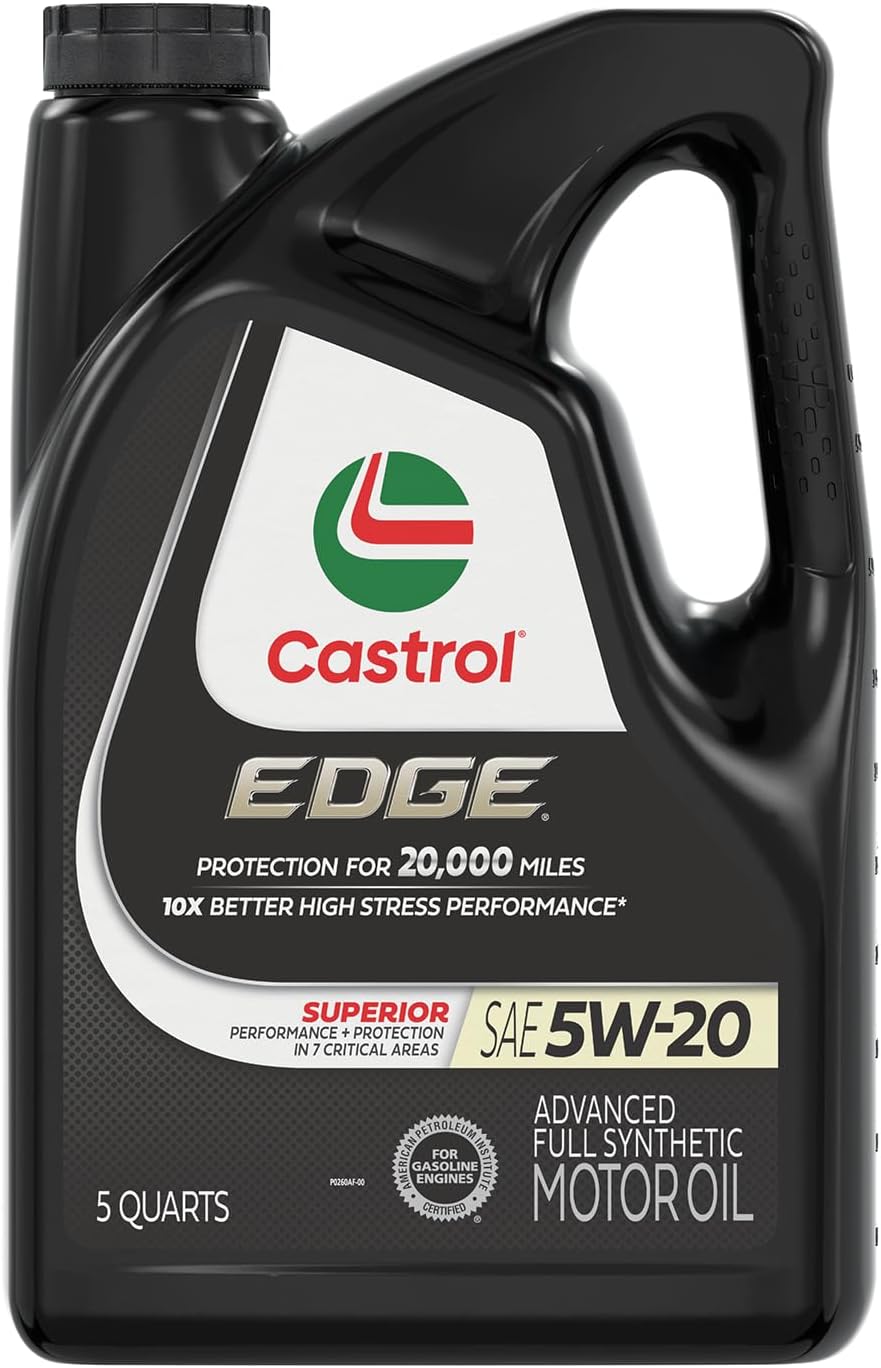
4. Castrol EDGE 5W-20 Full Synthetic Motor Oil, 5 Quart Jug
Best Full Synthetic Engine Oil
| SAE Viscosity Grade | 5W-20 |
|---|---|
| Compatibility | Car, Truck |
| Container Type | Jug |
| Liquid Volume | 5 Quarts |
| Approvals | API SP / ILSAC GF-7 |
This 5W-20 Castrol EDGE jug is a full synthetic motor oil designed to protect engines under high temperatures while maintaining flow at cold starts. DIY mechanics will appreciate that it targets reduced sludge and metal wear through an advanced additive system and claims extended drain capability. Typical use is standard oil changes in vehicles calling for 5W-20 viscosity where factory-quality protection is desired; it is packaged as a 5 quart jug suitable for a single complete service on most engines needing that volume. Notable features include formulation for thermal stability, reduced friction for fuel economy, and approvals that meet modern API and ILSAC specifications. In practical terms you can expect cleaner internals, consistent oil pressure during hot driving, and easier cold starts compared with conventional oils. Limits to consider are strict fitment to vehicles requiring 5W-20 and that the extended drain claims depend on driving conditions and manufacturer service intervals rather than guaranteed extended warranty coverage.
Best for: DIY mechanics who prioritize maximum heat resistance, strong wear protection, and reliable flow at temperature extremes for routine oil changes in vehicles specified to use 5W-20.
Less Ideal for: Drivers whose vehicles require a different viscosity grade or who must follow manufacturer-prescribed extended drain intervals without deviation.
- Full synthetic formulation for improved thermal stability and reduced sludge formation
- Designed to maintain viscosity control across temperature extremes for reliable cold starts and high-temp protection
- Advanced additives to reduce engine wear and help preserve engine internals
- Comes in a 5 quart jug that covers a typical full oil change without multiple containers
- Viscosity limited to 5W-20 so it is unsuitable for engines that require other grades
Verdict: The best full synthetic engine oil for DIY mechanics who need maximum heat resistance, improved flow at temperature extremes, and the best overall wear protection.
5. Valvoline MaxLife Full Synthetic High Mileage 5W-20 Motor Oil, 5 qt
Best High-Mileage Engine Oil

| SAE Grade | 5W-20 |
|---|---|
| Liquid Volume | 5 Quarts |
| Compatible Vehicle Type | Car, Truck |
| Viscosity Level | Low to Medium |
Valvoline MaxLife Full Synthetic 5W-20 is a high‑mileage motor oil designed to protect aging engines and reduce common wear-related issues. It is typically used as an engine oil change replacement in vehicles that have surpassed roughly 75,000 miles, supplying a full synthetic base with added anti‑wear agents and seal conditioners. Notable features include enhanced wear protection, improved defense against sludge and heat, and additives aimed at minimizing oil leaks and consumption. In practical use the oil offers stronger protection during highway driving and towing compared with conventional or blend oils, and the seal conditioners can help slow small leaks and reduce top‑off frequency. The product meets current API and ILSAC specifications for gasoline engines and is available in a 5 quart bottle with an anti‑glug pour spout for cleaner refills. Limitations to consider are the fixed SAE grade of 5W‑20, so it is appropriate only where that viscosity is recommended, and benefits like leak improvement depend on the condition of engine seals and are not a guaranteed repair for major leaks.
Best for: Drivers of higher‑mileage vehicles seeking an oil that prioritizes extra wear protection and seal conditioning to extend engine life while maintaining factory recommended viscosity.
Less Ideal for: People whose Explorer is under the mileage threshold or who require a different viscosity grade should choose a viscosity that matches the engine manufacturer recommendations instead of this specific product.
- Formulated for high‑mileage engines with seal conditioners to help reduce small oil leaks
- Full synthetic base for improved wear and heat protection over conventional oils
- Claims stronger sludge defense to help keep older engines cleaner
- Meets relevant API and ILSAC gasoline engine specifications
- 5 quart bottle with anti‑glug spout makes refilling cleaner and easier
- Only available in 5W‑20 grade for this listing, so not suitable where a different viscosity is required
- Seal conditioning helps minor leaks but will not fix major gasket or seal failures
Verdict: The best high‑mileage engine oil for vehicles with higher mileage that benefit from seal-conditioning additives, reduced oil consumption, and extra wear protection.
6. Castrol EDGE 0W-20 Full Synthetic Motor Oil, 5 Quart Jug
Best Low-Viscosity Engine Oil

| Viscosity | 0W-20 |
|---|---|
| Type | Full Synthetic |
| Container Type | Jug |
| Liquid Volume | 5 Quarts |
| Compatible with Vehicle Type | Car, Hybrids, Truck |
Castrol EDGE 0W-20 is a full synthetic, low-viscosity motor oil designed to deliver quick circulation at startup and help improve fuel economy while protecting engine components during everyday driving. It is typically used as a factory-quality replacement for engines that specify 0W-20, and is sold in a 5-quart jug suitable for a full service fill of many modern engines. Notable features include Castrol's advanced additive chemistry aimed at reducing sludge, controlling viscosity at high temperatures, and providing wear protection. In practice this means faster oil flow on cold mornings, modest gains in fuel efficiency compared with thicker oils, and stable protection during highway driving and light towing. Limitations to note are that low-viscosity 0W-20 oils can show higher consumption on older or high-mileage engines designed for thicker oils, and they may offer less film thickness under extreme performance or heavy-duty towing compared with heavier grades. For a 2026 Ford Explorer that calls for 0W-20, this product aligns with the goals of improved cold-start protection and fuel economy while remaining a practical daily-use oil.
Best for: Drivers of a 2026 Ford Explorer who prioritize better cold-start protection and improved fuel economy while keeping to the manufacturer recommended 0W-20 viscosity.
Less Ideal for: Owners who regularly subject their Explorer to extreme towing, heavy-load commercial use, or who prefer thicker oils for very high-mileage engines should consider a different viscosity or a heavy-duty formulation.
- Low 0W-20 viscosity for fast cold-start flow and reduced friction at startup
- Full synthetic formulation for thermal stability and sludge control
- Formulated to support fuel economy improvements compared with higher-viscosity oils
- 5-quart jug provides a full-service quantity for most oil changes
- Meets multiple industry specifications indicating broad compatibility with modern gasoline engines
- Lower film thickness compared with heavier grades may be less ideal under extreme heavy-load or high-performance conditions
Verdict: The best low-viscosity engine oil for drivers seeking improved fuel economy and fast cold-start flow without sacrificing adequate lubrication under normal operating conditions.
7. Castrol EDGE Extended Performance 0W-20 Full Synthetic Motor Oil, 5 Quart
Best Extended-Drain Engine Oil

| SAE J300 Viscosity Grade | 0W-20 |
|---|---|
| Compatible with Vehicle Type | Car, Gasoline and Light Duty Diesel, Hybrids, Truck |
| Container Type | Jug |
| Liquid Volume | 160 Fluid Ounces |
Castrol EDGE Extended Performance 0W-20 is a full synthetic motor oil designed for drivers who want much longer service intervals while maintaining engine protection. It is used like any engine oil but is formulated with Castrol's proprietary additives to resist oxidation, reduce high-temperature breakdown, and limit wear over extended mileage claims up to 25,000 miles or one year. In everyday use it provides stable low-viscosity flow at cold start and maintains thermal stability under sustained heat, which helps protect valve train components and reduce deposits. The product lists broad compatibility with gasoline, light-duty diesel and hybrid cars and meets several industry and manufacturer specifications including GM dexos1 Gen 3 and ACEA C5. Practical benefits are less frequent oil changes and strong protection against sludge and wear, but extended drains depend on following manufacturer service recommendations and oil-monitoring systems. For DIYers, the jug format is easy to handle for home changes and the 5-quart size suits most single oil changes without needing multiple bottles.
Best for: DIY mechanics who prefer longer oil-change intervals and want a low-viscosity synthetic engineered to resist oxidation and high-temperature breakdown for extended use.
Less Ideal for: Drivers who must strictly follow short factory-recommended change intervals, those without an oil-monitoring system, or owners of vehicles that require a different viscosity or specification.
- Formulated for extended drain intervals with claimed protection up to 25,000 miles or one year
- Advanced additive package improves high-temperature stability and reduces wear
- Meets multiple industry and manufacturer specifications including GM dexos1 Gen 3 and ACEA C5
- Low-viscosity 0W-20 grade provides good cold-start flow while maintaining protection at operating temperature
- Extended drain claims require adherence to manufacturer recommendations and monitoring, so not suitable to blindly exceed factory service intervals
Verdict: The best extended-drain engine oil for DIY mechanics who prefer longer oil-change intervals and need oils formulated to resist oxidation and breakdown over extended use.
Choosing the Right 2026 Ford Explorer Engine Oil: Key Factors to Consider
Viscosity Grade and Climate
Viscosity determines how the oil flows at cold start and how it maintains a protective film at operating temperature. For the 2026 Ford Explorer, picking the right grade affects startup wear in cold climates and oil pressure during hot summer driving.
Lower-number winter grades like 0W-20 improve cold-start flow and can marginally increase fuel economy, but they may offer thinner film thickness at very high operating temperatures compared with a 5W-30. Consider local winter lows, summer highs, and whether you do frequent short trips when choosing viscosity so the oil protects the engine across the most demanding conditions you encounter.
Synthetic Versus Conventional
Synthetic motor oil offers superior thermal stability, oxidation resistance, and shear retention compared with conventional oils. For modern Explorer engines, synthetics better resist sludge and varnish formation and maintain viscosity over longer drain intervals.
Synthetic blends may be a middle ground if you want improved protection without the full cost of full-synthetic formulations. For high-mileage engines or turbocharged variants, full-synthetic oils are typically preferable because they control deposits and heat-related degradation more effectively, preserving performance and reducing maintenance risks.
Additive Chemistry and Deposit Control
Additives control wear, neutralize acids, and prevent deposits on critical engine surfaces. Detergents and dispersants keep contaminants in suspension, while anti-wear agents protect camshafts, lifters, and bearings.
For the 2026 Explorer, an oil with strong deposit control will help maintain intake and valvetrain cleanliness over time, which supports consistent performance and reduces the chance of oil-related drivability issues. Look for oils with proven antioxidant and dispersant packages suited to the engine's operating profile.
Compatibility With Emissions and Turbo Systems
If your Explorer has turbocharged engines, the oil must protect turbo bearings and resist coking at elevated exhaust-system temperatures. Oils that are incompatible with emissions-control devices can accelerate filter or catalyst wear.
Choose oils that explicitly state compatibility with contemporary emissions hardware and turbocharged applications. This reduces the risk of deposits forming in turbo housings or EGR systems and helps maintain exhaust aftertreatment function over the long term.
Drain Interval and Oxidation Stability
Oxidation stability determines how long an oil can resist breakdown under heat and contamination. Better stability supports extended drain intervals and consistent protection between services.
For the 2026 Explorer, longer intervals can be beneficial if the oil maintains anti-wear and detergent performance throughout the service period. However, interval length should be balanced with driving conditions; heavy towing or repeated short trips can justify shorter intervals even when using high-stability synthetics.
High Mileage Considerations
Engines with higher miles may benefit from oils formulated for high mileage that include seal conditioners and higher-viscosity retention. These oils can reduce leaks, minimize oil consumption, and restore marginal seal performance.
If your Explorer has significant mileage, prioritize oils that address wear and oil consumption while still meeting the engine's viscosity and specification requirements. Seal-safe additive blends and slightly higher film strength help reduce oil burning and extend engine life when components have experienced normal wear.
Understanding Ford's Oil Specifications
Ford publishes specific oil specifications and recommended viscosity grades for different engines and model years. For owners of the 2026 Explorer and the 2020–present model range, confirming that a chosen oil meets the vehicle's required spec is the first step before considering other benefits.
Specifications address additive levels, volatility, and shear stability scales that affect warranty compliance and long-term engine health. Always cross-check the oil's stated specs against those listed in the owner's manual or factory service information for your exact engine variant.
- Check the owner manual for the recommended viscosity grades and approved specifications.
- Look for oils that list explicit compliance with the manufacturer or equivalent engineering standards.
- Confirm whether a lower-viscosity oil is acceptable for your engine and operating climate.
Matching Oil Choice to Driving Habits
Your daily driving pattern will influence which oil properties matter most. Frequent short trips keep the engine in the warm-up phase and can encourage fuel dilution and deposit formation, making detergency and cold-flow performance important.
Conversely, highway driving and towing place greater stress on oil film strength and high-temperature stability. If you tow often or drive at sustained highway speeds, favor oils with higher high-temperature shear resistance and strong oxidation control.
- City and short-trip drivers: prioritize cold-start flow and detergent action.
- Highway and towing drivers: prioritize thermal stability and anti-wear properties.
- Mixed use: select a balanced synthetic that addresses both low-temperature flow and high-temperature protection.
Oil Change Practices for the 2026 Explorer
Follow the maintenance interval guidance in the service manual, but adjust based on actual use. Severe service conditions such as towing, off-road driving, or many short trips can necessitate more frequent oil changes than the nominal interval.
When changing oil, use a high-quality filter rated for the engine's oil flow and pressure. A compatible filter helps keep contaminants out of circulating oil and preserves additive life between changes.
- Replace the oil filter at every oil change to maintain filtration efficiency.
- Record mileage and conditions to tailor change intervals to real-world use.
- Consider oil analysis if you plan to extend drain intervals beyond manufacturer recommendations.
Dealing With Oil Consumption and High Mileage Engines
If your Explorer uses more oil than expected, first confirm correct grade and specification and check for leaks. High-mileage-specific oils with seal conditioners can reduce small leaks and curb consumption in older engines.
Regular monitoring of oil level and condition is important. For high-mileage vehicles, choosing an oil that preserves viscosity and includes additives to minimize wear will help sustain compression and reduce the pace of mechanical degradation.
- Top up between changes when monitoring shows consumption.
- Inspect valve cover gaskets, PCV systems, and external seals for leaks.
- Select oils with higher film strength and seal-friendly additives for aging engines.
How Viscosity Affects Performance and Economy
Viscosity affects frictional losses and therefore has a direct effect on fuel economy and engine responsiveness. Thinner oils reduce internal drag at low temperatures, which can yield a small fuel economy improvement, while thicker oils maintain stronger hydrodynamic film under heavy loads.
Balance is the goal: pick an oil that preserves fuel economy benefits where desired but still provides a safe margin of film strength under the Explorer's typical operating temperatures and loads.
- 0W-20 may help fuel economy in cold climates but check high-temperature protection for your engine.
- 5W-30 offers more high-temperature film strength for towing and sustained high-load driving.
- Follow the vehicle's recommended grade unless specific conditions justify a different viscosity.
Synthetic Oil Benefits for Modern Engines
Full-synthetic oils resist thermal breakdown and maintain additive performance longer than conventional oils. That stability helps reduce sludge and varnish, particularly for turbocharged or downsized engines found in modern Explorers.
Synthetics often support longer drain intervals and better low-temperature startup protection, which makes them a practical choice for drivers who want consistent protection without frequent changes.
- Better shear stability preserves viscosity over time.
- Improved cold-flow properties reduce startup wear.
- Stronger oxidation resistance supports extended drains under appropriate conditions.
Still looking for the perfect fit?
Select your Ford Explorer configuration to see the most relevant Engine Oils recommendations
How We Chose the Best 2026 Ford Explorer Engine Oil
We shortlisted engine oils by applying criteria that reflect real-world needs for the 2026 Ford Explorer and the wider 2020–present model range. First, we verified compatibility with Ford engine specifications and common OEM viscosity recommendations for this vehicle. We prioritized oils that offer robust high-temperature film strength and low-temperature flow to protect both turbocharged and naturally aspirated variants.Key evaluation criteria included viscosity grade behavior across temperature ranges, wear protection measured by additive chemistry and zinc/phosphorus content, oxidation stability for extended drain intervals, and deposit control to keep intake and valvetrain components clean. We also considered fuel-economy benefits where lower-viscosity formulations are appropriate and compatibility with emissions-control hardware.We excluded oils that lack clear spec compliance or that do not provide published data on thermal or shear stability. Oils intended only for racing or non-street use were not considered. The result is a set of practical, street-legal oils chosen for durability, drivability, and long-term engine health in the 2026 Ford Explorer.
Our full evaluation process is outlined in our review methodology.
FAQ
How often should I change the engine oil on a 2026 Ford Explorer?
Follow the service interval in the owner's manual for normal driving, but expect to shorten intervals under severe service like towing or many short trips. Monitoring oil condition and level between services is a practical approach.
Can I use 0W-20 instead of 5W-30 in my 2026 Explorer?
That depends on the engine's approved viscosity range and your climate. 0W-20 improves cold-start flow and may aid fuel economy, but 5W-30 provides thicker protection under sustained high loads. Check the owner's manual and choose based on operating conditions.
Is full-synthetic motor oil necessary for the 2026 Explorer?
Full-synthetic oils offer better thermal stability and deposit control, which benefits turbocharged and modern engines. It is not always strictly necessary, but for longevity and consistent protection, many owners prefer synthetic formulations.
Will a high-mileage engine oil help an older Explorer?
High-mileage formulations include seal conditioners and additives that can reduce leaks and oil consumption in worn engines. They can be helpful for aging Explorers, but confirming viscosity and specification compatibility is important before switching.
Can I extend oil change intervals with a high-quality synthetic?
Some high-quality synthetics have the oxidation stability to support longer intervals, but extension should be based on driving conditions and OEM guidance. Heavy loads, towing, and frequent short trips typically require standard or shorter intervals.
How do I check if an oil is compatible with my Explorer's emissions equipment?
Look for oils that state compatibility with modern emissions systems and that meet the manufacturer's specifications. Avoid oils that do not list relevant emissions or OEM compliance information.
Final Verdict
Choosing the right engine oil for a 2026 Ford Explorer comes down to matching viscosity, additive performance, and synthetic chemistry to your engine variant and driving habits. Prioritize oils that meet Ford specifications, provide strong high-temperature protection if you tow or drive hard, and offer good cold-start flow for winter conditions. For high-mileage vehicles, look for seal-compatible formulations that reduce consumption.Balance fuel-economy benefits against required film strength and don't extend drain intervals without confirming oil stability and assessing your driving profile. With those tradeoffs in mind, you can select an engine oil that protects performance and extends the life of your Explorer's engine.
Explore More:
- Check out all Ford Explorer parts & accessories
- Explore Fluids & Chemicals
- Browse all Accessories
