

Note: This article contains affiliate links. If you click on these links and make a purchase, I may earn a small commission at no extra cost to you. This helps support my research and content. Read my full affiliate disclosure here.
Picking the right engine oil for your Subaru Outback 2.4L matters more than many owners realize. The wrong viscosity or oil type can reduce fuel efficiency, increase wear, and compromise drivability, while the right oil helps keep seals healthy, controls deposits, and supports reliable start-up in varied temperatures. This guide covers the top shortlisted engine oils suitable for the Outback 2.4L, explaining the practical tradeoffs between viscosity grades, synthetic versus conventional options, and when to choose high-mileage formulations.Below you will find the top recommended oils for common driving patterns and climates, with clear notes on why each option made the list and the evaluation criteria used to compare them.
Looking for other parts? See all Subaru Outback parts & accessories.
Top Picks at a Glance
| Best Overall Engine Oil A balanced synthetic oil that suits most DIY maintenance needs | Mobil 1 High Mileage Full Synthetic Motor Oil 0W-20, 5 Quart |  |
| Best Budget Engine Oil A lower-cost synthetic or blend that delivers reliable protection on a budget | Valvoline Advanced Full Synthetic 0W-20 Motor Oil, 5 QT |  |
| Best OEM Subaru Engine Oil Genuine Subaru-branded synthetic oil sold in factory-specified viscosities and packages | Subaru Synthetic Motor Oil SAE 0W-20, 5 Quart Bottle |  |
| Best Oil Change Kit A complete kit including oil, OEM filter, and crush gasket for one service | Subaru Oil Change Kit with Genuine Filter, Gasket, and 5 qt SAE 0W-20 Synthetic Oil |  |
| Best Bulk / Multi-Quart Pack Larger-quantity or multi-bottle packs that lower per-quart cost for frequent changers | Castrol EDGE Extended Performance 0W-20 Full Synthetic Motor Oil, 1 qt (Pack of 6) |  |
1. Mobil 1 High Mileage Full Synthetic Motor Oil 0W-20, 5 Quart
Best Overall Engine Oil

| Viscosity | 0W-20 |
|---|---|
| Size | 5 Quart |
| Model | Extended Performance |
| Vehicle Service Type | Car |
Mobil 1 High Mileage 0W-20 is a synthetic engine oil designed to protect engines with higher mileage while extending drain intervals. For a Subaru Outback 2.4L, it provides the low-temperature flow and viscosity control needed for smooth cold starts and consistent hydraulic performance in normal driving. Mobil 1’s formulation targets deposit control and oxidation resistance, which helps reduce sludge and keeps intake and valvetrain areas cleaner in older engines. The product is intended for routine DIY oil changes and supports extended service intervals up to 10,000 miles when following manufacturer recommendations. Notable features include Mobil 1’s Triple Action Formula and compatibility with modern engine technologies that can reduce timing-chain wear and help mitigate low-speed pre-ignition risk. The main compromise is that extended-interval claims require careful adherence to service conditions and monitoring of oil condition; some owners may prefer shorter changes for peace of mind. Overall it is a practical choice for steady highway and mixed-use driving when you want strong protection and fewer oil changes between services.
Best for: Owners who prioritize strong engine protection and fewer routine oil changes for a daily-driven Subaru Outback 2.4L and want a widely recommended synthetic suited to higher-mileage engines.
Less Ideal for: Drivers who perform severe-service driving, track use, or who prefer strictly conservative, shorter oil-change intervals should consider oils or schedules tailored to those conditions.
- Formulated for engines with higher mileage to help reduce sludge and deposits
- Full-synthetic 0W-20 viscosity that supports cold starts and consistent oil pressure
- Designed for extended drain intervals up to 10,000 miles when service conditions are met
- Helps control oxidation and lower operating temperatures for improved engine longevity
- Extended 10,000-mile change interval depends on driving conditions and may not suit all maintenance preferences
Verdict: This pick is the go-to synthetic oil that balances protection, drivability, and compatibility for routine DIY oil changes.
2. Valvoline Advanced Full Synthetic 0W-20 Motor Oil, 5 QT
Best Budget Engine Oil

| Viscosity | 0W-20 |
|---|---|
| Size | 5 QT |
| Specifications met | ILSAC GF-7A, API SP, API SN |
| Vehicle Service Type | Car, Truck |
Valvoline Advanced Full Synthetic 0W-20 is a five-quart jug of full synthetic motor oil formulated to protect modern gasoline engines. It is used as a direct engine oil replacement during routine oil changes and is designed to flow easily at low temperatures to reduce wear at cold starts while offering improved deposit control and heat resistance compared with basic industry standards. Notable features include claimed 40% stronger wear protection, better deposit defense, and up to 2.5 times improved heat protection versus standard oils, which translate to cleaner internals and longer-lasting performance between service intervals. It meets ILSAC GF-7A and several API specifications and manufacturer requirements relevant to many late-model gasoline engines. The main trade-off is that this is a general engine oil rather than a vehicle-specific formula, so installers should confirm 0W-20 is the recommended grade for a Subaru Outback 2.4L before use; otherwise it provides a cost-effective, high-performing synthetic option for regular maintenance cycles.
Best for: Drivers seeking dependable, fleet-friendly engine protection for routine oil changes who prioritize minimizing parts cost while keeping a factory-quality synthetic oil in their service schedule.
Less Ideal for: People who need a heavier viscosity or a specialty fluid for high-mileage or modified engines should consider alternative formulations matched to those needs.
- Full synthetic formulation for improved cold-start flow and wear protection
- Claims stronger wear, deposit, and heat protection versus industry baseline oils
- Meets ILSAC GF-7A and multiple API and manufacturer specifications
- Five-quart size covers a single oil change for most engines without needing multiple bottles
- Not a vehicle-specific formulation so you must verify 0W-20 is the correct grade for your engine
Verdict: Choose this option if you want dependable engine protection for regular oil changes while keeping parts cost to a minimum.
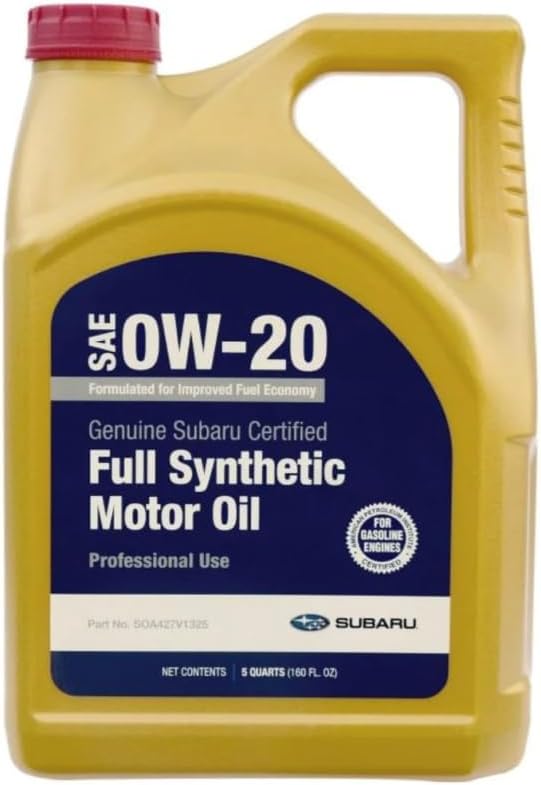
3. Subaru Synthetic Motor Oil SAE 0W-20, 5 Quart Bottle
Best OEM Subaru Engine Oil
| Viscosity Level | Low to Medium |
|---|---|
| Compatible with Vehicle Type | Car |
| Container Type | Bottle |
| Liquid Volume | 5 Quarts |
This is the factory-specified Subaru full synthetic 0W-20 motor oil supplied in a 5-quart bottle for top-up or full oil changes. It is designed to meet Subaru formulation targets for modern Subaru engines and is typically used during routine maintenance to maintain engine protection, improve cold-start lubrication, and support fuel economy. Notable features include the vehicle-specific fitment label, low-viscosity 0W-20 grade for tighter engine tolerances, and a flash point specification that indicates thermal stability. Practical benefits are straightforward: you get a factory-brand oil that removes fitment guesswork and aligns with Subaru service recommendations so warranty-sensitive owners can use a matching fluid. Limitations are that the product is a single viscosity grade only, so it is intended for engines requiring 0W-20 and not suitable where a different viscosity or specialized high-mileage/formulation is needed. Also this listing is a standard oil supply without additional accessories like funnels or drain kits.
Best for: Buyers who prioritize using factory-specified fluids and want a direct-fit, manufacturer-approved 0W-20 oil for routine maintenance on Subaru engines.
Less Ideal for: Drivers looking for specialty oils such as high-mileage, diesel, or thicker viscosity formulations should consider alternative products.
- Factory-branded formulation matching Subaru specifications
- Full synthetic 0W-20 grade for strong cold-start protection and fuel economy
- 5-quart bottle is convenient for single-vehicle oil changes
- Vehicle-specific labeling reduces risk of using the wrong oil grade
- Only available in one viscosity grade, so not suitable for engines requiring other viscosities
Verdict: This slot is for factory-specified Subaru oil that guarantees compatibility and meets OEM formulation and warranty expectations.
4. Subaru Oil Change Kit with Genuine Filter, Gasket, and 5 qt SAE 0W-20 Synthetic Oil
Best Oil Change Kit

| Viscosity Grade | 0W-20 |
|---|---|
| Container Type | Bottle |
| Compatible Vehicles | Select Subaru Forester, Outback, Impreza, Ascent, Legacy, Crosstrek |
| Liquid Volume | 5 quarts |
This Subaru oil change kit bundles everything needed for a straightforward DIY service on supported Subaru 4-cylinder models. The kit pairs five quarts of factory-spec 0W-20 synthetic oil with a genuine Subaru engine oil filter and crush gasket, so you can drain and refill the crankcase and replace the seal in one visit. It is typically used for routine maintenance at the recommended intervals and is especially convenient if you prefer to keep factory-quality parts and fluid on hand. Notable features include vehicle-specific fitment and factory-formulated oil that matches Subaru recommendations for low-viscosity protection and cold-start flow. The practical benefits are simplified parts sourcing and confidence that the filter and gasket match current Subaru specifications. Limitations to note are that the kit is tailored to certain Subaru 4-cylinder models and may not cover turbo engines or vehicles with different oil capacities, so you should verify fitment and required volume against your owner’s manual before starting the job.
Best for: Buyers who want a single, ready-to-install package for a clean DIY oil change on compatible Subaru 4-cylinder models and value using factory-quality parts and fluid.
Less Ideal for: People servicing turbocharged engines, vehicles outside the listed model years, or those who need a different oil viscosity or additional fluids and parts.
- Includes genuine Subaru oil filter and factory crush gasket for proper sealing
- Five quarts of Subaru-branded 0W-20 synthetic oil matched to manufacturer recommendations
- Vehicle-specific fit reduces guesswork when servicing compatible Subaru 4-cylinder models
- All-in-one kit simplifies DIY oil changes and minimizes trips to source parts separately
- Fitment is limited to specific Subaru 4-cylinder models and years so it is not universal
Verdict: Choose a kit when you want a single, ready-to-install package that includes oil, the correct filter, and gasket for a clean DIY change.
5. Castrol EDGE Extended Performance 0W-20 Full Synthetic Motor Oil, 1 qt (Pack of 6)
Best Bulk / Multi-Quart Pack

| Viscosity grade | 0W-20 |
|---|---|
| Volume | 6 quarts |
| Type | Full Synthetic |
| Automotive fit type | Universal Fit |
| Approvals | API SP; GM dexos1 Gen 3 |
Castrol EDGE Extended Performance 0W-20 is a hyper-premium full synthetic engine oil offered here in a six-quart bulk pack suited to frequent oil changes. It is formulated to meet modern car specifications including API SP and GM dexos1 Gen 3 and emphasizes wear protection, thermal stability, and extended drain capability. Typical use is routine engine lubrication for compatible 0W-20 applications; the multi-quart pack streamlines DIY servicing and fleet maintenance by keeping enough oil on hand. Notable features include a proprietary additive boost for high temperature performance and claims of protection that support extended drain intervals up to 25,000 miles under specified conditions. Practical benefits are consistent viscosity in cold starts, strong high-temperature film strength, and the convenience and cost-per-quart advantage of a bulk pack. Limitations are that extended drain claims depend on meeting vehicle manufacturer guidelines and service conditions, and the 0W-20 weight must match the Subaru Outback 2.4L owner manual requirements before use.
Best for: DIYers and small fleet maintainers who perform frequent oil changes on a schedule and value having a ready supply of factory-grade full synthetic 0W-20 oil.
Less Ideal for: Drivers who do not require 0W-20 or who prefer to strictly follow shorter manufacturer-recommended service intervals should consider single-quart purchases or different viscosity grades.
- Sold as a six-quart pack that reduces trips to buy oil and lowers per-quart cost
- Full synthetic formula for improved cold-start flow and thermal stability
- Meets modern specifications including API SP and GM dexos1 Gen 3 for wide compatibility with contemporary engines
- Formulated for strong wear protection and sustained performance at higher temperatures
- Extended 25,000-mile drain interval is conditional and may not apply to every driving pattern or service schedule
Verdict: This pick suits DIYers who do frequent oil changes or fleet maintenance and want to save by buying multi-quart or bulk packs.
Choosing the Right Subaru Outback 2.4L Engine Oil: Key Factors to Consider
Viscosity Grade and Climate
Viscosity grade determines how the oil flows at cold startup and at operating temperature. For the Outback 2.4L, choosing the right multi-grade oil ensures adequate film strength at highway speeds while allowing quick circulation at low temperatures. In colder climates, a lower winter rating helps reduce startup wear by improving cold-flow; in hotter regions, a higher high-temperature viscosity rating preserves the oil film under sustained heat.
Manufacturers often recommend specific grades for a reason: they reflect the engine's bearing clearances and pump requirements. Selecting a viscosity that matches ambient conditions and driving patterns reduces stress on the oil pump and bearings and can improve fuel economy. If you regularly tow, carry loads, or drive at sustained highway speeds, favor oils with robust high-temperature viscosity retention.
Synthetic Vs Conventional Formulation
Synthetic motor oil and synthetic blends generally offer better shear stability, cleaner combustion discharge, and superior cold-start performance compared with conventional oils. For the Subaru Outback 2.4L, those traits translate to more consistent protection across a wider temperature range and longer intervals between oil breakdown.
Conventional oils can be acceptable for low-mileage, low-stress use, but they tend to oxidize faster and may leave more deposits over time. Synthetic options are often recommended for drivers who want stronger long-term protection, better fuel efficiency, and reduced sludge formation.
API and Manufacturer Performance Ratings
Industry and manufacturer ratings show whether an oil meets minimum protection and compatibility standards. Look for current API and ILSAC certifications and any OEM-specific applicability notes. For the Outback 2.4L, oils that meet contemporary API resource conservations and performance categories indicate adequate detergent levels, oxidation resistance, and anti-wear chemistry for modern gasoline engines.
Choosing an oil with the right certifications reduces the risk of using formulations that lack sufficient detergency or thermal stability. Always verify that the oil meets the specifications recommended in the vehicle's maintenance documentation.
High-Mileage Considerations
If your Outback 2.4L has significant mileage, look for high-mileage formulations designed to condition seals, reduce leaks, and minimize oil burn-off. These oils include seal conditioners and additives that can swell older gaskets slightly and reduce seepage.
High-mileage oils also tend to include detergents and dispersants focused on removing varnish and sludge formed over years of operation. While they are not a cure-all for mechanical wear, they can help stabilize consumption and maintain compression characteristics in older engines when used as part of a consistent maintenance routine.
Shear Stability and Oil Film Strength
Shear stability measures how well the oil maintains its viscosity under mechanical stress. Engines with tighter bearing clearances or high loads benefit from oils that resist viscosity loss, since film thinning increases metal-to-metal contact and wear. For the Outback 2.4L, oils with proven shear resistance retain protective film strength through long highway runs, hill climbs, or towing.
Policies on extended drain intervals should consider shear stability; an oil that thins prematurely can undermine any planned longer change interval, so match drain expectations to the formulation's proven performance.
Additive Package and Deposit Control
Additives control oxidation, neutralize acids, inhibit wear, and keep surfaces clean. A balanced additive package reduces sludge and varnish formation in the Outback 2.4L's combustion and oil circulation areas. Detergents and dispersants suspend contaminants so they reach the oil filter instead of forming deposits on critical surfaces.
Consider oils with robust anti-wear agents if you engage in frequent low-speed, high-load driving or stop-and-go commuting. Overly aggressive additive chemistries are not common in reputable motor oils, but understanding the package helps align selection with maintenance goals.
Choosing the Right Viscosity for Your Driving Conditions
Your driving environment dictates the optimal viscosity. If you live where temperatures routinely drop below freezing, prioritize oils with strong cold-flow characteristics to reduce wear during startup. In milder climates, broader multi-grade oils provide a good balance between cold starts and high-temperature film protection.
Consider how you use the Outback 2.4L. Frequent short trips keep the engine from reaching full operating temperature, which can encourage moisture and deposit formation. A synthetic option with good detergency and a lower winter grade helps improve circulation and reduce initial wear in those situations.
- Cold climates: choose lower winter-grade such as 0W-20 where recommended
- Hot climates or heavy loading: prefer oils with strong high-temp viscosity retention
- Mixed use: a balanced multi-grade gives reliable all-season protection
When to Use High-Mileage Formulations
High-mileage oils are formulated to address common issues in older engines like seal hardening and increased oil consumption. They often include seal conditioners and slightly different additive ratios to reduce leaks and stabilize oil consumption.
If your Outback 2.4L has accumulated significant miles and you notice small leaks or rising oil consumption between services, a high-mileage formulation can be a simple maintenance step to help manage those issues without major mechanical work.
- Useful for engines with over 75,000 miles or where leaks are present
- Not a substitute for mechanical repair of major oil leaks
- Combines detergents with conditioners to balance cleaning and sealing
Synthetic Vs Conventional: Real-World Tradeoffs
Synthetic oils offer clear performance benefits in cold starts, thermal stability, and deposit control. For owners who prioritize long life, consistent protection, and stable viscosity, synthetics are typically the better choice for the Outback 2.4L. They also maintain performance across a broader temperature range.
Conventional oils remain a viable option for low-mileage vehicles or owners who perform more frequent oil changes. If you drive mostly short distances and follow a conservative service interval, a conventional oil meeting the proper specs can provide adequate protection.
- Synthetic: better shear stability, cleaner operation, and wider temperature range
- Conventional: acceptable with frequent changes and light-duty driving
- Synthetic blends: middle ground for some drivers
Oil Change Intervals and Maintenance Habits
Oil change interval should match the oil formulation and driving patterns. Severe-service conditions such as frequent towing, repeated short trips, or dusty roads justify shorter intervals even with modern synthetics. Conversely, long highway miles at steady speeds allow for longer intervals if the oil's specifications support it.
Always pair oil changes with a quality filter and confirm the vehicle's recommended capacity and torque specs when topping up. Regular inspection for leaks, consumption trends, and oil color can indicate whether you should adjust the interval or try a different formulation.
- Short trips and towing: shorten intervals
- Predominantly highway driving: you can extend intervals if oil supports it
- Inspect for leaks after switching formulations or following high-mileage use
Environmental and Fuel Economy Impacts
Using the correct viscosity and a low-friction formulation can marginally improve fuel economy over time. While the gains are usually modest, optimizing oil choice for the Outback 2.4L's recommended grade contributes to cumulative efficiency improvements.
Environmentally, longer-lasting synthetic oils can reduce waste by enabling longer drain intervals when appropriate. However, extended intervals should only be used when the oil's performance data and the vehicle's usage justify them.
- Proper viscosity can slightly improve MPG
- Synthetic oils may reduce total waste if they allow validated longer drains
- Balance environmental goals with proven protection needs
Still looking for the perfect fit?
Select your Subaru Outback configuration to see the most relevant Engine Oils recommendations
How We Chose the Best Subaru Outback 2.4L Engine Oil
We focused on attributes that directly affect longevity, reliability, and day-to-day performance in the Subaru Outback 2.4L. Primary evaluation criteria included viscosity suitability across expected ambient temperatures, API and ILSAC performance grades, and whether the oil formulation supports the Outback 2.4L engine's sealing and deposit-control needs. We also weighted synthetic technology and multi-grade stability for better cold starts and high-temperature protection, plus shear-resistance to maintain film strength under load.Durability and maintenance considerations were another filter: we assessed recommended drain intervals and whether the formulation is appropriate for owners who follow manufacturer-recommended service schedules. Compatibility with higher-mileage engines and presence of conditioners for seals were considered for higher-odometer vehicles. Noise and vibration damping potential was noted where applicable because some formulations can slightly influence engine NVH on this platform.We excluded oils that do not meet current industry performance standards or that specify incompatibility with Subaru flat-four architectures. Products lacking clear viscosity labeling, missing certification claims, or with formulations intended only for diesel applications were also removed from consideration. The resulting shortlist balances protection, drivability, and long-term engine health for the Outback 2.4L.
Our full evaluation process is outlined in our review methodology.
FAQ
What viscosity should I use in a Subaru Outback 2.4L?
It depends on climate and driving style. Follow the vehicle's maintenance recommendations first, then choose a multi-grade viscosity that supports cold starts in winter and retains viscosity at highway temperatures.
Is synthetic oil necessary for the Outback 2.4L?
Synthetic oil is not strictly required but offers better cold-start protection, cleaner operation, and greater shear stability. It is a practical choice for many owners, especially in extreme temperatures or for long-service intervals.
Should I switch to high-mileage oil for an older Outback 2.4L?
High-mileage formulations can help if you notice leaks or rising oil consumption. They include conditioners that support seals, but they do not replace the need for mechanical repairs if leaks are significant.
How often should I change oil in the Outback 2.4L?
Change intervals depend on oil type and driving conditions. Under severe use, shorten intervals. For steady highway use and oils rated for extended drains, you can follow longer intervals recommended by the oil maker and manufacturer guidelines.
Can using the wrong oil void warranty or cause issues?
Using an oil that does not meet the engine's specified performance grades or viscosity recommendations can increase wear and may affect warranty claims. Always use oils that meet the certifications and grades called out in the maintenance manual.
Final Verdict
Prioritize viscosity and formulation that match your climate and driving habits when choosing engine oil for the Subaru Outback 2.4L. For most owners, a high-quality synthetic with the correct multi-grade rating delivers the best balance of cold-start protection, deposit control, and shear resistance. If mileage is high or you observe leaks, consider a high-mileage formulation to help condition seals and stabilize consumption.Focus on certified oils that meet the vehicle's recommended specs and align oil change intervals with the formulation and your operating conditions. That approach gives the best protection and predictable long-term performance for the Outback 2.4L.
Explore More:
- Check out all Subaru Outback parts & accessories
- Explore Fluids & Chemicals
- Browse all Accessories
