

Note: This article contains affiliate links. If you click on these links and make a purchase, I may earn a small commission at no extra cost to you. This helps support my research and content. Read my full affiliate disclosure here.
Selecting the correct engine oil for a Subaru Forester XT matters more than many owners realize. The XT's turbocharged engine runs hotter and under higher pressure than non-turbo variants, so oil choice affects performance, longevity, and how often you need to service the car.This guide covers the six top engine oils we shortlisted for the Forester XT, with attention to viscosity, thermal stability, and wear protection. You will find clear evaluation criteria, practical maintenance guidance, and notes on how different oils suit various driving conditions. Read on to match the right oil to your Forester XT and driving routine.
Looking for other parts? See all Subaru Forester parts & accessories.
Top Picks at a Glance
| Best Overall Engine Oil The best all-around oil choice balancing protection and compatibility | Subaru Synthetic 5W-30 Motor Oil — 5 Quart Bottle (SOA427V1425) |  |
| Best Budget Engine Oil Good, affordable oil that covers basic maintenance needs | Valvoline High Mileage with MaxLife Technology 10W-30 Synthetic Blend Motor Oil, 1 qt |  |
| Best OEM Subaru Engine Oil Genuine Subaru-branded oil sold in factory-specified viscosities and containers | Subaru Genuine Synthetic 0W-20 Engine Oil, 1 Quart (SOA427V1310) |  |
| Best 0W-20 Synthetic Engine Oil Full-synthetic 0W-20 options suited to modern fuel-economy engines | Valvoline Advanced Protection Full Synthetic 0W-20 Motor Oil, 5 qt |  |
| Best 0W-16 Synthetic Engine Oil Very low-viscosity synthetic for the latest low-viscosity engine specs | Subaru Synthetic Motor Oil SAE 0W-16, 5-Quart Container |  |
| Best Engine Oil Change Kit Packaged kits that include oil plus filter and crush gasket for one service | Subaru Oil Change Kit with Genuine Filter, Gasket & 5 qts 0W-20 Synthetic |  |
1. Subaru Synthetic 5W-30 Motor Oil — 5 Quart Bottle (SOA427V1425)
Best Overall Engine Oil
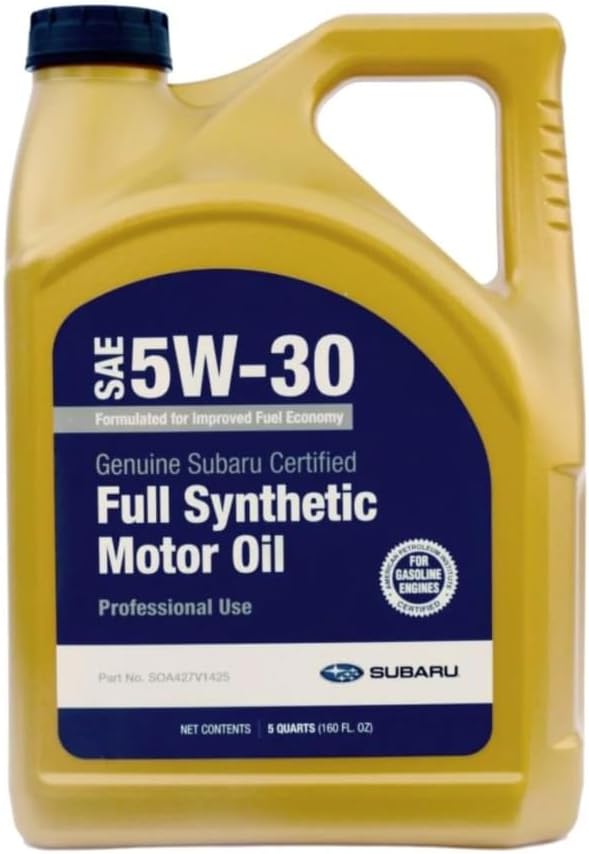
| Manufacturer | Subaru |
|---|---|
| Viscosity | 5w-30 |
| Item model number | SOA427V1425 |
| Item Weight | 9.24 pounds |
This is Subaru branded synthetic 5W-30 motor oil packaged in a 5-quart bottle and intended as a factory-compatible fill for turbocharged Subaru engines. It is used for routine oil changes and provides the expected combination of cold-start flow at low temperatures and film strength at operating temperature. As an OEM-branded fluid it simplifies service decisions because it matches Subaru recommendations for many WRX and STI turbo applications and Forester XT models listed in the fitment. The single-viscosity label makes it easy to stock for DIY maintenance and the 5-quart size covers a full drain-and-fill without topping up. Limitations are that this SKU is a single viscosity grade, so users who need different weight oils for non-turbo or older engines must choose a different product, and it does not include additives marketed for extended drain intervals beyond Subaru guidance. For home mechanics who prioritize factory compatibility and straightforward routine service, this oil is a practical, no-surprises choice.
Best for: DIY owners who perform their own routine oil changes on Subaru turbo models and want a factory-recommended synthetic oil that removes guesswork from fluid selection.
Less Ideal for: Shoppers who need a different viscosity for non-turbo or older engines or those seeking oils formulated for extended drain intervals should consider alternatives.
- Branded to Subaru for direct factory compatibility with listed turbo models
- Synthetic formulation offers reliable cold-start flow and thermal protection
- 5-quart bottle size matches a full oil change without needing multiple containers
- Simple single-grade labeling reduces confusion when performing routine maintenance
- Only available in one viscosity grade so not suitable if another weight is required
Verdict: A top pick for DIY mechanics who want a reliable, well-rounded engine oil that balances wear protection, low-temperature flow, and OEM compatibility for routine service.
2. Valvoline High Mileage with MaxLife Technology 10W-30 Synthetic Blend Motor Oil, 1 qt
Best Budget Engine Oil

| SAE Viscosity Grade | 10W-30 |
|---|---|
| Container Type | Bottle |
| Compatible with Vehicle Type | Car, Truck |
| Liquid Volume | 1 quarts |
| Viscosity Level | Medium to High |
Valvoline High Mileage 10W-30 is a synthetic-blend motor oil designed to protect aging engines by combining anti-wear additives, detergents, and seal conditioners. You’d typically use this at scheduled oil changes in older vehicles to reduce oil consumption, cut down on leaks, and help control sludge and deposits. The MaxLife formula claims stronger wear protection and includes friction-fighting additives that can help maintain smooth operation and modest fuel-efficiency benefits versus worn oil. The bottle is a single-quart universal-fit container that meets modern industry specs including ILSAC GF-6A and API SP, so it covers standard protection needs for routine service. Expect practical benefits for an inexpensive oil: better seal conditioning, cleaner internals, and reduced top-off frequency in higher-mileage engines. Limitations are that it is a synthetic blend rather than a full synthetic, so it may not match the extended drain intervals or top-end thermal protection of premium full-synthetic oils under extreme driving or aggressively tuned applications.
Best for: Shoppers who need a low-cost, competent motor oil for routine oil changes on an aging vehicle and prioritize preventing leaks and reducing sludge without paying for top-tier full synthetics.
Less Ideal for: Drivers planning extended drain intervals, high-performance driving, or heavily modified engines should choose a premium full-synthetic oil designed for those demands.
- Formulated for high-mileage engines with seal conditioners to reduce leaks
- Meets ILSAC GF-6A and API SP performance standards
- Synthetic blend offers better protection than conventional oils at modest cost
- Detergents and additives help reduce sludge and deposits
- Available in single-quart bottles for easy DIY topping or changes
- Not a full synthetic so it provides less extreme-temperature and extended-drain protection than premium full-synthetic oils
Verdict: For shoppers on a tight budget who need an inexpensive, serviceable motor oil that meets basic viscosity and protection requirements for routine oil changes.
3. Subaru Genuine Synthetic 0W-20 Engine Oil, 1 Quart (SOA427V1310)
Best OEM Subaru Engine Oil

| SAE J300 Viscosity Grade | 0W-20 |
|---|---|
| Container Type | Bottle |
| Compatible with Vehicle Type | Car |
| Liquid Volume | 32 fluid ounces |
This is Subaru's factory synthetic 0W-20 engine oil in a single-quart bottle intended as a direct replacement fluid for vehicles that call for 0W-20. It provides the low-viscosity flow needed at cold starts and is marketed to reduce varnish and deposits while resisting oxidation for longer oil life. Typical use is routine oil service or top-offs where owners want the exact Subaru-formulated product rather than a third-party equivalent. The product is packaged for easy pouring and labeled with the correct spec, so installers and DIYers can be confident of compatibility when the owner manual specifies Subaru 0W-20. The formulation focuses on cleanliness and protection rather than extreme high-temperature performance, so it fits normal and warranty-conscious use but is not aimed at motorsport or heavy-duty towing duty. Being a single-quart bottle it is convenient for topping off but buyers planning a full oil change will likely need multiple bottles or a larger supply.
Best for: Buyers who want the exact Subaru-branded synthetic fluid specified by the manufacturer and prioritize factory-spec fitment and consistency for routine maintenance.
Less Ideal for: Drivers seeking performance-focused or high-temperature specialty oils or those who prefer buying bulk quantities for frequent full oil changes.
- Factory-branded formulation that matches Subaru specifications
- Low-viscosity 0W-20 suited for cold starts and improved fuel efficiency
- Packed in a pour-friendly 1-quart bottle for easy top-offs or small jobs
- Sold only in single-quart bottles which may require multiple units for a full oil change
Verdict: For owners who prefer factory-spec fluids and want the exact Subaru-branded synthetic formulation recommended by the manufacturer for correct specs and fitment.
4. Valvoline Advanced Protection Full Synthetic 0W-20 Motor Oil, 5 qt
Best 0W-20 Synthetic Engine Oil

| Viscosity | 0W-20 |
|---|---|
| Size | 5 QT |
| API Certifications | ILSAC GF-7A, API SQ, API SP, API SN with SN PLUS |
| Manufacturer | Valvoline |
Valvoline Advanced Protection 0W-20 is a full-synthetic engine oil designed to keep modern gasoline engines clean and protected while improving low-temperature flow and fuel economy. It is typically used at oil service intervals in passenger cars and light trucks where 0W-20 is specified and is suitable for turbocharged and naturally aspirated engines. The formulation claims stronger wear protection and better deposit control than industry standards, which helps preserve bearing surfaces and reduce sludge buildup over time. Its low-viscosity base oils improve circulation at cold starts to limit metal-to-metal contact, and the heat-protection additives resist thermal breakdown during sustained highway running. Practical benefits include smoother cold starts, potential small gains in fuel efficiency, and longer-term engine cleanliness. Limitations: this is a low-viscosity 0W-20 intended for engines that call for it, so it is not a fix for engines that require a different grade or for high-mileage engines needing thicker oils; performance claims reference comparisons to industry standards rather than specific manufacturer test results.
Best for: Buyers who prioritize easy cold starts and modest fuel-economy gains while maintaining strong bearing and turbocharger protection in regular daily driving.
Less Ideal for: Drivers looking for a heavier oil for very high-mileage engines or those who need a specialized fluid for racing or extreme-duty use should consider alternatives.
- Full-synthetic formula for consistent viscosity and protection across temperatures
- Enhanced low-temperature flow to reduce wear at cold starts
- Claims improved wear protection and deposit control compared with industry norms
- Additives that boost heat resistance to help prevent thermal breakdown during long drives
- Not suitable when the vehicle requires a different viscosity grade or specialized oil type
Verdict: Choose this slot if you need a full-synthetic 0W-20 that prioritizes cold-start flow and fuel-economy benefits while protecting bearings and turbochargers during everyday driving.
5. Subaru Synthetic Motor Oil SAE 0W-16, 5-Quart Container
Best 0W-16 Synthetic Engine Oil

| Brand | Subaru |
|---|---|
| Viscosity | 0W-16 |
| Container volume | 5 Quart |
| Manufacturer part number | SOA427V3100 |
This Subaru-branded 0W-16 synthetic motor oil is a factory-quality fluid supplied in a 5-quart container for easy service intervals. It is intended for modern Subaru engines specifying 0W-16 and is typically used during scheduled oil changes to provide low-temperature flow and fuel-efficiency benefits associated with very low-viscosity oils. The product lists Subaru part number SOA427V3100 and matches the viscosity requirement for newer models, so it simplifies meeting manufacturer recommendations without cross-referencing aftermarket options. Practical benefits include predictable compatibility with Subaru service procedures and enough volume for a full oil change on most modern Subaru engines. Limitations are inherent to the viscosity choice: it prioritizes cold-start protection and economy over thicker-film protection under extreme high-load or heavily modified conditions, and it is specific to engines that require 0W-16 rather than a broader range of applications.
Best for: Buyers who need a factory-quality 0W-16 synthetic oil to meet Subaru manufacturer recommendations and want a straightforward, vehicle-branded option for routine oil changes.
Less Ideal for: Drivers running modified, high-torque, or vintage engines that demand higher-viscosity oils or enhanced high-temperature film strength should choose a different oil.
- Factory-formulated to meet Subaru specified 0W-16 viscosity and part number SOA427V3100
- Comes in a 5-quart container, sufficient for most full oil change needs
- Very low cold-start viscosity for quicker circulation and potential fuel economy gains
- Branded by the vehicle manufacturer for straightforward compatibility with Subaru service recommendations
- 0W-16 is not ideal for heavily modified or high-performance engines that benefit from thicker oils
- Only appropriate for engines that explicitly require 0W-16 viscosity
Verdict: Intended for buyers whose engine requires 0W-16 — this pick focuses on the thinnest synthetic oils that meet newer low-viscosity manufacturer recommendations.
6. Subaru Oil Change Kit with Genuine Filter, Gasket & 5 qts 0W-20 Synthetic
Best Engine Oil Change Kit

| Viscosity | 0W-20 |
|---|---|
| Liquid Volume | 5 quarts |
| Automotive Fit Type | Vehicle Specific Fit |
| Compatible with Vehicle Type | Forester, Outback, Impreza, Ascent, Legacy, Crosstrek |
This Subaru oil change kit bundles everything needed for a single full service on compatible Subaru 4-cylinder models: five quarts of factory 0W-20 synthetic oil, a genuine Subaru engine oil filter, and the crush gasket. It is intended for DIY installation during routine maintenance and simplifies purchasing by matching the oil viscosity and factory filter part numbers specified for many Forester, Outback, Impreza, Crosstrek, Ascent, and Legacy 4-cylinder engines. Using all factory-specified parts helps maintain engine protection, filtration efficiency, and correct sealing at the drain plug. The kit is convenient for home mechanics because it eliminates the need to source parts separately and reduces the chance of mixing viscosities or wrong filters. Limitations are that it is vehicle-specific so you must confirm exact model and engine fitment and oil capacity before starting, and the kit covers one oil change only so you will need to buy additional oil for larger capacities or interval top-offs.
Best for: DIY-minded Subaru owners who want a one-stop kit with the correct oil viscosity, filter, and gasket to perform a complete matched oil change without shopping for parts separately.
Less Ideal for: Drivers who prefer professional service or who need a multi-change supply or different viscosity for turbocharged or non-4-cylinder engines should look elsewhere.
- Includes factory-spec 0W-20 synthetic oil matched to Subaru recommendations
- Comes with a genuine Subaru oil filter to ensure proper filtration and fit
- Includes the crush gasket for a correct drain plug seal
- Single-purchase kit reduces parts mismatch risk and simplifies a DIY oil change
- Fits only specified Subaru 4-cylinder models so must verify compatibility
- Supplies exactly five quarts which may not cover vehicles with larger oil capacities
Verdict: For DIYers who want a single purchase containing the correct quarts, an oil filter, and the crush washer so they can do a complete, matched oil change in one go.
Choosing the Right Subaru Forester XT Engine Oil: Key Factors to Consider
Viscosity and Cold-Start Performance
Viscosity determines how well the oil flows at different temperatures and affects both startup protection and high-temperature film strength. For a turbocharged Forester XT, you want oil that provides easy circulation during cold starts to reduce wear, especially on bearings and cam lobes, while still maintaining a robust film under sustained boost.
Lower first-number viscosities like 0W or 5W improve cold-start lubrication and reduce friction at startup, which helps short trips and cold climates. The second number governs high-temperature viscosity; a 30 or 40 rating reflects how the oil resists thinning under heat. Choose a viscosity that balances seasonal cold-start needs with the engine's operating temperature range for reliable protection.
Thermal Stability and Shear Resistance
Turbocharged engines generate higher exhaust and intake temperatures, which can accelerate oil breakdown. Thermal stability measures how well an oil resists oxidation and viscosity loss when exposed to heat. Oils with stronger thermal stability form fewer deposits and keep clearances predictable over time.
Shear resistance is important because mechanical shearing can reduce effective viscosity during operation, diminishing the oil's protective qualities. For a Forester XT, favor oils with proven low volatility and high viscosity index to maintain consistent lubrication in the turbocharged environment.
Additive Package and Deposit Control
Modern engine oils contain detergents, dispersants, and anti-wear additives that slow deposit formation and protect critical components. Detergents help neutralize combustion acids and keep piston crowns and rings cleaner, while dispersants keep soot suspended so it does not form sludge.
For the Forester XT, maintaining clean turbocharger internals and piston areas preserves boost response and efficiency. Oils with robust deposit-control chemistry reduce the risk of port or intercooler contamination and prolong intervals between deep maintenance tasks.
Compatibility with Emissions and Turbo Systems
Some oils are formulated to be low-ash to protect emissions equipment and turbocharger longevity. While Subaru's Forester XT does not require diesel-type low-ash specs, using oils that generate excessive ash can contribute to deposits in the turbo and exhaust components over time.
Check that the oil meets relevant API and ACEA specifications and any Subaru service recommendations. Ensuring compatibility helps avoid negative interactions with turbo seals, PCV systems, and catalytic converters, which in turn supports durability and consistent performance.
Synthetic Versus Conventional Base Stocks
Synthetic base stocks offer better thermal and oxidative stability compared with conventional oils, which is especially valuable in turbocharged engines that run hotter and at higher loads. Synthetics typically resist viscosity breakdown, reduce sludge, and improve flow at low temperatures.
For owners of a Forester XT who push the engine or drive in varied climates, synthetic motor oil is often the safer long-term choice. However, conformity with viscosity and additive requirements is still essential; not all synthetics are formulated the same, so verify specifications rather than assuming equivalence.
Service Interval and Oil Change Practices
How often you change the oil depends on driving habits, climate, and the oil formulation. Short trips, frequent high-load driving, and towing increase contamination and thermal stress on the oil. The Forester XT's turbocharger can accelerate oil degradation under hard driving.
Plan oil change intervals based on the oil maker's guidance for turbocharged engines and your driving pattern rather than blanket mileage figures. Regular oil and filter changes protect the turbocharger and bearings and help maintain consistent engine performance.
Which Viscosity Works Best for Forester XT
Choosing the right viscosity depends on your local climate and driving style. For most moderate climates, 5W-30 offers a balance of cold-start flow and high-temperature protection that suits the Forester XT's turbocharged engine during varied use.
In colder regions, a 0W-20 or 0W-30 option improves cold-start lubrication and reduces warm-up stress, while hotter climates or sustained high-load driving may justify a higher high-temperature grade to resist thinning. Always verify that the chosen viscosity meets Subaru's baseline recommendations and the oil's API/ACEA ratings.
- 0W grades enhance cold-start protection in subfreezing conditions
- 5W-30 is a common compromise for mixed climates and spirited driving
- Higher second numbers help resist viscosity loss under prolonged heat
Synthetic Oils and Turbocharger Protection
Synthetic formulations provide improved thermal stability and reduced volatility, which helps maintain oil film strength under boost and around turbo bearings. They also flow faster on startup, reducing wear at critical engine components.
If you regularly drive at high RPM, tow, or perform spirited driving, choosing a high-quality synthetic motor oil is a sound insurance policy for turbo longevity and consistent performance.
- Better oxidation resistance extends useful oil life
- Lower volatility reduces top-up frequency during hard use
- Enhanced detergent systems help keep turbo internals cleaner
Engine Oil Change Best Practices for the XT
Regular oil and filter changes are essential for protecting the turbo and maintaining peak engine health. Follow either the manufacturer's schedule adjusted for severe service or a conservative interval if you frequently drive hard or do many short trips.
Use a high-quality filter rated for turbocharged engines to ensure proper flow and particle capture. Always top up with the same grade and specification if you cannot complete a full change immediately.
- Inspect for oil leaks and turbo oil feed lines during each change
- Record oil type and mileage to track degradation and intervals
- Consider shorter intervals for track or high-load use
High Mileage Considerations
As mileage accumulates, seals and clearances change, which can affect oil consumption and engine behavior. High mileage formulations can include conditioners that help preserve seals and reduce external leaks, though their effectiveness varies.
For a Forester XT with higher miles, monitor consumption and compression, and choose an oil with suitable additive chemistry that balances wear protection with seal compatibility.
- Watch for increased oil consumption that may indicate ring or seal wear
- High mileage oils may reduce minor leaks but are not a cure-all
- Match viscosity to existing engine condition rather than changing solely for mileage
Understanding Manufacturer Specifications
Subaru and oil industry standards list viscosity and performance specifications that ensure basic compatibility. Confirm any oil you select meets the relevant API and ACEA levels and the viscosity range recommended for your Forester XT.
Using oils that meet these specifications reduces the risk of warranty issues and ensures the formulation contains the necessary detergent and anti-wear chemistry for your engine type.
- Check API or ACEA ratings stamped on the container
- Verify the oil's viscosity range suits your climate
- Prefer oils with clear turbocharged-engine guidance
Still looking for the perfect fit?
Select your Subaru Forester configuration to see the most relevant Engine Oils recommendations
How We Chose the Best Subaru Forester XT Engine Oil
We evaluated candidate engine oils for the Subaru Forester XT using criteria that matter for turbocharged, small-displacement boxer engines. Key evaluation points included viscosity range and thermal stability to ensure the oil maintains protective film strength under boost and high temperatures; shear resistance and viscosity index to limit thinning between oil changes; deposit control and detergent performance to keep turbocharger passages and piston crowns clean; anti-wear additives and zinc/phosphorus levels that protect bearings and cam lobes under heavy load; low-ash formulations when relevant to emissions systems and turbo cleanliness; and manufacturer specifications and API/ILSAC/ACEA ratings to confirm basic compatibility.We prioritized oils proven for sustained high-temperature protection and frequent boost cycles while also considering cold-start performance for variable climates. Oils that failed to meet modern performance standards, lacked appropriate API/ACEA ratings, or showed poor viscosity stability in manufacturer datasheets were excluded. We also filtered out blends without clear testing data or those primarily intended for non-turbo engines. The result is a focused list that balances protection, fuel efficiency, and long-term engine health for the Forester XT.
Our full evaluation process is outlined in our review methodology.
FAQ
How often should I change the oil in a Forester XT?
It depends on driving habits. For typical driving, follow Subaru's recommended intervals adjusted for turbo engines. If you do frequent short trips, spirited driving, or towing, shorten intervals to protect the turbo and bearings.
Can I switch from conventional to full synthetic in my Forester XT?
Yes, switching is generally safe and often beneficial for turbocharged engines because synthetics resist thermal breakdown better. Change the oil and filter when switching and monitor for any leaks or changes in consumption.
Is a lower-viscosity oil like 0W-20 safe for the XT?
Lower cold-start viscosities improve startup flow but you must ensure the high-temperature rating still protects the engine under boost. Use lower viscosities only if they meet Subaru's recommendations and your driving conditions permit it.
How does oil affect turbocharger life?
Oil lubricates turbo bearings and helps manage heat. Poor thermal stability or degraded oil increases wear and deposit formation, which can shorten turbo life. Regular changes and a formulation with good deposit control support turbo longevity.
Should I use a high mileage oil in an older Forester XT?
High mileage oils can help with seals and minor leaks, but they are not a fix for major wear. If your Forester XT shows increased consumption or leaks, a high mileage formulation may be part of a broader maintenance approach.
Does switching oil viscosity affect fuel economy?
Slight differences in fuel economy can result from viscosity changes because thinner oils reduce friction. However, the primary concern should be adequate protection for the turbocharged engine rather than marginal fuel economy gains.
Final Verdict
When choosing engine oil for a Subaru Forester XT, prioritize formulations that deliver stable viscosity under heat, strong deposit control, and compatibility with turbocharged engines. Synthetic oils with appropriate viscosity ratings typically offer the best balance of cold-start flow and high-temperature protection.Weigh your local climate, driving style, and mileage when selecting oil and adopt an oil-change interval that matches real-world use. Focusing on those priorities will help maintain performance, preserve the turbocharger, and extend engine life.
Explore More:
- Check out all Subaru Forester parts & accessories
- Explore Fluids & Chemicals
- Browse all Accessories
