

Note: This article contains affiliate links. If you click on these links and make a purchase, I may earn a small commission at no extra cost to you. This helps support my research and content. Read my full affiliate disclosure here.
If you own a 2009-2013 Subaru Forester, picking the right engine oil is one of the simplest ways to protect engine life and maintain drivability. The wrong oil viscosity or specification can increase wear, reduce fuel economy, or accelerate sludge buildup, while the right oil helps control temperatures, reduce friction, and support reliable starts in varied climates.This guide shortlists six top-rated engine oils selected for the Forester's engines and common use cases from daily commuting to higher-mileage duty. We explain the evaluation criteria used and highlight the key tradeoffs so you can pick the oil that best matches your driving patterns and maintenance plan.
Looking for other parts? See all Subaru Forester parts & accessories.
Top Picks at a Glance
| Best Overall Engine Oil A balanced, top-performing synthetic oil that fits most Forester engines | Valvoline Advanced Full Synthetic 0W-20 Motor Oil, 5 qt |  |
| Best Budget Engine Oil An inexpensive synthetic or synthetic-blend option that saves money on changes | Castrol GTX Full Synthetic 0W-20 Motor Oil, 5 Quart Jug |  |
| Best 0W-20 Viscosity Oil A 0W-20 full-synthetic option optimized for cold starts and fuel economy | Castrol EDGE 0W-20 Full Synthetic Motor Oil, 5 Quart Jug |  |
| Best 5W-30 / Turbo-Capable Oil Higher-viscosity full-synthetic oil suitable for turbocharged or hotter-running engines | Subaru Synthetic 5W-30 Motor Oil 5-Quart (SOA427V1425) |  |
| Best High-Mileage Formula Formulated for engines with more miles—seals, anti-wear, and anti-leak additives | Valvoline High Mileage 150K with MaxLife Plus Technology 5W-30 Motor Oil, 5 Quart |  |
| Best Oil Change Kit (Oil + Filter) Complete kits that include the correct oil quantity plus filter and crush gasket | Subaru Genuine Oil Change Kit with Filter, Gasket & 6 Qts 0W-20 Synthetic |  |
1. Valvoline Advanced Full Synthetic 0W-20 Motor Oil, 5 qt
Best Overall Engine Oil

| Viscosity | 0W-20 |
|---|---|
| Size | 5 QT |
| Meets | ILSAC GF-7A, API SP, API SN with SN PLUS |
| Suitable for | Gasoline cars and trucks |
Valvoline Advanced Full Synthetic 0W-20 is a modern synthetic engine oil designed to protect and extend engine life while helping fuel economy. It is intended for routine service in gasoline engines and is formulated to improve low-temperature flow so it reduces wear during cold starts and helps maintain cleanliness with additive boosters that resist deposits and sludge. Notable claims include stronger wear protection, better deposit control, and increased heat resistance compared with basic industry standards, and it meets current ILSAC and API gasoline oil specifications plus several manufacturer requirements. In real-world use this oil is convenient for drivers who want a single, factory-quality replacement for regular service intervals and smoother cold-start behavior in cooler climates. The product is focused on protection and drivability rather than specialty needs, so drivers requiring very high-mileage formulations or nonstandard viscosities for extreme conditions may prefer a different oil.
Best for: Drivers of 2009–2013 Subaru Forester models looking for a broadly compatible, fuel-economy minded full synthetic oil that improves cold-start protection and everyday durability.
Less Ideal for: Owners who need a different viscosity for modified engines, towing, or extreme high-temperature use should choose an oil grade specified for those conditions.
- Full synthetic base oil for superior wear protection compared with conventional oils
- 0W-20 viscosity improves cold-start flow and can help reduce engine wear at low temperatures
- Formulated to resist deposits and sludge for better engine cleanliness over time
- Meets ILSAC GF-7A and API SP plus several manufacturer specifications for broad compatibility
- Viscosity is limited to 0W-20 so it is not suitable where a thicker factory-specified grade is required
Verdict: Choose this when you want a broadly compatible, high-performing synthetic oil that balances protection, fuel economy, and cold-start flow for everyday driving.
2. Castrol GTX Full Synthetic 0W-20 Motor Oil, 5 Quart Jug
Best Budget Engine Oil

| SAE J300 Viscosity Grade | 0W-20 |
|---|---|
| Container Type | Can |
| Compatible with Vehicle Type | Car, Truck |
| Liquid Volume | 5 Quarts |
Castrol GTX Full Synthetic 0W-20 is a full-synthetic engine oil designed to reduce wear, resist viscosity breakdown, and help prevent sludge buildup. It is typically used for routine oil changes in modern gasoline engines that call for 0W-20 viscosity and relevant specifications. Notable features include formulation claims for improved wear protection, high-temperature stability, and extended endurance between changes; the product is offered in a five-quart jug that covers a complete oil change with filter for many four-cylinder engines. In practical use this oil provides strong cleanliness and wear protection benefits compared with conventional oils, and the low-viscosity 0W-20 grade helps with cold starts and fuel economy in compatible engines. Limitations for the 2009-2013 Subaru Forester are that compatibility must be checked against Subaru's required specifications and that this single-viscosity grade only fits engines specified for 0W-20 rather than higher-viscosity requirements or diesel applications.
Best for: Buyers seeking a low-cost full synthetic 0W-20 oil for routine oil changes on compatible 2009–2013 Subaru Forester engines who prioritize reliable wear and sludge protection over premium specialty oils.
Less Ideal for: Owners running engines that require a different viscosity or factory-specified alternative formulations, or those who need oils formulated for diesel engines or extreme high-performance builds.
- Full synthetic formulation designed to reduce engine wear and resist viscosity breakdown
- Claims improved sludge protection and engine cleanliness compared with industry standards
- 0W-20 viscosity aids cold-start protection and can help fuel economy in compatible engines
- Five-quart jug provides enough volume for most complete oil changes without buying multiple containers
- Must verify that 0W-20 grade and listed manufacturer specifications align with the Forester's required oil; not suitable if a different viscosity is specified
Verdict: Pick this if you prioritize low purchase cost while still getting acceptable protection for routine oil changes.
3. Castrol EDGE 0W-20 Full Synthetic Motor Oil, 5 Quart Jug
Best 0W-20 Viscosity Oil

| Viscosity Level | Low to Medium |
|---|---|
| Compatible with Vehicle Type | Car, Hybrids, Truck |
| Container Type | Jug |
| Liquid Volume | 5 Quarts |
Castrol EDGE 0W-20 is a full synthetic motor oil built to provide improved cold-start flow and stable viscosity under high temperature and pressure. It is typically used as a factory-replacement oil for engines that specify 0W-20, offering benefits like reduced friction for better fuel economy, enhanced sludge control to keep the engine cleaner, and reinforced wear protection for long-term durability. Notable features include Castrol's additive technology aimed at endurance and thermal stability and compatibility with modern gasoline engines. In real-world use it helps the engine start more easily in cold weather, supports smoother idling and acceleration, and can help maintain performance on longer drain intervals when used per manufacturer guidance. Limitations are that it is formulated specifically for vehicles calling for 0W-20, so it is not a universal substitute where a different viscosity is required, and claimed extended drain intervals depend on driving conditions and service recommendations.
Best for: Buyers who need a modern 0W-20 full synthetic that improves cold-start performance and supports fuel-economy focused driving for regular highway and city use.
Less Ideal for: Drivers who must follow a different viscosity requirement, those running older engines that need thicker oil, or users preferring specialty formulations for racing or severe-duty use.
- Formulated for 0W-20 viscosity to improve cold-start flow and fuel economy
- Full synthetic base with additive system for thermal stability and sludge control
- Designed to reduce engine wear under high pressure and high temperature
- Available in a 5-quart jug suitable for a complete oil change without combining containers
- Not appropriate for engines that require a different viscosity grade
Verdict: Use this slot for oils specifically formulated to 0W-20 viscosity when you need improved cold-flow and EPA-friendly fuel-economy performance.
4. Subaru Synthetic 5W-30 Motor Oil 5-Quart (SOA427V1425)
Best 5W-30 / Turbo-Capable Oil
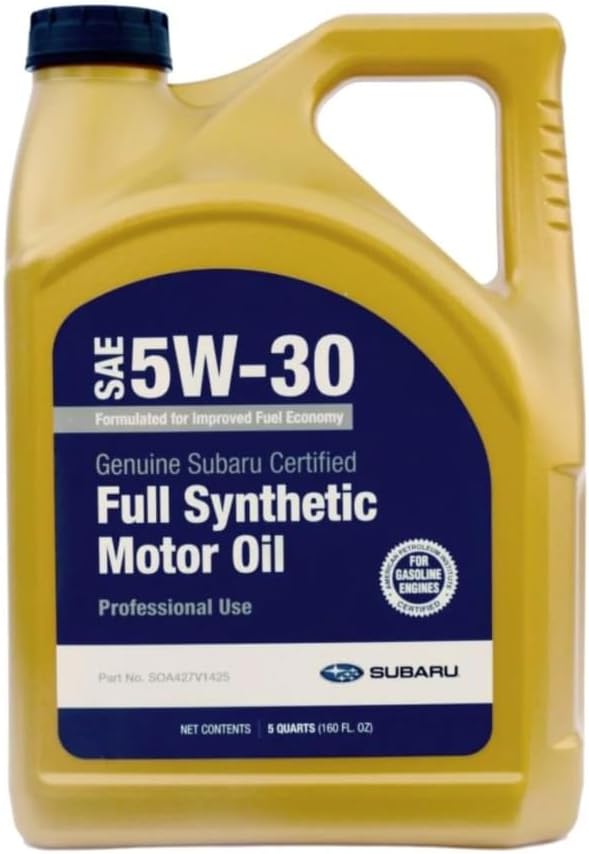
| Viscosity | 5W-30 |
|---|---|
| Manufacturer | Subaru |
| Package | 5 quart bottle |
| Model number | SOA427V1425 |
This Subaru-branded synthetic 5W-30 is formulated for turbocharged Subaru engines and comes in a convenient 5-quart bottle for a full service fill. It is intended for use in performance turbo models and is suitable for higher operating temperatures and more aggressive driving, providing the viscosity and film strength expected at operating temperature for a turbocharged flat-four. Typical use is regular oil changes on turbo Forester/WRX/STI engines where factory-quality lubrication and compatibility with Subaru seals and engine tolerances matter. Notable features include the OEM branding and a formula marketed for turbo applications, which simplifies parts lookup and fitment for Subaru owners. Practical benefits are peace of mind from a factory-specified product and straightforward serviceability using a single 5-quart bottle. Limitations are that this is a single-viscosity grade without details on additive chemistry or specific performance standards on the label, so drivers wanting explicit high-mileage, racing, or diesel-rated formulations may prefer a specialty oil with published spec sheets.
Best for: Buyers who prioritize factory-specified lubrication for turbo Subaru engines and want a ready-to-use 5-quart synthetic oil for regular maintenance on performance models.
Less Ideal for: Drivers chasing documented racing-grade, specialty high-mileage blends, or those who require explicit aftermarket performance certifications should look at dedicated performance oils with published spec sheets.
- Formulated as a 5W-30 synthetic suitable for turbocharged Subaru engines
- Factory-branded for straightforward compatibility with Subaru service recommendations
- Sold in a 5-quart bottle that covers a full-engine oil change
- Good choice for drivers who run hot or drive aggressively and need stronger film strength at temperature
- Product listing does not include detailed additive package or industry spec certifications on the label
Verdict: Choose a 5W-30 turbo-capable oil if your engine runs hotter or you drive more aggressively and need stronger film strength at operating temperature.
5. Valvoline High Mileage 150K with MaxLife Plus Technology 5W-30 Motor Oil, 5 Quart
Best High-Mileage Formula

| SAE J300 Viscosity Grade | 5W-30 |
|---|---|
| Compatible with Vehicle Type | Car, Truck |
| Container Type | Bottle |
| Liquid Volume | 5 Quarts |
Valvoline High Mileage 150K is a synthetic blend motor oil designed to help older engines run cleaner and last longer. It combines conventional and synthetic base stocks with Valvoline's MaxLife Plus Technology, which includes a molybdenum-based antiwear additive to form a protective film on critical surfaces, a boosted detergent system to fight sludge and deposits, and seal conditioners to reduce leaks and oil consumption. In real-world use this oil is suitable for routine service in a high-mileage Subaru Forester from 2009 to 2013 where owners want to address oil seepage and wear without switching to a full synthetic. The 5W-30 viscosity provides reliable start-up protection in varied temperatures while the additives aim to lower friction and heat under load. Limitations are that it is a synthetic blend rather than full synthetic, so it may not match the extended drain or peak thermal stability of premium full synthetics, and it is formulated specifically as a high-mileage treatment rather than a performance racing oil.
Best for: Owners of older Subaru Forester models looking to reduce oil leaks, curb oil consumption, and protect worn engine internals without changing viscosity or switching immediately to a full synthetic program.
Less Ideal for: Drivers who prioritize maximum thermal stability and the longest possible drain intervals should consider a premium full synthetic oil instead.
- Formulated additives for high-mileage engines including molybdenum antiwear chemistry
- Seal conditioners to help reduce leaks and oil consumption
- Boosted detergent and antioxidant system to combat sludge and thermal degradation
- Synthetic blend rather than full synthetic, so ultimate thermal stability and extended drain capability are lower than top-tier full synthetics
Verdict: Pick a high-mileage formula when you want additives that help reduce oil consumption, condition seals, and protect older engine internals.
6. Subaru Genuine Oil Change Kit with Filter, Gasket & 6 Qts 0W-20 Synthetic
Best Oil Change Kit (Oil + Filter)

| Viscosity Level | Low to Medium (0W-20) |
|---|---|
| Liquid Volume | 6000 ml |
| Compatible with Vehicle Type | Car |
| Automotive Fit Type | Vehicle Specific Fit |
This kit bundles the exact Subaru 0W-20 synthetic oil with a matching Subaru engine oil filter and crush gasket so you can complete a full oil change with one purchase. For a 2009–2013 Forester (4-cylinder, non-turbo), the six quarts cover a drain plus refill and any small top-ups, while the factory filter and gasket match the vehicle’s sealing and filtration requirements. The genuine filter is designed to capture fine contaminants and the crush gasket simplifies oil pan sealing during reassembly. Using factory-quality oil and parts reduces compatibility risk and makes the service straightforward for DIYers or shops following Subaru service recommendations. Limitations: this kit is specific to Subaru 4-cylinder applications and will not fit turbocharged engines or non-Subaru vehicles, and it does not include tools or a drain pan so you still need basic service supplies to perform the change.
Best for: Buyers who want the convenience and assurance of a single package that supplies the exact oil quantity plus a factory filter and gasket for routine DIY oil changes on their 2009–2013 Forester 4-cylinder.
Less Ideal for: People servicing turbocharged Subaru engines, owners who need additional service supplies like a drain pan or socket set, and those who prefer non-factory or performance oil formulas.
- Includes six quarts of factory-formulated 0W-20 synthetic oil matched to Subaru recommendations
- Genuine Subaru engine oil filter to trap microscopic contaminants
- Crush gasket included for correct oil pan sealing
- Single kit simplifies buying the correct oil quantity and filter for a complete service
- Fits only specified Subaru 4-cylinder models and not turbocharged engines
Verdict: Choose a full oil-change kit when you want the convenience of buying the correct oil amount plus the matching filter and gasket in one package.
Choosing the Right 2009-2013 Subaru Forester Engine Oil: Key Factors to Consider
Viscosity and Seasonal Performance
Viscosity determines how the oil flows at cold start and at operating temperature. Choosing a grade that matches Subaru recommendations helps ensure fast oil circulation on cold starts while still providing a protective film at highway temperatures. For 2009-2013 Forester engines, common published grades include 5W-30 and 0W-20 depending on engine variant and climate.
Incorrect viscosity can increase wear on startup or reduce fuel efficiency if the oil is too thick. In colder regions, lower cold-viscosity ratings improve immediate protection during startup; in hot climates or heavy-load driving, higher hot-viscosity stability helps maintain film strength.
Additive Chemistry and Wear Protection
Additives such as anti-wear agents, detergents, dispersants, and high-performance base stocks influence how well oil protects metal surfaces and keeps contaminants suspended. For Forester engines, strong anti-wear chemistry reduces cam, lifter, and bearing wear over time, especially for vehicles with higher miles or frequent short trips.
Detergents and dispersants help limit sludge and varnish formation. Oils with demonstrated performance in standard wear and oxidation tests typically offer better long-term protection and more consistent engine cleanliness for these Subaru engines.
High-Mileage Considerations
If your Forester has significant miles, choose oils formulated for high-mileage engines. These often include seal conditioners that can reduce oil seepage and additives tailored to thicker deposits control. High-mileage oils may help maintain compression and reduce oil consumption in older engines.
However, thicker high-mileage formulations can slightly change oil pressure and flow characteristics. Balance the benefits of reduced leaks and deposit control against the need to stay within recommended viscosity ranges for proper valve train and bearing protection.
Synthetic Vs Conventional Base Stocks
Fully synthetic oils provide more uniform molecular structure and better resistance to thermal breakdown than conventional oils. For a 2009-2013 Forester, synthetics typically improve cold-start protection, reduce volatility and oil burn-off, and extend oil change intervals where manufacturer guidance allows.
Conventional oils may be acceptable for low-mileage, low-stress use but they generally offer less resistance to sludge and oxidation. Consider synthetic blends when looking for a balance of cost and improved protection, and full synthetics for maximum stability and long-term cleanliness.
Compatibility With Subaru Specifications
Confirm that the oil meets industry specifications and any Subaru-recommended standards applicable to the 2009-2013 Forester engines. Using oils that meet the right API and other manufacturer-referenced specifications ensures appropriate performance of detergency, wear protection, and emission-system friendliness.
Using oils outside the recommended spec or viscosity can affect warranty coverage in some situations and may alter long-term engine behavior. Always cross-check the oil's published specifications against your owner's manual or maintenance documentation.
Oil Change Interval and Maintenance Practices
Oil change interval affects which oil is appropriate. Oils with higher oxidation stability can safely run longer between changes when used with proper filtration. For Forester owners who do frequent short trips, more frequent changes help control moisture and contaminants that accumulate in the oil.
Regular use of the correct viscosity, timely filter replacement, and following the vehicle's service schedule together determine how effectively the oil protects the engine over time. Plan your oil choice around both expected mileage and service habits.
Recommended Viscosity Choices For Different Climates
Select a viscosity that matches seasonal conditions and the Forester's engine variant. In colder climates, lower cold-grade numbers improve startup protection and oil flow, while in warmer areas a stable high-temperature viscosity preserves film strength.
Many 2009-2013 Forester owners will choose 5W-30 for a broad balance of cold start protection and hot-operating stability, while 0W-20 can offer improved fuel economy and quicker circulation in very cold regions when compatible with the specific engine.
- 0W-20: Best where cold-start fuel economy and quick flow matter.
- 5W-30: Good all-around choice for mixed climates and heavier loads.
How Oil Choice Affects Fuel Economy And Emissions
Oil viscosity and base stock affect internal friction. Lower-viscosity oils can reduce parasitic drag and improve fuel economy slightly, but gains depend on driving style and engine condition. For an older Forester, engine wear may blunt the fuel-economy benefit of switching grades.
Modern synthetic oils also tend to have lower volatility, which can reduce oil consumption and evaporative losses that influence emissions. Choose oils that balance low friction with long-term protection to avoid tradeoffs between economy and component wear.
- Lower high-temperature viscosities often yield marginal fuel savings.
- Synthetic oils typically reduce evaporative losses compared with conventional oils.
Addressing Oil Consumption And Leaks In Higher-Mileage Foresters
Higher-mileage Foresters may develop increased oil consumption or minor seepage. Switching to a high-mileage formulation that contains conditioners can sometimes reduce seepage without changing the recommended viscosity grade.
Regular inspection of valve-cover gaskets, oil pan, and drain plug area helps catch leaks early. Combining a vigilant maintenance routine with an oil formulated for high-mileage engines can extend useful service life while limiting the need for more intrusive repairs.
- Use a high-mileage formulation if your Forester shows increased oil consumption.
- Inspect seals and gaskets during every oil change to detect seepage early.
Cold Starts And Short Trip Driving
Short trips and frequent cold starts are hard on engine oil because the engine often does not reach stable operating temperature, allowing moisture and fuel dilution to accumulate. Lower cold-grade oils improve lubrication during those critical first seconds after start-up.
If your Forester mostly does short trips, plan for shorter oil change intervals and consider an oil with strong detergent and dispersant properties to manage contaminants that build up without extended operating periods.
- Short-trip drivers should prioritize cold-start flow and detergency.
- Consider more frequent changes to control moisture and fuel dilution.
Oil Additives That Matter For Subaru Boxer Engines
Boxer engines have a different layout and heat distribution compared with inline engines. Additives that protect against wear and control deposits in piston crowns and ring lands are especially useful. Anti-wear agents and robust detergent packages help maintain ring sealing and compression.
Detergents, dispersants, and anti-oxidants are the key additive groups to evaluate. These help keep the oil and engine internals cleaner over time and support longevity in the Forester's horizontally opposed engine design.
- Prioritize anti-wear and dispersant chemistry for better long-term sealing.
- Oxidation inhibitors extend oil life under repeated thermal cycling.
Still looking for the perfect fit?
Select your Subaru Forester configuration to see the most relevant Engine Oils recommendations
How We Chose the Best 2009-2013 Subaru Forester Engine Oil
We focused on metrics and practical fitment that matter specifically to 2009-2013 Subaru Forester engines. Primary evaluation criteria included: viscosity compatibility with Subaru recommended grades and seasonal performance; wear protection measured by additive chemistry and industry test coverage; thermal stability and resistance to oxidation for longer oil life under typical Forester operating temperatures; deposit and sludge control to reduce risk in older engines; and compatibility with seals and gaskets to limit leaks in higher-mileage examples.We also considered suitability across common Forester use cases such as city commuting, highway driving, towing-like loads, and cold-weather starting. Oils were screened for industry certifications and published performance specifications relevant to Subaru engines. Exclusions included products that lacked appropriate viscosity grades for the 2009-2013 Forester range or that did not list necessary performance specs. The result is a focused shortlist that balances protection, longevity, and real-world compatibility for this model range.
Our full evaluation process is outlined in our review methodology.
FAQ
What oil viscosity should I use in my 2009-2013 Subaru Forester?
Viscosity depends on the specific engine and climate. Commonly recommended grades for the 2009-2013 Forester include 5W-30 and 0W-20. Check the owner's manual for the factory-recommended grade and choose based on local temperatures and driving style.
Can I switch from conventional to full synthetic in an older Forester?
You can often switch to full synthetic; it usually improves cold-start protection and thermal stability. For very high-mileage engines, monitor for any change in oil consumption or leaks after switching, and choose a synthetic formulated for high-mileage use if needed.
How often should I change the oil in a 2009-2013 Forester?
Change intervals depend on oil type and driving habits. Under severe or short-trip conditions, change more frequently. Follow the vehicle's maintenance schedule as a baseline and shorten intervals if you do frequent short trips or towing-like loads.
Is 0W-20 safe for cold climates for these Forester years?
0W-20 offers excellent cold-start flow and can be appropriate in cold climates if it is listed as acceptable for your Forester engine. Confirm compatibility with the engine specifications before switching to ensure proper protection at operating temperatures.
Should I use a high-mileage oil if my Forester has over 100,000 miles?
A high-mileage formulation can help reduce seepage and manage deposits in older engines. It often contains additives aimed at conditioning seals and controlling wear, though you should remain within the recommended viscosity range.
Will changing oil brands affect my Forester's performance?
Changing brands is usually fine as long as the oil meets the correct viscosity and performance specifications. Differences between reputable formulations are typically small; focus on specifications and the oil's suitability for your driving conditions.
Final Verdict
When choosing engine oil for a 2009-2013 Subaru Forester, prioritize the correct viscosity for your climate and the engine variant, along with robust wear protection and good deposit control. Decide between full synthetic, synthetic blend, or high-mileage formulations based on mileage, driving patterns, and desired oil change intervals.Balance fuel economy benefits against long-term protection needs, and maintain a consistent service routine including timely filter changes. By matching oil specifications and maintenance to how you use the Forester, you can protect engine life and performance with confidence.
Explore More:
- Check out all Subaru Forester parts & accessories
- Explore Fluids & Chemicals
- Browse all Accessories
