

Note: This article contains affiliate links. If you click on these links and make a purchase, I may earn a small commission at no extra cost to you. This helps support my research and content. Read my full affiliate disclosure here.
Picking the right engine oil for a 2014-2018 Subaru Forester matters more than many owners realize. The correct oil affects fuel economy, cold-start performance, and long-term engine wear—especially on turbocharged or higher-mileage Forester engines. In this guide we shortlist the top options for this model years range and explain the tradeoffs between weight, synthetic versus conventional choices, and formulations aimed at higher-mileage engines.The selections below focus on oils suitable for the Forester platform and cover common viscosity choices, service interval implications, and maintenance considerations. Read on for the factors we weighed and practical tips to help you choose the right oil for your driving style and mileage. The next section lists the top picks and why they fit these Forester model years.
Looking for other parts? See all Subaru Forester parts & accessories.
Top Picks at a Glance
| Best Overall Engine Oil A balanced synthetic option that suits most owners and conditions | Valvoline Advanced Full Synthetic SAE 0W-20 Motor Oil, 5 qt |  |
| Best Budget Engine Oil A low-cost synthetic or blend that still meets OEM performance specs | Castrol GTX Full Synthetic 0W-20 Motor Oil, 5 Quart Jug |  |
| Best Turbo 5W-30 Engine Oil A 5W-30 synthetic grade formulated for turbocharged engines and higher thermal loads | Subaru Synthetic 5W-30 Motor Oil 5-Quart (SOA427V1425) |  |
| Best Oil Change Kit Complete kits with a 5-quart supply plus filter and crush gasket included | Subaru Genuine 0W-20 Synthetic Oil Change Kit with Filter and Gasket (6 Qts) |  |
| Best Premium Synthetic Engine Oil High-end synthetic brands formulated for extended protection and long drain intervals | Royal Purple 5W-30 High Performance Synthetic Motor Oil, 5 qt |  |
1. Valvoline Advanced Full Synthetic SAE 0W-20 Motor Oil, 5 qt
Best Overall Engine Oil

| Viscosity | 0W-20 |
|---|---|
| Size | 5 QT |
| Meets | ILSAC GF-7A, API SP, API SN with SN PLUS |
| Manufacturer | Valvoline |
Valvoline Advanced Full Synthetic 0W-20 is a full-synthetic motor oil designed to protect and keep modern gasoline engines running clean. For a 2014–2018 Subaru Forester that calls for 0W-20, this oil flows easily at cold starts to reduce wear, resists thermal breakdown to help prevent sludge, and includes additives aimed at minimizing deposits. Valvoline claims stronger wear protection and better heat resistance than industry baselines, which translates to longer component life and steadier performance under normal commuting and highway driving. Its formula also supports improved fuel efficiency compared with thicker oils, which is useful for drivers focused on economy. Limitations: it is specific to vehicles requiring 0W-20 and does not address diesel or specialty applications, and compatibility should be confirmed against Subaru service specs and any model-specific manufacturer recommendations.
Best for: Drivers of 2014–2018 Subaru Forester who want a single, reliable synthetic oil that balances engine protection and fuel economy for everyday driving and routine maintenance.
Less Ideal for: Owners who need a different viscosity for modified engines, heavy towing, or diesel applications should choose an alternative formulated for those conditions.
- Full synthetic base oil for improved cold-start flow and long-term protection
- Formulated to reduce wear, heat-related breakdown, and engine deposits
- Meets modern gasoline oil specifications including API SP and ILSAC GF-7A
- Supports improved fuel economy compared with higher-viscosity oils
- Intended only for engines specified to use 0W-20 and not suitable for other viscosity requirements
Verdict: Choose this when you want the single best all-around synthetic oil for reliable protection, fuel economy, and common driving conditions.
2. Castrol GTX Full Synthetic 0W-20 Motor Oil, 5 Quart Jug
Best Budget Engine Oil

| SAE Viscosity Grade | 0W-20 |
|---|---|
| Container Type | Can |
| Compatible Vehicle Type | Car, Truck |
| Liquid Volume | 5 Quarts |
| Meets Specs | API SP, ILSAC GF-6, dexos1 Gen 3 |
Castrol GTX Full Synthetic 0W-20 is a full-synthetic engine oil intended for routine service in vehicles that call for 0W-20 viscosity. It is used like any engine oil during oil changes and is packaged in a 5 quart jug that covers a typical oil change and filter for most passenger engines. Key features include protection against wear and sludge, a formula designed to resist high-temperature breakdown, and claims of extended drain performance up to about 10,000 miles under recommended schedules. In practical terms that means cleaner internals, reduced metal-to-metal wear, and stable viscosity that helps preserve fuel economy and engine response. Limitations are that extended drain intervals depend on driving conditions and manufacturer recommendations, so stick to Subaru Forester service intervals and dealer guidance rather than stretching changes solely based on marketing. Also this specific grade is for engines requiring 0W-20 and is not suitable for Foresters specifying a different viscosity.
Best for: A buyer seeking an affordable, factory-quality 0W-20 full synthetic for regular maintenance on a 2014–2018 Subaru Forester who prioritizes reliable protection and straightforward DIY or dealer oil changes.
Less Ideal for: Not a fit for drivers wanting specialty blends for extreme race or heavy towing use or for Foresters that require a different viscosity grade than 0W-20.
- Full synthetic formulation for improved high-temperature stability and wear protection
- Specifically graded SAE 0W-20 for modern engines requiring low-viscosity oil
- Packaged as a 5 quart jug convenient for a single service with room for filter top-up
- Formulated to reduce sludge and help keep engine internals cleaner
- Meets multiple industry specifications including API SP and ILSAC GF-6
- Extended oil change claims depend on driving conditions and should not replace following Subaru service recommendations
Verdict: Pick this if you need an affordable motor oil that covers standard service intervals without breaking the bank.
3. Subaru Synthetic 5W-30 Motor Oil 5-Quart (SOA427V1425)
Best Turbo 5W-30 Engine Oil
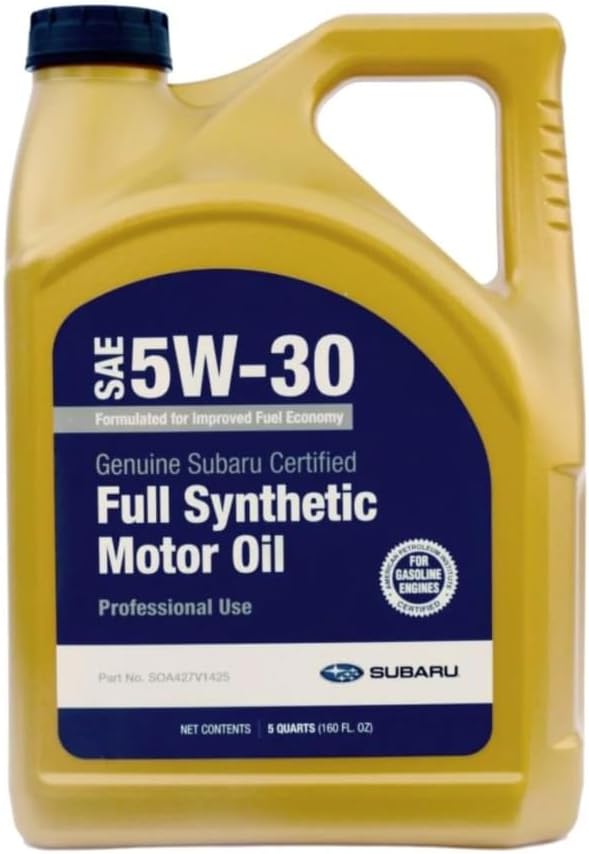
| Manufacturer | Subaru |
|---|---|
| Viscosity | 5W-30 |
| Quantity | 5 quarts |
| Model | Motor Oil |
This Subaru-branded synthetic 5W-30 is a factory-formulated motor oil packaged in a 5-quart bottle and targeted at turbocharged and high-output Subaru engines. It is intended for routine oil changes where a manufacturer-recommended 5W-30 is specified, offering the thermal stability and shear resistance expected from a synthetic formulation. Typical use is straightforward: drain and replace oil during service intervals for models like WRX and STI or turbo Forester variants. The product lists 5W-30 viscosity and carries Subaru part number SOA427V1425, which simplifies fitment for owners who prefer factory-specified fluids. Practical benefits include consistent viscosity control across a wide temperature range and the convenience of a single 5-quart container that covers most conventional oil-change capacities. Limitations are that the listing does not specify API or ILSAC certifications on the label and it is positioned as a manufacturer-branded fluid rather than a performance aftermarket formula tailored for extreme track conditions.
Best for: Drivers of turbocharged or high-output Subaru models who want a factory-branded synthetic 5W-30 that matches manufacturer labeling and simplifies service decisions.
Less Ideal for: Owners seeking a specialty high-performance or track-focused racing oil with explicit competitive-grade additives and certifications should consider aftermarket performance formulations instead.
- Factory-formulated and branded by Subaru for direct fit with Subaru service recommendations
- Synthetic 5W-30 viscosity provides stable flow at cold start and protection at high operating temperatures
- Sold in a single 5-quart bottle that matches common oil change capacity for many Subaru engines
- Clear manufacturer part number for easy identification during maintenance
- Listing does not state specific industry certifications such as API or ACEA on the product page
Verdict: Select this oil when you run a turbo or high-output engine and need a 5W-30 formulation rated for elevated temperatures and stress.
4. Subaru Genuine 0W-20 Synthetic Oil Change Kit with Filter and Gasket (6 Qts)
Best Oil Change Kit

| Viscosity Level | 0W-20 synthetic |
|---|---|
| Liquid Volume | 6000 ml |
| Compatible with Vehicle Type | Car |
| Automotive Fit Type | Vehicle Specific Fit |
This one-box kit supplies everything needed for a complete oil service on compatible Subaru 4-cylinder Forester models from the specified model years. It includes six quarts of Subaru 0W-20 synthetic motor oil plus a factory-quality oil filter and crush gasket so you can replace the filter and refill the crankcase in a single visit to the garage or during a DIY drain-and-fill. Using the manufacturer-specified viscosity helps preserve cold-start protection and fuel economy in these engines, and the genuine filter is designed to capture microscopic contaminants the oil removes. The kit simplifies parts sourcing and reduces the chance of buying the wrong filter or insufficient oil. Limitations are that it is vehicle-specific and intended for certain non-turbo 4-cylinder Forester model years only, so confirm capacity and fitment against your owner’s manual before buying; the pack also assumes a conventional drain-and-fill rather than extended service procedures or turbocharged engine requirements.
Best for: Buyers who want a single-package, manufacturer-specified oil change solution for their compatible Subaru 4-cylinder Forester and prefer the convenience of one shipment that matches factory recommendations.
Less Ideal for: People with turbocharged Subaru engines, models outside the stated year ranges, or those who need different oil capacities or multi-filter servicing should choose a different kit or parts.
- Complete kit includes correct oil quantity plus a genuine Subaru oil filter and crush gasket for one oil change.
- Factory-formulated 0W-20 synthetic oil matches Subaru recommendations for cold-start protection and efficiency.
- Simplifies DIY or shop service by removing guesswork about filter fitment and oil volume.
- Fits specific non-turbo 4-cylinder Subaru model ranges only, so it is not universal.
- Contains only six quarts and one filter, so it does not cover vehicles requiring different capacities or multi-filter services.
Verdict: Choose a kit when you want a one-box service solution that includes the correct oil quantity, oil filter, and gasket for a full change.
5. Royal Purple 5W-30 High Performance Synthetic Motor Oil, 5 qt
Best Premium Synthetic Engine Oil

| SAE J300 Viscosity Grade | 5W-30 |
|---|---|
| Liquid Volume | 5 Quarts |
| Compatible with Vehicle Type | Car |
| Container Type | Bottle |
Royal Purple 5W-30 is a fully synthetic motor oil designed to provide strong wear protection and enhanced performance in modern gasoline engines. Typical use is as a direct replacement during scheduled oil changes for 2014–2018 Subaru Forester engines that call for 5W-30; the formula is compatible with conventional and other synthetic oils so no special prep is needed. Notable features include patented anti-wear and polar additives that adhere to metal surfaces, chemistry intended to reduce low speed pre-ignition in turbocharged GDI engines, and a low friction coefficient that can help fuel economy. In practical terms you can expect confident startup protection, resistance to sludge and deposits, and stability for extended drain intervals compared with standard mineral oils. Limitations to consider are that its benefits are tied to using the correct viscosity and change interval for your Forester, and longer drain intervals should follow manufacturer guidance rather than manufacturer-agnostic marketing claims.
Best for: Someone prioritizing top-tier synthetic protection and performance for a 2014–2018 Subaru Forester who wants improved wear control and potential fuel-economy gains.
Less Ideal for: Drivers who strictly follow only dealership-specified oil brands or who prefer to use lower-cost conventional oils for high-mileage, low-stress daily commuting.
- Advanced anti-wear additives reduce metal-to-metal contact under load.
- Formulated to help reduce LSPI in modern turbocharged GDI engines.
- Low coefficient of friction can improve fuel efficiency versus heavier oils.
- Compatible with conventional and other synthetic oils for straightforward upgrades.
- Manufacturer-recommended change intervals should still be followed despite marketing about extended drains.
Verdict: Choose this when you want top-tier synthetic performance—better shear stability, additives, and longer protection between oil changes.
Choosing the Right 2014-2018 Subaru Forester Engine Oil: Key Factors to Consider
Viscosity and Cold-Start Performance
Viscosity is the single most important attribute when choosing oil for your Forester. The right viscosity ensures full-film lubrication at operating temperature and sufficient flow at startup. For the 2014-2018 Forester, common weights like 0W-20 and 5W-30 each have different advantages: thinner oils improve cold-start flow and can help fuel economy, while slightly heavier oils may provide thicker film under sustained high-load conditions.
Cold-start protection matters because most engine wear occurs in the first seconds after startup. If you live in a cold climate, choose an oil with a lower winter rating to reduce friction until the engine reaches operating temperature. Conversely, if you frequently tow, carry heavy loads, or drive at sustained highway speeds, a higher hot-viscosity rating helps maintain protective film and reduce wear.
Synthetic Vs Conventional Formulations
Synthetic motor oil offers more stable viscosity across a wide temperature range and better resistance to oxidation than conventional oils. For Forester owners seeking extended drain intervals, improved high-temperature protection, and reduced deposit formation, synthetic oils are often the better choice. They also tend to provide superior low-temperature flow for cold starts.
Conventional oils may be acceptable for owners who follow frequent service intervals and do mostly low-stress driving, but they can thin faster at high temperatures and break down sooner. Consider the vehicle's mileage, driving style, and service plan when choosing between synthetic and conventional formulations.
Manufacturer Approvals and Industry Specs
Always verify that the oil meets Subaru requirements and relevant industry standards. Look for API service classifications and any ILSAC or manufacturer-specific approvals that indicate compatibility with Subaru engine materials and emissions systems. Oils meeting these specs are formulated to protect valve trains, piston rings, and catalytic systems common to the Forester lineup.
Using an oil without the recommended approvals can increase deposit formation, accelerate wear, or affect emissions-control performance. When in doubt, consult your vehicle manual and choose an oil with the stated approvals to ensure fit-for-service performance.
High-Mileage Considerations
If your Forester has higher mileage, look for oils formulated to address older-engine needs. High-mileage formulations often include conditioners that help maintain seal pliability and reduce external leaks, detergents to manage sludge, and additives that counter increased oil consumption. These features can extend the useful life of an aging engine and reduce noisy valve lifters or blow-by symptoms.
High-mileage oils are not a cure-all, but they can mitigate some wear-related symptoms and improve oil control. Factor in the engine's current condition, existing oil consumption patterns, and whether you plan to continue using the vehicle long-term when selecting a high-mileage-specific product.
Service Interval and Maintenance Habits
Your typical service interval directly affects which oil makes the most sense. Oils rated for longer drain intervals can reduce service frequency but require strict adherence to vehicle monitoring and oil-analysis practices if you push service periods beyond factory recommendations. Shorter intervals with a conventional or standard synthetic oil can be a safer plan for older engines or those with a history of oil consumption.
Also consider the ease of obtaining the correct oil at routine service locations. Choosing a commonly stocked viscosity and formulation helps ensure consistent maintenance and prevents accidental cross-use of incorrect grades during oil changes.
Additive Package and Deposit Control
An oil's additive package determines how well it controls deposits, keeps pistons and rings clean, and neutralizes acids formed during combustion. For the 2014-2018 Forester, prioritize oils with robust detergent and dispersant chemistry that minimize sludge buildup and varnish on critical engine components. Anti-wear additives like zinc dialkyldithiophosphate offer boundary protection for high-load or start-stop conditions.
While additive chemistry is important, balance is key. Some additives can affect emissions-control systems or accelerate the breakdown of certain seals if not formulated correctly. Choose oils designed for gasoline passenger engines and that explicitly mention deposit control and anti-wear benefits relevant to the Forester's operating profile.
Choosing the Right Viscosity for Your Driving Conditions
Decide between 0W-20 and 5W-30 based on local climate and driving load. If you do a lot of short trips in cold weather, a 0W-20 grade can improve startup flow and fuel economy. If you frequently tow, carry heavy loads, or drive at high sustained speeds, 5W-30 offers a thicker hot film and may better resist shear under heavy stress.
Check your owner manual for the manufacturer-recommended viscosity range and then adjust only for real-world extremes. Avoid switching grades back and forth frequently; pick the most appropriate grade for the majority of your driving and stick with it for consistent wear characteristics.
- Cold climates favor lower winter numbers like 0W-20.
- High load or heavy towing favors higher hot-viscosity such as 5W-30.
- Follow the manual for baseline recommendations before adapting to conditions.
Signs Your Forester Might Benefit From a High-Mileage Formula
Look for increased oil consumption, blue smoke on startup, or minor oil leaks as indicators that a high-mileage formulation could help. These oils include seal conditioners and additives aimed at reducing seepage and managing blow-by. Using a high-mileage oil is a low-risk, reversible step you can take before pursuing more invasive engine repairs.
If the engine has been well maintained with regular oil changes and does not show consumption issues, high-mileage oil may offer little immediate advantage. Still, it can provide additional detergency and conditioning benefits if you plan to keep the vehicle longer.
- Watch for higher-than-normal oil top-ups between services.
- High-mileage oils can help reduce minor leaks and improve compression retention.
Oil Change Intervals and Monitoring
Follow Subaru-recommended service intervals as a baseline. For many drivers, conventional changes every few thousand miles or synthetic changes at longer intervals both work, but your driving style should dictate the final schedule. Severe duty cycles such as frequent short trips, heavy towing, or many cold starts require shorter intervals.
Consider periodic oil condition checks or oil analysis if you extend drain intervals. Monitoring oil level and clarity between changes is a practical way to spot consumption or contamination before it becomes damaging.
- Short-trip commuting and stop-and-go traffic demand more frequent oil changes.
- Long highway miles are less stressful on oil but still require scheduled maintenance.
Cold-Weather Start-Up Tips
In cold weather, allow the engine to idle briefly if temperatures are well below freezing to promote oil flow to critical components. Use an oil with good low-temperature starting characteristics to reduce wear during these warm-up moments.
Cold-weather additives and synthetic base oils maintain fluidity at low temperatures, providing lubrication more quickly than many conventional oils. If you live in a region with harsh winters, this attribute should weigh heavily in your selection.
- Park in a garage or use engine block heaters where available to reduce cold start stress.
- Choose an oil with a low winter viscosity rating for best protection in freezing conditions.
Compatibility With Emissions and Turbo Systems
Ensure the oil you select is formulated for gasoline engines and is compatible with emissions-control systems. Some additives can affect catalytic converters or oxygen sensors over time, so pick oils that specify passenger car gasoline engine compatibility.
If your Forester has a turbocharged engine, give extra weight to oils with robust high-temperature stability and anti-oxidation chemistry. Turbochargers operate at higher temperatures and place additional demands on lubricant longevity and film strength.
- Oils labeled for gasoline passenger vehicles are the correct starting point.
- Turbocharged engines benefit from oils with strong thermal and shear resistance.
Still looking for the perfect fit?
Select your Subaru Forester configuration to see the most relevant Engine Oils recommendations
How We Chose the Best 2014-2018 Subaru Forester Engine Oil
We prioritized products that meet Subaru factory specifications for the 2014-2018 Forester and that offer clear performance benefits relevant to this vehicle. Evaluation centered on motor oil viscosity compatibility with Subaru engine tolerances, API and ILSAC/API or manufacturer approvals, and formulations designed for either naturally aspirated or turbocharged engines where applicable. We also considered oil longevity by reviewing published drain interval recommendations and additive chemistry that helps control wear, deposits, and oxidation.Cold-start protection and low-temperature flow were assessed because many Forester owners drive in varied climates; oils that maintain sufficient film strength at startup earned higher marks. We evaluated compatibility with higher-mileage engines by looking at conditioning agents and seal-swelling components that can reduce leaks and oil consumption. Real-world usability factors such as availability in common sizes, clear labeling of viscosity grades, and compatibility with standard service procedures were also considered.Exclusions: we excluded any oil that lacks required spec approvals for Subaru engines or that is formulated exclusively for diesel engines. We did not include products marketed only for extreme racing use because those do not reflect typical owner service intervals. The resulting list emphasizes oils that balance protection, drivability, and service practicality for the 2014-2018 Subaru Forester.
Our full evaluation process is outlined in our review methodology.
FAQ
What viscosity should I use in a 2014-2018 Subaru Forester?
It depends on your engine variant and climate. Many Forester owners use 0W-20 for better cold-start flow and fuel economy, while 5W-30 can be preferable for heavy-load or high-temperature operation. Check the owner manual and choose the grade that matches your typical driving.
Can I switch from conventional to synthetic oil in my Forester?
Yes. Switching to synthetic is generally safe and often beneficial, offering better thermal stability and low-temperature performance. Ensure the synthetic meets the required industry and manufacturer specifications for Subaru engines.
Should I use a high-mileage oil if my Forester has over 100,000 miles?
Often high-mileage formulations help by conditioning seals and improving deposit control, which can reduce minor leaks and oil consumption. Their benefit depends on the engine's current condition, so consider monitoring results over a few oil-change cycles.
How often should I check oil level between changes?
Check the oil at least once a month or before long trips, and top up as needed. More frequent checks are prudent if you notice increased oil consumption, leaks, or if the vehicle does many short trips.
Does turbocharging change oil selection for a Forester?
Yes. Turbocharged engines place higher thermal and shear loads on oil, so choose oils with strong high-temperature stability and anti-oxidation properties. Oils formulated for turbocharged gasoline engines are preferable in those Foresters.
Can the wrong oil harm my Forester's emissions system?
Potentially. Oils without the appropriate passenger-car specifications or with incompatible additive packages can affect catalytic converter performance over time. Use oils that meet recognized industry and manufacturer approvals to avoid issues.
Final Verdict
When choosing engine oil for a 2014-2018 Subaru Forester, prioritize the correct viscosity for your climate and driving load, and select formulations that meet Subaru and industry specifications. Synthetic oils offer broader temperature protection and longer-lasting performance, while high-mileage formulations can help address aging-engine symptoms.Balance your desire for longer drain intervals with regular monitoring of oil level and condition. Focus on viscosity, approved specifications, and deposit control to make a confident, practical choice for your Forester's longevity and day-to-day performance.
Explore More:
- Check out all Subaru Forester parts & accessories
- Explore Fluids & Chemicals
- Browse all Accessories
