

Note: This article contains affiliate links. If you click on these links and make a purchase, I may earn a small commission at no extra cost to you. This helps support my research and content. Read my full affiliate disclosure here.
If you own a Subaru Forester with a continuously variable transmission, picking the right CVT transmission fluid matters more than you might think. The correct fluid supports smooth belt or chain operation, controls clutch and belt friction, reduces heat buildup, and helps prevent premature wear that can lead to costly repairs.This guide covers the top shortlisted fluids suitable for Subaru Forester CVT configurations. We focused on products that meet the vehicle's specifications and offer dependable friction characteristics, thermal stability, and protection against deposits. Read on for the evaluation criteria, practical fitment notes, and guidance to help you choose the right fluid for routine service or preventive maintenance.
Looking for other parts? See all Subaru Forester parts & accessories.
Top Picks at a Glance
| Best Overall Transmission Fluid The best all-around CVT fluid balancing performance and reliability | Idemitsu CVT Transmission Fluid Type SB2, 5-Quart |  |
| Best CVT Transmission Fluid Formulated specifically for continuously variable transmissions' needs | Subaru CVTF-II Continuously Variable Transmission Fluid (6 Quarts) |  |
| Best Premium Transmission Fluid Higher-end fluid offering extended life and top-tier protection | ENEOS ECO CVT Fully Synthetic Transmission Fluid, 1 qt (6-pack) |  |
| Best Synthetic Transmission Fluid Fully synthetic formula for improved stability and cold performance | Red Line 30804 Synthetic Non-Slip CVT Fluid, 1 Quart |  |
| Best Low-Viscosity Transmission Fluid Thin-viscosity option for improved efficiency and cold shifting | Subaru CVTF-III (CVT 3) Transmission Fluid, 6-Quart Pack |  |
1. Idemitsu CVT Transmission Fluid Type SB2, 5-Quart
Best Overall Transmission Fluid

| Brand | Idemitsu |
|---|---|
| Model | CVTF Type SB2 |
| Viscosity | 30.9 centistokes |
| Volume | 5 quart |
Idemitsu CVT Type SB2 is a purpose-built continuously variable transmission fluid supplied in a 5‑quart bottle for topping off or servicing CVT gearboxes. It is designed to provide hydraulic pressure, reduce wear, and control friction so belt and pulley systems shift smoothly rather than jerking. Typical use is service or fluid change for compatible CVT units where a Type CVTF‑II specification is recommended; one bottle covers most routine fill or top‑off jobs. Notable features include anti‑wear chemistry, thermal stability to resist breakdown under high temperatures, and formulation tuned for high torque CVT applications. In practice this delivers consistent shift feel and helps limit buildup that can affect longevity when used to the vehicle maker's specification. Limitations are that compatibility should be verified against the Forester's service manual and Subaru TR580 mention implies fitment is specific; this is not a universal transmission fluid for non‑CVT or non‑specified CVT systems.
Best for: Drivers who want a balanced, garage‑friendly CVT fluid that promotes smooth shifting and offers protective additives for longer service life when maintaining compatible CVT Subaru transmissions.
Less Ideal for: Drivers seeking a universal ATF for non‑CVT gearboxes or those who cannot confirm their Forester specifies CVTF Type SB2 should look at alternative fluids matched to their transmission.
- Formulated specifically for CVT systems to promote smooth, jerk‑free shifting.
- Anti‑wear additives and viscous stability help protect belts, gears, and pulleys under high load.
- 5‑quart volume is convenient for a full service or multiple top‑offs.
- Viscosity tuned for high torque CVT applications and resists buildup that shortens service life.
- Compatibility is model‑specific and requires checking Subaru TR580 or vehicle manual before use.
Verdict: The best all-around transmission fluid for buyers who want a balance of proven CVT compatibility, smooth shifting, long service life, and broad garage-friendly performance.
2. Subaru CVTF-II Continuously Variable Transmission Fluid (6 Quarts)
Best CVT Transmission Fluid

| Brand | Subaru |
|---|---|
| Liquid Volume | 6 Quarts |
| Specific Uses For Product | Maintenance of Subaru CVT transmissions |
| Upper Temperature Rating | 176 Degrees Celsius |
This genuine Subaru CVTF-II comes as a six-quart pack formulated specifically for Subaru CVT transmissions. It is intended to maintain the frictional and hydraulic properties CVTs need for consistent belt or chain engagement and smooth shift feel. In use you pour the green fluid into the transmission during service or a fluid change to restore designed shift characteristics and protect internal components. As factory fluid, it matches Subaru specifications and is a straightforward choice for scheduled maintenance or rebuilding work where factory compatibility matters. The main benefits are proper friction characteristics for CVT operation and the convenience of a six-quart supply to cover full fill and top-up needs. Limitations are that it is a vehicle-specific fluid intended for Subaru CVTs only and does not substitute for universal ATF or other synthetic formulas for non-CVT gearboxes, so confirm fitment to your exact model and year before buying.
Best for: Buyers who prioritize a factory-specified CVT fluid to maintain original shift feel and protect Subaru belt or chain-driven CVTs during routine service.
Less Ideal for: Anyone seeking a multi-vehicle or universal automatic transmission fluid or those working on non-CVT transmissions should look elsewhere.
- Formulated for CVT friction and shift feel to preserve factory shift characteristics
- Genuine Subaru product that meets manufacturer specifications for compatible CVT models
- Six-quart package provides enough fluid for a complete service plus top-up
- Green fluid makes it easy to identify as CVTF-II during service
- Intended only for Subaru CVT applications and not suitable for non-CVT or non-Subaru transmissions
Verdict: The best CVT transmission fluid for buyers who need a formula engineered for CVT friction characteristics, belt/chain protection, and consistent shift feel.
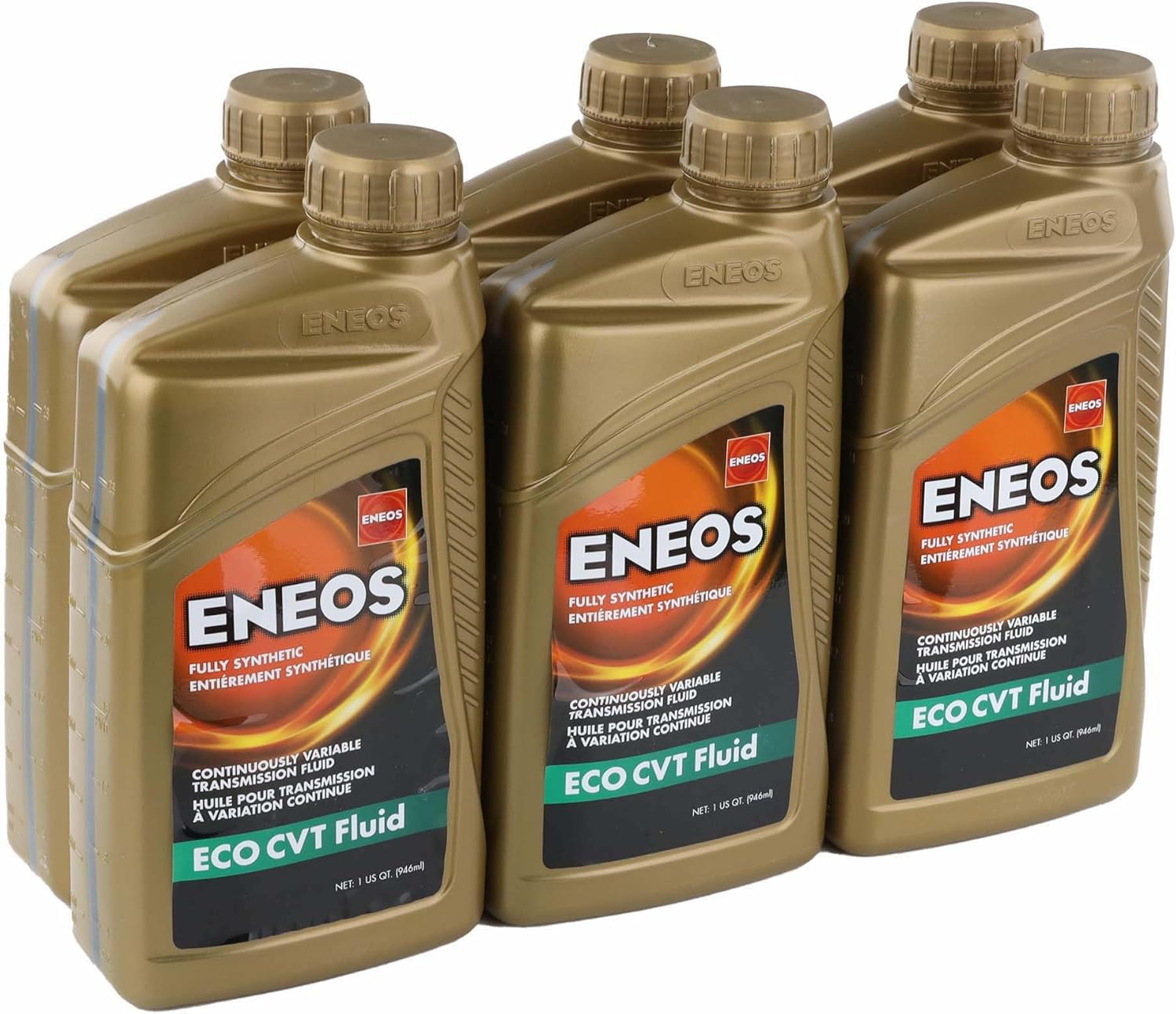
3. ENEOS ECO CVT Fully Synthetic Transmission Fluid, 1 qt (6-pack)
Best Premium Transmission Fluid
| Container Type | Bottle |
|---|---|
| Compatible with Vehicle Type | Car |
| Automotive Fit Type | Vehicle Specific Fit |
| Liquid Volume | 1 Quarts |
ENEOS ECO CVT is a fully synthetic transmission fluid formulated for belt- and chain-type continuously variable transmissions. It is intended for vehicle-specific CVT fitment and lists compatibility with several Asian CVT specifications, so it is used like a direct-replacement fluid during service fills or top-ups. The formula combines low-viscosity base oils with viscosity index improvers and additives to help maintain shift feel, reduce friction, and resist high-temperature breakdown during sustained use. ENEOS also claims reduced transmission noise and detergency to help keep components cleaner over time. Practical benefits include smoother, quieter operation and fluid stability under longer running periods compared with conventional fluids. Important limitations are the stated incompatibilities with some hybrid eCVT designs and certain toroidal or dry-type transmissions, so confirming the Forester CVT type against the owner manual is necessary before use. This 6-quart pack suits full drain and refill jobs on vehicles that require the listed Asian CVT specifications.
Best for: Buyers who prioritize long-term transmission durability and stable performance under heavier highway or towing-style use and want a premium, factory-quality CVT fluid for their Forester's CVT.
Less Ideal for: Drivers seeking a budget or universal fluid solution or owners of Subaru Foresters with hybrid eCVT or non-belt CVT designs should consider alternatives or confirm compatibility first.
- Fully synthetic formulation for improved thermal and oxidative stability
- Developed to meet multiple Asian CVT specifications for direct-replacement use
- Formulated to reduce transmission noise and maintain smooth belt or chain operation
- Designed to help keep internal components cleaner through detergency and additive package
- Not recommended for hybrid eCVT, toroidal, or dry-type CVTs which limits applicability
Verdict: The best premium transmission fluid for buyers willing to pay more for enhanced thermal stability, longer service intervals, and superior wear protection under heavier use.
4. Red Line 30804 Synthetic Non-Slip CVT Fluid, 1 Quart
Best Synthetic Transmission Fluid

| Unit Count | 32 Fluid Ounces |
|---|---|
| Material | Synthetic |
| Specific Uses For Product | CVTs in Mini, Nissan, and Subaru vehicles |
| Viscosity | Stable |
Red Line 30804 is a full synthetic, non-slip CVT fluid designed for metal belt-type continuously variable transmissions such as those used in many Subaru CVT applications. It is typically used during fluid service or filter changes to restore correct friction behavior and protect clutch surfaces in torque converters. The formula emphasizes thermal stability and low volatility, which helps maintain viscosity and reduce oxidation over long drain intervals when the manufacturer allows extended service. Anti-wear additives provide metal-to-metal protection and the stable viscosity improves shear resistance across a wide temperature range, translating to smoother low-temperature starts and consistent shift feel as the drivetrain heats up. The main limitations are that this product is a specialist CVT fluid targeted at metal-belt designs and may not match every factory fluid specification, so confirm compatibility with Subaru's recommended spec before use. Also, only quart bottles are provided, so larger jobs require multiple bottles.
Best for: DIY mechanics who prioritize strong low-temperature flow and long-term oxidation resistance in CVT service and want a synthetic fluid that preserves clutch friction characteristics.
Less Ideal for: Shoppers who need an exact factory-specified Subaru CVT fluid or a ready-to-use multi-quart kit for a full drain and fill without buying multiple bottles.
- Full synthetic base stocks for improved low-temperature flow and oxidation resistance
- Anti-wear additives for clutch and torque-converter protection
- Stable viscosity and improved shear characteristics for consistent performance across temperature range
- Formulated specifically for metal belt-type CVTs and may not meet all factory-specified fluids for every Subaru model
Verdict: The best synthetic transmission fluid for DIY mechanics who want superior low-temperature flow, oxidation resistance, and consistent performance across a wide temperature range.
5. Subaru CVTF-III (CVT 3) Transmission Fluid, 6-Quart Pack
Best Low-Viscosity Transmission Fluid

| Unit Count | 192 Fluid Ounces |
|---|---|
| Item Form | Liquid |
| SAE J300 Viscosity Grade | 10W-30 |
| Material | Synthetic |
This is the factory Subaru CVTF-III (CVT 3) fluid supplied in a six-quart package for service of compatible Subaru continuously variable transmissions. It is a low-viscosity synthetic fluid engineered to preserve the friction characteristics CVT designs need while improving cold-start shift responsiveness and supporting fuel efficiency. Typical use is a drain and refill or top-up during routine maintenance on the listed Subaru CVT models; the blue opaque fluid and OEM part number make model matching straightforward. The product offers the practical benefit of matching factory chemistry, which helps maintain shift feel and reduces the chance of transmission wear caused by incorrect fluids. Limitations are that it is specific to Subaru CVTs and intended for the model years and configurations listed, so confirming fitment before purchasing is essential. Also this is sold as a full six-quart set which may exceed the amount needed for partial service in some vehicles.
Best for: Buyers who want a factory-matched low-viscosity CVT fluid to preserve Subaru shift feel and improve cold-weather responsiveness while prioritizing fuel economy.
Less Ideal for: People seeking a universal or multi-brand CVT fluid or those who only need a small quantity for a partial top-up should consider alternative packaging or formulations.
- Factory-formulated synthetic matched to Subaru CVT friction requirements
- Low-viscosity formulation for better cold-weather shift response and potential fuel economy gains
- Sold as a six-quart package that covers full service needs for most CVT refill jobs
- Limited to specific Subaru CVT models and model years listed, not a universal CVT fluid
Verdict: The best low-viscosity transmission fluid for buyers focused on improved fuel efficiency and quicker cold-weather shift response while maintaining necessary CVT friction characteristics.
Choosing the Right Subaru Forester CVT Transmission Fluid: Key Factors to Consider
Compatibility With Subaru CVT Specification
Using a fluid that explicitly meets Subaru CVT requirements matters because CVT systems use different friction properties than torque-converter automatics. A compatible fluid will match the manufacturer's recommended friction coefficient, which governs clutch engagement smoothness and prevents chatter.
If the fluid does not meet Subaru's specification you may see rough or delayed engagement and accelerated wear of friction elements. Always confirm compatibility for the Forester CVT configuration and model years covered by your vehicle.
Frictional Behavior and Shift Quality
CVT performance depends heavily on stable frictional behavior under varying temperatures and loads. Fluids formulated with the correct friction modifiers produce predictable clutch and belt interaction, resulting in smooth takeoffs and steady acceleration.
Variability in friction characteristics can cause judder or slipping sensations. For Forester owners, prioritize fluids noted for consistent shift feel across warm and cold starts, as inconsistent friction shows up quickly in day-to-day driving.
Thermal Stability and Oxidation Resistance
CVT units can run hot, especially under towing, hilly driving, or repeated stop-and-go conditions. Fluids with strong thermal stability resist viscosity breakdown and oxidation that lead to sludge and varnish.
A fluid that withstands thermal stress helps maintain protective film thickness on bearings, chains, and clutches. That reduces wear and supports longer fluid life between recommended drain intervals for the Forester CVT.
Viscosity Retention and Shear Stability
Maintaining the correct viscosity under mechanical shear is critical in a CVT because reduced viscosity undermines hydraulic pressure and film strength. Shear stability ensures the fluid does not thin out excessively after repeated use.
Poor viscosity retention can cause lower pressure, softer shifts, and increased metal-to-metal contact. For the Forester CVT, choose fluids that advertise or test well for viscosity retention after shear.
Seal and Material Compatibility
CVT manufacturers design seals, gaskets, and clutch materials expecting specific additive chemistries. Fluids that are incompatible can cause seal swelling, shrinking, or premature degradation leading to leaks or pressure loss.
Selecting a fluid formulated to be compatible with Subaru CVT elastomers and metals reduces the risk of leakage and preserves hydraulic circuit integrity.
Contamination Control and Lifespan
Good CVT fluids include detergents and dispersants that suspend contaminants and prevent deposit formation. Over time, trapped particles and degraded additives can form varnish that interferes with valve bodies and clutch surfaces.
A fluid with strong contamination control extends component life and preserves consistent operation between recommended service intervals. Consider maintenance history and whether more frequent changes are needed in high-stress driving conditions.
When to Change CVT Fluid in a Forester
Owners should follow Subaru's recommended service schedule, but driving conditions influence change intervals. Frequent towing, heavy loads, mountain driving, or prolonged idling increase thermal stress on the CVT and may warrant more frequent fluid changes.
If you notice changes in shift quality, unusual noises, or higher transmission temperatures, inspect the fluid for darkening or burnt odor. Those are signs the fluid may have degraded and should be replaced to protect the transmission.
- Typical interval guidance varies; consult your owner manual for the baseline interval.
- Consider earlier replacement for severe or high-mileage use.
- After any service, verify proper fluid level with the vehicle on level ground and at the correct operating temperature if required.
DIY Fluid Change Vs. Professional Service
A fluid change on a Forester CVT can be performed at home by experienced DIYers who have the correct tools and access to the fill and drain points. Accurate fluid quantity and correct procedure are essential to avoid overfill or underfill conditions that affect shift behavior.
Professional service is beneficial when the job requires a lift, access to the CVT cooler line for a full flush, or when the vehicle needs a proper fill and bleed at operating temperature. Professionals can also inspect for leaks, worn seals, or other issues during service.
- DIY pros should follow Subaru's fill and level procedures exactly.
- A partial drain replaces less fluid than a complete cooler-line flush; know which method you are performing.
- Use only fluids that list compatibility with Subaru CVT systems.
Reading Product Labels and Compatibility Notes
When evaluating fluid options, check the technical data and compatibility statements on the label or technical data sheet. Look for explicit mention of Subaru CVT compatibility or a listing of the applicable Subaru specification.
Also review the fluid's performance claims for friction behavior, thermal limits, and viscosity grade. Technical details like recommended service temperatures and shear stability metrics help you compare options objectively.
- Verify the vehicle scope on the product datasheet before use.
- Avoid fluids that only reference manual transmissions or non-CVT automatic specifications.
- Look for manufacturer or third-party test results when available.
Signs of Fluid-Related CVT Problems
Early detection of fluid-related problems can prevent major transmission damage. Symptoms to watch for include hesitation on acceleration, judder or shudder during low-speed operation, unusual whining, and slipping under load.
Inspecting the fluid color and smell is a simple diagnostic. Healthy CVT fluid is usually clear to lightly colored; dark or burnt-smelling fluid indicates oxidation or overheating and should prompt a service visit.
- Hesitation or slipping under gentle throttle.
- Low-speed shudder or vibration when taking off.
- Unusual noises or higher-than-normal operating temperatures.
Storage and Handling Best Practices
Store unopened fluid in a cool, dry place away from direct sunlight to preserve additive integrity. Avoid contamination by using clean funnels and containers during a service to prevent dirt and moisture from entering the CVT.
Once opened, keep containers sealed and use within the supplier-recommended timeframe. Clearly label any partially used containers to avoid cross-contamination between fluid types.
- Use clean tools and disposable funnels for each fluid change.
- Keep different fluid types separate and clearly marked.
- Dispose of used fluid responsibly at an approved recycling facility.
Still looking for the perfect fit?
Select your Subaru Forester configuration to see the most relevant Transmission Fluids recommendations
How We Chose the Best Subaru Forester CVT Transmission Fluid
To assemble this list we screened fluids against criteria that matter specifically for Subaru Forester CVT drivetrains. Our editorial filters prioritized compatibility with Subaru CVT specifications, proven frictional performance for belt and clutch engagement, thermal stability to resist breakdown under repeated heat cycles, and contamination control to limit varnish and deposits. We also scored fluids on shear stability and viscosity retention, which affect how well the fluid maintains protective film thickness and shift feel over time.Additional selection criteria included corrosion and seal compatibility to avoid leaks or degraded seals, and the presence of friction modifiers engineered for CVT systems. We excluded products that lack clear manufacturer compatibility information for Subaru CVT applications or that are formulated solely for traditional torque-converter automatics. We avoided fluids intended only for manual transmissions or non-CVT automatic gearboxes. The final shortlist reflects fluids that balance protection, longevity, and consistent shift characteristics for Subaru Forester CVT service intervals.
Our full evaluation process is outlined in our review methodology.
FAQ
Can I use standard automatic transmission fluid in my Forester CVT?
Often standard ATF formulations do not have the specific friction and additive package required for Subaru CVT systems. Using a non-compatible fluid can lead to poor shift quality and accelerated wear, so verify compatibility before using an ATF in a CVT.
How often should I check the CVT fluid level on my Forester?
Check the fluid level at regular service intervals and whenever you notice a shift-quality change. Frequency depends on driving conditions, but a visual inspection during oil changes or every 12 months is a practical baseline.
Will a CVT fluid flush improve shudder or judder symptoms?
A fluid change or full flush can help if the symptoms are related to degraded fluid or contamination. However, judder can also stem from mechanical wear or clutch issues, so a fluid change may not resolve problems caused by hardware wear.
Is it okay to top off with a different brand of CVT fluid?
Mixing fluids is generally acceptable short term if both fluids meet the same Subaru CVT specification, but continual mixing can complicate additive performance. For best results, use a single approved fluid when possible.
Does high-mileage Forester CVT require special fluid?
High-mileage vehicles may benefit from fresh, high-quality fluid to restore hydraulic properties and reduce varnish. Specialized 'conditioner' additives are not typically necessary and may not be recommended; focus on choosing a compatible fluid with good contamination control.
Can a fluid change prevent CVT failure?
Regular, correct fluid maintenance reduces the risk of premature wear and some failure modes, but it cannot eliminate failures caused by mechanical defects or extreme driving stress. Proper fluid care is an important preventive measure, not a guaranteed cure.
Final Verdict
For Subaru Forester CVT owners, prioritize fluids that explicitly meet Subaru CVT specifications and demonstrate stable frictional behavior, thermal resistance, and shear stability. Those attributes help preserve smooth shift quality, reduce wear on belts and clutches, and maintain hydraulic pressure under varied driving conditions.Weigh the tradeoffs between extended-drain formulations and more conservative change intervals based on your driving habits. If you drive in severe conditions, lean toward fluids with stronger thermal and contamination control and consider more frequent service for long-term transmission health.
Explore More:
- Check out all Subaru Forester parts & accessories
- Explore Fluids & Chemicals
- Browse all Accessories
