

Note: This article contains affiliate links. If you click on these links and make a purchase, I may earn a small commission at no extra cost to you. This helps support my research and content. Read my full affiliate disclosure here.
If your Ford Explorer Sport Trac is showing emission issues or a persistent check engine light, replacing the catalytic converter can restore proper exhaust function and emissions control. You need a direct-fit, durable converter that addresses the specific exhaust routing and O2 sensor locations used on the Sport Trac so installation goes smoothly and performance is predictable.This guide shortlists the top catalytic converters suitable for the Ford Explorer Sport Trac across common model years and configurations. We focused on converters that balance emissions performance, fitment accuracy, and long-term durability. The next sections explain what matters when choosing a converter and how we evaluated candidates, then move into practical topics to help you complete the repair or replacement with confidence.
Looking for other parts? See all Ford Explorer parts & accessories.
Top Picks at a Glance
| Best Overall The best all-around choice for most situations | Walker Ultra 53500 Direct-Fit Catalytic Converter |  |
| Best Quality Built to a higher standard if you want something more solid | AISIN Aftermarket Catalytic Converter CCTFD-00392 for Ford 4.6L V8 |  |
| Best Value The sweet spot between price and what you get | HIGHBRICK Catalytic Converter Compatible with Ford Explorer Sport Trac 4.0L (2001–2005) |  |
| Best Budget The cheapest option that still gets the job done reliably | PHILTOP Direct-Fit Stainless Steel Catalytic Converter for 2001–2005 Explorer Sport Trac (Front) |  |
| Highest Rated A top-rated pick with lots of positive feedback | PHILTOP High-Flow Stainless Steel Catalytic Converter for 2001–2005 Explorer Sport Trac (Front) |  |
| Most Popular A crowd favorite that many people choose with confidence | ZonCar Catalytic Converter for 2001–2005 Explorer Sport and 2001 Mountaineer 4.0L (EPA Compliant) |  |
1. Walker Ultra 53500 Direct-Fit Catalytic Converter

| Brand | Walker |
|---|---|
| Model Number | 53500 |
| Warranty Description | 25K Miles |
| Applicable Vehicles | OBDII 1996 and newer (Ford Explorer / Sport Trac specified) |
The Walker Ultra 53500 is a direct-fit catalytic converter designed for Ford Explorer and Sport Trac OBDII applications. It replaces the factory unit using OE-style hangers, flanges, brackets and heat shields so installation is typically bolt-on with no welding or major fabrication. Built from durable stainless construction and offering an OE-style washcoat and precious metal loading, it is intended to restore emissions control and keep a vehicle compliant with EPA standards on supported models. The converter is most useful for technicians or owners who want a straightforward replacement that mirrors factory routing and underbody protection. Limitations include the need to verify exact vehicle/engine fitment before ordering and the standard emissions warranty mileage rather than a lifetime guarantee. This is a practical, no-frills replacement when you need a durable, factory-quality catalytic converter that installs cleanly and performs to regulatory requirements.
Best for: Buyers who want a straightforward, factory-like replacement that restores emissions function without custom fabrication and values ease of installation and regulatory compliance.
Less Ideal for: People seeking a universal or custom-fit solution for multiple vehicle types or those who want extended lifetime warranties and guaranteed precious-metal recovery value.
- Direct-fit design with OE-style hangers and flanges for bolt-on installation
- Engineered to meet EPA requirements for OBDII vehicles
- Stainless construction and thick hardware for improved durability
- OE-style heat shields to protect the undercarriage and match factory routing
- Compatibility must be confirmed for year, engine and trim before purchase
- Warranty coverage is limited to the stated mileage rather than lifetime protection
Verdict: Choose this Walker Ultra direct-fit converter when you need a durable, factory-style replacement that installs easily and meets EPA OBDII emissions requirements for Explorer Sport Trac models.
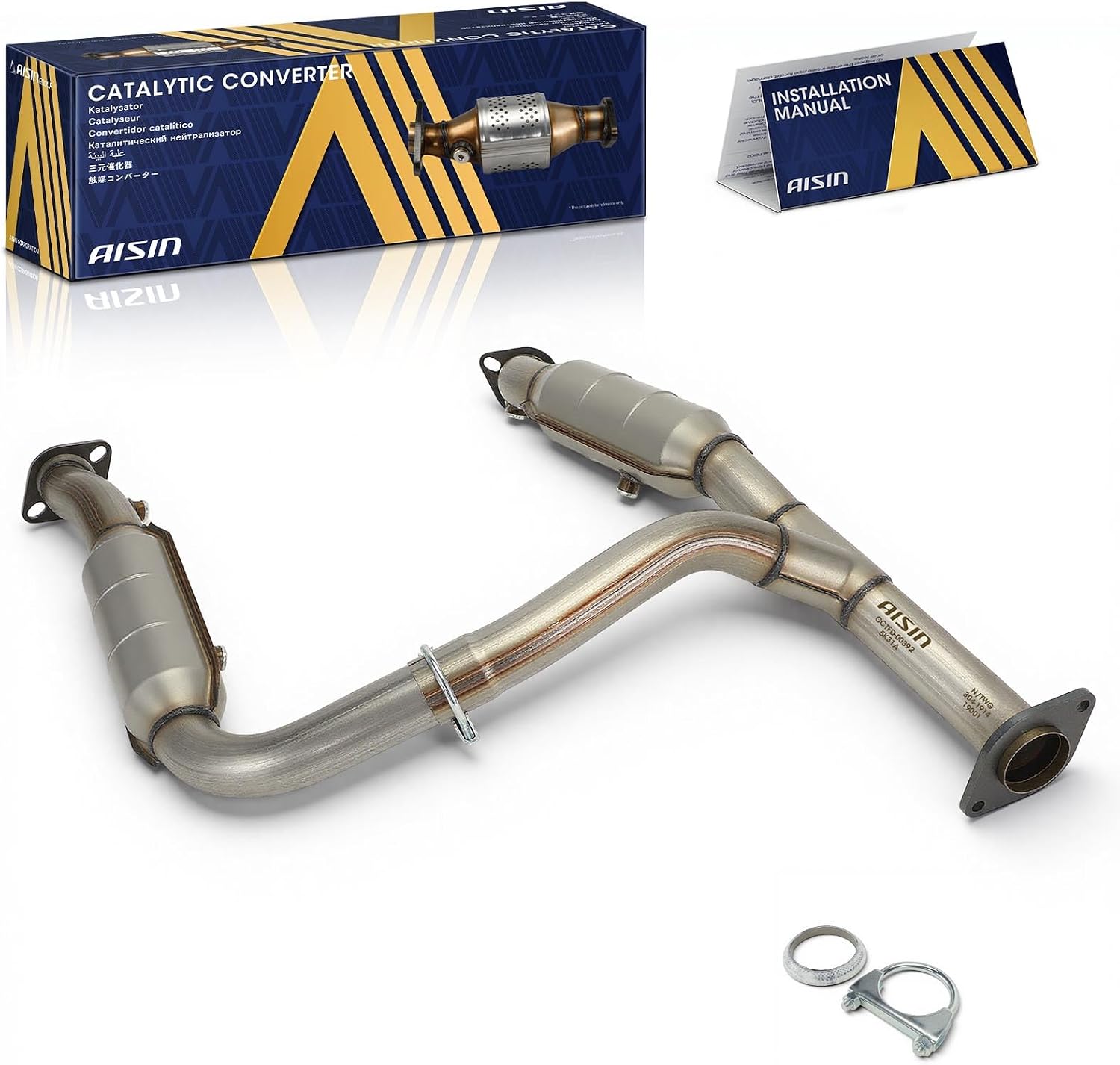
2. AISIN Aftermarket Catalytic Converter CCTFD-00392 for Ford 4.6L V8
| Manufacturer | AISIN |
|---|---|
| Manufacturer Part Number | CCTFD-00392 |
| Compatible Engines | V8 4.6L |
| Special Features | Located at the Exhaust Side |
This Aisin catalytic converter is a direct-fit replacement intended for the 4.6L V8 versions of the 2006–2010 Ford Explorer, 2007–2010 Explorer Sport Trac, and 2006–2010 Mercury Mountaineer. It installs in the exhaust side location and is built to match factory fitment so technicians can swap it in without modifying the exhaust system. The unit is marketed as EPA compliant for federal emissions vehicles and uses Aisin manufacturing standards aimed at long-term durability. For performance-minded buyers it restores proper backpressure and emissions control after a failed converter and supports OBDII diagnostics. Important limitations: it is not legal for sale in several states with stricter emissions rules and therefore is not appropriate where California-spec emissions are required, and it is a direct replacement rather than a high-flow performance unit, so expect factory-like flow characteristics rather than increased horsepower.
Best for: Buyers who need a reliable, factory-quality replacement to restore proper emissions control and exhaust flow on a 4.6L V8 Ford Explorer, Explorer Sport Trac, or Mercury Mountaineer and who prioritize durability and correct fitment over performance gains.
Less Ideal for: Enthusiasts seeking increased horsepower or freer exhaust flow or owners in states that require California-spec emissions equipment should look for a high-flow or CARB-compliant alternative.
- Direct-fit design that matches factory mounting for straightforward installation
- Manufactured by Aisin to factory-quality standards for durability and long service life
- EPA-compliant for federal emissions vehicles and compatible with OBDII diagnostics
- Includes multiple manufacturer reference part numbers for correct vehicle match
- Not legal for sale or use in states that require California emissions equipment
- Designed as a factory-equivalent unit rather than a high-flow performance converter
Verdict: Choose this Aisin unit when you want a durable, factory-matching catalytic converter to restore emissions compliance and stock exhaust behavior on a 4.6L V8 Ford Explorer Sport Trac.
3. HIGHBRICK Catalytic Converter Compatible with Ford Explorer Sport Trac 4.0L (2001–2005)

| Compatible engines | 4.0L |
|---|---|
| Vehicle fitment | Ford Explorer Sport Trac 2001-2005; Explorer Sport 2002-2003; Ranger 2001-2003 |
| Material | Stainless steel with ceramic catalyst |
| EPA compliance | Federal EPA compliant (not CARB) |
This HIGHBRICK catalytic converter is a direct bolt-on replacement intended for 4.0L Ford Explorer Sport Trac (2001–2005) and a few related models. It is constructed from stainless steel with a ceramic catalyst core and is marketed as EPA compliant for federal use, so it reduces emissions through a three-way catalytic reaction while resisting thermal shock. Installation is straightforward because the unit is engineered to match mounting points and includes the expected hardware and gaskets, avoiding welding or cutting for most installations. Buyers will appreciate the polished exterior and the claim of enhanced airflow and durability compared with worn OEM pieces. Important limitations are that it is certified only to federal EPA standards and is not legal for sale in several states with stricter rules, so confirm local compliance before buying. Also, fitment must be verified against your exact year, trim, and engine variant despite the stated vehicle list.
Best for: Buyers who want a practical, long-lasting replacement that restores emissions performance and simplifies installation without major modifications.
Less Ideal for: Drivers in states with stricter emissions laws or those who need a state-certified converter should look for locally compliant units or dealer-sourced parts.
- Direct bolt-on design that matches factory mounting points to simplify installation
- Constructed from stainless steel with a ceramic catalyst core for thermal resistance
- Certified to meet federal EPA emission requirements for cleaner exhaust gases
- Polished exterior finish for corrosion resistance and a neater underbody appearance
- Not legal for sale or use in several states with stricter emission rules
- Fitment still requires verification for exact year/trim to avoid mismatches
Verdict: Choose this HIGHBRICK converter if you need a durable, direct-fit federal EPA replacement that restores emissions control with simple bolt-on installation.
4. PHILTOP Direct-Fit Stainless Steel Catalytic Converter for 2001–2005 Explorer Sport Trac (Front)

| Position | Front |
|---|---|
| Vehicle fitment | 2001–2005 Explorer Sport Trac; 2001–2003 Ranger/Explorer Sport 4.0L |
| Manufacturer | PHILTOP |
| Exterior | Machined |
This PHILTOP catalytic converter is a direct-fit replacement designed for the front position on 2001–2005 Explorer Sport Trac and compatible 2001–2003 Ranger/Explorer Sport 4.0L engines. It uses a stainless steel body and a high-temperature ceramic honeycomb substrate intended to increase flow and maintain oxygen storage for emissions control. The unit ships with OE-style gaskets and hardware so installation is typically plug-and-play and can be completed in a few hours without modification. In practical use it should restore emissions performance, reduce rattling or loud exhaust caused by a failed converter, and may slightly improve throttle response and fuel economy by lowering backpressure. Important limitations are legal: this EPA-compliant model is not legal for states requiring California standards and may not be acceptable where stricter local regs apply. Buyers should also plan to reuse or replace any damaged flange or mounting parts during installation since the listing focuses on the converter itself.
Best for: A buyer looking to restore emissions function and drivability on a Sport Trac without paying dealer prices; ideal for owners prioritizing a budget-friendly, direct-fit repair that installs with basic tools.
Less Ideal for: Do not choose this if you need a converter certified for California or other states with stricter emissions rules or if you require a universal or performance-oriented exhaust upgrade.
- Direct-fit front replacement for specified 2001–2005 Explorer Sport Trac and listed 4.0L models
- Stainless steel body and high-temperature ceramic substrate for corrosion resistance and flow
- Includes OE-style gaskets and hardware for straightforward installation
- EPA-compliant design for use outside states with stricter emissions rules
- Not legal for use in states that require California emissions standards
Verdict: A cost-conscious, direct-fit front catalytic converter that restores emissions and drivability on 2001–2005 Explorer Sport Trac models without dealer-level expense.
5. PHILTOP High-Flow Stainless Steel Catalytic Converter for 2001–2005 Explorer Sport Trac (Front)

| Position | Front |
|---|---|
| Compatible engine | 4.0L (VIN E) |
| Manufacturer | PHILTOP |
| Construction | Stainless steel shell |
This PHILTOP catalytic converter is a direct-fit replacement for the front position on 2001–2005 Explorer Sport Trac (4.0L VIN E) and is built around a high-flow ceramic substrate inside a stainless steel shell. It is typically used as a factory-style replacement to restore emissions control, reduce exhaust noise from a failing unit, and recover normal engine breathing by lowering backpressure. The converter comes with OE-style gaskets and hardware for a bolt-on installation that most shops can complete in a few hours without modification. Notable features include a heavy-duty machined stainless shell and a high-flow internal honeycomb that aims to improve catalytic efficiency and durability. Practical benefits are straightforward: restores smog compliance where allowed, quieter operation compared with a damaged unit, and potentially steadier fuel and throttle response due to reduced restriction. Important limitations are regulatory: this EPA-approved federal model is not legal for use in states that require California-level emissions, and buyers should verify fitment for their exact VIN before purchasing.
Best for: A buyer who prioritizes a dependable, factory-style replacement to restore emissions function and quiet running on a 2001–2005 Explorer Sport Trac without modifications.
Less Ideal for: Drivers in states with California-level emissions requirements or anyone needing a CARB-compliant converter should look for a certified alternative.
- Direct-fit design with OE-style gaskets and hardware for bolt-on installation
- Stainless steel outer shell resists corrosion and withstands high temperatures
- High-flow ceramic substrate reduces backpressure to improve exhaust flow
- Comes with necessary mounting hardware so no modifications are required
- Not legal for use in states that require California emissions standards
Verdict: Choose this converter when you want a sturdy, direct-fit replacement that restores emissions performance and reduces exhaust noise on a 2001–2005 Explorer Sport Trac.
6. ZonCar Catalytic Converter for 2001–2005 Explorer Sport and 2001 Mountaineer 4.0L (EPA Compliant)

| Brand | ZonCar |
|---|---|
| Manufacturer Part Number | 2341EXP5781US |
| Position | Front, Rear |
| EPA Compliance | Yes (not legal in CA, NY, ME, CO) |
This ZonCar catalytic converter is a direct-fit replacement for the front or rear positions on the specified Explorer Sport and Mountaineer 4.0L models and is built with a stainless-steel outer shell and a honeycomb ceramic substrate. It is intended to reduce harmful exhaust emissions while maintaining exhaust flow, with the manufacturer stating EPA compliance and a high-flow design that aims to preserve engine power. Typical use is a bolt-in replacement during exhaust repair or emissions-related service where you need to restore converter function. Notable features include heavy-duty stainless construction for corrosion and heat resistance and a catalyst-loaded substrate claimed to improve conversion efficiency. Practical benefits are straightforward: restores emissions control, resists corrosion better than thin-shell alternatives, and supports performance by avoiding restrictive flow. Important limitations: the listing excludes sale in several states with stricter emissions rules and you should verify fitment to your exact year and configuration before buying because multiple OEM part numbers are referenced.
Best for: Buyers who want a factory-style replacement that restores emissions control and exhaust flow while prioritizing durable construction and documented compliance outside restricted states.
Less Ideal for: Drivers living in states with stricter emissions laws or anyone who needs a part with explicit local certification should look for a converter certified for those jurisdictions.
- Stainless steel outer shell improves resistance to corrosion and heat
- Honeycomb ceramic substrate with catalyst for efficient emission conversion
- High-flow design intended to maintain engine power while treating exhaust
- Available for front or rear positions to match common replacement needs
- Not legal for sale or use in California, New York, Maine, and Colorado due to emissions regulations
Verdict: Choose this stainless-steel, EPA-compliant replacement if you need a durable, high-flow catalytic converter to restore emissions control and exhaust performance on specified 2001–2005 Explorer Sport and 2001 Mountaineer 4.0L vehicles.
Choosing the Right Ford Explorer Sport Trac Catalytic Converter: Key Factors to Consider
Fitment and Mounting Style
Accurate fitment is the single most important factor for a Ford Explorer Sport Trac catalytic converter. The Sport Trac uses specific exhaust pipe diameters, flange patterns, and oxygen sensor locations that vary by model year and configuration. A converter that matches those dimensions saves time and reduces the risk of leaks.
Consider whether the converter is a direct bolt-on designed for the Sport Trac or a universal unit that needs cutting and welding. Direct-fit units will align with the factory flanges and sensor bosses, minimizing installation time and maintaining exhaust geometry. Poor fitment can lead to exhaust leaks, check engine lights, and premature stress on exhaust hangers.
Emissions Compliance and Substrate Type
For emissions-sensitive repairs, choose a converter with certification or stated compliance with EPA or CARB standards where applicable for your vehicle scope. The substrate material and cell density affect how efficiently the converter converts harmful gases. Higher quality substrates resist thermal breakdown and maintain conversion efficiency longer.
Also pay attention to whether the converter uses a monolithic ceramic substrate or a metal foil substrate. Ceramic substrates are common and effective but can be more brittle if exposed to mechanical shock. Metal substrates tolerate thermal cycling differently. The right substrate choice affects longevity and emissions performance over time.
Durability and Corrosion Resistance
Catalytic converters are exposed to heat, road salt, and mechanical stress. The housing and flange materials should resist corrosion and cracking, particularly if you drive in regions with salted roads or frequent moisture. Stainless steel housings and robust welds reduce the chance of exhaust leaks caused by rusting or failure at joints.
Durability also includes the internal bond between the substrate and housing. Units that allow substrate movement or show weak mounting can suffer premature failure. Consider the expected lifespan and whether the manufacturer provides a warranty that reflects confidence in long-term durability.
Oxygen Sensor and Electronics Accommodation
The Ford Explorer Sport Trac uses one or more oxygen sensors upstream and downstream of the catalytic converter to monitor emissions performance. Your replacement must have the correct number and location of sensor bosses or be compatible with your vehicle's sensor setup. Some converters include pre-welded sensor ports while others require separate fitting.
Incorrect sensor placement can trigger a check engine light catalytic converter trouble code even if the unit is otherwise functional. Confirm the converter supports the Sport Trac sensor layout and that the sensor threads and heights match the factory positions to ensure accurate feedback to the engine control module.
Thermal Performance and Backpressure
A catalytic converter must operate at sufficient temperature to convert pollutants effectively. Design factors that influence thermal performance include substrate mass, cell density, and housing insulation. On the Sport Trac, where driving patterns vary between city and highway use, choose a converter that reaches operating temperature reliably without causing excessive backpressure.
Excessive backpressure can reduce engine efficiency and throttle response. Conversely, a converter that is under-dimensioned for the engine or has an overly dense substrate can restrict flow. Balance thermal conversion needs with the Sport Trac's engine characteristics to avoid noticeable performance tradeoffs.
Installation Complexity and Serviceability
Consider how much labor the installation will require on the Sport Trac. Direct-fit converters with factory-style flanges typically install quickly and may be suitable for competent DIYers with basic tools. Universal converters or those requiring pipe modifications may increase labor and the chance of improper sealing.
Also evaluate whether the unit allows for future service, such as replacing oxygen sensors without removing the entire converter. Clear installation instructions, included gaskets or hardware, and compatibility with standard fasteners reduce installation surprises and lower the chance of leaks after fitting.
Common Catalytic Converter Symptoms on the Sport Trac
Recognizing failure signs early can prevent broader exhaust or engine issues. Typical catalytic converter symptoms on the Ford Explorer Sport Trac include a persistent check engine light catalytic converter code, reduced engine power or hesitation, and changes in exhaust odor. You may also notice decreased fuel economy or a rattling noise from the converter housing if the internal substrate has broken loose.
Some sensor-related symptoms mimic converter failure, so it is worth confirming fault codes and inspecting the unit visually before assuming replacement. Addressing signs quickly helps maintain exhaust emissions catalytic converter performance and avoids downstream damage to the oxygen sensors or engine management system.
- Check engine light with OBD-II codes related to conversion efficiency
- Rattling noises from the underbody at idle or during acceleration
- Reduced power, poor throttle response, or increased fuel consumption
- Strong sulfur or rotten-egg smell from the exhaust
Assessing Fitment: What To Measure Before Buying
Before ordering a replacement, measure the exhaust pipe diameter, flange bolt pattern, and distance between oxygen sensor ports on your Ford Explorer Sport Trac. These basic dimensions determine whether a converter will bolt up or require modification. Note the number of sensors and whether any heat shields or hangers will need to be reinstalled.
If you are uncertain about model year differences or existing aftermarket modifications, take photos and measurements to compare with product fitment information. Accurate measurements reduce the chance of returns and make installation smoother.
- Pipe diameter at the mating points
- Flange bolt hole spacing and orientation
- Oxygen sensor boss locations and thread sizes
- Overall unit length and hanger positions
Installation Tips for a Smooth Replacement
When replacing a catalytic converter on the Sport Trac, start by lifting the vehicle securely and supporting it with jack stands to access the underbody safely. Let the exhaust cool completely before working to avoid burns. Apply penetrating oil to bolts and nuts to ease removal; exhaust fasteners often corrode in place.
When installing the new unit, use new gaskets and torque fasteners to manufacturer specs to prevent leaks. If welding is needed, ensure clean, gap-free joints and protect sensor threads from heat when required. Recheck clearances to prevent hanger strain or interference with suspension components.
- Always replace exhaust gaskets and hardware when possible
- Hand-start bolts to avoid cross-threading sensor ports
- Use anti-seize on sensor threads where appropriate
- Perform a post-installation leak check at idle
Legal and Emissions Considerations
Catalytic converter replacement can have legal implications where emissions regulations are enforced. Ensure the unit you select complies with local vehicle emissions rules for your Sport Trac. Using a noncompliant converter can cause failed inspections and potential fines in regulated jurisdictions.
Keep records of the replacement and any documentation indicating emissions compliance. This paperwork can be helpful during inspections or if a future owner asks about emissions-related repairs.
- Verify stated emissions certifications for your jurisdiction
- Retain receipts and compliance documentation after installation
- Understand local requirements for certified replacements
When To Repair Versus Replace the Converter
Minor exhaust leaks at flanges or small external damage can sometimes be repaired without replacing the entire catalytic converter. However, internal substrate damage, melted or missing substrate material, or severe corrosion typically necessitates replacement. Assess whether the problem is with a gasket, flange, or the converter body itself before deciding.
If oxygen sensors are contaminated but the substrate is intact, replacing the sensors and cleaning nearby components may resolve codes. For persistent conversion efficiency failures or mechanical damage, full replacement is the most reliable long-term solution.
- Repair flange leaks and replace gaskets when substrate is intact
- Replace when substrate is cracked, melted, or internally loose
- Address contaminated sensors separately if possible
Preparing for Inspection and Post-Install Checks
After installation, run the engine through warm-up cycles and then inspect for leaks and proper sensor readings. Use an OBD-II scanner to clear codes and monitor if check engine light catalytic converter codes recur. Watch for drivability changes and confirm the exhaust does not produce abnormal odors or noises.
A brief road test under varying loads ensures the converter reaches operating temperature and that the Sport Trac is breathing correctly. If codes return, recheck sensor connections, ground integrity, and gasket seals as part of troubleshooting.
- Clear codes and monitor for recurrence after warm-up
- Perform a leak and vibration check at idle and under load
- Confirm sensor readings are within expected ranges
Still looking for the perfect fit?
Select your Ford Explorer configuration to see the most relevant Catalytic Converters recommendations
How We Chose the Best Ford Explorer Sport Trac Catalytic Converter
We evaluated candidates using criteria that matter to Ford Explorer Sport Trac owners who need a dependable catalytic converter replacement. Key evaluation factors included fitment accuracy to the Sport Trac exhaust geometry and O2 sensor locations, construction quality of the substrate and housing, and emissions performance verified by manufacturer specifications or compliance statements. We also considered thermal durability and corrosion resistance for typical driving conditions, plus ease of installation including whether the unit is a direct bolt-on or requires modifications.Additional selection filters included warranty length and seller-provided installation guidance, as longer warranties and clear fitment notes tend to indicate higher confidence in durability and compatibility. We excluded universal or heavily modified converters that would require significant custom exhaust work and units lacking clear compatibility with Sport Trac exhaust layouts. Finally, we prioritized converters that address common failure modes for this vehicle, such as substrate breakdown and flange corrosion, while avoiding products with unclear materials or undocumented fitment.
Our full evaluation process is outlined in our review methodology.
FAQ
How long does a catalytic converter typically last on a Sport Trac?
Longevity varies with driving conditions, exposure to road salt, and maintenance history. Many converters last over a decade under normal use, but thermal stress, contamination, or physical damage can shorten lifespan.
Will a failing catalytic converter cause the check engine light to come on?
Yes. The engine control module monitors converter efficiency through oxygen sensors and can set a check engine light catalytic converter code when conversion falls below thresholds. However, sensor faults and exhaust leaks can cause similar codes.
Can I replace just the sensor instead of the whole catalytic converter?
If the converter substrate is intact and the only issue is a contaminated or failed oxygen sensor, replacing the sensor may resolve codes. If the converter is mechanically damaged or no longer converting gases effectively, sensor replacement alone will not fix the problem.
What should I measure to check CAT converter fitment before buying?
Measure the exhaust pipe diameters at the mating points, flange bolt spacing, distance between sensor ports, and overall unit length. These dimensions ensure the replacement aligns with the Sport Trac's factory exhaust layout.
Are there temporary repairs I can use until a full replacement?
Temporary fixes like sealing flange leaks or using exhaust patch methods can address minor leaks, but they do not restore conversion efficiency and are not a long-term solution for a failing converter.
Will replacing the catalytic converter affect engine performance?
A properly sized and fitted converter should restore normal exhaust flow and emissions without harming performance. Incorrectly matched converters can create excessive backpressure or poor thermal behavior, which may reduce engine responsiveness.
Final Verdict
For the Ford Explorer Sport Trac, prioritize a catalytic converter that matches the factory fitment and oxygen sensor layout while offering durable construction and proven emissions performance. Balance substrate type and thermal behavior against the vehicle's typical driving patterns to avoid unnecessary backpressure or premature failure. Finally, consider installation complexity and warranty support as part of the decision.Choosing a direct-fit, emissions-compliant converter and following proper installation and post-install checks will minimize surprises and keep your Sport Trac operating cleanly and reliably.
Explore More:
- Check out all Ford Explorer parts & accessories
- Explore Catalytic Converters Maintenance & Repair Guides
- Explore Exhaust & Emissions
- Browse all Auto Parts
