

Note: This article contains affiliate links. If you click on these links and make a purchase, I may earn a small commission at no extra cost to you. This helps support my research and content. Read my full affiliate disclosure here.
If you drive a Ford Explorer with the 3.5L V6, a failing catalytic converter can lead to reduced engine responsiveness, failed emissions tests, and persistent check-engine lights. Choosing the right catalytic converter matters because fitment, emissions efficiency, and durability directly affect drivability and compliance with local regulations. This guide shortlists seven top-rated options specifically for the Ford Explorer 3.5L V6 and explains the most important decision factors we used. You will get clear guidance on fitment, emission-control performance, and installation considerations to help you pick the right replacement for real-world use. Below are the top selections followed by detailed buying guidance and practical maintenance tips.
Looking for other parts? See all Ford Explorer parts & accessories.
Top Picks at a Glance
| Best Overall The best all-around choice for most situations | CAT CLEAN Catalytic Converter for Ford 3.5L/3.7L (left & right) |  |
| Best Quality Built to a higher standard if you want something more solid | JT Catalytic Converter Compatible with 2013–2019 Ford 3.5L V6 (Catalyst+ Upgraded) |  |
| Best Value The sweet spot between price and what you get | AKWH Front Left & Right Manifold Catalytic Converters for Ford 3.5L/3.7L (Front) |  |
| Best Budget The cheapest option that still gets the job done reliably | AutoShack Front Catalytic Converter with Exhaust Manifold for Ford Explorer 3.5L V6 |  |
| Highest Rated A top-rated pick with lots of positive feedback | SPEEDFusion High-Flow Catalytic Converter — direct-fit, EPA compliant |  |
| Most Popular A crowd favorite that many people choose with confidence | SPEEDFusion High-Flow Catalytic Converter for Ford 3.5L V6 (EPA Compliant) |  |
| Best Seller A high-volume bestseller chosen again and again | NutsCata Direct-Fit Catalytic Converter Kit, Left and Right | 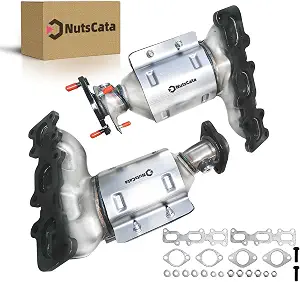 |
1. CAT CLEAN Catalytic Converter for Ford 3.5L/3.7L (left & right)

| Vehicle fitment | Ford/Lincoln 3.5L and 3.7L V6 models (listed years/models) |
|---|---|
| Material | 409L stainless steel body |
| Catalyst media | High-density honeycomb with Pt, Rh, Pd |
| Warranty | 6-year/50,000-mile performance warranty |
| Installation | Direct bolt connection design |
This CAT CLEAN catalytic converter is a direct-replacement unit engineered for 3.5L and 3.7L Ford and Lincoln V6 applications. It uses a high-density honeycomb ceramic substrate with platinum, rhodium, and palladium loading to improve conversion efficiency and help clear low-efficiency diagnostic codes. The converter body is stainless steel with internal high-temperature padding to protect the ceramic carrier and resist corrosion. Designed for bolt-on installation, the unit avoids cutting or welding on compatible exhaust systems and aims to restore emissions performance while reducing exhaust noise and potentially improving fuel trim. It is EPA compliant for use in federal-emissions vehicles and includes a six-year/50,000-mile performance warranty. Important limitations are legal: it is not for sale or use in certain states with stricter rules, and fitment is limited to the listed Ford and Lincoln models and years, so verify OEM reference numbers and compatibility before purchase.
Best for: A buyer who wants a balanced, factory-style replacement to restore emissions performance and clear efficiency codes on compatible Ford/Lincoln V6 vehicles without complicated installation or extensive modifications.
Less Ideal for: Drivers living in states with stricter emissions regulations or those who need a universal or multi-vehicle converter solution should look elsewhere.
- Direct bolt-on design for installation without welding or modification
- High-density honeycomb substrate with Pt/Rh/Pd for improved catalytic efficiency
- 409L stainless steel body and internal padding for corrosion and thermal protection
- EPA compliant for federal-emission vehicles and aimed at resolving P0420/P0430 codes
- Six-year/50,000-mile performance warranty from the manufacturer
- Not legal for sale or use in several states with stricter emissions rules
Verdict: A factory-style, bolt-on EPA-compliant replacement that restores catalytic efficiency on compatible Ford and Lincoln 3.5L/3.7L V6s without welding.
2. JT Catalytic Converter Compatible with 2013–2019 Ford 3.5L V6 (Catalyst+ Upgraded)

| Compatible engines | 3.5L V6 |
|---|---|
| Fitment years | 2013–2019 Explorer/Flex/Taurus; 2015–2018 Edge |
| Shell material | Stainless Steel 409 |
| Substrate | Honeycomb ceramic |
| Coating | Higher-dose precious metal (Catalyst+) |
This JT catalytic converter is a direct-fit replacement designed for the 3.5L V6 Ford family (Explorer, Flex, Taurus, Edge) and targets drivers who want better emissions performance than a basic aftermarket unit. It uses a stainless steel 409 shell and an OEM-grade honeycomb ceramic substrate with an upgraded high-dose precious metal coating the seller calls Catalyst+ to increase catalytic activity and help clear P0420-style fault codes. The unit is laser welded and finished to a polished exterior, and the manufacturer says 3D scan fitting makes installation straightforward for a like-for-like swap. In real-world use this product aims to improve light-off and conversion efficiency versus budget EPA-grade cats, which can help with emissions testing and keep the check engine light off. Important limitations are that it is still an emissions component rather than a performance exhaust part, so you should not expect horsepower gains, and long-term durability depends on installation quality and engine condition. Fitment is limited to the specified 3.5L V6 Ford models only.
Best for: Buyers who prioritize cleaner emissions and a reliable direct-replacement catalytic converter for their 3.5L V6 Ford and want a product with higher catalyst loading than basic aftermarket units.
Less Ideal for: Drivers seeking power or sound upgrades or those who need a universal or multi-vehicle solution should look elsewhere.
- Direct-fit design for 2013–2019 Ford 3.5L V6 applications simplifies installation
- Upgraded precious-metal coating (Catalyst+) for improved conversion efficiency
- OEM-grade honeycomb ceramic substrate for factory-quality flow and filtration
- Stainless steel 409 shell with laser welding for durable construction
- Not intended to increase engine power or provide performance gains
Verdict: Choose this JT Catalyst+ converter if you want a direct-fit, higher-precious-metal replacement to improve emissions efficiency and help prevent P0420 faults on Ford 3.5L V6 vehicles.
3. AKWH Front Left & Right Manifold Catalytic Converters for Ford 3.5L/3.7L (Front)

| Manufacturer | AKWH |
|---|---|
| Manufacturer Part Number | AKWH 30584 30585 |
| OEM Part Number | 30584+30585, 19516+19517, 1378+1379, 674255+674256 |
| Oxygen sensor ports | 2 Sensor Ports |
| Fitment years | 2013-2019 |
These AKWH front manifold catalytic converters replace the left and right front units on compatible Ford and Lincoln 3.5L/3.7L engines. They come as a matched pair with a manifold gasket, bolts, and washers so you can swap both sides at once during a front-end exhaust repair. The converters include two oxygen sensor ports each, which keeps factory sensor locations intact and simplifies installation when reusing original sensors. Practical benefits are that the kit bundles needed hardware and covers a broad set of model years, which reduces parts hunting and downtime. Limitations to consider are regulatory: the seller notes restricted sales to several states with stricter emission rules and indicates development of a different three-way design for those areas, so this unit may not meet every local emission requirement. Also the product is an aftermarket replacement rather than a factory-branded part, so fit and long-term durability can vary and professional installation is recommended to ensure proper sealing and sensor function.
Best for: Buyers who want a practical, all-in-one replacement to repair front catalytic converters on compatible 3.5L/3.7L Ford or Lincoln vehicles and prefer bundled hardware to reduce shop time.
Less Ideal for: If you need a state-compliant converter for California, Colorado, New York, or Maine or require a factory-branded part for warranty or resale reasons, look elsewhere.
- Ships as a matched pair with gaskets and mounting hardware for a single repair job
- Maintains factory oxygen sensor ports (2 per converter) for easier sensor reuse
- Covers a wide range of 2013–2019 Ford and Lincoln 3.5L/3.7L applications to simplify fitment selection
- Not compliant for sale in certain states with stricter emission standards
- Aftermarket unit so long-term durability and exact fitment may differ from factory-quality parts
Verdict: A practical, hardware-included front pair replacement that simplifies catalytic converter repair on 3.5L/3.7L Ford and Lincoln models outside states with stricter emissions rules.
4. AutoShack Front Catalytic Converter with Exhaust Manifold for Ford Explorer 3.5L V6

| Compatible engines | 3.5L V6 |
|---|---|
| Includes | 1 catalytic converter with exhaust manifold |
| Exterior | Stainless Steel and Ceramic |
| Legal status | 46-state federal-compliant (not legal in some states) |
This AutoShack unit combines the exhaust manifold and front catalytic converter into a single direct-fit replacement for Ford Explorer 3.5L V6 applications. It is intended to replace a worn or damaged manifold/converter assembly to restore exhaust flow and reduce harmful emissions. Installation is typically done by a mechanic because the assembly bolts to the cylinder head and requires proper sealing and O2 sensor replacement to avoid false diagnostic codes. The converter is stainless steel with a ceramic substrate and is sold as a 46-state federal-compliant part, so it is not legal in certain states with stricter rules. Because hardware is not included, expect to reuse or purchase separate gaskets and bolts. For budget-focused buyers this offers a one-piece replacement that simplifies the repair compared with sourcing separate components, but it does not meet California and several other states emissions certifications and may not include all installation fittings you need.
Best for: Buyers looking for a lower-cost, single-piece replacement to get a 3.5L V6 Explorer back to working emissions and exhaust function without sourcing multiple parts.
Less Ideal for: Owners in states with strict emissions regulations or anyone who needs a CARB-compliant converter should look for a certified alternative.
- One-piece manifold and converter simplifies replacement and reduces installation steps.
- Designed as a direct-fit for 3.5L V6 Ford Explorer applications to restore emissions performance.
- Stainless steel exterior offers corrosion resistance compared with painted components.
- Not CARB certified and illegal for sale or use in certain states with stricter emissions rules.
- Does not include installation hardware or gaskets, so additional parts may be required.
Verdict: A budget-friendly, direct-fit manifold-plus-converter that restores emissions function on 3.5L V6 Explorers when CARB compliance is not required.
5. SPEEDFusion High-Flow Catalytic Converter — direct-fit, EPA compliant

| Vehicle fitment | Ford Explorer 2011-2012 3.5L; Ford Edge 2011-2015 3.5L/2011-2014 3.7L; Lincoln MKX 2011-2015 3.7L |
|---|---|
| Material | 409L stainless steel shell |
| Substrate | 400-hole ceramic with Pt, Rh, Pd coating |
| Emission certification | EPA compliant (federal) |
This SPEEDFusion catalytic converter replaces the factory unit on compatible 3.5L and 3.7L V6 Ford applications and is intended as a direct fit for straightforward installation. It uses a 409L stainless steel shell and a 400-hole ceramic substrate coated with platinum, rhodium, and palladium to increase conversion efficiency and keep the check engine light from triggering related fault codes. The unit is EPA certified for federal emissions compliance and is built to OEM-style dimensions so it can be bolted in place without major exhaust modifications. Practical benefits include improved durability over thin-stock replacements, reduced risk of emissions-related codes, and a high-flow design that helps preserve exhaust flow. Important limitations are that it is not CARB-compliant so it cannot be used in states with California-equivalent regulations, and professional installation is recommended to ensure proper fit and emissions performance. The manufacturer offers a structural and limited emissions warranty for added assurance.
Best for: Buyers who prioritize a durable, factory-style replacement that keeps emissions systems functioning and avoids check-engine codes will appreciate this unit for routine repairs or end-of-life catalytic converter replacement.
Less Ideal for: Drivers in states that require California emissions certification or those seeking a CARB-compliant solution should look for a different converter.
- Direct-fit design for compatible Ford 3.5L/3.7L V6 applications simplifies installation
- 409L stainless steel shell for better corrosion resistance and durability
- 400-hole ceramic substrate with precious metal coating for effective catalytic conversion
- EPA certification for vehicles meeting federal emission standards
- Manufacturer-backed structural and emissions warranty for added reliability
- Not CARB-compliant so illegal to use in states with California-equivalent emissions rules
Verdict: A durable, EPA-certified direct-fit replacement built to keep emissions systems and check-engine lights quiet on compatible Ford 3.5L/3.7L V6 vehicles.
6. SPEEDFusion High-Flow Catalytic Converter for Ford 3.5L V6 (EPA Compliant)

| Vehicle fitment | Ford Explorer 2013-2016, Ford Flex 2010-2015, Taurus 2010-2015, Lincoln MKS/MKT 2010-2014 V6 3.5L |
|---|---|
| Material | 409L stainless steel |
| Substrate | OEM-grade 400-hole ceramic |
| Certification | EPA compliant (not CARB) |
This SPEEDFusion catalytic converter is a direct-fit replacement for 3.5L V6 Ford and Lincoln applications and is intended to restore factory-quality emissions control. It uses a 409L stainless steel shell and an OEM-grade ceramic substrate plated with precious metals to increase conversion efficiency and help prevent codes such as P0420 and P0430. Installation is straightforward for a professional shop or a competent DIY mechanic because the unit is built to match factory connections and mounting points. The part is EPA certified for federal emissions-compliant vehicles, so it is suitable for states that accept federal equipment but not for CARB states. Practical benefits include improved exhaust purification and a construction aimed at resisting core detachment in typical driving conditions. Limitations are the legal restriction in CARB states and the recommendation to have it fitted by a shop to ensure proper operation and warranty coverage.
Best for: Buyers who want a reliable, factory-quality emissions replacement that keeps the check-engine light off and prioritizes proven construction and federal emissions compliance.
Less Ideal for: Drivers in California, Colorado, New York, Maine, or other jurisdictions requiring CARB-compliant parts should look for a certified alternative that meets their local regulations.
- Direct-fit design that matches factory mounting for easier installation
- EPA compliant for vehicles meeting federal emission standards
- 409L stainless steel shell and anti-core-detachment welding for durability
- OEM-grade 400-hole ceramic substrate with precious metal coatings to boost catalytic efficiency
- Not CARB-compliant and therefore illegal for sale or use in certain states
Verdict: Choose this SPEEDFusion converter if you need a direct-fit, EPA-certified replacement that restores emissions performance and prevents P0420/P0430 codes on 3.5L V6 Ford and Lincoln vehicles.
7. NutsCata Direct-Fit Catalytic Converter Kit, Left and Right
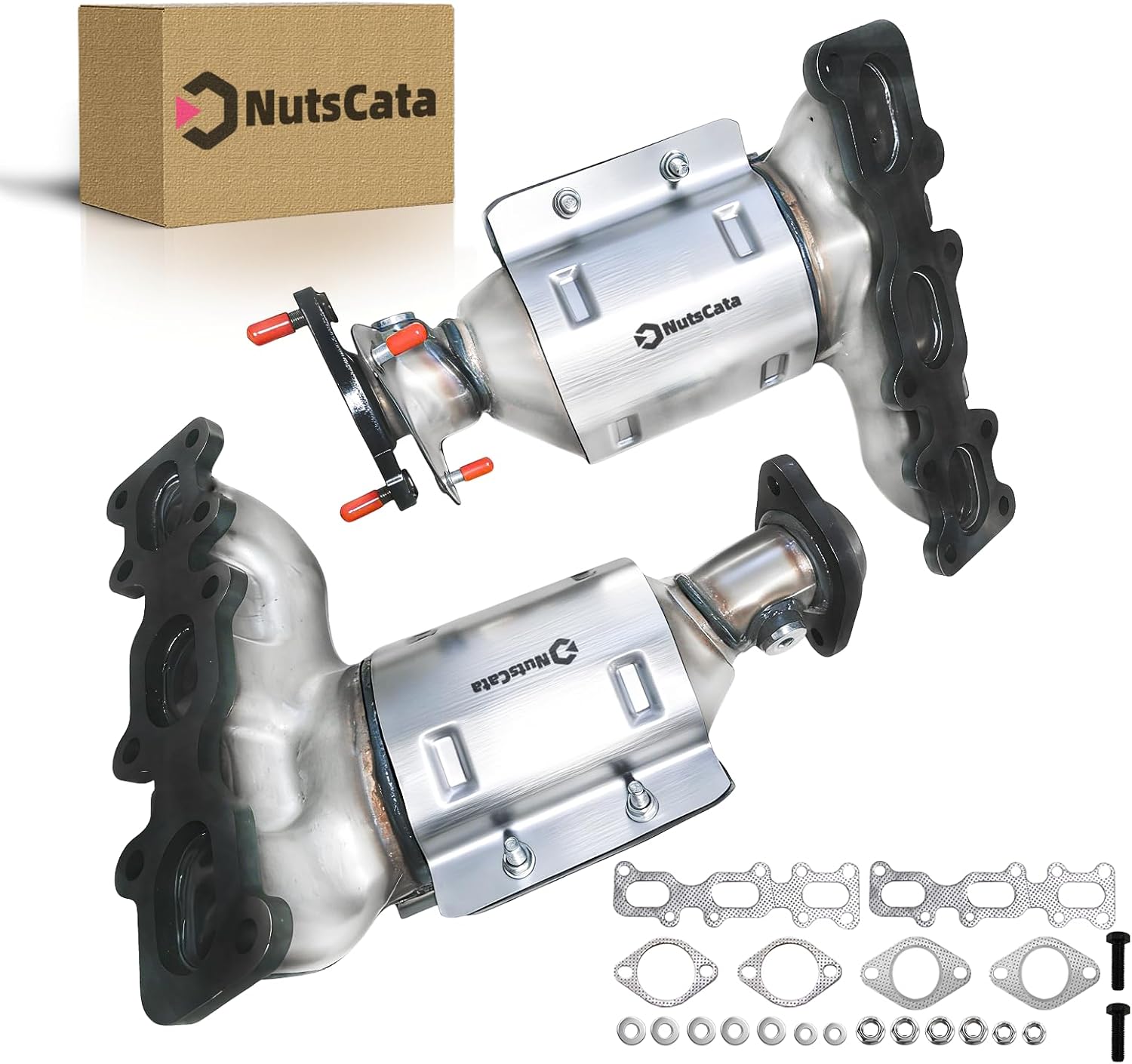
| Compatible engines | 3.5L V6 and 3.7L V6 (listed models) |
|---|---|
| EPA compliance | Meets federal emission standards |
| Included pieces | Left and right catalytic converters |
| Warranty | 6 years or 60,000 miles |
This two-piece NutsCata catalytic converter kit replaces the left and right units on covered Ford Explorer 3.5L V6 applications and similar 3.5L/3.7L V6 Ford and Lincoln models. It uses honeycomb ceramic substrates coated with high-content precious metals to reduce emissions and restore catalytic function. The converters are offered as a direct-fit bolt-on design intended to install without additional welding or machining, which simplifies replacement during a routine exhaust service. The kit is EPA-compliant for federal applications and comes with a six-year or 60,000-mile performance assurance from the maker. Practical benefits include restoring emission control and avoiding check-engine lights tied to catalyst failures, plus the convenience of a pair supplied together. Important limitations are that the part is restricted from sale or use in several states with stricter regulations and that it is intended only for the specified Ford/Lincoln V6 applications, so verify exact vehicle fitment before ordering.
Best for: Buyers who prioritize a straightforward, factory-style replacement to restore emissions performance and avoid catalytic-converter related faults on covered Ford and Lincoln V6 vehicles.
Less Ideal for: Anyone located in states that require California-equivalent parts or drivers who need a custom or high-flow performance converter should look elsewhere.
- Direct-fit bolt-on design for installation without machining or welding
- Honeycomb ceramic substrate with high-content precious metals for effective emission reduction
- Supplied as a left and right pair so both sides can be serviced at once
- EPA-compliant for federal emission standards and includes a six-year/60,000-mile performance assurance
- Not legal for sale or use in certain states with stricter emission rules
- Fitment limited to the listed Ford and Lincoln 3.5L/3.7L V6 applications only
Verdict: A practical, factory-style direct-fit pair that restores emissions control on the specified Ford and Lincoln V6 vehicles with minimal installation hassle.
Choosing the Right Ford Explorer 3.5L V6 Catalytic Converter: Key Factors to Consider
Fitment and Mounting
Correct fitment is the single most important factor when replacing a catalytic converter on the Ford Explorer 3.5L V6. Exhaust flange patterns, inlet and outlet diameters, length, and O2 sensor port placement must match the vehicle's existing exhaust to avoid leaks, misalignment, or the need for major pipe modification.
A converter that fits closely to the factory mounting points reduces installation time and the risk of exhaust leaks that can trigger check-engine codes. Consider whether the unit requires additional gaskets, flange adapters, or welding, and whether O2 sensor bungs align with the vehicle's sensors. If a unit requires significant modification, factor in labor time and the potential impact on emissions performance.
Emissions Performance
The primary purpose of a catalytic converter is to reduce harmful exhaust emissions. For the Ford Explorer 3.5L V6, choose a converter with an appropriate catalyst substrate and sufficient washcoat loading to convert hydrocarbons, carbon monoxide, and oxides of nitrogen effectively.
Look for information on catalyst type and cell density because these attributes influence conversion efficiency and backpressure. Units designed to meet emission standards for your region are preferable. Strong emissions performance helps the vehicle pass inspections and reduces environmental impact while maintaining proper engine management.
Backpressure and Engine Performance
Catalytic converters create resistance to exhaust flow, and excessive backpressure can reduce engine power, throttle response, and fuel economy. For the 3.5L V6, a balance is needed between having enough catalyst surface for emissions control and keeping backpressure low enough to preserve performance.
Manufacturers sometimes specify flow characteristics or recommend cell densities suited to the engine. Avoid high-restriction units unless the device is explicitly designed for this engine. Consider the impact on turbocharging or supercharging only if your Explorer has such modifications; for stock 3.5L V6 setups, prioritize converters designed to maintain stock-like exhaust flow.
Durability and Construction Quality
Longevity is a practical concern for catalytic converters because replacing them is labor intensive. Look for heavy-gauge housings, quality welds, and corrosion-resistant coatings that stand up to road salt and heat cycling experienced by the Ford Explorer 3.5L V6.
Carefully constructed flanges and reinforcement at mounting points help prevent cracking and leaks over time. Thermal protection and insulation can reduce heat soak to nearby components and help the catalyst reach optimal operating temperature more reliably. A well-built converter reduces the chance of premature failure and the need for repeat replacements.
O2 Sensor Compatibility
Proper O2 sensor function is critical to maintaining engine control and avoiding diagnostic trouble codes. The replacement unit should have sensor bungs in the correct locations for the 3.5L V6 so that upstream and downstream sensors read accurately.
If sensor ports are absent or mislocated, you may need to transfer sensors or use adapters, which adds complexity. Ensuring correct sensor placement supports closed-loop fuel control and helps prevent check-engine lights tied to emissions monitoring.
Installation Complexity and Serviceability
Consider how the converter will be installed on the Explorer 3.5L V6. Bolt-on direct-fit units generally simplify installation and minimize labor costs, while universal or short-bodied converters may require cutting, welding, or additional hardware.
Also factor in future serviceability: units with accessible flanges and standard fasteners make later removal and replacement easier. Clear installation guidance and compatibility notes reduce the risk of improper fitting and the associated exhaust leaks or sensor faults.
Common Symptoms of Catalytic Converter Problems
Owners of the Ford Explorer 3.5L V6 often see similar warning signs when the catalytic converter begins to fail. Persistent check-engine lights, reduced acceleration, a rotten-egg odor, or a sudden drop in fuel economy are all indicators that warrant inspection of the converter and related exhaust components.
Some symptoms stem from partial blockages that increase backpressure and impair engine breathing. Others are caused by catalyst degradation that reduces conversion efficiency and triggers emissions-related diagnostic trouble codes. Identifying the root cause early can prevent further engine or exhaust damage.
- Check-engine light with emissions-related trouble codes
- Loss of power or sluggish throttle response
- Unusual exhaust odors, including sulfuric smells
- Rattling noises from the converter when cold or under load
- Failed emissions or smog inspection
Preparing for Replacement on the Explorer 3.5L V6
Before starting a replacement job, inspect the surrounding exhaust components, hangers, and heat shields for corrosion or damage. Addressing any supporting issues will help ensure the new converter fits correctly and lasts longer.
Gather the correct gaskets, bolts, and any anti-seize or high-temperature sealants recommended for exhaust work. If your Explorer has oxygen sensor fittings, either transfer the sensors from the old unit or ensure the replacement has properly placed bungs. Make sure the vehicle is safely supported and cooled before working on the exhaust.
- Verify O2 sensor locations and remove sensors carefully
- Check flange faces for warping or damage
- Have replacement gaskets and bolts sized to the factory specifications
- Prepare for potential cutting or welding if a direct-fit unit is not available
Legal and Emissions Considerations
Catalytic converters are emissions-control devices regulated in many jurisdictions. For the Ford Explorer 3.5L V6, ensure any replacement meets the emissions requirements applicable to your area. Using a unit that is not compliant can lead to failed inspections or legal issues.
Keep documentation of the converter's emissions compliance and installation in case you need it for inspections. Some regions restrict certain types of converters or require specific certification, so check local regulations before purchasing.
- Confirm regional certification or compliance statements
- Retain installation documentation for inspection purposes
- Avoid units that explicitly state incompatibility with local emissions rules
Maintenance Tips to Prolong Converter Life
Good engine tune and proper combustion are the best ways to extend catalytic converter life on the Explorer 3.5L V6. Address misfires, oil consumption, and coolant leaks promptly because these conditions can poison or overheat the catalyst.
Avoid using leaded fuels or fuel additives that are not compatible with catalyst-equipped engines. Periodic visual inspections for impact damage, corrosion, and mounting integrity help catch issues early and prevent catastrophic failure.
- Repair misfires and fueling issues quickly
- Monitor for oil or coolant consumption that may contaminate the catalyst
- Keep exhaust hangers and shields in good condition
- Inspect for physical damage from road debris
Diagnostic Steps Before Replacing the Converter
Run a diagnostic scan to capture emissions-related trouble codes before deciding on replacement. Codes that reference downstream or upstream O2 sensors can indicate whether the problem is sensor-related or truly converter-related.
Additional checks include measuring exhaust backpressure, performing a visual inspection for internal rattling, and using temperature differentials across the unit to spot blockages. These steps help avoid replacing a converter when the real issue is a faulty sensor or exhaust leak.
- Scan for diagnostic trouble codes and interpret O2 sensor data
- Check for internal rattling by gently tapping the housing when cool
- Compare inlet and outlet temperatures when the engine is at operating temperature
- Measure exhaust backpressure if symptoms suggest flow restriction
Still looking for the perfect fit?
Select your Ford Explorer configuration to see the most relevant Catalytic Converters recommendations
How We Chose the Best Ford Explorer 3.5L V6 Catalytic Converter
We built this list by applying filters that reflect the most important technical and practical considerations for replacing a catalytic converter on a Ford Explorer 3.5L V6. Evaluation criteria included fitment accuracy to the 3.5L V6 exhaust geometry, catalyst substrate type and cell density as they relate to emissions conversion efficiency, and durability of the housing and welds for long-term service life. We also considered backpressure characteristics and how closely the unit preserves engine performance, plus compliance with emissions standards relevant to on-vehicle inspections.Products that lacked clear fitment data for the 3.5L V6, did not disclose catalyst type or cell count, or showed poor construction details were excluded. We prioritized converters that balance emissions conversion with acceptable exhaust flow, use robust housings and flanges, and provide clear installation guidance. Other factors that influenced selection include O2 sensor port provisions, thermal shielding, and corrosion-resistant finishes. The resulting shortlist reflects units that meet practical fitment needs and emissions performance expectations for Ford Explorer 3.5L V6 owners.
Our full evaluation process is outlined in our review methodology.
FAQ
What are the most common catalytic converter symptoms on a Ford Explorer 3.5L V6?
Common symptoms include a persistent check-engine light with emissions codes, reduced acceleration, unusual exhaust odors such as sulfur, rattling noises from inside the converter, and failing emissions tests. These signs often appear gradually but can also present after a specific impact or engine issue.
Can a bad O2 sensor trigger the same warning lights as a failing converter?
Yes. Faulty upstream or downstream O2 sensors can cause similar diagnostic trouble codes and affect engine management. Diagnosing with a scan tool and verifying sensor readings helps determine whether the sensor or the catalytic converter is the primary issue.
Is a direct-fit converter always the best option for the 3.5L V6 Explorer?
Direct-fit converters that match flange patterns and sensor locations typically simplify installation and reduce the risk of leaks. However, if a direct-fit unit is not available, a properly fabricated unit can work but may require cutting, welding, or additional fittings.
How long does a catalytic converter usually last on the Explorer 3.5L V6?
Lifespan varies widely depending on driving conditions, maintenance, and exposure to contaminants. With proper engine care and normal use, converters often last many years, but early failure can occur if the engine runs poorly, consumes oil, or experiences physical damage.
Will replacing the catalytic converter clear the check-engine light?
Replacing the converter may clear emissions-related codes if the catalyst was the root cause. However, if the light is due to sensors, leaks, or unrelated engine faults, the light may persist until those issues are resolved. Clearing codes without addressing the underlying problem typically results in a recurring fault.
Do I need to replace O2 sensors when installing a new converter?
Not always. If the sensors are within specification and undamaged, they can often be reused. That said, if sensors are old, contaminated, or provide erratic readings, replacing them when you install the converter can simplify diagnosis and help ensure proper engine control.
Final Verdict
When selecting a catalytic converter for a Ford Explorer 3.5L V6, prioritize a unit that matches the vehicle's fitment and sensor locations, delivers strong emissions conversion, and preserves exhaust flow to avoid performance losses. Balance durability and construction quality against potential installation complexity, and address any engine issues that could damage a new converter.Ultimately, choose the option that best fits your installation preferences and emissions requirements, and make sure the unit supports proper O2 sensor placement. Taking these tradeoffs into account will help you restore emissions performance and maintain reliable operation.
Explore More:
- Check out all Ford Explorer parts & accessories
- Explore Catalytic Converters Maintenance & Repair Guides
- Explore Exhaust & Emissions
- Browse all Auto Parts
