

Note: This article contains affiliate links. If you click on these links and make a purchase, I may earn a small commission at no extra cost to you. This helps support my research and content. Read my full affiliate disclosure here.
If you own a Ford Explorer 4.0L V6, picking the right radiator matters for everyday reliability and long highway runs. A failing or undersized radiator can cause overheating, break down seals, and lead to expensive downstream repairs. This guide gathers the top shortlisted radiators suited to the Explorer 4.0L V6 and explains the performance and durability features that matter in real use.We evaluated candidates on cooling capacity, construction quality, and ease of installation for this specific engine and chassis configuration. Read on to see the picks and the evaluation criteria that informed our selection.
Looking for other parts? See all Ford Explorer parts & accessories.
Top Picks at a Glance
| Best Overall The best all-around choice for most situations | DWVO Complete Radiator Compatible with Ford 4.0L V6 |  |
| Best Quality Built to a higher standard if you want something more solid | ASCIUTTA 3-Row All-Aluminum Radiator for 2006–2010 Ford Explorer / Mercury Mountaineer / Sport Trac |  |
| Best Value The sweet spot between price and what you get | TRQ Radiator Assembly with Aluminum Core and Plastic Tanks (Direct Fit) |  |
| Best Budget The cheapest option that still gets the job done reliably | ECCPP CU2342 Replacement Radiator for 2002–2005 Ford Explorer / Mercury Mountaineer |  |
| Highest Rated A top-rated pick with lots of positive feedback | AParts Radiator Replacement for Ford Explorer 4.0L (2002–2005) |  |
| Most Popular A crowd favorite that many people choose with confidence | AUTOSAVER88 Radiator Compatible with Ford Explorer 4.0L V6 |  |
| Best Seller A high-volume bestseller chosen again and again | DWVO Complete Radiator for 4.0L Ford Explorer and Compatible Trucks |  |
1. DWVO Complete Radiator Compatible with Ford 4.0L V6

| Manufacturer | DWVO |
|---|---|
| Model | Radiator Compatible with Ford Mazda Explorer Ranger B3000 B4000 3.0L 4.0L V6 |
| Manufacturer Part Number | DWRD1014 |
| OEM Part Number | 6L5Z8005DA,1L5Z8005MA,1L5Z8005NA,XL2Z8005LA |
This DWVO complete radiator is a full replacement unit made to match factory fit for Ford 4.0L V6 applications. It installs in place of the original radiator and includes an aluminum core with multi-louvered fins, TIG-welded construction, reinforced inlet/outlet tanks, and a brass transmission oil cooler for automatic transmissions. The design aims to improve cooling efficiency and resist leaks, and the package ships with foam corner protection and a user manual; the radiator cap is not included. For everyday drivers and light towing, the high-density fins and treated coating should keep operating temperatures stable and provide long service life when installed properly. Limitations to note are that it requires professional-level installation for best results and the absence of a radiator cap means a small additional purchase or reuse of the original cap is necessary. Fitment is meant specifically for compatible Ford/Mazda models using the 4.0L V6 configuration.
Best for: Buyers seeking a reliable, factory-style replacement radiator for routine driving and occasional towing who value cooling performance and long-term durability.
Less Ideal for: Shoppers wanting a plug-and-play performance upgrade beyond factory cooling capacity or a do-it-yourself buyer looking to avoid professional installation.
- Direct replacement fitment for Ford 4.0L V6 applications for straightforward swap-in
- Aluminum core with high-density multi-louvered fins for improved cooling performance
- TIG-welded construction and treated coating designed to resist leaks and corrosion
- Includes brass transmission oil cooler for automatic transmission compatibility
- Radiator cap is not included so a separate cap or reuse of the old one is required
- Professional installation is recommended, which adds labor cost and time
Verdict: Choose this radiator when you want a full, factory-style replacement that restores cooling reliability for Ford 4.0L V6 vehicles without overcomplicating the swap.
2. ASCIUTTA 3-Row All-Aluminum Radiator for 2006–2010 Ford Explorer / Mercury Mountaineer / Sport Trac

| Core Row | 3 Rows |
|---|---|
| Core Material | All Aluminum |
| Flow Type | Down Flow |
| Radiator Cap | Included |
This ASCIUTTA radiator is a drop-in, downflow replacement built from AA5052 aircraft-grade aluminum with a three-row core to boost cooling capacity for 2006–2010 Ford Explorer 4.0L and related applications. It includes an aluminum tank, CNC-machined filler neck and cap, and a brass-style petcock drain, and arrives fully tig welded and pressure tested for leaks. In practice the larger core and all-aluminum construction mean lower operating temperatures and better resistance to heat under heavy loads or spirited driving, making it useful for towing, long highway pulls, or performance upgrades. Installation is bolt-on with no drilling required, so a competent DIYer or shop can swap it without major modification. Expect improved coolant volume and heat rejection compared with many factory units, but note the radiator is a higher-capacity aftermarket part rather than a vehicle-specific performance system with integrated fan or transmission cooler lines beyond stock connections. Buyers should verify fittings and transmission cooler needs for their exact vehicle configuration before installation.
Best for: Drivers upgrading cooling for spirited driving, towing, or heavier-duty use who want a higher-capacity, bolt-on replacement to reduce operating temperatures and improve thermal stability.
Less Ideal for: Owners looking for a complete cooling system upgrade with integrated fan assembly or additional transmission cooling plumbing should consider more comprehensive kits or vehicle-specific solutions.
- Three-row all-aluminum core for increased cooling capacity and heat rejection.
- CNC-machined filler neck and included cap for a secure, durable seal.
- Bolt-on fitment with no drilling required simplifies installation.
- 100% leak tested and tig welded for durability and reliability.
- Does not include integrated fan or extra transmission cooler fittings beyond standard connections.
Verdict: Choose this radiator if you need a higher-capacity, bolt-on aluminum replacement to keep a 2006–2010 Explorer 4.0L running cooler under heavier loads or performance driving.
3. TRQ Radiator Assembly with Aluminum Core and Plastic Tanks (Direct Fit)
| Core Row Quantity | 1 |
|---|---|
| Core Thickness | 1.25 in |
| Inlet Diameter | 1.56 in |
| Outlet Diameter | 1.56 in |
| Core Material | Aluminum |
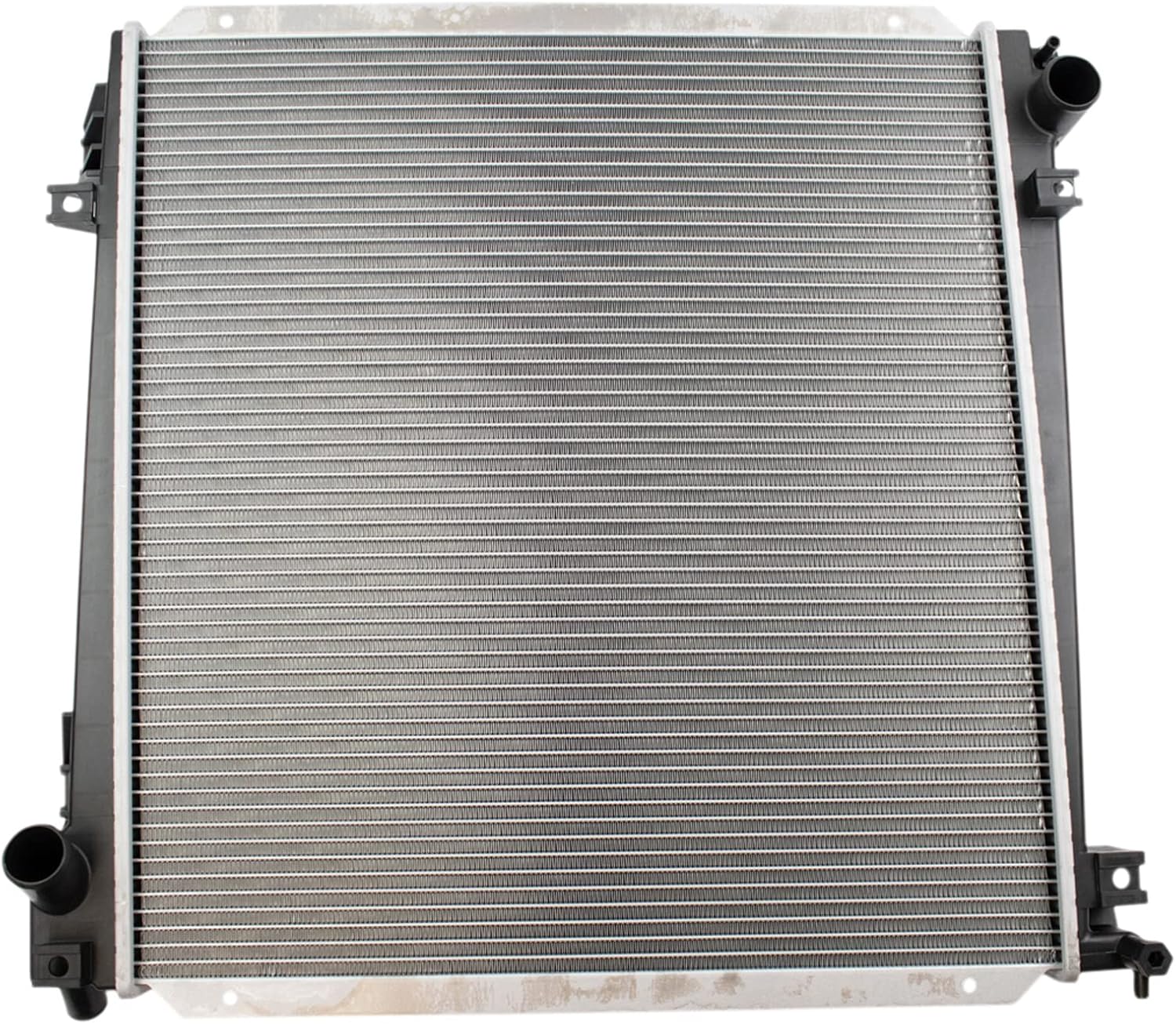
This TRQ radiator is a direct-fit replacement built around an aluminum core with plastic tanks for cross-flow cooling in 2002–2005 Ford Explorer and Mercury Mountaineer engines. It installs as a drop-in replacement for the factory unit and is used to restore cooling performance after a leak, clog, or age-related degradation. Notable features include a single-row core with 1.25 inch thickness, 1.56 inch inlet and outlet diameters, and left and right mounting provisions to match factory attachment points. The aluminum core should transfer heat efficiently while the plastic tanks keep weight and cost down. It does not include a radiator cap or internal engine/transmission oil coolers, so vehicles needing those integrations require separate components. For DIYers the pre-assembled design and available installation videos simplify the swap, though plastic tanks can be less impact-resistant than all-metal options. In short, this is a practical, straightforward replacement that restores cooling function without extra features or upgrades.
Best for: Buyers who want a practical, no-frills replacement that restores cooling reliability on a 2002–2005 Explorer or Mountaineer with minimal hassle and easy DIY installation.
Less Ideal for: Shoppers seeking a heavy-duty performance upgrade or an all-metal radiator for high-stress towing and racing conditions should consider performance-oriented alternatives.
- Direct-fit design matches factory mounting for straightforward installation
- Aluminum core offers good thermal conductivity for engine cooling
- Pre-assembled unit reduces labor and avoids modification
- Cross-flow core layout aligns with factory cooling flow for the vehicle
- Plastic tanks instead of full-metal construction are more vulnerable to impact and heat aging
Verdict: A straightforward, direct-fit aluminum-core radiator that gets a 2002–2005 Explorer or Mountaineer back to factory cooling performance with minimal fuss.
4. ECCPP CU2342 Replacement Radiator for 2002–2005 Ford Explorer / Mercury Mountaineer

| Compatible Engines | 4.0L and 4.6L |
|---|---|
| Fitment Years | 2002-2005 |
| Core Material | Aluminum |
| Manufacturer | ECCPP |
This ECCPP replacement radiator swaps in for the factory unit on 2002–2005 Ford Explorer and Mercury Mountaineer V6 models to restore cooling capacity and stop leaks. It uses a full aluminum core with high-grade plastic end tanks and is intended for routine replacement after a failed or leaking factory radiator. Installation is the same as a like-for-like radiator and will be typical for DIY mechanics or a local shop. The aluminum core increases heat dissipation compared with older, all-plastic cores and the unit is pressure-tested at the factory to reduce early leakage. Practical benefits include a straightforward fit to the specified vehicles and improved cooling under normal driving loads. Limitations are that this is a direct replacement without performance upgrades and buyers should confirm exact fitment to their model year and engine before purchasing. Expect standard radiator maintenance steps and professional help if you are not comfortable with coolant system service.
Best for: Buyers looking for an affordable, vehicle-specific replacement to restore cooling function on a 2002–2005 Explorer or Mountaineer and who prioritize cost-effectiveness over performance upgrades.
Less Ideal for: Drivers seeking a heavy-duty or upgraded cooling solution for high-performance, towing, or modified engines should consider purpose-built performance radiators instead.
- Full aluminum core improves heat dissipation compared with older designs
- Factory pressure testing reduces the chance of shipping defects or early leaks
- Direct-fit replacement for 2002–2005 Explorer and Mountaineer V6 models simplifies installation
- Restores cooling system performance to factory-like operation
- Plastic end tanks, while common, are not as durable as brazed all-aluminum tanks
Verdict: A budget-friendly, direct-fit aluminum-core replacement that restores factory cooling for 2002–2005 Explorer and Mountaineer V6 models.
5. AParts Radiator Replacement for Ford Explorer 4.0L (2002–2005)

| Fit Type | Direct Replacement |
|---|---|
| Core Material | Aluminum |
| Inlet Diameter | 38.00 mm (1.5 inch) |
| Outlet Diameter | 38.00 mm (1.5 inch) |
This AParts radiator is a direct replacement made to OEM specifications for the Ford Explorer 4.0L (2002–2005). It uses a high-efficiency aluminum core to move heat away from engine coolant and help maintain stable operating temperatures during daily driving. The unit is pressure and leak tested before shipping and installs on factory mounting points, so the swap is straightforward for a competent DIYer or a shop. Notable features include a factory-style inlet and outlet sizing and a compact core thickness that fits the original radiator area. The practical benefit is restored cooling performance and lower risk of overheating compared with an aging, corroded original. Limitations to keep in mind are that fitment is specific to the listed Explorer engine and years and that installation still requires confirming hose and bracket compatibility; this is not an upgraded performance radiator for heavy-duty towing or extreme track use. For anyone prioritizing a dependable, factory-quality replacement to get their Explorer back to proper cooling function, this covers the essentials effectively.
Best for: Drivers repairing an Explorer 4.0L who want a dependable, factory-quality replacement to restore normal cooling without modification or performance upgrades.
Less Ideal for: Buyers looking for a high-capacity or performance racing radiator for heavy towing or track use should consider purpose-built aftermarket options instead.
- Engineered to OEM-spec direct fit for Ford Explorer 4.0L 2002–2005 simplifying installation
- High-efficiency aluminum core for effective heat dissipation
- Pressure and leak tested for reliable daily driving
- Installs using factory mounting points without modification
- Fitment is limited to the specified Ford Explorer 4.0L years and not suitable for other engines or models
Verdict: A straightforward, factory-spec aluminum radiator replacement that reliably restores cooling for the Ford Explorer 4.0L (2002–2005).
6. AUTOSAVER88 Radiator Compatible with Ford Explorer 4.0L V6

| Core Size | 24" x 21" |
|---|---|
| OEM Part Number | 6L5Z8005DA, 1L5Z8005MA, 1L5Z8005NA, XL2Z8005LA |
| Manufacturer Part Number | ATRD1014 |
This AUTOSAVER88 radiator is a direct replacement designed for the Ford Explorer 4.0L V6 and similar compatible trucks. It installs in place of the factory unit to restore cooling capacity and uses a machined exterior and core sized to the listed fitment so it works with the vehicle's existing mounting points and hose connections. In use the radiator handles everyday driving and towing demands typical of these V6 engines, and buyers report it performs like a factory-quality unit when correctly installed. The package includes the radiator only, so reuse or transfer of sensors, caps, mounting hardware, and hoses from the old radiator is usually required. Because this is a vehicle-specific replacement, fitment must be confirmed against the OEM part numbers before purchasing. For someone replacing a failed or leaking radiator on an Explorer, it offers a practical OEM-style swap; for custom or modified cooling systems additional parts may be needed.
Best for: Buyers who want a straightforward, factory-style replacement to restore cooling on a Ford Explorer 4.0L V6 and who prioritize proven fitment and community feedback when choosing parts.
Less Ideal for: Drivers building a custom cooling setup or those who need an upgraded high-capacity performance radiator should look at specialized aftermarket options.
- Designed to match factory mounting points and hose connections for direct replacement
- Machined exterior and core construction aimed at restoring OEM cooling performance
- Lists OEM part numbers to help confirm correct fitment for Ford Explorer 4.0L V6
- Available from a dedicated auto parts brand with focused replacement parts range
- Includes only the radiator so existing caps, sensors, mounting hardware, or hoses may need to be transferred
- Fitment must be double-checked against OEM part numbers to avoid ordering the wrong unit
Verdict: A practical factory-style replacement radiator for Ford Explorer 4.0L V6 owners who want reliable, fitment-focused cooling restoration.
7. DWVO Complete Radiator for 4.0L Ford Explorer and Compatible Trucks
| Manufacturer Part Number | DWRD1086 |
|---|---|
| OEM Part Number | FD37071A,6L5Z8005DA |
| Core Material | Aluminum |
| Item Weight | 15.67 pounds |
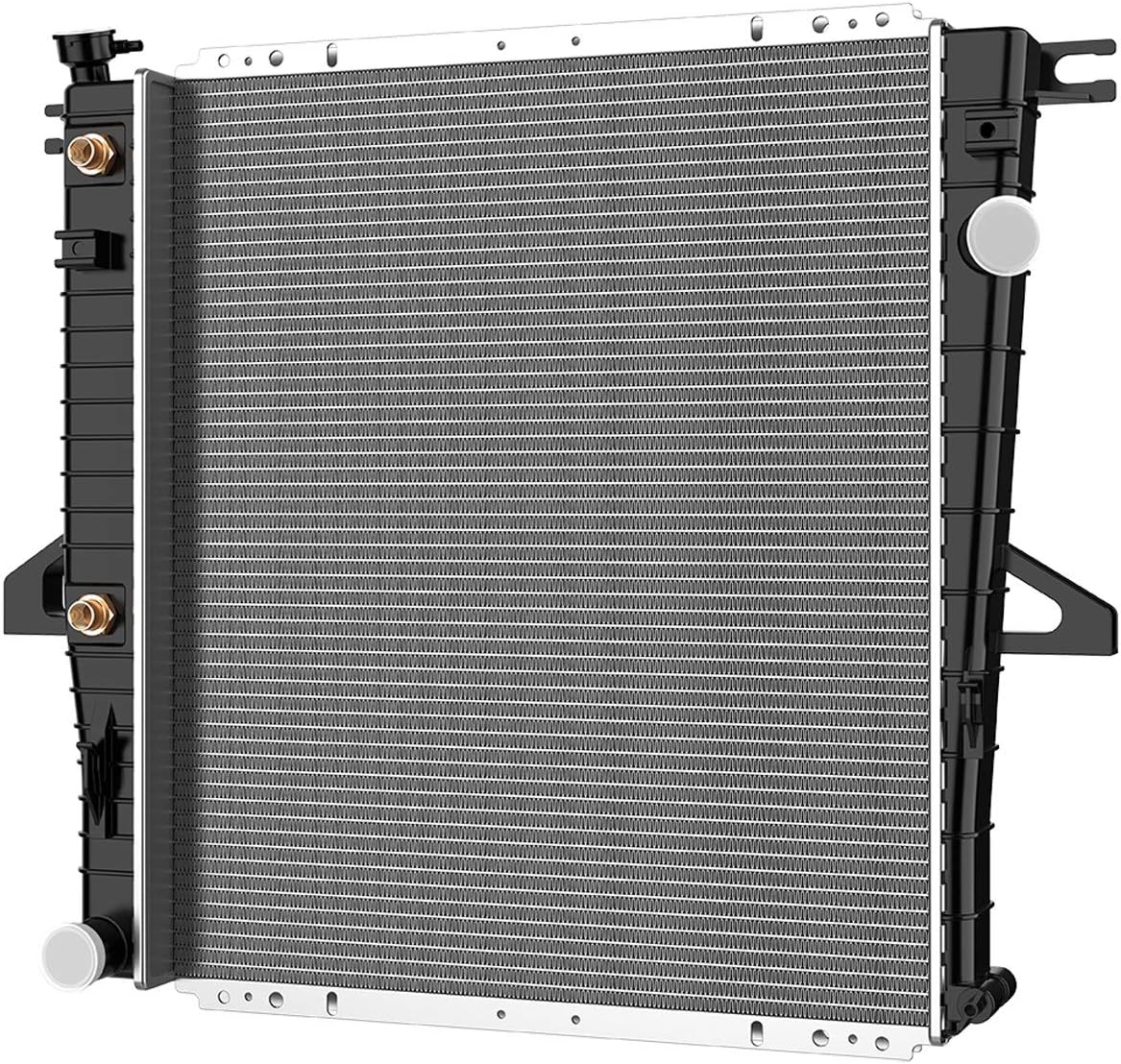
This DWVO radiator is a direct-fit replacement for 4.0L Ford Explorer applications and several compatible Ford trucks, offering a full radiator assembly with aluminum core, TIG-welded inlet/outlet connections, and a built-in transmission oil cooler. It is typically used to replace a leaking, clogged, or damaged factory radiator and restore proper engine cooling. The high-density multi-louvered fins and treated coating aim to improve heat dissipation and resist corrosion, while the supplied foam padding helps prevent shipping damage. The unit is shipped without a radiator cap and the manufacturer recommends professional installation, which is sensible given the integrated transmission cooler and welded fittings. For buyers prioritizing reliability and fitment the radiator presents a budget-friendly way to return cooling performance close to factory standards, but expect to arrange for a shop installation and to verify exact fit using OEM part numbers before ordering.
Best for: Buyers who want a reliably built, direct-replacement radiator to restore factory cooling performance on a 4.0L Explorer or similar Ford vehicle and prefer a part that closely matches original fit and function.
Less Ideal for: If you plan to install at home without workshop experience or need a radiator with upgraded performance features for racing or heavy towing, this standard replacement may not be the best choice.
- Direct-fit design matched to listed 4.0L Ford applications for straightforward replacement
- Aluminum core with high-density multi-louvered fins for better heat transfer
- TIG-welded connections and treated coating for improved durability and leak resistance
- Includes integrated transmission oil cooler so no separate cooler purchase is required
- Radiator cap is not included
- Professional installation is recommended due to integrated cooler and welded fittings
Verdict: A dependable, factory-style complete replacement radiator that restores cooling for 4.0L Explorer applications without major modification.
Choosing the Right Ford Explorer 4.0L V6 Radiator: Key Factors to Consider
Cooling Capacity and Core Design
Cooling capacity is the single most important performance factor for the Ford Explorer 4.0L V6 radiator. Core height, thickness, and whether the unit uses a single or multi-row core change the amount of coolant and the surface area exposed to airflow. More surface area and additional rows generally improve heat transfer, reducing operating temperature under load and during towing.
Core design also affects airflow resistance and fan efficiency. A denser fin pattern can increase thermal transfer but may restrict airflow at low speeds, so balance matters. For this vehicle, choose a core that matches the engine's heat output while fitting the available space behind the grille.
Material and Corrosion Resistance
Materials determine how long a radiator will last in typical driving conditions. All-aluminum cores with quality brazing often offer good heat transfer and weight savings, while models with plastic tanks can be more affordable but risk tank cracking from heat cycling. Corrosion resistance is critical for areas with road salt or hard water; protective coatings, proper brazing, and quality aluminum alloys help prevent premature leaks.
When planning a replacement for an Explorer 4.0L V6, consider the expected climate and maintenance habits. Frequent coolant changes and using the correct coolant minimize corrosion risk, but initial material choices set the baseline durability.
Fitment and Mounting Accuracy
A radiator that fits precisely reduces installation time and avoids alignment stresses on hoses and mounts. For the 4.0L V6 Explorer, correct inlet and outlet locations, mounting tab positions, and overall height and width are important to ensure a direct swap without modification. Poor fitment can lead to hose kinks, misaligned fan shrouds, or pressure on surrounding components.
Verify that the replacement supports any integrated transmission cooler lines if your vehicle has an automatic transmission. Accurate fitment also simplifies retaining the factory fan, shroud, and associated sensors or hardware.
Transmission Cooler Integration
Many radiators serving the Explorer 4.0L V6 include an integrated transmission cooler. If your vehicle uses a radiator-mounted transmission cooler, choosing a replacement with comparable or better cooler capacity helps maintain transmission fluid temperatures under load. Insufficient cooler efficiency can accelerate transmission wear, especially during towing or heavy traffic.
If you have an external transmission cooler setup, confirm the replacement radiator will not interfere with the existing plumbing. For vehicles that rely on the radiator-mounted cooler, look for well-separated cooling paths and durable hose fittings.
Ease of Installation and Serviceability
Ease of installation affects labor time and the likelihood of a clean, leak-free job. Radiators that retain factory mounting points, pre-drilled fittings, and alignment features are easier to install. Features such as a drain petcock, clearly accessible bleed points, and straightforward inlet/outlet orientations reduce the chance of trapped air and simplify coolant refills.
Serviceability also covers replacement of related components. Consider whether thermostat access, hose clamp locations, and fan removal are straightforward with the new unit. A radiator that complicates routine maintenance will increase ownership costs over time.
Warranty and Manufacturer Support
A solid warranty signals confidence in manufacturing quality and provides protection against early failure. For the Explorer 4.0L V6 radiator replacements, look for clear coverage terms that address leaks, core failures, and premature corrosion. Warranty length matters, but so do exclusion terms and the claims process.
Manufacturer support can also include available installation guides, replacement parts such as mounting clips, and responsiveness for fitment questions. These services reduce downtime and simplify troubleshooting if issues arise after installation.
Signs Your Explorer 4.0L V6 Radiator Needs Replacement
Early detection of radiator problems helps avoid overheating and engine damage. Common signs include visible coolant leakage under the vehicle, a steady rise in normal operating temperature, or repeated need to top up coolant. Watch for discolored or oily coolant, which can indicate internal damage or head gasket issues.
Other clues are steam from the engine bay, a constantly running cooling fan, or a soft, swollen lower radiator hose. Any of these symptoms warrant a careful inspection and pressure test to confirm whether the radiator itself is leaking or another component of the cooling system is at fault.
- Coolant puddles or wet spots beneath the front of the vehicle
- Temperature gauge creeping higher than normal under load
- Visible corrosion, cracks, or physical damage on the radiator
- Steam or persistent overheating during idle or low-speed driving
- Soft or collapsed hoses indicating flow issues
Preparing Your Vehicle for Radiator Replacement
Preparing the Explorer before removal reduces time and risk. Start by letting the engine cool completely and then drain the coolant into a suitable container. Disconnect the battery and remove any plastic covers or shrouds that block access to the radiator top and mounting points.
Label hoses and fasteners as you remove them to make reassembly straightforward. Inspect associated components like the thermostat, water pump, fan clutch or electric fan connections, and hoses for wear. Replacing worn ancillary parts during the radiator swap avoids a repeat job shortly after installation.
- Cool engine completely and use proper drain tools
- Disconnect battery and unplug fan connectors
- Remove obstructing trim and label hoses
- Inspect thermostat, water pump, and hoses for wear
Transmission Cooler Considerations for Automatic Models
If your Explorer 4.0L V6 is an automatic equipped with a radiator-mounted transmission cooler, ensure any replacement provides compatible line ports and adequate cooler capacity. Transmission fluid runs hot under towing or heavy loads, and the cooler inside the radiator needs to be effective to protect transmission life.
Some radiators offer improved transmission cooling passages or additional surface area to help maintain fluid temperatures. If you tow regularly, prioritize replacements that explicitly state support for transmission fluid cooling and match the factory connection type to avoid adapter fittings.
- Confirm port locations and thread types match factory lines
- Prefer radiators with dedicated transmission passages
- Consider added transmission cooling capacity for towing
Rust, Electrolysis, and Coolant Quality
Corrosion and electrolysis are common causes of radiator failure. Using the correct type of coolant and following recommended service intervals reduces corrosion risk. Electrolysis can occur when stray current interacts with coolant and radiator metals, causing pitting and eventual leaks.
Flushing the cooling system and replacing with manufacturer-specified coolant helps maintain pH and inhibitor levels. If you suspect electrolysis, test the system ground and alternator for stray voltage before installing a new radiator to avoid repeat failures.
- Use manufacturer-recommended coolant type and mixture
- Perform periodic coolant changes to maintain inhibitor levels
- Test for stray electrical currents if corrosion recurs
Post-Installation Checklist and Break-In
After installing a replacement radiator, follow a step-by-step fill and bleed procedure to remove trapped air. Start with a partial fill, run the engine to operating temperature with the heater on high, and top off as air pockets escape. Check for leaks at hose clamps, fittings, and cooler line connections while the system is under pressure.
Reinspect the coolant level after a short test drive and again after a few days of normal operation. Torque mounting hardware to factory specifications and verify fan clearance and shroud alignment to prevent rubbing or vibrations that could stress the new radiator.
- Use proper bleed procedure with heater on to purge air
- Check all hose clamps and fittings under pressure
- Recheck coolant level after initial drive and after a few days
When to Consider Upgrading Beyond Stock Spec
Owners who tow, carry heavy loads, or frequently drive in hot climates may benefit from a radiator with greater cooling capacity than the stock unit. Upgraded cores, additional rows, or high-flow designs can reduce peak coolant temperatures and provide more stable thermal control under stress.
However, upgrades should still match the Explorer 4.0L V6 mounting constraints and maintain proper airflow to the condenser and engine bay. Consider whether a cooling fan upgrade, transmission cooler, or higher-capacity thermostat complements the radiator upgrade to create a balanced cooling system.
- Match upgrades to towing and climate demands
- Ensure physical fitment and airflow remain uncompromised
- Balance radiator upgrades with supporting cooling components
Still looking for the perfect fit?
Select your Ford Explorer configuration to see the most relevant Radiators recommendations
How We Chose the Best Ford Explorer 4.0L V6 Radiator
To assemble this list we focused on the attributes that most directly affect cooling performance and long-term reliability for the Ford Explorer 4.0L V6. Evaluation criteria included core cooling capacity and tube-and-fin or multi-core design, which determine how effectively heat is transferred away from the coolant. Build materials and corrosion resistance were assessed, such as thickness of aluminum, brazing quality, and protective coatings that influence lifespan under road salt and thermal cycling.Fitment accuracy and mounting points for the 4.0L V6 configuration were required to avoid modification. We also weighed compatibility with factory hose connections and transmission cooler integration when applicable. Ease of installation and serviceability were considered, including inlet/outlet placement and provision for drain petcocks or bleeder locations.We excluded radiators that required custom fabrication, major alteration to the cooling system, or were only advertised for general vehicle groups without clear Explorer 4.0L V6 fitment. We did not consider cosmetic accessories or unrelated cooling components. The resulting shortlist balances heat rejection, durability, corrosion resistance, and fitment for practical ownership.
Our full evaluation process is outlined in our review methodology.
FAQ
How long should a replacement radiator last in a Ford Explorer 4.0L V6?
Lifespan depends on material, coolant maintenance, and environment. Many quality radiators last a decade or more with proper coolant service, while radiators exposed to heavy road salt or poor maintenance may fail sooner.
Can I replace the radiator myself on an Explorer 4.0L V6?
Many mechanically inclined owners can perform the replacement with basic tools, proper safety precautions, and an installation guide. Complexity increases if transmission cooler lines are integrated or if removal of ancillary components is required.
What coolant should I use after installing a new radiator?
Use the coolant type and mixture specified by Ford for the Explorer 4.0L V6. Using the correct formulation preserves corrosion inhibitors and helps prevent premature radiator and engine component damage.
Will a radiator leak always be visible from the outside?
Not always. Small internal leaks, hairline cracks, or core failures can allow coolant to escape slowly or evaporate before pooling. A pressure test and dye inspection can reveal leaks that are not obvious visually.
Should I replace hoses and the thermostat when changing the radiator?
It is often wise to inspect and replace worn hoses, clamps, and the thermostat during a radiator replacement. These parts are inexpensive relative to the job and help ensure the new radiator functions properly without causing additional service soon after installation.
How do I know if the radiator or another component is causing overheating?
Start with a visual inspection and pressure test of the radiator, then check coolant flow, thermostat operation, and water pump condition. Monitoring temperature behavior during idle and load can help isolate whether the radiator is the primary cause.
Final Verdict
For the Ford Explorer 4.0L V6, prioritize radiators that balance core cooling capacity with durable materials and precise fitment. Address related components such as hoses, thermostat, and transmission cooler during a replacement to minimize the chance of repeat work. Consider climate and towing needs when choosing between stock-equivalent units and higher-capacity options.Ultimately, choose a radiator that provides reliable heat rejection, corrosion resistance, and straightforward installation for this engine configuration to maintain long-term serviceability and avoid overheating risks.
Explore More:
- Check out all Ford Explorer parts & accessories
- Explore Radiators Maintenance & Repair Guides
- Explore Cooling System
- Browse all Auto Parts
