

Note: This article contains affiliate links. If you click on these links and make a purchase, I may earn a small commission at no extra cost to you. This helps support my research and content. Read my full affiliate disclosure here.
Replacing a worn rear lower control arm on a Jeep Wrangler directly affects alignment, handling, and tire life. You want parts that restore proper rear geometry and resist premature wear under offroad and daily driving conditions. This guide covers seven top rear lower control arms shortlisted for fit, durability, and ride impact specifically for the Jeep Wrangler.Each pick was evaluated on bushing design, strength of construction, and how the arm influences ride comfort and steering stability. Read on to see which features matter most and which rear lower control arm styles suit common Wrangler uses like trail driving or pavement commuting.
Looking for other parts? See all Jeep Wrangler parts & accessories.
Top Picks at a Glance
| Best Overall The best all-around choice for most situations | Rough Country Rear Lower X-Flex Adjustable Control Arms |  |
| Best Quality Built to a higher standard if you want something more solid | Synergy Manufacturing High-Clearance Adjustable Rear Lower Control Arms (Pair) |  |
| Best Value The sweet spot between price and what you get | Metrix Premium Chassis Parts 4‑Piece Rear Upper & Lower Control Arm Kit |  |
| Best Budget The cheapest option that still gets the job done reliably | Metrix Premium Chassis Parts Rear Lower Control Arm (Rear Lower) |  |
| Highest Rated A top-rated pick with lots of positive feedback | TeraFlex Rear Lower Sport Arms (JK) | 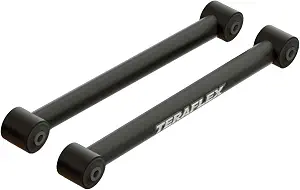 |
| Most Popular A crowd favorite that many people choose with confidence | TRQ 4-Piece Rear Control Arm Set (Rear Upper and Lower) |  |
| Best Seller A high-volume bestseller chosen again and again | Detroit Axle Front or Rear Lower Control Arms Set for 1997–2006 Jeep Wrangler TJ |  |
1. Rough Country Rear Lower X-Flex Adjustable Control Arms

| Fit Type | Vehicle Specific Fit |
|---|---|
| Auto Part Position | Rear |
| Material Type | Alloy Steel |
These Rough Country Rear Lower X-Flex control arms replace the factory lower links on 2007–2018 Jeep Wrangler JKs to provide greater suspension articulation for off-road driving. They use large ball-in joints with a 2.5" diameter body and 1.25" threads and are fully greaseable so you can service the joints after heavy use. Upper joints pivot up to 20 degrees and the lower joints up to 35 degrees, which helps keep tires planted when crawling over uneven terrain. Installation is vehicle-specific and intended to be performed by someone familiar with suspension work or a professional installer. In real-world use you can expect improved wheel travel and durability compared with stock arms, but some users report bushing or joint wear under heavy duty cycles so routine inspection and greasing are recommended. The kit ships with hardware and flex joints, and Rough Country backs it with a limited lifetime replacement warranty.
Best for: Drivers who want a balance of improved off-road articulation and serviceability without wholesale suspension redesign, and who plan to maintain their suspension with regular inspections and greasing.
Less Ideal for: Drivers seeking a no-maintenance, lifetime heavy-duty solution for extreme commercial or continuous rock-crawling use should consider higher-end or service-free specialty arms.
- High articulation range with lower joints pivoting up to 35 degrees for improved off-road wheel travel
- Fully greaseable ball-in joints for routine maintenance and longer service life
- Heavy-duty 2.5" diameter joint body and 1.25" threads designed for strength in off-road use
- Vehicle-specific fitment for direct replacement on 2007–2018 Jeep Wrangler JK rear lower positions
- Some customers report premature bushing or joint wear under intensive use requiring replacement
- Installation and periodic checks require suspension knowledge or a professional technician
Verdict: A practical upgrade for JK owners who want greater rear articulation and serviceable joints to improve off-road capability while retaining a direct-fit replacement.
2. Synergy Manufacturing High-Clearance Adjustable Rear Lower Control Arms (Pair)

| Fit Type | Vehicle Specific |
|---|---|
| Auto Part Position | Lower |
| Auto Part Orientation | Rear |
These Synergy Manufacturing rear lower control arms are built for drivers who want stronger, adjustable suspension geometry and better off-road clearance. They replace factory lower rear arms with a high-clearance design and adjustable length to help correct alignment and control under lifted or modified setups. In practice they are typically used when lifting a Wrangler or upgrading suspension for more aggressive trails; the adjustable feature makes it easier to dial in pinion and wheel alignment without fabricating or bending stock pieces. The arms are precision manufactured for a close fit and arrive as a matched pair for both sides. Expect improved articulation and reduced binding compared with worn factory components, plus a cleaner look under the axle. Limitations are that these are vehicle-specific rear lower arms so you'll need the correct part number for fitment and professional installation is recommended for alignment and torque specs.
Best for: Buyers focused on improving off-road capability and suspension geometry after lifting or modifying a Jeep who want an adjustable, durable replacement for factory rear lower arms.
Less Ideal for: Drivers keeping a completely stock suspension or those unwilling to follow up with alignment and possible additional suspension tuning should consider simpler direct-replacement arms.
- Adjustable length lets you correct pinion and wheel alignment after a lift
- High-clearance design reduces interference with rocks and trail obstacles
- Precision manufactured for a close, vehicle-specific fit
- Sold as a matched pair for consistent suspension geometry
- Requires correct vehicle-specific part and professional alignment after installation
Verdict: Choose these adjustable high-clearance rear lower control arms if you need stronger, tunable suspension geometry and better off-road clearance for a modified Jeep Wrangler.
3. Metrix Premium Chassis Parts 4‑Piece Rear Upper & Lower Control Arm Kit

| Fit Type | Vehicle Specific Fit |
|---|---|
| Auto Part Position | Rear |
| Material Type | Alloy Steel |
| Unit Count | 4.0 Count |
This Metrix kit supplies both rear upper and lower control arms intended to replace worn steering and suspension links on compatible Jeep Wranglers. It ships as a complete four-piece set with hardware and ball joint assemblies so you can swap both sides without sourcing separate parts. The arms are made from alloy steel, feature greaseable joints on serviceable pieces, and are treated with cataphoresis plating to resist salt and road corrosion. That construction gives predictable steering geometry and should restore handling and tire wear when original arms are tired. Installation is straightforward for a competent DIYer or a shop; alignment after installation is still necessary. Quality-control issues have been reported occasionally, such as damaged boots or mismatched fasteners that required replacements, so inspect parts on arrival and keep old hardware handy as spares. The kit is backed by a three-year/36,000-mile warranty and meets IATF 16949 and ISO 9001 manufacturing standards, which helps reassure buyers looking for a factory-quality replacement at a value price point.
Best for: Buyers who want a budget-conscious, ready-to-install rear control arm replacement that restores alignment and handling with parts designed for routine maintenance and long-term corrosion resistance.
Less Ideal for: If you need heavy-duty aftermarket strengthening for extreme off‑roading or lifted Wrangler setups, choose a reinforced performance arm from a specialist supplier instead.
- Complete four-piece kit includes both rear upper and lower arms plus necessary hardware for full-side replacement.
- Alloy steel construction with cataphoresis coating improves corrosion resistance for longevity in salted or wet climates.
- Greasable design on serviceable joints lets you maintain lubrication and extend service life.
- Manufactured to IATF 16949 and ISO 9001 standards and supported by a 3-year/36,000-mile warranty.
- Some buyers reported occasional quality-control problems like torn boots or incorrect nuts requiring replacement parts or reuse of old hardware.
Verdict: A complete, corrosion-resistant rear upper and lower control arm kit that restores handling and offers factory-quality construction at a value for practical Jeep Wrangler repairs.
4. Metrix Premium Chassis Parts Rear Lower Control Arm (Rear Lower)

| Fit Type | Vehicle Specific Fit |
|---|---|
| Auto Part Position | Rear Lower |
| Material Type | Carbon Steel |
| Manufacturer Part Number | 48713MT |
This Metrix rear lower control arm is a direct replacement designed for Jeep Wrangler models and connects the steering knuckle to the frame while restoring rear wheel alignment and stability. The arm is made from carbon steel, comes pre-greased for the bushing to reduce initial wear, and is finished with a corrosion-resistant coating intended to extend service life. Installation is straightforward for a mechanic or competent DIYer and customers report an OEM-like fit that reduces clunking, uneven tire wear, and loose steering after replacement. The part meets IATF 16949 and ISO 9001 production standards and includes interchange numbers for cross-referencing. Limitations are that this is a single arm sold individually and fitment is vehicle-specific, so you must verify it matches your Wrangler year and configuration; wheel alignment is still required after installation. For buyers focused on replacing a worn or damaged rear lower arm cheaply without sacrificing build quality, this part delivers reliable function and simple installability.
Best for: Buyers looking to replace a worn or damaged rear lower control arm on a Jeep Wrangler who prioritize a low-cost part that still offers solid build quality and straightforward installation.
Less Ideal for: Those seeking upgraded performance or lighter-weight aftermarket arms for off-road competition should consider heavier-duty or aluminum performance options instead.
- Vehicle-specific design for direct fit on listed Jeep Wrangler years
- Carbon steel construction with corrosion-resistant coating for durability
- Pre-greased bushing reduces break-in wear and simplifies initial maintenance
- Manufactured to IATF 16949 and ISO 9001 standards for consistent quality
- Sold as a single arm so replacing both sides requires purchasing two units
Verdict: A budget-friendly, factory-quality rear lower control arm for Jeep Wrangler owners who want a direct-fit, durable replacement.
5. TeraFlex Rear Lower Sport Arms (JK)

| Fit Type | Vehicle Specific Fit |
|---|---|
| Auto Part Position | Lower |
| Auto Part Orientation | Rear |
| Included Components | 2 rear lower JK control arms |
These fixed-length rear lower sport arms are built for Jeep JK and JKU Wranglers running 2.5 to 3 inch lifts and replace the factory lower rear control arms to restore proper geometry. They are typically used as part of a lift kit or when upgraded suspension hardware is needed; installation replaces the stock arms using the factory mounting points with 9/16 inch hardware. Notable features include a tubular steel construction sized for lift applications and a maintenance-free fixed length that eliminates periodic adjustment. In practice they tighten up rear axle control, reduce bump steer and improve steering stability over rough roads compared with worn factory arms. The arms are a targeted, vehicle-specific solution so they integrate cleanly with other lift components, but because they are fixed length they do not offer adjustable correction for extreme alignment tweaks or multi-inch lifts. Buyers should also plan for professional alignment after installation to get the full benefit.
Best for: Buyers focused on reliable, low-maintenance suspension upgrades for a lifted Jeep who want a direct-fit rear lower arm to restore factory-aligned handling and reduce rear axle movement.
Less Ideal for: Anyone seeking adjustable control arms to dial in custom pinion angle or for lifts outside the 2.5–3" range should consider adjustable alternatives.
- Vehicle-specific design for Jeep JK and JKU with 2.5–3" lifts improves compatibility
- Tubular, fixed-length construction provides stable axle control and maintenance-free operation
- Uses standard 9/16" mounting bolt for direct replacement and straightforward installation
- Fixed-length design lacks adjustability for non-standard lift heights or fine alignment tuning
Verdict: Choose these TeraFlex rear lower sport arms when you want a durable, maintenance-free direct-fit upgrade to stabilize a JK/JKU Wrangler with a 2.5–3" lift.
6. TRQ 4-Piece Rear Control Arm Set (Rear Upper and Lower)

| Included Components | 2 Rear Lower Control Arms, 2 Rear Upper Control Arms |
|---|---|
| Fit Type | Vehicle Specific Fit |
| Manufacturer Part Number | PSA62958 |
| Manufacturer Warranty Description | 2 years |
This TRQ control arm set replaces both rear upper and lower arms on compatible Jeep Wranglers and is intended to restore suspension geometry and correct rear camber and sag. The kit includes two upper and two lower arms with thick bushings and adjustable components where applicable, so installers can pre-adjust lengths to reduce alignment work after fitment. In real-world use it improves stability, evens tire wear, and often brings worn rear camber back toward factory alignment. Installation is typical for rear control arms and can be done by a competent DIYer in a garage or by a shop; TRQ provides step-by-step videos to simplify the process. Expect to take the vehicle for a professional alignment after installation. One limitation is that some buyers report fitment differences across models or years, so confirming exact vehicle fit is important before installing; the lower trailing arms in some cases required swapping or modification to match certain vehicles.
Best for: Buyers who prioritize proven user feedback and want a complete rear control arm replacement to correct sagging camber and improve tire life on a Wrangler, and who prefer parts that come with DIY support resources.
Less Ideal for: Drivers unwilling to verify exact year/submodel fit or those seeking a bolt-in swap without any chance of minor adjustments or professional alignment after installation.
- Complete 4-piece kit replaces both rear upper and lower control arms for a coordinated repair
- Adjustable components allow pre-setting to reduce alignment time after install
- Thick bushings and robust construction aim to restore stability and reduce uneven tire wear
- Manufacturer-provided installation videos help DIY installers follow correct steps
- Fitment can vary by year and submodel so some vehicles may need minor modification or different trailing arms
Verdict: Buy this TRQ four-piece rear control arm kit if you want a complete, user-verified replacement that restores rear camber and stability on compatible Jeep Wranglers.
7. Detroit Axle Front or Rear Lower Control Arms Set for 1997–2006 Jeep Wrangler TJ

| Fit Type | Vehicle Specific Fit |
|---|---|
| Auto Part Position | Front Lower, Rear Lower |
| Material Type | Alloy Steel |
| Manufacturer Part Number | K640734 x2 |
These Detroit Axle lower control arms replace the factory front or rear lower control arms on 1997–2006 Jeep Wrangler TJ models. Sold as a pair, the arms are stamped alloy steel units with factory-style mounting points and preinstalled bushings and ball joints where applicable, so installation follows the same procedure as the original parts. In everyday use they restore proper suspension geometry, reduce play that causes clunking or uneven tire wear, and should return steering feel to factory levels. Notable extras include a long advertised warranty and broad user reports of good fitment for TJ Wranglers. Expect straightforward bolt-on installation for a mechanically competent DIYer or a quick job for a shop. Limitations to be aware of: some buyers report early ball-joint or boot wear on heavy-duty or high-mileage vehicles, and if the vehicle mounting bolts are rusted they may break and require replacement during install. For buyers wanting a conservative, cost-effective factory-replacement option these arms balance fit and value, but owners looking for heavy off-road reinforcement or upgraded long-life ball joints may prefer higher-end aftermarket units.
Best for: Buyers who need a straightforward, factory-style replacement to stop clunks and restore steering and alignment on a Jeep Wrangler TJ and who prefer a conservative, value-focused repair over performance upgrades.
Less Ideal for: Owners who routinely subject their Wrangler to heavy off-road abuse or who want reinforced control arms and long-life aftermarket ball joints should consider specialty off-road parts instead.
- Vehicle-specific fit for 1997–2006 Jeep Wrangler TJ which simplifies installation
- Alloy steel construction and factory-style mounting points for a stock-like feel
- Sold as a two-piece set to replace both lower arms at once
- Many buyers report excellent fit and restored steering/suspension feel
- Some reports of premature ball-joint or boot failure on high-mileage or heavy-use vehicles
- May require replacement of corroded vehicle mounting bolts during installation
Verdict: A practical, factory-style replacement set that reliably restores steering and suspension feel on 1997–2006 Jeep Wrangler TJs without premium off-road upgrades.
Choosing the Right Jeep Wrangler Rear Lower Control Arm: Key Factors to Consider
Fitment and Mounting Points
Correct fitment is the baseline for a successful rear lower control arm replacement. On the Jeep Wrangler, mounting point spacing and bushing bore diameter must match the factory subframe and axle brackets to maintain factory suspension geometry.
If an arm does not sit at the correct angle or has different mounting offsets, you can see rapid tire wear, pull to one side, or persistent alignment drift. Confirm whether the replacement requires any additional brackets, hardware, or minor drilling; most owners prefer a direct-fit arm to minimize installation complexity and alignment headaches.
Bushing Type and Compliance
Bushings determine how much movement is allowed between the axle and chassis and directly influence ride comfort, isolation from road noise, and precise alignment control.
Rubber bushings offer smoother NVH characteristics and a more compliant ride but may wear faster under aggressive offroad use. Polyurethane bushings increase durability and control at the cost of firmer ride and sometimes more transmitted noise. Some arms use a bonded or sleeve-mounted design to control movement more tightly; consider your balance between comfort and lateral stability when choosing.
Material Strength and Construction Quality
A rear lower control arm takes repeated loads from braking, cornering, and trail impacts, so material grade and construction matter. Tubular steel, plate-welded designs, and forged arms each have different strength-to-weight profiles.
Look for arms with clear material spec or visible heavy-gauge steel and consistent welds. Corrosion protection such as powder coat or galvanized finishes extends service life, especially if you drive in salted winter roads or muddy trails. Poorly fabricated arms can bend or fail, leading to sudden alignment issues and unsafe handling.
Geometry and Alignment Impact
Even a direct-fit replacement can subtly alter suspension geometry, affecting toe and camber at the rear axle. Some aftermarket arms restore factory geometry, while others intentionally alter arm length or angle to correct for lift or heavy-duty use.
If you run a lift kit, heavier tires, or aftermarket suspension, select an arm that maintains correct axle positioning under load. Incorrect geometry can cause wandering, premature inner or outer tire wear, and unpredictable handling at speed. Plan to check and adjust alignment after installation to verify the intended geometry is achieved.
Durability Under Offroad Conditions
Wrangler owners often expose rear lower control arms to rocks, ruts, and repetitive articulation. Durability considerations include impact resistance, fatigue life, and protection against abrasion and corrosion.
Choose arms designed with reinforcement in high-stress areas and protective coatings to resist chipping and rust. Consider whether the arm's profile clears common trail obstacles and whether its bushing design tolerates repeated flexing. Robust construction reduces the need for frequent replacement and lowers the chance of sudden failure while offroad.
Serviceability and Replacement Hardware
Ease of installation and the availability of quality replacement hardware affects total repair time and long-term ownership costs. Some arms come with pressed-in bushings, removable sleeves, or serviceable bolts allowing future bushing swaps without replacing the entire arm.
Assess whether special tools, alignment plates, or press equipment are needed. Arms that include new mounting hardware or greaseable fittings simplify maintenance. Additionally, clear installation instructions and compatibility with standard torque specifications help ensure a correct and durable installation.
When To Replace The Rear Lower Control Arm
Determine replacement based on symptoms, inspection, and driving behavior. Common indicators include uneven tire wear, a rear that pulls to one side, or clunks and thuds from the rear during acceleration, braking, or over bumps. Visual inspection can reveal cracked bushings, excessive play at the mounting points, or a visibly bent arm.
- Inspect bushings for cracks, splitting, or missing material.
- Check for lateral play by prying at the wheel while the vehicle is lifted.
- Look for rust-through, large dents, or bends in the arm tube or plate.
How Bushing Choices Affect Ride And Handling
Bushing compliance alters how forces transfer between the axle and chassis. Softer bushings absorb road harshness and reduce noise but allow slight alignment movement under load. Firmer bushings reduce deflection for more consistent rear toe but can transmit more vibration into the cabin.Consider driving style: if you prioritize daily comfort on pavement, a more compliant bushing may be preferable. If you routinely tow, carry heavy loads, or drive aggressively offroad, a firmer bushing or a design with integrated sleeves gives more predictable handling.
- Rubber: quieter, smoother, easier on alignment.
- Polyurethane: stiffer, longer-lasting, can increase noise.
- Sleeved or bonded: controls deflection for consistent geometry.
Installation Tips And Alignment Considerations
Plan for a proper wheel alignment after replacing rear lower control arms. Even correct-fit arms can change toe or camber slightly and torqueing the mounting hardware under load can shift geometry. Use manufacturer torque specs and, if possible, hold the suspension near droop position when tightening to mimic road conditions.If the vehicle has a lift or aftermarket track bars, check that the rear axle remains centered and that control arm angles do not induce bump steer or exaggerated toe change during articulation. Consider servicing adjacent components like sway bar links or mounting bolts while access is available.
- Torque bolts to spec with the vehicle on the ground or at specified droop.
- Replace mounting hardware if corroded or visibly stretched.
- Verify axle centering and perform a full alignment after installation.
Addressing Noise And NVH From The Rear Suspension
Rear lower control arm noise can stem from worn bushings, loose mounting hardware, or contact between the arm and nearby components. Determining whether the noise is bushing knock or a structural contact helps select the correct fix.If vibration or humming increases after swapping to a firmer bushing, consider adding isolators or choosing a bushing compound aimed at NVH control. Properly torqued hardware and anti-seize or thread-lock treatments on bolts reduce the chance of creaks and rattles developing over time.
- Listen for clunks during acceleration, braking, and lateral maneuvers.
- Isolate bushing noise by supporting the axle and checking for play at each mount.
- Use correct torque and lock washers to prevent loosened fasteners.
Upgrading For Heavy Duty Or Offroad Use
Upgraded arms for heavier duty use often feature thicker materials, reinforced brackets, or improved mounting options to withstand higher loads. If you routinely carry heavy gear or navigate technical trails, prioritize arms with proven fatigue resistance and protective finishes.Be mindful that more rigid arms can alter suspension feedback and increase transmitted vibration. When upgrading, ensure the replacement arm maintains safe geometry and that other suspension components are rated for the added stresses.
- Check material thickness and reinforcement in impact zones.
- Confirm protective coatings for corrosion resistance.
- Balance rigidity needs with anticipated NVH changes.
Still looking for the perfect fit?
Select your Jeep Wrangler configuration to see the most relevant Lower Control Arms recommendations
How We Chose the Best Jeep Wrangler Rear Lower Control Arm
We focused on selection criteria that matter to Jeep Wrangler owners replacing rear lower control arms. Primary considerations included fitment accuracy to Wrangler rear suspension mounting points, bushing type and quality, and the arm's structural design and material grade to resist bending or fatigue under typical Wrangler loads.We also evaluated durability factors such as corrosion resistance and weld quality, plus how different arm geometries affect rear toe and camber under load. Ride quality and NVH implications received attention through assessment of bushing compliance and mounting method. Compatibility with common Wrangler lift heights and typical wheel/tire setups was considered to ensure real-world applicability.Items were excluded if they lacked clear vehicle fitment information, used ambiguous materials, or omitted bushing specifications. We prioritized arms with documented engineering details, measurable durability features, and those that address common Wrangler rear alignment and wear issues.
Our full evaluation process is outlined in our review methodology.
FAQ
How do I know if the rear lower control arm bushings are bad?
You will often notice clunks, increased rear vibration, or wandering during braking. Visually, bushings will show cracks, separation, or movement at the mounting points. Checking for play by prying on the wheel while the vehicle is raised helps confirm worn bushings.
Can I replace rear lower control arms myself?
Depends on your tools and experience. A mechanically inclined owner with a jack, stands, and basic hand tools can perform the swap, but some bushings may require a press. Plan for a professional alignment after installation to ensure geometry is correct.
Will changing the rear lower control arm affect wheel alignment?
Yes. Replacing the arm can change toe or camber at the rear, especially if bushings compress or the arm geometry differs. Always schedule an alignment after replacement and torque hardware per specifications to minimize shift.
Are polyurethane bushings a good choice for Wrangler rear control arms?
Polyurethane offers greater durability and less deflection, which helps maintain rear alignment under load. However, they transmit more vibration and can increase NVH. Choose them when durability and precise axle control are priorities.
What causes rear lower control arm noise?
Noise often comes from degraded bushings, loose or corroded mounting hardware, or physical contact with nearby components. Proper diagnosis includes inspecting bushings and mounts and reproducing noises under controlled conditions to isolate the source.
How often should rear lower control arms be inspected?
Inspect arms during routine maintenance intervals or whenever you notice handling changes. For vehicles that see offroad use or heavy loads, check arms and bushings at least annually or after significant trail events to catch wear early.
Final Verdict
Prioritize fitment accuracy, bushing type, and construction quality when choosing a rear lower control arm for a Jeep Wrangler. Those factors determine how well the arm restores alignment, controls axle movement, and withstands trail and road exposure. Balance durability against NVH outcomes based on whether you mainly street drive or frequently offroad.After installation, follow proper torque procedures and complete a wheel alignment to confirm the intended geometry. Focusing on these tradeoffs will help you select a rear lower control arm that meets your Wrangler driving style and reduces the chance of repeat repairs.
Explore More:
- Check out all Jeep Wrangler parts & accessories
- Explore Lower Control Arms Maintenance & Repair Guides
- Explore Suspension & Steering
- Browse all Auto Parts
