

Note: This article contains affiliate links. If you click on these links and make a purchase, I may earn a small commission at no extra cost to you. This helps support my research and content. Read my full affiliate disclosure here.
If you drive a 2018‑present Jeep Wrangler you already know steering feel and wheel control matter on and off road. Worn tie rod ends let steering wander, create uneven tire wear, and can make steering unpredictable when you need it most. This guide covers our seven shortlisted tie rod ends selected specifically for the 2018‑present Wrangler chassis and driving conditions. We evaluate each option for fitment, durability, and how well it resists contamination, then explain the key tradeoffs so you can pick the part that matches your typical driving and maintenance plan. Read on for a clear buying path and practical installation and alignment notes.
Looking for other parts? See all Jeep Wrangler parts & accessories.
Top Picks at a Glance
| Best Overall The best all-around choice for most situations | MOOG DS300043 Steering Tie Rod End for Jeep Wrangler |  |
| Best Quality Built to a higher standard if you want something more solid | TeraFlex JL/JT HD Chromoly Tie Rod Kit (0-6" Lift) |  |
| Best Value The sweet spot between price and what you get | Metrix Premium Chassis Parts Front Left Outer Tie Rod End (Fits 2018-2025 Jeep Wrangler, 2020-2025 Gladiator) |  |
| Best Budget The cheapest option that still gets the job done reliably | KFVF Front Outer Tie Rod Ends Kit (ES800593/ES800594) for Jeep Wrangler JK |  |
| Highest Rated A top-rated pick with lots of positive feedback | METRIX Premium Front Right Outer Tie Rod End (Fits Jeep Wrangler) |  |
| Most Popular A crowd favorite that many people choose with confidence | Detroit Axle Front Outer Tie Rod Ends (pair) for Jeep Wrangler JK |  |
| Best Seller A high-volume bestseller chosen again and again | Detroit Axle 10‑Piece Suspension Kit for 2007–2018 Jeep Wrangler (Tie Rods, Ball Joints, Sway Bar Links) |  |
1. MOOG DS300043 Steering Tie Rod End for Jeep Wrangler

| Brand | MOOG |
|---|---|
| Material | Metal, Rubber |
| Bearing Type | Ball Bearing |
| Compatible Lubricant | Grease |
| Manufacturer | MOOG Chassis Products |
The MOOG DS300043 is an outer tie rod end intended to replace a worn steering link on 2018-present Jeep Wrangler models. It uses a greaseable socket and a pressed-in cover plate to keep contaminants out, while a Belleville preload washer and MOOG's gusher-style bearing aim to maintain tightness and smooth movement as the joint wears. In practice this part simplifies installation with precision tolerances and should restore like-new steering feel and alignment retention. The grease fitting means you can service the joint to extend life, and heat-processed ball studs improve fatigue strength under heavier driving. Some buyers report excellent longevity and fit, while a few experienced users have seen premature wear, so regular inspection after installation is wise. Also note the part does not include smaller hardware like castle nuts, and in some repairs you may need additional connecting pieces to complete the full tie rod assembly.
Best for: Buyers who want a reliable, serviceable replacement that restores steering feel and holds alignment on a daily-driven Jeep Wrangler and who value parts that can be greased and maintained.
Less Ideal for: If you prefer a lifetime-sealed, maintenance-free joint or need a complete tie rod assembly including all connecting pieces and hardware, consider other options or purchase additional components.
- Greaseable socket allows periodic lubrication to flush debris and extend joint life
- Pressed-in cover plate and bearing design reduce contamination and minimize looseness
- Heat-processed ball stud increases strength and fatigue resistance
- Precision tolerances make installation and alignment adjustments straightforward
- Does not include small hardware such as castle nut or steering damper nut
- Some users have reported shorter-than-expected service life on high-mileage vehicles
Verdict: A serviceable, factory-style outer tie rod end that restores steering precision on Jeep Wranglers and is easy to install and maintain.
2. TeraFlex JL/JT HD Chromoly Tie Rod Kit (0-6" Lift)
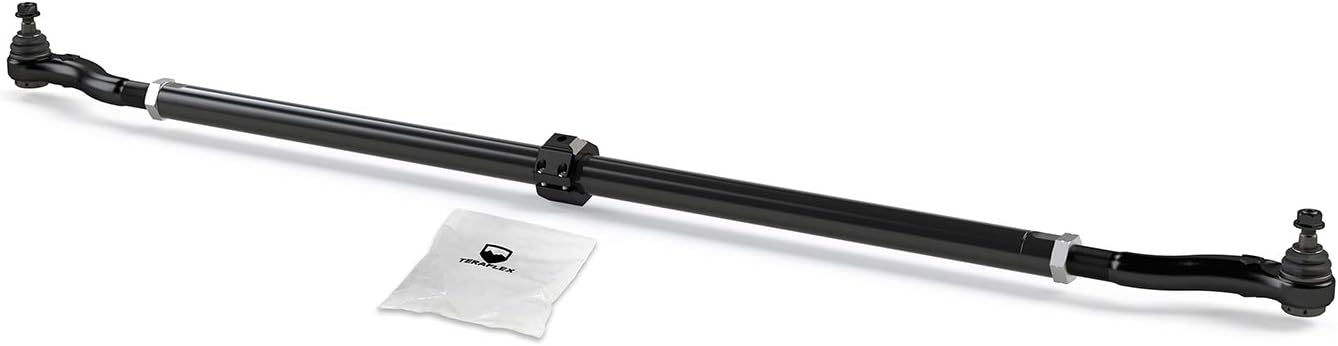
| Fitment | JL Wrangler and JT Gladiator (2018–present) |
|---|---|
| Lift range | 0–6" lift |
| Material | 4140 heat-treated chromoly steel |
| Construction | 42mm O.D. x 7mm wall tube |
This TeraFlex HD Chromoly Tie Rod Kit is built to replace the factory steering tie rod on 2018‑present Jeep Wrangler JL and JT Gladiator models and is aimed at drivers who push their rigs off road or run lifts up to 6 inches. The kit uses heat-treated 4140 chromoly tubing with a beefy 42mm outer diameter to provide much greater strength and stiffness than the factory component, and the triple-stage powder coat helps resist corrosion from exposure and trail debris. Installation does not require cutting or removal of factory bracketry, and the kit relocates the steering stabilizer above the tie rod to reduce the chance of stabilizer damage during impacts. In practical terms this means firmer, more predictable steering under load, less bending when hitting obstacles, and improved durability for lifted Jeeps. The main compromises are the added weight compared with stock and the fact that this is a vehicle-specific upgrade, so alignment and setup after installation are still necessary to avoid uneven tire wear.
Best for: Drivers who upgrade their 2018‑present Jeep Wrangler JL or JT Gladiator for off-road performance or lifted use and want a much stronger, more durable steering component to resist bending and failure.
Less Ideal for: Daily drivers that prioritize the lightest possible steering feel or owners who plan no suspension lift and rarely encounter off-road impacts.
- 4140 heat-treated chromoly construction for much higher strength than factory steering components
- Relocates steering stabilizer above the tie rod to reduce risk of stabilizer shaft damage
- Triple-stage UV protected powder coat improves corrosion resistance in harsh conditions
- Designed for stock and lifted Jeeps up to 6 inches with no cutting or bracket removal required
- Heavier and stiffer than factory parts which can slightly change steering feel and add unsprung mass
Verdict: Choose this kit if you need a significantly stronger, trail-ready tie rod for 2018‑present Wrangler JL or JT Gladiator setups up to a 6 inch lift.
3. Metrix Premium Chassis Parts Front Left Outer Tie Rod End (Fits 2018-2025 Jeep Wrangler, 2020-2025 Gladiator)

| Fitment | 2018-2025 Jeep Wrangler; 2020-2025 Jeep Gladiator |
|---|---|
| Material | Steel (heat-treated) |
| Pre-greased | Yes |
| Manufacturer part number | 59361MT |
| OEM part numbers | 68258762AB/AC/AD/AE, TO96151, TA4026 |
This Metrix front left outer tie rod end is a direct-fit replacement designed for 2018–2025 Jeep Wrangler and 2020–2025 Gladiator applications. It connects the steering linkage to the knuckle and restores proper steering feel and toe alignment after wear or failure. The unit ships pre-greased, uses a greasable design for periodic maintenance, and includes the mounting nut to simplify installation. Metrix highlights heat-treated steel construction, corrosion-resistant coating, and factory-style threads so it installs and aligns like a factory part. Practical benefits include easier DIY swap with typical hand tools and longer service life from the pre-grease and coating. Limitations to note are that this listing is for the left outer piece only so you may need a matching right side and a wheel alignment after installation; packaging or left/right labeling errors have been reported on similar parts so double-check orientation before fitting. Follow standard safety procedures when lifting the vehicle and plan for an alignment afterward.
Best for: Buyers who prioritize a practical, factory-like replacement that installs cleanly and restores steering feel on late-model Jeep Wranglers or Gladiators and who prefer parts that are easy to maintain.
Less Ideal for: Those looking to replace both sides as a kit, or shoppers who want a heavy-duty off-road upgraded tie rod end beyond factory-strength components.
- Direct-fit design for 2018–2025 Jeep Wrangler and 2020–2025 Gladiator for straightforward replacement.
- Pre-greased and greasable fitting reduces initial break-in wear and allows future maintenance.
- Heat-treated steel and corrosion-resistant coating aim to extend service life compared with untreated aftermarket parts.
- Sold as a single left outer tie rod end so you may need to buy the opposite side separately.
Verdict: A practical, factory-style left outer tie rod end that restores steering alignment and durability on 2018+ Jeep Wranglers and Gladiators.
4. KFVF Front Outer Tie Rod Ends Kit (ES800593/ES800594) for Jeep Wrangler JK

| Brand | KFVF |
|---|---|
| Model | ES800593 ES800594 |
| Exterior | Polished |
| Compatible Years | 2018-present Wrangler JK listed |
| Package | 2 front outer tie rod ends |
This KFVF kit supplies the two front outer tie rod ends needed to replace worn steering components on a 2018-present Jeep Wrangler JK. The parts are built to factory-style dimensions and ship as a matched pair so installation and alignment are straightforward for a DIYer or a shop. Notable features include polished finish, preassembled boots and hardware, and claimed precision tolerances to ease fitment. In practice the kit restores steering feel and removes play that causes wandering or uneven tire wear; multiple buyers report correct fit and quick delivery. Limitations to note are that the listing covers only the outer tie rod ends, so inner tie rods or a full steering rack inspection may still be required, and the kit uses basic clamps that some installers replace with zip ties or aftermarket clamps. For someone replacing only outer ends to get steering tightness back, this is a practical budget option with decent fitment for the Wrangler JK platform.
Best for: Buyers prioritizing an affordable, direct-fit replacement to remove steering play and restore on-road steering feel on a Wrangler JK; suitable for DIY mechanics and budget-focused repairs.
Less Ideal for: Do not choose this if you need a complete steering overhaul or heavy-duty upgraded components for off-road abuse; professional shops doing full steering system rebuilds may prefer higher-end or OEM-equivalent kits.
- Sold as a matched pair for left and right front outer positions
- Manufactured to factory-style tolerances for straightforward fitment and alignment
- Polished finish and preinstalled boots for basic protection against contamination
- Well reviewed by buyers for correct fit on listed Wrangler JK years
- Includes only outer tie rod ends so additional steering components may still need inspection or replacement
- Supplied clamps are basic and some users substitute stronger fasteners during installation
Verdict: A budget-friendly, matched pair of front outer tie rod ends that restores steering tightness on Wrangler JK models without unnecessary extras.
5. METRIX Premium Front Right Outer Tie Rod End (Fits Jeep Wrangler)

| Manufacturer | METRIX PREMIUM CHASSIS PARTS |
|---|---|
| Model | 48707MT |
| Position | Front Right Outer |
| OEM Part Number | 52060052AE, 52060052AG, 537-064, DS300043 |
| Certifications | IATF 16949; ISO 9001 |
The METRIX front right outer tie rod end replaces the factory steering terminal on compatible Jeep Wranglers and restores steering connection and alignment control. It is a direct-fit replacement that installs where the steering knuckle meets the steering linkage and is intended for use when the original tie rod shows play, noise, or uneven tire wear. Notable features include a pre-greased, greasable design for periodic maintenance, heat-treated stud and machined exterior for strength, and a cataphoretic coating to resist corrosion. METRIX claims factory-quality engineering with IATF 16949 and ISO 9001 certification and provides a 3 year/36,000 mile limited warranty. In practice this part gives a precision fit that several buyers report matches the original part and returns stable steering feel after installation. Limitations: it is sold as a single outer tie rod end and does not include the adjusting sleeve, so expect to reuse or replace associated linkage pieces and to perform a wheel alignment after installation. Installation requires basic suspension tools and knowledge or a shop for alignment work.
Best for: Buyers who prioritize long-term steering reliability and want a close-to-factory replacement for a 2018-or-later Jeep Wrangler that can be serviced and greased during routine maintenance.
Less Ideal for: Drivers seeking a complete steering linkage overhaul or a plug-and-play adjustable assembly should consider full kits that include inner tie rods, adjusting sleeves, or center links rather than this single replacement part.
- Direct-fit design for Jeep Wrangler steering linkage that matches factory geometry
- Pre-greased and greasable stud for easier maintenance and extended service life
- Heat-treated stud and machined exterior aimed at durability under road stresses
- Cataphoresis corrosion coating to reduce rust over time
- Backed by industry certifications and a 3 year/36,000 mile limited warranty
- Sold as a single outer tie rod end and does not include the adjusting sleeve or center link components
Verdict: A factory-style, greasable outer tie rod end engineered for durable, serviceable steering performance on 2018‑present Jeep Wranglers.
6. Detroit Axle Front Outer Tie Rod Ends (pair) for Jeep Wrangler JK

| Fitment years | 2007–2018 Jeep Wrangler JK |
|---|---|
| Quantity | 2 front outer tie rod ends |
| Thread | M25×1.5-6g |
| Special feature | Grease zerts (serviceable) |
These Detroit Axle outer tie rod ends are a direct-fit replacement intended to restore steering connection and wheel alignment on Wrangler JK front ends. Sold as a pair, they mount where the steering knuckle meets the outer tie rod and are used when worn joints cause play, vibration, or uneven tire wear. Notable features include factory-style threads and serviceable grease fittings that let you add lubricant during routine maintenance. In practice the parts install like a factory replacement and match OEM geometry so alignment adjustments are straightforward after fitting. Benefits include improved steering feel and the ability to prolong joint life via greasing. Limitations to consider are that this listing only includes the two outer tie rod ends and does not supply new jam nuts or additional hardware some installers expect; swapping them will typically require an alignment afterward. The product carries the brand warranty and is presented as an aftermarket, factory-quality option rather than a performance upgrade.
Best for: Buyers who prioritize proven performance and social proof over experimental upgrades and want a like-for-like steering repair that reduces play and restores alignment.
Less Ideal for: Not a good choice for owners seeking heavy-duty or off-road reinforced tie rod upgrades or those wanting a complete front-end hardware kit with new nuts and sleeves.
- Direct-fit design matched to factory steering geometry for straightforward replacement
- Includes grease zerts for on-vehicle lubrication and easier long-term service
- Sold as a matched pair to ensure symmetric steering response after replacement
- Does not include jam nuts or extra hardware which may be needed for some installations
Verdict: A straightforward, factory-quality pair of front outer tie rod ends that restore steering feel and allow on-vehicle greasing, ideal for buyers who prefer low-risk, well-reviewed replacements.
7. Detroit Axle 10‑Piece Suspension Kit for 2007–2018 Jeep Wrangler (Tie Rods, Ball Joints, Sway Bar Links)
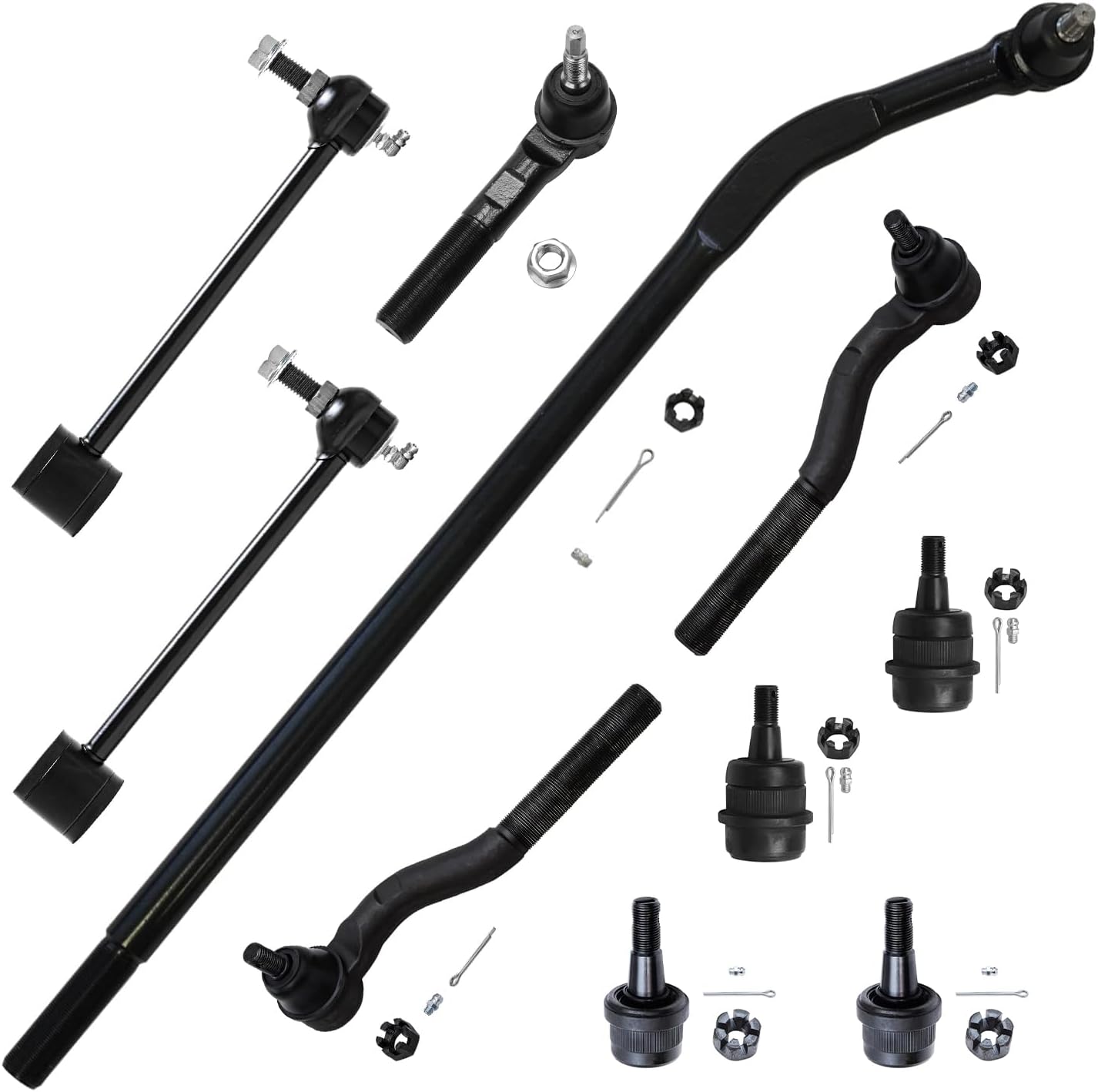
| Fitment | 2007-2017 Jeep Wrangler; 2018 Wrangler JK |
|---|---|
| Kit contents | Front inner & outer tie rods, 4 ball joints, 2 sway bar end links, rear upper outer tie rod |
| Manufacturer | Detroit Axle |
| Item weight | 19 pounds |
This Detroit Axle 10‑piece suspension kit supplies the common front-end steering and suspension wear items needed when refreshing a 2007–2018 Jeep Wrangler front end. The set includes inner and outer tie rod components, front upper and lower ball joints, and sway bar end links so you can replace multiple failure points in one job instead of sourcing parts individually. In use it aims to restore steering response and reduce issues like death wobble when worn components are the cause. The product is marketed as direct-fit and made from premium alloy with corrosion resistance and reinforced structure for everyday driving and off-road loads. Real-world feedback shows many buyers get correct fit and improved handling, though some have reported fitment issues on specific model years or lifted rigs such as incorrect ball joint grease zerk clearance or a drag link bolt that required trimming. Expect a more complete repair vs buying single OEM parts, but be prepared to check critical clearances during installation and to make minor adjustments on altered or tight-clearance setups.
Best for: Buyers who want a single-package solution to refresh a Wrangler front end and prioritize reducing steering play and restoring stable handling with fewer parts orders or returns.
Less Ideal for: Owners seeking guaranteed factory-exact individual components for a lifted or heavily modified Wrangler or those who prefer to replace only one steering part at a time.
- Comprehensive kit replaces multiple front-end wear items in one purchase
- Designed as direct-fit replacements to simplify installation
- Components made from alloy and reinforced for impact resistance
- Can address steering play and help mitigate death wobble when worn parts are the cause
- Some users report incorrect fit for certain model years or lifted vehicles requiring trimming or modification
- A few kits have missing or mismatched pieces out of the box
Verdict: A convenient all-in-one front suspension kit that gets most 2007–2018 Wrangler owners back to stable steering without buying parts separately.
Choosing the Right 2018-Present Jeep Wrangler Tie Rod End: Key Factors to Consider
Exact Fitment and Taper Geometry
Correct fitment is the foundation of a safe tie rod end replacement. The taper angle and ball stud profile must match the Wrangler steering knuckle and drag link taper to seat securely and avoid premature loosening or play. Using a component with slightly different geometry can lead to uneven contact, accelerated wear, or the need for aftermarket adapters. For 2018‑present Wranglers, confirm whether the part is listed for the JL and JLU generation to ensure the splines, thread pitch, and taper are correct.
Durability and Corrosion Protection
Wranglers spend a lot of time exposed to water, mud, salt, and road debris, so materials and protective finishes matter. Look for heavy-duty housings, hardened ball studs, and effective coatings like zinc plating or e-coating to slow rusting. Sealed boots or replaceable grease fittings contribute to longevity by keeping contaminants away from the ball joint. Parts designed with stronger housings and thicker threads will resist the repeated loads encountered during off-road use and towing.
Sealing and Serviceability
How a tie rod end seals against dirt and water greatly affects lifespan. A high-quality rubber or thermoplastic boot should keep grit out while allowing movement without cracking. Some assemblies include a grease fitting so you can periodically repack the joint, which is advantageous for owners who regularly run through dust or water. Others are sealed for life; those can be convenient but will need replacement sooner if contamination occurs.
Thread Quality and Adjustment Range
Tie rod ends must allow for precise length adjustment to achieve correct toe settings during alignment. Threads should be cleanly cut, with enough length and the correct pitch to permit alignment shops to dial toe in without altering center links or requiring shims. Poor thread quality risks cross-threading during installation and may prevent achieving factory alignment specifications. Also verify the available adjustment range matches the Wrangler's steering geometry and any lift or leveling modifications you may have.
Load Rating and Fatigue Resistance
Steering components endure repeated dynamic loads, especially when off road. Check whether manufacturers provide load or fatigue data, and favor designs with reinforced housings or thicker ball studs that resist deformation under impact. Higher fatigue resistance reduces the chance of sudden failure during hard use and extends the service interval between replacements.
Compatibility With Alignment and Aftermarket Steering Upgrades
If your Wrangler has an aftermarket track bar, lift, or heavy-duty steering damper, choose tie rod ends that support the altered geometry and additional loads. Some upgraded steering kits require longer or differently threaded ends to retain proper toe range and caster settings. Confirm the replacement will work with alignments after suspension changes, and consider parts that maintain standard adjustment methods to keep alignment straightforward.
Why Tie Rod Ends Fail on 2018‑Present Wrangler Chassis (JL and JLU)
Tie rod ends on Wranglers fail for a few predictable reasons: contamination of the ball joint, corrosion of the threaded shaft, and metal fatigue from sustained off‑road impacts. The JL and JLU generation introduced changes in steering geometry and components that affect how forces transmit through the tie rods, so understanding common wear mechanisms helps you spot problems earlier.
Driving through water and mud forces abrasive particles into the boot if it is compromised, while salt accelerates corrosion on exposed threads. Repeated impacts from rocks and potholes produce stress cycles that eventually cause loosening or cracking in lower-quality components.
- Boot failure lets grit abrade the ball stud, creating play
- Corroded threads make adjustments difficult and can weaken the connection
- Fatigue from repeated impacts leads to cracking or sudden failure
Inspection Checklist Before You Replace
A methodical inspection helps determine whether you need a full replacement or a simple service. With the vehicle safely lifted, check for play by grasping the wheel at 3 and 9 o'clock and rocking it while an assistant watches the tie rod end for movement. Excessive free play, torn boots, or visible rust indicate replacement.
Also inspect the castellated nut and cotter pin condition, the thread engagement, and whether the boot is flexible or hard and cracked. If you find uneven tire wear or wandering steering, inspect the tie rod ends as part of the diagnosis rather than assuming a wheel alignment alone will fix the issue.
- Check boots for tears or grease loss
- Feel for looseness at the ball stud while rocking the wheel
- Inspect threads and nut engagement for corrosion
- Look for uneven or feathered tire wear patterns
Installation and Alignment Notes Specific to the Wrangler
Replacing tie rod ends on a 2018‑present Wrangler follows standard steering procedures but pay attention to alignment tolerances. Keep track of the number of turns or count of exposed threads as you remove the old end so you can approximate the new part to the same length before final alignment.
After installation, always get a professional toe alignment. If your Wrangler is lifted, provide the alignment shop with lift details so they can compensate for changed geometry. Tighten castellated nuts to the specified torque and secure new cotter pins to prevent loosening during off‑road use.
- Approximate initial length by matching exposed threads
- Torque castellated nut to spec and install new cotter pin
- Always perform a toe alignment after installation
- Inform the alignment shop of any lift or steering upgrades
Maintenance Tips to Extend Tie Rod End Life
Routine inspection after heavy off‑road trips and cleaning salt and mud from steering components can extend tie rod end life. If parts have grease fittings, make regreasing part of your service interval; a short pump of grease after muddy runs helps purge water from the joint.
Replace torn boots promptly and avoid high‑pressure washing directly at the joint to reduce forced water intrusion. If you plan extended off‑road use, consider more frequent visual checks and carry basic tools and a spare cotter pin.
- Grease fittings: pump after muddy runs
- Clean components of salt; avoid direct high‑pressure washing at boots
- Inspect boots and threads regularly
- Carry spare cotter pins and basic tools
Common Symptoms of a Failing Tie Rod End
Symptoms often start subtly and worsen over time. Owners usually notice wandering or vague steering, increased steering play, or a clunking noise when going over bumps. Uneven tire wear, especially feathering on front tires, is a common sign that toe is out due to tie rod play.
Driving with a failing tie rod end can affect control and safety, so treat early symptoms seriously. If you see visible boot damage or feel looseness during the inspection checklist, plan replacement before alignment or other suspension work.
- Wandering steering or decreased steering precision
- Clunking or knocking over bumps
- Uneven or accelerated front tire wear
- Loose-feeling steering wheel with increased free play
Still looking for the perfect fit?
Select your Jeep Wrangler configuration to see the most relevant Tie Rod Ends recommendations
How We Chose the Best 2018-Present Jeep Wrangler Tie Rod End
We focused on criteria that directly affect steering safety and longevity on the 2018‑present Jeep Wrangler chassis, including JL and JLU generation fitment where applicable. Primary evaluation points were mechanical fit and correct taper geometry to ensure proper connection to factory steering knuckles and drag links; material quality and corrosion protection because salt, mud, and water intrusion accelerate failure on Wranglers; ball stud sealing and greaseability to determine serviceability and resistance to contamination; precision of the threaded ends and factory-style castellations to preserve alignment settings; and load ratings and fatigue resistance to reflect off-road and towing stresses. We also considered manufacturing tolerances and warranty coverage as proxies for long-term reliability. Exclusions included parts that did not clearly state Wrangler 2018‑present compatibility, universal-fit assemblies requiring substantial modification, or components that omit critical installation hardware. The result is a set of seven options that meet fitment expectations and prioritize steering performance, corrosion resistance, and serviceability for Jeep Wrangler owners.
Our full evaluation process is outlined in our review methodology.
FAQ
How quickly do I need to replace a worn tie rod end on my Wrangler?
It depends on how severe the wear is. If you detect visible play, torn boots, or steering that wanders, replace it promptly because continued use increases the risk of sudden failure. Minor wear with no play can be monitored closely, but err on the side of replacement for safety.
Can I drive my 2018‑present Jeep Wrangler with a bad tie rod end?
Driving short distances slowly may be possible, but it is not recommended. A failing tie rod end can suddenly worsen and lead to loss of precise steering control, so get it inspected and replaced as soon as practical.
Will replacing tie rod ends fix my alignment issues?
Replacing worn ends is often necessary to restore proper toe, but it will not guarantee a correct alignment without an alignment service. After installation, a professional toe adjustment is required to bring the steering geometry back into specification.
Is there a difference between outer tie rod end and inner on my Wrangler?
Yes. Outer tie rod ends connect to the steering knuckle and typically take more lateral loads, while inner tie rod ends attach to the steering rack or center link depending on steering type. Each has distinct dimensions and wear patterns, so replace the correct side when needed.
How can I tell if the tie rod end boot is the issue versus the joint itself?
A cracked or torn boot is a clear sign contamination can enter, but the joint may still function if no grit has penetrated. However, a damaged boot usually precedes joint wear, so if you find a torn boot it is wise to inspect for play and consider replacement rather than risk accelerated damage.
Does replacing tie rod ends affect caster or camber on the Wrangler?
Tie rod ends primarily affect toe; they have little direct effect on caster or camber. However, changes in ride height or suspension components combined with new tie rod ends can change overall alignment needs, so have all three angles checked if you suspect broader geometry shifts.
Final Verdict
When selecting tie rod ends for a 2018‑present Jeep Wrangler, prioritize exact fitment, robust sealing, and threads that provide the necessary adjustment range for a proper toe alignment. Consider the conditions you drive in and whether serviceable grease fittings or sealed units better match your maintenance habits. Replacing worn tie rod ends promptly restores steering precision and prevents uneven tire wear. Focus on parts that balance corrosion protection and durable materials with the correct taper and adjustment range so you can drive confidently both on pavement and off road.
Explore More:
- Check out all Jeep Wrangler parts & accessories
- Explore Tie Rod Ends Maintenance & Repair Guides
- Explore Suspension & Steering
- Browse all Auto Parts
