

Note: This article contains affiliate links. If you click on these links and make a purchase, I may earn a small commission at no extra cost to you. This helps support my research and content. Read my full affiliate disclosure here.
An oil pressure test gauge is one of the most useful diagnostic tools a DIY mechanic can keep in the garage. When a warning light flickers, an engine sounds noisy, or dashboard readings seem questionable, a direct mechanical reading helps confirm whether the problem is real oil pressure loss, a bad sender, or an electrical issue.Choosing the right kit matters because not every engine uses the same thread size, access point, or working pressure range. A good setup should be easy to connect, simple to read, and durable enough for repeated testing without leaks. The picks that follow focus on the features that make oil pressure testing more accurate, less frustrating, and safer for home mechanics.
Top Picks at a Glance
| Best Overall Oil Pressure Test Gauge for DIY Mechanics An accurate, versatile gauge suited to most DIY engine pressure checks | OTC 5610 Transmission and Engine Oil Pressure Tester Kit |  |
| Best Budget Oil Pressure Test Gauge for DIY Mechanics A reliable, no-frills gauge offering essential readings at low cost | Gnhydxfe Oil Pressure Tester Kit with 0-140 PSI Gauge and 10 Adapters |  |
| Best Premium Oil Pressure Test Gauge High-accuracy, durable gauge with premium materials and comprehensive adapters | AUTOOL PT620 Digital Oil Pressure Tester Kit |  |
| Best Compact Oil Pressure Test Gauge Small, easy-to-store gauge for tight spaces with clear readout | MEANLIN MEASURE 0–200 PSI Stainless Steel Liquid-Filled Pressure Gauge, 1.5" Dial, Lower Mount |  |
| Best Heavy-Duty Oil Pressure Test Gauge Built tough for frequent shop use with reinforced hoses and fittings | ajee Hydraulic Pressure Test Kit with Five Gauges and Carrying Case |  |
| Best Complete Oil Pressure Test Kit Includes broad adapter selection and accessories for testing many engines | YSTOOL Oil Pressure Tester Kit with 0-140 PSI Gauge and Adapter Set |  |
| Best 0–100 PSI Oil Pressure Gauge Wide-range 0–100 PSI dial for high-pressure applications and clarity | MEANLIN MEASURE 0–100 PSI Stainless Steel 2.5" Liquid-Filled Pressure Gauge (1/4" NPT, Lower Mount) |  |
OTC 5610 Transmission and Engine Oil Pressure Tester Kit
Best Overall Oil Pressure Test Gauge for DIY Mechanics

| High gauge range | 0-400 psi |
|---|---|
| Low gauge range | 0-100 psi |
| Gauge size | 3.5 inch diameter |
| Included adapters | 13 adapters |
The OTC 5610 is a handheld pressure test kit built for both engine and transmission diagnostics; it includes separate high and low pressure gauges, a hose assembly with quick couplers, and 13 adapters to fit a wide range of domestic and import vehicles. Technicians and DIYers use it for static compression checks in the shop and on-road pressure monitoring while the engine or transmission is under load. The large 3.5 inch gauges have chrome bezels and protective boots for easier reading and durability and the kit stores in a blow-molded hard case with a removable lid for organized transport. Practical benefits include the ability to measure up to 400 psi on the high gauge and 100 psi on the low gauge, quick-connect fittings for faster hookup, and a range of adapters that reduce the need for extra fittings. Limitations are that the kit is a mechanical gauge set so it lacks digital logging or data export and learning to interpret on-road readings requires some diagnostic experience.
Best for: DIY mechanics who want a reliable, easy-to-use oil and transmission pressure tester for routine diagnostics, mobile troubleshooting, and home garage use where a broad gauge range and multiple adapters simplify testing across domestic and import engines.
Less Ideal for: Buyers who need digital data capture, smartphone integration, or automated logging should consider electronic testers instead.
- Separate high (0-400 psi) and low (0-100 psi) gauges for both transmission and engine applications
- Large 3.5 inch gauges with protective boots and chrome bezels for easy visibility and durability
- Quick coupler hose assembly and 13 adapters to fit most domestic and import vehicles
- Blow-molded hard case with removable lid keeps components organized and protected
- Mechanical gauges do not provide digital readout or data logging
- Requires familiarity with pressure testing to interpret on-road results
Verdict: The best all-around oil pressure test gauge for DIY mechanics that balances accuracy, gauge range, hose and adapter selection, and ease of use for routine engine diagnostics.
Gnhydxfe Oil Pressure Tester Kit with 0-140 PSI Gauge and 10 Adapters
Best Budget Oil Pressure Test Gauge for DIY Mechanics

| Gauge range | 0-140 PSI |
|---|---|
| Material type | Brass, Rubber |
| Included adapters | 10 adapters |
This Gnhydxfe oil pressure tester kit provides a practical, budget-friendly way to check engine oil pressure on cars, small diesel engines, motorcycles, and boats. The kit centers on a 0–140 PSI dual-display gauge with a rubber protective cover and an oil-resistant, high-temperature hose that stays flexible during use. Ten brass adapters and quick-fit straight and angled fittings let you connect to a wide range of test points without adapters leaking, and the compact red case keeps components organized for roadside or garage use. In practice the gauge reads instantly and the hose and fittings hold pressure well for short diagnostic checks. Expect accurate-enough results for DIY troubleshooting and verifying oil pump or pressure warning issues, though the kit lacks calibration certification and professional-grade accuracy for shop-level diagnostics. The fittings and hose are durable for occasional use, but users who need lab-grade precision or frequent heavy shop use should consider higher-end instruments. For routine home diagnostics this kit is convenient, portable, and easy to use.
Best for: DIY home mechanics and hobbyists who need an affordable, no-frills oil pressure gauge kit for routine engine checks and troubleshooting, especially when they want a straightforward toolset with common adapters to test passenger cars, small diesel engines, motorcycles, or boats.
Less Ideal for: Professional technicians or users who require certified accuracy, frequent shop use, or industrial-grade durability should choose a commercial-grade pressure tester instead.
- Wide 0–140 PSI range suitable for most gasoline and small diesel engines
- Includes ten adapters and both straight and angled brass fittings for broad compatibility
- Oil-resistant, high-temperature hose that stays flexible during testing
- Protective rubber-covered dual-display gauge and compact case for portability and protection
- No calibration certificate or stated accuracy spec for professional-level measurements
- Kit is designed for diagnostic checks not continuous monitoring or laboratory precision
Verdict: The best low-cost oil pressure test gauge that gives reliable pressure readings and essential adapters for basic engine checks without extra features or premium materials.
AUTOOL PT620 Digital Oil Pressure Tester Kit
Best Premium Oil Pressure Test Gauge

| Pressure range | 0-426.6 PSI / 0-29.4 bar / 0-30 kg/cm² |
|---|---|
| Display | 2.8-inch backlit LCD |
| Adapters | 17 fitting adapters plus 1 extension hose |
| Test lead | 78.74-inch reinforced rubber cable |
| Resolution | 0.01 (units) with ±0.2% claimed accuracy |
The AUTOOL PT620 is a portable digital oil pressure tester kit designed for shop and garage use by DIY mechanics. It measures real-time, maximum and minimum, and differential oil pressure and displays values on a 2.8-inch backlit screen for easy reading in low light. The gauge supports PSI, bar, and kg/cm² units, offers a data-hold function and a zeroing feature, and stores peak and trough readings for diagnostic checks. The kit includes a long reinforced rubber test line and many riveted copper adapters that fit a wide range of sensor ports, making it straightforward to connect to most engines without improvisation. Accuracy is claimed to be high with fine resolution and the construction uses wear-resistant components suited for repeated shop use. The trade-offs are typical of compact digital gauges: you need to remove the oil pressure sensor to hook it up which adds some time and it requires careful handling of the fittings to avoid leaks. For vehicle troubleshooting and routine checks this kit provides clear, repeatable readings and useful features for pinpointing oil pressure issues.
Best for: Experienced DIY mechanics and professional home-shop techs who need a highly accurate, durable oil pressure gauge with a wide adapter set for long-term, repeatable diagnostics and peace of mind.
Less Ideal for: Casual car owners who want a purely plug-and-play solution or those unwilling to work around engine sensors should consider simpler gauge options or professional service.
- Backlit 2.8-inch digital display shows real-time, max/min and differential readings for clear diagnostics
- Wide pressure range with selectable units (PSI, bar, kg/cm²) for versatility across vehicles
- Includes numerous riveted copper adapters and a long reinforced rubber test line for broad connector fitment
- Data-hold and quick-zero functions simplify capturing and comparing measurements during tests
- Requires removal of the vehicle oil pressure sensor to connect which adds installation time
- Relies on proper adapter sealing and careful handling to avoid test-line leaks under high pressure
Verdict: A top-tier oil pressure test gauge with superior accuracy, robust construction, and a comprehensive adapter set for mechanics who prioritize long-term reliability and precision.
MEANLIN MEASURE 0–200 PSI Stainless Steel Liquid-Filled Pressure Gauge, 1.5" Dial, Lower Mount
Best Compact Oil Pressure Test Gauge

| Thread size | 1/8" NPT (lower mount) with 1/4" and 3/8" adaptors |
|---|---|
| Dial size | 1.5" |
| Pressure range | 0–200 PSI |
| Fill | Glycerin |
| Material Type | Stainless Steel |
This MEANLIN liquid-filled pressure gauge is a compact mechanical gauge designed to measure pressures up to 200 PSI in water, oil, and air systems. It installs as a lower-mount instrument using the supplied thread adaptors and Teflon tape, and the glycerin fill damps needle vibration for steadier readings on engines or compressor-driven systems. The stainless steel case and brass thread joint offer corrosion resistance appropriate for garage and shop environments, while the precision pointer and stated accuracy help with routine oil pressure checks and basic troubleshooting. Its small 1.5" dial keeps the package compact for tight engine bays but can make fine readings slightly harder to read at a glance compared with larger dials. Temperature limits and fluid compatibility are adequate for typical DIY engine work, though the mechanical display lacks digital logging or alarm functions. For hands-on mechanics who want a simple, durable test gauge that resists needle bounce, this is a practical, low-tech tool; those wanting high-resolution digital data or larger, easier-to-read faces may prefer a different instrument.
Best for: A DIY mechanic who needs a compact, easy-to-store oil pressure test gauge for tight engine bays and garage work, prioritizing maneuverability and clear analog readings for routine checks and troubleshooting.
Less Ideal for: Users who need digital logging, high-resolution measurements, or larger, easy-to-read displays for diagnostic work should consider electronic alternatives.
- Glycerin fill reduces needle vibration for stable readings on running engines.
- Stainless steel case and brass joints resist corrosion in workshop environments.
- Compact 1.5" dial fits tight spaces and installs with lower-mount NPT fittings.
- Includes both 1/4" and 3/8" NPT adaptors and Teflon tape for straightforward installation.
- Small dial limits readability for quick checks at a distance.
- Mechanical gauge does not record data or provide digital precision beyond its stated accuracy.
Verdict: A small, lightweight oil pressure test gauge that is easy to store and maneuver in cramped garages while still providing clear, usable pressure readings.
ajee Hydraulic Pressure Test Kit with Five Gauges and Carrying Case
Best Heavy-Duty Oil Pressure Test Gauge

| Maximum working pressure | 600 bar / 9000 psi / 60 MPa |
|---|---|
| Gauge count | 5 gauges |
| Hose length | 1.6 m (per hose) |
| Material type | Nylon, Stainless Steel |
This ajee hydraulic pressure test kit is built to diagnose high-pressure systems on heavy equipment and machinery. It includes five gauges covering from low to very high pressures, multiple 1.6 m test hoses, and a range of fittings and tees so you can connect to different ports without improvising. The gauges use stainless steel shells and glycerin damping which helps reduce needle flutter when systems vibrate, while the nylon-aramid-polyurethane hoses are rated for sustained high pressure. In practice it is useful for pressure checks on excavators, construction machinery, and other diesel hydraulic circuits where accuracy across a wide range matters. The kit is portable in a fitted case, so techs can carry a full set to the job site. Limitations are that the kit is specialized for hydraulic/oil systems rather than general automotive low-pressure use and the set is relatively heavy to carry for prolonged periods due to the metal gauges and robust hoses.
Best for: DIY mechanics and small-shop technicians who need a rugged, shop-ready oil pressure tester that tolerates frequent use and rough handling while providing reliable pressure checks on engines and hydraulic systems.
Less Ideal for: Casual car owners or weekend hobbyists who only need occasional low-pressure oil checks and prefer a lighter, simpler toolset.
- Five gauges cover a wide pressure range for stepwise testing from low to very high pressures.
- Glycerin-filled stainless steel gauges reduce needle vibration and improve readability on vibrating equipment.
- High-pressure test hoses with nylon, aramid and polyurethane layers are rated for demanding hydraulic service.
- Comes with a comprehensive set of fittings and tees to connect to different test ports without adapters.
- Designed for heavy hydraulic systems so it is overkill for light automotive or low-pressure oil checks.
- Bulk and weight of the metal gauges and long hoses make the kit less convenient for one-person mobile use.
Verdict: A rugged oil pressure test gauge built with durable components, reinforced hoses, and metal fittings to withstand frequent shop use and rough handling.
YSTOOL Oil Pressure Tester Kit with 0-140 PSI Gauge and Adapter Set
Best Complete Oil Pressure Test Kit
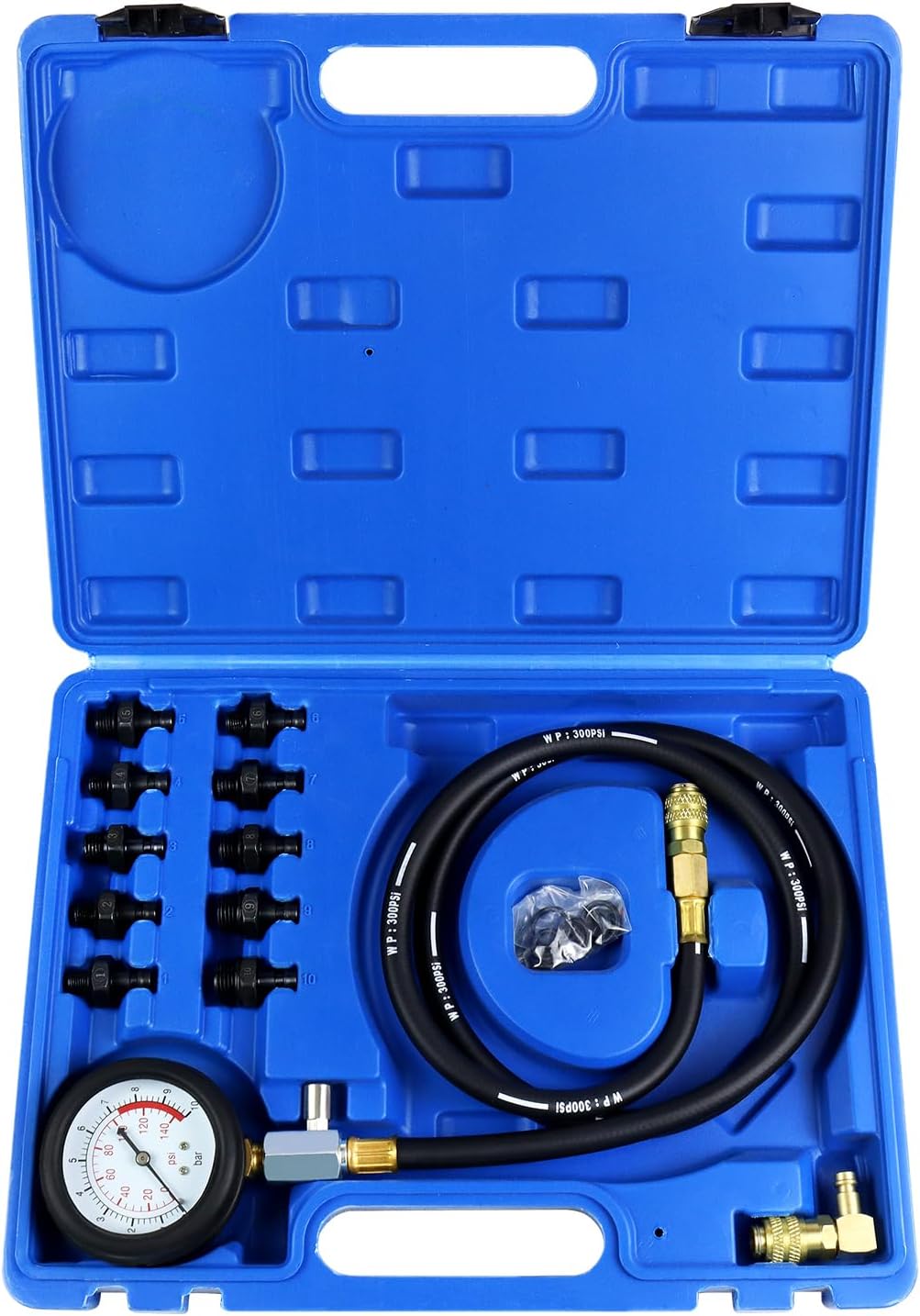
| Gauge range | 0-140 psi / 0-10 bar |
|---|---|
| Hose length | 4 ft |
| Hose max working pressure | 300 PSI |
| Adapters included | 10 stamped steel adapters |
| Gauge size | 3 inch dial |
The YSTOOL oil pressure tester kit provides a straightforward way to measure engine oil pressure and verify whether a dash gauge or sensor is functioning correctly. It is typically used by DIY mechanics to remove the oil pressure sensor or sender, install the tester with the correct adapter, start the engine, and read pressure on the 3-inch dual-scale gauge. Notable features include a large, metal-bodied gauge with a shockproof rubber cover, a 4-foot rubber nylon hose rated to 300 psi, brass quick couplers in straight and 90-degree configurations, and ten stamped steel adapters to fit a wide range of engines. The kit comes in a compact case that keeps adapters organized and ready for roadside or garage use. Limitations are that the gauge tops out at 140 psi so it cannot measure extremely high pressures and users must confirm adapter fit for specific engines before relying on it; the kit is sized for small gasoline and diesel engines rather than heavy industrial equipment. For hands-on troubleshooting and occasional testing, this kit gives clear readings and useful adapter coverage in a portable package.
Best for: Self-reliant DIY mechanics and home garage technicians who need a single, portable oil pressure testing kit that covers most small gasoline and diesel engines without buying extra adapters.
Less Ideal for: Professional heavy-duty shops or users who need measurements beyond 140 psi or vehicle-specific factory diagnostic tools should consider higher-capacity or model-specific testers.
- Large 3-inch dual-scale gauge for easy reading of psi and bar.
- Includes ten marked steel adapters to fit many engine test ports.
- 4-foot rubber nylon hose with 300 psi working pressure for flexible reach.
- Brass straight and 90-degree quick couplers for faster, positive sealing and easier connections.
- Maximum gauge range is 140 psi which may not cover very high-pressure applications.
- Adapter compatibility is broad but not universal so fit must be confirmed for some engines.
Verdict: An oil pressure test kit that includes a wide range of adapters, multiple hose lengths, and accessories so DIY mechanics can test pressure on many engine types without buying extras.
MEANLIN MEASURE 0–100 PSI Stainless Steel 2.5" Liquid-Filled Pressure Gauge (1/4" NPT, Lower Mount)
Best 0–100 PSI Oil Pressure Gauge

| Thread size | 1/4" NPT |
|---|---|
| Dial size | 2.5" |
| Pressure range | 0–100 Psi |
| Fillers | Glycerin |
This MEANLIN MEASURE liquid-filled pressure gauge is a simple mechanical instrument for monitoring system pressure up to 100 PSI. It is built around a 2.5 inch dial in a stainless steel case with a lower 1/4 inch NPT connection and comes with adapters and Teflon tape for installation. The glycerin fill damps needle vibration for steadier readings on pumps and running engines and helps protect the movement from shocks and pulsation common in DIY oil pressure checks. The brass thread joint and precision pointer support reliable repeatable readings and the specified accuracy range makes it useful for general troubleshooting and routine checks rather than precision laboratory measurement. Installation is straightforward for anyone comfortable with plumbing fittings, and the included adapters cover common hookup needs. Limitations include the analog display resolution compared with digital testers and a specified accuracy tolerance that may not match professional-grade gauges, so you should avoid it where very tight tolerances matter.
Best for: DIY mechanics and small-shop technicians who work on performance or diesel engines and need a robust, higher-range 0–100 PSI mechanical gauge with clear gradations for reliable pressure checks and troubleshooting.
Less Ideal for: Professionals or users who need high-precision, repeatable digital measurements for calibration or detailed diagnostics should choose a certified test instrument instead.
- Liquid-filled glycerin movement reduces needle flutter for stable readings under pulsating conditions
- Stainless steel case and brass thread joints resist corrosion for workshop use
- 2.5 inch dial offers easy-to-read analog display for quick checks
- Includes adapters and Teflon tape to fit common lower-mount setups
- Analog dial and stated accuracy are not as precise as many digital pressure testers
- Accuracy specification (+/-3-2-3%) is broad for diagnostics that require tight tolerances
Verdict: An oil pressure gauge with a 0–100 PSI scale designed for users who need higher-range readings and clear graduations for accurate measurement on performance or diesel engines.
How We Chose the Best Oil Pressure Test Gauge
We selected these oil pressure test gauge kits by focusing on what actually affects successful engine diagnostics in a home garage. First, we looked at gauge range and readability, since an oil pressure test gauge needs clear markings and a scale that makes normal, low, and high readings easy to interpret. We also prioritized adapter variety because thread compatibility is one of the biggest reasons a kit becomes unusable on certain engines. Hose quality and length mattered as well, especially for routing the gauge where it can be read safely during cranking or idle checks.We gave extra weight to connection security, including the quality of fittings, seals, and couplers, because oil leaks at the test point can create false impressions and unnecessary mess. Case organization and labeling also mattered, since mixed adapters are easy to lose or confuse. Finally, we considered overall build quality for repeated DIY use rather than one-time emergency testing.We excluded kits with unclear thread coverage, hard-to-read gauges, flimsy hoses, or poorly organized components that could slow down troubleshooting or increase the chance of leaks.
Our full evaluation process is outlined in our review methodology.
What an Oil Pressure Test Gauge Is Used For
An oil pressure test gauge lets you verify actual engine oil pressure directly at the source instead of relying only on the dash warning light or sender signal. That makes it especially useful when you are chasing symptoms like ticking valvetrain noise, a low-pressure warning, inconsistent dashboard readings, or concerns after an oil pump, filter housing, or sensor repair.
For DIY mechanics, this tool helps separate mechanical problems from electrical ones. If the gauge shows healthy pressure while the dashboard still warns of a fault, the issue may be the sender, wiring, or instrument cluster. If the reading is genuinely low, you can investigate the engine lubrication system with much more confidence.
- Useful for confirming low oil pressure complaints
- Helps diagnose faulty sending units or wiring
- Supports post-repair verification after engine service
- Provides a direct mechanical reading for troubleshooting
Key Features That Matter Most in a Kit
The most important part of any oil pressure gauge kit is compatibility. Many engines use different thread sizes and port styles, so a kit with a broad adapter selection is far more practical than one with only a few common fittings. Even if you work on one vehicle now, extra adapter coverage makes the tool more useful over time.
Gauge readability is another major factor. A dial with clear numbers, sensible spacing, and a pressure range that suits passenger vehicles and light trucks is easier to interpret than a crowded face. You should also look closely at hose quality, fitting construction, and whether the kit feels built for repeated use rather than occasional emergency checks.
- Wide adapter selection for different engine ports
- A readable pressure scale with clear markings
- Oil-resistant hose material and secure crimps
- Leak-resistant fittings and washers or seals
- Organized storage case for easy setup and cleanup
Choosing the Right Pressure Range and Dial Style
For most DIY mechanics, the best gauge range is one that covers normal automotive oil pressure without compressing the most useful part of the scale into a tiny section. If the maximum range is far higher than what you normally expect to see, small changes at idle or warm operating temperature can be harder to judge. A well-matched range gives you more readable detail where it counts.
Dial design matters too. Bold markings, a stable needle, and an easy-to-read face help you compare cold-start pressure, hot idle pressure, and higher-rpm readings without second-guessing the tool. If you often work in dim garages, strong contrast on the dial can make a bigger difference than you might expect.
- Choose a range suited to common automotive oil pressure values
- Prefer clear spacing over a crowded high-range dial
- Look for a face that is readable at a glance
- Make sure the gauge can be positioned safely during testing
Why Adapter Coverage Can Make or Break the Purchase
Adapter coverage is often the difference between a useful oil pressure test gauge kit and one that sits unused in a drawer. Oil pressure sender ports vary by engine family, manufacturer, and even model year, so a kit that looks complete at first glance may still miss the fitting you need most. A broader set of adapters reduces the odds of stopping mid-diagnosis because the connection cannot be made.
Good kits also make the adapters easier to identify and organize. Clearly separated fittings, marked sizes, and a case that keeps parts from mixing together save time during troubleshooting. For DIY mechanics who work on multiple vehicles or help friends and family, flexible thread coverage adds long-term value far beyond the first test.
- Check that the kit includes multiple common thread sizes
- Look for adapters stored in labeled positions when possible
- Avoid kits with loose, unlabeled fittings that are easy to mix up
How to Test Oil Pressure Safely and Get Useful Readings
Before installing the gauge, make sure the engine is cool enough to work around safely and locate the correct oil pressure sender or test port. Thread the proper adapter carefully by hand first to avoid cross-threading, then tighten only as needed to seal. Route the hose away from exhaust heat, belts, and rotating parts so the gauge can be observed without leaning into dangerous areas.
For the most useful results, compare readings at cold start, warm idle, and a moderate raised rpm once the engine reaches operating temperature. Those checkpoints tell you much more than a single snapshot. It also helps to verify the engine has the correct oil level and viscosity before testing, since those factors can influence pressure and lead to misleading conclusions.
- Confirm oil level before testing
- Use the correct adapter and start threads by hand
- Keep hoses away from hot and moving components
- Record readings cold, warm, and at raised rpm
Common Mistakes DIY Mechanics Should Avoid
One common mistake is assuming every low-pressure warning means internal engine wear. In many cases, the fault is a sender, switch, wiring issue, clogged screen, or another problem that a mechanical gauge can help uncover. Another frequent error is using the wrong adapter or over-tightening fittings, which can damage threads and create leaks that complicate the test.
It is also easy to misread the results if you do not test under comparable conditions. Cold oil can raise readings, while fully warmed oil gives a more realistic picture of normal operating pressure. If you are comparing readings to service information, make sure engine temperature, idle speed, and oil condition are all in the right range.
- Do not diagnose by warning light alone
- Do not force mismatched fittings into the port
- Do not judge pressure from cold readings only
- Do not ignore engine temperature and oil condition
When a Basic Kit Is Enough and when You Need More
A basic oil pressure test gauge kit can be enough if you only work on one or two common vehicles and need occasional confirmation of oil pressure. In that situation, a clear gauge, a reliable hose, and the correct adapter for your engine may be all you need. Simplicity can be an advantage if you want faster setup and less clutter.
A more complete kit makes sense if you work across different makes, maintain older vehicles, or troubleshoot engines regularly. Extra adapters, better labeling, a stronger case, and more durable connections become more valuable as your testing becomes more frequent. DIY mechanics who help others or maintain a mixed garage usually benefit from the added flexibility.
- Basic kits suit occasional single-vehicle use
- Expanded kits suit mixed garages and repeat diagnostics
- More adapters usually mean fewer setup surprises
FAQ
How do I know if an oil pressure test gauge will fit my engine?
Start by checking the thread size and port type used by your oil pressure sender or factory test location. Then compare that requirement to the adapter list included in the kit. A broad adapter selection improves your chances, but it is still worth confirming compatibility before you rely on a kit for diagnosis.
Is a mechanical oil pressure test gauge more accurate than the dashboard reading?
It is often more useful for diagnosis because it measures pressure directly at the engine rather than through the sender and vehicle electronics. That does not guarantee perfection, but it does remove several possible failure points from the system. When the dash reading seems suspicious, a direct mechanical test is usually the best next step.
What pressure range should a DIY mechanic look for?
Choose a range that comfortably covers normal automotive oil pressure while still giving readable detail in the lower and middle part of the scale. If the maximum range is excessively high, small differences can be harder to interpret. Clear markings are usually more important than chasing the highest number on the dial.
Can I leave the test gauge installed while driving?
That is generally not the best approach for most DIY users unless the setup is specifically intended and secured for that kind of testing. Temporary diagnostic kits are usually meant for controlled checks at idle or stationary raised rpm. Hoses and fittings should be kept away from heat and moving parts, and any road testing should be approached with caution.
What can cause low oil pressure besides a bad oil pump?
Low oil pressure can result from low oil level, the wrong oil viscosity, a worn engine, a clogged pickup screen, internal bearing wear, or a restriction or leak in the lubrication system. It can also appear to be low if the sender or wiring is faulty. That is why a direct mechanical reading is so helpful before deeper repairs begin.
Do I need a large adapter set if I only work on my own car?
Not always. If you know the exact fitting your vehicle needs, a smaller kit may be enough for occasional use. However, even for one vehicle, a few extra adapters can be useful if the engine port changes by trim, model year, or repair history.
Final Verdict
The best oil pressure test gauge for DIY mechanics is the one that gives you a clear reading, fits your engine correctly, and holds up to repeated troubleshooting without leaks or confusion. Adapter coverage, gauge readability, hose quality, and secure fittings matter far more than flashy extras when you are trying to make a reliable diagnosis.If you only need occasional confirmation on one vehicle, keep it simple and focus on fit and readability. If you maintain several vehicles or do frequent garage diagnostics, prioritize a more complete kit with better adapter support and organization. Choose based on the engines you actually service, and you can test oil pressure with far more confidence and far less guesswork.
