

Note: This article contains affiliate links. If you click on these links and make a purchase, I may earn a small commission at no extra cost to you. This helps support my research and content. Read my full affiliate disclosure here.
An engine hoist can turn a difficult engine pull into a manageable garage job, but only if it fits your space, your vehicle, and the weight of the parts you plan to lift. DIY mechanics need more than a headline capacity rating. Real-world performance depends on boom position, leg clearance, caster movement, and how stable the hoist feels when the load is moving.In the picks that follow, you will see options suited to different garage setups and project types. Before you choose, it helps to understand the key trade-offs between lifting range, storage footprint, adjustability, and overall ease of use.
Top Picks at a Glance
| Best Overall Engine Hoist for DIY Mechanics Reliable, versatile hoist balancing capacity, durability, and easy garage use | Goplus 2 Ton Folding Hydraulic Engine Hoist (4400 lb Closed Boom) |  |
| Best Budget Engine Hoist for DIY Mechanics Affordable, safe lifting solution with essential features for occasional DIY jobs | GDIFLS 2-Ton Folding Engine Hoist Crane with Foldable Base and 6" Casters |  |
| Best Heavy-Duty Engine Hoist Reinforced, higher-tonnage hoist built for frequent use and larger engines | Generic 7000 lb Folding Hydraulic Engine Hoist with Leveler |  |
| Best Compact Engine Hoist Space-saving design that folds or breaks down for tight garage storage | LTIGOAW 2T Foldable Hydraulic Engine Hoist (Cherry Picker) |  |
| Best Folding/Portable Engine Hoist Lightweight, collapsible hoist made for easy transport and on-site use | EliteEdge 2-Ton Folding Hydraulic Engine Hoist |  |
| Best High-Capacity Engine Hoist High-rated lifting capacity with extended reach for very heavy assemblies | BSMTEK 3-Ton Portable Gantry Crane with Adjustable Height |  |
| Best Premium Engine Hoist Top-quality construction with smooth hydraulics and precise, long-lasting performance | OTC 2004 4,000 lb Folding Engine Hoist |  |
Goplus 2 Ton Folding Hydraulic Engine Hoist (4400 lb Closed Boom)
Best Overall Engine Hoist for DIY Mechanics

| Material Type | Alloy Steel, Iron |
|---|---|
| Compatible with Vehicle Type | Car, Truck, Sport Utility Vehicle |
| Load Capacity | 2 tons (4,000 lb closed boom) |
This Goplus engine hoist is a shop-grade folding crane intended for lifting and moving engines, transmissions, axles and other heavy components in a garage or workshop. It uses a hydraulic ram and a telescopic boom with four positions so you can choose a higher reach or higher capacity; the manufacturer lists a 4,000 lb closed-boom capacity and a lower capacity when the boom is extended. The steel frame and powder-coated finish give it a durable feel, and the six 360 degree swivel casters make positioning and rolling an engine clearer and easier than single-caster designs. Folding legs let the hoist collapse for storage when not in use. Expect straightforward assembly and everyday use for repairs and part swapping, but be mindful that the heaviest capacities apply only with the boom retracted and that the unit is heavy to move by hand when unladen. This is a practical, space-saving lifting tool for hands-on mechanics who need a robust, low-profile shop crane without professional shop installation.
Best for: Home mechanics and weekend DIYers who need a sturdy, versatile engine hoist for occasional engine and drivetrain work and who prioritize a high lifting capacity, foldable storage, and easy maneuverability in a typical garage setting.
Less Ideal for: Users who need very high lift heights at full rated capacity or who require a permanently installed, commercial shop crane should look at heavier-duty shop systems or professional lift solutions.
- Steel construction with corrosion-resistant finish for durability in a garage environment
- Telescopic boom with multiple positions for flexible reach and capacity control
- Six 360 degree swivel casters for improved maneuverability and easy positioning
- Folding design reduces storage footprint when not in use
- Rated capacities differ between closed and extended boom positions which limits maximum lift height at full capacity
- At 150 lb product weight the unit is bulky to assemble and reposition without assistance
Verdict: The best all-around engine hoist for DIY mechanics that balances lifting capacity, build quality, ease of assembly, and value for typical home-garage engine work.
GDIFLS 2-Ton Folding Engine Hoist Crane with Foldable Base and 6" Casters
Best Budget Engine Hoist for DIY Mechanics

| Load Capacity | 4409 Pounds |
|---|---|
| Compatible with Vehicle Type | Lawn Mover |
| Material Type | Q235 Carbon Steel |
This folding engine hoist is a budget-friendly hydraulic crane intended for DIY engine and transmission work in home garages, small farms, and workshop settings. It lifts up to 4,409 pounds using a three-stage hydraulic pump and an extendable boom that reaches high enough for most engine swaps and heavy component moves. The hoist collapses for compact storage, mounts on six casters for easy positioning, and includes multiple height settings plus an automatic lock valve to reduce the chance of sudden drops. Practical benefits include a detachable tray for tools, non-marring pads to protect frames, and welded construction in Q235 carbon steel for durability. Expect assembly effort and a bulky footprint when set up, and the fold-and-roll convenience relies on reasonably flat floors; rough terrain will reduce mobility. The advertised testing numbers are strong, but this remains a consumer-grade unit so professional shops that require daily heavy lifting should consider full shop-grade gear instead.
Best for: DIY mechanics and hobbyist garage owners who need an affordable, no-frills engine hoist for occasional engine, transmission, or equipment lifts and value a compact foldable design for easy storage.
Less Ideal for: Professional shops or high-volume commercial users who need continuous daily lifting reliability and faster cycle times should choose a commercial shop hoist instead.
- High rated 4,409 lb load capacity suitable for most passenger engines and transmissions
- Foldable design saves garage space and enables wall storage when not in use
- Six casters including locking wheels make positioning and stabilizing the hoist straightforward
- Three-pump hydraulic system and automatic lock valve provide strong lift power and added safety
- Large assembled footprint and significant mass make initial setup and moving the folded unit two-person tasks at times
- Mobility and caster performance are best on smooth, level floors rather than gravel or very uneven surfaces
Verdict: The best low-cost engine hoist that provides safe, adequate lifting capacity and reliable basic features for occasional engine removal without a large upfront expense.
Generic 7000 lb Folding Hydraulic Engine Hoist with Leveler
Best Heavy-Duty Engine Hoist

| Rated lift capacity | 7000 lbs (3 tons) |
|---|---|
| Leveler capacity | 2500 lbs |
| Boom positions | 4 adjustable positions |
| Hydraulic pump | 9-ton pump |
This folding hydraulic engine hoist is built for heavy lifting in home and small commercial garages. It uses a 9-ton hydraulic pump and a heavy alloy steel frame to lift engines up to about 7,000 pounds, while a four-position telescoping boom lets you select lower capacities for longer reach or lighter loads. The integrated 2,500 lb leveler gives precise tilt control when lowering engines into mounts, which is useful for alignment during engine swaps or rebuilds. Six 360 degree swivel casters improve maneuverability across shop floors and the base telescopic outriggers and streamlined footprint help with stability. The hoist folds down for compact storage when not in use, making it practical for DIY mechanics with limited space. Expect assembly and occasional hydraulic maintenance, and be mindful that the listed max lift height and boom travel affect reach and clearance in tight engine bays. This tool is effective for home pros who need high capacity and accurate leveling but adds complexity compared with simpler, lower-capacity stands.
Best for: Professional mechanics and serious DIYers who need a commercial‑grade, high-capacity hoist for lifting larger engines or frequent shop use, and who value a reinforced, space‑saving folding design with adjustable boom positions for versatile heavy lifts.
Less Ideal for: Users who only perform occasional light-duty tasks or who need an ultra-compact, tool-free lift should consider simpler, lower-capacity alternatives or engine stands instead.
- High rated capacity up to 7,000 lb suitable for large engines and heavy components
- Integrated 2,500 lb leveler for controlled tilting and alignment during installs
- Four-position telescoping boom for selectable reach and capacity
- Six 360 degree swivel casters for easy positioning and shop mobility
- Foldable frame for compact storage in small garages
- Likely requires significant assembly and periodic hydraulic maintenance
- Large folded and deployed footprint may still challenge very tight workspaces
- No manufacturer warranty or service details provided in product information
Verdict: A heavy-duty engine hoist with higher tonnage, reinforced construction, and commercial-grade components for lifting larger engines or repeated professional-level use.
LTIGOAW 2T Foldable Hydraulic Engine Hoist (Cherry Picker)
Best Compact Engine Hoist

| Power Source | Hydraulic Powered |
|---|---|
| Load Capacity | 0.5T/1T/1.5T/2T (up to 4409lbs) |
| Lifting Height Range | 0-2.1m/0-6.89ft |
| Material | Carbon Steel, Iron, Alloy Steel |
This LTIGOAW foldable engine hoist is a hydraulic cherry picker built to lift engines and heavy components in home garages and small shops. It uses a hydraulic ram for smooth, controlled lifting and offers selectable load capacities up to 2 tons, making it suitable for four-cylinder and many V6 engines when used within capacity. The frame is constructed from carbon steel with argon arc welding and a sprayed plastic finish for corrosion resistance. Its folding design reduces storage footprint and the package includes assembly accessories and a manual, so you can set it up and tuck it away between jobs. Practical touches include swivel casters for positioning and an adjustable lifting range to help align loads precisely. Limitations are the maximum 2.1 m lift height which may be overkill or unnecessary depending on your workspace ceiling, and the hoist’s total weight means it still requires some effort to move and assemble; heavier engines close to the 2-ton limit demand careful rigging and safe working practices. This is a solid, value-oriented option for DIY mechanics who need a reliable, space-saving engine hoist.
Best for: Home mechanics and hobbyist DIYers working in small garages who need a foldable, easy-to-store engine hoist that still handles routine engine removal and light-duty lifts with stable hydraulic control.
Less Ideal for: Shops that need very frequent heavy lifts, mobile technicians who require ultra-light portable gear, or anyone needing lifts above 2 tons or specialized commercial equipment.
- Hydraulic lifting provides smooth, controlled raises for accurate positioning.
- Foldable frame reduces storage footprint when not in use.
- Multiple load settings up to 2 tons cover a wide range of small-to-mid engines.
- Carbon steel construction with welded joints and sprayed finish resists corrosion and wear.
- Still relatively heavy to move and requires assembly before first use.
- 2.1 m maximum lift height may not be necessary in low-ceiling garages.
Verdict: A compact, space-saving engine hoist that folds or breaks down for easy storage in small garages while still offering sufficient capacity for common DIY jobs.
EliteEdge 2-Ton Folding Hydraulic Engine Hoist
Best Folding/Portable Engine Hoist
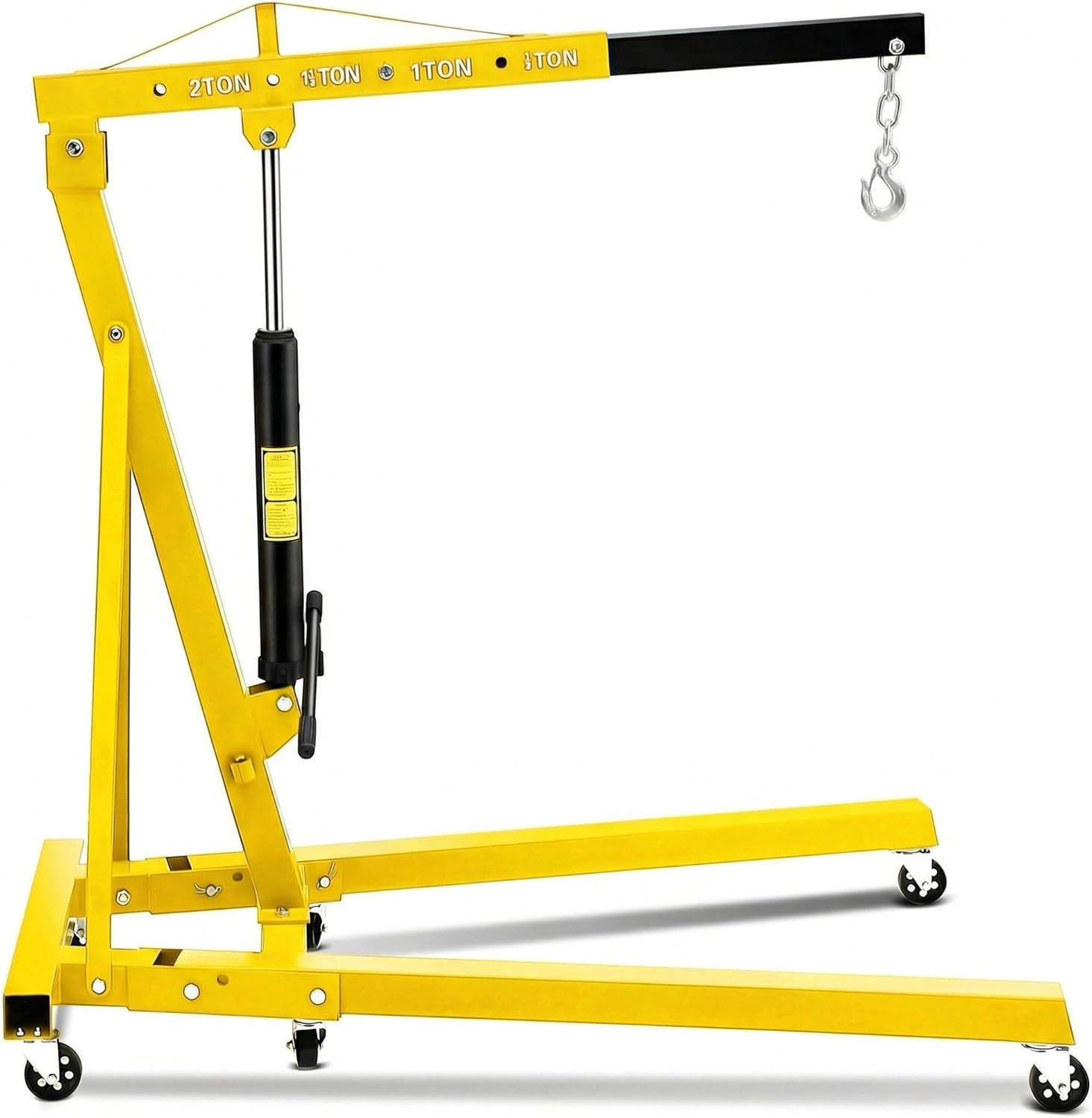
| Capacity | 2 ton / 4,400 lb |
|---|---|
| Boom positions | 4 adjustable positions |
| Casters | 6 swivel casters (4 rear rotating, 2 fixed front) |
The EliteEdge 2-Ton Folding Hydraulic Engine Hoist is a portable shop crane designed to lift engines, transmissions, and other heavy components in home garages and light commercial shops. It uses a hydraulic cylinder for controlled, quiet lifting and a telescopic boom with four preset positions that let you balance reach and capacity from light lifts up to the full 2-ton rating. Six 360 degree swivel casters (four rear rotating and two front fixed) make it easy to roll and position the hoist around a workspace, while the foldable frame reduces storage footprint and eases transport between job sites. Practical benefits include smoother lifting with less operator effort, adjustable reach for different engines, and compact storage when not in use. Limitations to note are the implied assembly requirement and the usual caution that maximum capacity applies only at the shortest boom setting; like most portable hoists it is not a replacement for larger shop cranes when repeated heavy-duty industrial use is required.
Best for: Mobile or space-conscious mechanics who need a sturdy, foldable hoist that can be rolled between job sites and stored in tight garages, ideal for DIY engine and transmission removal where portability and compact storage matter.
Less Ideal for: Users who need an all-day industrial crane for high-volume shop use or those who require a permanent, heavy-capacity lifting installation should consider heavier duty shop cranes instead.
- Rated 2-ton (4,400 lb) capacity for heavy components
- Hydraulic cylinder provides smooth, controlled lifting with reduced effort
- Six swivel casters offer excellent maneuverability in tight workshop spaces
- Foldable design saves storage space and simplifies transport
- Four adjustable boom positions for flexible reach and lifting scenarios
- Capacity varies by boom position so maximum load requires the shortest reach
- May require time-consuming assembly and occasional hydraulic maintenance
- Not intended as a continuous-use industrial crane for high-volume commercial shops
Verdict: A portable, foldable engine hoist designed for mechanics who need to move or transport the hoist between workspaces or store it in tight areas.
BSMTEK 3-Ton Portable Gantry Crane with Adjustable Height
Best High-Capacity Engine Hoist

| Capacity | 6600 lb |
|---|---|
| Height range | 8.53–12.47 ft |
| Beam material | Steel I-beam |
| Portability | Removable legs with wheels |
This BSMTEK gantry crane is a heavy-duty portable lifting solution designed to move engines, transmissions, and other large components up to 6,600 pounds. It assembles from removable legs and wheeled bases so you can roll it around a shop or break it down for transport to a job site. The adjustable height (8.53 to 12.47 feet) lets you position the hoist for engine removal or overhead work while the steel I-beam and triangular base deliver the stability needed when handling heavy loads. Anti-corrosion paint and high-strength fasteners improve durability in workshop environments. The included manual trolley and wide fixed span give adequate clearance for most automotive engines, but the crane is large and requires floor space and at least two people for safe assembly and operation. Expect some on-site assembly time and plan for secure anchoring or outriggers if you use it on uneven surfaces. For DIY mechanics who regularly lift heavy powertrains, it replaces renting shop time; for occasional light jobs it may be more than needed.
Best for: Experienced DIY mechanics and small-shop technicians who need a mobile, heavy-duty hoist capable of lifting larger V8 engines and long-block assemblies and value a stable, portable rig for repeated heavy lifts.
Less Ideal for: Casual hobbyists with occasional light lifts or users constrained by small garage footprints should consider smaller, easier-to-store hoists instead.
- 6600 lb (3 ton) rated capacity suitable for heavy engines and transmissions
- Adjustable height range (8.53–12.47 ft) adapts to different lift clearances
- Steel I-beam construction and triangular base for improved stability under load
- Removable legs and wheels make the crane portable and reconfigurable for shop or site use
- Fixed width limits placement options and may not fit very tight bays
- Large size and assembly complexity require multiple people to install and move safely
Verdict: An engine hoist with a higher-rated lifting capacity and extended reach for handling large V8s, long-block assemblies, or heavier drivetrain components.
OTC 2004 4,000 lb Folding Engine Hoist
Best Premium Engine Hoist

| Maximum capacity (retracted) | 4,000 lb |
|---|---|
| Maximum capacity (extended) | 1,000 lb |
| Maximum reach (extended) | 46 inch |
| Maximum reach (retracted) | 25 inch |
The OTC 2004 is a folding engine hoist designed for workshop engine removal and light-duty lifting tasks. It provides a 4,000 lb rating with the boom retracted and a 1,000 lb rating at full extension, letting you move heavy loads at shorter reach and lighter loads farther out. The crane rolls on large front wheels and swivel casters so you can position it precisely under an engine or move it around the shop. Its fold-flat design saves floor space when not in use and makes storage simpler in a home garage. Practical benefits include durable construction aimed at regular shop use and clear capacity differences by boom position so you can match lift needs safely. Important limitations are the steep drop in capacity when the boom is extended and the fact that reach and capacity require attention during setup, which means DIYers should check capacity charts before lifting and secure loads carefully.
Best for: Experienced DIY mechanics and small-shop professionals who need a heavy-duty, reliable engine hoist for frequent use and prioritize durable construction, smooth hydraulic operation, and precise control over occasional lighter-weight, budget options.
Less Ideal for: Professional shops or users who need full rated capacity at long reach or continuous heavy lifting should choose a higher-capacity shop crane designed for industrial cycles.
- High maximum lifting capacity at short boom position for heavy engine pulls
- Folding design reduces storage footprint in a home garage
- Large front wheels and swivel casters make positioning and mobility easy
- Clear multi-position boom gives flexibility between reach and capacity
- Capacity drops significantly at full boom extension limiting heavy lifts at long reach
- Not intended for continuous industrial duty cycles despite robust construction
Verdict: A premium engine hoist that prioritizes superior materials, smoother hydraulic operation, precise controls, and long-term durability for frequent, demanding garage use.
How We Chose the Best Engine Hoist
We focused on the factors that matter most when an engine hoist is used in a home garage rather than a dedicated commercial shop. First, we looked at rated lifting capacity across boom positions, since many hoists lose usable capacity as the boom extends. We also considered boom reach and lifting height because engine bay access, truck front-end clearance, and the ability to raise a load high enough for safe removal are critical in real use.Next, we evaluated frame design, including leg spacing, under-vehicle access, and overall stability while rolling a suspended load. Mobility mattered too, especially caster layout and how manageable the hoist is on typical garage floors. For DIY users, storage is a major issue, so folding design and parked footprint were part of the filter. We also weighed build quality details such as weld consistency, ram operation, chain and hook hardware, and ease of assembly. We excluded poorly documented hoists, designs with unclear load charts, and models that appeared oversized or impractical for most home garages.
Our full evaluation process is outlined in our review methodology.
What Capacity Do You Actually Need
Capacity is the first spec most buyers notice, but it is also one of the easiest to misread. An engine hoist may advertise a high maximum rating, yet the effective capacity can drop as the boom extends to reach deeper into an engine bay. For a DIY mechanic, that means you should choose based on the heaviest load you expect to lift at the boom length you are likely to use, not the largest number on the label.
If you work on compact cars and smaller four-cylinder engines, your needs are different from someone pulling cast-iron V8s, diesel components, or complete powertrain assemblies. Leave a sensible safety margin so the hoist is not operating near its limit. A higher-capacity unit can add confidence, but it also tends to be larger and harder to store, so balance capability with the realities of your workspace.
- Check capacity at each boom position, not just the maximum headline rating
- Consider the weight of attached accessories such as manifolds or transmissions if lifting as an assembly
- Leave extra headroom instead of planning around the bare minimum rating
Why Boom Reach and Lift Height Matter
A hoist that cannot reach far enough over the front of the vehicle can turn a simple removal into a frustrating struggle. Boom reach affects whether you can access engines in vehicles with long front clips, deep bays, or limited approach space. Lift height matters just as much because the load often needs to clear the radiator support, core support area, or the angle created by the transmission still attached.
These two specs work together. A long reach helps placement, but the farther out the boom extends, the more capacity may fall and the more carefully you need to watch stability. For many home mechanics, the best choice is not the tallest or longest hoist on paper. It is the one that can comfortably clear the vehicles you actually service while staying stable and easy to control.
- Measure garage ceiling height before buying
- Think about whether you remove engines alone or with a load leveler
- Verify that the boom can reach your engine bay without forcing awkward vehicle positioning
Folding Vs Fixed Frame Design
A folding engine hoist is often the best fit for a home garage because storage becomes part of the buying decision. When the job is done, a foldable frame can free up valuable floor space for parking, tool carts, or another project. That convenience is a major advantage for occasional users who do not want a large piece of equipment parked in the way year-round.
A fixed frame design can feel more straightforward and may suit frequent use, but it demands dedicated space. Folding models are ideal when storage is tight, though they still need enough room to open fully and roll safely. If your garage is narrow, pay attention to how the legs swing, how much space the hoist needs when folded, and whether the design is manageable for one person to set up and put away.
- Choose folding if floor space is limited
- Choose fixed if the hoist will stay in service often and space is not a concern
- Check stored dimensions as carefully as working dimensions
Stability and Mobility in a Home Garage
DIY mechanics often work on imperfect surfaces, cramped bays, and spaces shared with other tools and vehicles. That makes stability and mobility more important than many buyers expect. A hoist should roll predictably, track straight, and avoid feeling tippy when the load is suspended. Wide, well-supported legs and a sensible caster layout help keep movement controlled.
Caster quality also affects the experience more than raw numbers suggest. A hoist can be strong on paper but frustrating if it binds on expansion joints, catches on rough concrete, or requires too much force to reposition. In a small garage, controlled movement is a safety feature. The less wrestling required, the easier it is to guide an engine smoothly and keep the load aligned during removal or installation.
- Wider stance generally improves confidence under load
- Good caster movement matters on typical garage concrete
- Stable rolling behavior is especially important when working alone
Features That Improve Real-world Usability
Small design details can make a big difference when you are halfway through an engine pull. A clear load chart, easy-to-pin boom adjustments, smooth hydraulic action, and accessible release control all contribute to a safer, less stressful job. Chain and hook hardware should feel appropriately sized for the hoist rating, and the lifting point should allow secure attachment without awkward angles.
Assembly and setup matter too, especially for first-time buyers. Clear instructions, sensible hardware organization, and a design that does not require constant adjustment can save time before the real work even starts. For occasional users, the best engine hoist is often the one that feels straightforward to deploy, stable to operate, and easy to store when the project is finished.
- Look for readable boom-position markings
- Smooth ram operation helps with precise lifting and lowering
- Simple setup is valuable for garage users who do not use a hoist every week
Safe Setup and Planning Before the Lift
Even the right engine hoist can perform poorly if the setup is rushed. Start by confirming the load weight, attachment points, and intended removal path. Clear the area around the vehicle so the hoist can approach straight and roll without interruption. If you are working in a crowded garage, pre-plan where the load will go once it is out of the bay.
Use the hoist on a solid, level surface whenever possible and watch for pinch points as the load shifts. Keep movements slow and controlled, especially when changing height or rolling with weight suspended. If the engine needs to tilt during removal, plan for that before you start. A little preparation goes a long way toward reducing strain, protecting parts, and keeping the job predictable.
- Confirm the load path before lifting
- Keep the floor clear of obstacles and loose tools
- Move slowly and reassess if the load begins to swing or bind
FAQ
What size engine hoist is best for a home garage?
For many DIY mechanics, the right size depends on the heaviest engine or assembly they plan to remove and how far the boom must extend to reach it. A hoist with enough reserve capacity at working boom positions is usually a smarter choice than one chosen by maximum rating alone. Also make sure the frame fits your garage and can be stored without becoming a constant obstacle.
Is a folding engine hoist strong enough for most DIY jobs?
Yes, a folding design is often strong enough for typical home garage engine work when it is properly rated for the intended load. The important part is checking capacity at each boom position and not assuming the folded design makes it lighter duty. Many DIY users prefer folding models because storage is such a major practical concern.
Do I need a load leveler with an engine hoist?
Not always, but it can be very helpful when the engine and transmission need to come out at an angle or when space around the engine bay is tight. A leveler gives you more control over tilt during removal and installation. If you often work alone or deal with awkward engine bay geometry, it can make the process smoother.
Can I roll an engine hoist with the engine suspended?
It is sometimes necessary, but it should be done carefully and only over a suitable surface. Movement should be slow, controlled, and limited to what is needed to complete the job safely. Rough concrete, slopes, debris, and sudden direction changes can all increase risk, so plan the path before lifting.
How much garage space do I need for an engine hoist?
You need room for both storage and operation. Beyond the hoist's parked footprint, consider the space required to open the legs fully, position the boom over the vehicle, and move the load clear of the engine bay. Ceiling height also matters if the engine must be lifted high to clear the front structure.
What is the biggest mistake buyers make when choosing an engine hoist?
A common mistake is focusing only on maximum lifting capacity while ignoring boom reach, height, leg clearance, and storage needs. Another is buying a hoist that technically works on paper but is awkward in a tight home garage. The best choice is the one that matches your vehicles, your workflow, and your available space.
Final Verdict
The right engine hoist is the one that gives you enough real working capacity, enough reach for your vehicles, and a frame you can safely use and store in your garage. Bigger is not always better if it becomes harder to position, move, or tuck away between projects.Focus on the combination of boom-position capacity, lift height, stability, mobility, and storage footprint. If you choose around those trade-offs instead of chasing the biggest rating, you will end up with an engine hoist that fits your garage and helps you work with more confidence.
