

Note: This article contains affiliate links. If you click on these links and make a purchase, I may earn a small commission at no extra cost to you. This helps support my research and content. Read my full affiliate disclosure here.
A good UV leak detection kit can save a DIY mechanic a lot of time when chasing down slow, messy, or hard-to-see leaks. Instead of guessing where refrigerant, oil, coolant, or other system fluids are escaping, you can add the proper dye, inspect with UV light, and narrow the problem to the actual source.The right kit is not just about having a flashlight. Dye compatibility, injector style, light strength, glasses, and overall ease of use all affect how quickly you can get a reliable answer. The picks that follow are meant to help you compare the most practical options for garage use, whether you are tracking AC leaks or general automotive fluid leaks.
Top Picks at a Glance
| Best Overall UV Leak Detection Kit for DIY Mechanics Balanced, user-friendly kit suitable for most DIY leak detection needs | Mastercool 53351 Professional UV Leak Detection Kit |  |
| Best Budget UV Leak Detection Kit for DIY Mechanics Affordable basic kit with essential dye and lamp for occasional checks | COSOOS 21-LED UV Leak Detector Kit with Protective Glasses and Carry Bag |  |
| Best Compact UV Leak Detection Kit Pocket-sized kit with minimal components for portability and easy storage | DARKDAWN 395nm USB-C Rechargeable Mini UV Flashlight |  |
| Best Comprehensive UV Leak Detection Kit Extensive kit including multiple lamps, dyes, and diagnostic accessories | ISN Complete A/C UV Leak Detection Kit |  |
| Best Professional‑Grade UV Leak Detection Kit Rugged, high-performance kit built for frequent professional workshop use | Robinair 16235 UV Leak Detection Kit with Injection Gun and Fluorescent Light |  |
| Best Rechargeable UV Leak Detection Kit Includes rechargeable lamps and power solutions for extended fieldwork | Mastercool 53451-110 Rechargeable UV Leak Detection Kit |  |
| Best High‑Sensitivity UV Leak Detection Kit High-output lamps and concentrated dyes to detect the smallest leaks | Aprvtio WJL-6000PRO Refrigerant Leak Detector with UV & LED Light |  |
Mastercool 53351 Professional UV Leak Detection Kit
Best Overall UV Leak Detection Kit for DIY Mechanics

| Light | 12V / 50W high-intensity mini UV light |
|---|---|
| Dye cartridge | 1 oz universal oil dye (10 applications) |
| Compatibility | R134a coupler with R12 adapter |
| Includes | UV glasses, dye remover, service labels, molded carry case |
The Mastercool 53351 is a ready-to-use UV leak detection kit aimed at automotive and HVAC tasks, combining a 12V/50W high-intensity mini UV light with multiple fluorescent dyes and a refillable injector. Technicians and DIYers use the kit by adding the dye to the suspect system, then scanning with the UV lamp while wearing the included UV-enhancing safety glasses to spot bright leak traces. Notable inclusions are a universal oil dye cartridge compatible with R134a and an R12 adapter, a separate coolant dye, a 4 oz dye remover for cleanup, and service labels for recordkeeping, all packed in a molded carry case for field work. The powerful compact lamp and refillable injector make it efficient for repeated service visits or garage diagnostics. Limitations are that the lamp is 12V and becomes hot during use so care and eye protection are required, and dye-based methods can require system access and time to circulate dye before small leaks become visible.
Best for: Home mechanics and DIY hobbyists who need a single, easy-to-use kit to find A/C, coolant, oil, fuel, and ATF leaks without professional gear, prioritizing straightforward setup, portability, and the included dyes and UV lamp for typical vehicle repairs.
Less Ideal for: Users who need instantaneous electronic leak sniffing without adding dye or those who will not perform the system access and dye flushing steps required for dye-based detection.
- Includes high-intensity 12V/50W UV lamp for clear visualization of fluorescent dye traces
- Comes with both universal oil dye cartridge and a dedicated engine coolant dye for multiple system types
- Refillable injector with R134a coupler and R12 adapter supports common automotive refrigerant systems
- Includes practical accessories: UV safety glasses, dye remover, service labels, and a durable molded carry case
- UV lamp runs hot and must be used with caution and eye protection
- Requires adding dye and allowing circulation, so very small or intermittent leaks may need multiple passes to detect
Verdict: The all‑around kit that balances sensitivity, ease of use, included dyes and lamps, and value to reliably find leaks in typical home automotive repairs.
COSOOS 21-LED UV Leak Detector Kit with Protective Glasses and Carry Bag
Best Budget UV Leak Detection Kit for DIY Mechanics

| Manufacturer | COSOOS |
|---|---|
| Model | Oil AC UV Dye Leak Test Detection |
| LED quantity | 21 |
| Power source | 3xAA batteries (not included) |
The COSOOS 21-LED UV leak detector is a pocket-size flashlight meant for DIY mechanics to spot dye-marked refrigerant and oil leaks on vehicle air conditioning and other systems. It runs on three AA batteries (not included) and produces focused UV light that makes most fluorescent leak dyes glow for quick visual tracing in engine bays, undercarriage areas, and around AC fittings. The kit includes yellow-tinted protective glasses to improve contrast and reduce glare plus a small carrying pouch for storage. Its compact aluminum body makes it easy to carry and use in tight spaces while the 21 high-intensity LEDs provide brighter illumination than many basic UV pens. Limitations are that it relies entirely on dye being present to show leaks so it will not detect non-dyed losses, and battery operation means run time varies by cell quality. Also it is a point-inspection tool rather than a replacement for professional electronic leak detection on complex HVAC jobs. For hobbyists and routine vehicle checks it is a practical, affordable way to find visible dye leaks quickly.
Best for: DIYers and budget-conscious home mechanics who need an affordable, portable UV flashlight kit to spot A/C and oil leaks occasionally and prefer a simple, no-frills toolset that includes protective glasses and a storage pouch.
Less Ideal for: Professional HVAC technicians or anyone needing detection of undyed leaks, extended runtime, or electronic refrigerant sensing should consider professional-grade detectors instead.
- Compact, lightweight aluminum body is easy to carry and use in tight engine-bay spaces.
- 21 high-intensity LEDs produce strong UV illumination for clear dye fluorescence.
- Includes protective yellow-tint glasses to improve visibility and reduce eye strain.
- Comes with a small carry pouch for neat storage and transport.
- Requires UV dye to reveal leaks so it cannot find undyed leaks.
- Powered by three AA batteries which limits continuous runtime and may need frequent replacement.
Verdict: An inexpensive kit that provides adequate UV dye, a basic UV lamp, and essential accessories for occasional leak hunting without unnecessary extras.
DARKDAWN 395nm USB-C Rechargeable Mini UV Flashlight
Best Compact UV Leak Detection Kit

| Wavelength | 395nm |
|---|---|
| Power | 10 watts |
| Battery Life | 3-6 hour |
| Charging | USB-C, 4 hour charge |
| Light Path Distance | 30 Feet |
The DARKDAWN 395nm mini UV flashlight is a pocketable tool designed to reveal fluorescent leaks, pet urine, scorpions, counterfeit marks, and to assist light-cured resin work. It runs from an internal lithium-ion battery charged by a Type-C port, provides a focused beam that can be zoomed in or out, and claims a useful runtime of three to six hours depending on use. The aluminum housing and waterproof rating make it rugged enough for garage and outdoor work, and the included pocket clip keeps it accessible during inspections. Practical features include a power indicator that warns when charging is needed and a reported 30 foot light path for scanning under vehicles or around engine bays. Limitations are that the 395nm wavelength favors dried organic stains and some fluorescent materials but is less effective on highly reflective surfaces or certain dark carpets, and it will not perform like higher-intensity 365nm inspection lamps used in professional leak detection. For DIY mechanics it is a convenient, portable first step for finding visible traces without bulky equipment, but it is not a substitute for specialist, higher-power UV inspection gear when maximum sensitivity is required.
Best for: A mechanic or DIYer who needs a pocketable, easy-to-store UV lamp for quick leak and stain detection on the go and values portability and simple operation over a full multi-piece kit.
Less Ideal for: Professionals who need maximum sensitivity for invisible refrigerant leaks or forensic-level fluorescence detection should choose higher-power, 365nm inspection lamps and dedicated leak kits.
- Compact, pocketable aluminum body with pocket clip for hands-free carry
- USB-C rechargeable lithium-ion battery eliminates frequent cell replacement
- Adjustable focus/zoom lets you widen the beam for area scans or narrow it for pinpointing stains
- Waterproof construction suitable for outdoor and garage use
- Multi-function 395nm wavelength works for pet urine, resin curing, scorpion and fluorescent item detection
- 395nm wavelength is less sensitive than 365nm professional UV lamps for detecting faint leaks or certain fluorescents
- Not ideal on reflective surfaces or some dark-colored carpets where contrast is low
Verdict: A small, space-saving kit with fewer components and a pocket-sized UV lamp for mechanics who need portability and minimal storage footprint.
ISN Complete A/C UV Leak Detection Kit
Best Comprehensive UV Leak Detection Kit
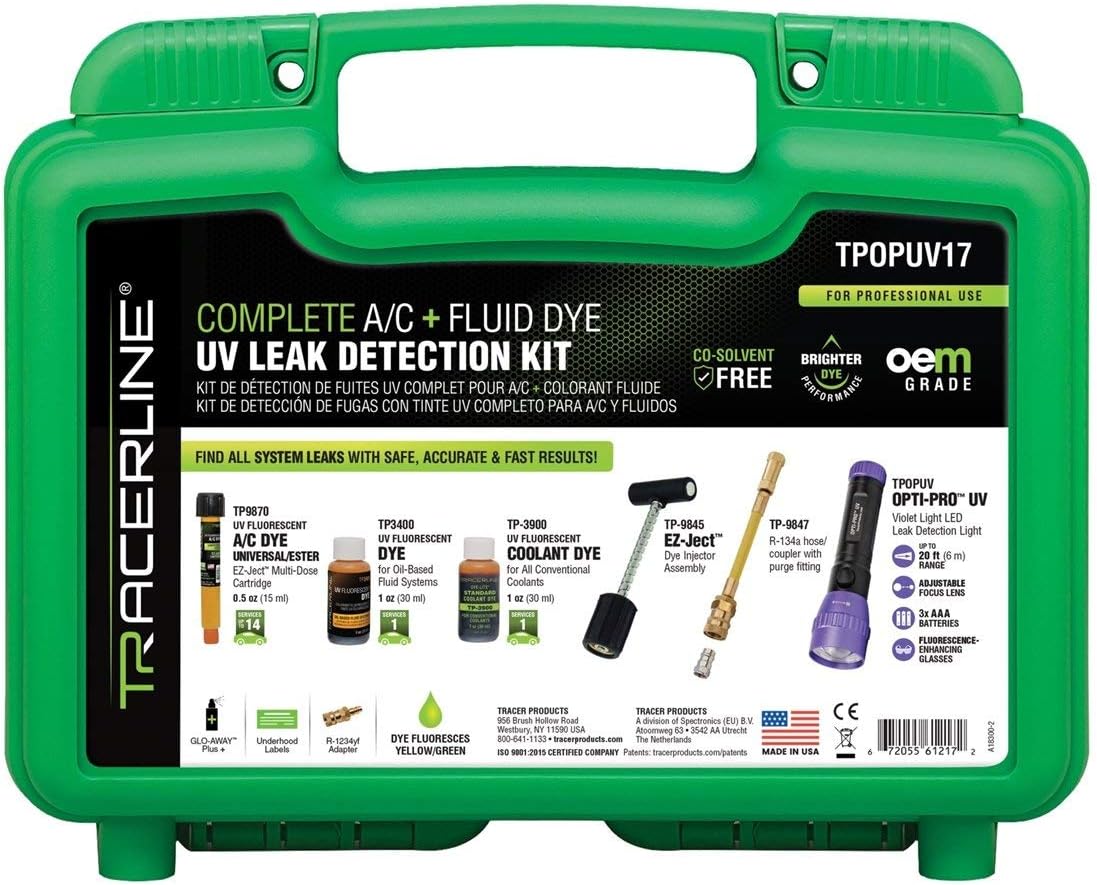
| Brand | ISN |
|---|---|
| Item Form | Liquid |
| Unit Count | 1.0 Count |
| Manufacturer | Tracerline |
This kit supplies everything a DIY mechanic needs to find refrigerant leaks in vehicle A/C lines. It includes a dye injector with hose and couplers to introduce fluorescent tracer into the system, a high-intensity blue LED flashlight to make the dye glow, and fluorescence-enhancing glasses to improve visibility of small leaks. The components come organized in a plastic carrying case for storage and transport, and the injector design lets you attach to service ports for typical A/C diagnostics. In practical use the bright blue light and glasses help spot even fine seepage around fittings and hose ends, and the single-package layout avoids hunting for separate tools. Limitations are that the kit focuses on visual detection only and requires the system to be pressurized and circulating dye to reveal leaks, so it will not replace electronic sniffer tools or professional vacuum testing for some failure modes. For routine DIY leak hunting this kit is a straightforward, ready-to-use solution with clear real-world benefits and predictable constraints.
Best for: DIY mechanics who want a single, ready-to-use A/C UV leak detection kit for garage troubleshooting and occasional professional jobs, preferring a complete set that includes an injector, couplers, UV flashlight, and viewing glasses for quick, reliable leak locating.
Less Ideal for: Technicians who need instrument-grade leak detection for very small or intermittent leaks or those who require non-visual electronic sniffing methods should consider professional tools instead.
- Complete kit includes injector, hose and couplers, blue LED flashlight, and enhancing glasses for one-box use.
- Carrying case keeps tools organized and portable for garage or roadside diagnostics.
- High-intensity blue LED improves visibility of fluorescent dye under varied lighting conditions.
- Relies on visual detection and dye circulation so it cannot detect leaks when the system is depressurized or dye has not reached the leak.
- Not a replacement for electronic leak detectors or professional pressure/vacuum testing in complex cases.
Verdict: A full-featured kit that includes multiple dye types, several lamp sizes, filters, replacement bulbs, and a broad accessory set for thorough diagnostics.
Robinair 16235 UV Leak Detection Kit with Injection Gun and Fluorescent Light
Best Professional‑Grade UV Leak Detection Kit

| Item Form | Liquid |
|---|---|
| Included Components | Injection gun, fluorescent light, dye, cleaner, UV glasses, case |
| Compatibility Standard | Meets SAE J2297 for R134A and R1234YF |
The Robinair 16235 is a professional-style UV leak detection kit designed to make finding A/C leaks faster and cleaner. It uses a pre-measured injection gun that dispenses a fixed 1/8 ounce of fluorescent dye with each squeeze, which removes guesswork and keeps dye application consistent for repeatable diagnostics. The kit’s high-intensity fluorescent light helps you spot dye at long distances, and the included dye cleaner and UV glasses make cleanup and inspection safer and more convenient. The blow-molded case keeps tools organized for shop or mobile use. Practical benefits include faster leak isolation, reduced waste from over-application, and a compact kit that covers everything needed to perform a dye-based inspection. Limitations are that dye testing is an additive method that requires system access and may not replace electronic sniffer methods for very small leaks, and it adds a chemical into the A/C system that should be cleaned out during repairs.
Best for: Professional DIY mechanics and small shop technicians who need a heavy‑duty, reliable UV leak detection kit for frequent use and fast, accurate diagnosis in challenging work environments.
Less Ideal for: Users who need to detect ultra-fine or pinhole leaks without introducing chemicals into the system should consider electronic refrigerant leak detectors instead.
- Pre-measured injection gun delivers a consistent 1/8 oz. dose to avoid over-application
- High-intensity fluorescent light that fluoresces dye from long distances for easier inspection
- Complete kit includes dye, cleaner, UV glasses, and a blow-molded storage case for portability
- Meets SAE J2297 standard and is approved for use with R134A and R1234YF systems
- Adds dye to the A/C system which requires cleaning during repair
- Less effective at detecting the smallest slow leaks compared with electronic sniffer tools
Verdict: A heavy-duty kit built with durable lamps, high-sensitivity dyes, and robust accessories designed for frequent, demanding use and long-term reliability.
Mastercool 53451-110 Rechargeable UV Leak Detection Kit
Best Rechargeable UV Leak Detection Kit

| Lamp Power | 2W (154–170 μW/cm2 equivalent to a 50W UV lamp) |
|---|---|
| UV Wavelength | 390–400 nm |
| Power Options | Rechargeable Li‑Ion battery plus AAA battery holder and 110V charger |
| Includes | 2 oz universal fluorescent dye and 4 oz dye remover |
The Mastercool 53451-110 is a professional-style UV leak detection kit designed for automotive technicians and experienced DIYers who need a reliable way to find refrigerant, oil, coolant, and fuel leaks. The kit centers on a high-intensity rechargeable UV flashlight that can also run on three AAA batteries for backup power, making it useful both in the shop and roadside. A refillable 2 oz dye injector and 2 oz concentrated universal fluorescent dye let you introduce tracer dye into A/C, engine, and other systems, while the included dye remover helps clean up after testing. The molded carrying case keeps the flashlight, injector, charger, safety glasses, labels, and accessories organized for mobile diagnostics. Practical benefits include multiple power options, a purge-capable injector for controlled dye delivery, and UV-enhancing glasses to make stains easier to spot. Limitations are that effective dye use requires system access and safe handling procedures, and UV inspection can miss very slow or internal leaks without additional pressure testing.
Best for: DIY mechanics and independent technicians who want a portable, rechargeable UV leak detection kit that minimizes disposable batteries and supports repeated on‑job use for A/C, coolant, oil, and fuel system diagnostics.
Less Ideal for: Users who prefer purely electronic sensor detectors or who need a one-step solution for sealed or internal-system leaks that cannot accept tracer dye.
- Includes rechargeable high-intensity UV flashlight plus AAA backup power for flexibility
- Refillable 2 oz dye injector with purge control for precise dye application
- Complete kit: dye, dye remover, safety glasses, labels, charger, and molded carry case for portability
- Compatible for multiple systems: A/C, engine coolant, oil, fuel, and ATF leak detection
- Requires manual access to the system and proper safety procedures to inject dye and interpret results
- UV inspection alone can miss internal or very slow leaks without complementary diagnostic tests
Verdict: A kit featuring rechargeable UV lamps and rechargeable-friendly accessories to eliminate disposable batteries and support extended on‑job use.
Aprvtio WJL-6000PRO Refrigerant Leak Detector with UV & LED Light
Best High‑Sensitivity UV Leak Detection Kit

| Measuring Range | 0.14 – ∞ oz/yr |
|---|---|
| Output Type | Digital |
| Specific Uses For Product | automotive, home HVAC maintenance, residential air conditioning units |
| Included Components | Freon Leak Detector, LED Light |
The Aprvtio WJL-6000PRO is a portable refrigerant leak detector designed for DIY mechanics and homeowners working on automotive or residential HVAC systems. It uses a digital sensor rated to detect as low as 0.14 oz/yr and gives both audible and visual alarms plus an LCD readout that shows leak level and sensitivity setting. The 7.9-inch flexible probe helps reach tight spots in engine bays and along refrigerant lines while the white LED flashlight and built-in UV lamp let you both illuminate dark areas and verify dye-based leaks. Typical use is hands-on troubleshooting: power up in fresh air to auto-calibrate, sweep slowly near fittings and joints, and follow the increasing beep rate and screen numbers to the source. Practical benefits include high sensitivity for tiny leaks, clear visual guidance for novices, and a compact kit suitable for occasional professional or homeowner use. Limitations are that it runs on batteries, so runtime depends on usage, and like all gas sniffer tools it can produce false readings if not used with the recommended slow sweep and calibration steps.
Best for: DIY mechanics and rental‑property handymen who need a budget-friendly, high-sensitivity leak detector that combines a precise halogen sensor with a UV light for locating very small or slow refrigerant leaks in automotive and home A/C systems.
Less Ideal for: Technicians who need continuous, long-duration field use or who require explosive-gas detection across non-halogen sources should consider higher-end industrial detectors or multi-gas instruments.
- High sensitivity down to 0.14 oz/yr for detecting very small refrigerant leaks
- Digital LCD that displays leak level and sensitivity for easier, more precise troubleshooting
- Flexible 7.9-inch probe to access tight engine bays and HVAC corners
- Built-in white LED flashlight and UV lamp for visual inspection and dye verification
- Battery powered so run time and continuous use are limited by battery life
- Requires proper calibration and slow probe movement to avoid false positives
Verdict: A kit optimized for detecting very small or slow leaks, with high-output UV lamps and concentrated fluorescent dyes to reveal faint traces in automotive systems.
How We Chose the Best UV Leak Detection Kit
We focused on the things that matter most when a DIY mechanic uses a UV leak detection kit in a home garage. First, we looked at dye compatibility and whether the kit was suited for automotive AC systems, engine oil, coolant, fuel, or power steering, since not every dye works safely across every system. Next, we considered UV light effectiveness, including beam intensity, wavelength suitability for fluorescent dye, and how easy the light is to use in dark engine bays or under a vehicle.We also compared injector and adapter practicality, especially hose connection style, service port fit, and whether the setup is realistic for occasional DIY use rather than shop-only work. Included accessories mattered too, such as UV glasses, batteries, storage cases, and enough dye or application tools to get started without extra trial and error. Durability and mess control were important filters, since cheap applicators and leaking bottles can make diagnosis harder, not easier.We excluded kits with unclear system compatibility, weak lighting, poor sealing hardware, or incomplete accessory sets that would force too many workarounds for basic leak tracing.
Our full evaluation process is outlined in our review methodology.
What a UV Leak Detection Kit Actually Does
A UV leak detection kit helps you confirm where a system is leaking by making escaping fluid or refrigerant dye glow under ultraviolet light. In practice, that means you can inspect hose connections, fittings, seals, condensers, compressors, radiators, gaskets, and other suspect areas after circulating the dye through the system. This is especially useful for slow leaks that do not leave an obvious wet trail right away.
For DIY mechanics, the main advantage is confidence. Instead of replacing parts based on symptoms alone, you can trace the leak path visually and focus your repair time on the component or connection that is actually failing.
- Useful for AC systems, oil leaks, coolant leaks, and some other automotive fluids when the dye matches the system
- Best for confirming leak location after symptoms suggest a pressure or fluid loss problem
- Most effective in lower ambient light or shaded inspection conditions
Key Features to Compare Before You Buy
The most important buying point is system compatibility. Some kits are built mainly for automotive AC work, while others are aimed at engine oil, coolant, transmission fluid, or multi-fluid diagnosis. Using the wrong dye can create confusion or even cause problems, so the first check should always be whether the dye and injector method match your intended system.
Light quality is the next big separator. A weak UV flashlight can make a decent dye seem ineffective, while a stronger and better-focused light makes leak tracing much easier around tight fittings, behind pulleys, and beneath splash shields. Also pay attention to whether the kit includes UV-enhancing glasses, because they improve contrast and help small traces stand out sooner.
- Dye type and fluid compatibility
- Injector style and connection hardware
- UV flashlight strength and beam focus
- Glasses or eye protection for better visibility
- Storage and organization for repeat use
AC-specific Vs Multi-fluid Kits
If your main goal is finding refrigerant leaks, an AC-focused UV leak detection kit usually makes more sense than a broad, general-purpose kit. AC systems need the correct dye formulation and a practical way to introduce it through the service port without creating extra mess or air intrusion. For occasional home use, simpler injector setups are often easier to manage than complex shop-style arrangements.
A multi-fluid kit can be useful if you work on several vehicles and expect to diagnose more than one type of leak over time. The trade-off is that these kits can be less specialized, so you need to double-check whether each included dye is appropriate for the fluid system you are testing. More versatility is only valuable if the kit stays clear, safe, and easy to use.
- Choose AC-focused kits if refrigerant leak tracing is your main job
- Choose multi-fluid kits if you regularly diagnose different systems
- Always verify dye compatibility before adding anything to a vehicle
How to Use a Kit Safely and Get Clearer Results
Good results depend as much on process as on the kit itself. Start by cleaning old residue from suspected leak areas so fresh glowing dye is easier to spot. Add only the recommended amount of dye, then operate the vehicle or system long enough for the dye to circulate. After that, inspect methodically with the UV light, starting at common leak points and following any glowing trail back to its highest or earliest visible point.
It also helps to work in shaded conditions and avoid rushing to conclusions from splatter or old contamination. In engine bays, airflow and belt movement can spread fluid, so the brightest spot is not always the origin. For AC systems, small leaks may need time to show, which is why reinspection after a short period can be more useful than a single quick check.
- Clean surfaces before testing
- Use the correct dye amount
- Inspect in low light for stronger contrast
- Trace the glow back to the likely source
- Recheck after circulation if the leak is slow
Common Mistakes DIY Mechanics Should Avoid
One of the most common mistakes is assuming every glowing mark indicates the failed part. Dye can travel along hoses, pool at low points, or collect on nearby brackets, so careful interpretation matters. Another mistake is using a kit with the wrong adapter or forcing a connection that does not seal well, which can lead to poor dye delivery and unreliable results.
It is also easy to overvalue accessories and overlook core performance. A large case or extra bottles do not help much if the UV light is weak or the injector is awkward to control. Finally, avoid treating UV dye as a substitute for basic diagnosis. Pressure loss, oily residue, noise, and performance symptoms still matter, and the best kit supports that larger diagnostic process rather than replacing it.
- Do not use dye that is not rated for the system
- Do not assume the first glowing area is the exact leak source
- Do not ignore connection quality and adapter fit
- Do not rely on accessories more than light and dye performance
FAQ
Can a UV leak detection kit be used for both AC and engine fluid leaks?
Some kits can, but only if the included dye is specifically rated for each fluid system. AC dye is not automatically suitable for oil, coolant, or transmission fluid, and vice versa. Always verify compatibility before adding dye to any vehicle system.
How long does it take for UV dye to show a leak?
That depends on the size and location of the leak. A larger leak may show quickly after the dye circulates, while a very small leak can take longer and may require a second inspection after more operating time. Clean surfaces and low-light inspection conditions make the results easier to read.
Do I need UV glasses if the kit already includes a flashlight?
They are not always mandatory, but they are very helpful. UV glasses improve contrast and make faint fluorescent traces easier to see, especially in engine bays with mixed lighting. For small leaks, that extra visibility can make diagnosis faster and more accurate.
Is a stronger UV flashlight always better?
Not automatically, but light output and beam quality do matter. A focused light with the right wavelength for fluorescent dye is usually more useful than a broad, weak beam. Practical usability also counts, especially if you are inspecting tight spaces under the hood or under the car.
Can UV dye identify the exact failed part on its own?
It can point you very close to the source, but you still need to interpret what you see. Dye may spread from the origin to nearby surfaces, so follow the trail carefully and inspect the highest or earliest visible point. Pair the UV inspection with normal diagnostic checks for the best answer.
What makes a UV leak detection kit good for DIY mechanics specifically?
The best kits for DIY use are easy to set up, have clear compatibility, and include practical accessories that reduce guesswork. A reliable light, straightforward injector method, and manageable storage usually matter more than having a lot of extra pieces. Home garage users benefit most from kits that are simple to deploy and easy to read.
Final Verdict
Choosing the right UV leak detection kit comes down to matching the kit to the job you actually do. If you mainly diagnose AC problems, focus on correct refrigerant-system compatibility, easy service port connection, and a UV light that makes faint dye easy to spot. If you handle several fluid systems, versatility matters more, but only if the kit stays clear about where each dye can be used.The best choice is the one that helps you confirm leaks with less guesswork, less mess, and better visibility in real garage conditions. Prioritize compatibility, lighting performance, and ease of use first, and you will be in a much better position to choose confidently.
