

Note: This article contains affiliate links. If you click on these links and make a purchase, I may earn a small commission at no extra cost to you. This helps support my research and content. Read my full affiliate disclosure here.
Your Honda Accord with the 4-cylinder engine relies on the right motor oil to run smoothly, preserve internal components, and maintain fuel efficiency. Choosing the correct oil affects cold starts, long-term wear, and service intervals for this engine configuration. This guide presents seven carefully shortlisted engine oils suited to the Honda Accord 4-cylinder, selected for their relevant viscosity options, additive packages, and compatibility with factory recommendations.Below you will find concise notes about what matters for this vehicle, including viscosity choices, synthetic versus conventional options, and considerations for higher-mileage engines. The following picks reflect those priorities and the key evaluation criteria used to compare them.
Looking for other parts? See all Honda Accord parts & accessories.
Top Picks at a Glance
| Best Overall Engine Oil A balanced, top-performing oil that suits most Accord 4‑cylinder needs | Factory Racing Parts SAE 0W-20 Full Synthetic 4.5 Quart Oil Change Kit |  |
| Best Budget Engine Oil A low-cost, reliable option for routine oil changes without breaking the bank | K&N 5W-30 Full Synthetic Motor Oil, 1 Quart |  |
| Best OEM Honda Engine Oil Genuine Honda-formulated oil sold as OEM units and single‑quart or case options | Honda Ultimate Full Synthetic SAE 0W-20 Motor Oil (5 Quart) |  |
| Best Full Synthetic Engine Oil Highest-performance synthetic oils designed for extended protection and thermal stability | Royal Purple SAE 0W-20 Full Synthetic Motor Oil, 5 qt. |  |
| Best Synthetic-Blend Engine Oil A blend that balances synthetic protection with lower cost than full synthetics | Honda 0W-20 Blended Full Synthetic Motor Oil, 1 Quart |  |
| Best High-Mileage Engine Oil Formulations targeted at engines with higher miles to reduce leaks and wear | Castrol GTX High Mileage 5W-30 Synthetic Blend Motor Oil, 5 Quart Bottle |  |
| Best Value Pack Engine Oil Multi‑quart, 5‑quart, or case packs that lower per‑quart cost for frequent changers | Honda SAE 5W-30 Engine Oil — Case of 12 Quarts |  |
1. Factory Racing Parts SAE 0W-20 Full Synthetic 4.5 Quart Oil Change Kit
Best Overall Engine Oil

| SAE Viscosity | 0W-20 |
|---|---|
| Volume | 4.5 Quarts |
| API Rating | API SP Resource Conserving |
| ILSAC | GF-6A |
| Included Components | Oil, filter, gloves, crush washer, funnel, oil change sticker |
This oil change kit supplies everything a DIYer needs to service a Honda or Acura 4-cylinder engine: 4.5 quarts of Factory Racing Parts full synthetic SAE 0W-20 oil, a replacement oil filter sized to fit designated models, gloves, a crush washer, a funnel, and an oil change sticker. The oil is certified API SP Resource Conserving and ILSAC GF-6A, so it flows quickly on cold starts, supports fuel economy, and is formulated to resist low-speed pre-ignition that can harm modern turbocharged and direct-injected engines. The bundled filter is intended to meet factory-quality fit and filtration standards, which simplifies parts selection for a home mechanic. Practical benefits include reduced shopping time and a complete kit that covers the typical 4.5 quart service for many Honda 4-cylinder engines. Limitations to note are that fitment is vehicle-specific so you must confirm model-year compatibility, and a few customer reports mention packing or missing components, so inspect the kit on arrival before starting the job.
Best for: DIY mechanics who prioritize a factory-grade, all-around protective oil package for routine 4-cylinder Honda and Acura services and want a single kit that supplies oil and the matching filter.
Less Ideal for: Drivers seeking specialty lubricants for racing, heavy towing, or nonlisted vehicles should choose a product formulated for those specific conditions instead.
- Includes oil, a matching oil filter, gloves, funnel, crush washer, and oil change sticker for a complete DIY service
- Full synthetic SAE 0W-20 formula certified API SP Resource Conserving and ILSAC GF-6A
- Designed to improve cold-start flow and support fuel economy
- Formulation claims protection against LSPI and wear in start-stop engines
- Kit is labeled 4.5 quarts but a small number of customers reported receiving less or missing components
- Fitment is vehicle-specific so it may not cover every year or engine variant without checking the listed applications
Verdict: The go-to pick for DIY mechanics who want the best all-around protection, viscosity stability, and compatibility without specialty compromises.
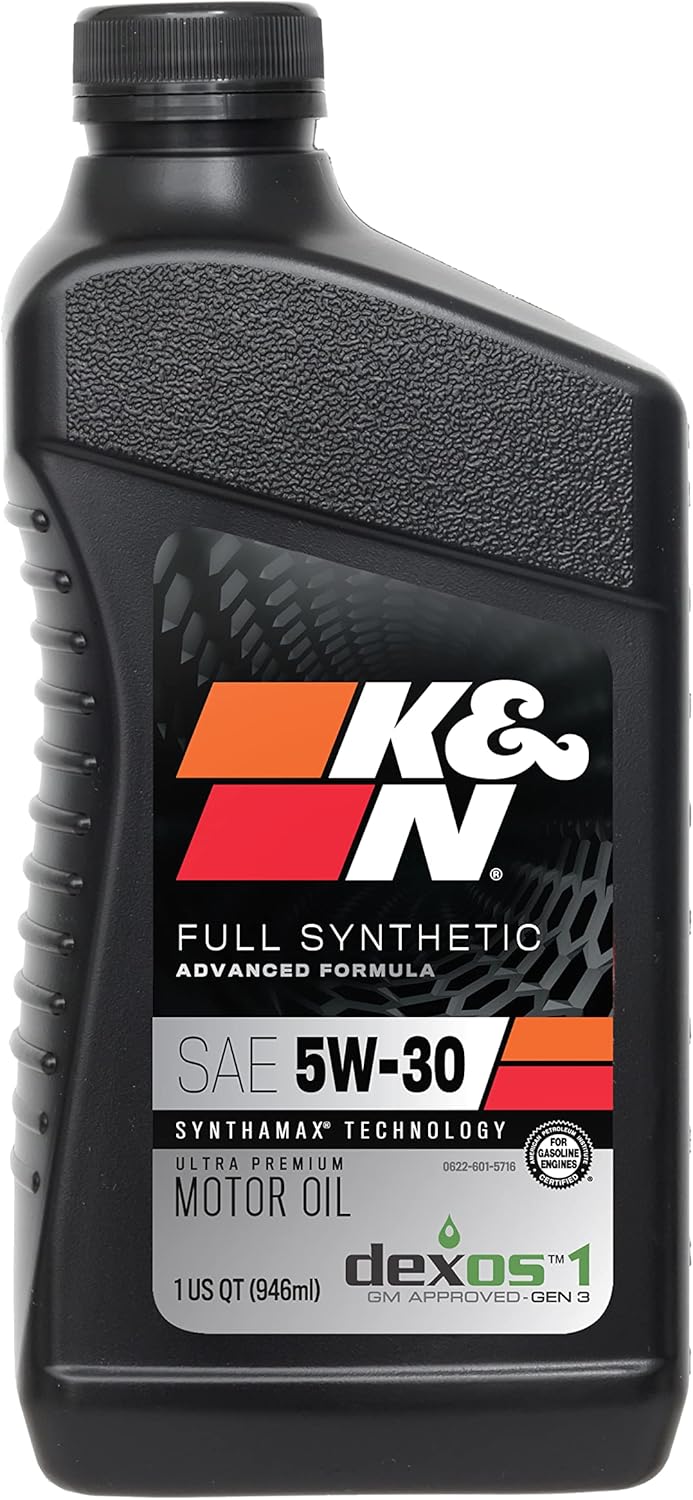
2. K&N 5W-30 Full Synthetic Motor Oil, 1 Quart
Best Budget Engine Oil
| Viscosity | 5W-30 |
|---|---|
| Container Type | Bottle |
| Compatible with Vehicle Type | Car |
| Liquid Volume | 946 Milliliters |
K&N 5W-30 full synthetic motor oil is a ready-to-use quart of engine oil aimed at routine service and topping off on modern 4-cylinder engines. It is formulated with the brand's Synthamax additive package to reduce wear, limit sludge formation, and provide protection across cold starts and high-temperature operation. For a Honda Accord 4-cylinder, it works as a factory-quality grade replacement where 5W-30 is recommended, making it suitable for regular oil changes and helping keep maintenance costs predictable. The bottle size is convenient for small top-ups and service work, and the universal fit labeling means it is intended for typical passenger cars. Important limitations are the single-quart packaging if you need a full drain and fill for engines that require more oil per change and the manufacturer-stated short warranty period; buyers should verify Honda's recommended viscosity and service specs for their model year before use. Overall this oil provides a balance of protection and value for routine Accord maintenance when 5W-30 is appropriate.
Best for: Buyers seeking a dependable, low-cost full synthetic oil for routine maintenance and occasional top-offs on a Honda Accord 4-cylinder who prioritize meeting manufacturer viscosity recommendations without overspending.
Less Ideal for: Drivers who prefer buying oil in multi-quart jugs for fewer containers during standard oil changes or those needing a different viscosity or specific manufacturer-certified formulation.
- Full synthetic formulation with Synthamax additives for improved wear protection
- Designed for all-weather performance to aid cold starts and high-temperature stability
- Universal fit for passenger cars makes selection straightforward for many Accord owners
- Sold in single-quart bottles useful for top-offs and small jobs
- Quart packaging means multiple bottles are needed for a full oil change on many engines
Verdict: Choose this slot if you need a dependable, affordable oil that meets required specs and keeps maintenance costs low.
3. Honda Ultimate Full Synthetic SAE 0W-20 Motor Oil (5 Quart)
Best OEM Honda Engine Oil

| SAE J300 Viscosity Grade | 0W-20 |
|---|---|
| Compatible with Vehicle Type | Car |
| Container Type | Bottle |
| Liquid Volume | 5 Quarts |
This Honda Ultimate Full Synthetic 0W-20 is the factory-formulated motor oil intended for Honda engines and packaged here as a 5-quart supply. It is used like any engine oil during routine changes and is especially aimed at drivers who want a Honda-approved fluid that matches service recommendations. Notable features include full synthetic base stocks engineered to resist varnish, corrosion, foam, and high-temperature viscosity breakdown, plus faster circulation at cold starts to improve protection on initial cranking. Practical benefits are straightforward: spec compliance with Honda testing, potential for steady fuel efficiency thanks to the 0W-20 viscosity, and reduced oil consumption from lower volatility. The product is vehicle-specific and sold under Honda branding, which simplifies replacement decisions for owners who follow factory guidance. Limitations are few but relevant: this is a single-viscosity grade so it only fits applications calling for 0W-20, and it is a consumable product without a manufacturer warranty for fluids.
Best for: Buyers who prioritize using Honda-approved fluids to maintain factory service recommendations and want a ready-made 5-quart supply for routine oil changes on Honda 4-cylinder engines.
Less Ideal for: Drivers who need a different viscosity grade or those seeking aftermarket specialty oils with performance additives beyond factory formulation.
- Factory-formulated and tested by Honda to meet Honda specifications
- Full synthetic 0W-20 designed for better cold-start protection and fast circulation
- Formulation resists varnish, corrosion, foam and high-temperature breakdown
- Sold as a 5-quart pack convenient for a complete oil change
- Only available in the 0W-20 viscosity grade so not suitable where a different weight is required
Verdict: This slot is for buyers who prefer factory-formulated, Honda-approved oil to guarantee spec compliance and preserve factory recommendations.
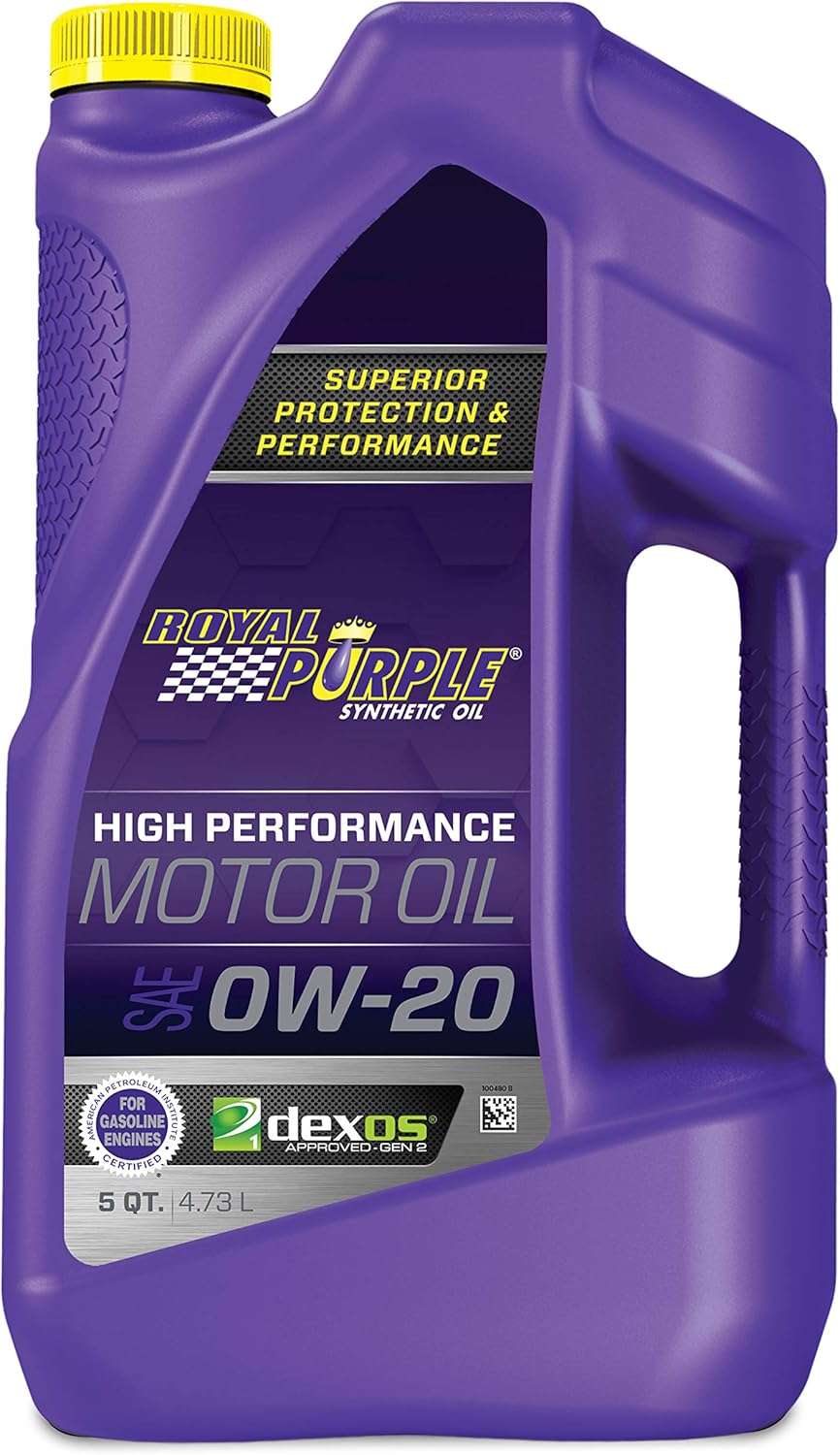
4. Royal Purple SAE 0W-20 Full Synthetic Motor Oil, 5 qt.
Best Full Synthetic Engine Oil
| Viscosity | SAE 0W-20 |
|---|---|
| Liquid Volume | 4.73 Liters |
| API license | API SN |
| Fit Type | Vehicle Specific Fit |
Royal Purple 0W-20 is a full synthetic motor oil formulated to protect modern gasoline engines while supporting better fuel economy and reliable cold starts. It is used like any engine oil replacement for vehicles calling for 0W-20 viscosity and is marketed as compatible with mineral or other synthetic oils so no special procedures are needed when switching. Notable features include proprietary anti-wear and polar additives that reduce metal-to-metal contact, claimed resistance to sludge and corrosion, and formulations targeting LSPI protection for turbocharged GDI engines. In practice that means stronger startup protection, cleaner internals over time, and stable viscosity even under load or extended drains. The product is API licensed and meets ILSAC GF-5 and Dexos1 performance requirements, so it fits the spec sheet for many 4-cylinder Honda Accord engines that call for 0W-20. The trade-off is a premium positioning versus commodity oils, so cost-conscious owners may prefer lower-priced synthetics or factory-branded oil for routine changes.
Best for: Buyers who prioritize durable, full synthetic protection and want an oil that supports better cold starts and potential longer drain intervals for their 4-cylinder Accord.
Less Ideal for: Drivers focused primarily on lowest upfront cost or those strictly following dealer-branded maintenance plans may prefer cheaper or factory-recommended alternatives.
- Full synthetic 0W-20 formulation for strong cold-start flow and startup protection
- Advanced additive chemistry aimed at anti-wear, sludge resistance, and corrosion protection
- Meets API, ILSAC GF-5 and Dexos1 performance requirements for broad modern engine compatibility
- Helps maintain fuel economy through low-friction base oils and additives
- Positioned as a premium oil, making it more expensive than many mainstream synthetics
Verdict: Pick this when you want full synthetic protection that resists breakdown, improves cold starts, and supports longer drain intervals.
5. Honda 0W-20 Blended Full Synthetic Motor Oil, 1 Quart
Best Synthetic-Blend Engine Oil

| Liquid Volume | 32 Fluid Ounces |
|---|---|
| Compatible with Vehicle Type | Car |
| Automotive Fit Type | Vehicle Specific Fit |
| Item Type Name | 0W-20 Blended Full Synthetic Motor Oil |
This Honda 0W-20 blended full synthetic motor oil provides a middle ground between conventional and full-synthetic lubricants for Honda engines. It is formulated specifically for Honda ultra fuel-efficient vehicles and is typically used for routine oil changes or top-offs to maintain engine protection and fuel economy. The 0W-20 viscosity helps with cold starts and supports engine protection across a wide temperature range while additives fight sludge, corrosion, and wear. As a genuine Honda fluid it matches the chemical profile expected by the manufacturer, which gives confidence for people keeping a Honda-maintained service history. The product comes in a single-quart bottle that makes it convenient to carry a spare for emergencies or to add a quart when needed. The main limitation is that it is a blended full synthetic rather than a true full-synthetic oil, so drivers seeking the absolute highest thermal stability and extended drain intervals may prefer full-synthetic alternatives.
Best for: Buyers who want better-than-conventional protection and factory-matching fluid for a Honda 4-cylinder while avoiding full-synthetic prices; useful for routine oil changes and keeping a few quarts on hand.
Less Ideal for: Drivers seeking maximum high-heat stability and the longest OEM-approved extended oil change intervals should consider a full-synthetic 0W-20 instead.
- Formulated to Honda specifications for compatibility with Honda engines
- 0W-20 viscosity eases cold starts and supports fuel-efficient operation
- Additive package resists sludge, corrosion, and engine wear
- Available in single-quart bottles convenient for topping off or carrying a spare
- Blended full synthetic rather than a pure full-synthetic, so it may not offer the longest possible drain intervals
Verdict: Use this slot if you want improved protection over conventional oil but don’t need or want to pay full-synthetic prices.
6. Castrol GTX High Mileage 5W-30 Synthetic Blend Motor Oil, 5 Quart Bottle
Best High-Mileage Engine Oil

| SAE J300 Viscosity Grade | 5W-30 |
|---|---|
| Compatible with Vehicle Type | For use in vehicles with over 75,000 miles, Passenger cars, trucks, and SUVs |
| Container Type | Bottle |
| Liquid Volume | 160 Fluid Ounces |
Castrol GTX High Mileage 5W-30 is a synthetic blend aimed at older engines and is typically used during routine oil changes to help extend component life. It contains a detergent and dispersant package to fight sludge and carbon deposits, seal conditioners to reduce leaks, and a phosphorus-reduction additive intended to protect catalytic converters. In practice this means the oil helps control sludge buildup, lowers oil burn-off compared with lower-grade oils, and can reduce minor seepage from aging gaskets. The product meets current industry specs including API SP and ILSAC GF-6 and is offered in a convenient 5 quart bottle for an oil-and-filter service. Limitations are that it is a synthetic blend rather than a full synthetic, so very high-performance protection or the longest possible drain intervals of some full synthetics may not be matched. Also its benefits are targeted at higher-mileage engines rather than restoring severely worn components.
Best for: Drivers with high-mileage four-cylinder engines who prioritize preserving seals, cutting sludge, and protecting emissions components during regular oil service.
Less Ideal for: Drivers seeking the highest-end full synthetic protection for aggressive driving, extended oil-change intervals, or performance tuning should consider a full synthetic alternative.
- Formulated specifically for engines with over 75,000 miles to address age-related issues
- Contains seal conditioners to help reduce leaks in older gaskets and seals
- Detergents and dispersants reduce sludge and carbon deposits for cleaner operation
- Phosphorus Replacement Technology reduces phosphorus to help protect the catalytic converter
- Meets API SP and ILSAC GF-6 specifications for modern gasoline engines
- Synthetic blend rather than full synthetic, so it may not provide the same maximum heat-resistance or longest drain intervals as some full synthetics
Verdict: Select this if the engine has significant mileage and you want additives that condition seals, reduce oil consumption, and protect older components.
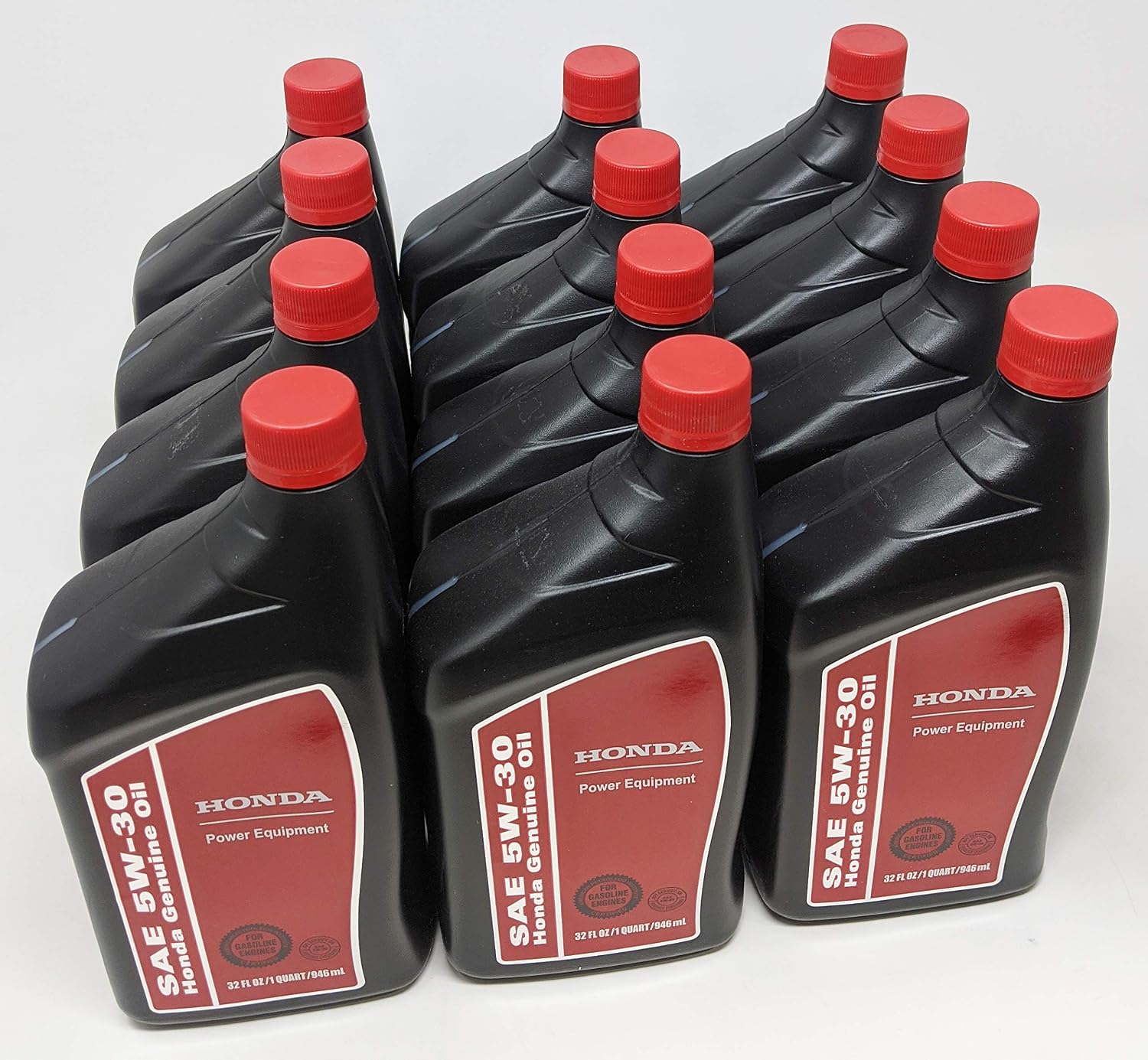
7. Honda SAE 5W-30 Engine Oil — Case of 12 Quarts
Best Value Pack Engine Oil
| SAE Viscosity Grade | 5W-30 |
|---|---|
| Container Type | Bottle |
| Compatible with Vehicle Type | Car, Truck, Other Power Equipment |
| Liquid Volume | 12 Quarts |
This 12-quart case of Honda SAE 5W-30 is a straightforward offering for routine oil changes on compatible Honda engines. Packaged as factory-branded engine oil, it meets SAE J300 5W-30 viscosity and is promoted for use across Honda power equipment and vehicles that call for 5W-30. The case format is designed for frequent DIY maintenance or small shops and keeps replacement oil on hand to reduce trips to the store. Practical benefits include consistent, factory-specified oil viscosity and the convenience of bulk supply that lowers the hassle of frequent repurchasing. Limitations are that the listing does not specify whether the formula is conventional, synthetic blend, or full synthetic and there is no detail on performance additives or extended drain intervals, so buyers seeking specific fuel-economy or high-mileage benefits should confirm formulation before use. For routine oil changes that require 5W-30, the case format makes maintenance simpler and more efficient.
Best for: DIYers and small shop owners who perform frequent oil changes and prioritize having a ready bulk supply to reduce cost and trips to resupply.
Less Ideal for: Drivers looking for a specific synthetic formulation, extended-drain oil, or additives for high-mileage engines should consider alternatives with explicit formulation and performance claims.
- Factory-branded formulation matched to Honda engine requirements
- Sold as a 12-quart case for repeated oil changes without frequent repurchasing
- Meets SAE J300 5W-30 viscosity grade suitable for many 4-cylinder Honda engines
- Packaged in individual bottles for easy pouring and storage
- Product details do not state whether the oil is conventional, synthetic blend, or full synthetic
Verdict: This slot suits DIYers who do frequent oil changes or want a lower per‑quart price by buying multi‑quart or case quantities.
Choosing the Right Honda Accord 4-Cylinder Engine Oil: Key Factors to Consider
Viscosity and Seasonal Fit
Viscosity determines how the oil flows at cold start and at operating temperature. For the Honda Accord 4-cylinder, choosing the correct SAE grade affects start-up wear and fuel economy. A lower cold-viscosity grade helps reduce wear during brief commutes in colder climates, while a stable hot-viscosity number preserves the oil film under sustained highway speeds.
Pay attention to the owner manual recommendations and the local climate. Multi-grade oils offer flexibility across seasons, but matching the oil to ambient temperature ranges maximizes protection. Shear stability is also important because thinning under high RPMs or load reduces film strength and can increase wear.
Synthetic Vs Conventional Formulations
Synthetic oils generally provide better thermal stability, lower volatility, and more consistent shear resistance than conventional oils. For a modern Honda Accord 4-cylinder engine, synthetic motor oil often helps maintain clearances, protect timing components, and support longer drain intervals when appropriate.
Conventional oils can still be acceptable for lower-mileage, low-stress driving but may oxidize faster and require more frequent changes. Some synthetic blends aim to bridge performance and cost, offering improved protection over conventional oils without the full expense of full-synthetic formulations.
OEM Specifications and Certification
Matching the oil to Honda-recommended specifications and industry certifications is essential. Look for oils that meet the API and ILSAC standards specified in the vehicle manual and that list applicable manufacturer approvals when present. Using a product that meets or exceeds these specs helps ensure proper protection and compatibility with seals and emissions control systems.
Certifications also indicate that the oil has been tested for key performance measures such as high-temperature protection and deposit control, which are important for preserving engine health over time.
Additive Package and Deposit Control
The additive system in an oil—detergents, dispersants, anti-wear agents, and antioxidants—determines how well it controls sludge, varnish, and metal wear. For the Honda Accord 4-cylinder, good deposit control helps maintain intake and piston cleanliness, which supports fuel economy and smooth idle.
Anti-wear additives like zinc dialkyldithiophosphate or alternative formulations protect cam lobes, lifters, and bearings. Detergents and dispersants keep contaminants suspended until the next oil change, reducing the risk of deposit formation in longer drain interval scenarios.
High-Mileage Considerations
Older Accords with substantial miles may benefit from oils formulated with seal conditioners and higher viscosity retention. High-mileage engine oils often include additives that help reduce external leaks, condition rubber seals, and restore some compression support by compensating for worn parts.
However, increased viscosity can affect cold-start behavior, so balance seal-conditioning benefits with seasonal viscosity needs. A targeted high-mileage product can extend engine life when used alongside proper maintenance practices.
Oil Change Interval and Cost-Effectiveness
Recommended oil change intervals vary by formulation and driving conditions. Full-synthetic oils often allow longer intervals between changes when manufacturer guidelines permit, but interval choices should consider driving habits like frequent short trips or towing that increase contamination rates.
Assess cost-effectiveness by evaluating both product longevity and protection. Paying more per fill can be justified if it reduces change frequency and lowers long-term wear, but always adhere to Honda's maintenance schedule unless a qualified technician advises otherwise.
Recommended Viscosity Choices for Different Climates
Honda commonly recommends specific viscosity grades for the Accord 4-cylinder depending on ambient temperature ranges. In colder regions, a lower winter grade helps with cold starts and reduces wear during the warm-up phase. For temperate and hot climates, a slightly thicker operating viscosity preserves the oil film under higher engine temperatures.
When selecting an oil for year-round use, choose a multi-grade that covers the local freeze and high-temperature points and that meets the engine's spec. This ensures reliable protection without manual seasonal oil changes in most cases.
- Colder climates: favor lower cold-flow numbers to reduce start-up wear
- Hot climates: ensure strong high-temp viscosity and thermal stability
- All-season picks: multi-grade oils with proven shear stability
Signs Your Accord Needs a Different Oil Type
Pay attention to symptoms that suggest a change in oil strategy. Excessive oil consumption, visible smoke, or new leaks can indicate deteriorating seals or increased blow-by, signaling that a high-mileage formulation or different viscosity might help.
Other indicators include frequent oil darkening between changes or noticeable performance shifts. Address the root cause before switching oils permanently, and consult maintenance records to determine whether a change in grade or a conditioning additive is appropriate.
- Increased oil consumption may point to worn rings or seals
- Dark, gritty oil before scheduled changes can mean contamination
- Loss of fuel economy or rough idle may be related to deposit buildup
Drain Interval Best Practices
Follow Honda's published drain intervals unless your driving profile demands shorter service. Short trips, heavy stop-and-go traffic, and dusty conditions shorten the effective life of oil and filter. In those cases, use the conservative interval recommended for severe service and replace the filter at each change.
If using a long-drain full-synthetic product, confirm the oil meets required specifications and consider periodic oil analysis for high-mileage or hard-driven vehicles to verify the oil is still protecting the engine.
- Short trips and severe service require more frequent changes
- When extending intervals, verify product specifications and monitor engine condition
- Always replace the oil filter during a service interval
High-Mileage Engine Care for the Accord 4-Cylinder
For Accords with higher mileage, look for oils that include seal conditioners and targeted additives to reduce leaks and improve compression. These formulations can help reduce external seepage and restore some performance characteristics affected by age.
Combine a high-mileage oil choice with a careful inspection of the valve cover, gaskets, and PCV system. Address mechanical issues alongside oil changes to avoid masking underlying problems with oil additives alone.
- Use seal conditioners cautiously and monitor for improvements
- Inspect gaskets and PCV components when switching to high-mileage oil
- Avoid overly thick oils that can hamper cold starts
Environmental and Emissions Considerations
Modern gasoline engines and their emissions systems respond best to oils that do not interfere with catalytic converters or oxygen sensors. Choose oils that meet the appropriate API/ILSAC categories and avoid additive packages that can accelerate catalyst fouling.
Proper oil selection also reduces evaporative losses and blow-by that can affect emissions control. Staying within manufacturer-recommended specs helps maintain emissions performance over the long term.
- Confirm API and ILSAC specifications to protect emissions systems
- Lower volatility oils reduce evaporative loss and pollution
- Regular maintenance preserves emission system effectiveness
Still looking for the perfect fit?
Select your Honda Accord configuration to see the most relevant Engine Oils recommendations
How We Chose the Best Honda Accord 4-Cylinder Engine Oil
We applied a practical, vehicle-focused filter to identify the seven engine oils featured here. First, compatibility with the Honda Accord four-cylinder requirements was required, including recommended viscosity grades and API/ILSAC performance levels. We prioritized oils formulated for reliable cold starts and stable viscosity at operating temperature because these directly affect drivability and engine protection in everyday use.Evaluation criteria included viscosity range and seasonal flexibility, thermal stability and shear resistance, wear-control additives and anti-corrosion chemistry, and compatibility with emissions and catalyst systems. We also considered long-drain formulations and high-mileage-specific conditioners for Accords with significant miles. Lab-tested performance claims and manufacturer specifications were weighed when available.We excluded specialty racing blends, oils formulated strictly for diesel engines, and products lacking clear specification labels or certification. The final list represents oils that meet the mechanical and maintenance needs of the Honda Accord 4-cylinder while offering reliable protection across typical driving conditions.
Our full evaluation process is outlined in our review methodology.
FAQ
What oil weight is best for a Honda Accord 4-cylinder year-round?
The best weight depends on your climate and the engine's age. Many owners use a multi-grade oil that matches Honda recommendations for cold-start performance and high-temp protection. Check the owner's manual for the official guidance and adjust for extreme temperatures as needed.
Can I switch from conventional to synthetic in my Accord 4-cylinder?
Yes, switching to full-synthetic is generally safe and can offer better thermal stability and longer drain potential. Ensure the synthetic meets Honda's specifications and change the oil and filter during the transition. Monitor for leaks or unusual consumption after the switch.
Should high-mileage Accords use a different oil?
High-mileage engines may benefit from formulations with seal conditioners and additives designed to reduce leaks and condition worn components. Balance the potential benefits with cold-start behavior and consult a technician if major symptoms like heavy consumption or smoke are present.
How often should I change oil if I drive mostly short trips?
Short-trip driving increases moisture and contaminant buildup, so follow the severe-service interval recommended by Honda rather than extended schedules. More frequent changes and regular filter replacements help prevent sludge and maintain protection.
Does switching viscosity affect fuel economy in the Accord 4-cylinder?
Viscosity can influence friction and therefore fuel economy. Using an oil with the correct cold-flow and operating viscosity helps preserve fuel efficiency. Very thick oils may slightly reduce economy, while properly specified lower-viscosity oils can improve it in cooler climates.
Are extended-drain synthetic oils safe for older Accord engines?
Extended-drain synthetics can be safe if they meet the required specifications and the engine is in good mechanical condition. For high-mileage engines, periodic monitoring or oil analysis is advisable to ensure contaminants and wear metals remain within acceptable levels.
Final Verdict
Prioritize oils that match Honda's viscosity recommendations and industry certifications while balancing seasonal needs and the engine's mileage. For everyday driving, a multi-grade synthetic that offers good shear stability and deposit control is a practical choice for the Accord 4-cylinder. For older engines, consider high-mileage formulations that include seal conditioners but weigh those benefits against cold-start behavior.Use the factors above to decide which oil best fits your driving patterns and maintenance schedule. Staying within recommended specifications and replacing the oil and filter at appropriate intervals will do the most to preserve performance and longevity.
Explore More:
- Check out all Honda Accord parts & accessories
- Explore Fluids & Chemicals
- Browse all Accessories
