

Note: This article contains affiliate links. If you click on these links and make a purchase, I may earn a small commission at no extra cost to you. This helps support my research and content. Read my full affiliate disclosure here.
If you drive a Honda Accord with the 2.4L engine, using the right engine oil matters for longevity, fuel efficiency, and reliable cold starts. The wrong viscosity or spec can reduce protection during hot highway runs or leave bearings vulnerable during short trips. This guide shortlists the top choices for the 2.4L Accord, focusing on oils that meet the manufacturer's viscosity and detergent requirements while addressing common owner concerns like start-up wear, high-mileage seals, and fuel economy.Below we cover the best options and explain the criteria used to evaluate them so you can pick the right oil for your driving style and maintenance schedule.
Looking for other parts? See all Honda Accord parts & accessories.
Top Picks at a Glance
| Best Overall Engine Oil An all-around top pick balancing protection, efficiency, and longevity | Valvoline Advanced Protection Full Synthetic 0W-20 Motor Oil, 5 qt |  |
| Best Budget Engine Oil A low-cost oil that still meets core protection standards | Valvoline Full Synthetic High Mileage with MaxLife Technology SAE 5W-30 Motor Oil, 1 qt (2-pack) |  |
| Best Full Synthetic Engine Oil Maximum engine protection and performance from fully synthetic base stocks | Royal Purple SAE 0W-20 High Performance Full Synthetic Motor Oil, 5 qt. |  |
| Best High-Mileage Engine Oil Formulated with conditioners and additives for older, higher-mileage engines | Valvoline MaxLife Extended Protection 0W-20 Full Synthetic High Mileage Motor Oil, 5 qt |  |
| Best 5W-20 Engine Oil The correct low-viscosity grade for many modern gasoline engines | Honda Genuine Synthetic Blend Motor Oil 5W-20 (29.6 oz) |  |
| Best Premium Engine Oil A top-tier formulation with advanced additives and extended-drain claims | Honda Genuine Full Synthetic SAE 0W-20 Motor Oil, 5-Quart Pack |  |
1. Valvoline Advanced Protection Full Synthetic 0W-20 Motor Oil, 5 qt
Best Overall Engine Oil

| Viscosity | 0W-20 SAE Grade |
|---|---|
| Size | 5 QT |
| Meets | ILSAC GF-7A, API SP, API SN with SN PLUS |
| Additional Specs | Ford WSS-M2C962-A1, Chrysler MS-13340, GM dexos1 Gen 3 |
| Flash Point | 200 Degrees Celsius |
Valvoline Advanced Protection 0W-20 is a full synthetic motor oil designed to protect modern gasoline engines through everyday driving and routine service intervals. It flows easily at cold starts to reduce wear, claims stronger wear and deposit protection than industry standards, and is formulated to resist thermal breakdown under sustained operating temperatures. In use it is intended for regular oil change cycles and for drivers who want a dependable factory-quality replacement that can help maintain fuel economy and engine cleanliness. Notable features include enhanced additive chemistry for deposit control and specifications that meet ILSAC GF-7A and API SP plus several OEM approvals. The main limitation is that 0W-20 is suited to engines specifying that viscosity, so fitment is a key consideration; benefits like "restore" effects typically appear gradually over multiple changes rather than instantly. For routine maintenance on compatible engines this oil balances protection and drivability without extra complexity.
Best for: Buyers who prioritize a single, reliable full synthetic to use for regular maintenance and want a balance of wear protection, deposit control, and fuel economy for everyday driving in a Honda Accord 2.4L.
Less Ideal for: Drivers whose Accord engine requires a different viscosity grade or who need specialized formulations for severe track use or unusual operating conditions.
- Full synthetic formulation for improved cold-start flow and consistent film strength
- Claims higher wear protection and improved deposit control versus industry standards
- Meets current industry specs including ILSAC GF-7A and API SP and has multiple manufacturer approvals
- Formulation aimed at helping fuel economy while resisting high-temperature breakdown
- Viscosity limited to 0W-20 so it is only appropriate for engines that require that grade
Verdict: The best all-around engine oil choice for most buyers, offering a balanced combination of wear protection, fuel economy, and thermal stability for everyday driving and routine maintenance.
2. Valvoline Full Synthetic High Mileage with MaxLife Technology SAE 5W-30 Motor Oil, 1 qt (2-pack)
Best Budget Engine Oil

| Viscosity | SAE 5W-30 |
|---|---|
| Volume | 1 qt (Pack of 2) |
| Compatible Vehicle Type | Car, Truck |
| Viscosity Level | Low to Medium |
| Automotive Fit Type | Universal Fit |
This Valvoline Full Synthetic High Mileage 5W-30 is designed to help older engines stay reliable by combining a factory-quality synthetic base with extra anti-wear additives and a seal conditioner. For a Honda Accord 2.4L with higher mileage, it provides standardized 5W-30 viscosity for correct oil pressure and flow while adding components meant to reduce leaks and slow wear in engines past 75,000 miles. Typical use is routine oil changes at the recommended interval for the Accord; it meets current API and ILSAC specifications so it aligns with manufacturer viscosity and performance expectations. Practical benefits include stronger wear and sludge protection versus many conventional oils and improved heat resistance under highway and stop-and-go driving. The product is sold in one-quart bottles as a two-pack, which makes topping off or staged changes convenient. Downsides are that it is positioned for high-mileage protection rather than long-interval drain claims or the most advanced additive packages found in premium race or synthetic blends, so buyers prioritizing maximum additive concentration or extended drain intervals may prefer a different product.
Best for: A budget-conscious owner of a higher-mileage Honda Accord 2.4L who wants dependable, factory-spec 5W-30 protection and simple leak-prevention benefits without paying for the highest-end additives or long-drain claims.
Less Ideal for: Drivers chasing maximum additive concentration, extended oil change intervals, or racing-level protection should consider premium synthetic options instead.
- Formulated specifically for high-mileage engines with added seal conditioners to help reduce leaks.
- Full synthetic base provides stronger wear and heat protection than conventional oils.
- Meets API and ILSAC specifications for modern gasoline engines, matching manufacturer viscosity needs.
- Sold as one-quart bottles in a two-pack for convenient storage and topping off between changes.
- Not marketed for extended drain intervals or the heaviest additive packages found in top-tier premium oils.
Verdict: The best budget engine oil for buyers who want dependable wear protection and manufacturer-spec viscosity at a lower price, accepting fewer premium additives or extended drain claims.
3. Royal Purple SAE 0W-20 High Performance Full Synthetic Motor Oil, 5 qt.
Best Full Synthetic Engine Oil
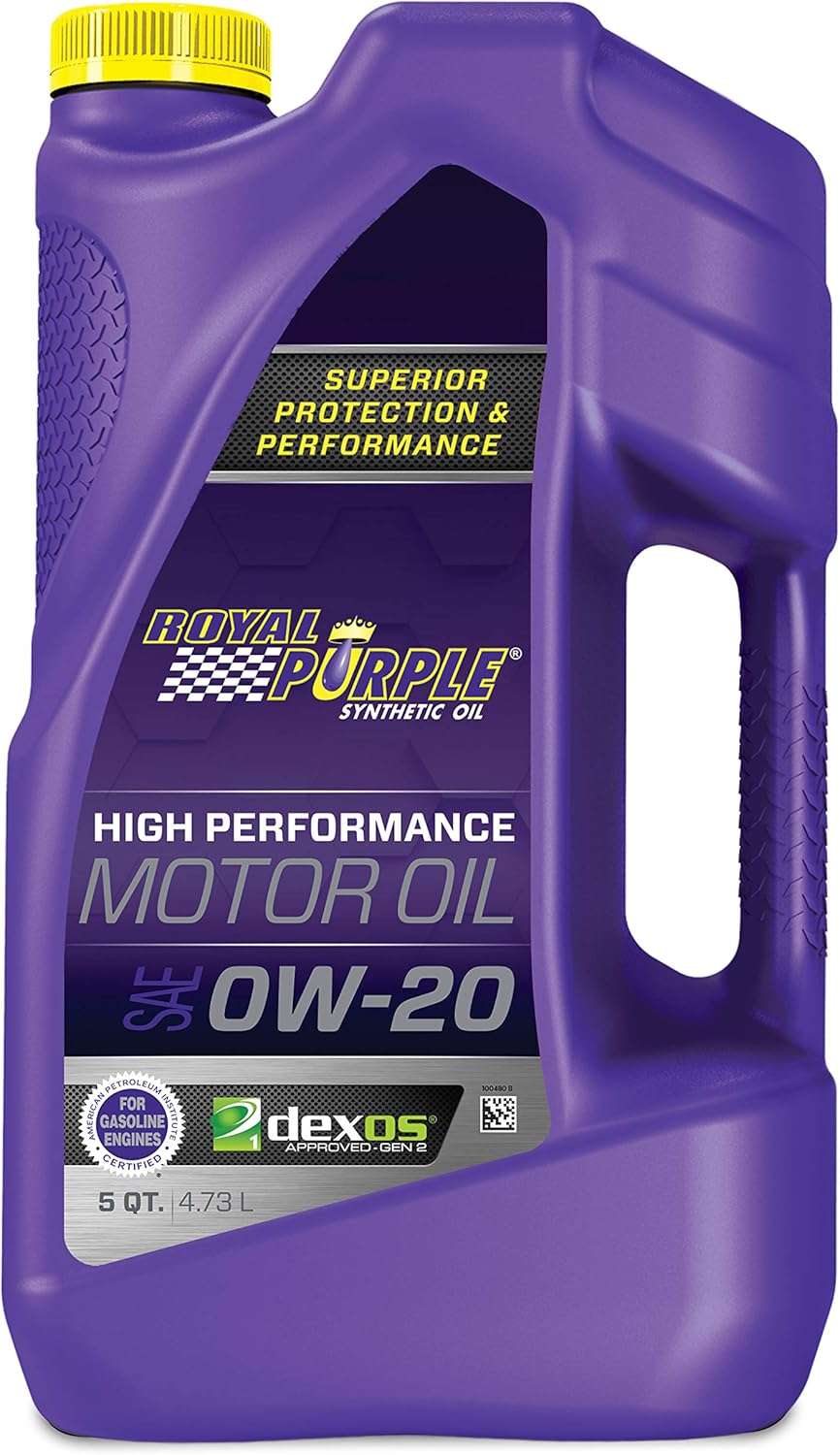
| Viscosity | SAE 0W-20 |
|---|---|
| Volume | 5 qt (4.73 L) |
| Performance ratings | API SN, ILSAC GF-5, Dexos1 1 |
This Royal Purple 0W-20 is a full synthetic motor oil designed to protect engines under varied driving conditions while helping maintain fuel economy. It combines premium base oils and proprietary additives to reduce metal-to-metal contact, resist sludge and varnish, and minimize low-speed pre-ignition in turbocharged direct-injection engines. For a DIY Honda Accord 2.4L, it provides strong start-up protection, keeps valve trains cleaner over time, and supports longer drain intervals compared with many conventional oils. The 5 quart bottle covers a typical Accord oil change with room for the filter and top-off. Expect stable viscosity at operating temperatures and improved corrosion resistance for components exposed to ethanol-blended fuels. The main compromises are cost and that very thin 0W-20 grades can show higher consumption in some older, high-mileage engines; careful monitoring of oil level between changes is recommended. Also pouring the current bottle design can be a bit messy without a funnel.
Best for: DIYers who want a high-performance full synthetic 0W-20 that prioritizes thermal stability, deposit control, and longer protection intervals for routine maintenance on a Honda Accord 2.4L.
Less Ideal for: Drivers seeking the lowest upfront cost or owners of very high-mileage Accord engines who prefer thicker viscosities to reduce consumption should consider other options.
- Full synthetic formulation offers strong thermal and shear stability for extended protection.
- Additive package reduces sludge and deposits for cleaner internals over time.
- Meets API SN and ILSAC GF-5 and Dexos1 1 performance claims for modern gasoline engines.
- Helps improve fuel efficiency due to low friction characteristics.
- 5 quart bottle is the right size for a DIY oil change plus spare for topping off.
- Higher cost than many mainstream 0W-20 oils.
- Thin 0W-20 viscosity may increase oil consumption in some older, high-mileage engines.
Verdict: The best full synthetic engine oil for DIYers who prioritize maximum thermal stability, superior deposit control, and longer-lasting protection under varied driving conditions.
4. Valvoline MaxLife Extended Protection 0W-20 Full Synthetic High Mileage Motor Oil, 5 qt
Best High-Mileage Engine Oil

| SAE J300 Viscosity Grade | 0W-20 |
|---|---|
| Compatible with Vehicle Type | Car, Truck |
| Container Type | Bottle |
| Liquid Volume | 5 Quarts |
Valvoline MaxLife Extended Protection 0W-20 is a full synthetic motor oil aimed at vehicles with elevated mileage and common age-related issues. It is used like any engine oil replacement and is intended for routine oil changes in gasoline and hybrid engines; the 5 quart bottle covers most service intervals for small engines that need roughly 4 to 5 quarts. Notable features include Ultra MaxLife additive technology, extra anti-wear chemistry, detergent boosters for sludge and deposit control, and premium seal conditioners to reduce leaks and oil consumption. In practice those translate to stronger wear protection, better thermal stability, and help restoring flexibility to hardened seals so leaks are less likely to develop after switching. The oil meets modern API and ILSAC specs so it fits current engine requirements. Limitations: the 0W-20 grade is specific to engines that call for that viscosity, so vehicles requiring a different grade need another product, and some vehicles with larger oil capacities may require an extra quart beyond the single 5 qt bottle.
Best for: Buyers who prioritize prolonging the life of a higher-mileage gasoline or hybrid engine and want an oil that targets wear, deposits, and leaking seals.
Less Ideal for: Drivers whose Accord 2.4L specifies a different viscosity or who prefer a different additive strategy such as boutique or racing formulations should look elsewhere.
- Formulated for high-mileage engines with anti-wear additives to slow wear in older engines
- Contains seal conditioners to help reduce and prevent oil leaks from hardened gaskets and seals
- Detergent and antioxidant system that resists sludge and thermal breakdown
- Meets current API and ILSAC performance specifications for modern gasoline engines
- Only available in 0W-20 grade for this listing, so not suitable if your engine requires a different viscosity
Verdict: The best high-mileage engine oil for vehicles with elevated mileage that need seal conditioners, extra detergents, and anti-wear additives to reduce leaks and restore performance.
5. Honda Genuine Synthetic Blend Motor Oil 5W-20 (29.6 oz)
Best 5W-20 Engine Oil

| SAE J300 Viscosity Grade | 5W-20 |
|---|---|
| Compatible with Vehicle Type | Car |
| Container Type | Bottle |
| Unit Count | 29.6 Ounce |
This is Honda's genuine synthetic blend 5W-20 motor oil sold in a factory-branded 29.6 ounce bottle for routine engine service. It is intended for vehicles that call for 5W-20 and delivers a low-viscosity formulation that helps cold starts and rapid oil circulation on startup. Typical use is standard oil changes where buyers prefer a factory-brand fluid matched to Honda recommendations rather than a third-party aftermarket product. Notable features from the listing include vehicle-specific fitment and SAE J300 5W-20 designation, and the product is marketed as an OEM genuine part which can simplify warranty-conscious service. In practice the oil provides everyday protection and compatibility for engines designed around 5W-20; users report normal engine performance across typical service intervals. Limitations are that this is a synthetic blend rather than a full synthetic and the bottle size is under one quart, so you may need multiple bottles for complete fills depending on engine capacity. If you want full-synthetic performance or larger-volume packaging you will need to look elsewhere.
Best for: Buyers who prioritize using a factory-branded 5W-20 oil that matches Honda recommendations for routine maintenance and cold-start performance.
Less Ideal for: Drivers seeking full synthetic protection for extended drain intervals or a single large bottle to service higher-capacity engines in one pour.
- Factory-branded formula matched to Honda specifications for straightforward compatibility
- 5W-20 viscosity supports easy cold starts and quick oil flow on startup
- Genuine part listing reduces uncertainty for warranty-sensitive maintenance
- Synthetic blend rather than full synthetic so peak high-temperature performance is more limited
Verdict: The best 5W-20 engine oil for buyers who need a low-viscosity formulation that ensures easy cold starts, quick oil flow, and factory-recommended protection for engines specified for 5W-20.
6. Honda Genuine Full Synthetic SAE 0W-20 Motor Oil, 5-Quart Pack
Best Premium Engine Oil

| SAE Viscosity Grade | 0W-20 |
|---|---|
| Liquid Volume | 5 Quarts |
| Brand | Honda |
This Honda Genuine full synthetic 0W-20 motor oil is engineered specifically for Honda engines and comes as five one-quart bottles to service a typical oil change. It meets GF-7 and HTO 06 guidance and is tested and approved by Honda R&D, so it focuses on protection against high-temperature viscosity breakdown, reduced volatility to limit oil consumption, and faster circulation at cold starts. You would use it as a direct factory-quality replacement when you want to keep a 2.4L Accord running to factory recommendations or when you prefer manufacturer-approved chemistry. The package size makes it convenient for home changes and keeps spillage minimal. Because it is a manufacturer-branded fluid, it prioritizes compatibility and long-term engine cleanliness over low-cost alternatives. If you expect longer-than-normal drain intervals, confirm service interval guidance in your owner manual since the product description emphasizes performance benefits but does not specify exact extended-drain claims.
Best for: Buyers who prioritize factory-approved protection and compatibility for a Honda 2.4L engine and are willing to pay a premium for manufacturer-tested synthetic oil.
Less Ideal for: Drivers seeking the lowest-cost synthetic oil or those who plan to extend drain intervals beyond factory recommendations without consulting service guidance.
- Formulated specifically for Honda engines and tested by Honda R&D for compatibility
- Full synthetic 0W-20 grade gives fast cold-start flow and protection at high temperature
- Sold as five separate one-quart bottles for convenient home oil changes
- Designed to help minimize deposits and reduce oil consumption through lower volatility
- Manufacturer materials do not state explicit extended drain interval certification
- Pack is branded Honda which can cost more than comparable aftermarket synthetics
Verdict: The best premium engine oil for buyers willing to spend more for advanced additive chemistry, extended drain intervals, and the highest-rated protection for demanding driving conditions.
Choosing the Right Honda Accord 2.4L Engine Oil: Key Factors to Consider
Viscosity and Cold-Start Flow
Viscosity determines how quickly oil circulates at engine start and how well it maintains a protective film at operating temperature. For the 2.4L Accord, choosing the correct SAE grade affects startup wear and drivability in different climates. A lower cold viscosity helps reduce metal-on-metal contact during the first seconds after start, which is important for short-trip city drivers who do many cold starts.
Conversely, viscosity that is too low can thin excessively on long highway runs and under high load, reducing film strength. Look at the oil's multi-grade rating, how it behaves in cold cranking conditions, and whether it stays within recommended limits at operating temperature to balance startup protection and hot-running stability.
Base Oil Type and Oxidation Resistance
Base oil — conventional, synthetic blend, or full synthetic — affects longevity, thermal stability, and resistance to sludge formation. Full synthetic oils resist oxidation and breakdown at higher temperatures better than conventional oils, which can extend oil life and maintain detergent action in the 2.4L's combustion environment.
Oxidation-resistant oils help prevent thickening and varnish on critical components such as piston rings and valve train parts. That stability also supports consistent viscosity over longer drain intervals and reduces the chance of maintenance-related issues between changes.
Additive Package and Wear Protection
The additive chemistry provides anti-wear, detergent, and dispersant functions that protect bearings, cam lobes, and piston rings. Zinc dialkyldithiophosphate (ZDDP) and other anti-wear agents are especially important in older engines or those with flat tappet components. A balanced additive package minimizes deposits, controls soot, and maintains surface protection in the 2.4L's operating conditions.
Consider oils that balance wear additives with detergents to prevent plug fouling and sludge. Overly aggressive detergents in the wrong context can expose weak seals or cause deposit redistribution, so matching additive focus to engine age and condition matters.
Manufacturer Specs and Industry Certifications
Oils that meet Honda-recommended viscosity and certification requirements provide confidence in compatibility and warranty compliance. Industry certifications like API and ILSAC indicate that an oil has passed baseline performance testing for wear, oxidation, and detergent performance. For the Accord 2.4L, verify that the oil meets the recommended API service category and any manufacturer-specific approvals.
Choosing oils aligned with specifications avoids unexpected compatibility issues with seals, gaskets, and emission systems. It also makes it easier to follow recommended service intervals and maintain reliable engine performance.
High-Mileage Considerations
As miles accumulate, engines tend to develop greater oil consumption, minor leaks, and wear that changes internal clearances. High-mileage formulations include conditioners and seal-friendly additives that can reduce leaks and improve compression retention. For a 2.4L Accord with significant miles, these properties can help extend the engine's usable life.
However, high-mileage oils may alter oil pressure slightly or affect seal softening over the short term. Evaluate whether the engine shows signs of leakage, consumption, or low compression before switching, and consider monitoring oil level closely after a change.
Service Interval and Long-Term Cost
Different formulations support different drain interval recommendations. Full synthetics often enable longer intervals between oil changes due to superior oxidation resistance, while conventional oils typically require shorter intervals. For the 2.4L Accord, longer drain intervals can be convenient, but only if the oil maintains protection under your typical driving conditions.
Also factor in the long-term cost of maintenance, including oil filters and the potential impacts of extended drains on engine deposits. Choosing an oil that aligns with your maintenance habits and the manufacturer's guidance helps avoid unnecessary wear or premature service needs.
Recommended Viscosity Choices for Different Climates
Selecting the right SAE grade for your climate affects start-up lubrication and high-temperature protection. In cooler regions, a lower cold-viscosity grade helps the 2.4L circulate oil faster at startup, reducing wear from brief warm-up periods. In hot climates, a slightly thicker high-temperature viscosity can maintain film strength during prolonged highway driving.
Follow the manufacturer guidance for the primary recommended viscosity range, and adjust within that range if your driving pattern or local temperature extremes warrant it. For drivers facing wide seasonal swings, multi-grade oils that preserve low-temperature flow and high-temperature stability are typically the best compromise.
- Cold climates benefit from oils with quicker cold-cranking flow.
- Hot climates need oils that resist thinning under extended high load.
- Multi-grade oils balance cold start and hot running needs.
When to Choose Full Synthetic Versus Conventional
Full synthetic oils offer stronger thermal stability and oxidation resistance, which can help maintain protection across longer drain intervals. They are beneficial for drivers doing frequent highway trips, towing, or operating in extreme temperatures. Conventional oils can be adequate for routine, low-stress driving and may be chosen where change intervals are short and cost is a concern.
Consider engine age and usage. Newer engines with tighter clearances often gain the most from synthetics, while older engines with higher oil consumption might benefit from a synthetic blend or high-mileage formulation that addresses seal condition.
- Full synthetics resist breakdown and help reduce deposits.
- Conventional oils can be acceptable for low-stress, short-interval maintenance.
- Synthetic blends offer a compromise between protection and cost.
High-Mileage Engine Care for the 2.4L
If your Accord 2.4L has high miles, focus on oils that include seal conditioners and targeted additives to address increased leaks and consumption. These formulations help maintain oil pressure and can reduce minor seepage that develops over time. Regular monitoring of oil level after a change is especially important to ensure no adverse reactions occur.
High-mileage oils can also support ring seal and compression retention, which helps with drivability and emissions. Be mindful that not every older engine benefits the same way from seal conditioners; monitor for any changes in oil pressure or drivability after switching.
- Look for seal-friendly additives to reduce minor leaks.
- Monitor oil level closely after switching formulas.
- High-mileage formulations can help with compression and drivability.
Oil Change Practices That Extend Engine Life
Regular oil and filter changes are among the most effective ways to protect the 2.4L engine. Use the correct viscosity and an appropriate filter with the right micron and bypass characteristics. Adhering to manufacturer-recommended intervals, or slightly more frequent changes under severe-service conditions, minimizes contamination and wear.
When performing an oil change, also inspect the oil pan, drain plug, and filter sealing areas for signs of leakage or thread damage. Proper torqueing of the drain plug and correct filter installation help prevent future leaks and ensure the new oil stays clean longer.
- Replace the oil filter at each oil change.
- Follow torque specs for drain plugs and filter housing.
- Shorten intervals for severe stop-and-go or dusty driving.
How Oil Choice Affects Fuel Economy and Emissions
Oil viscosity and friction-modifying additives can influence parasitic drag on the crankshaft and bearings, which in turn affects fuel economy. Using the right grade of oil for temperature conditions helps minimize energy losses without compromising protection. Advanced synthetics with lower friction characteristics may deliver small, measurable gains in mpg over time.
Maintaining clean oil and proper viscosity also supports the emission-control systems by limiting deposit formation that can affect sensors and combustion efficiency. This indirect benefit helps the engine run cleaner and stay within expected emissions parameters.
- Correct viscosity reduces internal friction and can improve mpg.
- Cleaner oil helps sensors and catalytic performance indirectly.
- Friction modifiers can provide modest fuel-economy gains.
Still looking for the perfect fit?
Select your Honda Accord configuration to see the most relevant Engine Oils recommendations
How We Chose the Best Honda Accord 2.4L Engine Oil
We evaluated candidate engine oils against a set of practical, vehicle-specific criteria to identify products suited to the Honda Accord 2.4L. Primary considerations included viscosity range and temperature performance, because the 2.4L needs an oil that flows quickly at cold start temperatures while maintaining a stable film under highway heat. We also prioritized formulation type, distinguishing between full synthetic, synthetic blend, and conventional base stocks for their differences in oxidation resistance and high-temperature protection.Wear protection and additive chemistry were weighed heavily, focusing on oils with robust anti-wear additives and detergent dispersants that help keep combustion byproducts in suspension. Compatibility with Honda-specified certifications and API ratings was required. For higher-mileage engines we assessed seal-compatibility and conditioners that reduce oil consumption and leaks. Finally, we considered real-world durability by looking at recommended drain intervals and manufacturer guidance.We excluded products that did not meet the required viscosity specifications or lacked mainstream API/industry certifications. Oils intended exclusively for racing or non-street use were not considered. The resulting shortlist balances protection, drivability, and long-term engine care for the Accord 2.4L.
Our full evaluation process is outlined in our review methodology.
FAQ
What viscosity oil should I use in a Honda Accord 2.4L?
Use the viscosity range recommended in the owner manual for your Accord 2.4L, which balances cold-start flow and hot-running film strength. Your choice can be adjusted within that recommended range based on local climate and driving conditions.
Can I switch from conventional to full synthetic in my 2.4L engine?
You can usually switch to full synthetic without issue. It often improves thermal stability and protection. After switching, monitor oil level and watch for any change in consumption or leaks, particularly on higher-mileage engines.
How often should I change the oil in a Honda Accord 2.4L?
Follow the manufacturer's interval for normal driving, and shorten intervals for severe-service conditions such as frequent short trips, towing, or heavy idling. Using full synthetic may allow for longer intervals within manufacturer guidelines.
Is a high-mileage oil necessary for an older Accord 2.4L?
High-mileage oils can benefit engines showing oil consumption, minor leaks, or reduced compression by offering seal conditioners and targeted additives. Whether to switch depends on the engine's condition and symptoms.
Will a different oil change my fuel economy in the Accord 2.4L?
Changing to an oil with lower internal friction or the correct viscosity for your climate can produce small fuel-economy improvements. The effect is usually modest and depends on driving habits and conditions.
Are synthetic blends a good compromise for the 2.4L?
Synthetic blends can provide better protection than conventional oil while costing less than full synthetics. They are a reasonable choice if you want improved thermal stability without committing to full synthetic intervals.
Final Verdict
Choose an oil that matches the Honda Accord 2.4L's recommended viscosity and certifications, then tailor the formulation to your driving style and engine condition. For most drivers, full synthetic delivers the best balance of cold-start protection, high-temperature stability, and extended drain capability, while high-mileage formulations address leak and consumption concerns on older engines.Prioritize viscosity, wear protection, and compatibility with manufacturer specs. With those tradeoffs in mind, you can select an oil that keeps the 2.4L running reliably and minimizes long-term wear.
Explore More:
- Check out all Honda Accord parts & accessories
- Explore Fluids & Chemicals
- Browse all Accessories
