

Note: This article contains affiliate links. If you click on these links and make a purchase, I may earn a small commission at no extra cost to you. This helps support my research and content. Read my full affiliate disclosure here.
If your Ford F-150 3.5L is showing check-engine lights, reduced fuel economy, or an exhaust odor, replacing the catalytic converter can be a necessary repair. Picking the correct catalytic converter matters because fitment, cell design, and emissions efficiency directly affect drivability, diagnostics, and legal compliance for this specific 3.5L configuration.This guide covers six shortlisted catalytic converters chosen for reliable fit and proven emissions performance with the Ford F-150 3.5L. We evaluate each option against practical criteria such as physical fitment, emissions effectiveness, backpressure impact, and installation considerations so you can pick the right unit for your needs. Read on for what matters when replacing the catalytic converter on this truck and how to prepare for installation.
Looking for other parts? See all Ford F-150 parts & accessories.
Top Picks at a Glance
| Best Overall The best all-around choice for most situations | pulcherflow Direct-Fit Catalytic Converter for 2011–2014 Ford F-150 3.5L V6 |  |
| Best Quality Built to a higher standard if you want something more solid | MagnaFlow 21-474 Direct-Fit OEM-Grade Catalytic Converter (Driver Side) |  |
| Best Value The sweet spot between price and what you get | ZHRUIHAN 2‑Piece Left and Right Catalytic Converter Kit for Ford F-150 3.5L Turbocharged (2015–2020) |  |
| Best Budget The cheapest option that still gets the job done reliably | ECCPP Direct-Fit Catalytic Converter for Ford F-150 3.3L / 3.5L (2015–2019) |  |
| Highest Rated A top-rated pick with lots of positive feedback | MagnaFlow 21-475 Direct-Fit Catalytic Converter (Passenger Side) |  |
| Most Popular A crowd favorite that many people choose with confidence | RZOCARULE Catalytic Converter Kit for Ford F-150 3.5L (Left & Right, EPA Compliant) |  |
pulcherflow Direct-Fit Catalytic Converter for 2011–2014 Ford F-150 3.5L V6

| Vehicle fitment | 2011–2014 Ford F150 3.5L V6 |
|---|---|
| Position | Left, Right |
| Manufacturer | PULCHERFLOW |
| EPA compliance | Federal emissions models only |
This pulcherflow catalytic converter is a direct-fit replacement for the 3.5L V6 Ford F-150 (2011–2014) intended to restore emissions control and exhaust flow without major modification. It uses an enlarged ceramic substrate and increased precious metal loading to improve conversion efficiency and meets EPA criteria for federal emissions models. The shell is stainless steel with mandrel-bent tubing to resist corrosion and withstand high temperatures, and the unit includes mounting holes, gaskets, and basic hardware to simplify installation. In practice this is a practical option if you want a quick, bolt-on replacement that brings back catalytic function and reduces emissions compared with a straight pipe. Some owners report needing stronger exhaust clamps or minor adjustments during fitment, and units are not legal for sale or use in several states with strict emissions regulations. Fit and sensor placement are generally good for the specified years but confirm exact vehicle emissions configuration before buying.
Best for: Buyers who want an affordable, bolt-on replacement that restores catalytic function and emissions compliance on a 2011–2014 Ford F‑150 3.5L V6 without extensive modification.
Less Ideal for: Do not choose this if you need a state-certified unit for restricted states or if you prefer a direct OEM-sourced factory part from a dealer.
- Direct-fit design with predrilled mounting holes and included basic hardware for easier installation
- Enlarged ceramic substrate and higher precious metal loading for improved conversion efficiency
- Stainless steel shell and mandrel bends for corrosion resistance and durability
- EPA compliant for federal emissions models, restoring emissions control functions
- Not legal for sale or use in certain states with stricter emissions rules
- Some customers report supplied clamps and hardware are low quality and may need replacement
Verdict: A cost-conscious, direct-fit converter that restores emissions control and exhaust flow for 2011–2014 Ford F‑150 3.5L V6 trucks when state-specific certification is not required.
MagnaFlow 21-474 Direct-Fit OEM-Grade Catalytic Converter (Driver Side)
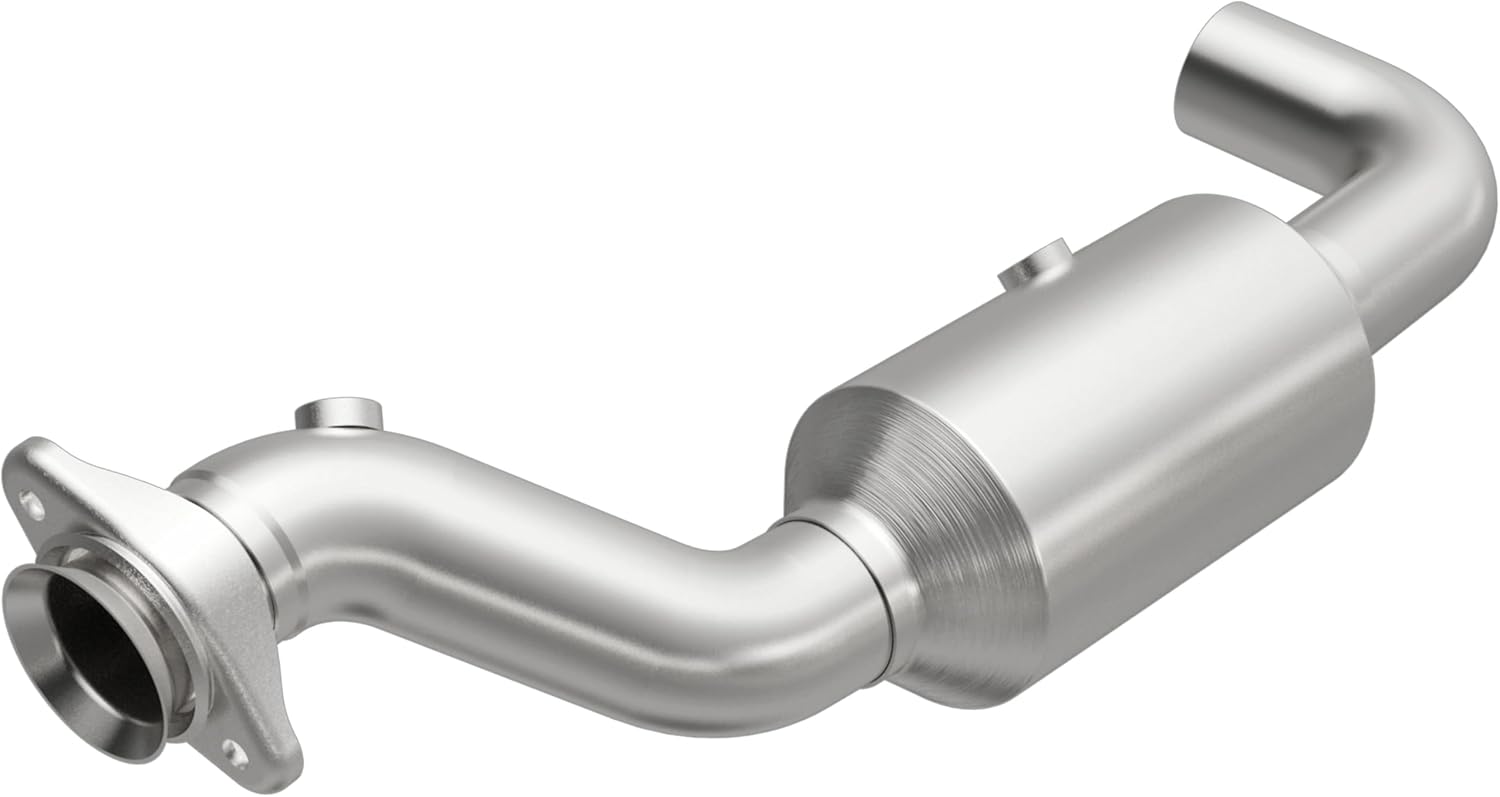
| Fitment | 2015–2020 Ford F-150 3.5L V6, driver side |
|---|---|
| Compliance | Federal EPA compliant |
| Construction | Mandrel-bent tubing, spun body stainless steel |
| Model | MagnaFlow 21-474 |
This MagnaFlow 21-474 is a direct-replacement catalytic converter built to match factory flow dynamics while meeting Federal EPA emissions requirements for 2015–2020 Ford F-150 3.5L trucks. It uses mandrel-bent tubing and a spun body design with a single laser fusion weld intended to reduce leaks and retain smooth exhaust flow, so installation can be done without cutting or welding when proper tools are used. The stainless steel construction and compact, low-mass design aim to resist corrosion and improve thermal efficiency relative to heavier aftermarket units. In practice this part is used to restore emissions control and keep the check engine light off while maintaining near-factory performance and fuel economy. Notable limitations are mixed user reports on long-term durability and some customer service friction for warranty returns, so expect variable longevity compared with higher-end OEM remanufactured units. Fitment is specific to the left/driver side for the 3.5L V6 F-150 and it is not for sale in certain states with different regulations.
Best for: Buyers who prioritize restoring factory emissions control and exhaust flow on a 2015–2020 F-150 3.5L while keeping installation straightforward and maintaining near-stock performance.
Less Ideal for: Drivers seeking the longest-term, highest-reliability performance upgrades or those who need parts approved for restricted states should consider alternatives or OEM dealer options.
- Direct-fit design replicates factory geometry for easy bolt-on installation
- Mandrel-bent tubing and spun body aim to preserve smooth exhaust flow and fuel economy
- Stainless steel construction improves corrosion resistance and thermal efficiency
- Federal EPA compliant for OBDII registered vehicles in applicable markets
- Some customers report early failures and inconsistent long-term durability
- Not available for sale in certain states with stricter regulations
Verdict: Choose this MagnaFlow converter when you want a bolt-on, factory-style replacement that preserves exhaust flow and keeps emissions systems functioning on a 3.5L F-150.
ZHRUIHAN 2‑Piece Left and Right Catalytic Converter Kit for Ford F-150 3.5L Turbocharged (2015–2020)

| Compatible vehicle | Ford F-150 2015–2020 3.5L V6 Turbocharged |
|---|---|
| Exterior | Stainless Steel |
| OEM Part Number | 52605 50404 52605 645146 |
| Model | SYCH0035 |
This ZHRUIHAN kit supplies both left and right front catalytic converters for the 3.5L turbocharged F-150, intended as a direct replacement to restore emissions function and exhaust routing. The housings are stainless steel with automated welds and an internal ceramic carrier loaded with platinum, rhodium, and palladium to convert NOx, CO, and hydrocarbons into cleaner gases. Installation is marketed as matching the original units so it can be bolted in without major modification, and reviewers note it includes hardware and an O2 sensor tool in some shipments. Practical benefits are that it addresses emissions failures, uses corrosion-resistant materials, and comes as a matched pair for both banks. Important limitations are mixed fitment reports and some customers needing extra machining or stud replacement to seal properly, as well as at least one report of new engine codes after installation. The product is not sold in certain states that require stricter local certification. Expect a replacement that often works as a cost-effective fix but may require a competent installer to ensure a leak-free, code-free result.
Best for: Buyers who want a practical, lower-cost replacement to restore emissions performance on a 2015–2020 3.5L F-150 and are comfortable having a professional installer verify fit and seal.
Less Ideal for: Drivers who need guaranteed state-specific certified converters or who want a completely bolt-on, no-modification installation experience should consider alternatives or factory-authorized parts.
- Matches both left and right front converter locations to replace both banks at once
- Stainless steel construction and automated welding for better corrosion and heat resistance
- Internal ceramic carrier with Pt, Rh, Pd catalysts for standard emissions conversion
- Includes installation hardware and sometimes an O2 sensor tool according to user reports
- Some buyers report fitment issues requiring stud replacement or additional work to stop exhaust leaks
- Not available for sale in certain states with stricter emissions rules
Verdict: A cost-conscious matched pair that restores emissions function on 2015–2020 F-150 3.5L trucks when installed and sealed by a competent technician.
ECCPP Direct-Fit Catalytic Converter for Ford F-150 3.3L / 3.5L (2015–2019)

| Fitment | 2015–2019 Ford F-150 3.3L / 3.5L |
|---|---|
| Certification | EPA compliant |
| Material | Stainless steel shell |
| Replacement part number | 52605 |
This ECCPP catalytic converter is a direct-fit replacement for 2015–2019 Ford F-150 3.3L and 3.5L engines and is aimed at straightforward bolt-in swaps. It uses a stainless steel shell with a honeycomb ceramic substrate coated in metal catalysts to improve conversion of harmful gases while resisting high heat. The unit comes with washers and nuts so you can install it without welding, which suits DIY repairs or quick garage installs. It is EPA certified for emissions performance, so it should restore catalytic function where required by federal standards, but it is not CARB compliant and cannot be shipped to certain states. As a budget-oriented aftermarket option, it balances cost and practical durability; buyers should note it is not marketed as a performance or lifetime upgrade and long-term longevity may vary compared with higher-end factory-quality units. Fitment requires verifying engine and year before purchase to ensure compatibility with your F-150 configuration.
Best for: Buyers prioritizing a low-cost, do-it-yourself replacement to restore emissions equipment on affected F-150 3.3L or 3.5L trucks who want a straightforward bolt-on part rather than a high-end performance upgrade.
Less Ideal for: Owners in states requiring CARB-certified parts or those seeking an OEM-level or performance-focused catalytic upgrade should look elsewhere.
- Direct-fit design for 2015–2019 F-150 3.3L and 3.5L simplifies installation
- Supplied washers and nuts allow bolt-on installation without welding
- Stainless steel shell and metal-coated honeycomb substrate aimed at improved durability and conversion efficiency
- EPA compliant for federal emissions standards
- Not CARB compliant so it is restricted from sale in some states
Verdict: A cost-conscious, bolt-on EPA-compliant catalytic converter that gets an F-150 3.3L/3.5L back to emissions spec without welding.
MagnaFlow 21-475 Direct-Fit Catalytic Converter (Passenger Side)

| Fitment | 2015-2020 Ford F-150 V6 3.5L passenger side |
|---|---|
| Material | Stainless Steel |
| Compliance | EPA compliant (not for use/sale in CA, CO, NY) |
| Part Number | 21-475 |
This MagnaFlow 21-475 is a direct-fit replacement catalytic converter for the passenger side of 2015–2020 Ford F-150 3.5L trucks. It installs in place of the factory unit and is built from stainless steel with mandrel-bent tubing and OE-style hangers to preserve exhaust routing and reduce vibration. In everyday use it restores emissions control, helps clear check-engine codes tied to catalytic efficiency, and maintains smooth exhaust flow for consistent engine performance and fuel economy. The EPA-compliant design makes it a legal replacement in most states outside the restricted list, and the corrosion-resistant materials are aimed at longer service life than cheaper coated units. Limitations include ineligibility for sale in California, Colorado, and New York and the fact that this is a direct factory-replacement style part rather than a performance-oriented converter, so it will not increase exhaust flow beyond stock. Expect professional installation if you lack exhaust experience because fitment and welding may be required.
Best for: Buyers who prioritize long-term reliability and emissions compliance for a Ford F-150 3.5L and want a straightforward factory-style replacement to restore proper operation and pass inspections.
Less Ideal for: Drivers seeking a high-flow or performance-oriented converter upgrade or those who need a unit legal for sale in California, Colorado, or New York should look elsewhere.
- Direct-fit design preserves factory exhaust geometry for straightforward replacement
- Stainless steel construction and mandrel-bent tubing improve corrosion resistance and maintain smooth exhaust flow
- Includes OE-sized barbed hangers to minimize vibration and simplify installation alignment
- Not legal for use or sale in California, Colorado, or New York
Verdict: Choose this MagnaFlow direct-fit converter when you want a durable, factory-quality replacement that restores emissions function and reliability on a 2015–2020 F-150 3.5L.
RZOCARULE Catalytic Converter Kit for Ford F-150 3.5L (Left & Right, EPA Compliant)

| Compatibility | 2011–2014 Ford F-150 3.5L |
|---|---|
| Material | Stainless steel outer shell |
| Design | Flange-to-flange, bolt-on with gaskets and hardware |
| Emissions compliance | EPA compliant (not for CA/NY/ME) |
This RZOCARULE kit supplies left and right catalytic converters sized to bolt in place on 2011–2014 Ford F-150 3.5L trucks that use flange-to-flange connections. The stainless steel shell promises corrosion and heat resistance while the internal honeycomb ceramic matrix and catalyst coating aim to improve conversion of harmful gases. Install is straightforward for shops or experienced DIYers because the kit includes gaskets and mounting hardware and uses standard flange fittings. Real-world buyer feedback is mixed: many buyers report the parts fit and cured check-engine issues after a break-in period, while some saw persistent monitor codes or fitment mismatches on specific exhaust headers. The converters are EPA compliant for most states but are explicitly not for use in California, New York, Maine, or for shipments to restricted states. If you need a direct replacement that focuses on emissions performance and a bolt-on install, this kit is a practical option, but expect to allow a few hundred miles for the vehicle computer to relearn sensor readings and confirm the repair.
Best for: Buyers who prioritize a direct, bolt-on emissions repair for a Ford F-150 3.5L and want a factory-style replacement that focuses on restoring catalytic function with included hardware.
Less Ideal for: People who need parts certified for California or other strict emissions states or those seeking an exact OEM-matching converter for modified headers should look elsewhere.
- Vehicle-specific fitment for Ford F-150 3.5L left and right positions.
- Stainless steel outer shell resists rust and high heat for longer service life.
- Flange-to-flange bolt-on design with included gaskets and hardware simplifies installation.
- High-flow ceramic honeycomb core designed to maximize catalyst contact and improve emissions conversion.
- EPA compliant for eligible states, containing catalyst materials to reduce tailpipe pollutants.
- Not legal for sale or use in California, New York, or Maine emissions models and cannot be shipped to restricted states.
- Some buyers reported fitment mismatches with certain header or manifold configurations and continued diagnostic codes on some vehicles.
Verdict: A practical, vehicle-specific bolt-on catalytic converter pair that restores emissions function for 2011–2014 F-150 3.5L trucks when you need an EPA-compliant replacement outside restricted states.
Choosing the Right Ford F-150 3.5L Catalytic Converter: Key Factors to Consider
Fitment and Direct-Mount Compatibility
Correct fitment is the primary concern when replacing a catalytic converter on the Ford F-150 3.5L. Direct-mount units that match the factory flange geometry, inlet/outlet diameter, and oxygen sensor bungs reduce the need for extra adapters or pipe modifications. A proper physical fit lowers labor time, reduces exhaust leaks, and helps preserve factory emission-control plumbing.
Fitment also affects diagnostics. If sensor locations are moved or bung angles are changed, the vehicle may register incorrect O2 readings and trigger check-engine codes. For owners who need a plug-and-play replacement, choose a converter designed specifically for the 3.5L configuration to avoid extra work or sensor extension harnesses.
Emissions Efficiency and Substrate Type
The converter's substrate and washcoat determine how effectively it converts hydrocarbons, carbon monoxide, and nitrogen oxides. High cell density and an appropriate washcoat loading improve conversion efficiency at operating temperatures, which is important for meeting emissions standards during both idle and highway driving for the 3.5L engine.
Different substrate materials and cell densities influence light-off time and efficiency across temperature ranges. For street-driven F-150s, prioritize converters engineered for quick light-off and sustained conversion efficiency under typical operating conditions to reduce the chance of failed emissions tests and persistent codes.
Backpressure and Engine Performance
Catalytic converters introduce flow restriction by design, and excessive backpressure can hurt throttle response, low-end torque, and fuel trims on the 3.5L engine. When selecting a replacement, consider units that balance sound conversion efficiency with minimized flow restriction to preserve engine performance.
Manufacturers may specify flow characteristics or use lower-cell-density cores for less restriction while still meeting emissions needs. For drivers who tow or frequently haul loads with the F-150 3.5L, maintaining adequate exhaust flow is particularly important to avoid power loss under load.
Durability and Corrosion Resistance
The converter housing and welds face heat cycles, road debris, and salt exposure over time. Look for robust shell construction, quality seam welding, and coatings or stainless materials that resist corrosion, especially if the truck sees winter roads or off-highway use. A durable housing reduces the likelihood of cracks and exhaust leaks that can lead to poor performance and additional repairs.
Lifetime expectations also hinge on the internal substrate resilience. Substrates that are less prone to thermal shock and that use reinforced mounting within the shell will generally outlast cheaper alternatives. Long-term durability matters for minimizing downtime and repeat garage visits for F-150 owners.
Oxygen Sensor and ECU Compatibility
The Ford F-150 3.5L relies on precise O2 sensor readings for closed-loop fuel control and catalyst monitoring. Replacement converters should provide proper sensor bung placement and sealing to preserve measurement accuracy. Mismatched bung angles or incorrect sensor-to-core spacing can cause false upstream or downstream readings and trigger diagnostic trouble codes.
Some replacements include pre-installed sensor bungs or heat shields that help maintain sensor life and signal integrity. Ensure the chosen unit keeps the factory sensor layout for straightforward plug-and-play installation and consistent ECU behavior.
Installation Complexity and Hardware Included
Installation considerations influence total repair cost and whether the job is DIY-friendly. Direct-fit converters that match factory flanges and come with necessary gaskets and hardware lower installation time. Conversely, universal units or those requiring cutting, welding, or custom hangers increase labor and may require a professional.
Evaluate whether the replacement includes gaskets, flange bolts, and any mounting brackets. Also consider whether the vehicle will need O2 sensor extensions, new hangers, or additional exhaust work. For owners seeking a straightforward repair on the 3.5L F-150, minimizing extra parts and modification requirements simplifies the process and reduces potential points of failure.
Legal and Emissions Compliance
Understanding local emissions rules is important when replacing a catalytic converter on the Ford F-150 3.5L. Many jurisdictions require that replacement converters meet specific emissions certifications or fitment standards to be street-legal; installing a unit that lacks necessary approvals could lead to inspection failures or fines. Check your state or regional requirements before choosing a unit.
- Verify required certification or CARB equivalence if applicable in your area.
- Confirm the replacement maintains original O2 sensor locations and emissions plumbing to avoid inspection issues.
Preparing for Installation
Preparing the truck and workspace before beginning work reduces surprises. Raise and securely support the F-150 on jack stands or a lift, and let the exhaust cool fully. Inspect surrounding components such as exhaust hangers, heat shields, and the flange faces for corrosion or damage that might complicate replacement.
- Have replacement gaskets, bolts, and anti-seize available to ensure proper sealing.
- Measure inlet and outlet diameters and note oxygen sensor locations to confirm part compatibility.
Common Symptoms That Indicate Converter Issues
Recognizing the signs of a failing catalytic converter helps prioritize replacement. Typical symptoms on a 3.5L F-150 include a persistent check-engine light with catalyst-related codes, reduced acceleration or power under load, and an unusual sulfur or rotten-egg odor from the exhaust. Excessive exhaust heat or rattling noises from the converter shell can indicate internal deterioration.
- Check-engine codes related to catalytic efficiency often appear before obvious drivability loss.
- Rattling or metallic noises under acceleration usually point to a physically damaged substrate.
Maintaining Converter Health After Replacement
After installing a new converter, routine maintenance and mindful driving habits help extend its life. Avoid running overly rich fuel mixtures, and address engine misfires promptly, as unburned fuel can overheat and damage the substrate. Keep the engine properly tuned, and repair oil or coolant leaks that could contaminate the catalyst.
- Address ignition and fuel system faults quickly to prevent substrate clogging.
- Inspect hangers and heat shields periodically to prevent premature damage from vibration or road debris.
When to Consult a Professional Mechanic
Some replacement scenarios are straightforward but others require professional attention. If the exhaust system has significant rusted flanges, frame-mounted hangers, or complex emissions plumbing, a shop with exhaust experience can ensure proper alignment and sealing. Professionals also have the tools to verify post-installation O2 sensor readings and perform smoke tests to confirm there are no leaks.
- Seek professional help if welding or pipe modification is needed.
- A technician can diagnose related engine issues that may have caused converter failure, such as misfires or fuel system faults.
Still looking for the perfect fit?
Select your Ford F-150 configuration to see the most relevant Catalytic Converters recommendations
How We Chose the Best Ford F-150 3.5L Catalytic Converter
Our selection process focused on factors that matter for replacing a catalytic converter on the Ford F-150 3.5L. We prioritized exact-fit units and direct-fit designs that match factory flange and sensor locations to reduce installation complexity. Emissions performance was evaluated by rated conversion efficiency and substrate construction, since effective reduction of HC, CO, and NOx is essential for this engine. We considered backpressure and flow characteristics to avoid adverse effects on torque and fuel trim, and durability factors such as substrate material and shell construction to resist cracking and premature failure. Corrosion resistance and mounting hardware quality were included to ensure longevity in real-world driving conditions.We excluded universal, highly modified, or race-only units that require major exhaust work or will not pass street emissions checks for this engine. Units that require significant O2 sensor relocation or custom tuning were not considered. The final list reflects a balance of fitment fidelity, emissions effectiveness, installation ease, and physical durability for owners of the Ford F-150 3.5L.
Our full evaluation process is outlined in our review methodology.
FAQ
How long does a catalytic converter last on a Ford F-150 3.5L?
Lifespan varies based on driving conditions and maintenance, but a properly functioning converter often lasts many years. Frequent short trips, engine problems, or contamination from oil or coolant can shorten service life.
Will a bad catalytic converter cause my check-engine light to stay on?
Often yes. Catalyst efficiency-related codes or downstream O2 sensor readings commonly trigger the check-engine light. However, the light can also be caused by unrelated engine issues, so proper diagnostics are important.
Can I install a replacement converter myself on the 3.5L F-150?
Some direct-fit replacements are installable by competent DIYers with the right tools and safety precautions. Jobs involving severe rust, welding, or complex sensor relocations are better handled by a professional.
Will replacing the catalytic converter affect engine performance?
A correctly selected converter balances emissions control with flow; it should restore normal performance if the old unit was clogged. Choosing an overly restrictive unit can negatively affect low-end torque and throttle response.
Do I need new gaskets or hardware when replacing the converter?
Yes. Replacing gaskets and fasteners during installation ensures proper sealing and reduces the chance of exhaust leaks. Many replacement units include hardware, but verify before starting the job.
What maintenance helps prevent premature converter failure?
Keep the engine well tuned, promptly repair misfires and fuel system issues, and fix oil or coolant leaks. Avoid prolonged low-temperature operation that prevents the converter from reaching efficient operating temperature.
Final Verdict
When replacing the catalytic converter on a Ford F-150 3.5L, prioritize exact fitment, emissions efficiency, and flow characteristics to maintain diagnostics and performance. Consider durability features and proper oxygen sensor placement to reduce future problems and keep the exhaust system sealed. Balance the need for low backpressure with sufficient conversion efficiency so the truck remains compliant while preserving torque under load.Choose a unit that matches the factory flange and sensor layout, includes necessary hardware when possible, and meets local emissions requirements. That approach will deliver the most reliable long-term outcome for your F-150 3.5L.
Explore More:
- Check out all Ford F-150 parts & accessories
- Explore Catalytic Converters Maintenance & Repair Guides
- Explore Exhaust & Emissions
- Browse all Auto Parts
