

Note: This article contains affiliate links. If you click on these links and make a purchase, I may earn a small commission at no extra cost to you. This helps support my research and content. Read my full affiliate disclosure here.
If you drive a 2018-2022 Honda Accord, the condition of your brake rotors has a big effect on pedal feel, stopping distances, and long-term brake-system health. Replacing worn or warped rotors restores consistent braking, reduces vibration, and helps extend pad life. This guide gathers the top shortlisted brake rotors suitable for the Accord's 2018–2022 model years and evaluates them against the needs of commuting, occasional spirited driving, and heavy-duty daily use.Below you will find the picks and a clear breakdown of the evaluation criteria used, including rotor construction, heat management, fitment, and serviceability. Use these notes to match the right rotor type to how you actually drive and maintain your Accord.
Looking for other parts? See all Honda Accord parts & accessories.
Top Picks at a Glance
| Best Overall The best all-around choice for most situations | Bendix Premium PRT6846 Front Brake Rotor |  |
| Best Quality Built to a higher standard if you want something more solid | PowerStop K8166 Front and Rear Z23 Carbon-Fiber Brake Kit (Drilled & Slotted Rotors) |  |
| Best Value The sweet spot between price and what you get | TRQ Front and Rear Ceramic Brake Pad and Rotor Kit for 2018–2021 Honda Accord |  |
| Best Budget The cheapest option that still gets the job done reliably | SUNROAD 11.10" Drilled & Slotted Rear Brake Rotors and Ceramic Pads Kit for Honda Accord 2018–2022 |  |
| Highest Rated A top-rated pick with lots of positive feedback | Detroit Axle Front Brake Kit for 2013–2022 Honda Accord (11.54" Rotor) |  |
| Most Popular A crowd favorite that many people choose with confidence | Max Advanced Brakes Front Brake Kit — Carbon Ceramic Pads and Front Rotors (ValueMAX) |  |
| Best Seller A high-volume bestseller chosen again and again | PowerStop Rear Brake Kit for Honda Accord (2018–2025) — Z17 Ceramic Pads & OE Replacement Rotors |  |
1. Bendix Premium PRT6846 Front Brake Rotor

| Material Type | Cast Iron |
|---|---|
| Exterior Finish | Machined |
| Automotive Fit Type | Vehicle Specific Fit |
| Included Components | (1) Bendix Rotor |
The Bendix Premium PRT6846 is a machined, cast-iron front brake rotor made as a vehicle-specific replacement for recent Honda and Acura models. It installs the same way as other single rotors — clean the hub, mount and torque to factory specs, then bed in with matching pads — and is meant for everyday driving rather than track use. Notable features include a machined finish, dynamic balancing to reduce vibration, and a vented design for heat dissipation, which together help maintain smooth, quiet braking and resist fade under normal road conditions. Buyers report generally good fitment and quiet operation; a few users noted occasional warping on long-term or heavy-duty use, so careful installation and proper break-in are important. This rotor comes individually, so order pairs for axle work. It is a solid midrange choice that prioritizes factory-style performance and durability for daily-driven Accords within the 2018–2022 model years but is not aimed at performance braking or heavy towing applications.
Best for: Buyers seeking a reliable, factory-quality front rotor that restores OEM-style braking feel and quiet daily performance on a 2018–2022 Honda Accord.
Less Ideal for: Drivers who need track-rated rotors or heavy-duty braking upgrades should look at performance- or heavy-duty-specific rotors instead.
- Vehicle-specific fit for a direct replacement on supported models
- Machined finish and dynamic balancing reduce noise and vibration
- Vented cast-iron construction helps dissipate heat and limit brake fade
- Designed to match factory fit, form, and function for straightforward installation
- Sold as a single rotor so you must purchase two for a full axle replacement
- Not designed for high-performance or heavy-duty towing use
Verdict: A dependable, factory-style replacement rotor that restores quiet, predictable braking for daily-driven 2018–2022 Honda Accords.
2. PowerStop K8166 Front and Rear Z23 Carbon-Fiber Brake Kit (Drilled & Slotted Rotors)

| Vehicle fitment years | 2018-2025 Accord variants listed |
|---|---|
| Pad material | Z23 carbon-fiber ceramic |
| Rotor finish | Silver zinc dichromate plated |
| Rotor type | Drilled and slotted |
This PowerStop kit delivers a full front-and-rear brake upgrade for compatible Honda Accord models by pairing Z23 carbon-fiber ceramic pads with drilled and slotted rotors and all required hardware. It is intended as a bolt-on replacement so installation is straightforward for someone comfortable with brake work and includes stainless-steel hardware and rubberized shims. The Z23 pads are low-dust and engineered to stay quiet while offering stronger, more consistent stopping power than many factory replacements, and the drilled and slotted rotors improve heat dissipation to reduce fade during repeated stops. Rotors carry a zinc plating to resist corrosion so they keep a finished look longer in wet climates. Expect improved pedal feel in daily driving and better performance under heavier use, but some drivers report occasional noises with slotted/drilled surfaces in very quiet conditions and one review noted a persistent clacking that may require attention during installation or bedding. This kit is best when you want a visible performance-oriented upgrade that remains suitable for everyday driving.
Best for: Buyers who prioritize stronger, more consistent stopping performance and reduced dust for a 2018–2022 Honda Accord while keeping a daily-drivable, quiet pedal feel.
Less Ideal for: Drivers seeking a silent, factory-identical replacement with no visual rotor features or those unwilling to inspect hardware after installation should consider a plain replacement rotor and pad set instead.
- Complete front-and-rear package includes matched pads, rotors, shims, and stainless-steel hardware for a single install.
- Z23 carbon-fiber ceramic pads deliver stronger, quiet stopping with reduced brake dust.
- Drilled and slotted rotors improve cooling and help evacuate gas and debris to reduce fade.
- Zinc plating on rotors provides corrosion resistance for longer visual and functional life.
- Drilled and slotted surfaces can produce faint noise in very quiet conditions for some vehicles.
- A small number of users reported fitment-related noises such as clacking that may require reinstallation or hardware checks.
Verdict: A convenient bolt-on performance upgrade that gives Accord drivers stronger, low-dust braking and improved heat control while remaining suitable for everyday use.
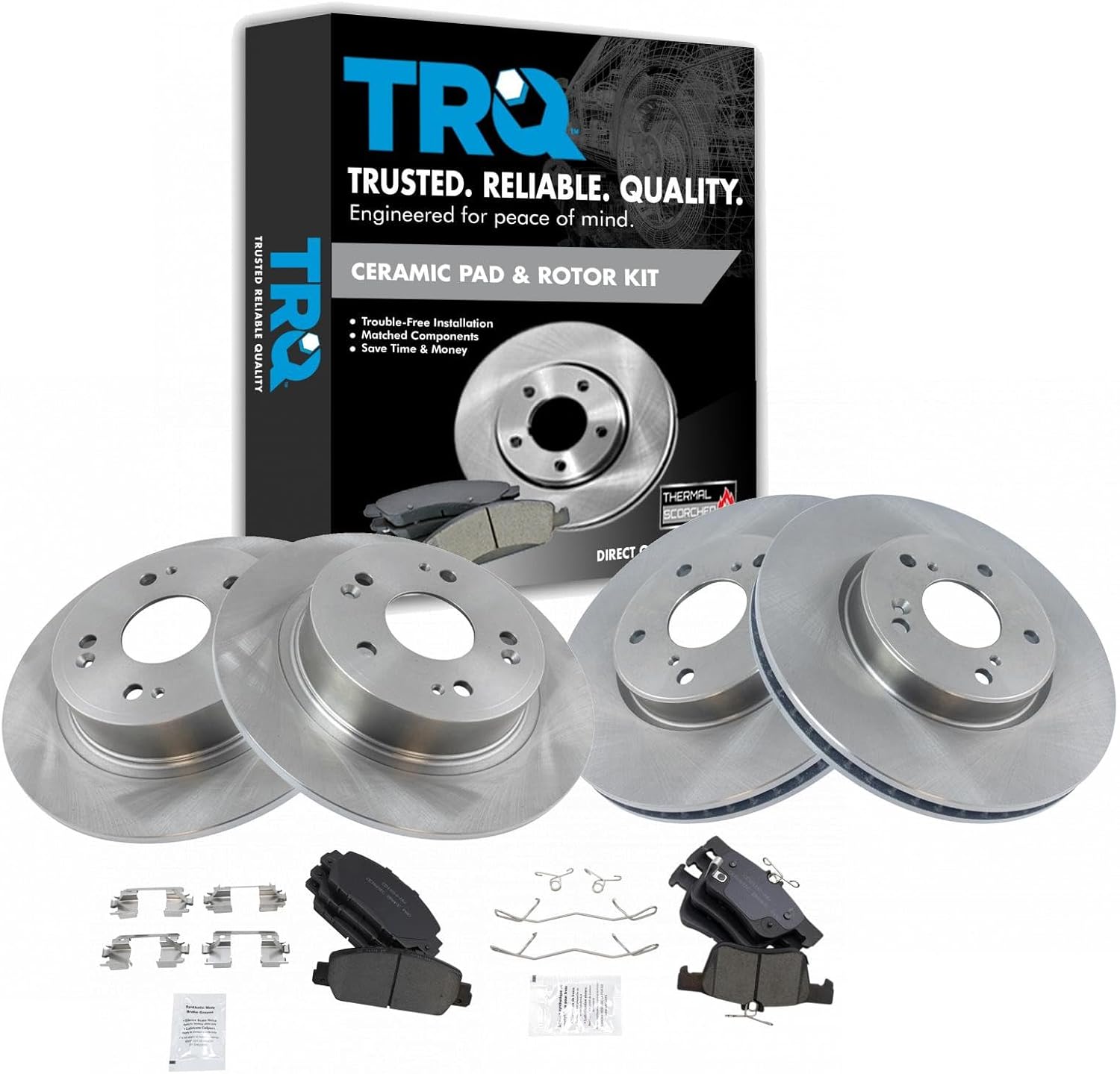
3. TRQ Front and Rear Ceramic Brake Pad and Rotor Kit for 2018–2021 Honda Accord
| Compatible with Vehicle Type | Car |
|---|---|
| Automotive Fit Type | Vehicle Specific Fit |
| Included Components | Front and rear ceramic pad sets and four rotors |
| Brake Pad Friction Material | Ceramic |
| Front Brake Rotor Venting Type | Vented |
This TRQ kit supplies a full front and rear brake replacement for compatible 2018–2021 Honda Accord models, with ceramic brake pads and matched rotors. It is intended for routine road use and DIY installation, and includes preassembled pad sets plus two vented front rotors and two solid rear rotors sized to the listed fitment. Ceramic pads typically run quieter and produce less dust than semi-metallic pads, which helps keep wheels cleaner and suits daily driving and commuting. The matched rotor set avoids cross-compatibility issues and the vehicle-specific fit reduces the need for modifications during installation. Expect improved pedal feel over worn components and compatibility with the listed OEM part numbers. Limits to consider are that ceramic pads can wear faster under heavy towing or aggressive track use, and solid rear rotors and the kit overall are aimed at normal driving rather than performance braking. Buyers should confirm exact trim and year fitment before ordering.
Best for: A practical buyer who wants a single, vehicle-specific brake replacement that restores stopping power and reduces dust and noise for daily driving while keeping installation straightforward.
Less Ideal for: Drivers who need heavy towing capacity, frequent track use, or aggressive performance braking should look for performance-oriented pads and rotors designed for high-heat conditions.
- Complete front and rear kit with matched pads and rotors for one purchase
- Ceramic friction material reduces brake dust and typically operates quieter than semi-metallic pads
- Vehicle-specific fit and OEM-equivalent part numbers simplify installation and compatibility checks
- Includes vented front rotors for better heat dissipation where needed
- Designed for everyday driving rather than heavy-duty or track use where performance-oriented pads and rotors are preferable
Verdict: Buy this kit if you want a ready-made, vehicle-specific ceramic pad and rotor replacement that cuts dust and noise and restores everyday braking performance for 2018–2021 Honda Accords.
4. SUNROAD 11.10" Drilled & Slotted Rear Brake Rotors and Ceramic Pads Kit for Honda Accord 2018–2022

| Fitment | Honda Accord 2018-2022 rear |
|---|---|
| Rotor Type | Drilled and slotted |
| Pad Type | Ceramic |
| Included Components | 2x rear rotors and 4x rear ceramic pads with hardware |
| Automotive Fit Type | Vehicle Specific Fit |
This SUNROAD kit replaces the rear rotors and pads on Honda Accord models from 2018 through 2022 and pairs drilled and slotted rotors with ceramic pads and mounting hardware. The drilled slots promote faster cooling under repeated braking and the rounded slots help clear debris and pad material to keep the pad contact patch consistent. The included ceramic pads are aimed at quiet, low-dust operation for everyday driving rather than aggressive track use. SUNROAD states the rotors are precision balanced to reduce vibration and are a direct-fit, vehicle-specific replacement so installation should be straightforward for a DIYer or a shop. Practical benefits are improved thermal management over plain rotors and a cleaner wheel appearance thanks to reduced pad dust. Limitations are typical of value aftermarket kits: long-term durability and noise behavior can vary compared with higher-end factory-quality replacements, and these pads are optimized for comfort rather than maximum stopping power in extreme conditions.
Best for: Buyers who need an affordable, complete rear brake replacement kit for routine street driving and prefer quieter, low-dust ceramic pads and straightforward installation.
Less Ideal for: Drivers who regularly tow heavy loads, perform spirited driving, or need track-capable braking should choose performance-focused rotors and high-friction pads instead.
- Vehicle-specific fit for 2018–2022 Honda Accord rear brakes simplifies installation
- Drilled and slotted rotor design improves cooling and helps evacuate debris
- Ceramic pads deliver quiet braking with low dust for daily driving
- Includes necessary hardware so you get rotors and pads in one package
- Intended as a budget aftermarket option so long-term wear and performance may not match premium factory-quality parts
Verdict: A cost-conscious, direct-fit rear rotor and ceramic pad kit that improves cooling and reduces dust for everyday 2018–2022 Honda Accord driving.
5. Detroit Axle Front Brake Kit for 2013–2022 Honda Accord (11.54" Rotor)

| Fit Type | Vehicle Specific Fit |
|---|---|
| Orientation | Front |
| Includes | 2 rotors + 2 ceramic pads with hardware |
| Rotor Size | 11.54 inch (293mm) |
This Detroit Axle front brake kit supplies two vented, zinc-plated front rotors and a set of ceramic pads with installation hardware intended for Honda Accord models that use 11.54-inch front rotors. The rotors are vented and described as heat-resistant, which helps dissipate heat during repeated stops and reduces the chance of warping under normal driving. Zinc plating reduces surface corrosion and keeps the visible rotor face cleaner over time. Ceramic pads are quieter and produce less brake dust than semi-metallic options, making them practical for daily driving and highway commuting. The kit is delivered as a vehicle-specific fit and includes properly machined locating holes to simplify installation without modifications. Limitations: this kit only fits Accords with the stated rotor size so measuring your rotor before buying is required, and ceramic pads sacrifice some initial bite compared with higher-friction performance compounds for very aggressive driving. For reliability-focused maintenance or a full front-brake refresh on the specified Accord models, this kit provides a balanced, low-noise replacement with corrosion resistance.
Best for: A buyer who prioritizes dependable, low-maintenance brake replacements for everyday driving and wants a ready-to-install, vehicle-specific front brake kit for their Accord.
Less Ideal for: Drivers who demand track-level stopping power or who frequently perform very aggressive braking should choose high-friction performance rotors and pads instead.
- Vehicle-specific fit designed for Accords using 11.54-inch front rotors
- Vented rotor design for improved heat dissipation under repeated stops
- Zinc plating that helps resist surface corrosion and visible wheel dust
- Ceramic brake pads deliver lower noise and reduced brake dust
- Includes hardware and machined locating holes for straightforward installation
- Fits only the 11.54-inch rotor variant so you must confirm rotor size before purchase
- Ceramic pads offer less initial bite than higher-friction performance pads
Verdict: A practical, reliability-focused front brake kit that replaces rotors and pads with corrosion-resistant rotors and quiet ceramic pads for Accords using 11.54-inch front rotors.
6. Max Advanced Brakes Front Brake Kit — Carbon Ceramic Pads and Front Rotors (ValueMAX)

| Orientation | Front |
|---|---|
| Automotive Fit Type | Vehicle Specific Fit |
| Included Components | Brake Rotors, Brake Pads, Hardware |
| Customer Reviews | 4.5 out of 5 stars |
| Manufacturer | Max Advanced Brakes |
This Max Advanced Brakes ValueMAX front kit pairs precision-machined cast iron rotors with carbon ceramic brake pads and the hardware needed for a bolt-on replacement. It is engineered for everyday use, giving consistent stopping power with reduced vibration and a non-directional rotor finish that speeds bedding-in. The carbon ceramic pads are formulated to be low-dust and quiet and include dual-layer rubberized shims to limit noise. Buyers report straightforward installation and good fitment when the correct rotor diameter is chosen for the vehicle. Practical benefits include cleaner wheels, quieter operation, and rotor machining that helps reduce pedal pulsation. Important limitations: fitment is vehicle-specific and there are different rotor sizes across some model/trim combinations, so confirming the correct rotor diameter before ordering is critical. The kit targets routine commuting and city driving rather than track use, and while quality and value are strong, drivers seeking heavy-duty or performance braking should consider dedicated performance rotors and pads instead.
Best for: Buyers who prioritize dependable, quiet daily braking and want a complete front replacement kit with matched rotors and low-dust pads backed by many positive owner experiences.
Less Ideal for: Drivers who need heavy-performance braking for track use or those who prefer a premium performance compound and directional rotors for aggressive driving should look at specialty performance kits.
- Vehicle-specific kit with rotors, pads, and installation hardware for a single purchase solution.
- Precision-machined cast iron rotors with a non-directional finish for faster bedding and reduced vibration.
- Carbon ceramic pads designed for low dust and reduced noise with dual-layer shims.
- Includes hardware and matched components that users report install cleanly and fit well.
- Requires verifying rotor diameter and trim fitment—wrong size choice has led to returns and fitment issues.
Verdict: A complete, vehicle-specific front kit that delivers quiet, low-dust everyday braking and strong value for Honda Accord drivers who need reliable replacement rotors and pads.
7. PowerStop Rear Brake Kit for Honda Accord (2018–2025) — Z17 Ceramic Pads & OE Replacement Rotors

| Included components | 2 OE Brake Rotors, Z17 Ceramic Brake pad Sets, Installation Hardware, Brake Lube |
|---|---|
| Fit | Vehicle Specific Fit |
| Orientation | Rear |
| Warranty | 60-day / 24 Month / 24,000 Mile Limited Warranty |
This PowerStop rear brake kit replaces the rear rotors and pads on compatible Accords with a complete bolt-on package. It pairs mill-balanced OE-style rotors with Z17 ceramic pads that are slotted, chamfered, and thermal-scored for faster break-in, quieter operation, and reduced dust compared with semi-metallic pads. The kit includes stainless-steel installation hardware and rubberized shims to simplify installation and help control noise. In everyday driving this combination delivers predictable, stock-like braking feel and keeps wheels cleaner thanks to the low-dust ceramic formula. The non-coated rotors are precision machined and balanced for smooth operation but are not specialty performance rotors for track use. This is aimed at drivers who want a straightforward, factory-quality replacement with modest improvements in noise and dust rather than high-performance or heavy-duty braking upgrades.
Best for: Buyers who prioritize a reliable, low-maintenance factory-style replacement that improves brake dust and noise without changing pedal feel or requiring aftermarket calibration.
Less Ideal for: Drivers seeking track-capable braking, heavy-duty towing upgrades, or corrosion-resistant coated rotors should consider performance-specific or coated options instead.
- Complete bolt-on kit includes rotors, Z17 ceramic pads, stainless-steel hardware, and shims for easier installation.
- Z17 ceramic pads offer low dust and quiet operation, keeping wheels cleaner and reducing nuisance noise.
- Rotors are mill-balanced and precision machined to match factory fitment for smooth braking and straightforward replacement.
- Rotors are non-coated, so they lack corrosion-resistant coating found on some upgraded rotors.
- Not designed for aggressive track use or heavy towing where higher-temperature performance is required.
Verdict: A straightforward, factory-quality rear brake replacement that reduces dust and noise while providing an easy bolt-on installation for the 2018–2025 Honda Accord.
Choosing the Right 2018-2022 Honda Accord Brake Rotors: Key Factors to Consider
Rotor Material and Casting Quality
Rotor material and casting quality determine how well a rotor resists cracking, warping, and uneven wear over time. High-quality cast iron with uniform grain structure tends to absorb and dissipate heat more evenly than poorly cast alternatives. For an Accord used for daily commuting and occasional heavy braking, consistent material quality reduces the chance of pedal pulsation and vibration.
Casting quality also affects the smoothness of the braking surface. A rotor with fewer casting defects needs less initial bedding and is more likely to accept brake pads evenly. Inspecting manufacturer specifications for material composition and manufacturing tolerances helps predict longevity and service intervals for the vehicle.
Thermal Management and Venting
How a rotor manages heat is crucial for braking performance and longevity. Venting style, internal vane design, and overall rotor thickness affect how quickly the rotor sheds heat during repeated stops. On a 2018–2022 Accord, poor thermal management can lead to glazing, accelerated pad wear, and reduced braking effectiveness during long descents or repeated hard stops.
Choose rotors with effective vent geometries if you do highway driving or live in hilly terrain. For mostly stop-and-go city use, simpler venting and thicker rotors can still provide ample thermal capacity and a longer service life.
Surface Treatments and Corrosion Resistance
Road salt, moisture, and humidity promote surface corrosion that can reduce braking efficiency and make future resurfacing more difficult. Rotors with protective coatings or zinc plating on non-friction surfaces help maintain fitment accuracy and ease of service over time. For owners of a 2018–2022 Accord in climates with seasonal salt use, a corrosion-resistant finish prevents rust buildup on hat areas and hub contact surfaces.
Surface treatments can also affect break-in behavior. Some coatings are applied only to the non-friction areas, while others include protective layers that must be scrubbed during the first bedding cycle. Consider how often the vehicle is exposed to corrosive conditions when weighing the benefit of treated rotors.
Design: Solid, Vented, Slotted, or Drilled
Rotor design choices influence noise, dust patterns, and cooling. Solid rotors are simple and often sufficient for light city use, while vented rotors offer better heat dissipation for higher-load scenarios. Slotted and drilled surfaces can help clear gas and debris from the pad face and marginally improve bite under wet conditions, but they can also wear pads faster or reduce rotor mass.
For an Accord used primarily for daily driving, vented rotors with minimal surface treatments typically strike a good balance. If you frequently perform harder stops or live where wet braking is common, slotted patterns may offer tangible benefits. Match the design to your driving style rather than picking a performance look alone.
Fitment Precision and Compatibility
Correct fitment to the Accord hub and caliper assembly is nonnegotiable. Rotors must match the vehicle's bolt pattern, hub bore, and thickness specifications to avoid runout and installation headaches. Tight tolerances reduce the need for machining or hub work and ensure consistent contact with the brake pads.
Buyers should verify that rotor dimensions align with service manual specs for the 2018–2022 Accord. Where possible, choose rotors that list explicit compatibility with the chassis and brake package for a direct replacement experience.
Serviceability and Resurfacing Potential
Knowing whether a rotor can be resurfaced extends life and lowers long-term ownership cost. Rotors that are too thin after resurfacing must be replaced, so initial rotor thickness and minimum-thickness specifications matter. Accurate thickness measurement and runout checks during service are easier with rotors that have clear minimum-spec labeling or accessible test points.
Consider how often you intend to have service performed and whether you prefer replace-as-needed or periodic resurfacing. For an Accord with moderate mileage, selecting rotors with sufficient original thickness and straightforward measurement points increases the options available during routine brake maintenance.
Matching Rotor Type to How You Drive the Accord
Match rotor design to your regular driving conditions. Commuters who spend most miles in urban traffic benefit from rotors optimized for corrosion resistance and long life, while drivers who do occasional spirited driving or towing should prioritize thermal capacity and venting.
If you routinely encounter wet roads or heavy traffic leading to frequent stops, consider rotors with surface features that help clear debris and gas from the pad face. For predominantly highway mileage, prioritize rotors that maximize thermal mass and consistent contact with pads to reduce the risk of heat-related issues.
- City driving: corrosion-resistant, thicker rotors
- Highway driving: vented rotors with higher thermal capacity
- Occasional spirited driving: slotted patterns for better pad cleaning
When to Resurface Rotors Vs Replace Them
Rotor resurfacing can be cost-effective when runout and wear are minor and the rotor remains above minimum thickness. Use a micrometer to measure thickness at multiple points, and check service manual minimums for the 2018–2022 Accord before deciding to machine.
Replace rotors if they show deep grooves, fatigue cracking, heavy corrosion near the hat area, or if resurfacing would drop them below the safe minimum thickness. Rotors with uneven wear or heat checks that compromise structural integrity should also be replaced rather than resurfaced.
- Resurface when thickness is safely above minimum and surface imperfections are shallow
- Replace when cracks, deep scoring, or corrosion compromise structural integrity
How to Measure Rotor Thickness and Runout
Measure rotor thickness with a caliper or micrometer at multiple points around the braking surface to detect taper. Compare measurements to the minimum thickness specification for the 2018–2022 Accord. Record the lowest reading to determine resaleability or resurfacing eligibility.
Check lateral runout using a dial indicator mounted to the hub with the rotor installed. Excessive runout causes pedal pulsation and uneven pad wear. If runout exceeds the service limit, try correcting by cleaning hub mating surfaces and re-torquing the wheel, then remeasure before considering machining or replacement.
- Thickness: measure at multiple points and use the lowest value
- Runout: use a dial indicator at the outer edge of the rotor surface
Common Brake Rotor Wear Symptoms on the Accord
Watch for pulsation in the brake pedal or steering wheel during braking. That often indicates rotor warp or excessive runout. Early detection reduces the chance of uneven pad wear and more expensive repairs.
Other symptoms include noise such as squeal or grinding, reduced braking effectiveness, and visible grooves or heat checks on the rotor surface. Address symptoms promptly to maintain safe stopping distances and prevent further damage to calipers and pads.
- Pedal pulsation: usually runout or warpage
- Grinding: indicates deep scoring or metal-on-metal contact
- Squeal: could be glazed pads or surface contamination
Single-Piece Vs Two-Piece Rotor Considerations
Single-piece rotors are the common factory-style replacement offering simplicity, lower weight, and straightforward installation. For most Accord owners, a well-made single-piece rotor provides the best balance of cost, serviceability, and performance for everyday driving.
Two-piece rotors separate the friction ring from the hat, allowing lighter hats and potentially better thermal characteristics in extreme use. Two-piece designs can reduce unsprung weight and allow replacement of just the ring in some situations, but they add complexity and are typically unnecessary for regular Accord use.
- Single-piece: simpler, usually adequate for daily driving
- Two-piece: performance edge in extreme conditions, more complex
Installation Tips Specific to the 2018–2022 Accord
Before installation, clean the hub mating surface on the Accord to eliminate rust and debris that can cause rotor runout. Use proper torque sequencing and specification when tightening wheel bolts to prevent distortion of the rotor under load.
Always check caliper slide pins for free movement and replace or service worn hardware. If the vehicle uses shims or anti-rattle clips, make sure they are reinstalled correctly to prevent noise and uneven pad wear.
- Clean hub mating surface to reduce runout
- Torque wheel bolts to factory specification
- Inspect caliper hardware and replace if seized
Still looking for the perfect fit?
Select your Honda Accord configuration to see the most relevant Brake Rotors recommendations
How We Chose the Best 2018-2022 Honda Accord Brake Rotors
We focused on the objective factors that most affect real-world braking on a 2018–2022 Honda Accord. Primary evaluation criteria included material and casting quality, which determines resistance to warping and long-term wear; rotor surface treatment and coatings that reduce corrosion on cars exposed to seasonal road salt; and thermal design, including venting and any slot or drill patterns that affect heat dissipation under load. Fitment precision and correct hub bore/bolt pattern were required to ensure straightforward installation without hub machining. We also assessed serviceability, meaning ease of measurement for runout and thickness, and whether rotors are readily resurfaceable when appropriate.We excluded rotors with unclear fitment data, nonstandard bolt patterns, or known quality control issues. We did not consider pricing as a primary quality metric but looked at value through expected life and warranty coverage. The shortlist consists of rotors that satisfy Accord-specific fitment, offer reliable materials and finishing, and address different buyer priorities such as corrosion resistance, heat control, and low-noise operation.
Our full evaluation process is outlined in our review methodology.
FAQ
How often should I replace brake rotors on a 2018–2022 Honda Accord?
Replacement frequency depends on driving style and mileage. Many drivers replace rotors between 50,000 and 100,000 miles, but heavy braking, towing, or frequent stop-and-go driving can shorten that. Regular inspections and thickness measurements help time replacement appropriately.
Can I resurface Accord rotors instead of replacing them?
You can resurface rotors if they remain above the minimum thickness specified for the 2018–2022 Accord and do not have structural cracks. Resurfacing removes minor grooves and restores a smooth contact area, but it is not suitable for rotors with deep damage or severe heat checks.
Are slotted or drilled rotors better for my Accord?
Slotted or drilled rotors offer specific benefits like improved pad cleaning and water dispersion, which can help in wet conditions or during harder stops. However, they can increase pad wear and are often unnecessary for regular commuting. Choose them only if your driving style benefits from those features.
What causes brake rotor pulsation on my Accord?
Pulsation is usually caused by rotor runout or localized thickness variations due to uneven wear or heat-induced distortion. It can also result from improper torque on the wheel bolts or debris on the hub mating surface. Accurate measurement and proper installation typically resolve the issue.
How do I know if a rotor is compatible with my exact Accord configuration?
Verify rotor compatibility by matching the rotor's bolt pattern, hub bore, overall diameter, and thickness to the 2018–2022 Honda Accord service specifications. Consult the vehicle's manual or parts data that lists compatibility by year and trim to ensure a direct fit.
Should I replace rotors in pairs on the Accord?
Yes. Replacing rotors in matched pairs on an axle helps maintain balanced braking performance. Installing a new rotor opposite a significantly worn rotor can lead to uneven pedal feel and uneven pad wear.
Final Verdict
Prioritize fitment accuracy, material quality, and thermal capacity when selecting rotors for a 2018–2022 Honda Accord. Consider your typical driving conditions to decide between simple corrosion-resistant vented rotors for daily commuting or rotors with enhanced surface patterns if you need improved wet performance or more aggressive stopping.Balance serviceability and long-term value by checking original thickness and corrosion protection. Replace rotors in axle pairs and follow proper installation procedures to get the most consistent braking performance from your Accord.
Explore More:
- Check out all Honda Accord parts & accessories
- Explore Brake Rotors Maintenance & Repair Guides
- Explore Brake System
- Browse all Auto Parts
