

Note: This article contains affiliate links. If you click on these links and make a purchase, I may earn a small commission at no extra cost to you. This helps support my research and content. Read my full affiliate disclosure here.
If you own a 1998-2002 Honda Accord and are hearing clunks, feeling looseness, or noticing uneven tire wear, worn ball joints are a likely cause. Choosing the right 1998-2002 Honda Accord ball joint matters because the wrong fit or inadequate durability can affect steering feel, alignment stability, and safety. This guide shortlists the top options built specifically for the 1998-2002 Accord range and explains the practical tradeoffs between longevity, fitment, and serviceability. We evaluated candidates for correct fit, material quality, and expected lifespan under normal driving.Below you will find the top picks and the key factors used to evaluate them, plus guidance on installation considerations and common symptoms to watch for.
Looking for other parts? See all Honda Accord parts & accessories.
Top Picks at a Glance
| Best Overall The best all-around choice for most situations | Detroit Axle 12‑Piece Front End Suspension Kit (replacement ball joints, tie rods, sway links) |  |
| Best Quality Built to a higher standard if you want something more solid | MOOG K9643 Front Lower Suspension Ball Joint |  |
| Best Value The sweet spot between price and what you get | KFVF Front Lower Ball Joint K9643 — 2-Pack |  |
| Best Budget The cheapest option that still gets the job done reliably | SCITOO Front Lower Ball Joint K9643 (single) |  |
| Highest Rated A top-rated pick with lots of positive feedback | Detroit Axle Front Lower Ball Joints (pair) – Replacement for 1998-2002 Honda Accord / 1997-2003 Acura CL |  |
| Most Popular A crowd favorite that many people choose with confidence | Detroit Axle Front Upper and Lower Ball Joint Kit (4-piece) |  |
1. Detroit Axle 12‑Piece Front End Suspension Kit (replacement ball joints, tie rods, sway links)

| Fit Type | Vehicle Specific Fit |
|---|---|
| Auto Part Position | Front |
| Material Type | Alloy Steel |
| Unit Count | 12.0 Count |
This Detroit Axle kit bundles the front upper control arms with preinstalled ball joints, lower ball joints, inner and outer tie rod ends, sway bar links, and protective boots to rebuild the front suspension in one purchase. It is intended as a direct-fit replacement for select 1998–2002 Honda Accord applications and related Acura TL/CL models, so installers can replace multiple wear items while the front end is apart. The control arms are stamped alloy steel with a corrosion-resistant finish and the upper joints arrive preassembled to speed installation. Buyers report straightforward fitment and a firmer, more stable front end after installation, and the included boots and clamps help protect steering components. Notable limitations: some users found inconsistencies such as one non-greasable arm, occasional missing or loosely retained boot clamps, and variable quality on smaller parts, so expect to inspect the kit and have small clamps or grease on hand if you want to maximize longevity. Professional installation and a post‑install alignment are recommended.
Best for: Buyers who want to rebuild the entire front suspension in one go and prefer a value-focused, direct-fit replacement that reduces parts sourcing and repeat trips to the store.
Less Ideal for: If you expect factory-identical long-term durability or need every small clamp and greaseable fitting guaranteed, a step-up to higher-end OE-grade components or buying individual, serviceable parts may be a better choice.
- Comprehensive 12-piece kit replaces upper control arms, ball joints, tie rods and sway links in one purchase
- Pre-assembled ball joints on the upper arms reduce install time
- Stamped alloy steel construction and finish designed to resist rust and wear
- Includes boots and C-clamps to protect joints and simplify reassembly
- Some components show inconsistent finish or fit quality and may need small hardware or clamps replaced
- At least one upper arm in some kits is non-greasable and may require earlier replacement if lubrication is needed
Verdict: If you need to refresh the front suspension on a late 1990s–early 2000s Accord quickly and affordably, this complete Detroit Axle kit lets you replace the main wear items in one install.
2. MOOG K9643 Front Lower Suspension Ball Joint

| Position | Front |
|---|---|
| Manufacturer Part Number | K9643 |
| Exterior | Machined |
| Item model number | K9643 |
The MOOG K9643 is a front lower suspension ball joint designed to replace worn components on 1998–2002 Honda Accords and restore precise steering and suspension movement. It installs where the control arm meets the steering knuckle and provides the ball-and-socket pivot that keeps alignment and wheel tracking consistent. MOOG highlights a heat-treated stud for improved fatigue strength, a pressed-in cover plate that helps keep out road debris, and a greasable/gusher bearing design on applicable applications to improve lubrication flow and reduce wear. In everyday use this part brings back tighter steering feel and reduces symptoms like front-end shimmy and uneven inner tire wear that come from loose joints. It is a direct-fit replacement built to factory-style specifications so installation is straightforward for a competent DIYer or mechanic. Limitations are typical of service parts: it replaces just the joint so worn control arms, tie rods, or alignment issues may still need addressing, and greasable fittings depend on vehicle provision and may not be applicable on every chassis variation.
Best for: Buyers who want a factory-style replacement that restores steering precision and reduces steering looseness on 1998–2002 Honda Accords, prioritizing durability and predictable handling.
Less Ideal for: Not a suitable choice for drivers seeking performance upgrades beyond stock geometry or those who need a complete upgraded suspension kit rather than a single replacement part.
- Direct-fit front lower ball joint matched to Honda Accord suspension geometry for straightforward replacement
- Heat-treated ball stud for improved durability and resistance to fatigue
- Pressed-in cover plate and design features that help seal out contaminants
- Greasable/gusher bearing design where applicable improves lubrication and reduces friction
- Manufactured and tested to provide reliable steering feel and restore alignment control
- Only replaces the ball joint component so other worn suspension parts may still need service
Verdict: Choose the MOOG K9643 when you need a durable, direct-fit front lower ball joint to restore steering control and alignment on a 1998–2002 Honda Accord.
3. KFVF Front Lower Ball Joint K9643 — 2-Pack

| Manufacturer | KFVF |
|---|---|
| Model | K9643 |
| Package | 2 x Front Lower Ball Joint |
These KFVF front lower ball joints are a direct replacement intended for front suspension on specified Honda Accord, Odyssey, Isuzu Oasis and Acura CL/TL model years. Supplied as a two-pack, they replace the lower ball joint that connects the control arm to the steering knuckle and are typically used during routine suspension maintenance or when you notice looseness, clunking, or uneven tire wear. The listing emphasizes factory-standard tolerances for straightforward installation and alignment, and the parts include press-in style hardware that matches original mounting. In practice you can expect a cost-effective repair option that restores steering feel and front-end geometry when installed correctly. Limitations: this is a vehicle-specific OEM-style replacement so fitment must be confirmed against the model years and engine variants listed, and installation usually requires a press or appropriate removal tools. Performance drivers looking for heavy-duty or performance-upgraded joints should consider specialty alternatives.
Best for: Buyers who want a practical, budget-conscious factory-style replacement to restore steering feel and front-end alignment on late 1990s to early 2000s Hondas and compatible Acuras.
Less Ideal for: Drivers seeking heavy-duty, high-mileage performance upgrades or those without access to suspension tools and a press should look at reinforced or performance-specific ball joints or professional installation services.
- Sold as a two-pack for replacing both front lower ball joints at once
- Made to factory-standard tolerances for easier installation and alignment
- Covers the specific late 1990s to early 2000s Accord and compatible Acura/Odyssey/Oasis fitments
- Fitment is vehicle- and engine-specific so incorrect selection can require return or exchange
- Requires suspension tools or a press for removal and installation rather than a simple bolt-on swap
Verdict: A cost-effective, factory-style two-pack replacement that restores front-end steering and alignment on compatible late 1990s to early 2000s Honda and Acura models.
4. SCITOO Front Lower Ball Joint K9643 (single)

| Position | Front Lower |
|---|---|
| OEM Part Number | K9643 |
| Model | 100010 |
| Package | 1pc Front Lower Ball Joint |
This SCITOO front lower ball joint is a budget-friendly replacement aimed at restoring steering feel and suspension control on compatible late 1990s and early 2000s Hondas and similar vehicles. It installs in place of the factory unit and is pre-greased with a pre-installed boot to help keep out dirt and moisture. Practical benefits include improved directional control and reduced noise over a worn joint, and a greasable design on some listings lets you refresh lubrication for longer life. Buyers should expect an affordable part that performs like a direct replacement for routine repairs, but quality can vary between units so careful inspection at installation is wise. A few users report boot fit issues or early failures, so professional installation and testing after fitment are recommended to confirm the part is seating correctly and the grease port and boot are intact. The product ships as one K9643 front lower ball joint and is intended for those repairing a single side or staging a matched replacement purchase.
Best for: Buyers looking to repair a noisy or worn front lower ball joint on a 1998–2002 Accord who prioritize low cost and a straightforward factory-style replacement.
Less Ideal for: Those seeking a long-term performance upgrade or a premium aftermarket joint with long-term durability testing should consider higher-end or brand-name alternatives.
- Pre-greased and shipped with a protective boot to reduce initial wear and simplify installation
- Priced for budget repairs while matching factory replacement function for eligible vehicles
- Grease fitting present on some units allows periodic lubrication to extend service life
- Quality control is inconsistent with some reports of boot fitment problems and occasional early failures
Verdict: A low-cost, pre-greased front lower ball joint that provides a practical factory-style replacement for repairing steering and suspension issues on late 1990s to early 2000s Honda Accords.
5. Detroit Axle Front Lower Ball Joints (pair) – Replacement for 1998-2002 Honda Accord / 1997-2003 Acura CL

| Kit contents | 2x Front Lower Suspension Ball Joints |
|---|---|
| Manufacturer | Detroit Axle |
| Manufacturer part number | K9643 x2 |
| Fitment | 1998-2002 Honda Accord; 1997-2003 Acura CL; other listed models |
These Detroit Axle front lower ball joints come as a two-piece kit intended as a direct-fit replacement for 1998-2002 Honda Accord and compatible Acura and Isuzu models. They are typically used to restore steering precision and suspension stability when worn ball joints cause looseness or clunking. The joints are made from high-strength alloy and Detroit Axle says they are manufactured to meet factory-fit expectations, which shows in many owner reports of easy installation and good initial fit. Practical benefits include included hardware and a design meant for straightforward swap-in replacement without control arm modification. Some units include a greaseable stud which helps maintenance on vehicles where serviceable joints are preferred. Limitations to consider: a subset of buyers reported fitment tolerance and longevity issues on high-mileage or heavy-use vehicles, so these are best for drivers who want a cost-effective, factory-quality replacement rather than a heavy-duty or lifetime solution. Expect solid short- to mid-term performance and value for routine driving and inspections.
Best for: Buyers prioritizing reliable, factory-style replacement at a budget-friendly price who need a straightforward swap to restore steering and suspension feel on the specified Accord and compatible models.
Less Ideal for: Drivers who demand heavy-duty longevity under aggressive driving or commercial use should consider premium OEM or heavy-duty alternatives instead.
- Direct-fit design made for 1998-2002 Honda Accord and listed Acura/Isuzu applications
- Manufactured from premium alloy with enhanced structural strength for wear resistance
- Includes the pair and necessary hardware for a straightforward replacement
- Many users report good initial fit and improved steering feel after installation
- Some users have reported inconsistent fit tolerances or premature wear under heavy use
Verdict: A cost-effective, factory-fit pair of front lower ball joints that restore steering feel and are a sensible reliability-focused replacement for 1998-2002 Honda Accord owners.
6. Detroit Axle Front Upper and Lower Ball Joint Kit (4-piece)
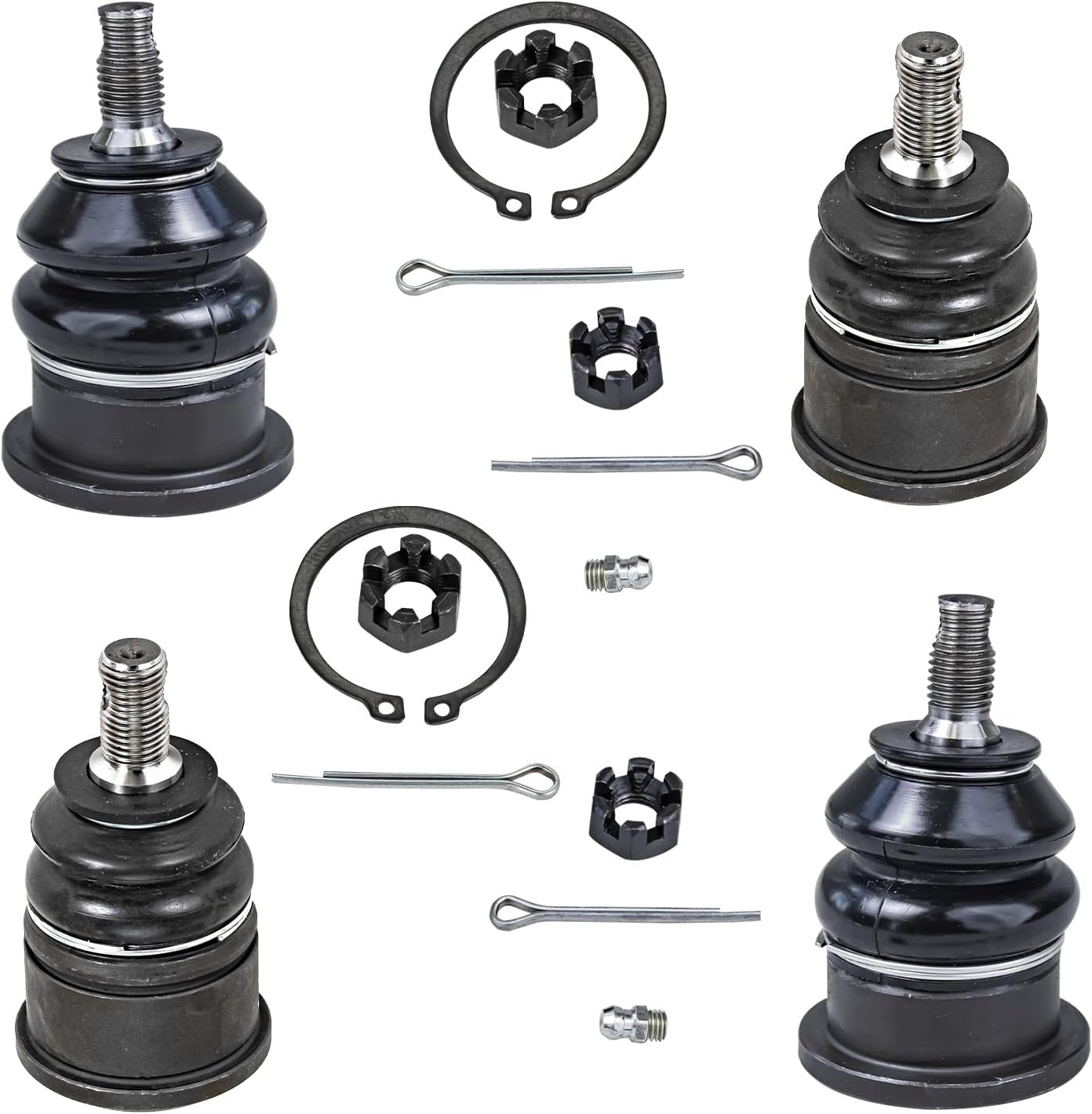
| Fitment | 1998-2002 Honda Accord; 1999-2003 Acura TL; 1997-2003 Acura CL; 1996-1999 Isuzu Oasis |
|---|---|
| Kit contents | 2 front upper ball joints and 2 front lower ball joints |
| Material | Premium alloy |
| Manufacturer | Detroit Axle |
This Detroit Axle kit supplies two front upper and two front lower ball joints as a direct-fit replacement for 1998–2002 Honda Accord and related Acura/Isuzu applications. The parts are manufactured from a premium alloy and claim enhanced structural strength to resist impact and wear, which makes them suitable for restoring steering stability and removing play in aged front suspension. Installation is typical for pressed-in ball joints and will usually require a ball-joint press and an alignment afterward; several owners noted tight, factory-like fitment and improved ride feel once installed. The kit is positioned as a factory-quality replacement and comes with corrosion-resistant finishes aimed at longer service life. Buyer feedback is mixed: many report good value and correct fit, though there are isolated reports of premature failure, so careful inspection and proper installation are important. This kit is a practical option if you want a budget-friendly, full-front replacement set and are prepared to press and align the suspension during installation.
Best for: Buyers who want a full, budget-conscious front ball joint replacement that closely matches factory fit and restores steering control and who are comfortable doing or arranging a press installation and alignment.
Less Ideal for: If you prefer a guaranteed long-term premium aftermarket or lifetime-duty part without the risk of variable durability, consider higher-end branded replacements or professional-specified units.
- Complete 4-piece kit covers both upper and lower front ball joints for one axle
- Direct-fit design intended to match factory mounting and alignment points
- Premium alloy construction and corrosion-resistant finish for improved durability
- Widely reported correct fitment and measurable improvement in steering feel after replacement
- Requires a press for installation and an alignment afterward which adds time and potential shop cost
- Some user reports of premature failures suggest variable long-term durability
Verdict: A cost-effective complete front ball joint kit that restores steering feel with factory-style fit for 1998–2002 Accords when installed and aligned correctly.
Choosing the Right 1998-2002 Honda Accord Ball Joint: Key Factors to Consider
Fitment and Taper Specifications
Correct fitment is critical for the 1998-2002 Honda Accord because the ball joint must seat precisely in the control arm and match the factory taper to maintain steering geometry. A mismatched taper or incorrect flange dimensions can cause looseness, accelerated wear, or difficulty during installation.
Verify the ball stud taper angle, flange diameter, and thread pitch where applicable. Parts that match OE mounting points reduce the need for suspension modification and help preserve alignment settings after installation. Accurate fit also affects safety since an improper press fit can allow movement under load.
Boot and Seal Design
The dust boot and internal seal protect the joint from moisture and contaminants, which is crucial for longevity on the 1998-2002 Accord. Boots with robust materials and secure retaining features keep grease in and dirt out, slowing wear of the bearing surfaces.
Examine whether the boot has an integrated clamp or bead seat that fits the control arm recess. Some designs use replaceable boots, which can extend service life if you retain the pressed-in cup. Good seals also reduce the likelihood of corrosion at the cup interface and help maintain consistent steering response.
Bearing Type and Load Capacity
Ball joints use different internal bearing systems that influence durability and steering feel. For the Accord, a design with adequate radial and axial load capacity is important because the front suspension handles both steering forces and vehicle weight transfer.
Consider whether the joint uses a polymer-lined bearing, needle rollers, or another load-bearing configuration, and whether the specified load ratings meet or exceed factory expectations. Higher-capacity bearings typically resist deformation and exhibit less play over time, preserving alignment and steering precision.
Greaseability and Serviceability
A greaseable ball joint lets you replenish lubricant and extend the component's life, which can be a practical advantage for the 1998-2002 Accord on high-mileage cars. Non-greaseable sealed units trade serviceability for simplicity, so weigh the expected lifetime against the convenience of occasional greasing.
If you opt for a greaseable joint, confirm access for a grease gun and the presence of a proper zerk fitting orientation. Also consider whether replacement boots or rebuild kits are available to avoid replacing the entire control arm assembly later.
Corrosion Resistance and Materials
Exposure to road salt and moisture can accelerate wear on suspension components. For Accords from 1998-2002, choosing ball joints with corrosion-resistant coatings, stainless or plated hardware, and robust cup materials helps maintain fitment and makes future removal easier.
Material quality influences how well threads and press-fit surfaces hold up over time. Rusted or seized components complicate repairs and increase labor time, so prioritize finishes and metals that resist environmental degradation.
Installation Requirements and Tooling
Understand the installation process and whether you will need a ball joint press tool, control arm press, or other specialty gear. The 1998-2002 Accord's front suspension can require a press to remove and install lower and upper joints cleanly.
Check whether the joint is designed as a direct-replacement press-in cup or a bolt-in style that uses studs and nuts. Clear instructions and compatible hardware decrease the risk of improper installation and help maintain alignment after the job is complete.
Common Ball Joint Symptoms on a 1998-2002 Accord
Recognizing early signs of ball joint wear helps you plan repairs before they affect safety. Typical symptoms include clunking noises when going over bumps, looseness in the steering wheel, uneven tire wear on the front edges, and an intermittent wandering sensation while driving. Wheel vibration at certain speeds can also be traced to a worn joint that allows the wheel hub to shift under load.
- Clunking or knocking from the front suspension over bumps
- Excessive free play in the steering wheel
- Inner or outer tire shoulder wear patterns
- Wheel vibration at specific speeds related to front-end play
Front Lower Vs Upper Ball Joints on the Accord
The Accord's lower and upper ball joints have different roles and service lifespans. Lower ball joints typically carry more vertical load and are more exposed to road debris, so they often show wear sooner. Upper joints handle steering articulation and can affect alignment when they develop play.When diagnosing, inspect both joints visually for torn boots and check for vertical and lateral play by lifting the front end and manipulating the wheel assembly. Addressing the joint with the most wear first preserves steering geometry and prevents uneven tire degradation.
- Lower joints often bear higher loads and wear faster
- Upper joints influence camber and toe when they develop play
Tools and Workshop Tips for Replacement
Removing and installing ball joints on the 1998-2002 Accord usually requires a hydraulic or hand-operated ball joint press and a selection of cups and adapters sized for the control arm. Using the correct press adapters prevents damage to the control arm and ensures the new cup seats squarely.Other helpful tips include supporting the knuckle to avoid stressing brake lines, marking alignment reference points before disassembly, and checking tie rod and sway bar link hardware for wear while you have the wheel off. If the chosen joint uses a zerk fitting, plan for accessibility so you can grease it after installation.
- Use a dedicated ball joint press with proper adaptor sizes
- Support the steering knuckle to protect brake hoses
- Mark alignment reference points and recheck toe after installation
When to Replace Boots Versus the Entire Ball Joint
A torn boot does not always mean you must replace the entire ball joint immediately. If the joint shows no play and the internal surfaces remain well lubricated, replacing the boot and re-greasing can be a cost-effective interim repair. However, if contamination has reached the bearing or there is detectable looseness, replacing the whole joint is safer.Inspect for trapped grit, corrosion inside the cup, or pitting on the ball stud. For high-mileage 1998-2002 Accords, boots are often an indication of deeper wear, so treat a torn boot as a strong prompt for a thorough inspection rather than an automatic delay.
- Replace just the boot only if the joint is otherwise firm and clean
- Replace the entire joint if there is any detectable play or internal corrosion
Alignment and Post‑Replacement Checks
After installing new ball joints, it is important to verify wheel alignment and to road-test the vehicle at slow speeds to detect any remaining noise or vibration. Even when parts match OE fitment, slight differences or reassembly torque sequences can alter toe or camber.Re-torque fasteners after a short break-in drive, then perform a professional alignment if you observe pull, uneven tire wear, or changed steering feel. Regular visual inspections for boot integrity during the first few weeks can catch settling or installation issues early.
- Road-test immediately after installation and re-torque fasteners
- Perform a professional alignment if handling or tire wear changes
Still looking for the perfect fit?
Select your Honda Accord configuration to see the most relevant Ball Joints recommendations
How We Chose the Best 1998-2002 Honda Accord Ball Joint
We prioritized components that match the 1998-2002 Honda Accord's factory fitment and steering geometry. Selection criteria included precise dimensional compatibility with the Accord suspension, ball stud and taper specifications, and correct mounting features to avoid modification during installation. Durability factors such as bearing type, grease retention design, and corrosion-resistant finishes were considered to estimate service life under mixed driving conditions.We also examined the quality of sealing and dust boot designs to reduce premature wear, plus the availability of replacement boots or service parts. Ease of installation was weighted, with attention to parts that accept standard press tools and hardware without requiring extensive suspension disassembly. Products that required uncommon modifications, lacked clear fitment data for the 1998-2002 Accord, or had poor reported longevity were excluded from the shortlist.
Our full evaluation process is outlined in our review methodology.
FAQ
How can I tell if my Accord needs a ball joint replacement?
Often you will notice clunking over bumps, looseness in steering, or uneven front tire wear. A physical check with the wheel off can reveal vertical or lateral play in the joint, which usually indicates replacement is needed.
Can I replace just the ball joint boot on my 1998-2002 Accord?
Sometimes you can replace a torn boot if the joint shows no play and internal surfaces look clean. However, if there is any measurable looseness or contamination, replacing the whole joint is the safer choice.
Do I need special tools to replace the ball joints on this Accord?
Yes. A ball joint press and matching adapters are commonly required to remove and install press-fit cups without damaging the control arm. Basic hand tools, a torque wrench, and support stands are also needed.
How soon should I expect to see alignment issues after replacing a ball joint?
Alignment can shift immediately after replacement if the joint seating alters suspension geometry or if fasteners were not torqued correctly. It is normal to check and, if necessary, correct alignment after the work is complete.
Are greaseable ball joints better for older Accords?
Greaseable joints offer the advantage of renewing lubrication, which can extend life on high-mileage vehicles. The tradeoff is periodic maintenance. Sealed joints eliminate maintenance but must be replaced when they fail.
What symptoms could be mistaken for bad wheel bearings instead of ball joints?
Both conditions can cause vibration or noise, but wheel bearings often produce a constant hum or rumble that changes with vehicle speed, while ball joints more commonly create clunks and play in steering. A hands-on inspection helps differentiate them.
Final Verdict
Prioritize correct fitment, robust sealing, and appropriate bearing capacity when choosing ball joints for a 1998-2002 Honda Accord. Consider whether greaseable serviceability matters for your mileage and driving conditions, and be mindful of corrosion-resistant finishes if the vehicle sees salted roads. Balance the ease of installation and available tools against the expected service life to make a practical choice. With the right focus on these tradeoffs, you can restore steering precision and prolong suspension life confidently.
Explore More:
- Check out all Honda Accord parts & accessories
- Explore Ball Joints Maintenance & Repair Guides
- Explore Suspension & Steering
- Browse all Auto Parts
