

Note: This article contains affiliate links. If you click on these links and make a purchase, I may earn a small commission at no extra cost to you. This helps support my research and content. Read my full affiliate disclosure here.
If you own a 1997-2006 Jeep Wrangler, keeping the suspension tight and predictable is essential for safe on-road driving and confident off-road work. Worn ball joints produce looseness, uneven tire wear, and steering play that can make handling feel vague or unsafe. This guide highlights the top shortlisted ball joints selected specifically for that 1997-2006 Wrangler generation, addressing common replacement scenarios and the parts owners typically need. We evaluated each option around vehicle-specific fitment, durability under load, and ease of installation so you can choose the right replacement whether you are swapping a front lower ball joint, upper ball joint, or installing a full ball joint kit. Read on to see which choices match your repair approach and shop tools, including what to expect when you replace a ball joint and which symptoms justify doing the job now.
Looking for other parts? See all Jeep Wrangler parts & accessories.
Top Picks at a Glance
| Best Overall The best all-around choice for most situations | Spicer 706944X Suspension Ball Joint Kit (Upper and Lower, One Side) |  |
| Best Quality Built to a higher standard if you want something more solid | TeraFlex Premium Series Front Ball Joint 4-Pack (1353100) |  |
| Best Value The sweet spot between price and what you get | Detroit Axle Front 11‑Piece Suspension Kit for 1997–2006 Jeep Wrangler TJ |  |
| Best Budget The cheapest option that still gets the job done reliably | SCITOO Front Suspension Kit with Upper and Lower Ball Joints (4-piece) |  |
| Highest Rated A top-rated pick with lots of positive feedback | Detroit Axle Front Upper & Lower Ball Joint Kit (4-piece) | 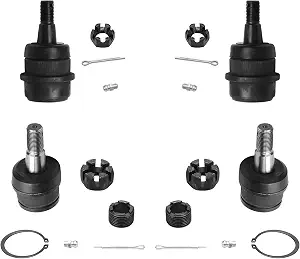 |
| Most Popular A crowd favorite that many people choose with confidence | Detroit Axle 13‑Piece Front Suspension Kit for 1997–2006 Jeep Wrangler |  |
| Best Seller A high-volume bestseller chosen again and again | Rough Country Heavy Duty Replacement Front Ball Joints (10642) |  |
1. Spicer 706944X Suspension Ball Joint Kit (Upper and Lower, One Side)
| Fit type | Vehicle Specific |
|---|---|
| Application | Upper/Lower (one side) |
| Exterior | Machined |
| Manufacturer Part Number | 706944X |
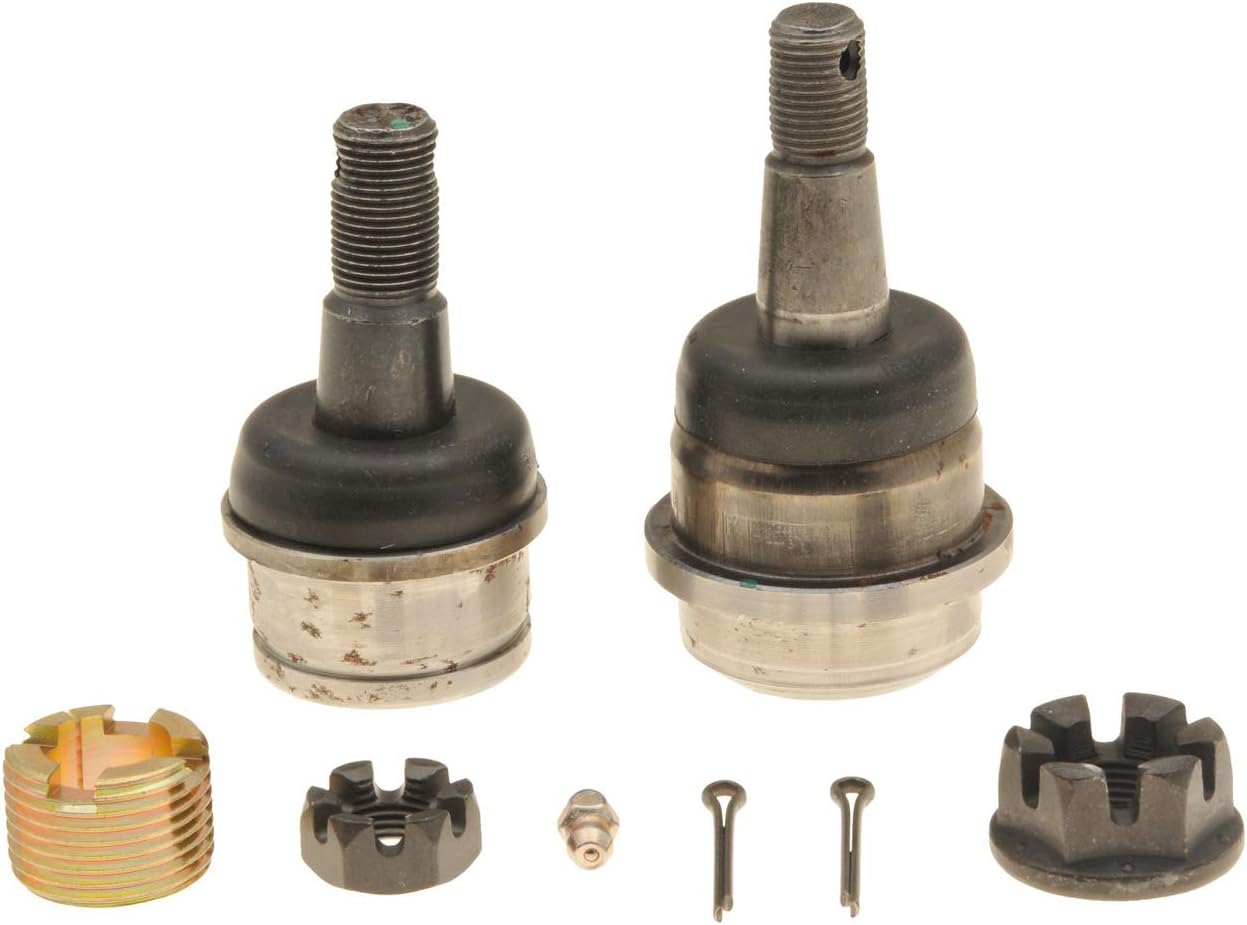
The Spicer 706944X kit supplies both the upper and lower front suspension ball joints for one side, built to factory-quality fit and finish for Dana 30/Dana 44 applications. It is typically used when restoring steering feel, eliminating play, or replacing worn joints during a front-end rebuild on compatible Jeep Wranglers. Notable features include machined components and manufacturer part numbers that match factory replacement specs, and many owners report straightforward fitment when pressed in with the correct tools. Practical benefits are improved steering response and tighter front-end feel after installation and the reassurance of a parts brand that follows original design tolerances. Important limitations are that installation requires a ball-joint press and some mechanical experience, and fit can vary on knuckles that have been previously oversized by aftermarket parts or heavy wear. The kit covers one side only, so buyers replacing both sides should plan to order two kits or source a full set.
Best for: Drivers who want a direct, factory-style replacement to restore steering feel and eliminate front-end play on a 1997–2006 Wrangler without modifying suspension geometry.
Less Ideal for: People seeking an easy bolt-in solution without special tools or novice DIYers who prefer plug-and-play aftermarket assemblies should consider professional installation or alternative parts.
- Factory-quality design matched to Dana 30/44 steering components
- Includes both upper and lower ball joints for one side
- Machined exterior finish for durable mating surfaces
- Widely reported accurate fitment on 1997–2006 Jeep front knuckles when press-installed
- Requires a ball-joint press and moderate mechanical skill to install
- Ships as one-side kit so replacing both sides needs multiple kits
Verdict: Choose this Spicer kit if you want factory-quality upper and lower ball joints to restore tight steering and reliable fitment on a 1997–2006 Jeep Wrangler front end.
2. TeraFlex Premium Series Front Ball Joint 4-Pack (1353100)

| Position | Front |
|---|---|
| Includes | Upper and lower ball joints (4 pieces) |
| Exterior | Machined |
| Manufacturer | TeraFlex |
These TeraFlex Premium Series ball joints are built for heavy-duty Wrangler use and aim to handle the extra side loads that come with larger tires and lifted suspensions. The kit includes upper and lower joints for the front Dana 30 and Dana 44 axles and features heat-treated 4140 chromoly studs, hard sintered wear bushings, and a magnesium phosphate coating to resist corrosion. Lower joints use a slotted wear plate with grease channels and a low-profile dust seal that helps keep contaminants out while allowing spent grease to exit. Adjustable preload and dual zerk fittings make servicing simpler and help extend service life when used with regular greasing. Fitment notes warn they will not work with RCV shafts and some buyers reported fit issues on certain years, so confirm axle specifics before buying. Installation can be moderately time consuming and may require a press or specialty tools, but for performance-focused Jeep owners running larger tires this kit offers stronger materials and serviceable features compared with basic replacements.
Best for: Jeep owners upgrading to larger tires or running lifted suspensions who prioritize durable, serviceable front suspension components that handle higher side loads.
Less Ideal for: People seeking a simple, direct-fit budget replacement for daily drivers with stock suspension or anyone with RCV shafts should look for a different part or confirm compatibility first.
- Heat-treated 4140 chromoly ball/studs for improved strength under heavy loads
- Lower wear plate with grease channels and dual zerk fittings for better lubrication and longevity
- Adjustable preload and preload tool included for straightforward wear adjustment
- Corrosion-resistant magnesium phosphate coating on key components
- Not compatible with RCV axle shafts
- Some buyers reported fitment problems on certain model years, so measuring/verification is required
Verdict: A serviceable, heavy-duty front ball joint kit built for lifted Wranglers that need stronger, greasable components to handle larger tires and harsher off-road loads.
3. Detroit Axle Front 11‑Piece Suspension Kit for 1997–2006 Jeep Wrangler TJ

| Brand | Detroit Axle |
|---|---|
| Position | Front |
| Manufacturer Part Number | 11S1900562 |
| Fitment Years | 1997-2006 Jeep Wrangler TJ |
This Detroit Axle front suspension kit supplies the common wear items needed when refreshing the TJ front end: a track bar, drag link, inner and outer tie rod ends, two sway bar end links, and four upper/lower ball joints. It is intended for street-driven Wranglers and DIYers who want a direct-replacement package to restore steering geometry and eliminate play without sourcing individual parts. The components are packaged together for a one-stop installation and most customers report straightforward fit and reasonable quality for the price. Expect the ball joints and rod ends to perform well for day-to-day driving, but this kit is not engineered as an extreme-duty, off-road upgrade. Some buyers reported missing grease fittings and fitment mismatch with certain axle brackets, so verify the track bar and parts against your vehicle before installation and plan for a professional alignment after fitting. The bundled approach saves time and ensures compatible steering components when the goal is reliable, budget-conscious maintenance.
Best for: Buyers who want a practical, budget-focused way to replace worn front-end steering and suspension parts on a 1997–2006 Jeep Wrangler TJ and prefer a bundled kit to simplify repairs and reduce parts-sourcing time.
Less Ideal for: Drivers planning heavy off-road use, high-angled lifts, or long-term extreme-duty applications should choose reinforced aftermarket or performance-grade components instead.
- Complete kit includes track bar, drag link, inner and outer tie rod ends, sway bar end links, and four ball joints for a coordinated front-end refresh
- Saves time compared with buying parts separately and simplifies a DIY replacement job
- Most parts are direct-fit replacements for 1997–2006 Jeep Wrangler TJ applications
- Good value for routine street use and restoration of steering tightness
- Not designed for extreme off-road use or heavy-duty lift applications
- Some buyers reported missing small hardware like grease zerks or cotter pins and occasional track bar fitment issues
Verdict: If you need a cost-effective, all-in-one front suspension refresh for a 1997–2006 Jeep Wrangler TJ, this kit delivers the essential steering and ball joint replacements to get the job done.
4. SCITOO Front Suspension Kit with Upper and Lower Ball Joints (4-piece)

| Position | Front |
|---|---|
| Item model number | 809547-5206-1824099331 |
| OEM Part Number | K3161T, K3134T |
| Manufacturer | SCITOO |
| Package contents | 4 Suspension Parts: 2 upper and 2 lower ball joints |
This SCITOO front suspension kit supplies two upper and two lower replacement ball joints intended to refresh the front end on older Jeep models. Installers typically use it when worn ball joints cause play in the steering or uneven tire wear; the kit is sold as a direct-replacement style group to swap both sides at once. The parts include grease fittings on most pieces and are promoted as suitable for DIY mechanics or repair shops. In practice the kit gives a cost-effective way to restore steering feel and reduce front-end noise, and several buyers report straightforward installs and good on-road and light off-road durability. Fitment reports are mixed, so double-check year and spindle details before ordering; some users found incorrect shaft lengths or stripped grease fittings that required replacement. A professional alignment after installation is recommended to ensure correct steering geometry.
Best for: Buyers looking to repair steering play or worn ball joints on an older Jeep on a tight budget and who prioritize replacing both sides together to restore front-end control.
Less Ideal for: Drivers who need guaranteed factory-exact fitment without modification or those who prefer premium, heavy-duty components for serious off-road use.
- Complete front kit replaces both upper and lower ball joints so both sides are addressed at once
- Includes grease fittings on most joints for routine lubrication
- Affordable option compared with dealer or premium aftermarket kits
- Reportedly straightforward to install for competent DIYers or professional shops
- Fitment inconsistency reported for some model years and spindles which may require returns or exchanges
- A few units arrived with damaged or stripped grease fittings, requiring replacement before use
Verdict: A budget-friendly way to replace worn front ball joints on eligible Jeep models while addressing both sides at once to restore steering feel.
5. Detroit Axle Front Upper & Lower Ball Joint Kit (4-piece)
| Fitment | 1997-2006 Jeep Wrangler TJ |
|---|---|
| Kit contents | 2 front upper + 2 front lower ball joints |
| Material | Premium alloy |
| Manufacturer | Detroit Axle |
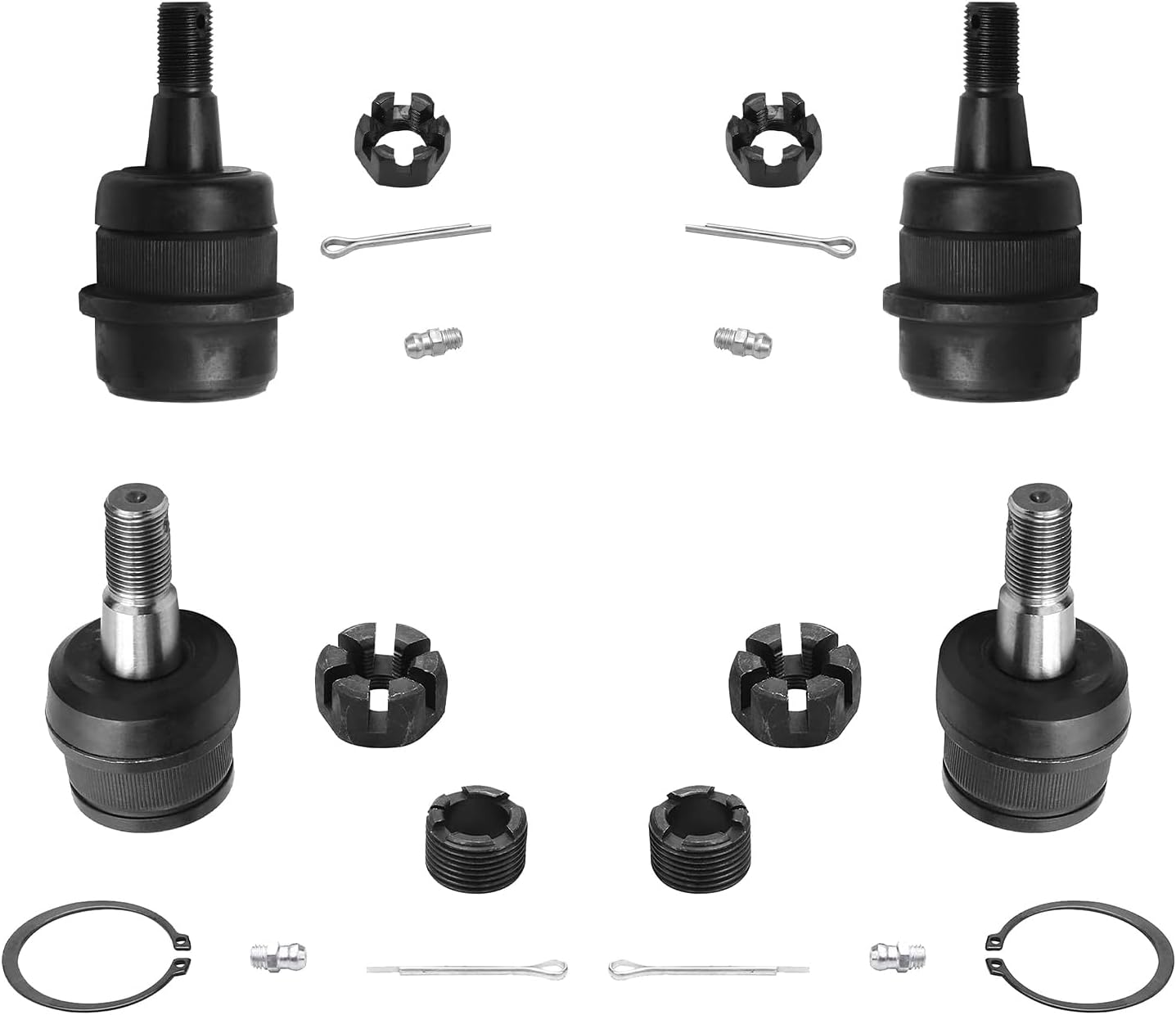
This Detroit Axle kit supplies two front upper and two front lower ball joints intended as direct-fit replacements for older Jeep models, including 1997-2006 Wrangler TJ. Installation is typical for pressed-in ball joints and usually requires a press or appropriate tools; several users report tight fits that indicate accurate tolerances but may need professional tools. The parts are made from premium alloy and the listing emphasizes reinforced structure for repeated impact loads, which should help with durability on daily-driven or light off-road Wranglers. Practical benefits include factory-quality fit and easier serviceability compared with chasing individual components, and most buyers find the kit restores steering feel and reduces play. Limitations to keep in mind are mixed long-term reports: many buyers see good value and longevity while a small number report early failures, so careful installation, greasing during assembly, and post-installation alignment are important. If you need a ready kit to refresh front suspension on a TJ, this covers the common wear points but monitor early miles for signs of premature wear.
Best for: A buyer who prioritizes restoring reliable steering and suspension performance on a 1997-2006 Wrangler TJ and prefers a straightforward, matched replacement kit they can install or have pressed in by a shop.
Less Ideal for: Not the best choice for someone seeking heavy-duty, lift-oriented or extreme off-road ball joints engineered for high articulation and load beyond typical trail use.
- Direct-fit 4-piece kit covers both upper and lower front ball joints for a complete front-end refresh
- Premium alloy construction and reinforced structure intended to resist wear and impact
- Accurate tolerances produce a tight fit that aligns bolt holes and helps restore steering precision
- Sold as a matched set so you replace all front joints at once for consistent wear and handling
- Some customers report occasional premature failures, so real-world longevity is variable
- Parts arrive with limited pre-applied grease, requiring greasing at installation for best life
Verdict: A convenient, factory-quality matched kit to restore front steering and reduce play on 1997-2006 Wrangler TJs, favored for accurate fit and practical durability.
6. Detroit Axle 13‑Piece Front Suspension Kit for 1997–2006 Jeep Wrangler

| Fitment | 1997-2006 Jeep Wrangler (front Pitman arm to RH steering arm) |
|---|---|
| Kit contents | Drag link, 3 tie rods, 2 adjusting sleeves, track bar, 2 sway bar links, 4 ball joints |
| Manufacturer | Detroit Axle |
| Item weight | 29.2 pounds |
This 13‑piece Detroit Axle front suspension kit supplies the common steering and suspension parts needed when overhauling the front end on a 1997–2006 Jeep Wrangler. It includes outer and inner tie rod ends, adjusting sleeves, a drag link, a track bar, sway bar end links, and upper and lower ball joints so you can replace worn steering linkage and restore alignment in one job. Parts are described as direct-fit replacements and made from premium alloy with corrosion resistance and reinforced structure for street and light off-road use. The bundled approach saves time hunting individual parts and generally simplifies installation for a competent DIYer or shop. Reports from users show good fitment and straightforward alignment after installation, though one experienced reviewer noted some ball joints can be incorrect on non-Wrangler models and another mentioned loose packaging and the need to grease lower ball joints before reassembly. If you value having a full front-end kit that matches factory fit and reduces parts-matching errors, this covers the usual wear items for the Wrangler TJ, but check vehicle-specific fit and inspect included ball joints before final installation.
Best for: Buyers who want a single, vehicle-specific kit to restore steering and front suspension on a 1997–2006 Jeep Wrangler and prefer the convenience of replacing all common wear items at once while relying on community feedback for fitment confidence.
Less Ideal for: If you only need one or two individual components or require premium OE-branded ball joints for heavy off-road or high-mileage builds, this full kit may be more than necessary and a different single-part purchase could be a better fit.
- Complete kit covers tie rods, drag link, track bar, sway bar links and both upper and lower ball joints so multiple worn parts can be replaced in one job
- Direct-fit design aimed at factory-quality fit and easier installation compared with sourcing individual parts
- Premium alloy construction and reinforced structure intended to resist wear and corrosion during normal driving and light off-road use
- Includes adjusting sleeves and hardware to simplify alignment and reduce downtime at the shop
- Some reviewers reported occasional fitment issues with ball joints on non-Wrangler vehicles and recommend verifying fit before installation
- Packaging can be loose which may allow small hardware to shift during shipping
Verdict: If you want a convenient, vehicle-specific front suspension refresh for a 1997–2006 Jeep Wrangler, this Detroit Axle 13‑piece kit supplies nearly every steering and ball joint part you need in one package.
7. Rough Country Heavy Duty Replacement Front Ball Joints (10642)
| Fitment | Dana 30 & Dana 44 Axles |
|---|---|
| Includes | 2 upper and 2 lower ball joints |
| Ball stud material | Chromoly |
| Position | Front |
| Construction | Drilling Required: No |
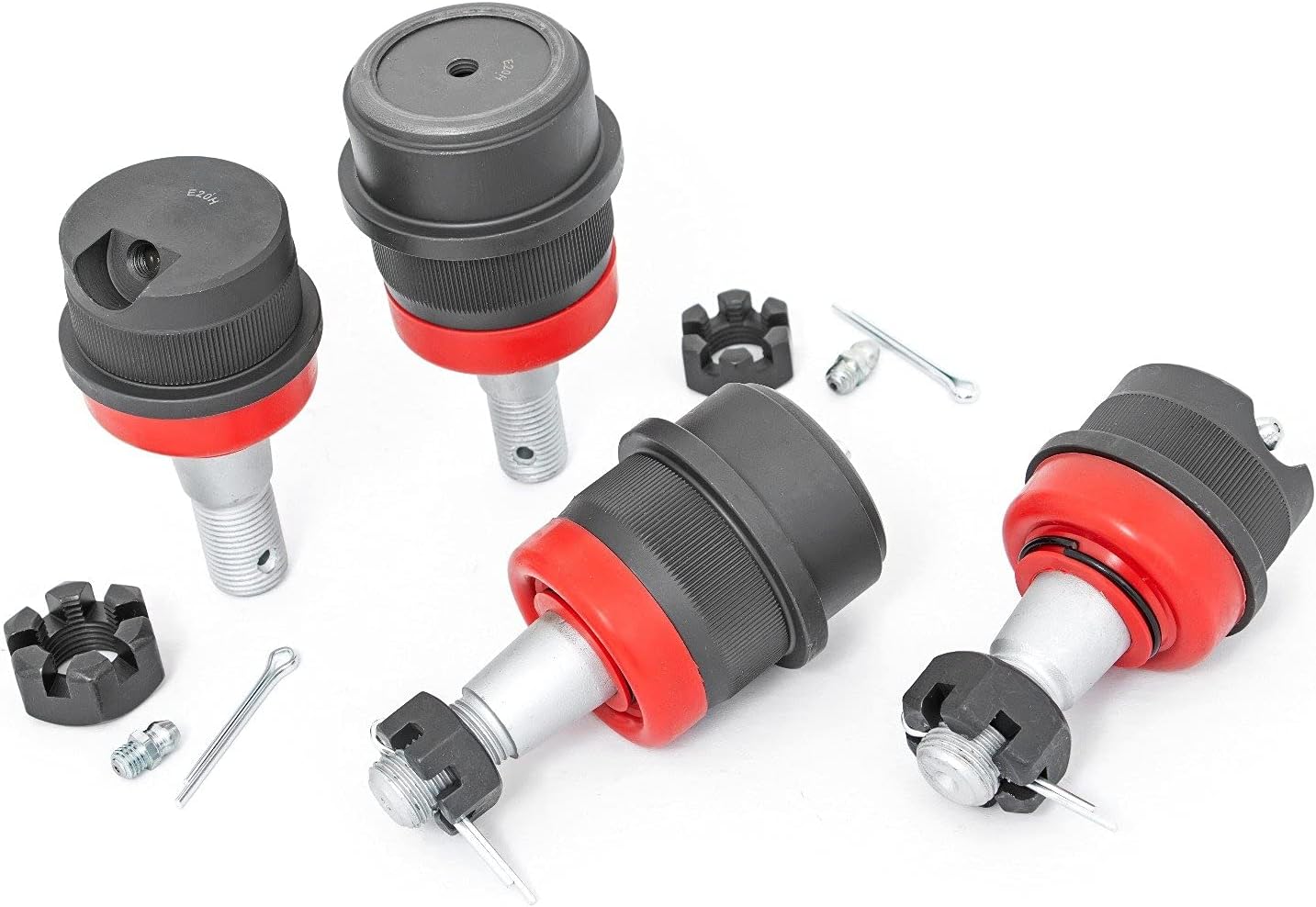
These Rough Country ball joints replace the factory front joints with heavier-duty components built for lifted or higher-stress Jeep use. The kit includes two upper and two lower joints with a chromoly ball stud and a polyurethane dust boot, and it is offered as a direct factory-style replacement that fits Dana 30 and Dana 44 axles. Expect a short metal-on-metal break-in period during the first 100 to 500 miles when steering may feel heavier and slow to return to center before settling into a tighter feel. Installation does not require drilling but basic suspension experience or a professional install is recommended; the manufacturer also advises post-install inspections and bolt torque checks. Buyers report the joints fit well and can cure issues like death wobble when other components are good, though durability varies in real-world use and occasional quality control or packaging issues have been reported.
Best for: Buyers who prioritize a sturdier replacement for front suspension on 1997–2006 Jeep Wranglers and want a product meant to handle the added stresses of lifts or larger tires while keeping a factory-style fit.
Less Ideal for: Drivers looking for a lifetime-maintenance-free or performance-grade racing joint should consider other purpose-built options or consult a mechanic for higher-end upgrades.
- Heavy-duty design intended for lifted Jeeps or oversized tires
- Chromoly ball stud for improved strength over basic replacements
- Polyurethane dust boot helps keep contaminants out
- Direct factory-style fit for Dana 30 and Dana 44 front axles
- No drilling required for installation
- Metal-on-metal break-in can make steering feel heavy for the first 100–500 miles
Verdict: A practical heavy-duty, factory-fit front ball joint kit for 1997–2006 Jeep Wranglers that strengthens suspension for lifted setups while retaining straightforward installation.
Choosing the Right 1997-2006 Jeep Wrangler Ball Joint: Key Factors to Consider
Fitment and Chassis Compatibility
Correct fitment is critical for the 1997-2006 Jeep Wrangler because the TJ, LJ, and TJU era suspension uses specific ball joint sizes and mounting details. A ball joint that does not precisely match stud diameter, taper angle, or mounting flange dimensions can lead to improper seating, accelerated wear, or safety issues. When shopping, verify whether the part is intended for the front lower ball joint, upper ball joint, or both. Some replacements are direct bolt-in units while others require pressing. Consider whether your Wrangler has any aftermarket lift or steering modifications; those changes can affect required clearances and may necessitate heavy-duty or extended-length components. Ensuring proper fit reduces installation time and avoids additional control arm or knuckle work.
Durability and Materials
Materials and protective finishes determine how long a ball joint lasts under the conditions typical for these Wranglers. Look for units with hardened steel studs and quality races that resist deformation under load. Dust boots and seals should be robust enough to keep out water, grit, and salt, which are common failure drivers on vehicles used off-road or in winter. Corrosion-resistant coatings and plated components extend life by preventing rust that can seize fittings or wear bearing surfaces. For owners who frequently drive trails or through standing water, prioritize ball joints with proven sealing systems and tougher internal bearings to withstand contaminant ingress.
Serviceability and Installation Method
How a ball joint installs affects both the time and tools required. Some replacements are press-in and need a ball joint press tool to remove the old unit and install the new one correctly. Others are bolt-in or come with service-friendly features such as grease fittings for periodic lubrication. If you plan to do the job yourself, choose a part that matches your available tools and mechanical skill. Technicians will prefer components that minimize bench time and don't require pressing out control arms or extensive suspension disassembly. Serviceable boots and easy access to grease fittings can also extend the effective life of a replacement joint.
Load Capacity and Performance Under Stress
Ball joints transfer steering and suspension loads, so they must handle vertical and lateral forces without excessive deflection. For a Jeep Wrangler used for towing, trail riding, or heavier-than-stock wheels and tires, higher-capacity joints reduce the risk of premature wear or failure. Design elements such as bearing type and stud geometry influence how the joint reacts to side loads and steering impacts. Choose a joint rated for the expected usage. Underestimating load capacity can lead to increased play, steering wander, or accelerated wear in as little as a few thousand miles under demanding conditions.
Seal Design and Maintenance Needs
Seals and dust boots are the primary defense against contaminants that shorten ball joint life. A well-designed seal prevents water and dirt from entering the bearing while allowing grease to stay in place. Some ball joints include a grease fitting so you can add lubrication during routine maintenance which can significantly extend service life. Consider how accessible any grease fittings will be once the assembly is installed. If a joint lacks a fitting, it should have a durable factory-packed lubricant and a seal tested for long-term service. Regular inspection and prompt replacement of torn boots will protect the investment and keep suspension geometry stable.
Installation Time and Tools Required
Estimate the labor and tools needed before you commit to a replacement. Press-in ball joints typically require a ball joint press tool, sometimes additional adapters, and more bench time to avoid damaging control arm bores. Bolt-in designs or kits that clamp in place can reduce labor and are preferred for roadside repairs. Factor in wheel alignment after replacement. Installing new ball joints often changes toe and camber enough that a professional alignment is recommended. If you cannot access alignment services immediately, choose parts that minimize geometry shift during replacement.
Why Ball Joints Fail on 1997-2006 Jeep Wrangler (TJ, LJ, and TJU)
Wear on ball joints for the 1997-2006 Jeep Wrangler often results from a combination of load cycles, environmental exposure, and mechanical damage. Repeated flexing from uneven terrain, steering impacts from curb hits, and exposure to water and road salt accelerate boot deterioration and allow contaminants into the bearing surfaces.
Mechanical damage from off-road obstacles or compressed boots during wheel travel can deform the dust cover and introduce grit. Once grit or moisture gets in, the joint will wear faster and develop play that shows up as steering looseness, clunks, or uneven tire wear. Understanding these failure modes helps prioritize inspections and choose replacements with better seals and tougher internal components.
- Common contributors: road salt, water ingress, off-road impacts
- Boot tears lead to rapid bearing wear
- Higher loads and larger tires increase stress on joints
Diagnosing Ball Joint Symptoms on Your Wrangler
Owners often notice symptoms before a joint fails completely. Typical signs include steering play that worsens at slow speeds, a knocking or clunking noise when driving over bumps, or unusual tire wear patterns such as inner edge cupping. Wheel vibration at highway speeds can also indicate ball joint or related suspension wear, although it can originate from other components so diagnostic checks are important.
A basic inspection includes checking for vertical or lateral play at the wheel, visually inspecting the dust boot for tears or grease loss, and listening for noises while lifting and rocking the wheel assembly. If you detect movement or damaged seals, plan for prompt replacement to avoid further suspension damage.
- Look for torn boots or dry bearings during visual inspection
- Check for play by lifting the vehicle and rocking the wheel
- Listen for clunks during slow-speed turns and bumps
Tools and Preparation For Replacing Ball Joints
Replacing ball joints on a TJ, LJ, and TJU era Wrangler can be tackled with basic to intermediate tools depending on the installation method. For press-in joints, a quality ball joint press tool plus the correct receiver/drift attachments will be necessary. Bolt-in or clamp-style units may reduce the tool list to common sockets, wrenches, and torque equipment.
Prepare for the job by having jack stands, wheel chocks, penetrating oil for stuck fasteners, and torque specs on hand. Consider whether you will perform a full control arm removal or press the joint in-place. Also budget time for a post-replacement alignment because new joints often affect toe and camber.
- Essential tools: jack stands, torque wrench, basic hand tools
- Press-in jobs need a ball joint press tool and adapters
- Reserve time and budget for a wheel alignment after installation
When to Replace Upper Versus Lower Ball Joints
The decision to replace an upper or lower ball joint depends on which component shows wear and the vehicle usage. Upper ball joints on the TJ, LJ, and TJU are often subjected to steering articulation and may show different wear patterns from lower joints, which carry more vertical load from the vehicle weight and impacts.
If both joints exhibit play or damaged boots, replacing them as a matched pair or using a kit reduces the chance of repeated labor. For owners focused on a minimal repair, replace only the joint that fails inspection, but plan to recheck the other side soon since asymmetric wear can affect alignment and handling.
- Lower joints typically handle heavier vertical loads
- Upper joints may wear from steering articulation
- Replacing both sides together saves future labor and alignment cycles
Maintenance Tips to Prolong Ball Joint Life
Regular visual inspections of the dust boots and periodic lubrication for joints with grease fittings extend service life. Clean away mud and debris that can abrade the boot surface and check for any signs of rust or contamination. If your Wrangler sees frequent off-road use, increase inspection frequency and address torn boots promptly.
Use only recommended greases at the fittings and avoid overpacking boots which can tear them. When replacing a boot or joint, ensure the mating surfaces are clean and free of corrosion so the new seal seats correctly. Preventive maintenance reduces the frequency of replacements and keeps steering predictable.
- Inspect boots after off-road trips and remove lodged debris
- Lubricate serviceable joints following manufacturer guidance
- Replace torn boots quickly to avoid bearing contamination
Alignment and Driving Impacts After a Ball Joint Replacement
Installing new ball joints can shift suspension geometry enough to require a wheel alignment. Even if the joints are direct-fit, their seating tolerances and any new control arm hardware can affect toe and camber. Plan for an alignment check after replacement to restore correct tire wear and steering response.
Drive gently for the first few miles after a replacement and listen for any odd noises that could indicate an installation issue. If you notice pulling, vibration, or uneven tire wear after the job, return for alignment confirmation and torque rechecks on fasteners.
- Always schedule an alignment after installing new suspension joints
- Monitor for vibration or steering pull during the first drive
- Re-torque suspension fasteners after a short break-in period
Still looking for the perfect fit?
Select your Jeep Wrangler configuration to see the most relevant Ball Joints recommendations
How We Chose the Best 1997-2006 Jeep Wrangler Ball Joint
We focused on criteria that matter to 1997-2006 Jeep Wrangler owners and technicians working on the TJ, LJ, and TJU era chassis. Fitment accuracy was the primary filter: parts had to match factory mounting points, stud sizes, and grease fittings where applicable so they install cleanly without modification. Durability followed closely. We prioritized materials and construction features that influence wear life under typical Jeep use, such as heavy steering loads, trail impacts, and exposure to water and road salt. Serviceability and installation factors were weighed heavily. We favored ball joints compatible with common service techniques used on this Wrangler generation, including press-in replacement or bolt-in designs, and those that work with standard ball joint press tools. Functional performance criteria included load capacity and bearing design to minimize play over time. Corrosion protection and seal design were evaluated to reduce premature failure from contaminants. We excluded any part that required custom modification to mounting points or altered suspension geometry. Also excluded were options lacking clear fitment data for the 1997-2006 Wrangler. The final list balances durability, correct fit, and realistic installation expectations for owners who plan to DIY or work with a local shop.
Our full evaluation process is outlined in our review methodology.
FAQ
How do I know if my 1997-2006 Wrangler needs a ball joint replacement?
Look for play when lifting and rocking the wheel, torn dust boots, clunking noises over bumps, or unusual tire wear. Wheel vibration and steering looseness often indicate worn joints but confirm with a hands-on inspection.
Can I replace a ball joint myself with basic tools?
You can perform some replacements with basic hand tools if the part is a bolt-in design. Press-in joints typically require a ball joint press tool and more mechanical experience. If you are unsure, consult a technician to avoid damaging control arm bores.
Should I replace upper and lower ball joints at the same time?
It depends. If both show wear or the vehicle has high mileage, replacing both sides or both upper and lower joints together reduces the chance of repeated labor and helps keep alignment stable. For a single failing joint, replacing just that unit is acceptable but plan to inspect the other joints soon.
Will a new ball joint eliminate wheel vibration?
A worn ball joint can cause wheel vibration, but vibration may also stem from tires, wheel balance, or other suspension components. If vibration persists after replacing a confirmed worn joint, check wheel balance, alignment, and related suspension parts.
Do replacement ball joints for a 1997-2006 Wrangler require a wheel alignment?
Yes. Installing new ball joints often alters toe and camber enough that a professional alignment is recommended to restore proper tire wear and steering geometry.
Final Verdict
When replacing ball joints on a 1997-2006 Jeep Wrangler, prioritize correct fitment to the TJ, LJ, and TJU chassis, robust seals, and an installation method that matches your tools and skill level. Durability under load and ease of service determine long-term value, so choose components with proven sealing, hardened bearings, and the appropriate capacity for any larger tires or trail use. Balance the need for longevity against installation complexity. If you plan to do the work yourself, favor serviceable or bolt-in designs that work with common tools. If the vehicle sees heavy off-road duty, select heavier-duty components and budget for an alignment after installation to restore precise steering and even tire wear.
Explore More:
- Check out all Jeep Wrangler parts & accessories
- Explore Ball Joints Maintenance & Repair Guides
- Explore Suspension & Steering
- Browse all Auto Parts
