

Note: This article contains affiliate links. If you click on these links and make a purchase, I may earn a small commission at no extra cost to you. This helps support my research and content. Read my full affiliate disclosure here.
Picking the right fluid matters more than you might think for a Honda Civic with a CVT. The correct transmission fluid keeps belt-and-pulley systems operating smoothly, stabilizes friction characteristics for consistent shift feel, and helps prevent premature wear under everyday commuting and highway use. For Civic owners who want dependable performance and longevity, choosing a CVT-specific fluid that matches the vehicle's requirements is essential.This guide covers our top five recommended transmission fluids for the Honda Civic CVT. We shortlisted options that address friction control, thermal stability, seal compatibility, and service intervals so you can pick a fluid that suits your driving habits. Read on for the evaluation criteria and factors that matter when you next schedule a transmission fluid change.
Looking for other parts? See all Honda Civic parts & accessories.
Top Picks at a Glance
| Best Overall Transmission Fluid A well-balanced, reliable CVT fluid that suits most owners | Idemitsu CVT Transmission Fluid HCF-2 Type H2 (5 Quart) |  |
| Best Premium Transmission Fluid Higher-end CVT fluid with enhanced additives and longer protection | Honda HCF-2 CVT Transmission Fluid, 5-Quart Pack |  |
| Best Synthetic Transmission Fluid Fully synthetic formula for improved performance and temperature stability | ENEOS ECO CVT Fully Synthetic Transmission Fluid, 1 Qt (6-Pack) |  |
| Best Long-Life Transmission Fluid Designed for extended drain intervals and durable fluid life | Genuine HCF-2 CVT Automatic Transmission Fluid 8 x 1 Quart |  |
| Best OEM-Spec Transmission Fluid Meets manufacturer specifications and certifications required for proper fitment | Honda Genuine HCF-2 Transmission Fluid, 1 U.S. Quart (946 ml) |  |
1. Idemitsu CVT Transmission Fluid HCF-2 Type H2 (5 Quart)
Best Overall Transmission Fluid

| Manufacturer | Idemitsu |
|---|---|
| Item model number | 30041114-95300C020 |
| Volume | 5 Quart |
Idemitsu CVT Transmission Fluid HCF-2 is a factory-replacement grade fluid designed specifically for Honda continuously variable transmissions that require the HCF-2 specification. It is used like any CVT service fluid during drain-and-fill or full flush maintenance and combines high-quality base oils with proprietary additives to reduce shudder, stabilize friction characteristics, and resist thermal breakdown. In everyday driving this translates to smoother low-speed acceleration, consistent belt/pulley engagement, and reduced clutch wear over long service intervals. The formula also claims fuel-efficiency benefits through friction modifiers and appears to offer strong resistance to oxidation and varnish buildup. The product is sold in a 5-quart container that suits most DIY CVT service jobs for compact Hondas. Limitations are that it is specific to CVT applications and not suitable for automatic or dual-clutch gearboxes, and buyers must verify HCF-2 compatibility for their exact Civic year and transmission code before use.
Best for: DIY mechanics who prioritize a dependable, Honda-compatible CVT fluid that balances everyday performance and longevity for routine maintenance on Civic CVTs.
Less Ideal for: People looking for a universal automatic transmission fluid or a product for dual-clutch transmissions should choose a fluid specified for those systems instead.
- Formulated to meet Honda HCF-2 spec for direct compatibility with Honda CVTs
- Additive package reduces shudder and maintains consistent friction for smooth shifts
- Good thermal and oxidation stability to extend fluid and transmission life
- Available in a 5-quart pack size convenient for DIY drain-and-fill services
- Intended only for CVT applications and not suitable for AT or DCT gearboxes
Verdict: The best all-around transmission fluid that balances performance, longevity, and value for DIY mechanics who want a dependable CVT fluid for general maintenance.
2. Honda HCF-2 CVT Transmission Fluid, 5-Quart Pack
Best Premium Transmission Fluid

| Material | Mineral-based |
|---|---|
| Liquid Volume | 5 Quarts |
| Specific Uses For Product | Second-generation CVT transmissions in Honda vehicles |
| Item form | Oil |
| Manufacturer | American Honda Motor Co., Inc. |
This is genuine Honda HCF-2 CVT transmission fluid sold in a five-quart set and intended specifically for second-generation Honda continuously variable transmissions. It is formulated to provide a stable coefficient of friction for smooth, predictable shifts while offering pressure and wear protection that helps transmission components resist heat and wear during extended driving. Typical use is a drain-and-fill or full service when your owner's manual calls for HCF-2; the five-quart quantity covers multiple partial changes or a full service when combined with the vehicle's sump capacity. Because it is a mineral-based factory fluid, you get compatibility and peace of mind that off-brand fluids may not guarantee, but it is limited to Honda second-generation CVT applications and should not be mixed with other CVT fluids. Buyers trading up to a premium fluid pay for factory-formulation reliability and broad temperature performance rather than aftermarket additives or multi-vehicle versatility.
Best for: Buyers who prioritize factory-specified fluid performance and want a premium, Honda-approved product that supports smooth shifting and long-term transmission protection.
Less Ideal for: Drivers who need a multi-vehicle or universal CVT fluid or who prefer synthetic aftermarket formulations with different additive packages.
- Factory-formulated for Honda second-generation CVT transmissions for assured compatibility
- Stable coefficient of friction aimed at smoother shifts and improved efficiency
- Designed for pressure and wear protection to extend transmission life
- Five-quart pack provides enough volume for multiple services or a complete change when needed
- Limited to second-generation Honda CVT applications and not compatible with other CVT fluids
Verdict: The best premium transmission fluid for buyers willing to pay more for superior thermal stability, smoother shifts, and extended protection under tougher driving conditions.
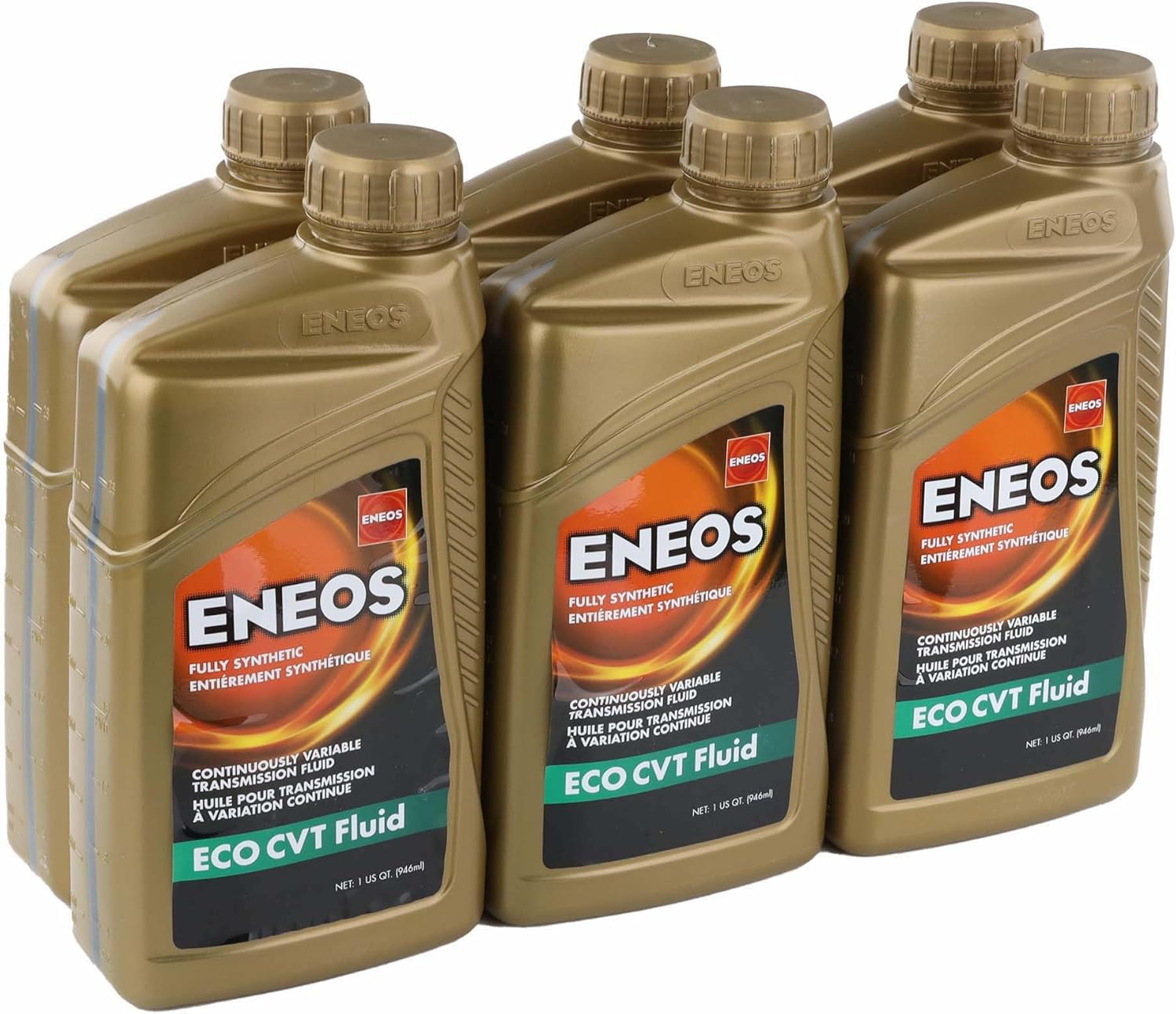
3. ENEOS ECO CVT Fully Synthetic Transmission Fluid, 1 Qt (6-Pack)
Best Synthetic Transmission Fluid
| Compatible with Vehicle Type | Car |
|---|---|
| Container Type | Bottle |
| Automotive Fit Type | Vehicle Specific Fit |
| Liquid Volume | 1 Quarts |
| Included Components | 1 Quart bottles, 6 Pack |
ENEOS ECO CVT is a fully synthetic transmission fluid formulated for belt and chain type continuously variable transmissions. It is intended for routine drain-and-fill service and claims compatibility with many Asian CVT specs such as Toyota CVTF TC/FE, Honda/Acura CVTF/HCF-2, Nissan NS series, Mazda CVTF 3320, Mitsubishi J-series, and Subaru CVTF while advising verification with the owner’s manual. The formula uses low-viscosity base oils and targeted additives to help maintain stable viscosity at high temperature, aid low-temperature flow for quicker shift response, and reduce transmission noise. In practice this means smoother, quieter operation and support for longer service intervals compared with conventional fluids when used in compatible CVTs. Limitations include explicit exclusions for some hybrid eCVTs, toroidal or dry-type CVTs, and certain proprietary units, so it is not universal across all CVT designs. The product comes as 1-quart bottles sold in a six-pack which suits DIY mechanics doing full fluid changes or topping off multiple vehicles.
Best for: DIY mechanics who want a factory-quality synthetic CVT fluid that maintains viscosity under thermal stress and supports longer intervals between services for compatible Asian CVT-equipped vehicles.
Less Ideal for: People working on hybrid eCVT systems, toroidal transmissions, dry-type CVTs, or owners who cannot confirm their vehicle’s CVT spec should look for a fluid explicitly specified for those transmissions.
- Fully synthetic formula designed for CVT applications to support stable viscosity and thermal performance.
- Compatible with many Asian CVT specifications including Honda/Acura and several Toyota and Nissan CVT specs when verified against the owner’s manual.
- Formulation aimed at reducing transmission noise and improving shift smoothness.
- Sold in 1-quart bottles with a six-pack unit count, convenient for DIY drain-and-fill jobs or servicing multiple vehicles.
- Not recommended for certain hybrid eCVTs, Nissan Extroid CVT, toroidal, or dry-type CVTs so fitment must be confirmed before purchase.
Verdict: The best synthetic transmission fluid for DIY mechanics who prioritize thermal performance, consistent viscosity under stress, and longer-service intervals compared with conventional fluids.
4. Genuine HCF-2 CVT Automatic Transmission Fluid 8 x 1 Quart
Best Long-Life Transmission Fluid

| Unit Count | 256.0 Fluid Ounces |
|---|---|
| Liquid Volume | 8 Quarts |
| Container Type | Bottle |
This eight-quart pack of genuine HCF-2 CVT transmission fluid is a factory-spec replacement designed for continuously variable transmissions. It is supplied as individual one-quart bottles, which makes it convenient for DIY fluid changes and topping off. The formulation is aimed at CVT friction control and corrosion protection, so users can expect stable shift feel and protection for internal components when used to Honda CVT fill specifications. Practical benefits include having a full service quantity on hand and eliminating the need to mix different fluids. Limitations are that the listing provides limited technical detail beyond volume and intended use, and this product should only be used where the HCF-2 specification is required; it is not a universal ATF substitute for other transmission types. Buyers should follow the vehicle manufacturer service interval guidance rather than assuming extended intervals solely because the product is a factory-spec fluid.
Best for: DIYers who want a factory-spec CVT fluid on hand to perform full drains and top-ups and prioritize using the correct Honda HCF-2 formulation for stable CVT performance.
Less Ideal for: People seeking a universal automatic fluid or detailed technical datasheets for extended-interval claims should look elsewhere.
- Supplied as genuine HCF-2 formulation intended for CVT applications
- Pack of eight one-quart bottles provides a full service quantity for most CVT drains
- One-quart bottles make DIY filling and storage easier and reduce contamination risk
- Formulation lists corrosion prevention and is designed to maintain CVT friction characteristics
- Product listing lacks detailed performance specifications or additive package information
- Sold in a bulk pack which may be more than needed for a single small job
Verdict: The best long-life transmission fluid for DIYers looking to maximize drain intervals and maintain stable performance between services with a more durable formulation.
5. Honda Genuine HCF-2 Transmission Fluid, 1 U.S. Quart (946 ml)
Best OEM-Spec Transmission Fluid

| Unit Count | 32.0 Fluid Ounces |
|---|---|
| SAE J300 Viscosity Grade | 20W-50 |
| Material | Synthetic |
| Part Number | 08200-HCF2 |
Honda Genuine HCF-2 transmission fluid is the factory-specified fluid intended for Honda automatic and CVT gearboxes. Packaged in a one-quart bottle and labeled as synthetic, it is designed to match Honda specifications and help prevent corrosion while maintaining smooth shifting. Technicians and DIY mechanics will appreciate that it is a genuine OEM part, so compatibility and warranty-conscious maintenance are straightforward when servicing Hondas. The SAE listing and synthetic base suggest stable viscosity under normal operating conditions, making it suitable for routine fluid changes and top-ups. Limitations are that it is offered in single-quart bottles, so servicing transmissions that require larger volumes means buying multiple bottles, and the product is typically priced higher than many aftermarket fluids. Also the listing does not provide an explicit compatibility year range on the bottle, so users should confirm fitment for their exact Civic CVT model year before use.
Best for: Technicians and competent DIY mechanics who prioritize using manufacturer-specified fluids for warranty-conscious maintenance and reliable compatibility when servicing Honda CVT transmissions.
Less Ideal for: Buyers who need large-volume supplies for fleet work or prefer lower-cost aftermarket fluids optimized for long drain intervals should consider alternatives.
- Factory-original formulation matched to Honda vehicle requirements
- Synthetic base for stable performance and corrosion prevention
- Sold in convenient one-quart bottles for easy top-ups and small jobs
- Single-quart packaging can be inconvenient and more costly for full transmission fills
- Listing lacks an explicit model-year fitment statement on the bottle
Verdict: The best OEM-spec transmission fluid for technicians and DIY mechanics who want a product that matches factory specs and approvals for reliable compatibility and warranty-conscious maintenance.
Choosing the Right Honda Civic CVT Transmission Fluid: Key Factors to Consider
CVT-Specific Friction Characteristics
CVT systems rely on controlled friction between the belt or chain and pulleys plus clutch pack elements. Fluids designed for CVTs have formulations that maintain consistent friction coefficients across a wide temperature range. Consistent friction prevents judder, slip, and erratic belt behavior, which directly affects drivability and perceived shift smoothness.
When selecting fluid for a Honda Civic CVT, look for products that state CVT compatibility and provide data on friction durability. Fluids that lose friction stability when hot can cause a mushy feel or belt slippage under load, while overly aggressive friction can lead to harsh engagement. The right balance preserves smooth acceleration and protects the transmission's mechanical components.
Viscosity Stability and Shear Resistance
Viscosity affects film strength and hydraulic function inside the transmission. CVT fluids must resist shear thinning so the fluid does not lose protective film strength under prolonged high-load conditions. If a fluid thins excessively, clearances can increase, increasing wear and reducing control accuracy.
For the Honda Civic CVT, choose fluids with additives and base oils that resist viscosity breakdown and maintain consistent flow characteristics from cold starts to extended highway runs. Stable viscosity supports consistent line pressure, clutch actuation, and hydraulic response which translates to predictable performance and longer component life.
Thermal and Oxidation Resistance
Transmission fluids operate at elevated temperatures and are exposed to oxygen that drives oxidation and deposit formation. Good thermal stability reduces varnish, sludge, and the buildup of residues that can interfere with valves, sensors, and friction surfaces in a CVT.
A fluid with strong oxidation resistance will sustain performance over longer drain intervals and in demanding conditions such as hot-weather or tow-like loads. For Civic owners who do lots of highway driving or city stop-and-go, prioritizing thermal stability helps maintain clutch modulation and reduces the risk of early component contamination.
Seal and Material Compatibility
CVT fluids contact a variety of elastomers, seals, and polymers inside the transmission. Incompatible chemistries can cause seals to swell, shrink, or harden, leading to leaks or loss of hydraulic pressure. Ensuring compatibility with materials used in Honda Civic CVT transmissions helps prevent such failures.
When selecting a fluid, verify that it is formulated to be compatible with modern transmission elastomers and that it does not contain additives known to attack seal materials. Compatibility reduces maintenance headaches and preserves the integrity of gaskets and O-rings over time.
Corrosion Protection and Additive Longevity
Metals inside the transmission require protection from corrosion and wear. Effective antiwear and anticorrosion chemistry helps protect bearings, cages, and gear surfaces from pitting and surface degradation. The longevity of these additives determines how well protection holds up between services.
Pick fluids with proven antiwear additives and corrosion inhibitors appropriate for CVT architectures. For Honda Civic CVT owners, this minimizes internal wear and helps keep hydraulic components functioning reliably across normal service intervals.
Service Interval and Maintenance Impact
Service interval considerations affect cost and convenience for owners. Some CVT fluids are designed for extended drain intervals, while others are intended for more frequent replacement to maintain peak performance. Longer intervals can be acceptable if the fluid demonstrates stable friction and oxidation resistance.
Decide based on your driving patterns: frequent short trips and heavy city use may justify shorter change intervals, while mostly highway driving could support longer intervals if the fluid's specifications and testing back that up. Also consider whether the fluid requires filter changes or special procedures during a transmission fluid change.
When To Replace CVT Fluid In A Honda Civic
Honda provides maintenance guidance for CVT fluid changes based on driving conditions, but actual needs vary with use. Routine inspection intervals let you spot contamination or discoloration before performance degrades. Many owners find high-mileage or heavy city usage accelerates fluid aging compared with mixed or highway driving.
Signs that a fluid change is needed include unusual noise, belt or pulley judder, inconsistent acceleration, or a shift feel that differs from normal. If you encounter these symptoms, inspect fluid condition and consult the service manual for the recommended replacement procedure and fluid specification.
- Check fluid color and smell for burnt or darkened signs
- Monitor for unusual transmission noise or vibration
- Follow Honda's specified inspection intervals for CVT service
How Fluid Choice Affects Fuel Economy And Shift Response
Fluid viscosity and friction stability influence hydraulic control and the mechanical efficiency of the CVT. A fluid that maintains proper viscosity supports precise pulley actuation, which can help sustain designed engine load profiles and reduce parasitic losses. Overly thin or degraded fluid can introduce slippage and reduce efficiency.
Stable friction properties contribute to predictable throttle response and smoother acceleration. While fluid choice alone will not dramatically change fuel economy, selecting the right CVT fluid helps preserve the transmission's intended behavior and prevents gradual performance loss that can impact efficiency over time.
- Proper viscosity supports accurate pulley control
- Consistent friction preserves shift feel and throttle response
- Degraded fluid can indirectly reduce fuel efficiency through slippage
DIY Fluid Change Tips For Civic Owners
A fluid change for a CVT is more involved than a simple engine oil swap. It often requires the correct fill procedure, attention to fluid temperature at fill, and sometimes a specific level-check method. Follow the service manual closely and use the specified fluid type and fill volume.
If you plan to do the work yourself, prepare proper tools, a clean workspace, and a means to safely lift and support the car. Dispose of used fluid responsibly and keep the transmission area clean to prevent contamination. When in doubt, have a technician confirm level and fill procedure to avoid overfilling or underfilling.
- Use the manufacturer-specified fluid and observe the correct fill temperature
- Ensure the vehicle is level when checking fluid level unless the manual specifies otherwise
- Keep all drain and refill openings free of dirt during service
Tools And Service Requirements For CVT Maintenance
Some CVT maintenance tasks require specialty tools such as accurate fluid pumps, level-check tools, or diagnostic equipment to perform a controlled refill or to cycle the transmission through its range during fill. Having the correct tools reduces the risk of incorrect fill and ensures the hydraulic circuits function properly after service.
If you take the vehicle to a technician, confirm they follow the Honda-recommended procedure and use CVT-compatible fluids. Request that any replaced seals or drain plugs are torqued to specification and that the area is inspected for leaks after service.
- Fluid pump or suction device for controlled refills
- Torque wrench for correct drain plug and pan fastener torque
- Diagnostic scanner helpful for resetting service indicators if needed
Environmental And Disposal Considerations
Used transmission fluid is a regulated waste in many jurisdictions and must be collected and disposed of responsibly. Plan ahead to store and transport used fluid to an authorized recycling or disposal facility. Improper disposal can harm the environment and may carry legal penalties.
When choosing a fluid, consider product lifecycle and whether the supplier provides guidance on recycling empty containers. Minimizing waste and following local disposal rules helps keep maintenance sustainable.
- Collect used fluid in sealed containers for recycling
- Avoid disposing of fluid in drains or soil
- Follow local regulations for hazardous waste disposal
Still looking for the perfect fit?
Select your Honda Civic configuration to see the most relevant Transmission Fluids recommendations
How We Chose the Best Honda Civic CVT Transmission Fluid
We focused on fluids formulated specifically for continuously variable transmissions and that match the performance expectations for a Honda Civic CVT. Our selection criteria prioritized friction stability under varying temperatures, shear resistance to maintain viscosity over time, and compatibility with CVT belt or chain materials to avoid seal swelling or hardening.We also considered thermal and oxidation resistance to reduce varnish and deposits during extended service intervals, and the ability to protect bearings and clutches in stop-and-go and highway driving. Another key factor was service life and maintenance implications, including whether a fluid supports longer drain intervals without compromising protection.Exclusions: we excluded generic automatic transmission fluids not rated for CVT use, fluids intended solely for manual gearboxes, and any formulations that lack clear technical data on CVT compatibility. The final list reflects fluids that meet CVT-specific performance markers and that are suitable for routine maintenance on the Honda Civic CVT.
Our full evaluation process is outlined in our review methodology.
FAQ
How often should I change CVT fluid in my Honda Civic?
It often depends on driving conditions. Light highway use can allow for longer intervals, while heavy city driving or frequent towing shortens service life. Check the vehicle's maintenance schedule and inspect fluid condition as a practical guide.
Can I use generic automatic transmission fluid in a Civic CVT?
Usually not. Generic ATF formulations may not have the friction characteristics or seal compatibility required for CVTs. Always use a fluid specified for CVT applications to avoid drivability and sealing issues.
Will changing the CVT fluid improve a slipping sensation?
Sometimes. If slipping is caused by degraded or contaminated fluid, a proper change can restore friction properties and improve feel. However, mechanical wear or other faults can also cause slip, so further diagnosis may be needed if symptoms persist.
Is it acceptable to top up CVT fluid between changes?
Topping up can be acceptable for small losses, but frequent top-ups may mask leaks. Use the specified fluid and confirm there are no external leaks. For level checks and topping up, follow the service manual's temperature and leveling procedures.
Do I need a filter change when replacing CVT fluid?
It depends on the transmission design and service procedure. Some CVT services include a filter or strainer change, while others rely on pan access. Refer to the maintenance procedure for your Civic CVT to determine whether a filter replacement is recommended.
Final Verdict
Prioritize CVT-specific formulations that preserve friction stability, resist shear and oxidation, and are compatible with the Civic's elastomers when choosing transmission fluid. Balance service interval expectations with your driving habits: shorter intervals for heavy urban use, and longer intervals may be acceptable for predominantly highway miles if the fluid's specs support it.By focusing on friction characteristics, viscosity stability, and material compatibility, you can maintain smooth shift feel and protect the transmission over the long term. Use the guidance above to pick a fluid that matches your maintenance plan and driving style so you can drive with confidence.
Explore More:
- Check out all Honda Civic parts & accessories
- Explore Fluids & Chemicals
- Browse all Accessories
