

Note: This article contains affiliate links. If you click on these links and make a purchase, I may earn a small commission at no extra cost to you. This helps support my research and content. Read my full affiliate disclosure here.
Picking the correct transmission fluid for your 2006-2011 Honda Civic matters more than many owners realize. The right fluid affects shift feel, clutch engagement in manuals, torque converter behavior in automatics, and long-term gearbox wear. For Civics built between 2006 and 2011, often referenced with the FA and FG chassis code, fluids have to match Honda specifications and the vehicle's service pattern to work reliably.This guide shortlists the top fluids suitable for the 2006-2011 Civic and explains the practical reasons behind each recommendation. We evaluated candidates for friction stability, viscosity at operating temperature, and compatibility with the Civic's wet clutch and seal materials. Read on to understand which fluid traits matter most for your Civic and how they influence shifting, longevity, and maintenance intervals.
Looking for other parts? See all Honda Civic parts & accessories.
Top Picks at a Glance
| Best Overall Transmission Fluid A balanced, OEM‑compatible fluid that prioritizes smooth shifting and protection | Honda Genuine ATF DW-1 Automatic Transmission Fluid 4-Quart Service Kit |  |
| Best Budget Transmission Fluid An affordable ATF option that covers basic maintenance without breaking the bank | Valvoline MaxLife Multi-Vehicle Full Synthetic ATF, 1 qt |  |
| Best OEM Honda ATF Genuine or factory-formula ATF specified for Honda automatic transmissions and fills | Honda Genuine ATF DW-1 Automatic Transmission Fluid, 2-Quart |  |
| Best CVT Fluid Specialized continuously variable transmission fluid formulated for CVT clutches and belts | Honda HCF-2 CVT Transmission Fluid, 1 Quart (4 Pack) |  |
| Best Manual Transmission Fluid A gearbox-specific manual trans oil that matches manual shift and gear protection needs | Honda Genuine Manual Transmission Fluid 08798-9031, 1 Quart |  |
| Best Bulk / Gallon Synthetic ATF One-gallon or multi-quart full‑synthetic ATF for frequent servicing or multiple vehicles | Valvoline MaxLife Multi-Vehicle Full Synthetic ATF, 1 Gallon |  |
| Best Complete Service Pack ATF bundle or kit that includes multiple quarts and service hardware or washers | Honda DW-1 Automatic Transmission Fluid, 1 qt — Pack of 4 |  |
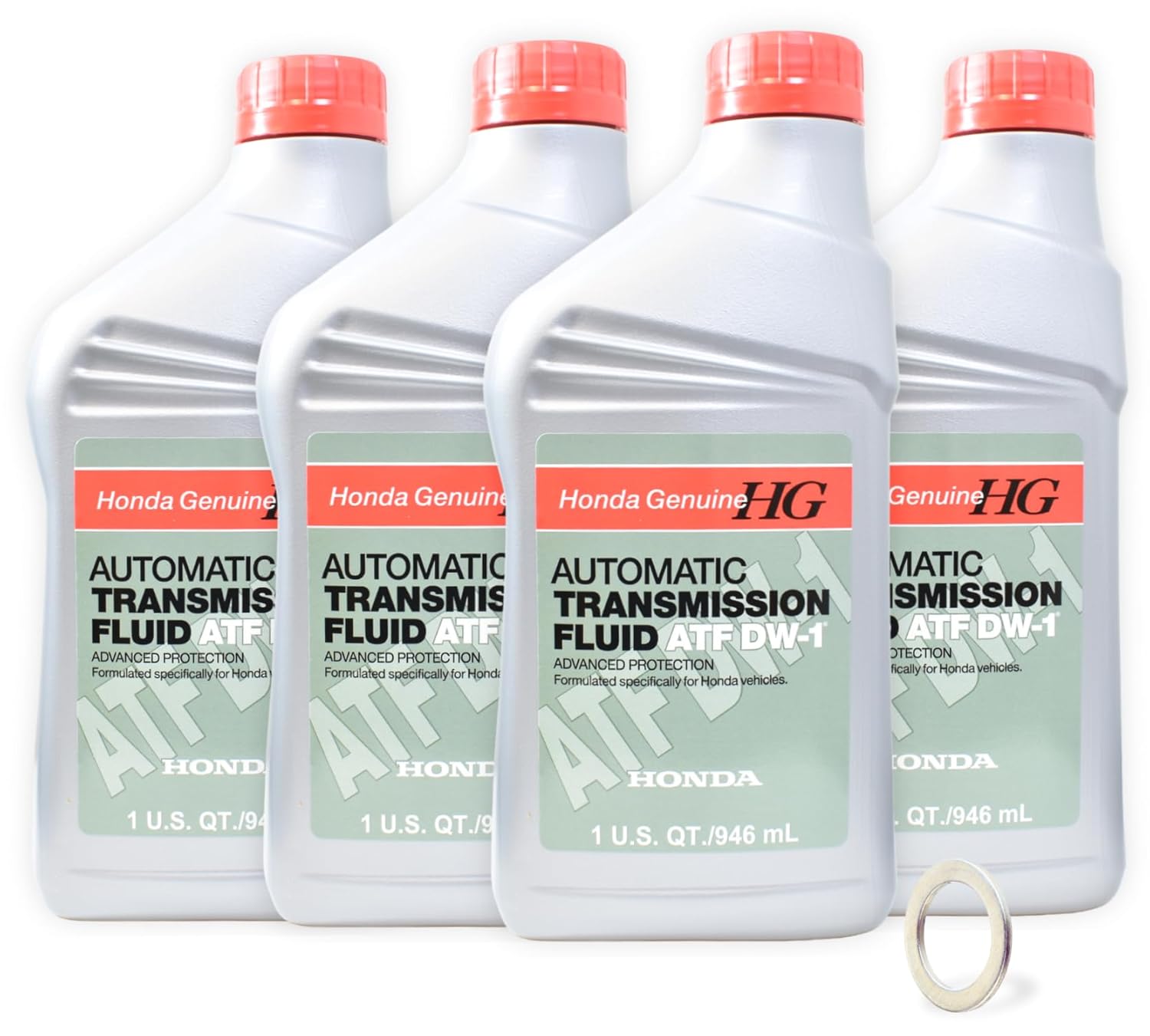
1. Honda Genuine ATF DW-1 Automatic Transmission Fluid 4-Quart Service Kit
Best Overall Transmission Fluid
| Liquid Volume | 4 Quarts |
|---|---|
| SAE J300 Viscosity Grade | 10W-30 |
| Package Information | Bottle |
| Manufacturer | American Honda Motor Company |
This Honda Genuine ATF DW-1 kit supplies four 1-quart bottles of factory-approved automatic transmission fluid plus an 18 mm drain plug washer for a straightforward drain-and-fill service. It is formulated to match Honda transmission friction characteristics so shifts remain smooth and consistent while helping resist thermal breakdown, oxidation, and wear in the valve body and clutch packs. Typical use is periodic service on Hondas that specify DW-1, either during a scheduled maintenance drain-and-fill or when refreshing aged fluid to reduce shift harshness and surging. Because it is the factory-specified formula, it supports warranty-conscious owners and helps avoid compatibility problems seen with some aftermarket blends. The kit does not include specialty tools or a full fluid flush system, so technicians doing multiple changes or full flushes will need additional equipment and more fluid. For older cars that require a deep flush to remove degraded fluid, plan for repeated changes rather than expecting a single drain to remove all contaminants.
Best for: Owners prioritizing factory compatibility and reliable shift quality for Honda transmissions who want a straightforward drain-and-fill service using the exact fluid the manufacturer recommends.
Less Ideal for: Technicians or DIYers planning a full transmission flush that removes all old fluid in one session should consider bulk fluid and a flush machine instead.
- Factory-approved DW-1 formulation tuned for Honda transmissions
- Includes four 1-quart bottles for a complete drain-and-fill service
- Improves shift smoothness and helps resist thermal breakdown and oxidation
- Package includes an 18 mm drain plug washer for a proper drain installation
- Sold as bottles only so a separate funnel or pump is needed for fill
- Not a full flush kit, multiple changes may be required to remove old fluid completely
Verdict: Choose this slot for a transmission fluid that delivers reliable shift quality, wear protection, and compatibility with common Honda transmission specs.
2. Valvoline MaxLife Multi-Vehicle Full Synthetic ATF, 1 qt
Best Budget Transmission Fluid

| Material | Synthetic |
|---|---|
| Liquid Volume | 1 Quarts |
| Flash Point | 394 Degrees Fahrenheit |
| Container Type | Bottle |
Valvoline MaxLife Multi-Vehicle ATF is a full synthetic transmission fluid formulated to work in a wide range of light-duty automatic and many CVT transmissions. For a routine DIY fluid change on a 2006–2011 Honda Civic, it replaces drained fluid, conditions seals to reduce leaks, and uses anti-wear additives and frictional modifiers to smooth shifts and reduce shudder. The one-quart bottle is easy to pour for top-ups or complete drain-and-fill services, and the formula is engineered for better viscosity and thermal stability than conventional ATFs, which helps under typical commuter driving and occasional towing. Limitations are that this multi-vehicle product is not a model-specific factory replacement so you should confirm Honda’s fluid spec before a full flush, and some transmissions call for manufacturer-specific CVT fluids with different friction properties. For routine maintenance and restoring fluid level during a service interval, MaxLife offers reliable performance and good value for DIYers working on these Civics.
Best for: A budget-minded DIYer seeking an affordable, serviceable ATF to restore fluid level and improve shift quality during routine maintenance on a 2006–2011 Honda Civic.
Less Ideal for: Drivers who require a Honda-specified transmission fluid for warranty, dealership maintenance, or CVT systems that mandate a unique friction formula should choose the OEM-recommended fluid instead.
- Full synthetic formula for improved thermal and viscosity stability versus conventional ATF
- Multi-vehicle compatibility suitable for many light-duty automatics and several CVTs
- Adds conditioning agents to help preserve seals and reduce leaks
- Anti-wear additives and friction modifiers that can smooth shifting and reduce shudder
- Convenient 1-quart bottle size for DIY drain-and-fill or top-up jobs
- Not a Honda-specific or manufacturer-designated CVT fluid so confirm vehicle spec before a complete fluid change
Verdict: Use this pick when you need a low-cost, serviceable ATF that restores fluid levels and provides acceptable protection for routine DIY fluid changes.
3. Honda Genuine ATF DW-1 Automatic Transmission Fluid, 2-Quart
Best OEM Honda ATF

| Manufacturer | HONDA |
|---|---|
| Brand | Honda |
| Model | FBA_08200-9008 |
This is Honda's genuine ATF DW-1 transmission fluid supplied in a 2-quart container and intended as a direct factory-spec replacement where DW-1 is required. It is used for topping off or servicing automatic transmissions designed for Honda’s DW-1 formula to preserve the transmission’s intended friction characteristics and shift quality. Being the manufacturer-specified fluid, it reduces the guesswork of cross-compatibility and helps maintain smooth shifting, torque converter operation, and clutch pack modulation in vehicles built for this specification. Practical benefits include consistent viscosity and additive balance matched to Honda transmissions and the convenience of a 2-quart size for partial service or top-ups. Limitations are that it is specific to systems calling for DW-1 and is not a universal ATF substitute, so it should only be used where the vehicle manufacturer specifies this fluid. Buyers should also plan for proper disposal of used fluid and measure required quantity before purchase since a 2-quart bottle may not cover a full fluid change on some models.
Best for: Buyers who prioritize using the exact factory-specified fluid to preserve shift quality and transmission performance in Honda vehicles from the era covered by the article goal.
Less Ideal for: Drivers looking for a single universal ATF to cover multiple makes or model years should choose a multi-vehicle fluid instead; also not ideal if you need a full change and require more than two quarts per service.
- Factory-formulated DW-1 to match Honda transmission friction and shift feel
- Consistent viscosity and additive package for predictable shift performance
- 2-quart size suitable for top-offs and partial services
- Sold by the brand manufacturer, reducing risk of incorrect formulation
- Only appropriate for transmissions that explicitly require DW-1 and not a universal replacement
Verdict: Pick this for owners who want the exact factory-specified fluid formulation to ensure correct friction characteristics and preserve transmission performance.
4. Honda HCF-2 CVT Transmission Fluid, 1 Quart (4 Pack)
Best CVT Fluid

| Specific Use | Second-generation Honda CVT transmissions |
|---|---|
| Liquid Volume | 4 Quarts (per bottle) |
| Material | Synthetic, Mineral-based |
| Manufacturer | American Honda Motor Co., Inc. |
This HCF-2 fluid is the factory-formulated CVT lubricant Honda specifies for its second-generation continuously variable transmissions. It is used for drain-and-fill service on compatible Honda Civics and other Honda models with that CVT design, providing a friction profile tuned to prevent shudder and ensure smooth clutch engagement. The formula lists synthetic and mineral-based components, a high viscosity index for stable performance across temperatures, and claims improved wear protection and efficiency. Buyers replacing or topping up CVT fluid will find the product convenient in multi-quart packs and recognizable factory labeling simplifies correct selection. Important limitations are strict compatibility and mixing rules: Honda warns HCF-2 must not be mixed with other CVT fluids, so verify your Civic uses second-generation CVT spec before using this fluid. The product is practical for routine service but requires correct fitment to deliver the anti-shudder and longevity benefits Honda intends.
Best for: A buyer who needs the exact CVT fluid specified for second-generation Honda CVTs and prioritizes correct factory-recommended lubrication to avoid shudder and premature wear.
Less Ideal for: Anyone whose Civic does not use a second-generation Honda CVT or who prefers a universal aftermarket CVT fluid for multi-vehicle service should look elsewhere.
- Factory-formulated specifically for Honda second-generation CVT transmissions
- Friction characteristics tuned to reduce shudder and support smooth clutch engagement
- High viscosity index for consistent performance across a wide temperature range
- Sold in multi-quart pack suitable for a full drain-and-fill service
- Not compatible with other CVT fluids and must not be mixed, limiting flexibility
Verdict: Select this slot when you need a CVT‑specific fluid engineered for anti‑shudder performance, proper clutch friction, and longer CVT life.
5. Honda Genuine Manual Transmission Fluid 08798-9031, 1 Quart
Best Manual Transmission Fluid

| Brand Name | Honda |
|---|---|
| Recommended Uses For Product | Transmission Fluid |
| Viscosity | 5w-30 |
| Liquid Volume | 1 Quarts |
This genuine Honda manual transmission fluid is the factory-specified lubricant for manual gearboxes that call for Honda MTF. It is supplied in a one-quart bottle and is designed to provide the viscosity and friction characteristics the transmission was engineered for, which helps produce smooth, predictable shifts and stable synchro performance. Typical use is a drain-and-fill or top-up during a service on a manual gearbox where the manufacturer specifies Honda fluid; it flows readily and users report immediate improvements in shift feel after replacement. Notable features include the OEM formulation and a 5W-30 viscosity grade listed by the manufacturer. Practical benefits are confidence in compatibility with Honda transmissions and reduced risk of abnormal wear from mismatched fluids. The main limitation is that this is a single-quart container, so some transmissions may require more than one bottle, and it is specific to gearboxes that require this Honda fluid rather than being a universal manual gear oil alternative.
Best for: Buyers who are servicing a Honda manual transmission and prioritize using the exact factory-recommended fluid to preserve shift quality and transmission longevity.
Less Ideal for: If you need a high-capacity container for multiple vehicles or are servicing a non-Honda gearbox that does not specify this fluid, consider a different multi-vehicle manual gear oil option.
- Factory-formulated for Honda manual transmissions so it matches the vehicle manufacturer specifications
- Listed 5W-30 viscosity suitable for smooth shifting and synchro compatibility
- Available in a tight-fill bottle convenient for service and top-ups
- Widely used by DIYers and shops with consistent user reports of improved shift feel
- Sold in one-quart bottles so multiple bottles may be needed to complete a full service
Verdict: Choose this pick if you're changing a manual gearbox fluid and need the correct viscosity and additive package for smooth shift feel and gear protection.
6. Valvoline MaxLife Multi-Vehicle Full Synthetic ATF, 1 Gallon
Best Bulk / Gallon Synthetic ATF

| Material | Synthetic |
|---|---|
| Liquid Volume | 1 Gallons |
| Viscosity | 1 |
| Flash Point | 394 Degrees Fahrenheit |
| Model | MaxLife Multi-Vehicle ATF |
Valvoline MaxLife Multi-Vehicle ATF is a full synthetic transmission fluid packaged in a one-gallon bottle intended for broad use across light-duty automatics and many CVTs. In practice you use it like any ATF: drain or flush the transmission and refill to the factory level. Its formula includes conditioning agents and anti-wear chemistry aimed at reducing leaks, preserving seal elasticity, and smoothing gear engagement across high and low temperatures. For routine maintenance on older cars the one-gallon format makes it easy to do a full fluid change or multiple top-ups without buying multiple quarts. It lists compatibility with many manufacturer specifications and DEXRON/MERCON/Toyota/Honda designations, so it can cover the fluid needs for common automatic transmissions. Limitations to note are that specific Honda Civic models or years may call for particular ATF specifications; always confirm your Civic's service manual before switching fluids. The product is practical for DIYers and small shops that value longer-lasting synthetic protection and the convenience of bulk packaging.
Best for: Buyers who perform their own maintenance or service multiple vehicles and want the lower per-quart cost and longer-lasting protection of a full-gallon synthetic ATF.
Less Ideal for: Users who need a manufacturer-specific factory replacement fluid that exactly matches a rare or proprietary spec without verification should consider the exact OEM-recommended product instead.
- Full synthetic formula for improved thermal and viscosity stability compared with conventional ATF
- One-gallon packaging convenient for a full drain and refill or multiple vehicles
- Additives to condition seals and reduce wear for longer transmission life
- Formulated to meet many common ATF specifications and manufacturer recommendations
- Not guaranteed to match every vehicle-specific fluid spec so you must verify compatibility with the Civic service manual
Verdict: Opt for the bulk synthetic option when you do multiple fluid changes or want longer-lasting full‑synthetic protection at a lower per‑quart cost.
7. Honda DW-1 Automatic Transmission Fluid, 1 qt — Pack of 4
Best Complete Service Pack

| Brand | Honda |
|---|---|
| Material | ATF |
| Liquid Volume | 128 Fluid Ounces |
| Number of Items | 4 |
| SAE J300 Viscosity Grade | 5W-40 |
This four‑quart pack of genuine Honda DW‑1 ATF is aimed at DIYers performing a simple transmission drain and fill on Hondas that specify DW‑1. The kit supplies four sealed one‑quart bottles, enough fluid for most gravity drain and refill jobs and for topping after a short road cycle. Using factory‑specified fluid helps maintain shift quality and torque converter performance because the formulation is matched to Honda transmissions. Bottles are sealed and easy to pour with a funnel, and the pack saves the hassle of buying single quarts. The main limitation is that this is fluid only — it does not include a drain plug washer, filter, or tools, so you will still need those items to complete a full service or a pan drop. Also, for a full fluid exchange or flush that requires more than a drain and fill, a four‑quart pack may be insufficient. For routine DIY maintenance on 2006–2011 Civic models that call for DW‑1, this provides factory‑specified fluid in convenient quantities.
Best for: DIY owners who want a straightforward, factory‑specified fluid supply to perform a drain and fill on 2006–2011 Honda Civic transmissions without sourcing individual quarts.
Less Ideal for: If you need a complete service kit with filter, pan gasket, washers, or if you plan a full flush that requires more fluid or specialized equipment, choose a bundled service pack instead.
- Genuine Honda DW‑1 formulation matched to Honda transmissions
- Four sealed one‑quart bottles cover typical drain-and-fill service
- Convenient packaging reduces multiple purchases and storage hassle
- Bottles are easy to pour with a funnel and arrive properly sealed
- Does not include drain plug washer, filter, or service tools required for a complete job
Verdict: Use this pick when you want an all‑in‑one service kit—multiple quarts plus drain/washer or other extras—to simplify a DIY transmission service.
Choosing the Right 2006-2011 Honda Civic Transmission Fluid: Key Factors to Consider
Honda Specification and Approval
Confirming the fluid meets Honda's published specification is the first step. Honda often prescribes particular grades and performance specifications for its transmissions to ensure correct friction characteristics and material compatibility.
Using a fluid without the appropriate Honda approval can lead to altered shift timing, clutch slippage in manual-style arrangements, or premature wear. For the 2006-2011 Civic, match the recommended spec listed in the owner's manual or service documentation before evaluating other traits.
Friction Characteristics
Friction modifiers and the fluid's friction curve determine how the clutches and bands engage. Stable, predictable friction is critical for smooth, consistent shifts and to avoid shudder or slip.
When selecting a fluid, consider how its friction formula behaves across temperature ranges. A fluid that provides firm clutch engagement when warm but not grabby when cold will yield the best everyday drivability for the Civic.
Viscosity and Shear Stability
Viscosity at operating temperature affects hydraulic pressure and film thickness on gear surfaces. Shear stability measures how well the fluid resists viscosity breakdown under mechanical stress.
A fluid that thins too much under shear or heat can reduce protection and increase wear. For the FA and FG era Civic transmissions, choose formulations that maintain target viscosity after prolonged use and repeated thermal cycles to protect internal components.
Low-Temperature Flow
Cold-start performance determines early-morning shift quality and initial lubrication while the transmission warms up. A fluid with good low-temperature flow reduces harsh engagement and allows pressure circuits to build quickly.
If you operate your 2006-2011 Civic in colder climates, prioritize fluids with lower pour points and documented cold-viscosity characteristics to improve drivability during winter starts.
Seal Compatibility and Additives
Transmissions rely on elastomer seals and gaskets that can be sensitive to additive chemistries. Some additive packages can cause swelling, shrinkage, or hardening over time, leading to leaks or loss of hydraulic control.
Select fluids that specify compatibility with Honda seal materials or that follow OEM recommendations. Also look for anti-foam, anti-wear, and corrosion inhibitors that match the Civic's service environment.
Service Interval and Long-Term Stability
How long a fluid retains its protective properties influences maintenance frequency and total cost of ownership. Some formulas are tailored for extended drain intervals, while others are intended for more frequent changes.
Consider your driving habits—stop-and-go traffic, towing, or frequent short trips increase thermal stress on fluid. Choose fluids that retain additive effectiveness and resist oxidation under those conditions to maintain gearbox health between changes.
Transmission Types in the 2006-2011 Civic
The 2006-2011 Honda Civic line includes manual gearboxes, conventional automatic transmissions, and some CVT-like configurations depending on market and trim. Identifying the specific transmission type in your Civic is essential because each system requires different fluid properties and specifications.
Manual transmissions generally need higher friction and robust gear protection, while traditional automatics rely on controlled friction to manage torque converter lockup and shift timing. CVT systems, where present, require specialized formulations that protect belts or pulleys and maintain consistent hydraulic control.
- Manual transmission: focus on friction, gear protection, and syncro compatibility
- Automatic transmission: focus on friction stability, viscosity, and anti-shudder properties
- CVT: specialized fluids for belt/pulley wear protection and consistent hydraulic response
When to Change Transmission Fluid on a 2006-2011 Civic
Interval recommendations vary by transmission type and driving conditions, but watch for signs that indicate a change is needed. Symptoms include slipping, delayed or harsh shifts, noisy operation, or burnt-smelling fluid. Regular visual checks for color and smell can provide early warning.
If you perform heavy city driving, frequent towing, or repeated short trips, shorten service intervals. For a Civic used primarily on highways with normal loads, following the manufacturer's baseline schedule is usually adequate, but periodic inspections help detect degradation earlier.
- Check fluid color and odor every 12 months or 12,000 miles as a basic inspection
- Service automatic transmission fluid sooner if shifts become harsh or irregular
- Manual transmissions often tolerate longer intervals but inspect for metal particles or clutch issues
Signs of Wrong Fluid or Degraded Fluid
Using an incorrect fluid or running degraded fluid often manifests as inconsistent shift timing, clutch chatter, or slipping under load. You may notice delayed engagement or vibration through the driveline when shifting between gears.
Degraded fluid may appear dark, have a burnt odor, or contain visible particulates. Addressing issues quickly by identifying the wrong fluid or changing contaminated fluid can prevent accelerated wear and more costly repairs.
- Dark, opaque fluid with a burnt smell indicates oxidation and heat damage
- Slip or chatter during gear changes suggests friction property problems
- Metallic particles in the fluid point to internal wear and require inspection
How Climate Affects Fluid Choice
Ambient temperature influences viscosity selection. In colder regions a fluid with better low-temperature flow reduces early wear and improves shift quality on startup. In hotter climates, prioritize shear-stable fluids that resist thinning under high operating temperatures.
If you live in an area with wide seasonal swings, choose a fluid with broad viscosity-temperature performance to maintain consistent hydraulic behavior year-round.
- Cold climates: look for low pour point and strong cold-viscosity ratings
- Hot climates: prioritize high-temperature viscosity retention and oxidation resistance
- Variable climates: choose fluids with broad viscosity index and good shear stability
DIY Fluid Change Tips for Civic Owners
If you plan to change fluid yourself, follow the shop manual for fill and level procedures. Accurate filling is critical because both underfill and overfill can cause pressure and shift problems. Use the dipstick or fill plug method specified for your transmission.
Warm the transmission to operating temperature before checking level to ensure correct reading. Dispose of used fluid according to local regulations and inspect the drain magnet or pan for metal filings that could indicate wear.
- Warm the transmission before checking fluid level
- Use the exact fill procedure in the service manual for your transmission type
- Inspect pan or drain magnet for metal particles during each change
Common Misconceptions About Transmission Fluids
A higher numbered viscosity or a 'synthetic' label does not automatically mean better compatibility with a Honda Civic. Compatibility with the vehicle's seals and the proper friction profile matter more than marketing claims.
Extended drain interval fluids can be useful, but they are not a substitute for addressing root causes like overheating, leaks, or mechanical wear. Prioritize fluids that meet the correct specifications and combine that choice with good maintenance practices.
- Not all synthetics are suitable for every transmission type
- Matching specifications and friction properties matters more than label claims
- Address mechanical issues rather than relying solely on fluid changes
Still looking for the perfect fit?
Select your Honda Civic configuration to see the most relevant Transmission Fluids recommendations
How We Chose the Best 2006-2011 Honda Civic Transmission Fluid
We filtered candidate fluids focusing on characteristics that directly affect Honda Civic drivability and durability. Primary evaluation criteria included friction formula compatibility with wet clutch and band systems, viscosity stability across typical operating temperatures, and additive packages that protect against wear and corrosion. We also considered low-temperature flow for cold-start shift quality and shear resistance to limit viscosity loss over service life.Durability and service life were weighted heavily, with attention to fluids that maintain protective film thickness under repeated heat cycles typical of city and highway driving. Seal compatibility and compatibility with Honda-specified materials were included to reduce the risk of leaks or seal degradation. Fluids lacking clear specifications for Honda applications, fluids with unknown additive chemistries, or those not recommended for the Civic's transmission types were excluded.Sources included manufacturer technical sheets, industry fluid classification standards, and common service practices for the Civic's 2006-2011 FA and FG chassis. We favored fluids that balance shift quality with long-term protection and excluded specialty race-only formulations that trade longevity for short-term friction performance.
Our full evaluation process is outlined in our review methodology.
FAQ
How often should I change the transmission fluid in my 2006-2011 Civic?
It depends on transmission type and driving conditions. For normal driving, follow Honda's baseline interval, but consider more frequent changes for heavy city use. Inspect the fluid annually for color and odor to catch degradation early.
Can I use a universal automatic transmission fluid in my Civic?
Universal fluids vary in friction formulas and may not match Honda specifications. Using a fluid that does not meet Honda's requirements can cause shudder or improper shift timing, so confirm spec compatibility before using a universal product.
Will switching to a synthetic fluid help my Civic's shifting?
Synthetic fluids often improve low-temperature flow and shear stability, which can enhance shift consistency. However, the key is choosing a synthetic that meets the Civic's friction and seal compatibility requirements rather than switching solely for the 'synthetic' label.
How should I check the transmission fluid level on these Civics?
Warm the transmission to operating temperature and follow the fill/level procedure in the service manual. Use the specific dipstick or fill plug method for your Civic's transmission type to get an accurate reading.
What are signs the transmission fluid is failing?
Look for dark or burnt-smelling fluid, slipping, delayed or harsh shifts, and metal particles in the pan. Any of these signs warrants a fluid inspection and likely a change and further mechanical assessment.
Final Verdict
Prioritize fluids that meet Honda specifications, offer stable friction characteristics, and retain viscosity under repeated heat cycles when maintaining a 2006-2011 Civic. Your choice should balance shift quality, seal compatibility, and long-term wear protection based on how and where you drive.Ultimately, match the correct specification for your transmission type, monitor fluid condition regularly, and select formulations that emphasize friction stability and shear resistance to keep your Civic shifting smoothly and reliably over time.
Explore More:
- Check out all Honda Civic parts & accessories
- Explore Fluids & Chemicals
- Browse all Accessories
