

Note: This article contains affiliate links. If you click on these links and make a purchase, I may earn a small commission at no extra cost to you. This helps support my research and content. Read my full affiliate disclosure here.
If you own a 1996-2000 Honda Civic you know the right transmission fluid matters for longevity and shift quality. Older Civics benefit from fluids that match the vehicle's specified viscosity and friction characteristics to avoid clutch chatter, hard shifts, or accelerated wear. This guide covers seven top-rated transmission fluids shortlisted for the 1996-2000 Civic platform, including EJ, EK, and EM chassis considerations, and focuses on real-world benefits like smoother shifts, thermal stability, and compatibility with manual and automatic gearboxes.Below you will find concise evaluations and the criteria used to vet each option so you can pick the fluid best suited to your Civic's transmission type and driving habits.
Looking for other parts? See all Honda Civic parts & accessories.
Top Picks at a Glance
| Best Overall Transmission Fluid A balanced pick that works reliably and matches Honda specs | Honda Genuine ATF DW-1 Automatic Transmission Fluid 4 qt (Service Kit) |  |
| Best Budget Transmission Fluid An inexpensive ATF option that saves money on fluid changes | Valvoline MaxLife Multi-Vehicle Full Synthetic ATF 1 Quart |  |
| Best OEM Honda ATF Genuine Honda ATF formulation sold in standard quart sizes or kits | Honda Genuine ATF DW-1 Automatic Transmission Fluid, 2-Quart |  |
| Best Manual Transmission Fluid Manual‑gearbox formulations that protect synchronizers and gear teeth | Honda Genuine Manual Transmission Fluid 1 Quart (08798-9031) |  |
| Best Synthetic Multi‑Vehicle ATF Full‑synthetic ATF compatible with multiple OEM specifications and applications | Valvoline MaxLife Multi‑Vehicle Full Synthetic ATF, 1 Gallon |  |
| Best Bulk / Value Pack Multi‑quart packs or gallon jugs for lower unit cost and multiple services | Honda DW-1 Automatic Transmission Fluid, 1 qt (pack of 12) |  |
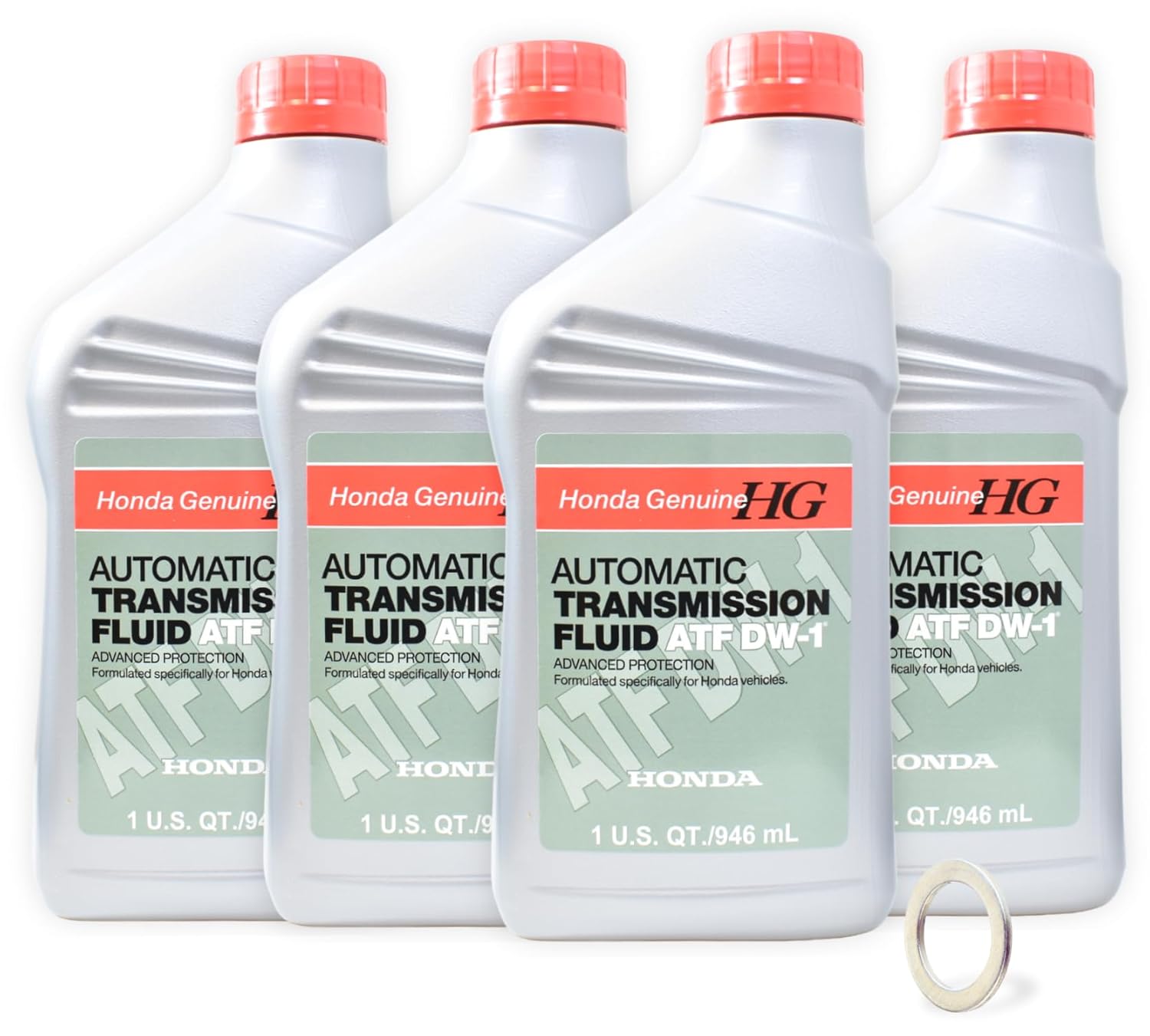
1. Honda Genuine ATF DW-1 Automatic Transmission Fluid 4 qt (Service Kit)
Best Overall Transmission Fluid
| Brand | Honda |
|---|---|
| Liquid Volume | 4 Quarts |
| SAE J300 Viscosity Grade | 10W-30 |
| Unit Count | 128.0 Fluid Ounces |
This Honda Genuine ATF DW-1 kit supplies four 1-quart bottles of factory-specified transmission fluid plus a drain plug washer for a simple drain-and-fill service. It is formulated by Honda to match the friction characteristics and thermal stability required by Honda automatic gearboxes, so expect smoother, quieter shifts and consistent performance after a service. Typical use is a DIY transmission fluid change or top-up during routine maintenance; the included crush washer removes one small extra trip to the parts store. The fluid’s cold-flow and oxidation resistance make it practical for year-round driving and helps protect valve bodies and clutch packs from wear. The main limitation is fitment: DW-1 is intended for Honda transmissions that call for that specific specification, so it is not a universal ATF and should only be used where the owner’s manual requires DW-1. Also the kit is sized for one basic service and will not cover a full flush on transmissions with large capacities.
Best for: DIYers who want a reliable, spec-matched transmission fluid to perform routine drain-and-fill maintenance on Hondas that specify DW-1 and prioritize correct shift feel and long-term protection.
Less Ideal for: People who need a universal or aftermarket multi-vehicle ATF or those planning a full flush on transmissions with larger capacities should look elsewhere.
- Factory-formulated to Honda specification for DW-1 compatibility and shift feel
- Includes four 1-quart bottles making a single drain-and-fill straightforward
- Comes with an 18 mm drain plug washer so you can complete the service without an extra parts run
- Designed to resist oxidation and provide stable friction characteristics for smooth shifting
- Only appropriate for transmissions that require ATF DW-1 and not a universal substitute
- Kit volume covers a drain-and-fill but may be insufficient for a full capacity refill or multi-vehicle jobs
Verdict: The go-to choice for DIYers wanting a dependable, spec‑matched transmission fluid that delivers smooth shifting and reliable protection for routine service.
2. Valvoline MaxLife Multi-Vehicle Full Synthetic ATF 1 Quart
Best Budget Transmission Fluid

| Material | Synthetic |
|---|---|
| Liquid Volume | 1 Quarts |
| Flash Point | 394 Degrees Fahrenheit |
| Recommended Uses For Product | Automatic Transmission Fluid Replacement, CVT Transmissions, Preventing Leaks, Prolonging Transmission Life |
Valvoline MaxLife Multi-Vehicle ATF is a full synthetic transmission fluid designed for broad compatibility across light-duty automatics and many CVTs. For routine service on older cars like a late-1990s Civic it delivers smoother shifts, reduced shudder, and improved thermal stability compared with conventional ATF. The formula includes conditioning agents to help preserve seals and anti-wear additives that aim to extend transmission life under typical driving. In practice you can use it for a flush-and-fill or top-up during maintenance; it pours cleanly from the bottle and is easy to handle. It is not a vehicle-specific factory fluid so you should confirm compatibility with the Civic's manufacturer specs before use, and some manufacturers recommend particular fluids for certain transmissions. Compared with OEM-branded ATF it is a more affordable option that still targets improved durability and shift feel, but if your transmission requires a unique spec or you need dealer-specified fluid, choose the exact manufacturer recommendation.
Best for: Buyers needing an economical, full synthetic ATF that improves shift feel and helps protect an older transmission during routine maintenance; ideal for owners prioritizing value over strict factory-brand fluids.
Less Ideal for: Owners who must follow a specific manufacturer-specified fluid listed for their transmission or those seeking dealer-only formulations should choose the exact recommended product instead.
- Full synthetic formula offers better thermal and viscosity stability than conventional ATF
- Multi-vehicle compatibility covers most light-duty automatics and many CVTs
- Additives to condition seals and reduce wear help extend transmission life
- Widely used and well-reviewed in real-world maintenance and flush jobs
- Not targeted to a single manufacturer specification so you must check your Civic's required ATF spec before using
- Sold in 1-quart bottles which may require purchasing multiple bottles for a full flush on some vehicles
Verdict: Choose this when you need an affordable transmission fluid that maintains basic protection and shift quality without a high price tag.
3. Honda Genuine ATF DW-1 Automatic Transmission Fluid, 2-Quart
Best OEM Honda ATF

| Manufacturer | HONDA |
|---|---|
| Brand | Honda |
| Model | FBA_08200-9008 |
This is Honda's genuine DW-1 automatic transmission fluid supplied in 2-quart bottles and intended for transmissions that require the manufacturer specified chemistry. Typical use is topping, flushing, or service-level refills where exact compatibility matters; the fluid is designed to preserve shift quality and protect clutch packs and seals in Honda transmissions formulated around DW-1. Because it is factory-formulated, you can expect consistent viscosity and additives matched to Honda's recommendations, which helps reduce the risk of harsh shifting or premature wear compared with nonapproved fluids. The packaging is standard retail two-quart bottles that are easy to pour for DIY maintenance. Limitations are straightforward: this is the specific DW-1 formula, so it only applies where that specification is required and it is not a universal ATF replacement for other fluid types or older non‑DW1 Honda specs. Buyers should confirm the DW-1 requirement for their Civic model year before use.
Best for: Buyers who prioritize factory-approved fluids for straightforward DIY transmission service and want the exact chemistry Honda recommends for compatible Civic transmissions.
Less Ideal for: People looking for a universal ATF for multiple brands or for vehicles that require a different Honda fluid specification should consider alternative fluids matched to those specs.
- Factory-formulated DW-1 chemistry matched to Honda transmission requirements
- Consistent viscosity and additive package for reliable shift quality
- 2-quart retail bottles convenient for DIY top-offs and service
- Widely used and recommended by Honda owners for improved transmission longevity
- Only suitable where DW-1 is specified so not interchangeable with other ATF types
Verdict: Pick genuine OEM Honda ATF when you want factory‑approved chemistry and exact compatibility for easy DIY service and peace of mind.
4. Honda Genuine Manual Transmission Fluid 1 Quart (08798-9031)
Best Manual Transmission Fluid

| Brand Name | Honda |
|---|---|
| Recommended Uses For Product | Transmission Fluid |
| Viscosity | 5w-30 |
| Liquid Volume | 1 Quarts |
This is Honda's factory-spec manual transmission fluid supplied in a one-quart bottle for topping or servicing stick-shift gearboxes. It is intended to preserve synchronizer function and provide consistent shift feel by matching the friction and viscosity properties Honda designers specified. Use it when draining and refilling a manual gearbox or topping off after a service; reviewers report smoother, more predictable shifts and reduced synchro noise after installation. Notable features include a formulation tuned for manual transmissions and clear OEM fitment guidance, which reduces guesswork when selecting fluid for Civics from the late 1990s. The practical benefit is confidence that internal components receive the lubrication and friction behavior expected by the transmission. Limitations are its single-quart packaging for jobs that require multiple quarts and the higher per-quart cost compared with some generic alternatives, although those alternatives may not deliver the same factory friction characteristics.
Best for: A buyer who prioritizes using the exact factory-recommended fluid to maintain shift quality and protect synchronizers during normal driving of a 1996–2000 Honda Civic manual transmission.
Less Ideal for: Someone on a strict budget who needs large volumes for frequent fluid changes or who prefers aftermarket fluids with different friction modifiers for modified transmissions.
- Factory-formulated for Honda manual transmissions to preserve synchronizer action
- Consistent viscosity and friction behavior for predictable shift feel
- Single-quart bottle convenient for topping or small services
- Packaged and labeled as genuine Honda fluid to reduce fitment guesswork
- Higher cost per quart than some aftermarket manual transmission fluids
Verdict: Choose a manual transmission fluid when servicing a stick‑shift to preserve synchronizer action and reduce gear wear under normal driving.
5. Valvoline MaxLife Multi‑Vehicle Full Synthetic ATF, 1 Gallon
Best Synthetic Multi‑Vehicle ATF

| Material | Synthetic |
|---|---|
| Liquid Volume | 1 Gallons |
| Model | MaxLife Multi-Vehicle ATF |
| Flash Point | 394 Degrees Fahrenheit |
Valvoline MaxLife Multi‑Vehicle ATF is a full synthetic transmission fluid formulated to work across a wide range of passenger car automatic and many CVT applications. For DIY service on a 1996–2000 Honda Civic this product covers common ATF specs those Civics may accept and delivers improved high and low temperature stability compared with conventional fluids. The bottle highlights conditioning agents that help keep seals pliable to reduce leaks and anti‑wear chemistry to protect clutch packs and bands during normal driving. In practice that means smoother shifts after a service and more consistent fluid performance in hot summer driving and colder starts. It is marketed as suitable for many manufacturer specifications, which simplifies choosing a single fluid for maintenance. Limitations: multi‑vehicle ATF is not a guaranteed substitute for fluids that explicitly require a specific Honda designation in strict factory recommendations, so verify your Civic’s service manual before full fluid replacement. Also this product is a generalist rather than a vehicle‑specific formulation tuned for unique OEM friction characteristics.
Best for: DIY owners who prioritize a single, widely compatible full‑synthetic ATF for routine maintenance and want improved temperature stability during everyday driving.
Less Ideal for: Owners restoring or troubleshooting transmissions that require an exact Honda OEM fluid specification or who need a fluid specially matched to factory friction characteristics.
- Full synthetic base offers improved thermal stability and longer fluid life than conventional ATF
- Formulated with conditioning agents to help maintain seal elasticity and reduce leaks
- Anti‑wear additives support transmission durability and smoother shift feel
- Marketed for broad compatibility with many ATF and CVT specifications for easier DIY servicing
- Not a guaranteed replacement for fluids that explicitly require a manufacturer‑specific Honda transmission fluid specification
Verdict: Go with a full‑synthetic multi‑vehicle ATF if you want wide compatibility and improved temperature stability for versatile DIY maintenance.
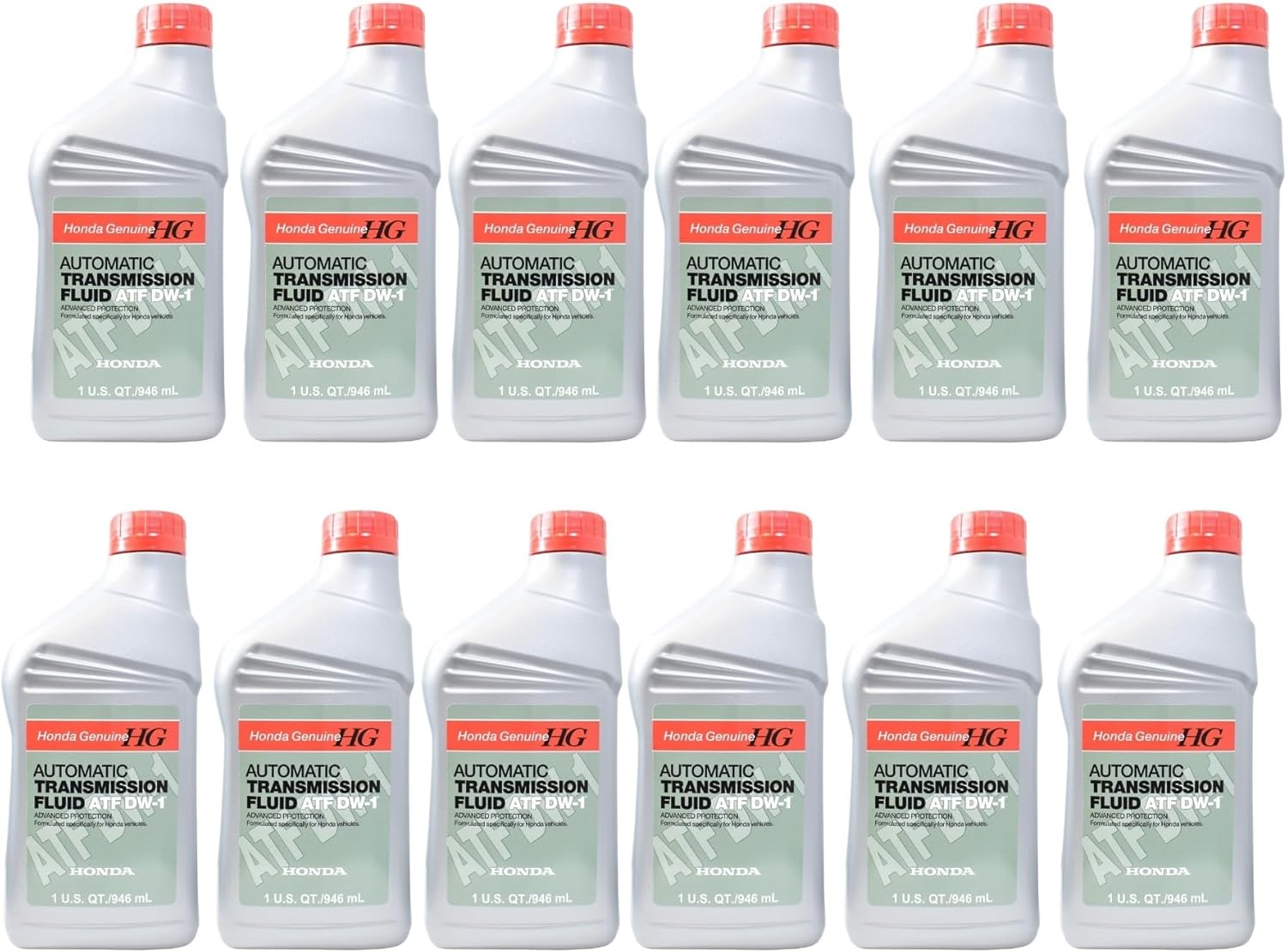
6. Honda DW-1 Automatic Transmission Fluid, 1 qt (pack of 12)
Best Bulk / Value Pack
| Brand | Honda |
|---|---|
| Liquid Volume | 32 Fluid Ounces per quart |
| Unit Count | 384.0 Fluid Ounces total |
| OEM Part Number | DW-1 |
| Model | 08200-9008 |
This is Honda branded DW-1 automatic transmission fluid supplied in a 12-quart case intended for transmission service and routine drain-and-fill maintenance. It meets Honda specifications and is used to maintain smooth, precise shifting and protect internal components from wear. The pack is convenient for owners or small shops that perform multiple services or follow the recommended repeated drain-and-fill procedure to refresh fluid throughout the torque converter. Because it is factory-specified fluid, it eliminates concern about compatibility for Honda transmissions. The case packaging is set up for long-term storage and repeated use, though you will need basic tools to pour and handle fluid safely. The main limitation is that this is a bulk pack so it is overkill for a single one-time service and takes more storage space than single quarts; also cost per purchase is higher up front even though the per-quart value is good. Overall it is a practical choice if you plan multiple changes or want to keep factory-standard fluid on hand for maintenance.
Best for: Buyers who plan to perform multiple transmission drain-and-fill services or keep a supply of factory-spec fluid for regular maintenance and prefer the lowest per-quart cost.
Less Ideal for: Drivers who only need to service a single vehicle once or lack space to store a 12-quart case should choose single-quart bottles or smaller packs instead.
- Factory-specified DW-1 formula compatible with Honda transmissions
- Pack of 12 offers low cost per quart for multiple services
- Consistent, clean fluid that supports smooth shifting and component protection
- Bulk packaging suited for DIY owners or small shops who perform repeated drain-and-fill maintenance
- Large multi-quart case is unnecessary for single-service users and requires storage space
- Higher upfront purchase cost despite better per-quart value
Verdict: Choose a bulk or multi‑pack when you plan multiple fluid changes or want the lowest cost per quart for routine maintenance.
Choosing the Right 1996-2000 Honda Civic Transmission Fluid: Key Factors to Consider
Viscosity and SAE Grade
Choose a fluid that matches the SAE viscosity grade recommended for your Civic's transmission. Viscosity affects fluid film strength at operating temperature and influences shift timing in automatics and gear protection in manuals. Too thin a fluid can reduce film thickness and accelerate wear; too thick a fluid can cause sluggish shifts and increased parasitic drag.
For 1996-2000 Civics, confirm the OEM-specified grade before selecting a product. Some formulations advertise multi-grade behavior that performs well across temperature ranges, which is helpful in climates with hot summers or cold winters.
Friction Characteristics and Shift Quality
Friction modifiers and additives determine clutch engagement feel in manuals and shift firmness or smoothness in automatics. Fluids with the wrong friction profile can lead to clutch chatter, slipping, or harsh gear changes. Look for products that state compatibility with the friction requirements of Honda transmissions or cite tests for low-speed engagement and torque transfer.
If your Civic has a manual transmission, prioritize fluids that explicitly mention clutch-friendly formulations. For automatics, seek fluids that maintain consistent friction coefficients after thermal cycling to preserve steady shift quality over time.
Thermal Stability and Oxidation Resistance
Transmission fluid sees wide temperature ranges and must resist oxidation to avoid viscosity thickening, varnish, and deposits. Fluids with strong thermal stability maintain protective film strength and do not form sludge that can clog valves or inhibit hydraulic function.
For older Civics that may run hotter due to worn cooling components, choose a fluid with proven high-temperature performance and anti-oxidant additives to extend service life and preserve component cleanliness.
Seal and Material Compatibility
Seals and gaskets in a 1996-2000 Civic can become brittle with age, so fluid compatibility with elastomers is important to prevent leaks and seal swelling. Some modern additives can cause excessive softening or shrinkage in older seals if not formulated for legacy components.
Verify the product literature for statements on seal compatibility or suitability for older Honda transmissions. A fluid that protects seal materials helps avoid post-service leakage and maintains hydraulic pressures.
Shear Stability and Wear Protection
Shear stability determines how well the fluid maintains viscosity under mechanical stress, which matters for gear protection and consistent hydraulic control. Poor shear stability can reduce film strength and increase wear in synchronizers, bearings, and gear teeth.
Look for fluids with anti-wear additives such as ZDDP or equivalent chemistries suitable for transmissions, and check manufacturer data on gear wear tests or ASTM shear results where available.
Application Compatibility and Serviceability
Confirm whether the fluid is intended for automatic, manual, or specific transmission types. Using the wrong formulation can impair operation. Also consider packaging sizes and availability of service-friendly quantities for fluid changes and top-offs.
Factor in whether the product supports typical service intervals for a Civic of this age and whether it is straightforward to source the correct quantity for a drain and refill or a complete flush if needed.
Automatic Vs Manual Fluid Needs for the EJ, EK, and EM Civic
Automatic and manual gearboxes have different hydraulic and friction demands. On EJ, EK, and EM chassis Civics from 1996 to 2000, automatic transmissions rely on fluid for both lubrication and hydraulic control of valve bodies, whereas manuals primarily use fluid for lubrication and synchronizer friction handling.
- Automatics need consistent viscosity and friction over temperature to preserve shift timing.
- Manual fluids must balance gear protection with clutch-friendly friction characteristics.
- Confirm the transmission type before purchasing; label guidance and Honda service manuals indicate the correct specification.
When To Perform a Transmission Fluid Change
Service intervals depend on driving style and conditions. For a Civic in daily commuting use with occasional highway runs, consider inspecting automatic fluid every 30,000 miles and changing at intervals recommended by Honda if fluid condition shows oxidation or contamination. Manual transmissions often tolerate longer intervals but should be checked for metal particles, burnt odor, or degraded friction behavior that indicates the need for replacement.
- Inspect fluid color and odor; dark or burnt-smelling fluid suggests oxidation.
- Check for metal shavings on the drain magnet during service.
- Factor in towing, high-heat, or frequent stop-and-go driving as reasons to shorten intervals.
How Temperature and Climate Affect Your Choice
Ambient temperature affects start-up viscosity and operating film strength. In colder climates choose fluids with good low-temperature flow so that hydraulics and syncros engage cleanly on startup. In hotter climates prioritize thermal stability and oxidation resistance to prevent viscosity loss and deposit formation.
- Cold starts need low-temperature pumpability to avoid hard shifts.
- Hot climates require fluids with strong anti-oxidant packages.
- If you experience seasonal extremes, consider a fluid rated for a broader temperature range.
How To Verify Compatibility With Your Civic
Use the vehicle's service manual or the transmission fill cap information to confirm the OEM fluid specification and capacity. Look for product technical data sheets that reference Honda approvals or list tested compatibility with older EJ, EK, and EM models. If documentation is absent, choose fluids that provide clear statements about compatibility with legacy Honda transmissions.
- Match SAE grade and friction recommendations from the manual.
- Check technical data sheets for seal compatibility statements.
- When in doubt, consult a qualified technician familiar with 1996-2000 Civics.
Maintaining Seals and Preventing Leaks After a Change
Older Civics are prone to seal wear and leaks. When changing fluid inspect seals and gaskets and replace any visibly hardened or cracked components. Use a fluid compatible with legacy elastomers to avoid accelerating seal degradation after service.
- Replace drain pan gasket and inspect output shaft seals if removing the pan.
- Top up slowly and check for external leaks after a short test drive.
- Avoid aggressive flushing solvents on older seals unless recommended by a technician.
Still looking for the perfect fit?
Select your Honda Civic configuration to see the most relevant Transmission Fluids recommendations
How We Chose the Best 1996-2000 Honda Civic Transmission Fluid
Our shortlist was produced by applying vehicle-specific compatibility filters and performance-focused criteria relevant to 1996-2000 Honda Civic drivetrains. We prioritized products that explicitly meet or exceed the viscosity grades and friction specifications recommended by Honda for EJ, EK, and EM era gearboxes. Thermal stability under continuous highway driving and resistance to shear breakdown were required attributes for automatic transmission fluid candidates.For manual transmission options we focused on clutch-friendly friction modifiers and adequate gear protection at the OEM-specified SAE grades. Corrosion and seal compatibility testing—based on manufacturer data—were considered to avoid leaks or hardening of sealing components in older Civic transmissions. Compatibility with common service intervals and ease of sourcing appropriate fill volumes were also factored.Excluded from consideration were fluids intended only for modern CVT systems that lack compatibility statements for older Honda gearboxes and products without clear technical data. Final selection balanced documented specs, independent lab data when available, and suitability for typical Civic use cases like commuting and light spirited driving.
Our full evaluation process is outlined in our review methodology.
FAQ
Can I use modern ATF in a manual transmission of a 1996-2000 Civic?
It depends. Some modern formulations are labeled for both manual and automatic applications and state compatibility with older Honda manuals. Confirm the product lists manual transmission compatibility and matches the OEM viscosity and friction requirements before use.
How often should I change ATF fluid in an automatic Civic from 1998?
Intervals vary, but inspecting the fluid every 30,000 miles is a good starting point. If the fluid appears dark, has a burnt smell, or shifting feels inconsistent, shorten the interval and replace the fluid sooner.
Will switching to a different fluid improve shifting firmness?
A fluid with different friction characteristics can alter shift feel. Choosing a fluid specified for Honda transmissions and with stable friction properties is more likely to restore or maintain intended shift quality rather than produce unpredictable results.
Is it safe to mix two different transmission fluids during a top-off?
Mixing fluids is generally not recommended because differing additive chemistries can change friction and corrosion control properties. If you must top off, try to use the same product already in the car or perform a full drain and refill with the new fluid.
What signs indicate a transmission fluid is failing in a Civic?
Common signs include darkened color, a burnt odor, rough or delayed shifts, slipping, or visible metal flakes on the drain magnet. Any of these indicate the fluid may no longer be protecting the gearbox effectively and should be changed.
Can a transmission fluid change fix slipping in an older Civic transmission?
Sometimes slipping caused by degraded fluid or contamination will improve after a proper fluid change, especially if the underlying problem is fluid breakdown. Mechanical wear or internal damage will not be corrected by fluid replacement alone.
Final Verdict
Prioritize matching the OEM viscosity and friction profile when selecting transmission fluid for a 1996-2000 Honda Civic. Focus on thermal stability for hotter climates, seal compatibility given the age of components, and shear-resistant formulations that protect gears and synchronizers. Weigh the tradeoffs between fluids that emphasize longevity and those tuned for crisper shift feel based on whether you drive conservatively or push the Civic harder. With the right specification and regular inspection, you can maintain smooth operation and extend transmission life confidently.
Explore More:
- Check out all Honda Civic parts & accessories
- Explore Fluids & Chemicals
- Browse all Accessories
