

Note: This article contains affiliate links. If you click on these links and make a purchase, I may earn a small commission at no extra cost to you. This helps support my research and content. Read my full affiliate disclosure here.
Upgrading or replacing the turbocharger on your Ford F-250 Diesel has a big effect on towing performance, throttle response, and engine longevity. The right turbocharger delivers stronger midrange torque for hauling while maintaining reliable spool characteristics to avoid lag under load. In this guide we shortlisted seven top options that suit common F-250 Diesel uses, from daily driving and towing to light commercial work.We evaluated candidates for fitment, compressor and turbine behavior, materials, and long-term serviceability. Below are the best turbochargers for the Ford F-250 Diesel, plus guidance on choosing, common symptoms to watch for, and practical installation considerations.
Looking for other parts? See all Ford F-250 parts & accessories.
Top Picks at a Glance
| Best Overall The best all-around choice for most situations | Bode-man Turbocharger — OEM-Style Replacement for 6.7L PowerStroke |  |
| Best Quality Built to a higher standard if you want something more solid | VIVAUTOPARTS GTP38R Ball Bearing Billet Turbocharger with 4" Inlet for 7.3L Power Stroke |  |
| Best Value The sweet spot between price and what you get | A-Premium GT3782VA Complete Turbocharger Kit for 2005–2007 Ford F-250/F-350/F-450/F-550 6.0L |  |
| Best Budget The cheapest option that still gets the job done reliably | WFLNHB GTP38 Replacement Turbocharger for Ford F-Series 7.3L Powerstroke 1994–1997 |  |
| Highest Rated A top-rated pick with lots of positive feedback | A-Premium Complete Twin Turbocharger Kit for Ford 6.4L Diesel (2008-2010) |  |
| Most Popular A crowd favorite that many people choose with confidence | maXpeedingrods GTP38 Turbocharger for Ford 7.3L Powerstroke | 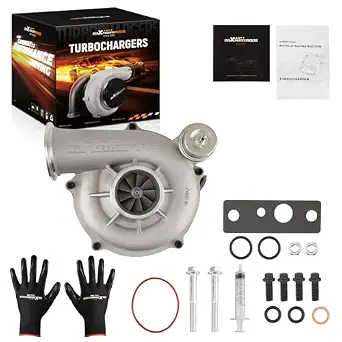 |
1. Bode-man Turbocharger — OEM-Style Replacement for 6.7L PowerStroke

| Manufacturer | Bode-man |
|---|---|
| Manufacturer Part Number | DBTC180 |
| OEM Part Number | 8881425001S, 888142-5001S, TBC673, HC3Q9G438AC, HC3Q-9G438-AC, APTBC180, GT3788BLVA |
| Fits Engines | 6.7L PowerStroke |
This Bode-man turbocharger is built as an OEM-style replacement for the GT3788BLVA turbo used on 6.7L PowerStroke diesel Super Duty trucks. It is intended to replace worn or failing turbos to restore boost response, towing power, and throttle feel. The unit is described as precision-balanced with heat-resistant housings to handle heavy-duty diesel duty and lists multiple OE interchange numbers for fit verification. In practical use it should drop into the designated engines with factory-style fit and provide engine performance comparable to the original when installed and calibrated correctly. The main benefits are restoring lost power and avoiding the fitment headaches of non-matching aftermarket cores. Limitations are that compatibility is limited to the listed 2017–2019 Super Duty and 2018–2019 F-750 fitments and buyers must verify OE numbers before ordering; this is a direct replacement rather than a performance upgrade, so expect factory-spec boost rather than increased power levels.
Best for: Buyers who want a factory-matching replacement to restore towing performance and drivability on a 6.7L PowerStroke Super Duty without modifying engine output.
Less Ideal for: Drivers seeking an aftermarket performance turbo for higher boost or significant power gains should look at performance-specific units instead.
- Designed to match fit and function of the original GT3788BLVA for straightforward installation
- Precision-balanced rotating assembly for smoother operation and longer service life
- Heat-resistant housings built for heavy-duty diesel operating conditions
- Interchangeable with multiple OE part numbers for easier verification of fitment
- Direct factory-style replacement only, not intended to increase power beyond stock levels
- Compatibility restricted to specific 2017–2019 Super Duty and 2018–2019 F-750 6.7L PowerStroke applications
Verdict: Choose this Bode-man unit when you need a factory-style replacement to reliably restore boost, towing power, and drivability on a 6.7L PowerStroke Super Duty.
2. VIVAUTOPARTS GTP38R Ball Bearing Billet Turbocharger with 4" Inlet for 7.3L Power Stroke

| Engine fit | 7.3L Power Stroke (1999.5–2003) |
|---|---|
| Compressor wheel | 88 mm billet |
| Turbine housing A/R | 1.00 |
| Bearing type | Ball bearing |
| Max recommended boost | 40 psi |
This GTP38R turbo swaps into 1999.5-2003 7.3L Power Stroke F-250 and F-350 trucks to deliver much stronger spool and higher flow than the factory unit. It uses a ball-bearing cartridge and a large 88mm billet compressor wheel to reduce lag and improve transient response, and the 1.00 A/R housing with a 4" inlet lowers back pressure and exhaust gas temperatures. Install is advertised as requiring no modifications, so it works well for owners who want a bolt-in upgrade for aggressive towing or performance builds. The increased flow and recommended boost capability (up to 40 psi max recommended) let the engine support substantially more horsepower when paired with proper fueling and tuning. Buyers should plan for supporting modifications and professional tuning to realize gains and protect the engine, and the larger-flow hardware may not be ideal for strictly low-speed daily driving where smooth, mild boost is preferred.
Best for: Drivers building higher-power or performance-oriented 7.3L Power Stroke trucks who prioritize quicker spool and maximum airflow and are prepared to add supporting fueling and tune work.
Less Ideal for: Owners seeking a subtle, factory-like replacement for daily commuting or those unwilling to invest in fuel system upgrades and professional tuning.
- Ball-bearing cartridge for faster spool and lower rotational drag
- 88mm billet compressor wheel provides substantially higher airflow than stock
- 1.00 A/R turbine housing and 4" inlet reduce back pressure and lower exhaust gas temperature
- Advertised as direct-fit for 1999.5–2003 7.3L Power Stroke with no modifications
- Requires upgraded fueling and tuning to safely realize higher boost and power
- Larger flow characteristics may compromise low-speed drivability and throttle smoothness for mild-use drivers
Verdict: Choose this turbo if you want a direct-fit, ball-bearing upgrade for a 7.3L Power Stroke that prioritizes fast spool and much higher airflow for performance builds.
3. A-Premium GT3782VA Complete Turbocharger Kit for 2005–2007 Ford F-250/F-350/F-450/F-550 6.0L

| Compatible vehicles | 2005–2007 F-250/F-350/F-450/F-550 6.0L V8 |
|---|---|
| Turbo model | GT3782VA |
| Wastegate actuator | Included |
| Gaskets | Included |
This A-Premium GT3782VA turbocharger kit replaces the factory turbo on 2005–2007 Ford Super Duty 6.0L V8 engines and ships as a ready-to-install assembly with a wastegate actuator and gaskets. It is intended for direct replacement use when the original turbo is worn, leaking, or failed, returning boost and response without the need to source separate parts. The kit claims premium alloy construction and includes multiple OEM part numbers for cross-reference, which helps match it to the correct vehicles. Practical benefits include reduced downtime because the actuator and gaskets are included and a one-year unlimited-mileage guarantee for peace of mind. Keep in mind this is a direct-fit aftermarket unit rather than a rebuild from the original manufacturer, so installation should follow proper torque and oil-priming procedures and professional installation is recommended if you are not experienced with turbo work. For owners seeking a practical, complete replacement to restore turbo function on the specified 6.0L Ford trucks, this kit covers the common needs without extra sourcing of parts.
Best for: Buyers who want a practical, ready-to-install replacement turbo to return boost and drivability to a 2005–2007 6.0L Ford Super Duty without hunting down separate components.
Less Ideal for: Customers seeking an exact factory-manufactured turbo or a high-performance upgrade tuned for increased boost and power should consider other options.
- Complete kit includes turbo assembly, wastegate actuator, and gaskets for faster installation
- Matches multiple OEM part numbers for easier compatibility checks
- Supplied as a brand new alloy assembly intended to meet or exceed factory specifications
- One-year unlimited-mileage guarantee provides added confidence after installation
- Aftermarket direct-fit unit rather than factory-manufactured part which may vary slightly in long-term durability
Verdict: A practical, all-in-one aftermarket turbo kit that restores factory-style boost and simplifies installation for 2005–2007 6.0L Ford Super Duty trucks.
4. WFLNHB GTP38 Replacement Turbocharger for Ford F-Series 7.3L Powerstroke 1994–1997

| Turbo Model | GTP38 |
|---|---|
| Fitment | Direct Replacement for 7.3L Powerstroke 1994–1997 |
| Manufacturer | WFLNHB |
| Manufacturer Part Number | 1-8204697-439548 |
This WFLNHB GTP38 turbocharger is a budget-focused direct replacement for 7.3L Powerstroke F‑Series trucks from 1994 to 1997. It is sold as a complete turbo with some gaskets included and is intended to bolt in where the factory unit came out, which keeps installation straightforward for a competent mechanic. The unit is advertised as made from high-temperature materials and stemless design components, which should handle normal diesel exhaust conditions and restore lost boost, torque, and throttle response compared with a worn turbo. On the downside the part comes from a third-party brand with limited warranty information and mixed customer feedback, so quality control and longevity may vary compared with higher-end or factory-quality replacements. This turbo is best when you need an affordable, ready-to-install replacement to get an older Powerstroke back on the road quickly, but plan for professional installation and inspect related hardware such as oil feed/return lines and gaskets during the swap.
Best for: Buyers looking for a low-cost, bolt-in turbo to restore boost and drivability on a 1994–1997 7.3L Powerstroke who prioritize getting the truck back on the road affordably.
Less Ideal for: Owners seeking long-term durability backed by factory-quality warranty or who prefer OEM-level parts and support.
- Direct-replacement GTP38 fitment for 7.3L Powerstroke 1994–1997 to simplify installation
- Includes turbocharger plus other gaskets for a more complete installation
- Constructed for high temperature resistance to handle diesel exhaust conditions
- Third-party brand with limited published warranty details and mixed user feedback
Verdict: A budget-friendly, bolt-in GTP38 turbo to quickly replace a worn turbo on 1994–1997 7.3L Powerstroke F‑Series trucks.
5. A-Premium Complete Twin Turbocharger Kit for Ford 6.4L Diesel (2008-2010)

| Vehicle fitment | Ford F-250/F-350/F-450/F-550 2008-2010 6.4L diesel |
|---|---|
| Turbo model | V2S |
| Gasket included | Yes |
| Material | Alloy |
This A-Premium kit provides both high- and low-pressure turbochargers and the gaskets needed for a direct replacement on 2008–2010 Ford F-250/F-350/F-450/F-550 6.4L diesel trucks. The housings are made from a high-grade alloy intended to improve heat dissipation at high rotational speeds, and the kit lists the V2S turbo model so installers know what to expect. Typical use is as a full turbocharger swap when the original units are worn or damaged; the included gaskets simplify reassembly. Practical benefits include a complete twin-turbo package that matches factory locations and a one-year unlimited-mileage guarantee for peace of mind. Limitations are that the kit does not include a wastegate actuator and buyers should verify referenced part numbers against their truck before ordering. Professional installation is recommended because this is a full engine-system component and proper tuning and exhaust fitment matter for long-term reliability.
Best for: Buyers who prioritize a reliable, factory-style replacement for worn turbos on 2008–2010 Ford 6.4L Super Duty trucks and want a complete kit that simplifies installation and reduces variables during repair.
Less Ideal for: People looking for a performance upgrade or downpipe/intake modifications should consider purpose-built turbo options and supporting hardware instead of this direct-replacement kit.
- Complete twin-turbo kit includes both high- and low-pressure units and necessary gaskets
- Compressor and turbine housings use high-grade alloy for improved heat dissipation
- Designed to match factory turbo locations for direct replacement on specified 6.4L Super Duty trucks
- One-year unlimited-mileage guarantee provides added confidence for long-term use
- Does not include a wastegate actuator which may need to be sourced separately
Verdict: A full, factory-style twin-turbo replacement kit built for reliable, like-for-like service on 2008–2010 Ford 6.4L Super Duty diesels.
6. maXpeedingrods GTP38 Turbocharger for Ford 7.3L Powerstroke

| Application | Ford 7.3L Powerstroke Excursion 2000-2003; F-250/F-350/F-450/F-550 1999-2003 |
|---|---|
| Turbo model | GTP38 |
| Cooling type | Oil cooling |
| Horsepower | Up to 275 HP |
This maXpeedingrods GTP38 is a direct-replacement turbo built for 7.3L Powerstroke F-250/F-350/F-450/F-550 and Excursion applications from the late 1999 to 2003 model years. It uses a forged aluminum compressor wheel and a ductile iron turbine housing, and the seller rates it for up to about 275 horsepower. Installation is intended to be bolt-in for the correct late-1999 and later engines so it is commonly used to restore boost and drivability after a failed factory turbo. The twin-scroll design and larger compressor/turbine sizing aim to give quicker boost response and improved midrange torque compared with a worn original. Practical benefits include factory-style fitment for compatible vehicles and corrosion and heat-resistant turbine materials for long-term use. Important limitations are compatibility details for early 1999 models with a different compressor-housing bolt pattern and the unit being an aftermarket alternative rather than a factory brand, so buyers seeking an exact factory-sourced part should consider that before purchasing.
Best for: Buyers who want a cost-effective, bolt-in replacement turbo to restore boost and drivability on late 1999–2003 7.3L Powerstroke trucks and value materials and design features that improve midrange power.
Less Ideal for: Those seeking a factory-branded original part or owners of early 1999 models with the 4-bolt compressor housing should look for an alternate unit tailored to their configuration.
- Designed as a direct OEM-replacement for late 1999–2003 7.3L Powerstroke engines for bolt-in installation
- Forged aluminum compressor wheel for improved airflow and boost response
- Ductile iron turbine housing and high-temp alloy turbine wheel for heat resistance
- Twin-scroll design aimed at stronger midrange torque and quicker spool
- Not compatible with early 1999 7.3L models that use the 4-bolt compressor housing pattern
Verdict: A practical, bolt-in aftermarket GTP38 turbo that restores boost and improves midrange response for late 1999–2003 7.3L Powerstroke trucks.
Choosing the Right Ford F-250 Diesel Turbocharger: Key Factors to Consider
Fitment and Mounting
Correct fitment is the foundation of a successful turbo swap. For the Ford F-250 Diesel that means matching the turbine housing flange, oil and coolant feed and return orientations, and actuator or wastegate interfaces. Incorrect bolt patterns or mismatched flanges can require custom manifolds or adapters that increase installation time and leak risk.
Confirming stock inlet and outlet sizes preserves airflow characteristics and prevents excessive vibration or boost leaks. Consider whether the turbo allows retention of the stock actuator or requires an external wastegate and how that affects vacuum lines, fittings, and space in the engine bay. Lastly, check turbine rotation and anti-surge provisions to avoid compatibility problems during installation.
Compressor and Turbine Sizing
Compressor and turbine geometry determine where the turbo makes usable power. Smaller compressors spool quickly and improve low-end torque and throttle response, which benefits towing and city driving. Larger compressors support higher peak power but can increase lag and may push the engine beyond intended operating ranges without supporting fueling or tuning.
Match sizing to your typical duty cycle: towing-heavy F-250s benefit from turbos designed for stronger midrange torque, while trucks used primarily for performance upgrades need units with higher airflow capacity. Consider the compressor map when available and choose a balance that preserves drivability under common load conditions.
Bearing Type and Durability
Bearing design is a major determinant of turbo longevity and responsiveness. Journal bearings are simple and robust for steady-state loads, while ball bearing designs reduce friction and often improve spool times, which can be valuable for heavy-duty use where quick boost recovery is needed. However, ball bearings may be more sensitive to lubrication issues and can cost more to replace.
Durable materials in the turbine and compressor housings, along with high-quality seals and balanced rotating assemblies, reduce the chance of premature failure. For diesel applications that run long periods at high load, look for turbos with proven heat resistance and corrosion protection.
Serviceability and Parts Availability
Access to replacement parts and rebuild kits affects long-term ownership cost and downtime. Turbocharger cores, seals, actuators, and rebuild kits should be reasonably accessible for the Ford F-250 Diesel to keep repairs straightforward. Units that require specialized core returns or have limited spare-part availability can lead to extended shop waits.
Consider whether the turbo can be serviced without removing ancillary components, and whether common failure parts are user-serviceable. Availability of documented rebuild procedures or community support also shortens repair cycles and reduces overall ownership headaches.
Boost Control and Actuation
How a turbo controls boost—via internal wastegate, external wastegate, or variable geometry—shapes its behavior under load. Internal wastegates are simpler but can be limited in high-boost scenarios. External wastegates allow finer control and better thermal management in demanding towing or performance use, but they require additional plumbing and tuning.
Variable geometry turbos can offer a wide torque band and excellent transient response, yet they add complexity and potential points of failure. Ensure the chosen boost control method fits your maintenance tolerance and intended use on the F-250 Diesel.
Emissions, Calibration and ECU Considerations
Swapping or upgrading a turbo on the Ford F-250 Diesel can affect exhaust backpressure and air metering, which influences emissions systems and engine calibration. Some turbos require ECU recalibration to manage fueling and boost safely, especially if they materially change airflow characteristics. Running a mismatched turbo without appropriate calibration can trigger fault codes or reduce engine reliability.
Confirm whether your installation will need sensor relocations, A/N fittings, or changes to the EGR system routing. If calibration is necessary, factor in the time and expertise required to tune the truck for safe operation across load ranges.
Common Turbocharger Symptoms and What They Mean
Recognizing symptoms early helps prevent catastrophic failure and downtime. Typical signs on an F-250 Diesel include loss of boost pressure, reduced towing acceleration, excessive smoke from the exhaust, and unusual noises from the turbo area such as whining or grinding.
Loss of boost often points to leaks in charge piping, a failed actuator, or internal damage to the compressor or turbine wheel. Black or blue smoke can indicate oil seal failure or excessive crankcase ventilation pressurization. Mechanical noises usually require inspection for bearing wear or foreign object damage.
- Reduced throttle response and slower spool suggest compressor or bearing wear.
- Blue smoke at low RPM often indicates oil seal failure inside the turbo.
- Whining or grinding noises typically mean bearing damage or shaft play.
- Intercooler or charge-pipe leaks can mimic turbo failure by dropping boost.
When To Repair Vs Replace Your Turbocharger
Deciding between repair and replacement depends on the extent of damage, cost of parts, and downtime tolerance. Minor seal leaks or worn actuators can often be addressed with a rebuild kit and fresh balancing, which restores many turbos to reliable service for less cost and waste.
If the compressor or turbine wheel is cracked, heavily eroded, or has severe shaft play, a full replacement is usually safer. For diesel F-250 owners who rely on the truck for heavy towing or daily commercial use, a new core may provide better long-term reliability than a repaired older unit.
- Rebuild when damage is limited to seals, bearings, or actuators and core integrity is intact.
- Replace when wheel damage, housing cracks, or severe shaft play are present.
- Consider mission-critical use cases and choose replacement when downtime or risk is unacceptable.
Installation Considerations and Typical Costs
Installing a turbocharger on an F-250 Diesel involves oil and coolant line connections, correct torque of exhaust fasteners, and proper priming of the turbo before first start. Ensuring clean oil feed lines and new gaskets reduces the risk of immediate post-install failure.
Labor requirements vary with engine layout and accessory clearance. While costs differ by shop and region, plan for time to inspect and potentially replace feed and return lines, and to perform a thorough leak check and test drive under load to verify proper boost behavior.
- Always replace oil feed and return gaskets and inspect lines for clogging.
- Prime the turbo with oil before initial startup to avoid dry-run bearing damage.
- After installation, check for exhaust leaks and confirm actuator movement and boost targets.
Turbocharger Rebuild Kits and When To Use Them
Rebuild kits for F-250 Diesel turbos typically include seals, thrust bearings, journal bearings, and sometimes balancing hardware. Kits are a cost-effective option when the core is structurally sound and damage is limited to wear components. They allow owners to retain a serviceable core while restoring performance.
Choosing a rebuild kit requires verifying compatibility with the turbo's bearing type and shaft dimensions. Professional balancing after rebuild is important because even small imbalances can shorten life or cause vibration under load.
- Use rebuild kits for worn seals, bearings, or minimal shaft play.
- Ensure kit compatibility with your turbo's bearing design and shaft size.
- Have rebuilt assemblies professionally balanced before reinstallation.
Planning a Turbocharger Upgrade for Towing or Power
If you are upgrading the turbo to gain torque for towing or increased power, plan the whole system: supporting fuel delivery, intercooling capacity, and exhaust flow must match the turbo's potential. On the Ford F-250 Diesel, modest increases in compressor size can yield useful midrange gains without forcing extensive engine modifications.
Also consider driveline components and cooling capacity. More torque can stress transmissions and differentials, and higher exhaust gas temperatures require robust turbine housings and heat shielding to protect nearby components.
- Pair upgrades with appropriate fueling and cooling improvements.
- Verify that driveline and transmission can handle increased torque.
- Monitor exhaust temperatures after upgrade to avoid heat-related failures.
Warranty, OEM Vs Aftermarket, and Long-Term Ownership
Warranty terms and post-sale support vary between OEM-style cores and aftermarket units. OEM-pattern replacements often prioritize fitment and may match original durability attributes, while aftermarket options can emphasize performance or cost savings. Consider warranty length, what is covered, and the process for warranty service.
Long-term ownership also hinges on maintenance accessibility and whether rebuild kits or replacement cores are readily available. For a working F-250 Diesel, choose an option that minimizes downtime and has clear service paths.
- Check warranty coverage for core failures, bearing wear, and seals.
- OEM-style units tend to simplify fitment while some aftermarket units offer enhanced performance.
- Factor in availability of rebuild kits and local service expertise when evaluating long-term ownership.
Still looking for the perfect fit?
Select your Ford F-250 configuration to see the most relevant Turbochargers recommendations
How We Chose the Best Ford F-250 Diesel Turbocharger
Our shortlist focused on turbochargers that meet the specific demands of the Ford F-250 Diesel platform. We prioritized mechanical compatibility including flange type and bolt patterns, compressor/turbine sizing matched to typical F-250 powerbands, and proven thermal materials that withstand prolonged highway and towing loads. Durability factors included bearing design, housing materials, and availability of replacement cores or rebuild kits. We assessed spool response and efficiency curves where manufacturer data existed to favor units that reduce low-end lag without sacrificing high-end flow.We also weighed serviceability: access to rebuild kits, common replacement parts, and documented maintenance procedures. Fitment filters excluded components that require extensive manifold or ECU modification. We excluded units designed only for high-horsepower race builds or those lacking clear fitment data for the F-250 Diesel. Final selections balanced everyday drivability, towing capability, and long-term reliability for real-world Ford F-250 Diesel owners.
Our full evaluation process is outlined in our review methodology.
FAQ
How can I tell if my F-250 Diesel turbocharger is failing?
Common signs include reduced boost and slower acceleration under load, blue or black exhaust smoke, and unusual whining or grinding noises. Inspect charge piping and actuator function first, then check the turbo for shaft play or oil leaks.
Is it worth installing a rebuilt turbocharger on my F-250 Diesel?
A rebuilt turbo can be cost-effective if the core is structurally sound and damage is limited to seals or bearings. Proper balancing and use of quality rebuild kits are essential to restore reliable operation for towing or daily use.
Will a different turbocharger affect my truck's emissions or calibration?
Yes, changing compressor or turbine characteristics can alter backpressure and airflow, which may require ECU recalibration to maintain proper fueling and emission controls. Factor calibration into the upgrade plan when airflow changes significantly.
Can I replace my turbocharger myself or should a shop do it?
Experienced DIYers can perform the swap with the right tools and knowledge of oil/coolant line routing and priming procedures. However, many owners prefer a professional installation to ensure correct torqueing, leak checks, and post-install testing under load.
How often do turbochargers need servicing on Ford F-250 Diesels?
Service intervals vary with use. Routine inspections during oil changes help detect leaks, shaft play, or actuator issues early. Heavy towing or commercial use may require more frequent checks and earlier attention to oil feed cleanliness.
Do I need to replace oil feed and return lines when installing a new turbo?
It is wise to inspect and often replace or thoroughly clean oil feed and return lines during installation. Clogged or degraded lines can starve the turbo of lubrication and lead to premature bearing failure.
Final Verdict
For the Ford F-250 Diesel, prioritize fitment and spool behavior that match your primary use—towing-focused setups need strong midrange response while performance-minded builds require greater airflow capacity. Also weigh durability factors such as bearing type, housing materials, and the availability of rebuild kits to reduce long-term downtime.Balance the desire for extra torque with the need for proper calibration, cooling, and driveline capacity. Choosing a turbo that fits the truck without extensive modification will give the most reliable real-world results and lower ownership friction over time.
Explore More:
- Check out all Ford F-250 parts & accessories
- Explore Turbochargers Maintenance & Repair Guides
- Explore Engine
- Browse all Auto Parts
