

Note: This article contains affiliate links. If you click on these links and make a purchase, I may earn a small commission at no extra cost to you. This helps support my research and content. Read my full affiliate disclosure here.
Upgrading or fitting a trailer brake controller matters because it directly affects stopping distance, trailer stability, and overall towing confidence. For owners of 2004-2008 Ford F-150 trucks, the right controller ensures the truck and trailer behave predictably under load and in emergency braking situations. This guide covers the top shortlisted trailer brake controllers suitable for the 2004-2008 F-150. We focus on units that balance braking performance, ease of installation, cab ergonomics, and reliability. Below you will find concise evaluations and the criteria we used to narrow the field, with practical advice to help you pick the best option for your towing needs.
Looking for other parts? See all Ford F-150 parts & accessories.
Top Picks at a Glance
| Best Overall Trailer Brake Controller A reliable, well-rounded proportional controller with wide compatibility and strong performance | Tekonsha P3 Proportional Trailer Brake Controller with Ford F-150 Wiring Harness |  |
| Best Budget Trailer Brake Controller A low-cost, functional controller or adapter for occasional towing on a tight budget | Hopkins 47235 Impulse Plug-in Time-Based Trailer Brake Controller |  |
| Best Plug-and-Play Trailer Brake Controller Controllers sold as complete kits with wiring harnesses for fast, no-fuss installation | Tekonsha P3 Trailer Brake Controller with Ford Plug-and-Play Harness | |
| Best Bluetooth / Smartphone Controller Controllers that pair with a phone app or offer wireless setup and monitoring features | CURT Echo Mobile Bluetooth Trailer Brake Controller (Proportional) |  |
| Best Compact Time‑Delay Controller Small, simple timed or impulse controllers that tuck under the dash and cost less | Reese Towpower Brakeman 74642 Timed Compact Brake Controller |  |
| Best Heavy‑Duty Proportional Controller High-capacity proportional controllers built for larger trailers, frequent towing, and demanding loads | REDARC Tow-Pro Elite Electric Trailer Brake Controller |  |
Tekonsha P3 Proportional Trailer Brake Controller with Ford F-150 Wiring Harness
Best Overall Trailer Brake Controller

| Brand | Tekonsha |
|---|---|
| Model | P3 |
| Includes | Direct-fit Ford F-150 wiring harness |
| Display | Bright LCD with adjustable contrast |
| Warranty | Limited lifetime warranty |
The Tekonsha P3 is a proportional brake controller designed to give smooth, automatic trailer braking that matches your truck’s braking effort. For 2004–2008 Ford F-150s the package includes a direct-fit wiring harness so installation is largely plug-and-play and avoids complex splicing. In use the P3 measures vehicle deceleration and applies trailer brakes proportionally, reducing the lurch and grab common with time-delay units. The bright LCD and adjustable contrast make it readable day or night and the controller lets you fine-tune gain and boost while driving to match empty or loaded trailers. Practical benefits include easier setup with heavier loads, an audible trailer-connected indicator, and a compact design that mounts discreetly on the dash. Limitations are the lack of explicit numeric guidance in the manual for how much to adjust gain between tests and that some Ford dash panels require extra trim removal for harness access, which can lengthen install time. Still, for typical towing tasks it gives consistent, predictable braking behavior once tuned.
Best for: Buyers who want a reliable, easy-to-tune proportional controller for everyday towing with a 2004–2008 Ford F-150 and value predictable, smooth trailer braking without complex electronics work.
Less Ideal for: Drivers who rarely tow and prefer a permanently disabled system when not towing or those who need a simple on/off mechanical switch integrated out of the box.
- Proportional braking provides smooth, matched trailer braking under varied road conditions.
- Includes a vehicle-specific plug-and-play Ford F-150 wiring harness for simpler installation.
- Adjustable gain and boost let you fine-tune braking while driving for empty or loaded trailers.
- Bright LCD with adjustable contrast improves visibility day or night.
- Compact dash-mounted design keeps the controller unobtrusive.
- Instructions do not quantify how much to change gain for specific towing conditions, requiring trial-and-error tuning.
- Accessing the factory connector on some F-150 dashboards can take significant trim removal and time.
Verdict: Choose this pick if you want a proven, easy-to-tune proportional brake controller that balances performance, installability, and reliability for most towing jobs.
Hopkins 47235 Impulse Plug-in Time-Based Trailer Brake Controller
Best Budget Trailer Brake Controller

| Braking type | Time-based actuation |
|---|---|
| Adjustable braking | 5% to 99% |
| Mounting | Mounts at any angle |
| Max trailer brakes | Up to 6 brakes |
The Hopkins 47235 Impulse is a simple, time-based brake controller designed for drivers who need reliable trailer braking without complexity. It plugs into a compatible vehicle wiring harness, mounts at any angle, and uses a vertical manual slide plus a clear digital display to set braking power between 5% and 99%. Typical use is direct towing duty on pickups like the 2004–2008 Ford F-150 where you want an easy install and straightforward operation rather than advanced proportional sensing. Notable features include short-circuit protection, ability to control up to six trailer brakes, and a user-visible percentage readout so you know exactly how much braking force is applied. Practical benefits are fast installation with available pigtail adapters, intuitive on-the-fly manual actuation, and predictable, gradual braking for light to medium trailer loads. Limitations are that it is time-based rather than inertia-sensing, so braking response can be less precise under varying tow conditions and may require more manual adjustment for heavy or irregular loads.
Best for: Buyers who prioritize low cost and straightforward, no-fuss towing setup for routine hauling and want a controller that is easy to install and operate.
Less Ideal for: Drivers who regularly tow very heavy, frequently shifting loads or who want the most precise proportional braking behavior should consider proportional controllers instead.
- Plug-in design and included cradle make installation quick when a compatible pigtail is available
- Digital percentage display lets you set braking power precisely from 5% to 99%
- Mounts at any angle and offers manual slide control for easy, quick adjustments on the road
- Short-circuit protection and capacity to control up to six trailer brakes for heavier trailers
- Time-based actuation is not as responsive as inertia or proportional controllers on variable tow dynamics
Verdict: Pick this when you need a dependable, inexpensive brake controller or wiring adapter that lets you tow safely without a big upfront spend.
Tekonsha P3 Trailer Brake Controller with Ford Plug-and-Play Harness
Best Plug-and-Play Trailer Brake Controller
| Manufacturer | TEKONSHA |
|---|---|
| Brand | Tekonsha |
| Item model number | CEQ90195- 3034G |
The Tekonsha P3 is a proportional trailer brake controller packaged with a Ford-specific plug-and-play harness so you can install a complete system without splicing. It mounts on the dash, displays braking force and diagnostics on a bright LCD with adjustable contrast, and stores settings for multiple trailers so you can jump between rigs without reprogramming. The kit includes a boost feature and pulse-style braking modes for improved control in slippery conditions and when towing heavier campers. In practical use the P3 gives smooth, adjustable braking while driving and the harness simplifies installation on compatible Ford F-150 model years in the specified range. Expect straightforward setup and on-the-road adjustment via the controller buttons, but verify you receive the correct Ford harness number for your year since some buyers report receiving the wrong plug and needing a harness swap. The product is well built and aimed at owners who want a factory-quality controller they can fit themselves without running wires through the truck.
Best for: Ford owners who want a full brake-control system they can install themselves quickly using a vehicle-specific harness and who prioritize easy on-road tuning and multi-trailer memory.
Less Ideal for: People who prefer a hardwired custom installation or who need a controller certified for specialized commercial towing applications should consider other options.
- Includes vehicle-specific plug-and-play Ford harness for faster DIY installation
- Proportional braking with boost and pulse modes for smoother, trailer-matched stops
- Bright LCD and adjustable contrast for clear status and diagnostics while driving
- Memory for multiple trailer settings lets you switch trailers without reprogramming
- Some units have shipped with an incorrect Ford harness requiring a replacement or harness swap
Verdict: This slot fits controllers packaged with vehicle-specific plug-and-play harnesses so DIYers can install a full brake-control system quickly and without splicing.
CURT Echo Mobile Bluetooth Trailer Brake Controller (Proportional)
Best Bluetooth / Smartphone Controller
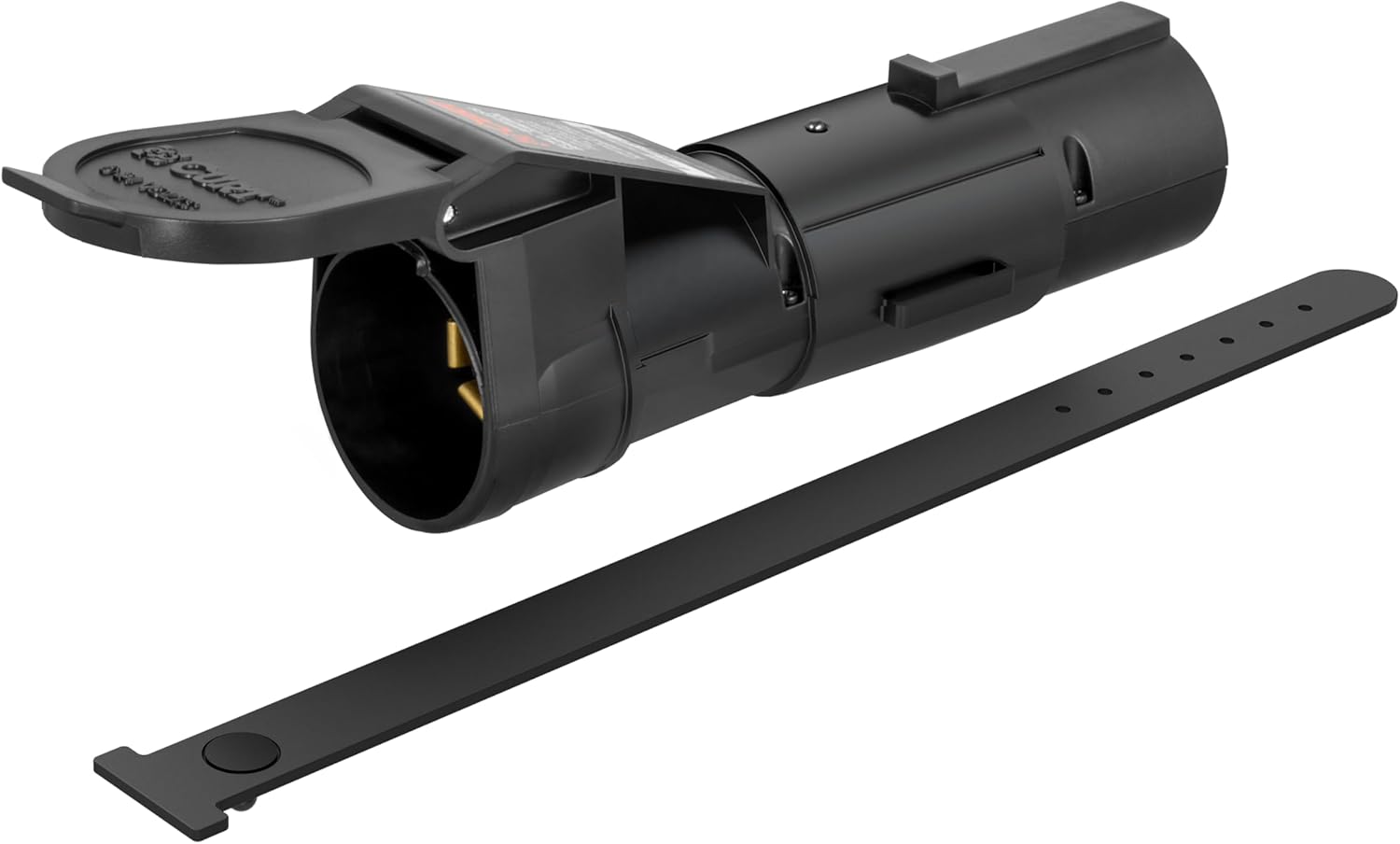
| Connection | 7-way RV blade plug |
|---|---|
| Control | Bluetooth smartphone app (OneControl Auto) |
| Brake type supported | 2–4 electric brakes (1–2 axles) |
| Sensing | Tri-axis accelerometer |
The CURT Echo Mobile puts proportional trailer braking control onto your phone instead of requiring an in‑cab module. For use with a 2004–2008 Ford F-150, it plugs into the vehicle 7-way connector and pairs with the OneControl Auto app to set maximum output, sensitivity, and save vehicle-trailer profiles. It uses a tri-axis accelerometer for smooth, hill-aware stops and continues to apply the last-used profile even if the phone disconnects. Installation is essentially plug-and-play but benefits from ensuring the 7-way auxiliary circuit is properly powered and fused per the app recommendations. The Echo is portable, so it can be moved between trucks without cutting harnesses, and its potted enclosure and retention strap help resist moisture and vibration. Limitations to note are its exterior placement on the 7-way plug, which adds length and can be vulnerable to snagging or poor clearance, and occasional Bluetooth pairing quirks on some phones that may require initial troubleshooting. For those who value quick setup and smartphone control, the Echo offers a modern, flexible alternative to a permanently wired under-dash controller.
Best for: Buyers who prefer smartphone setup and monitoring and want a no-permanent-wiring solution for controlling trailer brakes on a 2004–2008 Ford F-150.
Less Ideal for: Drivers who need a low-profile, permanently mounted in-cab controller or who frequently tow on very rough roads where a protruding 7-way device may be at risk.
- Bluetooth app control lets you adjust braking settings and monitor activity in real time
- Plug-and-play portable design transfers between vehicles without permanent wiring
- Tri-axis accelerometer provides proportional, hill-aware braking responses
- Potted enclosure and locking tab improve durability and moisture resistance
- External plug-in form factor adds length at the 7-way connector and can reduce ground clearance or snag
- Some phones experience pairing or connectivity issues during initial setup
Verdict: Select a Bluetooth-enabled controller if you prefer using a smartphone app for setup, real-time monitoring, and wireless control of trailer braking.
Reese Towpower Brakeman 74642 Timed Compact Brake Controller
Best Compact Time‑Delay Controller

| Model | 74642 |
|---|---|
| Manufacturer | Reese Towpower |
| Axles supported | 1-4 |
| Power system | 12 volt negative ground |
The Reese Towpower Brakeman 74642 is a small, solid‑state time‑delay brake controller built for straightforward towing tasks. It provides timed output for one to four axles and uses a slide sync adjustment plus a soft‑touch manual output for on‑demand braking, making it easy to use once you learn to apply the tow vehicle brakes smoothly. Its compact housing and lack of pendulums mean it can be mounted almost anywhere inside the cab, which is useful for cramped dashboards and rental trucks. The unit includes mounting hardware and basic diagnostics like a red indicator light and trailer continuity notification. Because it is a time‑based controller, braking ramp rate is fixed rather than proportional to vehicle deceleration, so it will not mimic pedal feel as closely as a proportional unit; drivers towing heavier trailers or who need very refined trailer response may prefer a proportional controller. For light to moderate towing and applications where space and simplicity matter, the Brakeman is an economical, reliable choice.
Best for: Buyers who need a small, easy-to-install time‑delay brake controller for light to moderate towing and who prioritize minimal dash footprint and straightforward controls over proportional braking.
Less Ideal for: Drivers who tow heavy trailers frequently or who want braking that closely matches vehicle deceleration should consider a proportional controller instead.
- Very compact solid‑state design mounts almost anywhere inside the cab
- Simple slide sync and fingertip manual control make setup and operation easy
- Works with one to four axle trailers and includes mounting bracket and hardware
- Built‑in diagnostics and trailer continuity indicator improve safety checks
- Time‑delay operation is not proportional to vehicle deceleration, so brake feel is less refined for heavier towing
Verdict: This pick is for buyers who want a compact, easy-to-use time‑delay or impulse controller that installs in tight spaces and handles light to moderate towing.
REDARC Tow-Pro Elite Electric Trailer Brake Controller
Best Heavy‑Duty Proportional Controller
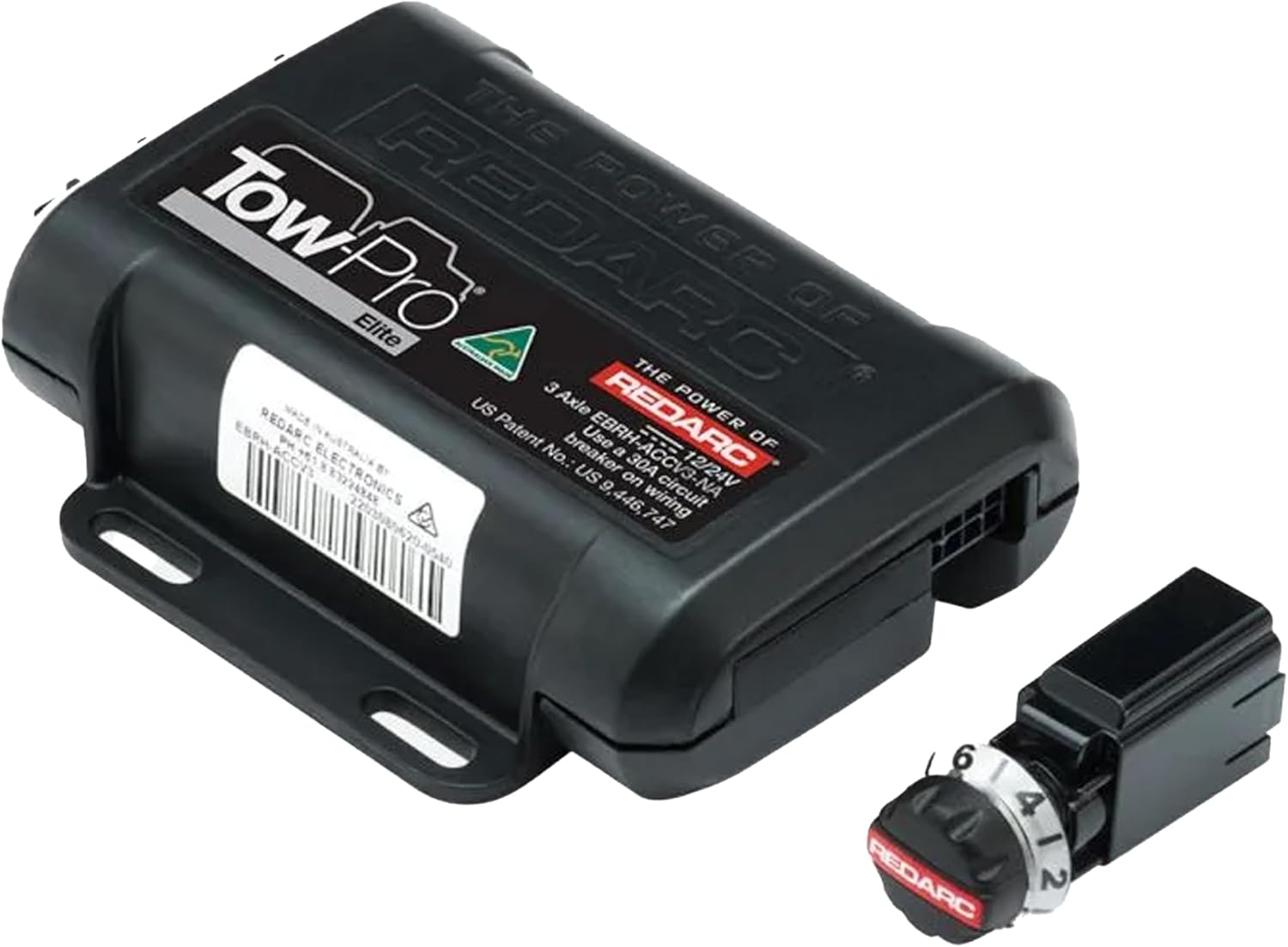
| Fitment | 1–3 axles |
|---|---|
| Voltage compatibility | 12V/24V |
| Model number | EBRH-ACCV3-NA |
The REDARC Tow-Pro Elite is a compact proportional electric brake controller designed for consistent, user-friendly trailer braking on-road and the option for manual control off-road. It mounts remotely with a small dash knob and connects with a universal harness so installation can look factory when a vehicle-specific plug is available or be spliced where needed. Proportional mode senses vehicle braking for smooth stops at highway speeds while the manual mode gives direct control for low-speed or technical towing. Built-in active calibration and sway control help reduce trailer pull and provide steady deceleration with or without a trailer connected. The unit supports 1–3 axle trailers and is rated for 12V and 24V systems, so it covers common towing setups. Trade-offs include the need for a vehicle wiring harness or splicing on some trucks and a small control knob that some users find harder to adjust than larger thumb-style levers. For frequent heavy towing the Tow-Pro Elite brings robust, predictable braking in a compact package.
Best for: Buyers who tow larger trailers frequently and prioritize strong, predictable proportional braking and a rugged, low-profile installation for long trips and demanding conditions.
Less Ideal for: People who only tow very small, infrequent loads or who prefer a larger, more tactile control lever may find this controller more capability than they need.
- Proportional braking for smooth, consistent stops across speeds
- Remote head and small dash knob provide a near-factory, low-profile installation
- Dual modes (proportional and manual) cover both highway and off-road towing needs
- Includes universal harness and mounting kit for flexible installation options
- Active calibration and sway control improve stability with or without a trailer
- May require splicing or an extra vehicle-specific harness if a factory plug is not present
- Small control knob can be harder to adjust precisely compared with larger lever-style controllers
Verdict: Choose a heavy‑duty proportional unit when you tow larger, heavier trailers often and need stronger, more consistent braking control and rugged construction.
Choosing the Right 2004-2008 Ford F-150 Trailer Brake Controller: Key Factors to Consider
Braking Type and Modulation
How a controller modulates brake force affects trailer stability and stopping distance. Proportional controllers sense the truck's deceleration and apply trailer brakes in direct proportion, which often yields smoother, more intuitive braking under normal driving conditions.
Time-delayed or user-adjustable output controllers can work but require careful tuning to avoid jackknifing or premature lockup. For the 2004-2008 F-150, choose a modulation style that matches your typical towing loads and driving style, and ensure the unit lets you fine-tune gain or sensitivity to dial in performance for different trailer weights.
Compatibility With F-150 Wiring
Compatibility with the truck's factory wiring or common harness adapters reduces installation time and potential electrical issues. The 2004-2008 F-150 often uses an auxiliary brake output circuit that some controllers can tap directly, while others require a separate harness or diode.
Check whether the controller supports the F-150's connector types and whether additional components, such as a powered brake output or a relay, are needed. Easier integration means fewer spliced wires and a cleaner, more reliable installation over time.
Installation Complexity and Mounting
Installation effort affects cost and whether you can fit the unit yourself. Some controllers offer simple in-cab mounting kits with plug-and-play wiring, while others require routing wiring through the dash and tapping into the vehicle's brake light circuit.
Consider how the controller mounts in the cab of the 2004-2008 F-150, access to trim panels, and the need for drill holes or custom brackets. A design that installs with minimal dashboard modification will save time and reduce the chance of vibration or fitment issues later.
User Interface and In-Cab Ergonomics
Controls that are easy to operate while driving reduce distraction and let you adjust braking force on the fly. Look for clear gain or sensitivity controls, simple manual override capability for testing or emergency use, and readable displays for status and error indications.
Placement matters in the F-150 cab: the unit should be reachable without blocking sightlines or entangling with steering or HVAC controls. Tactile knobs or large buttons are easier to use on the road than small recessed controls.
Durability and Environmental Resistance
Controllers can be exposed to heat, vibration, and moisture depending on where they are mounted and how wiring is run. Units with robust housings, sealed connectors, and vibration-resistant mounting hardware will last longer and require less maintenance.
For trucks used in varied conditions, choose controllers with corrosion-resistant terminals and weatherproof external connectors. Long-term reliability reduces troubleshooting and helps maintain consistent braking performance over years of towing.
Adjustability for Different Trailers
Many F-150 owners tow multiple trailers with varying weights and brake characteristics. A controller that allows quick adjustment of gain, braking curves, or mode selection makes switching between trailers easier and safer.
Features like multiple preset profiles, on-the-fly sensitivity changes, or manual boost options let you fine-tune braking for a small utility trailer one day and a heavier load the next. Ease of reconfiguration saves stops at the roadside and reduces the risk of mismatched braking behavior.
Why Proper Brake Control Matters for the 2004-2008 F-150
The 2004-2008 Ford F-150 is often used for towing a wide range of trailers, from small utility trailers to heavier cargo or recreational rigs. Proper trailer brake control helps keep the trailer tracking behind the truck and reduces the risk of trailer push during sudden stops.
A well-chosen controller also minimizes wear on both the trailer brakes and the tow vehicle by applying force in a controlled manner. Given the F-150s braking balance and weight distribution, matching controller response to typical tow loads is especially important for consistent, predictable performance.
- Improves stopping distance and reduces trailer sway risk
- Helps preserve trailer brake life through controlled modulation
- Makes trailer behavior more predictable under variable load
Wiring Basics and Installation Tips
Familiarize yourself with the F-150's brake controller wiring harness and the truck's factory wiring layout before starting. Identify the brake signal wire, auxiliary power source, ground, and trailer brake output, and use proper connectors or factory-style harnesses where available.
When routing wires, avoid hot surfaces and moving components. Secure wiring with clamps and keep connectors accessible for future maintenance. If splicing is necessary, use solder and heat-shrink or high-quality crimp connectors to prevent corrosion.
- Locate the vehicle brake signal and confirm with a multimeter before tapping
- Use in-line fuses and properly rated wiring for the controller power line
- Mount the controller where it is reachable but protected from direct heat or moisture
Mounting Locations and Ergonomics in the Cab
Typical mounting spots in the 2004-2008 F-150 cab include under the dash near the center console, on the left kick panel, or on a custom bracket beside the steering column. Choose a spot that keeps the unit accessible without obstructing pedals or controls.
Consider how the controller cable and manual override lever will be routed. A low-mounted unit can be out of sight but harder to reach, whereas a center-console placement provides quick access but must not block cup holders or storage compartments.
- Test reach and visibility before final mounting
- Avoid locations that concentrate heat from HVAC ducts
- Ensure the manual override is unobstructed for emergency use
Setting Up for Different Trailer Weights
Start with conservative gain or sensitivity settings when connecting an unfamiliar trailer. Perform a few low-speed braking tests in a safe area and adjust until the trailer tracks smoothly and brakes proportionally to the truck.
For heavier trailers, you may need higher gain or proportional sensitivity. Conversely, lighter trailers require lower settings to prevent wheel lockup. Document preferred settings for each trailer to speed future adjustments.
- Always test in a controlled environment before highway towing
- Record preferred settings for each trailer in your glovebox or phone
- Re-check settings if load distribution or trailer maintenance changes
Maintaining Your Trailer Brake System
Routine checks of wiring connections, grounding points, and the trailer's brake hardware prevent many common problems. Inspect connectors for corrosion, ensure the controller mounting remains secure, and verify fuses and power feeds periodically.
Pay attention to braking behavior during regular trips. Subtle changes such as increased pedal travel or delayed trailer response can indicate wear or connectivity issues that should be addressed before they escalate.
- Inspect electrical connectors and wiring every few months
- Verify controller mounting and manual override function regularly
- Service trailer brakes and couplers according to trailer manufacturer recommendations
Still looking for the perfect fit?
Select your Ford F-150 configuration to see the most relevant Trailer Brake Controllers recommendations
How We Chose the Best 2004-2008 Ford F-150 Trailer Brake Controller
We evaluated controllers against concrete, truck-specific requirements for the 2004-2008 Ford F-150 cab layout and towing capabilities. Key criteria included braking response and modulation, how smoothly the controller applies trailer brakes relative to tow vehicle braking, and the unit's ability to deliver consistent performance with variable trailer weights. Installation complexity and compatibility with the F-150 factory wiring or common aftermarket harnesses were assessed to estimate real-world fitment and labor time. Controller mounting and in-cab ergonomics were considered to ensure easy access and safe operation while driving. Durability and weather-resistant construction were included to reflect long-term reliability under towing conditions. We excluded controllers that require extensive chassis modification or custom vehicle-specific modules not generally available for the 2004-2008 F-150. Also left out were units with poor documented build quality or inconsistent performance reports. The remaining selections emphasize proven braking control, manageable installation, and user-friendly cab controls that suit routine towing use.
Our full evaluation process is outlined in our review methodology.
FAQ
Do I need a specific controller for the 2004-2008 F-150?
You do not necessarily need a truck-specific branded controller, but you should choose a unit compatible with the 2004-2008 F-150 wiring and mounting constraints. Look for controllers that support the truck's brake signal and can be integrated with common harnesses.
Can I install a controller myself in the 2004-2008 F-150?
Many owners can install a controller with basic tools and wiring knowledge, especially when using a vehicle-specific harness. If you are uncomfortable working with dash wiring or routing power lines, a professional installation is advisable.
Should I choose proportional or time-delayed control for my F-150?
Proportional control often provides smoother, more natural braking for varying trailer weights and driving styles. Time-delayed controllers can work for steady loads but usually require more tuning to avoid abrupt trailer braking.
How do I know if the controller is wired correctly?
After wiring, test the controller with the trailer on a level surface. Verify that the manual override activates the trailer brakes and that the unit registers a brake signal when you press the truck brake. Use a multimeter to confirm power and ground if the unit shows no response.
Will adding a controller affect my truck warranty or electronics?
Installing an aftermarket controller typically does not affect unrelated factory warranties, but incorrect wiring can cause electrical issues. Use proper connectors, in-line fusing, and, when in doubt, consult a qualified installer to avoid problems with vehicle electronics.
How often should I test or recalibrate the controller?
Check settings whenever you switch trailers, after major trailer maintenance, or if towing performance feels different. Periodic checks every few months are a good practice to ensure consistent braking behavior.
Final Verdict
Prioritize a controller that matches how and what you tow with your 2004-2008 Ford F-150. Focus on modulation style, ease of integration with the truck wiring, and cab ergonomics so you can make quick adjustments on the road. Balance durability and adjustability to handle different trailer weights and operating conditions. Choosing a controller that installs cleanly and allows straightforward tuning will give you the most consistent and predictable towing performance. With attention to wiring, mounting, and proper setup, you can significantly improve trailer control and towing safety.
Explore More:
- Check out all Ford F-150 parts & accessories
- Explore Electronics
- Browse all Accessories
