

Note: This article contains affiliate links. If you click on these links and make a purchase, I may earn a small commission at no extra cost to you. This helps support my research and content. Read my full affiliate disclosure here.
A torque wrench is one of the most important tools in a home garage because many fasteners need more than a good guess. Wheels, spark plugs, suspension parts, drain plugs, and engine components all depend on clamp load that falls within a safe range. Too little torque can let parts loosen over time, while too much can stretch threads, distort components, or crack delicate materials.For DIY mechanics, the best torque wrench is the one that matches the work you actually do, feels easy to control, and stays consistent over repeated use. The picks that follow cover the most useful options for home garage work, and this guide will help you narrow down the right style, size, and torque range before you choose.
Top Picks at a Glance
| Best Overall Torque Wrench for DIY Mechanics Reliable, accurate all-around wrench for most DIY garage tasks | LEXIVON 1/2-Inch Drive Click Torque Wrench (10–150 ft·lb) |  |
| Best Budget Torque Wrench for DIY Mechanics Affordable, dependable torque wrench for occasional maintenance and light work | EPAuto 1/2 |  |
| Best 1/4-inch Drive Torque Wrench Small-drive wrench for precise low-torque fasteners and tight spaces | LEXIVON 1/4-Inch Drive Inch-Pound Click Torque Wrench (LX-181) |  |
| Best 3/8-inch Drive Torque Wrench Versatile mid-range drive for general automotive tasks and repairs | CRAFTSMAN 3/8" Drive Micrometer Torque Wrench (100 ft-lb) |  |
| Best 1/2-inch Drive Torque Wrench High-torque drive suited to heavy fasteners and suspension work | CRAFTSMAN 1/2-Inch Drive Micrometer Torque Wrench, 50–250 ft-lb |  |
| Best Compact Torque Wrench Short, portable wrench for cramped engine bays and easy storage | Park Tool TW-6.2 Ratcheting Click Torque Wrench 10–60 Nm (3/8" Drive) |  |
| Best Premium Torque Wrench Precision-crafted, durable wrench for frequent users demanding accurate performance | Wera Click-Torque B2 3/8" Torque Wrench, 20–100 Nm |  |
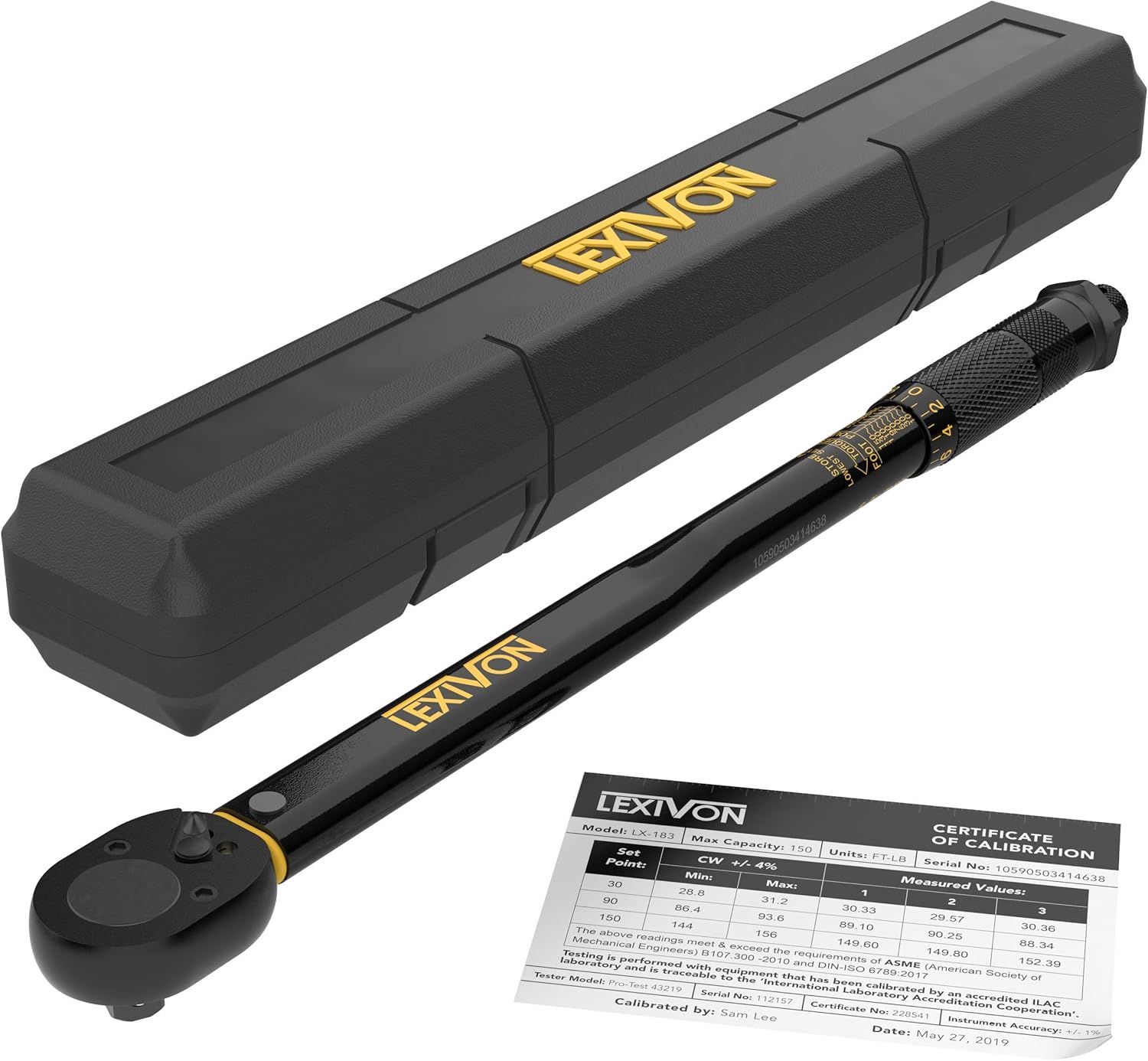
LEXIVON 1/2-Inch Drive Click Torque Wrench (10–150 ft·lb)
Best Overall Torque Wrench for DIY Mechanics
| Drive size | 1/2 inch |
|---|---|
| Torque range | 10–150 ft·lb |
| Material | Chrome Molybdenum Alloy Steel |
| Operation mode | Mechanical |
The LEXIVON 1/2-inch drive click torque wrench is a straightforward mechanical tool for tightening fasteners to a specified torque on cars and light trucks. It is typically used for lug nuts, suspension bolts, and other automotive jobs where consistent torque matters. The wrench offers a broad 10–150 ft·lb range and a reversible ratchet head so you can torque in tight spaces while switching drive direction. Its dual-range, high-contrast scale and knurled handle make setting and holding the target torque easier in dim garages. Built from chrome molybdenum alloy steel with a powder-coated finish, the wrench feels solid and resists corrosion better than plain steel. It ships pre-calibrated to about +/-4% accuracy and includes a calibration certificate for traceability. Limitations are that it is mechanical rather than digital so fine readouts and data logging are not available, and its 17-inch length may be bulky in very confined engine bays. For routine DIY automotive maintenance it strikes a practical balance of durability, visible settings, and usable torque range.
Best for: A practical DIY mechanic who needs a reliable, easy-to-read 1/2-inch torque wrench for routine vehicle and home repairs and values accuracy, durability, and simple controls over professional-caliber extras.
Less Ideal for: Users who need electronic torque logging, ultra-fine digital accuracy, or a very compact wrench for highly confined spaces should consider alternative models.
- Wide 10–150 ft·lb range covers most automotive tasks from spark plugs to lug nuts.
- Pre-calibrated with a traceable certificate for reliable torque control out of the box.
- Reversible ratchet head and knurled handle improve usability in confined or slippery conditions.
- Robust chrome molybdenum alloy construction and powder-coated finish resist wear and corrosion.
- Mechanical click design lacks digital readout or data logging for precision record-keeping.
- At 17 inches long it can be awkward in very tight engine compartments.
Verdict: The top all-around torque wrench that balances accuracy, durability, ease of use, and value for general automotive and home mechanic work.
EPAuto 1/2
Best Budget Torque Wrench for DIY Mechanics

| Drive size | 1/2 inch |
|---|---|
| Torque range | 10–150 ft·lb |
| Material | Chrome Vanadium steel alloy (Cr-V) |
| Accuracy | Pre-calibrated to ±4% |
This EPAuto 1/2-inch drive click torque wrench is a straightforward, budget-friendly tool for DIY vehicle maintenance and general workshop use. It works like a conventional click wrench: set the target torque on the dual-scale handle, apply force, and stop when the audible and tactile click indicates the preset value. The hardened chrome vanadium construction and satin finish resist corrosion for typical garage environments while the knurled handle improves grip during use. The included plastic storage case and a short extension bar make it easier to store and reach lug nuts and bolts in tight spots. The scale is high-contrast for easier reading, and the unit ships pre-calibrated to about ±4 percent which is acceptable for non-critical automotive tasks. Limitations include the lack of digital readout or optional calibration certificate and a fixed square head that may restrict access in some tight angles. For budget-conscious DIYers who need reliable torque for wheel lugs, suspension fasteners, and general repairs, this wrench delivers dependable basic performance without advanced features.
Best for: Budget-minded DIYers who need a reliable, easy-to-use torque wrench for occasional vehicle maintenance and tire work, prioritizing solid construction and clear click-feedback over professional-level calibration frequency.
Less Ideal for: Professional technicians or precision-critical applications where a digital wrench, tighter accuracy, or traceable calibration is required.
- Wide 10–150 ft·lb range covers most automotive tasks
- Hardened chrome vanadium construction for durability
- Click mechanism with audible and tactile feedback for repeatable torque application
- Includes plastic storage case and short extension for convenience
- Pre-calibrated accuracy approximately ±4% suitable for DIY work
- No digital display or memory for torque readings
- No supplied calibration certificate or easy recalibration process
Verdict: The best low-cost torque wrench that still delivers acceptable calibration, solid construction, and practical features for occasional vehicle maintenance.
LEXIVON 1/4-Inch Drive Inch-Pound Click Torque Wrench (LX-181)
Best 1/4-Inch Drive Torque Wrench

| Drive size | 1/4-inch |
|---|---|
| Torque range | 20–200 in-lb (2.26–22.6 Nm) |
| Material | Chrome-Molybdenum alloy steel |
| Operation mode | Mechanical |
The LEXIVON LX-181 is a compact 1/4-inch drive click torque wrench designed to apply and verify low torque on small fasteners. It is typically used for tasks like valve covers, intake manifold bolts, and other light automotive or bike work where inch-pound accuracy matters. The wrench features a dual-range click scale with high-contrast markings that make setting torque straightforward and a reversible ratchet head for driving in either direction while measuring clockwise torque. Construction uses chrome-molybdenum alloy steel with a powder-coated finish for corrosion resistance and a knurled handle for a secure grip during repeated use. The tool ships pre-calibrated and includes a calibration certificate, which supports reliable torque delivery for DIY maintenance. Limitations are its narrow torque range—suited to light-duty fasteners only—and the mechanical click design offers no digital readout or data logging for precision-critical workshops. It is a practical, durable option for routine low-torque jobs but not a substitute for larger or digital torque tools when higher ranges or traceable on-site recalibration are required.
Best for: DIY mechanics and hobbyists who need a compact, accurate 1/4-inch drive torque wrench for tightening small fasteners in tight spaces like electronics, motorcycles, and engine accessories where precise, lower-torque settings matter.
Less Ideal for: Users who need higher torque ranges, digital readouts, or built-in data logging for professional calibration records should choose a different tool.
- Pre-calibrated with a traceable calibration certificate for reliable torque accuracy.
- Clear dual-range scale with high-contrast markings for easy setting in low light.
- Reversible ratchet head allows driving in both directions while measuring torque.
- Durable chrome-molybdenum construction and corrosion-resistant finish for long service life.
- Limited torque range appropriate only for light inch-pound applications.
- Mechanical click mechanism lacks a digital display or logging capability.
Verdict: A torque wrench in a 1/4-inch drive size that’s ideal for precise, lower-torque fasteners and tight spaces commonly encountered on small components.
CRAFTSMAN 3/8" Drive Micrometer Torque Wrench (100 ft-lb)
Best 3/8-Inch Drive Torque Wrench

| Drive size | 3/8 in |
|---|---|
| Maximum torque | 100 Foot Pounds |
| Operation mode | Mechanical |
| Ratcheting | Yes |
| Included components | (1) 3/8 in. Drive Micrometer Torque Wrench |
This CRAFTSMAN 3/8" drive micrometer torque wrench is built for routine automotive and general mechanical work where controlled torque is required. It uses a micrometer-style scale with stamped inch and metric markings and a simple locking feature to set and hold the desired torque, making repeated tightening tasks faster and less fussy. The bi-material handle improves grip and comfort during longer jobs and the 3/8" square drive fits common sockets for brake, engine, and accessory fasteners. It meets or exceeds ASME specs, so it is suitable for DIY mechanics who want reliable accuracy without specialized calibration gear. The wrench is mechanical and ratcheting, so there are no batteries or electronics to fail, but that also means there is no digital readout or audible click precision found on some higher-end models. The tool ships in a durable case for storage and portability, but users seeking lab-level accuracy or a lower torque range may prefer a different design. For typical garage and home repair use this wrench offers a solid balance of durability, usability, and torque capacity.
Best for: DIY mechanics and home enthusiasts who need a reliable, easy-to-use 3/8-inch drive torque wrench for everyday automotive maintenance and light-to-medium repairs, prioritizing accuracy, portability, and a comfortable grip.
Less Ideal for: Precision-oriented technicians who need digital verification or shop professionals who regularly torque larger fasteners beyond 100 ft-lb should consider an alternate model.
- Micrometer scale with stamped inch and metric markings for clear torque setting.
- Hassle-free locking mechanism holds the selected torque during use.
- Bi-material handle improves comfort and grip for longer tasks.
- Ratcheting 3/8" square drive fits common automotive sockets and speeds repetitive work.
- Meets or exceeds ASME specifications for dependable performance.
- No digital display or electronic readout for torque verification.
- Maximum 100 ft-lb limit may be high for some 3/8" applications but insufficient for heavy-duty larger fasteners.
- Mechanical design requires occasional calibration to maintain peak accuracy.
Verdict: A 3/8-inch drive torque wrench that offers the most versatile torque range and balance for everyday automotive tasks and light-to-medium repairs.
CRAFTSMAN 1/2-Inch Drive Micrometer Torque Wrench, 50–250 ft-lb
Best 1/2-Inch Drive Torque Wrench

| Drive size | 1/2 inch |
|---|---|
| Torque range | 50–250 ft-lb (68–339 Nm) |
| Head style | Fixed square, ratcheting |
| Operation mode | Mechanical |
This CRAFTSMAN 1/2-inch drive micrometer torque wrench is a mechanical tool for applying and controlling torque on bolts and nuts in the 50 to 250 ft-lb range. It is used for tightening suspension, drivetrain, and lug fasteners where higher torque is required; the micrometer-style adjuster and locking feature let you set torque quickly and keep it from slipping during use. The ratcheting head improves access in confined spaces and stamped inch and metric scales make reading settings straightforward without extra tools. A bi-material handle improves grip and comfort during repeated use and the included carrying case keeps the wrench protected in a garage or truck. Important limitations are that it is a mechanical wrench so fine digital readouts are not available and its lower range starts at 50 ft-lb, which may be too high for light-duty tasks and small fasteners. For DIY mechanics working on larger automotive fasteners this wrench offers rugged, easy-to-use torque control, but it is not the best choice if you need very low-torque precision or a digital display.
Best for: DIY mechanics who work on suspension, drivetrain, and other heavy fastener jobs and need a robust, easy-to-set 1/2-inch torque wrench that handles high torque ranges with comfortable grip and portable storage.
Less Ideal for: People who regularly need very low torque settings or who prefer a digital torque wrench with a numeric display for calibration tracking should consider other options.
- Wide torque range suitable for suspension and drivetrain work (50–250 ft-lb).
- Micrometer-style adjustment with a positive locking feature for stable, repeatable settings.
- Ratcheting 1/2-inch drive head improves access in tight spaces.
- Stamped inch and metric scales for quick visual reference without extra tools.
- Comfortable bi-material handle and a carrying case for storage and transport.
- Minimum torque of 50 ft-lb may be too high for light automotive or precision tasks.
- Mechanical design lacks a digital readout for exact numeric feedback.
Verdict: A 1/2-inch drive torque wrench designed for higher-torque applications and heavy fasteners typically found on suspension, drivetrain, and larger components.
Park Tool TW-6.2 Ratcheting Click Torque Wrench 10–60 Nm (3/8" Drive)
Best Compact Torque Wrench

| Torque range | 10 to 60 Newton meters |
|---|---|
| Drive | 3/8-inch ratcheting drive |
| Operation mode | Mechanical click-type |
| Material | Alloy Steel |
The Park Tool TW-6.2 is a click-type, ratcheting torque wrench designed for mid-to-high torque bicycle and workshop fasteners. It uses a 3/8-inch ratcheting drive and an adjustable dial to pre-set torque between 10 and 60 Nm, delivering a tactile click when the target torque is reached. Typical uses include tightening crank bolts, bottom brackets, and cassette lockrings where accuracy matters to avoid component damage. The wrench comes with a protective case and a dual measurement scale for convenience. Practical benefits include accurate, repeatable torque application, a durable alloy steel construction with painted finish, and a ratcheting head that speeds work in tight spaces. Limitations are the 10 Nm lower limit, which makes it unsuitable for very low-torque fittings, and its single-range design means you may need smaller preset drivers for sub-10 Nm tasks. It is a workshop-grade, user-friendly tool well suited to routine bike maintenance but not a comprehensive solution if you need very low-torque precision drivers.
Best for: DIY mechanics who need a shorter, easy-to-store torque wrench for working in tight frames, engine bays, or crowded toolboxes and who prioritize portability and access over the absolute highest torque range.
Less Ideal for: Users who frequently work with very low-torque fasteners or need a multi-range kit covering sub-10 Nm precision should consider specialized preset drivers or a different wrench set.
- Accurate click-type mechanism with a 10–60 Nm range for mid-to-high torque applications
- 3/8-inch ratcheting drive speeds work in confined spaces
- Durable alloy steel construction and painted finish for workshop use
- Includes a protective case for storage and transport
- Minimum torque of 10 Nm excludes very low-torque bicycle fittings
- Single torque range means additional tools are needed for sub-10 Nm tasks
Verdict: A shorter, more portable torque wrench that trades some maximum range for easier access in cramped engine bays and convenient storage in a toolbox.
Wera Click-Torque B2 3/8" Torque Wrench, 20–100 Nm
Best Premium Torque Wrench

| Drive | 3/8" square |
|---|---|
| Torque range | 20–100 Nm |
| Accuracy | +/- 3% (DIN EN ISO 6789-1:2017) |
| Ratchet | 45-tooth reversible |
The Wera Click-Torque B2 is a mechanical click-type torque wrench built for accurate, repeatable tightening in workshop and garage use. It uses a 3/8" fixed square drive with a reversible 45-tooth ratchet and a clearly marked scale you set by hand; audible and tactile clicks signal when the preset torque is reached. The wrench covers 20–100 Nm with stated accuracy of +/-3% to DIN EN ISO 6789-1:2017, which makes it suitable for wheel nuts, engine and suspension fasteners where controlled torque matters. Its two-component ergonomic handle and robust construction feel durable for regular DIY and light professional work. Limitations are its right-hand calibration bias, which favors clockwise torquing, and the mechanical setting design can be slower to adjust than digital models; it also lacks a storage case and torque memory features found on higher-end electronic wrenches. For DIY mechanics who value reliable, calibrated mechanical performance, this is a strong premium option with proven accuracy.
Best for: Experienced DIY mechanics who need a high-accuracy, durable torque wrench for frequent use and value stable calibration, precise click-setting, and an ergonomic grip for long sessions.
Less Ideal for: Users who need left-hand torque control, instant digital readouts, or advanced data logging should consider electronic or specialty torque tools instead.
- Calibrated accuracy of +/-3% to DIN EN ISO 6789-1:2017 across 20–100 Nm
- Clear audible and tactile click at the set torque for confident tightening
- Reversible 45-tooth ratchet and 3/8" drive for common workshop fasteners
- Ergonomic two-component handle and robust build for frequent use
- Designed primarily for right-hand (clockwise) torque control so left-hand accuracy is limited
- Mechanical adjustment lacks the instant numeric readout and features of digital wrenches
- No included case or electronic torque logging
Verdict: A higher-end torque wrench that prioritizes exceptional accuracy, long-term calibration stability, superior materials, and refined ergonomics for frequent DIY mechanics.
How We Chose the Best Torque Wrench
We focused on torque wrenches that make sense for DIY mechanics handling common garage jobs rather than specialized shop-only work. Our filtering started with the torque ranges most useful for home maintenance, including lower settings for smaller fasteners and higher ranges for wheel and suspension work. We also looked closely at drive size, since 1/4-inch, 3/8-inch, and 1/2-inch tools each suit different tasks.Beyond range and size, we prioritized clear scale markings, repeatable adjustment mechanisms, audible or tactile feedback, comfortable grip design, and overall ease of resetting and storing the tool correctly. Accuracy claims and consistency within the stated operating range mattered more than extra features that do not improve actual fastening results. Build quality around the ratchet head, locking collar, and handle was another key filter because those areas affect long-term usability.We excluded oversized specialty models, ultra-low-capacity tools with narrow use cases, and gimmick-heavy options that add complexity without helping a home mechanic torque fasteners more confidently or more precisely.
Our full evaluation process is outlined in our review methodology.
Why Torque Accuracy Matters in a Home Garage
Torque is not just about tightening a fastener until it feels snug. It is about applying enough rotational force to create the proper clamping load without damaging the fastener, threads, gasket, or part being secured. On a vehicle, that matters for everything from wheel lug nuts to aluminum engine components where over-tightening can cause expensive problems.
For DIY mechanics, consistent torque also improves repeatability. When you service brakes, reinstall wheels, or work through a repair manual step by step, a torque wrench helps remove guesswork and gives you a more dependable result. It is one of the easiest ways to make home repairs safer and more professional.
- Too little torque can allow movement, leaks, or loosening over time
- Too much torque can strip threads, distort parts, or snap bolts
- Correct torque is especially important on wheels, spark plugs, drain plugs, and gasketed components
Choosing the Right Torque Range for Your Jobs
The most important buying decision is not the style of wrench first. It is the torque range. A torque wrench is most useful when your target values fall comfortably within its working span, not right at the minimum or maximum edge. DIY mechanics often need one range for smaller under-hood work and another for heavier chassis or wheel fasteners.
If you mainly work on interior components, hose clamps with adapters, small engine fasteners, or other light-duty tasks, a lower-range tool gives better control. For general maintenance such as spark plugs, valve covers, and many medium fasteners, a mid-range wrench is usually more versatile. For lug nuts, axle-related work, and larger suspension hardware, a higher-range model is the better fit. Matching the tool to the task improves both accuracy and feel.
- Lower ranges are better for smaller fasteners and delicate threads
- Mid-range tools often cover the broadest mix of routine maintenance jobs
- Higher-range tools are typically needed for wheel and heavier chassis work
- If your projects vary widely, more than one torque wrench may be the best long-term solution
Drive Sizes and Where Each One Fits
Drive size affects socket compatibility, tool bulk, and the kinds of fasteners you can access comfortably. A 1/4-inch drive torque wrench is commonly chosen for low-torque precision work where compact size matters. A 3/8-inch drive is often the sweet spot for DIY mechanics because it balances reach, control, and broad usefulness across many repair tasks. A 1/2-inch drive is the usual choice for higher torque jobs like wheel service and larger suspension fasteners.
Bigger is not automatically better. A large torque wrench can feel awkward in tight engine bays and may not be ideal for lower values. On the other hand, a smaller drive tool should not be pushed beyond its intended range just because the socket fits. The best setup depends on the fasteners you service most often and the amount of leverage those jobs require.
- 1/4-inch drive suits low-torque precision tasks
- 3/8-inch drive is a versatile all-around choice for many garage jobs
- 1/2-inch drive is best for higher torque applications and larger fasteners
Click, Beam, and Digital Torque Wrench Types
Click-style torque wrenches are popular with DIY mechanics because they are straightforward and fast to use. You set the desired value, tighten smoothly, and stop when the wrench signals that the target has been reached. They offer a good blend of convenience and repeatability for routine automotive work.
Beam-style torque wrenches are simple and durable, with fewer internal parts to drift or wear. They can be a solid choice if you value mechanical simplicity, but they require a clear line of sight to the scale and a steady hand to read accurately. Digital torque wrenches add easier readouts and sometimes alerts or memory functions, which can help newer users, but they also introduce batteries and extra complexity. The best type is the one you can use correctly and consistently during real repairs.
- Click style is practical for most home mechanics
- Beam style is simple and often durable but slower to read
- Digital style can improve readability but depends on electronics
Features That Improve Real-world Usability
A torque wrench does not need a long feature list to be useful, but a few details make a big difference in everyday garage work. Clear scale markings are essential, especially if you move between units or work in dim lighting. A secure adjustment lock helps prevent accidental setting changes, and a grip with good texture gives better control when applying force slowly and evenly.
Ratchet head design also matters. A smooth directional switch, reasonable head profile, and solid engagement with sockets can make the tool easier to use in cramped spaces. For some DIY mechanics, quick-release buttons or easier unit conversion improve convenience. Still, usability should support accuracy, not distract from it. A torque wrench should be simple to set, easy to read, and predictable under load.
- Easy-to-read scale or display
- Secure locking mechanism for the set value
- Comfortable grip for smooth, controlled pull
- Ratchet head that works well in tighter spaces
How to Use a Torque Wrench Correctly
Even a good torque wrench can give poor results if it is used the wrong way. Always verify the required torque spec for the exact fastener and application, then make sure the wrench range suits that target. Tighten in a smooth, steady motion using the handle area intended by the tool design. Avoid jerking the tool or using body weight suddenly, because that can overshoot the setting.
It also helps to seat the fastener first with a regular ratchet when appropriate, then switch to the torque wrench for final tightening only. On parts with multiple fasteners, follow the recommended sequence and tighten in stages if the service procedure calls for it. After use, reset adjustable click-style wrenches to their storage setting according to the maker guidance rather than leaving them loaded at a high value.
- Use the torque wrench for final tightening, not breaking loose stubborn fasteners
- Pull smoothly and stop at the signal
- Follow the correct torque pattern on multi-fastener components
- Store the tool properly to help maintain consistency
Care, Calibration, and Long-term Value
Torque wrenches are measuring tools, not just heavy-duty ratchets. Treating them carefully helps preserve accuracy over time. Keep the tool clean, avoid dropping it, and store it in its case or a protected drawer where the scale and adjustment mechanism will not be knocked around. If the wrench is used frequently, a periodic calibration check can be worthwhile, especially if accuracy is critical for the work you do.
For most DIY mechanics, long-term value comes from buying the right range and type first, then using it correctly. A well-matched torque wrench that feels intuitive in your hand is often more valuable than a more complicated option with features you rarely use. Think about the jobs you perform most often, the space you work in, and whether you may eventually need a second wrench to cover a different torque range more effectively.
- Protect the wrench from impact and rough storage
- Consider calibration checks if the tool sees regular use
- Choose practical range coverage over unnecessary extras
FAQ
What size torque wrench is best for DIY mechanics?
There is no single best size for every job. A 3/8-inch drive torque wrench is often the most versatile for general home garage work, while a 1/2-inch drive is commonly used for wheel and heavier fasteners. If you also handle smaller engine or low-torque tasks, a 1/4-inch drive can be useful as a second wrench.
Is a click torque wrench better than a beam torque wrench?
For many DIY mechanics, a click torque wrench is easier and faster to use because it gives a clear signal when you reach the target. A beam torque wrench is simpler and can be very dependable, but it requires careful reading during use. The better choice is the one that matches your workflow and that you can use accurately every time.
Can one torque wrench cover all automotive jobs?
Usually not. Automotive work spans a wide range of torque values, from small fasteners to wheel and suspension hardware. One wrench may handle a lot of routine work, but many DIY mechanics eventually benefit from two tools with different ranges for better accuracy and control.
Do I need to calibrate a torque wrench?
If you use it regularly, calibration checks are a smart idea over time. Accuracy can drift with wear, impact, or improper storage. Home users may not need frequent calibration, but if the wrench has been dropped, heavily used, or is critical for precise work, it is worth verifying.
Should I use a torque wrench to loosen bolts?
In most cases, no. A torque wrench is designed for controlled tightening, not for breaking loose seized or over-tightened fasteners. Use a breaker bar or standard ratchet for removal, then switch to the torque wrench for final tightening during reassembly.
What is the biggest mistake people make with torque wrenches?
One common mistake is using the wrong torque range for the job. Another is pulling too quickly and overshooting the setting, especially with click-style tools. Incorrect storage and using the tool as a general ratchet can also reduce long-term accuracy.
Final Verdict
The right torque wrench depends on the kind of repairs you handle most often, the torque values you need to hit, and how much control you want in tight or delicate applications. Range, drive size, readability, and ease of use matter more than extra features if your goal is repeatable, confident fastening in a home garage.For most DIY mechanics, the best choice is the one that fits your real maintenance routine rather than trying to cover every possible task with a single compromise. Focus on matching the wrench to your common jobs, use it correctly, and you will make safer, more consistent repairs with less guesswork.
