

Note: This article contains affiliate links. If you click on these links and make a purchase, I may earn a small commission at no extra cost to you. This helps support my research and content. Read my full affiliate disclosure here.
If you drive a Ford F-350 with the 7.3L Diesel, the radiator is one of the most important components for dependable performance under load. A failing radiator can cause overheating, reduced engine life, and loss of towing capability, so choosing the right replacement matters more than a simple swap.This guide presents seven shortlisted radiators that suit the 7.3L Diesel's cooling needs and tight engine-bay fitment. We evaluated each option for cooling capacity, build quality, and installation compatibility so you can pick a durable replacement that addresses common failure modes. Read on for practical buying criteria and installation considerations before you select a unit for your truck.
Top Picks at a Glance
| Best Overall The best all-around choice for most situations | Jepnriyo 2-Row Aluminum Radiator Replacement for Ford Super Duty 1999–2005 |  |
| Best Quality Built to a higher standard if you want something more solid | Mishimoto Performance Aluminum Radiator for Ford 7.3L Powerstroke (1999–2003) |  |
| Best Value The sweet spot between price and what you get | SCITOO Aluminum Radiator, Direct Fit for Ford Super Duty and Excursion 1998–2005 |  |
| Best Budget The cheapest option that still gets the job done reliably | Auto Shack Radiator for Ford F-250/F-350 Super Duty 1999–2004, 7.3L V8 / 6.8L V10 |  |
| Highest Rated A top-rated pick with lots of positive feedback | SCITOO Replacement Engine Radiator Assembly for Ford Super Duty 6.8L/7.3L (Fitment 2171) |  |
| Most Popular A crowd favorite that many people choose with confidence | SCITOO Radiator Assembly for Ford F-250/F-350 7.3L (1995–1997) |  |
| Best Seller A high-volume bestseller chosen again and again | TRQ Radiator, 1-Row Direct-Fit for Ford F-250/F-350/F-450/F-550 (7.3L V8 / 6.8L V10) |  |
1. Jepnriyo 2-Row Aluminum Radiator Replacement for Ford Super Duty 1999–2005

| Fitment | Ford F-250/F-350/F-450/F-550/Excursion 1999-2005 V8/V10 |
|---|---|
| Core type | Brazed aluminum tube-and-fin |
| Transmission oil cooler | Yes |
| Inlet/outlet | 1.77" |
This Jepnriyo two-row aluminum radiator is a direct-replacement cooling core for 1999–2005 Ford Super Duty trucks with V8 or V10 engines. It installs as a bolt-on replacement and includes a radiator cap; the unit uses a tube-and-fin brazed core and 2mm-thick all-aluminum tanks to improve heat transfer and durability. In practice the larger core volume and higher surface area should lower operating temperatures and increase resistance to temperature spikes during towing or heavy-load driving, and the built-in transmission oil cooler keeps accessory cooling integrated. The radiator is relatively light compared with cast-iron assemblies and is TIG-welded for strength, but professional installation is recommended since no instructions are included. Buyers should note this is a vehicle-specific replacement intended to match stock mounting and hose sizes rather than a universal performance upgrade, so verify inlet/outlet sizing and transmission cooler lines before ordering.
Best for: Buyers who want a durable, factory-style replacement that improves cooling capacity for heavy use like towing or long highway runs while keeping a straightforward bolt-on installation approach.
Less Ideal for: Drivers seeking a custom high-performance racing radiator or multi-vehicle universal upgrade should consider purpose-built performance cores instead.
- All-aluminum 2-row brazed core improves heat transfer over many stock radiators
- Integrated transmission oil cooler keeps transmission cooling consolidated
- TIG-welded construction and 2mm-thick tanks for increased durability
- Direct bolt-on fitment for 1999–2005 Super Duty trucks simplifies replacement
- No installation instructions included, so professional fitting is recommended
- Claims of being 40% more efficient than stock are manufacturer stated and not independently verified
Verdict: A solid factory-style aluminum replacement that lowers operating temps and keeps a direct bolt-on fit for 1999–2005 Ford Super Duty trucks needing more cooling capacity.
2. Mishimoto Performance Aluminum Radiator for Ford 7.3L Powerstroke (1999–2003)

| Compatibility | Ford Powerstroke 7.3L, 1999-2003 |
|---|---|
| Mounting Type | Chassis Mount |
| Cooler Heatsink Material | Aluminum |
This Mishimoto radiator is a performance-focused direct-fit replacement for the Ford 7.3L Powerstroke (1999–2003). It uses a fully brazed two-row aluminum core and TIG-welded end tanks to increase cooling capacity and resist deformation under heavy use. The thicker core and improved heat dissipation help keep temps down during towing, hauling, or sustained highway runs where stock units tend to run hot. Installation is straightforward because the unit aligns with the factory fan shroud, though the radiator cap is not included so you need a compatible cap to finish the system. Practical extras like a magnetic drain plug make coolant changes cleaner and help catch metal particles before they circulate. Expect a noticeable drop in operating temperature under load, with durability advantages from the aluminum construction, but this is a replacement tuned for cooling performance rather than a weight-saving or budget-focused option.
Best for: Drivers who prioritize lowering operating temperatures during heavy towing, repeated hard use, or when running performance upgrades and want a robust, drop-in cooling upgrade for a 7.3L truck.
Less Ideal for: Buyers seeking the cheapest replacement or a lightweight racing-only radiator should consider other options; this unit is focused on durable, high-capacity cooling rather than minimal cost or weight savings.
- Direct-fit design that aligns with factory fan shroud for straightforward installation
- Brazed aluminum core and TIG-welded end tanks for improved cooling and durability
- Thicker two-row core suited to heavy towing and sustained high-load operation
- Magnetic drain plug helps catch metal debris and simplifies coolant changes
- Radiator cap is not included and must be obtained separately
Verdict: If you need a reliable, high-capacity drop-in radiator to lower temperatures during towing and heavy-duty use on a 7.3L F-350, this Mishimoto unit is a strong choice.
3. SCITOO Aluminum Radiator, Direct Fit for Ford Super Duty and Excursion 1998–2005

| Brand | SCITOO |
|---|---|
| Model | 125823 |
| Manufacturer Part Number | 125823-5336-1022087921 |
| Vehicle Fitment | 1998–2005 Ford Super Duty and Excursion 6.8L/7.3L |
This SCITOO radiator is a full replacement unit built from aluminum and intended as a direct fit for 1998–2005 Ford Super Duty trucks and Excursions with 6.8L or 7.3L engines. It replaces the entire radiator assembly and is used the same way a factory unit is: remove the old core and mounting hardware and install this radiator with the existing hoses, fan shroud, and connections. Key features include an all-aluminum construction for improved heat transfer and a painted exterior to resist surface corrosion. For everyday towing and heavy-duty driving this radiator provides a straightforward way to restore cooling capacity without modifying the vehicle. The unit appears to match factory mounting points and service items, which speeds installation for a practical DIYer or a shop. Limitations to consider are that this is a vehicle-specific direct-fit part so compatibility must be verified against your exact year and engine, and it does not include additional upgraded cooling features like larger cores, electric fans, or integrated transmission coolers that some owners may prefer for severe-duty use.
Best for: Buyers who want a practical, vehicle-specific replacement to restore factory cooling performance without upgrades and who value straightforward fitment and a cost-effective repair.
Less Ideal for: Owners seeking a high-capacity performance cooling solution for sustained heavy towing or racing should consider purpose-built upgraded radiators instead.
- All-aluminum construction improves heat dissipation compared with some mixed-material replacements
- Designed as a direct-fit replacement matching factory mounting points for simpler installation
- Painted exterior finish helps resist surface corrosion and extend service life
- Covers the specific late 1990s–mid 2000s Ford 6.8L and 7.3L engine applications, reducing fitment guesswork
- Does not include upgraded features such as a larger core, integrated transmission cooler, or electric fan for extreme-duty cooling
Verdict: A practical, direct-fit aluminum replacement that restores factory cooling for late 1990s–mid 2000s Ford 6.8L and 7.3L trucks without extra modifications.
4. Auto Shack Radiator for Ford F-250/F-350 Super Duty 1999–2004, 7.3L V8 / 6.8L V10
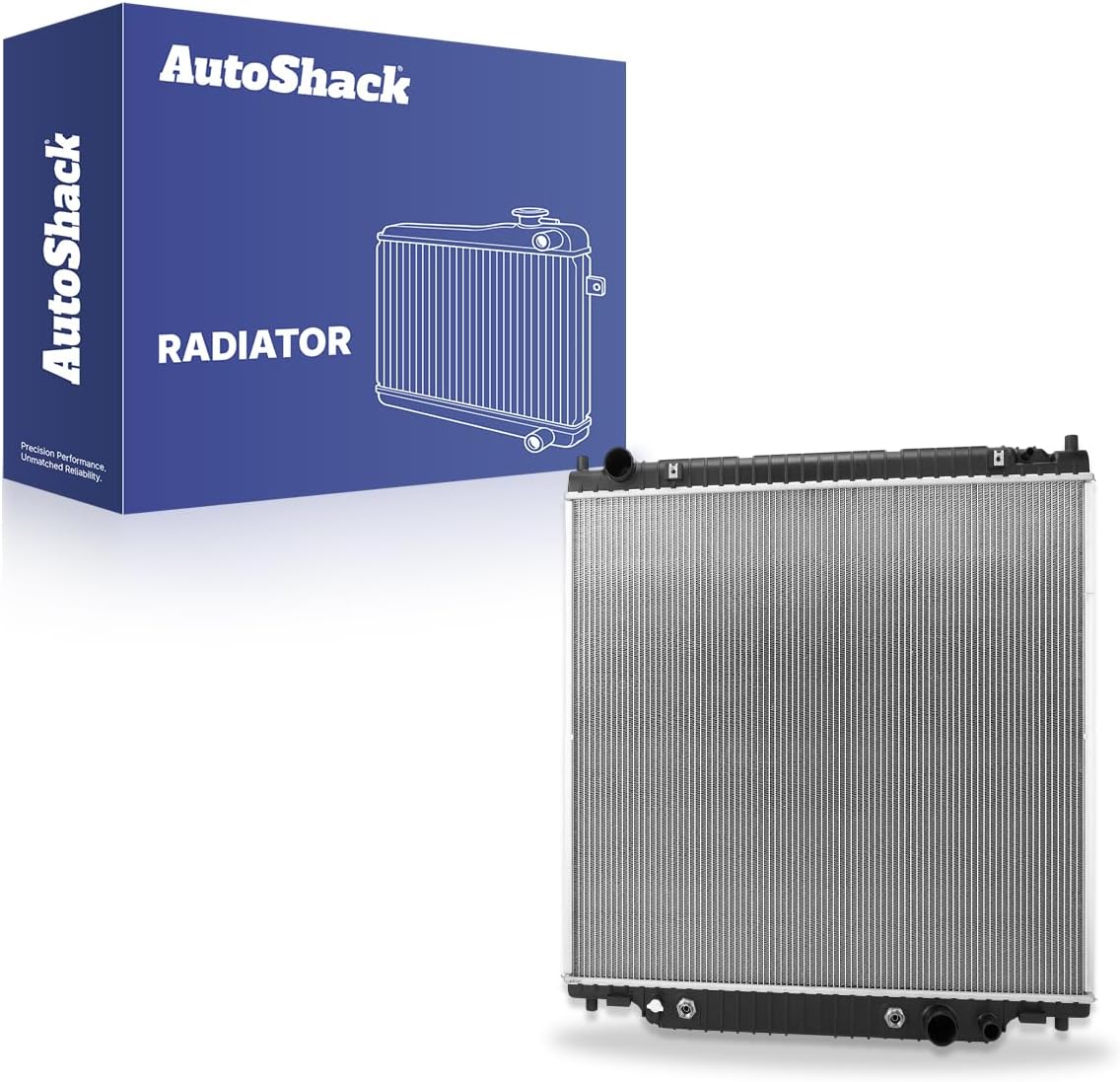
| Fitment | 1999–2004 F-250/F-350 Super Duty; Excursion 2000–2005 |
|---|---|
| Core Rows | 2 |
| Transmission Cooler | Built-in (automatic transmissions) |
| Exterior | Aluminum core, plastic tanks |
This Auto Shack radiator is a direct-fit replacement intended to restore cooling performance on 1999–2004 Ford F-250 and F-350 Super Duty trucks (also fits Excursion 2000–2005) equipped with the listed engine and automatic transmission. It uses an aluminum core with plastic end tanks and a two-row core to support steady coolant temperatures in everyday driving and towing scenarios. The assembly includes the radiator unit and has a transmission oil cooler built in but does not include a radiator cap. Fitment notes and core dimensions are provided so installers can verify compatibility with the truck's cooling package before purchase. For budget-focused owners this offers a straightforward swap to get the truck back on the road without upgrading to a heavy-duty aftermarket core, though it is not a performance or high-capacity racing replacement and professional installation is recommended for correct plumbing and mounting.
Best for: Practical owners who need an affordable, ready-to-install replacement to restore reliable engine cooling on an older Super Duty without spending on heavy-duty upgrades.
Less Ideal for: Buyers who want high-capacity or performance cooling upgrades for heavy tow or racing duty should consider aftermarket performance radiators instead.
- Direct-fit design for specified 1999–2004 Ford Super Duty models simplifies installation
- Aluminum core with plastic end tanks provides factory-style cooling performance
- Integrated transmission oil cooler saves the step of adding a separate cooler
- Includes core dimensions and fitment details to confirm compatibility before purchase
- Radiator cap is not included so a separate purchase or reuse is required
Verdict: A cost-conscious, direct-fit replacement radiator that restores factory-style cooling for 7.3L Super Duty trucks without the complexity or cost of a performance upgrade.
5. SCITOO Replacement Engine Radiator Assembly for Ford Super Duty 6.8L/7.3L (Fitment 2171)

| Fitment Years | 1999–2004 Super Duty; 2000–2003 Excursion |
|---|---|
| Engine Compatibility | 6.8L and 7.3L V8 |
| Core Rows | 1 Row |
| Engine Oil Cooler | Included |
| OEM Part Number | 2171 |
This SCITOO radiator is a direct-fit replacement for 1999–2004 Ford Super Duty and 2000–2003 Excursion 6.8L and 7.3L applications, offering a single-row core with a painted finish and a built-in engine oil cooler. It is used as a full radiator swap to restore cooling capacity after failure or during engine maintenance. The one-row core keeps the design simple and compatible with factory mounting points, while the included engine oil cooler eliminates the need to source a separate cooler. Practical benefits include straightforward fitment for the specified model years and a painted exterior that resists corrosion. Limits to consider are the single-row core, which is less efficient than multi-row performance radiators under extreme heavy-duty towing or sustained high-load conditions, and the lack of an integrated transmission oil cooler for automatic transmission cooling needs. Buyers should expect OEM-style function rather than upgraded cooling performance for modified engines or heavy commercial duty cycles.
Best for: Buyers who prioritize a reliable, factory-style replacement to restore stock cooling on older Ford Super Duty or Excursion trucks and want straightforward fitment without performance upgrades.
Less Ideal for: Not a good choice for owners running heavily modified engines, frequent heavy towing, or those who need extra cooling capacity or an integrated transmission oil cooler.
- Direct-fit design for specified Ford Super Duty and Excursion 6.8L/7.3L years to simplify installation
- Includes an integrated engine oil cooler so you do not need a separate unit
- Painted exterior helps resist surface corrosion and improves longevity of the assembly
- Single-row core keeps the unit lightweight and easy to handle during installation
- Single-row core provides less cooling headroom than multi-row radiators for heavy towing or high-performance use
- No transmission oil cooler included for automatic transmission cooling requirements
Verdict: Choose this SCITOO radiator when you need a dependable, direct-fit factory-style replacement to restore original cooling function on 6.8L and 7.3L Ford Super Duty trucks.
6. SCITOO Radiator Assembly for Ford F-250/F-350 7.3L (1995–1997)

| Engine Oil Cooler Included | No |
|---|---|
| Transmission Oil Cooler Included | Yes |
| Inlet Diameter | 1.75 inch |
| Outlet Diameter | 1.75 inch |
| Row count | 1-Row |
This SCITOO radiator is a one-row aluminum replacement built to match the factory fit for 1995–1997 Ford F-250 and F-350 7.3L trucks. It installs in place of the original radiator and includes an integrated transmission oil cooler, 1.75 inch inlet and outlet ports, and a core sized to the original dimensions to restore cooling capacity. The high-density multi-layer cooling design aims to improve heat transfer and reduce the chance of overheating under tow or heavy load. Typical use is a full radiator swap when the original has failed, leaked, or lost efficiency; professional or experienced DIY installers will appreciate the claimed OEM-style mounting and painted exterior. Practical benefits include a direct compatibility with the listed model years and the built-in transmission cooler that saves the step of adding a separate unit. Limitations to expect are that this is a single-row core—so it may not match the cooling margin of multi-row performance radiators for extreme towing, and final fit and performance depend on correct trim and model confirmation before purchase.
Best for: Buyers who prioritize a proven direct-replacement radiator that restores factory cooling and includes a transmission cooler, and who prefer to rely on units with strong customer feedback rather than experimental upgrades.
Less Ideal for: Drivers seeking maximum extra cooling for sustained heavy towing or high-performance modifications should consider multi-row or performance-specific radiators instead.
- Direct-fit design for specified 1995–1997 Ford 7.3L F-250/F-350 models which simplifies installation.
- Integrated transmission oil cooler eliminates need for a separate cooler when replacing the radiator.
- Aluminum one-row core with high-density multi-layer construction for efficient heat transfer.
- Painted exterior and factory-style mounting points intended to match original equipment fitment.
- Single-row core may offer less cooling headroom than multi-row or aftermarket performance radiators for heavy tow use.
- Compatibility relies on confirming exact trim and model year before installation.
Verdict: A straightforward, direct-fit replacement radiator that restores factory cooling for 1995–1997 7.3L Ford F-250/F-350 trucks while including a transmission cooler for convenient installation.
7. TRQ Radiator, 1-Row Direct-Fit for Ford F-250/F-350/F-450/F-550 (7.3L V8 / 6.8L V10)

| Core Row Quantity | 1 |
|---|---|
| Core Material | Aluminum |
| Transmission Oil Cooler Plate Quantity | 6 |
| Outlet Location | Bottom Right |
| Down Flow Or Cross Flow Type | Down Flow |
This TRQ radiator is a direct-replacement, single-row aluminum core intended for late 1990s to early 2000s Ford Super Duty trucks and the Excursion with the 7.3L diesel or 6.8L V10 engines. It installs using the factory upper and lower mounts and includes an internal transmission oil cooler with six plate fittings, so it serves both engine cooling and transmission cooling duties without extra parts. The machined aluminum core and plastic tanks mirror factory construction while offering a straightforward swap for owners wanting a like-for-like replacement. Practical benefits include preassembled fittings to reduce installation time and compatibility confirmation for specific model years to avoid fitment issues. Limitations are inherent to a single-row core: it matches stock cooling capacity but will not provide the extra cooling headroom of multi-row or performance radiators for heavy towing or sustained high-load use. Buyers should also plan for professional installation if they are not comfortable handling coolant and transmission lines.
Best for: Buyers who want a trusted, factory-style replacement radiator that fits their specific late-1990s to early-2000s Ford Super Duty or Excursion and prefer a low-risk, straightforward swap.
Less Ideal for: Owners planning heavy towing, frequent high-load hauling, or performance upgrades who need greater cooling capacity should consider multi-row or high-performance radiators instead.
- Direct-fit design uses factory mounting points for straightforward replacement
- Aluminum core with integrated transmission cooler plates replaces both radiator and transmission cooler
- Preassembled components reduce installation time and eliminate need for modifications
- Matches factory single-row cooling capacity for stock driving and normal duty
- Single-row core does not provide extra cooling capacity for heavy towing or sustained high-load conditions
- Plastic tanks may be less durable than full all-metal radiators over very long service life
Verdict: A straightforward, factory-style direct-fit radiator that replaces both engine and transmission coolers for stock 7.3L Super Duty use with minimal installation risk.
Choosing the Right Ford F-350 7.3L Diesel Radiator: Key Factors to Consider
Cooling Capacity and Core Design
Cooling capacity determines how well a radiator sheds heat, especially when towing heavy loads or operating at highway speeds. Look for core designs with adequate surface area and fin density to increase heat transfer without creating excessive airflow restriction. Multi-row cores typically provide greater cooling reserve, which helps prevent temperature spikes during prolonged heavy use.
Core thickness, fin type, and the number of coolant passages affect both heat rejection and airflow resistance. For the 7.3L Diesel, a radiator that balances a wider core with sufficient fin surface area will help maintain stable coolant temperatures under load. Consider how the truck will be used: repeated towing and long idling periods demand higher capacity than light-duty local driving.
Material and Corrosion Resistance
Radiators are commonly constructed from aluminum cores with plastic or aluminum tanks. Aluminum cores offer good thermal conductivity and light weight, but the tank material and joint brazing quality influence long-term corrosion resistance. Choose radiators with corrosion-resistant coatings, high-quality brazing at joints, and robust tank materials to avoid premature leakage.
Salt exposure, coolant chemistry, and high operating temperatures accelerate corrosion in heavy-use trucks. For a 7.3L Diesel used in varied climates, a radiator with proven resistance to electrochemical degradation and durable seals will reduce the chance of leaks and extend service life.
Fitment and Mounting Compatibility
Correct fitment is crucial to avoid modification during installation. The radiator must match the F-350's hose inlet and outlet locations, mounting ear positions, fan shroud alignment, and transmission oil cooler provisions if equipped. Poorly fitting radiators can lead to stressed hoses, misaligned shrouds that reduce airflow, or interference with adjacent components.
When evaluating options, verify the unit's mounting pattern and header tank orientation. A radiator that matches factory mounting points reduces labor time and the risk of installation-induced leaks. Also check for provision of OEM-style fittings or adapters for transmission cooler lines when required.
Tank Construction and Joint Quality
Radiator tanks and the joints between tanks and cores are common failure points. Quality tanks and secure joints reduce the chance of seam leaks and cracking under thermal cycling. Look for radiators with reinforced tank designs, high-quality gaskets or welded joints, and evidence of consistent manufacturing processes.
Avoid units with thin, flex-prone tanks or unclear bonding methods. For heavy-duty service, stronger tank reinforcements and well-executed brazing or welding will better tolerate pressure variations, vibration, and repeated heating and cooling cycles.
Cooling System Integration
A radiator does not operate alone; it works with the fan, thermostat, hoses, and coolant. Ensure the chosen radiator integrates cleanly with the existing fan shroud, fan clutch or electric fan setup, and thermostat to maintain correct flow rates and air movement. Mismatched flow characteristics or altered airflow paths can produce higher-than-expected engine temperatures.
Consider whether the radiator supports the vehicle's transmission cooler lines and if any additional fittings or hose changes are necessary. Also think about coolant type and capacity changes that might affect system pressure and heat rejection.
Ease of Service and Warranty Support
Serviceability affects lifecycle cost and convenience. Radiators that allow core repairs, have replaceable fittings, or come with clear warranty terms make future maintenance simpler. A solid warranty signals manufacturer confidence and offers protection if early leaks or manufacturing defects appear.
Check for clearly stated coverage that includes common failure modes. Also consider whether replacement parts such as seals or adapters are available separately. For trucks that see heavy duty use, easier serviceability reduces downtime and repair complexity.
Common Radiator Symptoms and What They Mean
Recognizing early signs of a failing radiator helps prevent costly engine damage. Persistent high temperature readings, visible coolant leaks beneath the truck, or a spongy heater core are all indicators that the cooling system deserves inspection.
Specific symptoms such as coolant loss without visible puddles can indicate internal leakage or a slow seam leak. Overheating under load often points to reduced heat rejection capacity, clogged fins, or diminished coolant flow due to internal blockages.
Pay attention to changes in coolant color or the presence of oil in the coolant, which can signal broader engine issues that also impact radiator function. Addressing the root cause early avoids repeated radiator failures and helps maintain towing performance.
- High operating temperature during towing: possible reduced core efficiency or blocked passages
- Visible coolant at the rear of the engine bay: likely external leak or hose issue
- Intermittent overheating that clears at highway speeds: may indicate fan or airflow problems
- Coolant contamination or discoloration: inspect for corrosion or internal engine leaks
Preparing Your Truck for Radiator Replacement
Plan the replacement with the engine cool and the battery disconnected where necessary. Gather the correct hose clamps, new coolant, and any sealants or replacement fittings specified for the radiator you select. Having a proper drain pan and protective gloves will reduce mess and exposure to hot coolant.
Confirm you have access to the service manual or a reputable installation guide for the F-350 7.3L Diesel to follow torque specs and proper bleed procedures. Inspect hoses, clamps, fan shroud, and the thermostat while the system is open; replacing worn peripheral parts at the same time can prevent repeat disassembly.
- Drain coolant and capture it safely for disposal or recycling
- Inspect and, if necessary, replace upper and lower radiator hoses
- Check fan shroud alignment and fan clutch or electric fan connections
Transmission Cooler Integration and Considerations
Many F-350s with the 7.3L Diesel use the radiator to house a transmission oil cooler. Ensure the replacement radiator has the proper transmission cooler ports or provisions. Installing a radiator without compatible cooler passages requires separate cooler lines or an auxiliary cooler to maintain transmission temperature control.
Transmission cooling is critical for towing; a mismatched or undersized transmission cooler can lead to higher fluid temperatures and shorter transmission life. Verify thread sizes, port locations, and sealing methods before committing to a unit to avoid additional adaptors or fabrication.
- Confirm transmission line port type and location
- Consider a separate auxiliary cooler if towing heavily and the radiator cooler appears undersized
- Inspect transmission cooler fittings for wear before reusing
Coolant Choice and Maintenance Best Practices
Using the correct coolant formulation and maintaining proper coolant condition reduces corrosion and extends radiator life. Follow Ford's recommended coolant type and change intervals, and avoid mixing incompatible coolant chemistries which can accelerate corrosion or form deposits.
Regular coolant flushes and system checks keep heat transfer efficient. When replacing the radiator, perform a coolant flush to remove debris and contaminants. Also bleed the system properly to remove air pockets that can cause hot spots and overheating.
- Use compatible coolant and maintain recommended concentration
- Flush the cooling system when installing a new radiator
- Bleed air from the system following the vehicle-specific procedure
Installation Tips to Reduce Leak Risk
Proper torque on mounting bolts and clamps prevents stress concentrations that cause leaks later. Tighten hose clamps evenly and avoid over-tightening plastic fittings which can crack. Replace any rubber seals or O-rings that show age to ensure proper sealing at the joints.
Align the radiator so the fan shroud seats correctly to avoid vibration and uneven airflow. After installation, pressure-test the cooling system and check for seepage at seams, hose connections, and transmission cooler fittings. Running the engine and observing temperature behavior confirms successful installation.
- Use a calibrated torque wrench on mounting hardware
- Pressure-test the system before final road testing
- Recheck hose clamp tightness after a short break-in drive
Still looking for the perfect fit?
Select your Ford F-350 configuration to see the most relevant Radiators recommendations
How We Chose the Best Ford F-350 7.3L Diesel Radiator
We focused on attributes that directly affect long-term cooling reliability and fitment for the Ford F-350 7.3L Diesel. Primary evaluation criteria included cooling capacity under load, material construction and corrosion resistance, factory-equivalent hose and mounting compatibility, and overall thermal flow design. We also considered manufacturing tolerances that influence leak risk and the availability of replacement cores or fittings for serviceability. Durability in towing and commercial-use scenarios was weighted higher because these trucks frequently operate under sustained thermal stress.Excluded items included universal-fit radiators that require major modification, units with unclear core specifications, and products lacking clear warranty or quality documentation. We prioritized options designed to match the 7.3L Diesel's plumbing and mounting points to minimize installation surprises. Finally, we reviewed reported failure modes such as seam leaks, corrosion at the tanks, and poor brazing to ensure the shortlist favored robust construction and proven engineering.
Our full evaluation process is outlined in our review methodology.
FAQ
How do I tell if my F-350 radiator is leaking or the problem is elsewhere?
Visible coolant under the truck or wetness at radiator seams points to the radiator, while overheating without obvious leaks can be thermostat, fan, or blockages. A pressure test of the cooling system helps isolate external leaks from internal issues.
Can I reuse my old hoses when installing a new radiator?
You can reuse hoses if they are flexible and free of cracks, bulges, or hardening; however, aged hoses frequently fail soon after a radiator swap. Inspect clamps and replace hoses if there is any doubt to avoid repeat labor.
Do I need a special transmission cooler if my truck tows heavy loads?
It depends on the radiator's integrated cooler capacity and towing demands. For heavy or frequent towing, an auxiliary transmission cooler is often recommended to keep fluid temperatures lower and protect transmission life.
How often should I flush the coolant after installing a new radiator?
Perform a flush and fill during installation to clear contaminants. After that, follow Ford's interval recommendations or check coolant condition annually; heavy-duty use may require more frequent inspection and flushing.
Will an aftermarket radiator cause fitment problems on my F-350?
Some aftermarket units differ in mounting patterns or port locations. Choose a radiator specified for the 7.3L Diesel and verify mounting and hose alignment to avoid modification during installation.
What should I check if the truck still overheats after radiator replacement?
Check for trapped air, thermostat operation, fan engagement, and possible blockages in the heater core or passages. Also confirm the radiator fan shroud is correctly positioned to ensure full airflow through the core.
Final Verdict
When replacing the radiator on a Ford F-350 7.3L Diesel, prioritize cooling capacity, correct fitment, and durable construction to ensure reliable performance under load. Consider the radiator's tank and joint quality, transmission cooler integration, and overall compatibility with the truck's fan and hose layout.Balancing cooling reserve against installation simplicity will guide most owners: pick a radiator that matches the F-350's mounting and plumbing while offering robust materials and a clear service path. That approach reduces the chance of recurring leaks and helps you retain towing and hauling capability with confidence.
