

Note: This article contains affiliate links. If you click on these links and make a purchase, I may earn a small commission at no extra cost to you. This helps support my research and content. Read my full affiliate disclosure here.
If you own a 1999-2007 Ford F-350, a failing radiator can lead to overheating, loss of cooling performance, and expensive engine damage. Replacing the radiator is one of the most effective ways to restore reliable cooling, stop leaks, and get the truck back to dependable service. This guide covers the top shortlisted radiators suited to the 1999-2007 F-350 and explains the practical tradeoffs you should expect in durability, cooling capacity, and ease of installation.Below we evaluate each candidate against fitment, cooling performance, construction quality, and installation needs so you can pick the right radiator for towing, heavy duty use, or everyday driving.
Top Picks at a Glance
| Best Overall The best all-around choice for most situations | TRQ Radiator, 1-Row Direct-Fit for 1999–2004 Ford Super Duty V8/V10 |  |
| Best Quality Built to a higher standard if you want something more solid | Mishimoto Aluminum Radiator for 6.0L Powerstroke (2003–2007) |  |
| Best Value The sweet spot between price and what you get | YITAMOTOR Replacement Radiator for 1999–2004 Ford F-250/350/450/550 and 2000–2005 Excursion |  |
| Best Budget The cheapest option that still gets the job done reliably | AutoShack Radiator for Ford F-250/F-350 Super Duty 1999-2004, 7.3L V8 / 6.8L V10 |  |
| Highest Rated A top-rated pick with lots of positive feedback | SCITOO Engine Radiator Assembly for 1999–2004 Ford Super Duty and 2000–2003 Excursion (Replace 2171) |  |
| Most Popular A crowd favorite that many people choose with confidence | DWVO Complete Radiator compatible with 1999–2004 Ford F-250/350/450/550 Super Duty and 2000–2005 Excursion |  |
1. TRQ Radiator, 1-Row Direct-Fit for 1999–2004 Ford Super Duty V8/V10

| Core Row Quantity | 1 |
|---|---|
| Core Material | Aluminum |
| Inlet Diameter | 1.75 in |
| Outlet Diameter | 1.75 in |
| Transmission Oil Cooler Plate Quantity | 6 |
This TRQ radiator is a one-row, down-flow replacement built to match factory fitment for 1999–2004 Ford F-250/F-350/F-450/F-550 and certain Excursion models with 7.3L or 6.8L engines. It installs as a direct-fit unit and includes transmission oil cooler plates, top-left inlet and bottom-right outlet locations, and plastic tanks over an aluminum core. In real-world use the single core row favors straightforward cooling duty and lighter weight, and the preassembled configuration and included installation resources reduce shop time for DIYers and independent shops. Practical benefits include simplified mounting and compatibility with the truck transmission cooler plumbing, plus a common inlet/outlet layout that avoids routing modifications. Limitations are inherent to a single-row core: on heavily loaded or high-tow applications it may run warmer than multi-row radiators, and the plastic tanks are more vulnerable to long-term heat and impact than full-metal designs. For buyers seeking a factory-style, cost-conscious replacement that fits without modification, this is a sensible option.
Best for: Buyers who want a straightforward, factory-style replacement that installs easily and restores reliable cooling for everyday driving and moderate towing on late-1990s to early-2000s Super Duty trucks.
Less Ideal for: Owners who regularly tow heavy loads, run severe duty cycles, or prioritize maximum cooling capacity and rugged all-metal construction should consider a thicker multi-row or performance radiator instead.
- Direct-fit design simplifies installation and replaces the factory unit without modification
- Integrated transmission oil cooler plates included for proper transmission cooling hookup
- Aluminum core provides good thermal conductivity for typical driving and towing
- Preassembled unit and supporting DIY videos reduce installation time for home mechanics
- Single-row core may run hotter under heavy towing or extreme duty compared with multi-row radiators
- Plastic tanks are less durable long term than all-aluminum tanks in high-heat or impact scenarios
Verdict: A direct-fit, budget-friendly aluminum single-row radiator that restores factory cooling and makes DIY installation easy for 1999–2004 Ford Super Duty trucks.
2. Mishimoto Aluminum Radiator for 6.0L Powerstroke (2003–2007)

| Fitment | 2003–2007 Ford 6.0L Powerstroke |
|---|---|
| Core | Two-row brazed aluminum core |
| Construction | Full aluminum with TIG-welded end tanks |
| Inlet/Outlet | 1.77" / 1.97" |
The Mishimoto aluminum radiator replaces the factory unit with a two-row brazed-aluminum core and TIG-welded end tanks to deliver stronger, more consistent cooling under load. Designed as a direct fit for 2003–2007 Ford trucks with the 6.0L Powerstroke, it installs without cutting or modification and includes a magnetic drain plug for maintenance. In real-world use the thicker aluminum core and full-metal construction resist the heat soak and cracking common with plastic-end radiators, which helps keep coolant temperatures lower while towing or during sustained heavy use. That makes it a sensible upgrade for drivers who tow, haul, or have modified engines that run hotter than stock. The radiator is heavier than an OEM plastic unit and requires basic clearance checks during installation, and buyers replacing a perfectly serviceable factory radiator will pay for durability and performance rather than saving on initial cost. For performance-focused owners wanting reliable cooling under stress, this is a practical, long-lived option.
Best for: Buyers focused on improving cooling performance for heavy towing, hauling, or modified 6.0L Powerstroke engines who prioritize durability and consistent operating temperatures.
Less Ideal for: If you prioritize the lowest upfront cost or are replacing a radiator on a vehicle used only for light commuting, a standard replacement may be more economical.
- Full all-aluminum construction with brazed two-row core for improved heat dissipation
- TIG-welded end tanks increase durability compared with plastic-end factory radiators
- Direct-fit design requires no cutting or modification for 2003–2007 6.0L Powerstroke trucks
- Includes magnetic drain plug for easier coolant maintenance
- Heavier and bulkier than some factory units which can complicate handling during install
Verdict: Choose this Mishimoto radiator if you need a direct-fit, all-aluminum upgrade to keep a 6.0L Powerstroke cool during towing and sustained heavy use.
3. YITAMOTOR Replacement Radiator for 1999–2004 Ford F-250/350/450/550 and 2000–2005 Excursion

| Compatibility | 1999-2004 F-250/350/450/550; 2000-2005 Excursion 6.8L/7.3L |
|---|---|
| Core Size | 26.5" x 30.2" |
| OEM Part Number | 4C3Z8005EB, FO3010240 |
| Exterior | Machined |
This YITAMOTOR radiator is a direct-fit replacement intended for 1999–2004 Ford Super Duty F-250/350/450/550 trucks and 2000–2005 Excursions with 6.8L or 7.3L engines. It uses a high-density aluminum core and fins plus an integrated aluminum oil cooler to increase cooling efficiency, which helps control engine temperature under towing or heavy-load conditions. The inlet and outlet tanks are nylon PA66 reinforced with glass fiber and are seam-welded to reduce the risk of cracks or leaks. It ships well packed and includes installation guidance, though the radiator cap is not included and professional installation is recommended for proper coolant handling. Practical buyers will appreciate the claimed 40 to 50 percent boost in oil-cooling efficiency compared with stainless designs and the OEM-style fitment that eases replacement. Expect real-world benefits during hauling or hot-weather use, but plan for installation costs and double-check fitment against your vehicle before ordering.
Best for: Buyers who prioritize reliable cooling performance and a practical, near-factory replacement for heavy-duty use such as towing and hauling.
Less Ideal for: If you want a plug-and-play part with every accessory included or plan a DIY install without prior experience, consider alternatives that include caps or professional installation support.
- Built with a high-density aluminum core and fins for stronger heat dissipation
- Integrated aluminum oil cooler to improve cooling efficiency under load
- Seamlessly welded, glass-fiber reinforced PA66 inlet/outlet tanks to resist cracking and leaking
- OEM-style fitment and clear installation instructions to simplify replacement
- Secure packaging to reduce shipping damage risk
- Radiator cap is not included so you may need to reuse or buy a replacement separately
Verdict: Choose this radiator if you need a practical, factory-style replacement that boosts cooling and holds up under heavy-duty driving.
4. AutoShack Radiator for Ford F-250/F-350 Super Duty 1999-2004, 7.3L V8 / 6.8L V10
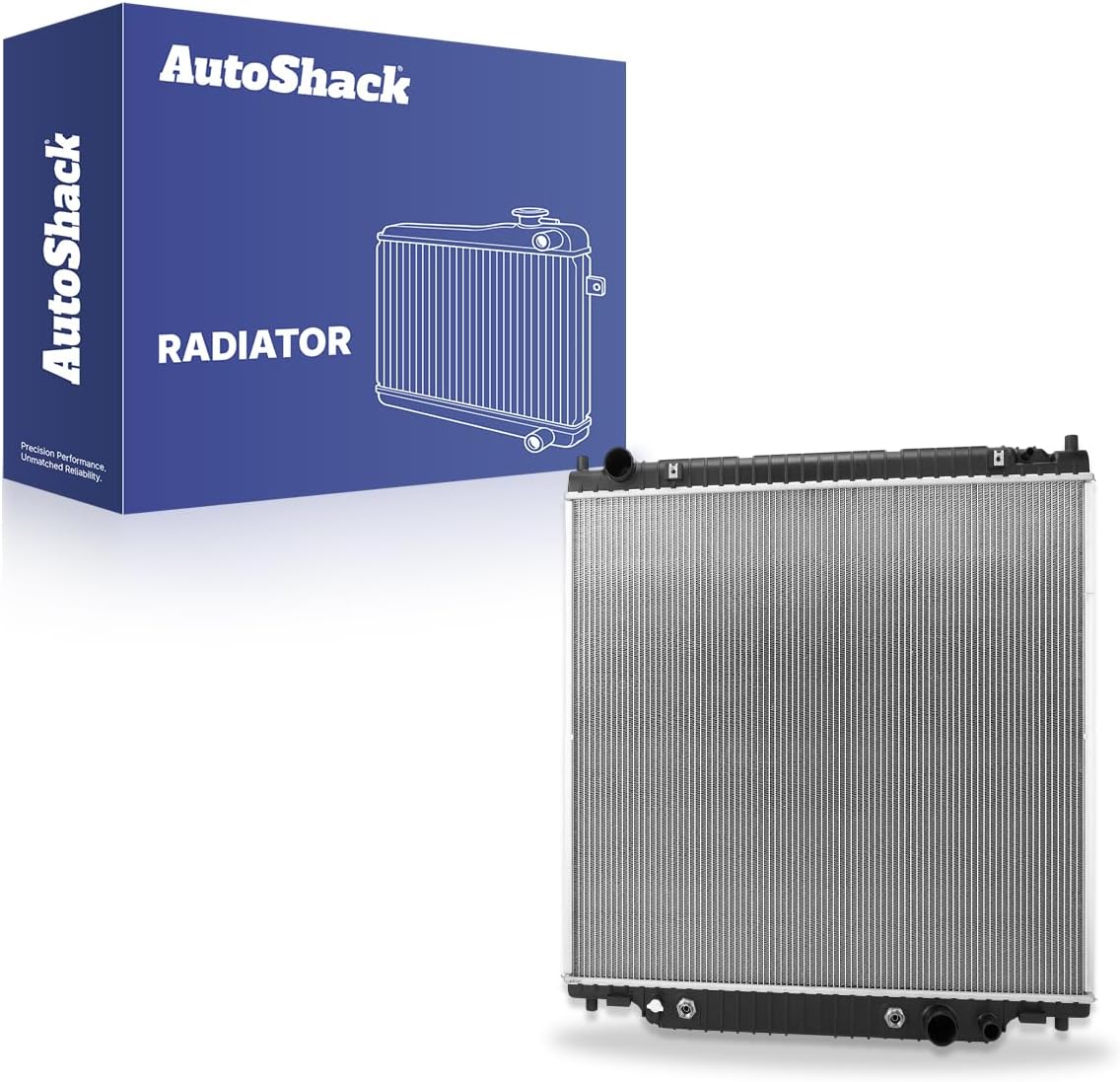
| Fitment | Ford F-250/F-350 1999-2004, Excursion 2000-2005 |
|---|---|
| Core Rows | 2 |
| Transmission Oil Cooler | Yes |
| Exterior | Aluminum, Plastic |
This AutoShack radiator is a direct-fit replacement intended to restore cooling performance on late 1990s and early 2000s Ford Super Duty trucks. It installs in place of the factory unit and is used for everyday driving and towing where maintaining stable coolant temperatures is important. The radiator is aluminum with plastic end tanks and includes a transmission oil cooler but not a radiator cap. AutoShack specifies core dimensions, a two-row core, and compatibility with automatic transmissions for the listed engines. Practical benefits include straightforward fitment for matching vehicles, a construction aimed at efficient heat dissipation, and inclusion of the transmission cooler which saves an extra replacement step. Limitations are the absence of an included cap and the recommendation for professional installation, which adds cost for DIY owners; buyers should also verify engine and cooling-package details carefully before ordering because fitment is specific to certain engine and transmission combinations.
Best for: Buyers who need an affordable, vehicle-specific replacement radiator to restore reliable cooling on a late 1990s to early 2000s Super Duty and prefer a straightforward direct-fit option over sourcing multiple parts.
Less Ideal for: People looking for a high-performance or heavy-duty aftermarket upgrade for intense towing or racing should consider purpose-built performance radiators instead.
- Direct-fit design for specified Ford Super Duty years and engines simplifies installation
- Aluminum core promotes effective heat dissipation for daily driving and light towing
- Built-in transmission oil cooler eliminates the need to replace that component separately
- Two-row core construction balances cooling performance and compact packaging
- Radiator cap is not included
- Professional installation is recommended, which increases total replacement cost
Verdict: A budget-friendly, direct-fit radiator that restores reliable cooling on specified Super Duty trucks while including a transmission oil cooler for convenience.
5. SCITOO Engine Radiator Assembly for 1999–2004 Ford Super Duty and 2000–2003 Excursion (Replace 2171)

| Compatible Vehicles | 1999–2004 F-250/F-350/F-450/F-550 Super Duty; 2000–2003 Excursion |
|---|---|
| Engine Oil Cooler | Included |
| Core Rows | 1 Row |
| Inlet Diameter | 1 3/4 in. |
| Outlet Diameter | 1 3/4 in. |
This SCITOO radiator is a straightforward replacement for 1999–2004 Ford F-250/F-350/F-450/F-550 Super Duty and 2000–2003 Excursion models, delivering the core cooling functions you need to keep a heavy-duty V8 running at safe temperatures. It installs like a factory-style unit, with 1 3/4-inch inlet and outlet diameters and an integrated engine oil cooler to help manage oil temperatures under load. The single-row core keeps the package thin for easier fitment behind existing brackets and support points, and the painted exterior helps resist corrosion. Because it is a one-row design, cooling capacity is adequate for stock or mildly worked engines but may be less effective than multi-row radiators under extreme towing or severe-duty use. Fitment covers a broad Super Duty range so you can replace a failing core without modifying hoses or mounts. Buyers should expect a reliable, OEM-style swap but consider higher-capacity radiators if you regularly tow heavy loads or run performance upgrades.
Best for: Buyers who prioritize a dependable, factory-style replacement to restore cooling performance on older Super Duty trucks and want a straightforward swap without modifications.
Less Ideal for: Drivers who frequently tow heavy loads, run high-power engine upgrades, or need maximum cooling capacity should consider multi-row or performance radiators instead.
- Direct-fit design for 1999–2004 Super Duty and 2000–2003 Excursion for easy installation
- Integrated engine oil cooler helps manage oil temperature under load
- Painted exterior offers basic corrosion resistance
- Factory-style inlet and outlet diameters match stock hose connections
- Single-row core provides less cooling capacity than multi-row or performance radiators
Verdict: A reliable, factory-style replacement radiator that restores proper cooling and includes an engine oil cooler for Super Duty trucks needing a dependable OEM-style swap.
6. DWVO Complete Radiator compatible with 1999–2004 Ford F-250/350/450/550 Super Duty and 2000–2005 Excursion

| Compatible vehicles | 1999–2004 Ford F-250/350/450/550 Super Duty; 2000–2005 Excursion |
|---|---|
| Core size | 30.2" x 26.5" |
| OEM part numbers | 4C3Z8005EB, FO3010240, CU2171 |
| Material | Aluminum core with PA66 GF30 inlet/outlet tanks |
This DWVO complete radiator is designed as a direct-fit replacement for 1999–2004 Ford F-250/350/450/550 Super Duty trucks and 2000–2005 Excursion models with 6.8L and 7.3L engines. It uses a TIG-welded aluminum core with multi-louvered fins to improve cooling efficiency and a treated coating to resist corrosion. The unit includes PA66 GF30 inlet/outlet tanks and provisions for an oil cooler; the package ships with two drain petcocks and a user manual but no radiator cap. Typical use is straightforward: remove the worn radiator and install this factory-replacement-style unit, ideally with a thermostat swap and fresh 50/50 coolant as recommended. Practical benefits are solid cooling capacity for heavy-duty use, corrosion protection, and a packaged fitment method to minimize shipping damage. Limitations to note are the absence of the radiator cap and that professional installation is recommended for correct mounting and leak testing; buyers should verify OEM part numbers and vehicle fitment carefully before purchase.
Best for: Buyers who value documented fitment and community-validated choices for maintaining heavy-duty Ford Super Duty trucks and prefer a factory-quality style replacement with improved cooling performance.
Less Ideal for: If you want an upgraded high-performance or aftermarket racing radiator or need a complete cooling system refresh including caps and extras, this standard replacement may not meet those needs.
- Direct-fit design matching listed OEM part numbers for straightforward replacement
- Aluminum core with multi-louvered fins for improved heat dissipation
- TIG-welded construction and coated surfaces to reduce corrosion and leakage risk
- Includes two drain petcocks and protective corner foam to reduce installation prep and transport damage
- Radiator cap is not included so an appropriate cap must be sourced separately
Verdict: A solid, documented direct-fit radiator replacement for 1999–2004 Ford Super Duty trucks that delivers improved cooling and corrosion resistance while matching OEM part numbers.
Choosing the Right 1999-2007 Ford F-350 Radiator: Key Factors to Consider
Fitment And Mounting Alignment
Accurate fitment is essential for the 1999-2007 Ford F-350 because incorrect mounting points, hose inlet/outlet locations, or transmission cooler hookups can require additional brackets or hose modifications. When a radiator matches factory dimensions and connection points it reduces installation time and the risk of leaks from forced hose angles.
Check that the replacement radiator lines up with the core support, mounts, and fan shroud on the F-350. For models with integrated transmission coolers, ensure the replacement supports that connection without adapter fittings. Proper fitment also affects airflow patterns and fan engagement, which influence cooling efficiency under load.
Core Design And Cooling Capacity
Core size, tube count, and fin density determine how effectively a radiator moves heat away from engine coolant. For F-350 trucks—often used for towing or hauling—look for cores sized to handle sustained heat loads over long drives and steep grades.
Thicker or multi-row cores typically offer greater capacity but may restrict airflow; balance core thickness with the truck s fan and shroud design. Consider the vehicle s typical duty cycle: frequent heavy towing warrants a higher-capacity core to keep temperatures stable in demanding conditions.
Material And Construction Quality
Radiator longevity depends on the materials used for the tanks, core, and joints. Aluminum cores with welded or brazed joints often provide good weight-to-strength ratios and corrosion resistance when properly treated. Plastic tanks are lighter and less expensive but can become brittle with age or heat cycling, especially under heavy-duty use.
Evaluate the quality of seams and reinforcements around mounting points. Durable construction matters for the F-350 because the truck experiences significant vibration and load stresses; robust materials and manufacturing reduce the chance of premature leaks or failures.
Transmission Cooler Integration
Many F-350 configurations are equipped with automatic transmissions that rely on an integrated transmission cooler in the radiator. A replacement unit must either include compatible cooler ports or provide a reliable method to connect external coolers.
Proper transmission cooling helps maintain transmission fluid temperatures within safe ranges during towing. Confirm whether the radiator supports the F-350 s transmission cooler lines and whether additional sealing or fittings are required to preserve proper fluid flow and avoid cross-contamination.
Ease Of Installation And Serviceability
A radiator that installs without cutting hoses, fabricating mounts, or relocating components will save time and reduce the risk of installation errors. Consider whether commonly replaced items—such as drain plugs, sensor ports, and transmission cooler fittings—are accessible and use standard fittings.
Serviceability also includes how easy it is to flush the cooling system, replace hoses, or service the fan clutch. For owners who perform maintenance themselves, straightforward access and common fastener types are valuable features.
Corrosion Resistance And Warranty Support
Exposure to road salts, coolant additives, and temperature cycling can cause corrosion over time. Radiators built with corrosion-resistant coatings, proper anodization, or materials that tolerate common coolants will last longer on F-350 trucks frequently driven in harsh climates.
Also consider the manufacturer s warranty or support policies, which reflect expected longevity and the vendor s confidence in the product. A clear warranty simplifies recourse if a unit develops leaks or other defects within the covered period.
Signs Your F-350 Radiator Needs Replacement
A failing radiator usually shows progressive signs that are easy to spot if you know what to watch for. Common symptoms include repeated overheating episodes, visible coolant puddles or stains under the truck, and a persistent sweet smell of coolant after parking. Minor leaks might appear as slow drips from tank seams or corroded areas while more severe failures produce larger fluid loss and rapid temperature rise.
Other indicators include inconsistent cabin heat, frequent need to top off coolant, and oil that looks milky if a head gasket or cooler interface has failed. Monitoring temperature gauge behavior during typical drives and towing sessions helps you detect early performance loss before it becomes a breakdown.
- Overheating under load or in traffic
- Visible coolant pooling or dried residue
- Frequent low coolant level
- Milky oil suggesting cross-contamination
When To Choose Heavy-Duty Or Upgraded Cores
If you use your F-350 for towing, carrying heavy loads, or operating in hot climates, an upgraded core provides extra cooling margin. Upgraded cores offer greater reserve capacity so coolant temperatures remain stable during long climbs or repeated heavy-duty cycles.
However, thicker cores can affect airflow and may interact differently with factory fans and shrouds. Confirm the upgrade maintains clearance for the fan assembly and does not require major modifications to the radiator support or surrounding components.
- Prioritize upgraded cores for consistent towing
- Balance core thickness with fan efficiency
- Verify clearance with fan shroud and accessories
Preparing The Cooling System For Radiator Replacement
Before installing a new radiator, plan a full system service to remove scale and contaminants that can shorten the life of the replacement. A coolant drain and flush helps eliminate trapped debris and old coolant chemistry. Inspect hoses, clamps, thermostat, and water pump so you don t reinstall a new radiator onto worn ancillary components.
Also prepare by gathering any needed fittings, replacement hoses, and new coolant formulated for Ford specifications. Bleeding air correctly after installation is critical to prevent hot spots and ensure proper circulation.
- Perform a coolant flush to remove deposits
- Replace aging hoses and clamps
- Have correct coolant type and bleed procedure ready
Installation Considerations For The 1999-2007 F-350
The F-350 s size and accessory layout mean some radiators are more straightforward to install than others. Ensure the replacement lines up with factory mounts, fan shroud, and any transmission cooler fittings. Some heavier-duty radiators may require two-person handling due to weight and core dimensions.
If the truck has factory A/C condenser or intercooler proximity, confirm there is sufficient clearance and that the condenser can be reinstalled without pinching fins. Keep torque values for mounting hardware consistent with factory recommendations to avoid warping or undue stress on the core.
- Verify fan shroud and accessory clearance
- Expect two-person handling for heavier units
- Follow factory torque specs for mounting bolts
Routine Cooling System Maintenance After Replacement
After installing a new radiator, maintain it with regular coolant inspections and periodic flushes based on driving conditions. Check for external leaks, verify hose clamp tightness after a few heat cycles, and monitor temperature behavior especially during the first few towing events.
Keep an eye on coolant concentration and use the recommended type and ratio. Preventative checks and prompt attention to minor seepage will extend the life of the replacement radiator and protect the engine.
- Inspect for leaks after initial heat cycles
- Monitor coolant concentration and top off as needed
- Schedule periodic coolant flushes for heavy-duty use
Still looking for the perfect fit?
Select your Ford F-350 configuration to see the most relevant Radiators recommendations
How We Chose the Best 1999-2007 Ford F-350 Radiator
Our editorial selection focused on radiators that meet the specific physical and thermal demands of the 1999-2007 Ford F-350. We prioritized components with verified fitment to the year range, appropriate core size and thickness for heavy-duty cooling, and durable materials that resist corrosion and vibration. Cooling performance was judged by core design and capacity to move heat under sustained loads, which matters for towing and high-ambient-temperature operation. Build quality factors included tank material, brazing or welded seams, and mounting robustness to withstand chassis vibration.We also evaluated practical installation considerations such as stock hose and bracket alignment, transmission cooler integration where applicable, and whether the radiator supports common factory sensors and bleed points. Longevity factors included corrosion resistance and serviceability for future repairs. We excluded radiators that required extensive chassis modification, adapters, or nonstandard fitting hardware. Units with unclear fitment information or lacking support for the F-350 year range were not considered.
Our full evaluation process is outlined in our review methodology.
FAQ
How can I tell if my F-350 radiator is leaking or the leak is elsewhere?
Look for coolant pooling under the radiator area and traces on the core or tank seams. If coolant appears lower near hoses or the water pump, inspect those points too. Pressure-testing the cooling system helps isolate the leak location when visual inspection is inconclusive.
Is it necessary to flush the cooling system when replacing the radiator?
Yes. Flushing removes rust, scale, and old coolant that can shorten the life of a new radiator and impair heat transfer. A thorough flush ensures the replacement starts with clean passages and correct coolant chemistry.
Can I install a replacement radiator myself on a 1999-2007 F-350?
Many owners can perform the swap with basic tools, but expect steps like draining coolant, removing the fan shroud, and handling a heavy core. Two-person assistance is useful for heavier radiators and attention to proper bleeding procedures is essential to avoid airlocks.
Should I choose a radiator with a thicker core for towing?
A thicker or multi-row core can provide better cooling under heavy towing. However, you must confirm it fits without interfering with the fan shroud or other components. Balance increased capacity against any potential airflow restriction.
How soon after installation should I check for leaks or re-torque fittings?
Inspect for leaks and re-check clamp tightness after a few heat cycles or the first long trip. Thermal cycling can change clamp tightness and mounting hardware seating, so an early follow-up inspection helps catch issues before they lead to failure.
Will a replacement radiator affect transmission cooling on models with integrated coolers?
Yes. If the radiator includes transmission cooler ports, ensure the ports match the factory lines and fittings. Proper transmission cooler integration is important to maintain safe fluid temperatures during towing.
Final Verdict
When replacing the radiator in a 1999-2007 Ford F-350, prioritize accurate fitment, appropriate core capacity for your typical workload, and construction quality that withstands heavy-duty use. Consider transmission cooler compatibility and ease of installation to avoid unexpected modifications.Balance the tradeoffs between thicker cores for higher cooling capacity and potential airflow or fitment impacts. With careful selection and proper installation, you can restore reliable cooling and reduce the risk of overheating during towing or heavy use.
