

Note: This article contains affiliate links. If you click on these links and make a purchase, I may earn a small commission at no extra cost to you. This helps support my research and content. Read my full affiliate disclosure here.
Upgrading to a performance air filter can sharpen throttle response, sustain engine power, and reduce maintenance hassle for a Honda Civic. Whether you use your Civic for daily commuting or spirited driving, the right filter affects airflow, filtration efficiency, and long-term engine health. This guide narrows the field to seven well-suited performance air filters for the Civic and explains the evaluation points that matter for fitment and performance.Below you will find the shortlisted options and clear notes on the design and usability considerations that informed our selections.
Looking for other parts? See all Honda Civic parts & accessories.
Top Picks at a Glance
| Best Overall The best all-around choice for most situations | K&N High-Flow Lifetime Engine Air Filter (33-5145) |  |
| Best Quality Built to a higher standard if you want something more solid | K&N High-Flow Lifetime Engine Air Filter (33-5045) |  |
| Best Value The sweet spot between price and what you get | K&N Advantage Plus Engine Air Filter (KNA-5045) |  |
| Most Popular A crowd favorite that many people choose with confidence | KAX Premium Engine Air Filter CA12051 (replacement for Honda Civic 2016–2026, HR-V 2023–2026) |  |
| Best Seller A high-volume bestseller chosen again and again | PHILTOP CA12051 Engine Air Filter (vehicle-specific fit) |  |
1. K&N High-Flow Lifetime Engine Air Filter (33-5145)

| Brand | K&N |
|---|---|
| Model Number | 33-5145 |
| Included Components | 1 Air Filter |
| Fit Type | Vehicle Specific Fit |
This K&N High-Flow engine air filter replaces the factory paper element with a multilayer cotton gauze filter that is pre-oiled and ready to drop into the stock air box. It is used as a direct replacement to increase airflow and can boost throttle response and low-end horsepower in everyday driving. The washable, reusable construction means you clean and re-oil the filter periodically instead of buying disposables, which reduces waste and long-term cost. Notable features include multilayer filter media engineered for higher flow, rugged construction meant to last the life of the vehicle, and a vehicle-specific fit for straightforward installation. In normal highway driving the company recommends cleaning roughly every 75,000 miles, so maintenance is infrequent. Trade-offs are that expected performance gains vary by engine and setup and the filter requires proper cleaning and re-oiling to maintain filtration effectiveness. Installation is simple but attention to service intervals and correct re-treatment is important to avoid contamination risk.
Best for: Drivers who want a low-maintenance, long-lived upgrade that prioritizes better airflow and everyday drivability improvements while avoiding frequent disposable-filter replacements.
Less Ideal for: If you prefer a completely maintenance-free disposable filter or need guaranteed measured horsepower gains for track-tuned engines, consider alternatives matched to high-performance builds and dyno-verified parts.
- Washable and reusable design reduces ongoing replacement costs and landfill waste
- Multilayer cotton gauze media engineered for higher airflow and improved throttle response
- Vehicle-specific fit for easy drop-in installation into the factory air box
- Requires periodic cleaning and re-oiling to retain filtration performance
Verdict: A durable, washable replacement filter that delivers improved airflow and everyday performance with minimal routine maintenance.
2. K&N High-Flow Lifetime Engine Air Filter (33-5045)

| Brand Name | K&N |
|---|---|
| Model Number | 33-5045 |
| Fit Type | Vehicle Specific Fit |
| Product Grade | Replacement Part |
This K&N High-Flow engine air filter replaces the factory paper element with multilayer cotton gauze to boost airflow and potentially add measurable horsepower and improved throttle response. It installs in the stock air box in minutes and arrives pre-oiled and ready to fit, making it a simple bolt-in upgrade for drivers chasing better on-road performance. The washable, reusable design means you clean and re-oil the filter instead of buying disposables every service interval; under normal highway use K&N recommends cleaning about every 75,000 miles. Construction is robust and intended to last the life of the vehicle, and the filter is backed by a long limited warranty. Trade-offs are that reusable filters require periodic cleaning and re-oiling to maintain peak filtration and flow, and some drivers prefer replacing paper filters for maintenance simplicity or peak filtration under extreme dusty conditions. For performance-focused Civic drivers this offers an easy way to increase airflow without changing the intake system.
Best for: Drivers focused on extracting modest, reliable performance gains from a stock Honda Civic without modifying the intake system, and who are willing to perform periodic maintenance to keep the filter working at peak levels.
Less Ideal for: Buyers who prefer low-maintenance disposable filters or who primarily drive in extremely dusty, off-road conditions where disposable filters may be more convenient.
- Increases airflow and can improve horsepower and throttle response.
- Washable and reusable design reduces ongoing filter purchases and waste.
- Pre-oiled, vehicle-specific fit for quick drop-in installation.
- Durable multilayer cotton gauze construction intended for long service life.
- Requires periodic cleaning and re-oiling to maintain performance and filtration.
Verdict: If you want a simple, long-lasting bolt-in upgrade to increase airflow and responsiveness on a Honda Civic, this washable K&N filter is the performance-focused choice.
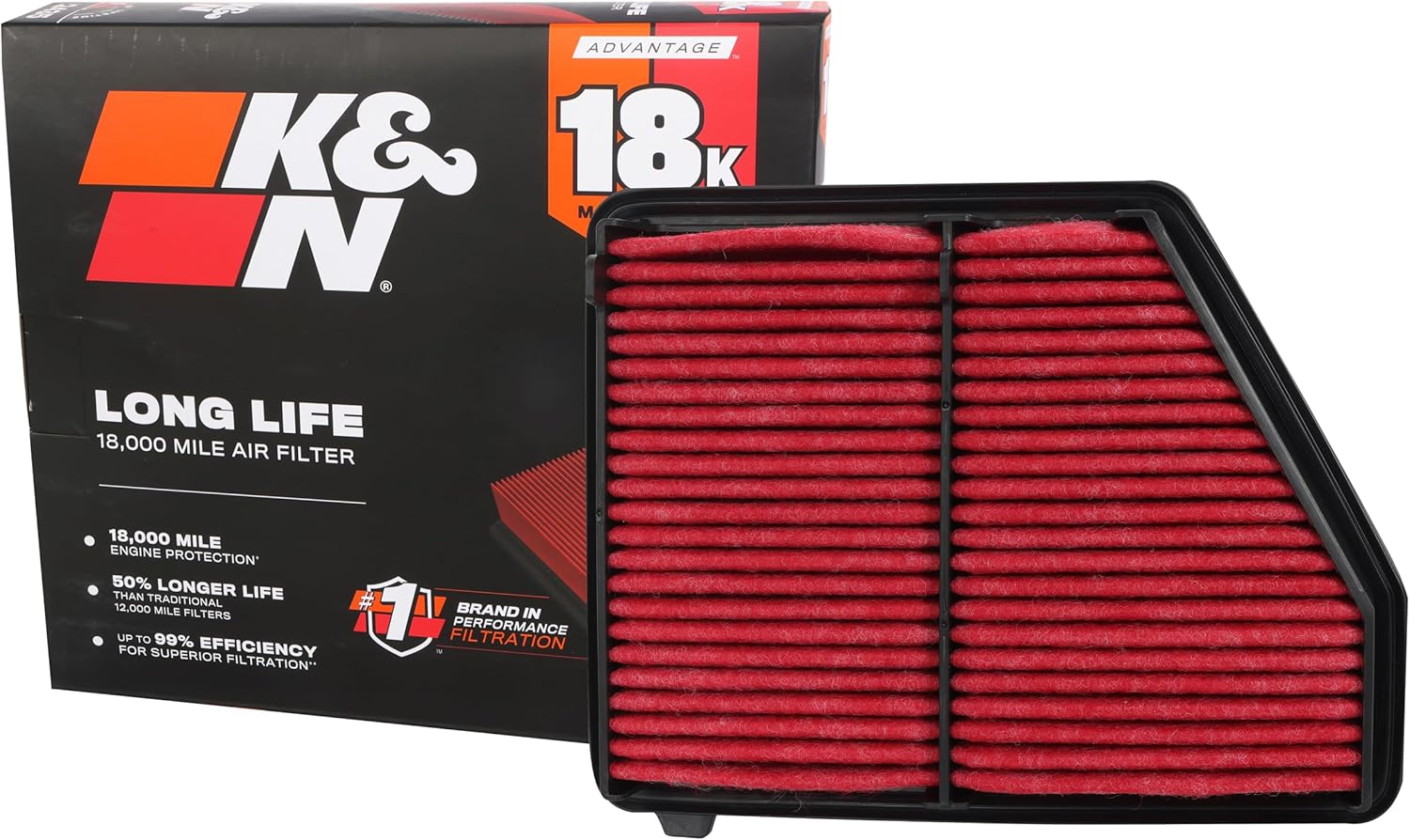
3. K&N Advantage Plus Engine Air Filter (KNA-5045)
| Model Number | KNA-5045 |
|---|---|
| Included Components | 1 Air Filter |
| Item Type Name | K&N Advantage Air Filter 18K Miles |
| Fit Type | Vehicle Specific Fit |
This K&N Advantage Plus air filter is a vehicle-specific replacement designed to fit Honda Civic applications and extend the typical service interval to 18,000 miles. It uses a premium synthetic or cellulose blend media to capture particles while allowing airflow comparable to factory filters, so it installs quickly in the factory air box and works without modification. The main practical benefit is reduced frequency of filter changes versus standard disposable filters, which suits drivers who prefer lower maintenance. K&N states the media provides up to 99% engine protection and the construction aims for rugged, long-life use. On the downside this is a replacement filter rather than a reusable oiled performance unit, so it does not offer the same potential for claimed power gains some K&N washable filters advertise. Also the one-year limited warranty is modest compared with multi-year guarantees on some premium parts. For budget-conscious Civic owners who want longer intervals and straightforward factory-fit protection, this is a sensible upgrade; buyers seeking maximum performance tuning should consider other K&N lines.
Best for: Buyers who prioritize lower upkeep and reliable factory-fit protection for everyday driving and want a longer service interval from their Civic's air filter.
Less Ideal for: Drivers focused on extracting maximum intake performance or those who prefer a washable, reusable oiled filter for repeated cleaning and tuning.
- Vehicle-specific fit for easy installation into the factory air box
- Extended 18,000-mile service interval reduces maintenance frequency
- Premium synthetic/cellulose blend media claims high filtration efficiency
- Durable construction intended for longer life than standard disposable filters
- Not a reusable oiled performance filter so it does not target maximum power gains
- Warranty coverage is limited to one year
Verdict: Choose this filter if you want a factory-fit, longer-life replacement that cuts filter change frequency for practical, low-maintenance Civic ownership.
4. KAX Premium Engine Air Filter CA12051 (replacement for Honda Civic 2016–2026, HR-V 2023–2026)

| Model Number | CA12051 |
|---|---|
| Vehicle Application | Honda Civic 2016-2026; HR-V 2023-2026 |
| Filtration Efficiency | 99.9% (manufacturer claim) |
| Service Life | Up to 20,000 miles (manufacturer claim) |
The KAX CA12051 is a direct-fit replacement engine air filter made for naturally aspirated Honda Civic models (2016–2026) and HR-V (2023–2026). It installs in the factory airbox and is intended to provide cleaner intake air by using multilayer filter media and higher dust-holding capacity than a standard paper element. In daily driving it should help maintain steady airflow to the engine, which can support consistent throttle response and steady fuel combustion over longer service intervals. Notable features include a claimed 99.9% filtration efficiency, an embossed paper media for crease stability, and a frame sized to match factory sealing surfaces to limit unfiltered air entry. The filter is single-use and not washable or reusable, and KAX rates its life at up to about 20,000 miles depending on conditions. For buyers focused on proven replacements, this product pairs familiar form-fit installation with improved dirt capacity, but it does not offer a washable or lifetime option so expect regular scheduled replacements in dusty environments.
Best for: Buyers who prioritize a proven, vehicle-specific replacement that balances improved filtration and easy installation over aftermarket washable systems, and who value strong user feedback when choosing parts.
Less Ideal for: Drivers seeking a washable or permanently reusable performance filter or those wanting to tune intake flow beyond factory-spec should consider dedicated performance or reusable options instead.
- Vehicle-specific frame for a factory-quality seal and straightforward drop-in installation.
- Multi-layer filter media with high dust-holding capacity for longer service life versus basic paper filters.
- Manufacturer states high filtration efficiency to protect engine components and maintain performance.
- Fits the listed Honda Civic and HR-V model years, simplifying parts selection for those vehicles.
- Not washable or reusable so it requires periodic replacement rather than cleaning and reinstalling.
- Claims on filtration efficiency and lifespan are manufacturer statements and can vary by driving conditions.
Verdict: A straightforward, vehicle-specific replacement that offers higher dust-holding capacity and factory-fit sealing for Civic owners who want improved filtration without changing intake hardware.
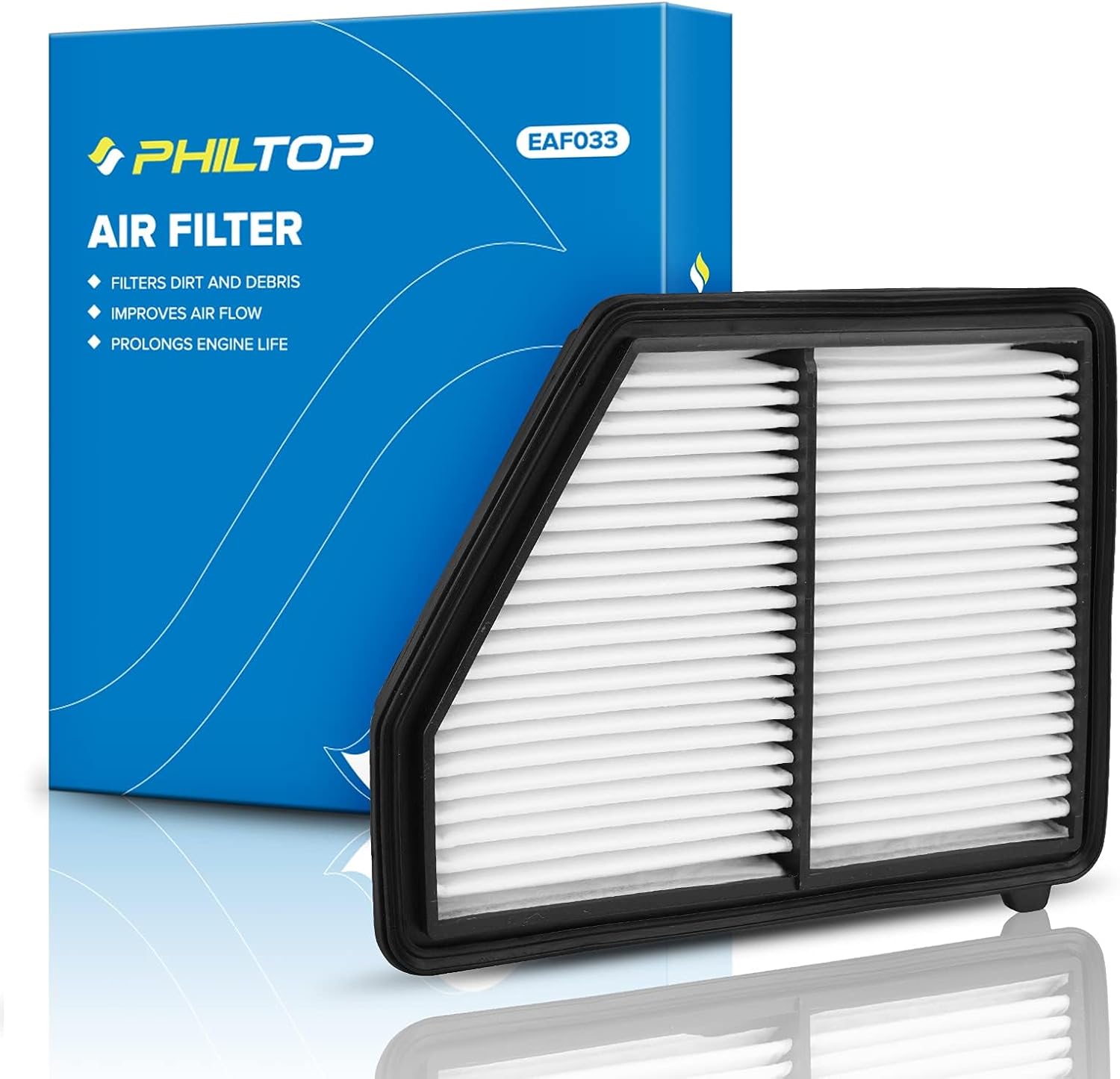
5. PHILTOP CA12051 Engine Air Filter (vehicle-specific fit)
| Fit Type | Vehicle Specific Fit |
|---|---|
| Model Number | CA12051 |
| Included Components | 1* CA12051 Engine Air Filter, 1x Product Manual |
| Manufacturer Warranty Description | 1 YEAR |
The PHILTOP CA12051 is a direct-fit replacement air filter made to slide into the factory housing without modification. It uses a three-stage progressive density media with an outer layer for large debris, a middle layer for finer dust, and an inner nanofiber layer to block very small particles. In everyday use this means cleaner intake air for the engine, which helps maintain combustion efficiency and can support steady fuel economy and reduced emissions. Installation is straightforward and typically takes about five minutes with basic hand tools. The filter is positioned as a year-or-12,000-mile service item and is especially useful for drivers who want a like-for-like replacement that emphasizes filtration over airflow tuning. Compared with performance-focused, high-flow filters, this unit prioritizes particle capture and engine protection rather than squeezing extra horsepower. If you want a simple, factory-style replacement that improves filtration and is easy to change yourself, this model delivers dependable results.
Best for: Buyers who prioritize dependable engine protection and easy maintenance over maximum airflow or aftermarket performance gains; good for drivers wanting a straightforward, low-risk replacement.
Less Ideal for: Drivers seeking a high-flow or performance-oriented filter to extract extra horsepower or aggressive intake sound should consider sport-focused alternatives.
- Vehicle-specific fit for Honda Civic 2016–2026 and HR-V 2023–2025 for straightforward installation
- Three-stage progressive density media including a nanofiber inner layer for improved particle capture
- Direct-fit OE-style design that installs in about five minutes with no modifications
- Designed for filtration and engine protection rather than increased airflow or measurable performance gains
Verdict: Choose this filter if you want a direct-fit, easy-to-install replacement that emphasizes superior filtration and engine protection for your Civic.
Choosing the Right Honda Civic Performance Air Filter: Key Factors to Consider
Fitment and Seal
A correct mechanical fit and an airtight seal are essential for any performance air filter in a Honda Civic. If the filter does not match the intake housing profile or the sealing surface is uneven, unfiltered air can bypass the media and introduce contaminants into the engine. Civic intake housings vary by model year and configuration, so ensure the filter matches the housing flange dimensions and overall geometry.
A reliable sealing gasket or molded lip reduces the risk of air leaks and simplifies installation. Poor sealing can also confuse the mass airflow sensor readings and lead to drivability issues. For installation ease, check whether the filter requires any adapter rings or changes to factory clamps, and avoid options that demand intake trimming or nonreversible modifications.
Filtration Efficiency
Filtration efficiency determines how well the filter captures dust, pollen, and abrasive particles before they reach engine internals. Higher efficiency extends engine life by reducing wear on cylinders and valves. Performance filters often trade some filtration for increased flow, so look for filters that publish micron ratings or particle capture percentages to understand that tradeoff.
Consider the driving environment of your Civic. If you frequently drive on dusty roads or in heavy traffic, prioritize higher filtration efficiency. For mainly urban paved driving, a slightly more open media that improves airflow while still filtering common contaminants may be acceptable.
Airflow and Throttle Response
Performance air filters aim to increase airflow to the engine, which can improve throttle response and potentially allow the engine to make power more easily. For the Civic, this often means a lower pressure drop across the filter at typical engine loads. Look for filters with published flow increases or pressure drop data, and favor designs with optimized pleat geometry or high-flow media.
Keep in mind that dramatic airflow changes can affect engine control parameters. Most Civics will adapt, but maintaining consistent airflow characteristics across the RPM range is important to avoid flat spots or hesitation. Choose a filter that offers measurable flow gains without sacrificing consistent performance in everyday driving.
Maintenance and Service Interval
Maintenance needs vary between washable and disposable filters, and this affects long-term ownership convenience and cost. Washable filters typically require periodic cleaning and re-oiling, which can restore flow and filtration performance but demands careful service to avoid over-oiling the intake. Disposable filters eliminate re-oiling but require replacement at regular intervals.
Assess how often you are willing to perform maintenance on your Civic. If you prefer low-maintenance ownership, a long-life disposable with clear replacement intervals may be preferable. Also consider ease of access to the intake housing on the Civic; some filters are easier to remove and reinstall, reducing the time needed for routine service.
Material Durability and Construction
The construction quality of a performance air filter affects its durability under heat cycles and exposure to engine bay contaminants. Look for robust media that resists collapse, secure pleat spacing that maintains surface area, and durable end caps or gaskets that retain shape over time. Materials that degrade under oil or solvent exposure can lead to failures.
Durability also matters for vibration resistance and long-term sealing. For the Civic, which experiences regular stop-and-go driving and occasional highway runs, choose filters built to withstand repeated handling during maintenance and fluctuating under-hood temperatures.
Compatibility With Engine Management
Changing airflow characteristics can influence sensor readings and engine management behavior. A performance air filter should maintain consistent, predictable airflow so the Civic's mass airflow sensor and fuel control strategies can adapt without persistent drivability complaints. Avoid filters that introduce turbulent flow near sensor inlets or require relocation of factory sensors.
If your Civic has aftermarket engine management or modifications, ensure the filter's flow characteristics align with any tuning or software adjustments. For stock engines, prioritize filters that minimize the chance of MAF confusion and do not produce erratic sensor values.
When a Performance Filter Makes Sense for Your Civic
A performance air filter is worth considering if you want crisper throttle response, easier breathing at higher engine speeds, or a longer interval between replacements depending on the media type. For daily city driving the benefit may be modest, but drivers who push their Civic on longer highway runs or occasional spirited drives often notice a more immediate throttle feel.
Owners who prioritize maintenance simplicity should weigh washable versus disposable options. Washable media can save money over many service cycles but requires correct cleaning and re-oiling procedures. Disposable high-efficiency elements can simplify ownership while still offering some performance upside.
- Improved throttle response at part-throttle and wide-open throttle
- Potential for longer media life depending on design
- Consider maintenance tradeoffs when selecting washable versus disposable
Installation Tips for a Smooth Fit
Prepare the Civic intake area by cleaning the housing flange and removing loose debris before installing a new performance filter. Ensure the engine is cool and the intake components are not under tension to prevent accidental tearing of gaskets. Follow the filter's orientation marks and torque any clamps to the factory specification where applicable.
If the filter requires a small adapter or ring, verify that the adapter seats evenly and that clamps are snug but not over-tightened. After installation, run the engine and listen for any hissing that might indicate a sealing issue. Recheck the fit after a short test drive and retighten clamps if necessary.
- Clean mating surfaces before installation
- Check orientation and clamp torque
- Inspect for leaks after initial run
Maintaining Peak Performance and Longevity
Establish a service interval based on your driving conditions. In dusty or rural environments, inspect the filter more frequently and clean or replace it sooner than in clean urban settings. For washable filters, follow the manufacturer-recommended cleaning procedure and let the element dry fully before reinstallation.
Record the service dates and any observations about airflow or throttle response after maintenance. Proper re-oiling quantity matters for oiled filters because excess oil can foul the mass airflow sensor; use the recommended amount and allow time for dispersion before starting the engine.
- Inspect more often in dusty conditions
- Allow washable filters to dry completely before reinstall
- Use recommended oil amounts for oiled filters
Effects on Fuel Economy and Emissions
A well-chosen performance air filter can have a neutral to slightly positive effect on fuel economy by reducing intake restriction, particularly during sustained higher-load driving. However, gains are typically modest on otherwise stock engines and will vary with driving style. Do not expect major economy improvements without complementary engine tuning.
Emissions are generally unaffected by filter choice when the element maintains proper filtration and the engine management system receives consistent airflow data. Avoid filters that allow significant particulate ingress or that cause intermittent MAF readings, as those conditions can lead to increased emissions or fault codes.
- Modest fuel economy changes possible during sustained high-load driving
- Maintain filtration performance to avoid emissions or sensor issues
Common Myths About Performance Air Filters
One common myth is that all performance filters dramatically increase horsepower. In most Civics with stock engines, expect improved throttle response rather than large peak power gains. Another misconception is that washable filters always outperform disposables; actual results depend on media design, sealing, and maintenance regimen.
Some owners worry that oiled filters will always foul mass airflow sensors. While over-oiling can cause issues, proper cleaning and measured re-oiling typically prevent sensor contamination. Choose a filter with clear maintenance instructions and follow them for the best results.
- Expect better throttle feel more than large horsepower gains
- Performance depends on correct maintenance, not just media type
Still looking for the perfect fit?
Select your Honda Civic configuration to see the most relevant Air Filters recommendations
How We Chose the Best Honda Civic Performance Air Filter
We focused on criteria that matter specifically to Honda Civic owners when selecting performance air filters. Priority went to fitment accuracy for Civic-specific intake housings to avoid installation issues or gaps that can undermine filtration. Filtration efficiency was evaluated through stated micron ratings and media type to balance particle capture with airflow gains. Flow performance and pressure drop under load were considered so the filter can improve throttle response without causing unacceptable decreases in filtration.Durability and maintenance were weighed by considering washable versus disposable media, expected service intervals, and resistance to collapse or deformation in the Civic intake environment. Materials and construction quality were assessed for sealing surfaces and pleat integrity to reduce the chance of unfiltered air bypass. We also reviewed compatibility with factory mass airflow sensor locations and intake routing to avoid fitment interference.Excluded from consideration were filters that did not list clear fitment for the Civic or that required intake modifications. We did not include cabin air filters because this guide focuses on engine intake filters. Final selections prioritized Civic-specific fit, measurable flow and filtration claims, durable construction, and practical maintenance needs.
Our full evaluation process is outlined in our review methodology.
FAQ
How often should I change or clean a performance air filter in my Honda Civic?
It depends on driving conditions. For typical urban driving, inspect the filter every 12,000 to 18,000 miles. In dusty or rural environments check it every 6,000 to 10,000 miles and clean or replace sooner if heavily soiled.
Will a performance air filter damage my Civic's mass airflow sensor?
Not if maintained correctly. The primary risk is over-oiling washable filters, which can leave residue on the sensor. Use the recommended cleaning and oiling procedures and allow the filter to settle before restarting the engine.
Can a performance air filter improve fuel economy in the Civic?
Improvements are usually modest and most noticeable under sustained higher-load driving. Stock engines typically see better throttle response rather than large fuel economy gains unless combined with additional tuning.
Are washable performance filters better than disposable ones for a Civic?
It often depends on owner preference. Washable filters can save money over many cycles but require correct servicing. Disposable filters remove maintenance steps but need periodic replacement. Choose based on your willingness to perform maintenance and local driving conditions.
Will installing a performance air filter trip engine warning lights?
Usually not if the filter fits properly and does not introduce unmetered air or contaminate sensors. If installation alters intake routing or creates leaks, the engine control unit may detect irregularities and set fault codes.
How do I know the performance filter I choose fits my Civic?
Confirm the filter lists compatibility with your Civic model year and intake configuration. Check the flange dimensions and mounting method against your intake housing and verify whether any adapter hardware is required for a secure seal.
Final Verdict
Select a performance air filter for your Honda Civic by prioritizing accurate fitment, appropriate filtration efficiency, and a maintenance approach you will follow. Balance airflow gains against the need to protect engine internals and ensure the filter seals correctly in the intake housing. For most Civic owners, the best choice is the option that offers measurable flow improvement while maintaining strong particle capture and straightforward servicing.Focus on filters that list clear Civic compatibility, provide documented filtration or flow data, and match your maintenance preferences. That balance will deliver the most reliable real-world benefits in throttle feel, engine protection, and long-term ownership satisfaction.
Explore More:
- Check out all Honda Civic parts & accessories
- Explore Air Filters Maintenance & Repair Guides
- Explore Engine
- Browse all Auto Parts
