

Note: This article contains affiliate links. If you click on these links and make a purchase, I may earn a small commission at no extra cost to you. This helps support my research and content. Read my full affiliate disclosure here.
A digital multimeter is one of the most useful tools for diagnosing electrical problems in cars, trucks, and project vehicles. Whether you are checking battery health, verifying alternator output, tracing a blown fuse circuit, or hunting down a parasitic draw, the right meter can save time and prevent wrong turns in the garage.Not every meter is equally suited to automotive work. Readability, input protection, current range, test speed, and probe quality all affect how confidently you can troubleshoot real vehicle faults. The picks that follow are aimed at DIY mechanics and garage users who need a dependable tool for everyday electrical diagnosis.
Top Picks at a Glance
| Best Overall Digital Multimeter for DIY Mechanics A reliable, all-purpose multimeter balancing accuracy, durability, and automotive features | Fluke 115 True RMS Digital Multimeter |  |
| Best Budget Digital Multimeter for DIY Mechanics An inexpensive, dependable meter for basic voltage, continuity, and current checks | AstroAI AM33D Digital Multimeter (2000 Count) |  |
| Best Compact Digital Multimeter Pocket-sized meter for quick diagnostics and tight spaces without sacrificing accuracy | Fluke 106 Palm-Sized Digital Multimeter (CAT III 600V) |  |
| Best Premium Digital Multimeter High-end meter with advanced diagnostics, precision readings, and durable construction | Fluke 87V Industrial Digital Multimeter with TL75 Leads and 80BK Temp Probe |  |
| Best Automotive-Specific Digital Multimeter Designed for car electrical systems with automotive-specific measurement modes and protections | KAIWEETS HT118A Digital TRMS Multimeter (6000 Counts) | 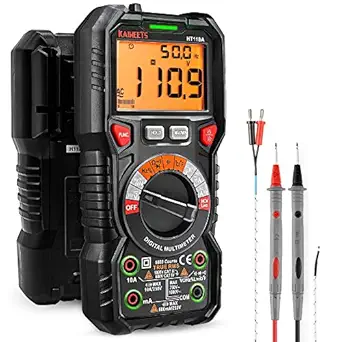 |
| Best Heavy-Duty Digital Multimeter Rugged, shop-ready multimeter built to resist impacts, dirt, and heavy use | Fluke 87V MAX True-RMS Digital Multimeter (Rugged, IP67) |  |
| Best True RMS Digital Multimeter True RMS capability for accurate readings on noisy, non-sinusoidal automotive signals | UNI-T UT89XD True RMS 6000-Count Digital Multimeter |  |
Fluke 115 True RMS Digital Multimeter
Best Overall Digital Multimeter for DIY Mechanics

| Maximum Voltage | 600 Volts |
|---|---|
| Current Measurement | 10 A |
| Display Resolution | 6000 counts |
| Safety Rating | CAT III 600 V |
The Fluke 115 is a compact True RMS multimeter built for field service and hands-on electrical work. It handles AC/DC voltage to 600 V and current up to 10 A for routine automotive and household diagnostics, plus resistance, continuity, frequency, capacitance, and diode tests. The 6000-count display with large digits and a white LED backlight makes readings easy in dim engine bays, and Min/Max/Average capture helps track fluctuating signals like sensor outputs. Safety-rated for CAT III 600 V and independently listed to common safety standards, the 115 is rugged enough for garage use and brief drops. It ships with test leads, a holster, and an installed 9 V battery for immediate use. Limitations include the 10 A continuous current cap which rules out sustained high-current testing and no built-in clamp or insulation tester functions, so you may need add-on tools for heavy-duty or specialized automotive diagnostics. For hands-on DIY mechanics who need a reliable, easy-to-use meter for most electrical troubleshooting, the Fluke 115 covers the essentials without unnecessary complexity.
Best for: DIY car owners and home mechanics who need a rugged, easy-to-use multimeter that delivers accurate True-RMS readings for common automotive electrical tasks like testing batteries, alternators, wiring, and sensors while offering reliable safety and one-handed field operation.
Less Ideal for: Technicians who regularly perform high-current measurements, insulation testing, or need a clamp-style meter should consider a different model or supplemental tools.
- True RMS measurements for accurate readings on non-linear automotive loads
- 6000-count backlit display with Min/Max/Average to capture fluctuating signals
- CAT III 600 V safety rating and independent safety listings for workshop use
- Compact rugged design with holster and installed battery for immediate field use
- 10 A continuous current limit prevents sustained high-current testing
- No built-in clamp or insulation testing features for specialized automotive tasks
Verdict: The best all-around digital multimeter that balances accuracy, automotive-specific measurements, durability, and ease of use for typical DIY car electrical diagnosis.
AstroAI AM33D Digital Multimeter (2000 Count)
Best Budget Digital Multimeter for DIY Mechanics

| Measurement Type | Multimeter |
|---|---|
| Maximum Operating Voltage | 500 Volts |
| Display | 2000 Counts, 3.5 digits |
| Power Source | Battery Powered |
The AstroAI AM33D is a compact 2000-count digital multimeter aimed at basic troubleshooting tasks. It measures DC and AC voltage, DC current, resistance, continuity and diode and is typically used for checking car batteries, charging systems, fuses and simple wiring faults. The manual rotary range and backlit 3.5 digit LCD make readings straightforward while the sampling speed and polarity indicator help with quick checks. Safety-minded features include dual fuses for current protection and a silicone protective cover to reduce damage from drops and accidental shorting. The kit includes test leads and a battery so you can start using it right away. Limitations are its manual ranging and 2000-count resolution, which make it less precise than higher-end or auto-ranging meters and the AC measurement floor is limited so low-voltage AC below 100 mV is not supported. For hands-on DIY mechanics who need a simple, portable meter for routine automotive diagnostics, this unit covers the essentials at a low cost.
Best for: DIY mechanics and home technicians who need an affordable, no-frills multimeter for routine automotive checks like battery voltage, charging system tests, continuity and basic DC current troubleshooting, prioritizing reliable basic readings and safety features over advanced lab-grade functions.
Less Ideal for: Technicians who need high-resolution, auto-ranging measurements or advanced features like true RMS, capacitance or temperature testing should choose a more capable meter.
- Covers core functions needed for automotive checks: AC/DC voltage, DC current, resistance, continuity and diode.
- Dual fuse protection and silicone cover provide added safety during vehicle diagnostics.
- Backlit LCD and polarity indication for clear readings in dim or cramped spaces.
- Includes test leads and battery so the tool is ready to use out of the box.
- Manual range selection and 2000-count resolution limit precision for fine troubleshooting.
- Cannot measure AC voltages below 100 mV which restricts very low-voltage checks.
Verdict: The best low-cost digital multimeter that still provides reliable voltage, continuity, and basic current readings suitable for routine automotive troubleshooting.
Fluke 106 Palm-Sized Digital Multimeter (CAT III 600V)
Best Compact Digital Multimeter
| Maximum Operating Voltage | 600 Volts |
|---|---|
| Current Measurement | Up to 10 A |
| Power Source | Battery Powered |
| Measurement Types | Voltage, current, resistance, continuity, capacitance, frequency |
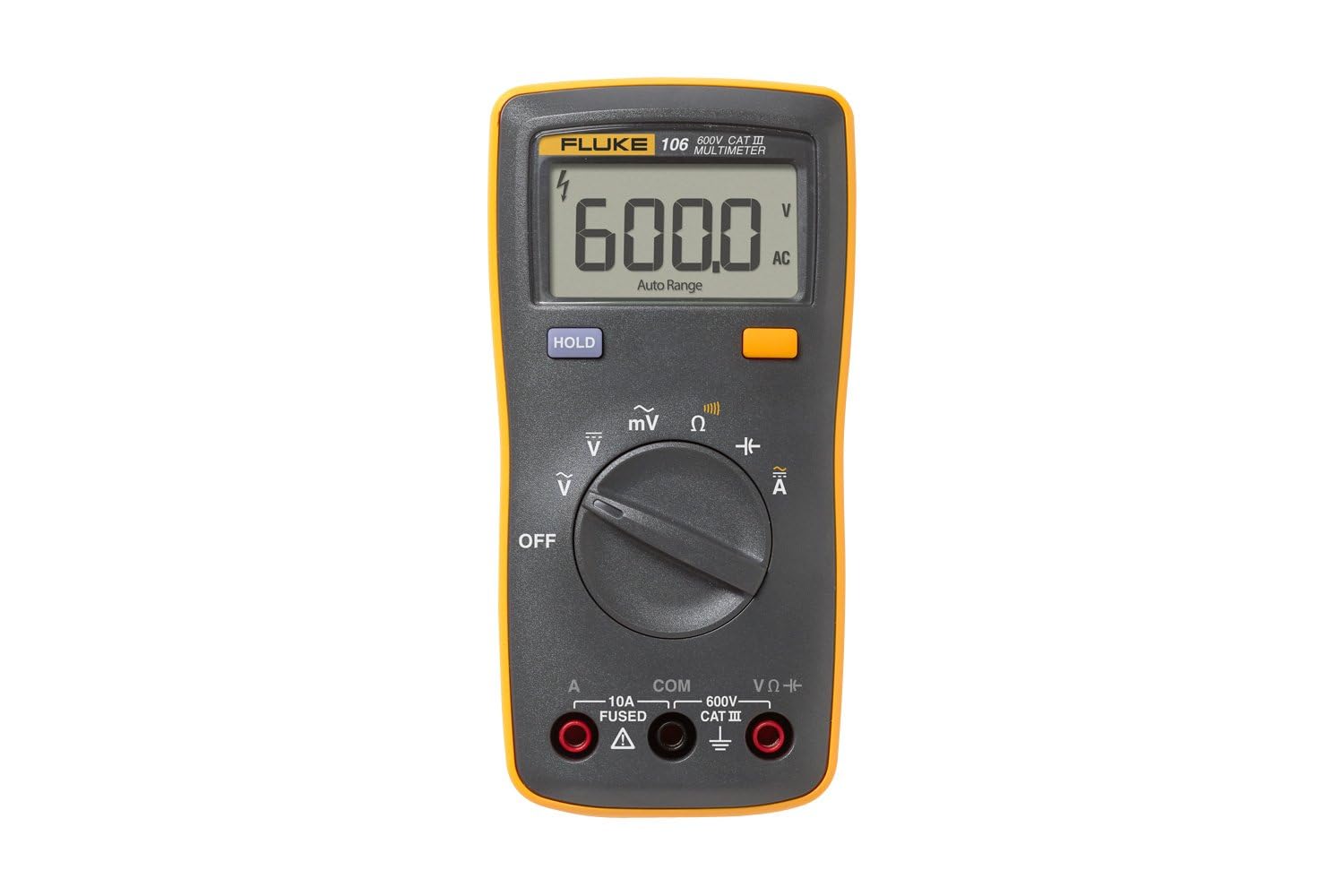
The Fluke 106 is a slim, palm-sized DMM built for quick diagnostic work in tight spaces. It measures AC and DC voltage up to 600 V, AC and DC current to 10 A via its input terminal, resistance, continuity, capacitance, and frequency on AC current, and includes data hold for capturing readings. The compact form and included TL75 test leads make it convenient for technicians who move between vehicles or cramped engine bays. Notable practical benefits are the rugged Fluke build quality and the CAT III 600 V rating that provide meaningful safety when probing automotive electrical systems, plus a lightweight design that fits on a belt or in a pocket. Limitations are its pared-down feature set compared with larger bench or true RMS models, so it may not capture complex waveform issues, and the small display can be harder to read in bright light. For routine voltage, current, continuity, and frequency checks this meter speeds up diagnosis, but specialists needing advanced measurements may prefer a fuller-featured unit.
Best for: Technicians and DIYers who need a truly pocketable multimeter for quick automotive electrical checks and tight spaces, prioritizing portability and reliable core measurements over advanced lab features.
Less Ideal for: Users who require advanced waveform analysis, true-RMS measurements, or a larger display for detailed bench diagnostics should consider a more feature-rich multimeter.
- Pocket-sized, lightweight design for easy carry and use in confined spaces
- Measures AC/DC voltage to 600 V and AC/DC current to 10 A for common automotive checks
- CAT III 600 V safety rating offers reliable protection when working on vehicle electrical systems
- Includes TL75 test leads and data hold to simplify capturing readings
- Not a true-RMS meter so it may miss complex or distorted AC waveforms
- Small display can be harder to read in bright or awkward positions
Verdict: A small, pocketable multimeter that prioritizes portability and basic functionality for quick checks and tight workspaces without sacrificing core measurement accuracy.
Fluke 87V Industrial Digital Multimeter with TL75 Leads and 80BK Temp Probe
Best Premium Digital Multimeter

| Measurement Type | Multimeter |
|---|---|
| Maximum Operating Voltage | 1000 Volts |
| Power Source | Alkaline |
| Upper Temperature Rating | 752 Degrees Fahrenheit |
The Fluke 87V is a purpose-built industrial digital multimeter that brings accurate voltage, current, resistance, frequency, and temperature measurements to demanding troubleshooting tasks. Technicians use it for motor drives, power distribution, and vehicle electrical systems where noisy signals and variable-frequency drives are present. Notable features include True RMS measurement, a Fluke-designed low-pass filter for clean readings on VFDs, peak capture that records transients as fast as 250 microseconds, a readable analog bar graph, and a bright two-level backlight for low-light work. The tool also includes TL75 test leads, AC175 alligator clips, and an 80BK temperature probe so you can start diagnosing right away. Safety ratings and heavy-duty input protection make it suitable for higher-voltage automotive electrical diagnostics on hybrid and heavy equipment systems. The trade-offs are that this meter is built for professionals so it is heavier and more expensive than basic meters and its full feature set may be overkill for hobbyists who only need simple measurements.
Best for: Mechanics and professional technicians who need a top-tier diagnostic multimeter with lab-grade accuracy, advanced capture and filtering features, and a rugged build for daily use in challenging workshop and field environments.
Less Ideal for: Casual DIYers or hobbyists who only need occasional, basic voltage and continuity checks and prefer a lighter, lower-cost meter.
- True RMS measurements for accurate readings on non-sinusoidal signals.
- Low-pass filter and peak capture for reliable diagnostics on VFDs and transient events.
- Includes test leads, alligator clips, and temperature probe for immediate use.
- Bright display with analog bar graph and two-level backlight for work in varied lighting.
- High safety ratings and robust input protection suitable for industrial and heavy automotive systems.
- Professional feature set and construction make it heavier and more costly than consumer meters.
- Many advanced functions require time to learn to use effectively in the field.
Verdict: A higher-end multimeter offering superior accuracy, advanced features, robust build quality, and longer warranty for mechanics who demand top-tier diagnostic performance.
KAIWEETS HT118A Digital TRMS Multimeter (6000 Counts)
Best Automotive-Specific Digital Multimeter
| Counts | 6000 |
|---|---|
| AC/DC current | 10A |
| Max DC voltage | 1000V |
| Display | 2.9 inch backlit LCD |
| Safety rating | CAT III 1000V, CAT IV 600V |
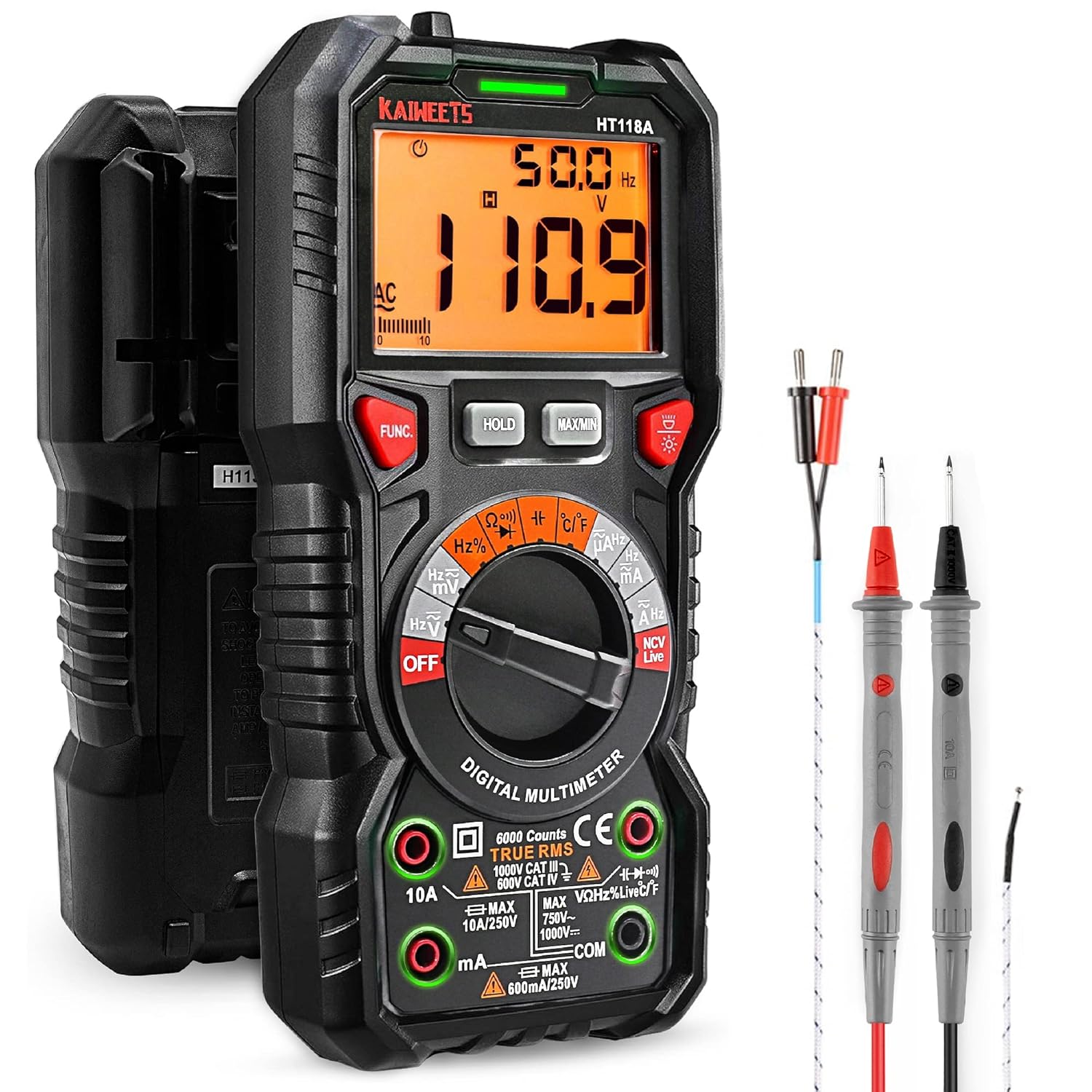
The KAIWEETS HT118A is a 6000-count TRMS multimeter built for hands-on automotive electrical diagnosis. It measures AC/DC voltage up to 1000V DC/750V AC, AC/DC current to 10A, resistance to 60 MΩ and also covers capacitance, frequency, temperature and duty cycle, so it handles typical vehicle circuits, sensors and charging systems. Practical additions like non-contact voltage detection, LED jack indicators, a built-in flashlight and a kickstand make workshop and roadside checks easier. Autoranging and a clear 2.9 inch backlit LCD simplify reading fluctuating signals, and safety features including ceramic fuses, thermistor protection and high-voltage category ratings reduce risk when probing automotive electrical systems. Limitations include the 10A handheld input which is suitable for most automotive jobs but not for high-current diagnostics, and the unit relies on disposable batteries rather than internal rechargeable power. For mechanics and DIYers who need wide measurement coverage and safety-minded design in a budget-friendly handheld meter, this is a capable choice.
Best for: Technicians and DIYers who primarily diagnose vehicle electrical systems and want an affordable, automotive-focused multimeter that covers common car checks like battery/charging tests, continuity, duty cycle/frequency, and temperature with auto-ranging and safety protections.
Less Ideal for: Specialists who frequently perform very high-current testing or need integrated rechargeable power and lab-grade current clamps should consider higher-end bench or clamp-meter solutions.
- True RMS measurements for accurate readings on nonlinear automotive signals
- Wide measurement set including voltage, current, resistance, capacitance, frequency, temperature and duty cycle
- Auto-ranging and large backlit 2.9 inch LCD for quick, readable measurements in dim areas
- Built-in NCV, flashlight and kickstand improve convenience for workshop and roadside use
- Safety protections with ceramic fuses, thermistor circuit and high-voltage category ratings
- 10A input limit restricts use on very high-current circuits or heavy charging system tests
- Uses replaceable batteries instead of a built-in rechargeable battery
Verdict: A multimeter that includes features tailored to vehicle electrical systems—such as low-impedance mode, duty-cycle/rpm measurement, and auto-ranging optimized for automotive voltages—making it ideal for car diagnostics.
Fluke 87V MAX True-RMS Digital Multimeter (Rugged, IP67)
Best Heavy-Duty Digital Multimeter

| Power Source | Alkaline |
|---|---|
| Upper Temperature Rating | 55 Degrees Celsius |
| Measurement Type | Multimeter |
The Fluke 87V MAX is a professional-grade True-RMS multimeter designed for demanding field and shop work. It measures voltage, current, resistance and temperature and includes upgraded test leads, alligator clips and a temperature probe for common automotive and electrical diagnostics. The IP67 rating and proven 4-meter drop survivability mean it tolerates wet, dirty, and elevated work locations where lesser meters fail. Safety ratings that cover high-voltage industrial environments give confidence when probing vehicle systems with transients. Practical benefits include durable construction, long battery life for extended service calls, and True-RMS accuracy which helps with modern variable-load circuits and noisy alternator outputs. The main compromises are size and weight compared with compact hobby meters and the cost, which reflects its professional positioning rather than casual garage use. For technicians who need a rugged, accurate meter that keeps working under real-world abuse, this model performs well; hobbyists seeking a lightweight budget tool may prefer a simpler option.
Best for: Technicians and DIYers who need a rock-solid, field-ready multimeter for automotive electrical diagnosis—those who prioritize a rugged, waterproof instrument that survives drops, harsh shop conditions, and frequent daily use while delivering reliable measurements.
Less Ideal for: If you need an inexpensive, pocket-sized meter for occasional household checks or basic DIY tasks, a simpler compact model would be a better fit.
- True-RMS measurement for accurate readings on non-sinusoidal and noisy signals
- IP67 waterproof and dustproof rating with validated 4-meter drop resistance
- Includes temperature probe, upgraded test leads and alligator clips for automotive tasks
- High safety ratings suitable for high-voltage environments
- Long battery life suitable for extended field use
- Larger and heavier than compact consumer multimeters, making pocket carry less convenient
- Premium price positions it for professionals rather than casual users
Verdict: A rugged, impact- and ingress-resistant multimeter built to withstand shop conditions and frequent field use while maintaining measurement reliability.
UNI-T UT89XD True RMS 6000-Count Digital Multimeter
Best True RMS Digital Multimeter

| Max DC/AC voltage | 1000V |
|---|---|
| Max DC/AC current | 20A |
| Display count | 6000 |
| True RMS | Yes |
| Functions | Voltage, current, resistance, capacitance, frequency, diode, continuity, NCV, LED test |
The UNI-T UT89XD is a full-featured handheld digital multimeter designed for general electrical and automotive troubleshooting. It measures up to 1000V AC/DC and 20A, offers True RMS readings and a 6000-count display for more accurate measurements on non-sinusoidal signals encountered in vehicle electronics. Typical uses include checking battery and charging system voltages, testing sensors, continuity checks, diode and LED tests, and verifying harness wiring with the dual-range NCV. Useful features for shop work include audible and visible alarms, a flashlight and auto backlight for working in tight, dim engine bays, plus a capacitor charging indicator and data hold for reading values while probes are positioned. The unit is ergonomically molded and claims 1m drop protection. Limitations are the basic sampling rate and a modest refresh rate of about three readings per second, and the accuracy margins on high-current AC measurements are looser than low-voltage DC specs, so for precision lab work or long-term data logging a bench meter or data-logging DMM is preferable.
Best for: Technicians and serious DIYers who need accurate AC and noisy-signal measurements for automotive electrical diagnosis, prioritizing reliable True RMS readings when troubleshooting alternators, inverters, sensors, and complex vehicle electronics.
Less Ideal for: Users who need high-frequency sampling, extensive data logging, or laboratory-grade precision should consider more specialized bench meters or dedicated data-loggers instead.
- True RMS measurement and 6000-count display improve accuracy on automotive alternator and inverter waveforms.
- Wide measurement range to 1000V and 20A covers most vehicle electrical checks.
- Dual-range NCV and LED test speed up identifying live versus neutral or damaged circuits.
- Built-in flashlight, auto backlight and audible/visual alarms help with diagnostics in dark or cramped engine bays.
- Sampling and update rate is relatively slow compared with specialized data-logging meters.
- AC current accuracy has larger error terms at higher ranges, so not ideal for high-precision AC measurements.
Verdict: A multimeter with True RMS capability to accurately measure AC signals and noisy waveforms commonly encountered in modern automotive electronics.
How We Chose the Best Digital Multimeter
We selected these digital multimeter picks with automotive electrical diagnosis in mind rather than general bench use. The shortlist focused on meters that make common vehicle tests easier, including battery voltage checks, charging system verification, continuity checks, fuse testing, resistance measurement, and parasitic draw diagnosis.Our main criteria were measurement accuracy in typical 12 volt and 24 volt systems, clear display visibility in garage lighting, safe input protection, useful DC current capability, probe and lead quality, and overall ease of use while working around an engine bay or under a dash. We also considered practical features like auto ranging, backlighting, audible continuity, min max capture, and stable readings when diagnosing intermittent faults.We excluded novelty meters, overly specialized lab units, and stripped down options that lacked the safety, range coverage, or usability needed for real automotive troubleshooting. The goal was to focus on tools that fit how DIY mechanics actually diagnose electrical issues at home.
Our full evaluation process is outlined in our review methodology.
What a Good Automotive Multimeter Needs
Automotive diagnosis puts different demands on a meter than household or electronics work. You are often testing low DC voltage circuits, checking grounds, comparing voltage drop across connections, and moving quickly from battery terminals to fuse panels to sensors. A good automotive meter should give stable readings fast, remain easy to read at awkward angles, and feel dependable when you are working around live circuits.
For most garage users, the basics matter more than exotic functions. A meter that covers DC voltage, resistance, continuity, and usable current ranges will handle a large share of real vehicle troubleshooting. The difference comes from how safely and conveniently those functions are delivered during actual diagnostic work.
- Fast, stable DC voltage readings for charging and starting tests
- Audible continuity for fuse checks and wiring verification
- Backlit display for under dash and low light work
- Reliable leads and probes that hold secure contact on small terminals
- Enough current capability for controlled parasitic draw testing
Key Functions for Battery, Charging, and Starting Tests
Most vehicle electrical diagnosis starts with three systems: the battery, the starter circuit, and the charging system. Your meter should make it easy to measure resting battery voltage, watch for voltage sag during cranking, and confirm alternator output with electrical loads switched on. Good resolution helps when you are comparing small differences that point to a weak battery, poor charging, or a resistance issue in the circuit.
Voltage drop testing is especially important in automotive work. Rather than only checking whether power is present, a multimeter lets you measure how much voltage is being lost across cables, grounds, and connections. That is often the fastest way to identify corrosion, loose terminals, or high resistance in starter and charging circuits.
- Resting battery voltage shows baseline state of charge
- Cranking voltage helps reveal battery and starter load issues
- Charging voltage confirms alternator performance under load
- Voltage drop testing finds resistance in cables and grounds
Why Safety Ratings and Input Protection Matter
Automotive systems may seem low risk because most passenger vehicles run on 12 volt electrical systems, but a meter still needs proper protection. Mistakes happen during current testing, lead placement, and range selection. Strong input protection helps reduce the chance of damaging the tool if you connect it incorrectly or encounter a transient event.
This matters even more when working on larger vehicles, modified electrical systems, or hybrid-adjacent service areas where caution is critical. A well designed meter should inspire careful use, but it should also include sensible safeguards such as protected inputs, clear jack labeling, and fusing where appropriate. For DIY users, those details are not just technical extras. They affect durability and peace of mind.
- Clear input labeling reduces setup errors
- Fused current ranges help protect the meter during misuse
- Better internal protection supports longer service life
- Safer design is important when moving between voltage and current tests
Choosing the Right Meter for Parasitic Draw Diagnosis
Parasitic draw testing is one of the main reasons many mechanics upgrade from a basic meter to a more capable one. This job requires patience, stable current readings, and safe connection methods. The meter should support the current ranges you need and make it easy to observe gradual changes as vehicle modules go to sleep.
In practical terms, you want a meter that does not force constant guesswork. Readings should settle predictably, and the controls should make it simple to switch functions without confusion. If parasitic drain diagnosis is high on your priority list, current measurement usability matters just as much as headline accuracy specs.
- Stable low current readings help track module sleep behavior
- A clear display makes long observation periods easier
- Strong lead connections reduce interruptions during testing
- Simple controls lower the chance of setup mistakes
Features Worth Paying Attention To
Many multimeters advertise long feature lists, but a few functions stand out for automotive work. Auto ranging is convenient for general troubleshooting, while manual range control can help when you want more consistent readings. A bright backlight, responsive continuity beeper, hold function, and min max capture can all make diagnosis faster in a busy garage setting.
Probe quality is easy to overlook until it becomes a problem. Stiff leads, weak insulation, and poor tip contact can make even a capable meter frustrating to use. For automotive users, comfort and control matter because testing often happens in tight spaces around moving parts, hot components, and awkward connectors.
- Backlight for dim interiors and engine bays
- Min max capture for intermittent charging or sensor issues
- Responsive continuity tone for quick circuit checks
- Comfortable probes and flexible leads for tighter access
FAQ
What should I look for in a digital multimeter for automotive use?
Focus on accurate DC voltage measurement, good input protection, a clear display, and dependable leads. For most garage work, you also want continuity, resistance, and usable current ranges. A practical layout and fast stable readings usually matter more than having the longest feature list.
Do I need auto ranging for car electrical diagnosis?
Auto ranging is helpful for beginners and casual users because it speeds up routine testing. Manual ranging can still be useful when you want tighter control over how a reading is displayed. Either can work well as long as the meter is responsive and easy to operate.
Can a multimeter help find a parasitic battery drain?
Yes, if it has suitable current measurement capability and you use it correctly. It can help you measure draw over time and identify when current drops as circuits are isolated. You still need to follow proper test procedure so you do not overload the meter or interrupt vehicle module behavior.
Is a basic multimeter enough for checking an alternator?
For a simple charging voltage check, a basic meter may be enough. If you want more complete diagnosis, such as testing voltage drop, intermittent charging behavior, or related circuit faults, a better automotive oriented meter is easier to trust. Stability and readability become more important as diagnosis gets more detailed.
What is the difference between checking voltage and doing a voltage drop test?
A voltage check tells you whether power is present and roughly how much is available at one point. A voltage drop test compares two points in a working circuit to show how much power is being lost across a cable, terminal, or ground path. That makes voltage drop testing one of the best ways to find hidden resistance problems in vehicles.
Final Verdict
The right digital multimeter for automotive electrical diagnosis comes down to the kind of work you do most often. If your jobs are mainly battery and charging checks, prioritize clear voltage readings, good leads, and simple operation. If you also chase intermittent faults and parasitic drains, current measurement usability, input protection, and display stability become more important.Choose the meter that matches your diagnostic habits, not just the longest spec sheet. When the core functions are accurate, safe, and easy to use in real garage conditions, you can troubleshoot faster and make decisions with more confidence.
