

Note: This article contains affiliate links. If you click on these links and make a purchase, I may earn a small commission at no extra cost to you. This helps support my research and content. Read my full affiliate disclosure here.
If your 2016-2021 Honda Civic is showing alignment drift, uneven tire wear, or clunking over bumps, the lower control arms could be the cause. Replacing worn or damaged arms restores steering precision, improves tire life, and returns predictable handling to daily driving or spirited commutes. This guide focuses on the Civic models built in 2016 through 2021 (FC and FK), covering both front and rear lower control arm options and the bushing choices that matter for longevity and ride quality. We shortlisted seven top options that match the chassis and mounting patterns for these years and evaluated them against common real-world concerns. Read on for the considerations that should shape your replacement decision and practical guidance for installation and maintenance.
Looking for other parts? See all Honda Civic parts & accessories.
Top Picks at a Glance
| Best Overall The best all-around choice for most situations | FXiaoy Front Lower Control Arm Pair with Ball Joints (K623649 & K623650) |  |
| Best Quality Built to a higher standard if you want something more solid | TRQ Front Lower Control Arm Set for 2016–2021 Honda Civic |  |
| Best Value The sweet spot between price and what you get | KDSA Front Lower Control Arm with Ball Joint, 2‑Piece Set (Left & Right) for 2016–2021 Honda Civic |  |
| Best Budget The cheapest option that still gets the job done reliably | PartsFlow Front Driver Side Lower Control Arm Assembly |  |
| Highest Rated A top-rated pick with lots of positive feedback | TRQ Front Lower Control Arm and Ball Joint 4‑Piece Set |  |
| Most Popular A crowd favorite that many people choose with confidence | Detroit Axle Front Lower Control Arms with Ball Joints for 2016-2021 Honda Civic (2‑pc kit) |  |
| Best Seller A high-volume bestseller chosen again and again | Detroit Axle Front Left Lower Control Arm with Ball Joint (Driver Side) |  |
1. FXiaoy Front Lower Control Arm Pair with Ball Joints (K623649 & K623650)

| Fitment | Honda Civic 2016–2021 (1.5L and 2.0L) |
|---|---|
| Included Components | Driver and passenger front lower control arms with ball joints |
| Manufacturer Part Number | FXY-92 |
| OEM Equivalent Part Number | 06510TBAA00, 51350TBAA00, 51350TBAA01, 51360TBAA00, 51360TBAA01 |
| Warranty | 2 Year Manufacturer |
This FXiaoy kit supplies both left and right front lower control arms preassembled with ball joints for Honda Civic 2016–2021 (1.5L and 2.0L). It is intended as a direct, vehicle-specific replacement to restore proper wheel alignment, reduce uneven tire wear, and bring back original steering feel after worn arms are removed. The parts are heat treated and quench-processed according to the listing, which suggests improved bearing durability and smoother ride quality compared with neglected stock components. Fitment is precise for the listed Civic models so installation is straightforward and alignment settings typically remain close to spec once fitted. Buyers should note this is an aftermarket brand rather than a factory nameplate and a minority of reviews mention quality control issues such as mounting flange flatness or missing grease zerts, so inspect parts on receipt and torque hardware to spec. The kit includes both driver and passenger sides and comes with a two year manufacturer warranty for added confidence.
Best for: A Civic owner who wants a complete, vehicle-specific front lower control arm replacement to restore handling, alignment, and tire life without sourcing individual parts.
Less Ideal for: Drivers seeking an OEM-branded part or upgraded performance suspension components should consider factory-quality replacements or performance-focused arms instead.
- Vehicle-specific fit for 2016–2021 Honda Civic models for simpler, correct installation.
- Includes both left and right front lower control arms with integrated ball joints so both sides are refreshed at once.
- Heat-treated components and high-frequency quenching claimed to improve bearing durability and ride smoothness.
- Precision tolerances intended to reduce the need for modification and help maintain alignment after installation.
- Aftermarket manufacturing variability reported by a small number of reviewers, so parts should be inspected before installation.
Verdict: A ready-to-install, vehicle-specific pair that refreshes front suspension geometry and handling on 2016–2021 Honda Civics without needing extra parts.
2. TRQ Front Lower Control Arm Set for 2016–2021 Honda Civic

| Fit Type | Vehicle Specific Fit |
|---|---|
| Auto Part Position | Front Lower |
| Material Type | Steel |
| Included Components | Driver and passenger lower control arms |
This TRQ control arm kit supplies both left and right front lower control arms intended as direct-fit replacements for 2016–2021 Honda Civic vehicles. Built from steel and supplied as a two-piece set, the parts are designed to restore factory suspension geometry, improve steering stability, and help maintain even tire wear after worn arms are removed. TRQ highlights preassembled components and an extensive library of step-by-step installation videos, which makes the kit a practical option for competent DIYers or technicians who want to complete the job quickly without custom modifications. The steel construction promises durability under everyday and spirited driving, but the parts are a like-for-like replacement rather than an aftermarket performance redesign, so drivers seeking stiffer bushings or adjustable alignment features will need a different product. Fitment is vehicle specific and the set replaces both driver and passenger lower front arms to keep handling balanced across the axle.
Best for: Drivers who prioritize restoring factory steering feel and suspension geometry on a 2016–2021 Civic and prefer a straight swap that can be installed with basic mechanical skills.
Less Ideal for: Enthusiasts wanting upgraded handling hardware with adjustable geometry or stiffer aftermarket bushings should consider performance-oriented control arms instead.
- Vehicle-specific direct-fit design for 2016–2021 Civic simplifies installation
- Includes both driver and passenger front lower control arms so both sides match
- Steel construction aimed at durable, long-lasting service
- Preassembled components and available installation videos speed DIY or shop replacement
- Not a performance-tuned or adjustable control arm; no enhanced bushings or camber adjustment
Verdict: A durable, vehicle-specific two-piece replacement that restores factory front suspension geometry for 2016–2021 Honda Civic owners who want a reliable, direct-fit swap.
3. KDSA Front Lower Control Arm with Ball Joint, 2‑Piece Set (Left & Right) for 2016–2021 Honda Civic

| Fitment | 2016-2021 Honda Civic (1.5L) and 2016-2020 Civic (2.0L), not Type R |
|---|---|
| Includes | Front left and front right lower control arm assemblies with ball joints |
| Unit count | 2.0 Count |
| Manufacturer | KDSA |
This KDSA 2-piece front lower control arm set replaces both left and right lower arms and includes preassembled ball joints to simplify front suspension repairs on 2016–2021 Honda Civics (not Type R). It is a vehicle-specific fit intended to match factory mounting points so installers should be able to swap the assemblies without major modification. Typical use is like-for-like replacement after worn bushings or ball joints cause play, uneven tire wear, or pulling. Notable features are the complete left/right pair, preinstalled ball joints, and claimed factory-standard manufacturing from a Taiwan facility. The practical benefits are reduced labor time since ball joints are already attached and a straightforward path back to correct steering alignment. Limitations are that longevity depends on installation and local road conditions and that this is a direct replacement rather than an upgraded performance arm, so buyers wanting stiffer bushings or performance geometry should look elsewhere.
Best for: A buyer who wants a practical, drop-in replacement to restore steering feel and front suspension geometry on a 2016–2021 Honda Civic and values straightforward installation and parts that match factory mounting points.
Less Ideal for: Not ideal for drivers seeking performance-tuned suspension components or heavy-duty arms for race or off-road use.
- Sold as a matched left and right pair for single-purchase front-end repair
- Ball joints are preinstalled to reduce installation time and alignment prep
- Vehicle-specific fit for 2016–2021 Honda Civic models (excludes Type R)
- Manufactured to claimed factory standards with over 30 years of production experience
- Not a performance or heavy-duty upgrade; intended as a factory-style replacement
- Durability will vary with installation quality and local driving conditions
Verdict: If you need a straightforward, factory-style left and right lower control arm replacement for a 2016–2021 Honda Civic, this matched KDSA pair offers preinstalled ball joints for faster installation.
4. PartsFlow Front Driver Side Lower Control Arm Assembly

| Fit Type | Vehicle Specific Fit |
|---|---|
| Manufacturer Part Number | PF498A47 |
| Manufacturer | PartsFlow |
| Manufacturer Warranty Description | 1 Year |
This PartsFlow lower control arm assembly is a ready-to-install replacement for the front driver-side lower arm on specified Honda Civic sedans and coupes. It arrives as a complete unit with pre-pressed rubber bushings and a pre-installed ball joint so you can bolt it in without a press, which speeds up DIY repairs or shop labor. The unit is built from high-strength material with a corrosion-resistant coating and a polished ball joint stud intended to keep articulation smooth while the rubber bushings help damp road vibration and reduce noise. In use it addresses common suspension symptoms such as steering vibration, pulling, uneven tire wear, and clunking over bumps. Because it matches factory fit and function, it should restore original steering feel when installed and followed by a professional alignment. Limitations include a single-side part and the usual recommendation to check associated suspension components when replacing control arms to avoid repeating the repair.
Best for: Buyers looking for an affordable, ready-to-install replacement that restores steering feel and reduces suspension noise on the specified Civic models and who want to minimize shop labor and specialized tooling.
Less Ideal for: Drivers who prefer to replace both control arms and related suspension components in a coordinated kit or who need a heavy-duty performance upgrade beyond factory-equivalent parts.
- Complete assembly with pre-pressed bushings and pre-installed ball joint for faster, tool-light installation
- Constructed from high-strength material with corrosion-resistant coating for durability
- Polished ball joint stud and rubber bushings help reduce noise and restore smooth steering
- Vehicle-specific fit designed to match factory form and function for the targeted Civic models
- Sold as a single driver-side unit so passenger-side replacements require a separate purchase
- Does not include alignment service or address worn adjacent suspension parts which may also need replacement
Verdict: A budget-friendly, bolt-on lower control arm assembly that restores factory handling and cuts installation time for qualified Civic repairs.
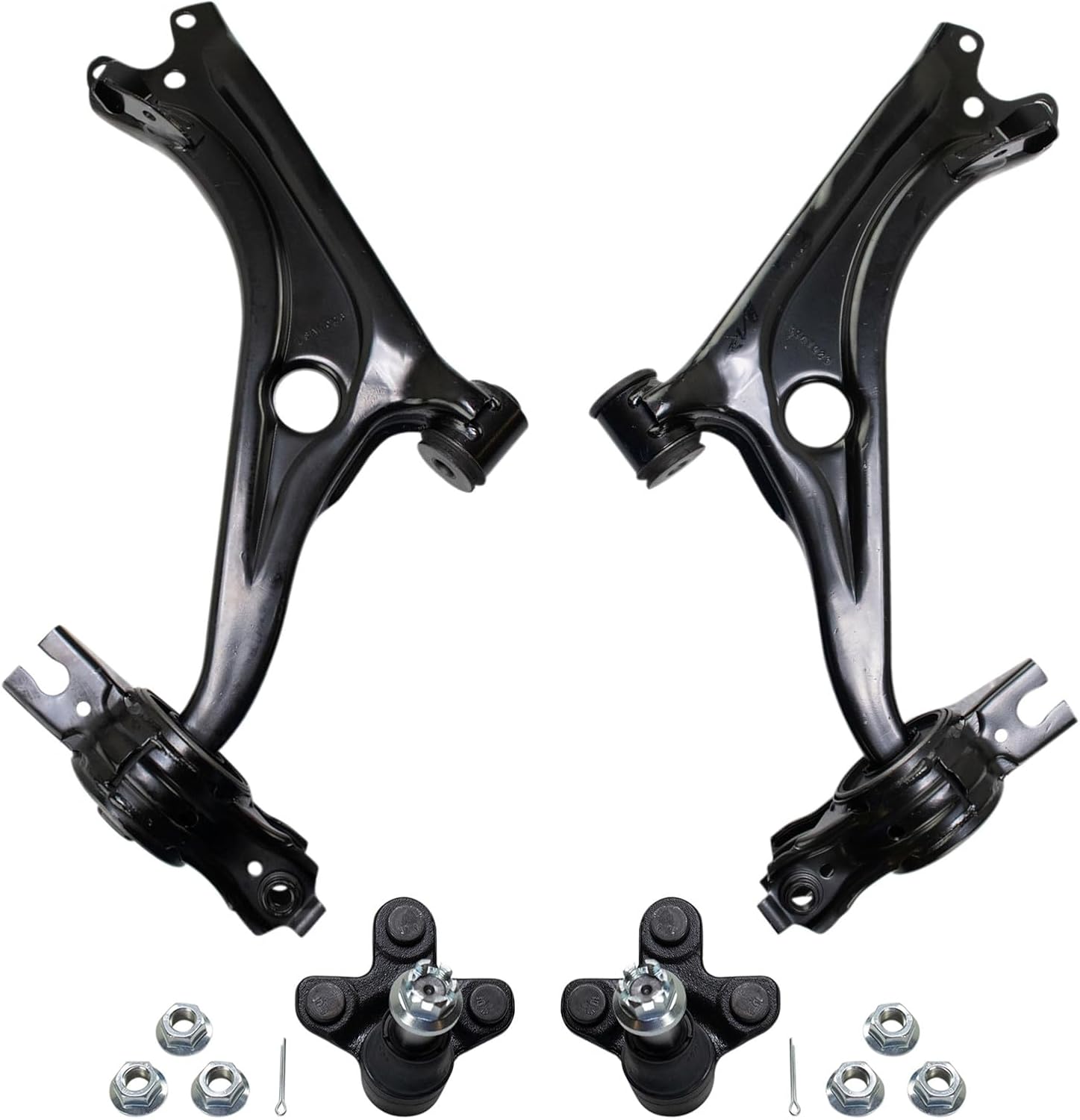
5. TRQ Front Lower Control Arm and Ball Joint 4‑Piece Set
| Fit Type | Vehicle Specific Fit |
|---|---|
| Auto Part Position | Front Lower |
| Quantity | 4 Piece |
| Manufacturer | TRQ |
This TRQ kit supplies two front lower control arms and two integrated ball joints intended as direct replacements for 2016–2021 Honda Civic front suspension. It ships pre-assembled so installation is straightforward for a competent DIYer or mechanic and TRQ provides video guidance to simplify the process. In practice the arms restore factory steering feel and handling when worn components cause looseness or clunking, and several owners report an OEM-like ride once aligned. Build quality looks solid for the arms, though some reports note limited grease at the joints and occasional missing small hardware that may require sourcing collars or fresh fasteners. That means plan for a torque‑to‑spec install, fresh control-arm bolts if yours are corroded, and a post-install alignment. For reliability-focused buyers this kit offers a close factory fit and good value, but budget extra time for prep and inspection of supplied ball-joint fittings before final assembly.
Best for: Buyers who need a reliable, factory-style replacement to restore steering feel and eliminate front-end play on 2016–2021 Honda Civics and who prioritize getting a direct-fit kit they can install with basic mechanic tools.
Less Ideal for: People who want a lifetime-lubricated or rebuildable ball joint solution or those unwilling to inspect supplied hardware and source any missing fasteners before installation.
- Vehicle-specific direct-fit design intended for 2016–2021 Honda Civic front lower position
- Includes both control arms and ball joints so front lower suspension is replaced as a matched set
- Pre-assembled components reduce installation time and simplify DIY or shop installation
- Manufacturer provides installation videos to guide users through the repair
- Some buyers reported low grease in the ball joints and occasional missing small hardware such as top collars
Verdict: A practical, factory-style four-piece front lower control arm and ball joint kit that restores Civic steering feel while keeping installation simple for reliability-minded owners.
6. Detroit Axle Front Lower Control Arms with Ball Joints for 2016-2021 Honda Civic (2‑pc kit)

| Fitment | 2016-2021 Honda Civic (1.5L and 2.0L) |
|---|---|
| Includes | 2 front lower control arms with ball joints |
| Position | Front lower |
| Manufacturer | Detroit Axle |
| Warranty | 10-year warranty |
This Detroit Axle kit supplies two front lower control arms with ball joints preinstalled, intended as a direct replacement for 2016–2021 Honda Civic (1.5L and 2.0L) models. Installation is aimed at DIY mechanics and shops: the ball joints arrive pressed in so you can bolt the arms into the suspension without having to press components yourself. The parts are built to meet common aftermarket quality checks and Detroit Axle says the components undergo impact and fatigue testing. In real use buyers report the arms bolt in with correct alignment and restore a firm, quiet front end when worn originals are replaced. Practical benefits include straightforward fitment, restored steering precision, and lower cost versus factory units. Limitations to note are occasional reports of rough handling in transit or a damaged joint on arrival and the lack of a grease fitting on the ball joint, which means the joint is service-free rather than serviceable. If you need a long-term heavy-duty upgrade or greasable joints, consider alternate designs.
Best for: Buyers who prioritize proven fit and reliable, low-hassle replacement parts supported by strong customer feedback and who want a straightforward repair that restores steering and suspension feel.
Less Ideal for: Drivers looking for heavy-duty or serviceable control arms with greasable ball joints or for those who want to custom-tune suspension geometry beyond stock fitment.
- Preinstalled ball joints speed up installation and avoid pressing tools
- Vehicle-specific fit for 2016–2021 Honda Civic reduces modification or adjustment
- Restores steering feel and reduces front-end play when replacing worn arms
- Made by a brand with factory-quality production standards and testing
- Ball joints are non-greasable so they cannot be re-lubricated during service
- Some buyers reported damaged or imperfect joints on rare arrival
Verdict: A cost-effective, vehicle-specific replacement that restores front-end tightness quickly thanks to preinstalled ball joints and reliable fitment.
7. Detroit Axle Front Left Lower Control Arm with Ball Joint (Driver Side)

| Fit Type | Vehicle Specific Fit |
|---|---|
| Auto Part Position | Front Left Lower |
| Auto Part Orientation | Drivers Side |
| Material Type | Metal |
This Detroit Axle front left lower control arm is a direct-fit replacement that swaps into 2016-2021 Honda Civic (1.5L and 2.0L naturally aspirated) front suspension to restore steering geometry and wheel alignment. It arrives as a single driver-side arm with an integrated ball joint and is marketed as an easy-install, vehicle-specific part intended to match factory fit and function. The arm is made from a premium metal alloy with claimed high rigidity and anti-rust treatment for longer service life and resistance to repeated impact loads. For everyday drivers the most practical benefits are restoring proper handling, eliminating clunks from a worn arm, and making alignment simpler after installation. The part is backed by the brand's testing claims and a long warranty, which should reassure cautious buyers. Limitations are that it is sold as one arm only and does not include related hardware or alignment service, so budget for installation and an alignment when replacing this component.
Best for: Buyers who prioritize a reliable, factory-style replacement to restore steering and handling on a 2016–2021 Honda Civic and want a part with manufacturer testing and a long warranty for peace of mind.
Less Ideal for: People looking to replace both sides at once on a tight budget or those wanting a performance-tuned aftermarket arm; also not intended for vehicles outside the specified Civic model years and engine options.
- Vehicle-specific direct-fit design simplifies installation and match to factory mounting points
- Integrated ball joint included so no separate ball joint purchase is needed
- Premium alloy construction with anti-rust treatment for improved durability
- Manufacturer states product undergoes impact, wear, and fatigue testing
- Sold as a single driver-side arm so matching passenger-side replacement must be purchased separately
Verdict: A factory-style, tested direct-fit replacement for restoring steering and suspension performance on 2016–2021 Honda Civic driver-side front lower control arm failures.
Choosing the Right 2016-2021 Honda Civic Lower Control Arm: Key Factors to Consider
Fitment to the FC and FK Chassis and Mounting Points
Exact fitment to the 2016-2021 (FC and FK) Civic chassis is critical. Even small deviations in control-arm length or bushing center-to-center distance change suspension geometry and toe settings, which can cause uneven tire wear or unstable steering. Confirm the arm matches the vehicle's transverse mounting pattern and ball-joint taper so you do not need aftermarket adapters or re-drilling.
Fitment also affects installation time and complexity. Arms designed specifically for the Civic often reuse factory bolts and alignment marks, reducing labor and limiting the need for alignment corrections beyond a toe and camber check. If a replacement is ambiguous about which side or production submodel it fits, treat it as a higher-risk option.
Bushing Type and Hardness
Bushing material strongly influences NVH, steering feel, and durability. Soft rubber bushings absorb road noise and provide a comfortable ride but can allow more movement under load, which may slightly reduce steering responsiveness. Stiffer polyurethane or bonded bushings minimize deflection and sharpen feedback but can transmit more vibration into the cabin.
Consider your typical use. Commuters and those who prioritize a quiet ride will favor rubber or dual-durometer designs. Drivers seeking crisper handling or those who track their Civic occasionally may prefer firmer bushings; just expect increased cabin vibration and possibly accelerated bushing wear on rough roads.
Ball Joint Design and Serviceability
Many lower control arms integrate a ball joint that connects to the steering knuckle. A robust, sealed ball joint reduces maintenance and resists water and grit intrusion. Check whether the ball joint is replaceable or permanently pressed in. Replaceable joints allow future service without replacing the entire arm, which can be more economical in the long run.
Also look at boot quality and retaining hardware. Thin boots or weak clamps lead to early joint contamination. For Civics with higher mileage, choosing an arm with a durable, serviceable ball joint can extend overall suspension life.
Material, Construction, and Corrosion Protection
Control arms are commonly stamped steel, forged steel, or cast metal. Forged or thicker stamped designs usually tolerate impacts and road stress better, reducing the risk of bending. Corrosion protection is essential on the lower control arm because it sits close to road spray; arms with zinc plating, powder coating, or additional seals last longer in wet climates.
Inspect weld quality and seam reinforcement where applicable. Poor welds are stress concentrators that shorten service life. Coatings that chip or peel offer limited protection, so look for factory-applied finishes or documented corrosion warranties for longer-term reliability.
Alignment Impact and Adjustability
Some replacement arms are strictly direct-fit and preserve factory alignment ranges, while others introduce slight geometry changes that may require aftermarket alignment adjustments. Understand how a new arm will affect camber and toe before installing. If an arm lacks adjustment, you may still need a shop with alignment shims or adjustable components to bring the vehicle back into specification.
Civic owners aiming to maintain OEM ride characteristics should favor arms that align to factory specs. Those pursuing performance tweaks should verify that the arm integrates with their chosen alignment setup and whether it allows controlled changes without requiring additional suspension modifications.
Durability, Warranty, and Real-World Reliability
Durability combines material quality, bushing life, and resistance to environmental damage. Look for arms with documented mileage reports or manufacturer warranty that indicate expected lifespan. A longer warranty often reflects confidence in component longevity.
Consider regional driving conditions. If you drive on salted roads, prioritize arms with better corrosion resistance and longer warranty terms. For higher-mileage Civics, components designed for serviceability and with replaceable joints can be more cost-effective over the vehicle's remaining life.
Identifying Lower Control Arm Symptoms on a 2016-2021 Civic
Lower control arm symptoms can be subtle or obvious depending on the failure mode. Typical signs include clunking or knocking noises when going over bumps, a pull to one side during braking, uneven tire wear across the tire shoulder, or excessive play in the front wheel while parked and lifted. Some owners notice vibration at certain speeds when bushings are failing.
Diagnosing the cause requires a visual inspection and simple checks such as prying at the control arm bushings to detect movement, checking the ball joint for play, and lifting the wheel to feel for looseness in the hub assembly. Record where the noise occurs and under what driving conditions to aid a technician.
- Clunking over bumps often indicates worn bushings or a loose ball joint
- Uneven inner or outer tire wear can point to alignment shifts from worn arms
- Steering wander or a pull under braking suggests geometry has changed
- Visible rust, cracked bushings, or torn ball-joint boots warrant replacement
Front Versus Rear Lower Control Arms on These Civics
The 2016-2021 Civic suspension uses distinct front and rear lower arm designs with different load paths and mounting arrangements. Front lower arms typically carry steering and braking loads and are more likely to show ball-joint wear and bushing deterioration. Rear lower arms manage lateral loads and affect rear toe and ride stability.
When replacing arms, treat front and rear as separate decisions. A worn front arm affects handling more directly and often demands quicker replacement. Rear arm issues primarily manifest as instability under lane changes or rear-end tire wear patterns.
- Front arms influence steering response and toe settings
- Rear arms affect rear alignment and high-speed stability
- Service intervals may differ: front arms often wear faster depending on driving conditions
Bushing Options and Their Practical Effects
Bushing selection changes how the Civic feels and responds. OEM-style rubber bushings absorb impact and reduce cabin noise, making them a sensible choice for daily drivers. Polyurethane bushings improve steering crispness and reduce deflection during cornering, which is attractive to drivers who want a firmer feel.
Consider hybrid solutions that use a rubber core with an outer urethane shell to balance comfort and control. Remember that stiffer bushings can transfer more road noise and may require periodic lubrication or attention to prevent squeaks.
- Rubber: quieter ride, more compliance
- Polyurethane: improved feedback, increased NVH
- Dual-material designs aim to balance comfort and control
Installation Considerations and Alignment After Replacement
Installing lower control arms on a 2016-2021 Civic typically requires lifting the vehicle, removing the wheel, and detaching the sway bar end link and ball joint. Some arms reuse factory hardware while others include new bolts and nuts. Follow torque specs and replace any damaged mounting hardware to preserve integrity.
After installation, always perform a full alignment. Even direct-fit arms can shift toe and camber slightly once new bushings settle. A professional alignment ensures even tire wear and restores intended handling characteristics. If the replacement arm has adjustable features, use them to dial in alignment before final tightening.
- Lift the vehicle safely and support it with stands
- Replace worn mounting hardware and torque to spec
- Always complete a post-installation alignment
Maintenance Tips to Extend Control Arm Life
Regular inspections are the best defense against sudden failures. Check for torn boots, cracked bushings, and signs of bending during routine oil changes or tire rotations. Address minor bushing deterioration early to prevent accelerated wear to connected components.
Keep drainage and protective coatings intact to reduce rust, and wash undercarriage areas exposed to salt or heavy grime. If your replacement arm has a replaceable ball joint, inspect and service it per the maintenance schedule to avoid a complete arm replacement later.
- Inspect during tire rotations and oil changes
- Rinse undercarriage in winter to remove salt
- Service replaceable ball joints as recommended
When to Consider Upgrading Versus Replacing With OEM-Style Parts
Decide between performance-oriented arms and OEM-style replacements based on your priorities. OEM-style arms preserve ride comfort and factory alignments without introducing additional NVH. Performance-oriented options may offer stronger construction, stiffer bushings, or aftermarket geometry changes for improved cornering.
If you do not plan other suspension modifications, an OEM-equivalent arm is a straightforward way to restore original handling. If you are modifying springs, dampers, or sway bars, consider arms that complement those upgrades and allow for the desired alignment settings.
- Choose OEM-equivalent for comfort and predictable handling
- Choose upgraded arms if you have complementary suspension modifications
- Confirm that any upgrade preserves necessary clearances and mounting geometry
Still looking for the perfect fit?
Select your Honda Civic configuration to see the most relevant Lower Control Arms recommendations
How We Chose the Best 2016-2021 Honda Civic Lower Control Arm
We narrowed candidates using criteria that matter specifically for 2016-2021 Civic owners. Primary filters included exact fitment to the FC and FK chassis mounting points and compatibility with the vehicle's factory suspension geometry. We prioritized construction quality such as stamped steel versus forged or cast designs, and the type and quality of bushings supplied, since bushing hardness affects ride comfort and NVH. Corrosion resistance and protective coatings were considered because road salt and wet climates accelerate failure on exposed control arms. We also evaluated reported longevity from owner feedback and service literature related to these production years, along with warranty coverage and manufacturer-specified load ratings. Exclusions: arms that required extensive vehicle modification, non-Civic-specific universal replacements, or components lacking clear fitment documentation for 2016-2021 (FC and FK) Civics were not considered. The goal was to find arms that balance durability, correct alignment geometry, and acceptable ride characteristics for typical Civic use.
Our full evaluation process is outlined in our review methodology.
FAQ
How can I tell if my Civic needs a lower control arm replacement?
Common signs include clunking noises over bumps, uneven tire wear, steering that pulls to one side, or excessive wheel play when the car is lifted. A visual inspection for torn bushings, rusted mounts, or ball-joint play helps confirm the diagnosis.
Are lower control arm bushings the same as ball joints?
No. Bushings isolate the arm at its chassis mounts and control lateral movement, while the ball joint connects the arm to the steering knuckle and provides pivoting motion. Both can wear independently and cause different symptoms.
Can I replace just the bushing instead of the whole arm on my 2016-2021 Civic?
Sometimes bushings are serviceable, and replacing only the bushing can be economical. However, many arms have pressed-in bushings or are sold as complete assemblies. Assess the arm's condition and whether the ball joint or metal structure is compromised before deciding.
Will installing new lower control arms fix my alignment issues?
Replacing worn arms can correct alignment drift caused by deflection or excessive play, but you should perform a proper wheel alignment after installation. Some replacements will require minor alignment adjustments to return to factory specifications.
How long do lower control arms typically last on a Civic?
Lifespan varies with driving conditions. In mild climates with light use, arms and bushings often last many years and tens of thousands of miles. In areas with heavy salt, rough roads, or aggressive driving, components may wear faster and require earlier replacement.
Is it worth choosing a control arm with replaceable ball joints?
Yes if you plan to keep the vehicle long term. Replaceable ball joints let you service the joint independently of the arm, which can be more cost-effective and reduce waste compared with replacing the entire arm when only the joint fails.
Final Verdict
Prioritize exact FC and FK chassis fitment, bushing type, and corrosion protection when choosing lower control arms for a 2016-2021 Honda Civic. Decide whether you want quiet, compliant rubber bushings for daily driving or firmer polyurethane options for sharper feedback, and weigh the benefits of serviceable ball joints for long-term maintenance. After installation, a proper alignment is essential to realize the handling and tire-life benefits. Focus on the tradeoffs between comfort, durability, and adjustability to select the option that best matches how you use your Civic.
Explore More:
- Check out all Honda Civic parts & accessories
- Explore Lower Control Arms Maintenance & Repair Guides
- Explore Suspension & Steering
- Browse all Auto Parts
