

Note: This article contains affiliate links. If you click on these links and make a purchase, I may earn a small commission at no extra cost to you. This helps support my research and content. Read my full affiliate disclosure here.
If you plan to add more clearance, fit larger tires, or improve off-road capability on your Ford Explorer 4WD, choosing the right lift kit makes a big difference. The wrong kit can hurt ride quality, steering geometry, and component longevity, while the right one improves capability without compromising daily driving.This guide shortlists seven top lift kits suitable for the Ford Explorer 4WD and explains the tradeoffs you should consider. We evaluated options for fitment, suspension type, and the effects on tire clearance and ride comfort to help you pick a kit that matches your intended use. Read on for the factors that matter and practical guidance for installation and setup.
Looking for other parts? See all Ford Explorer parts & accessories.
Top Picks at a Glance
| Best Overall Lift Kit The best all-around lift kit balancing performance and reliability | Truxxx 2.5" Front / 1.5" Rear Leveling Kit for Ford Explorer (2011–2019) |  |
| Best Budget Lift Kit A low-cost kit that raises ride height without breaking the bank | ECCPP 2.5" Front Leveling Lift Kit for Ford Explorer |  |
| Best Premium Lift Kit A higher-end kit with upgraded components and premium build quality | Truxxx 3" Front & 1.5" Rear Lift Kit for Ford Explorer (2011-2019) | |
| Best Complete Lift Kit Includes all necessary parts for a full suspension lift installation | SCITOO Leveling Lift Kit — 3" Front / 2" Rear for Ford Explorer (2011–2019) |  |
| Best Compact Lift Kit A smaller, lower-profile kit for mild lifts and tight packaging | YHTAUTO 2.5" Front Leveling Lift Kit for Ford Explorer 2011–2019 |  |
| Best 2–3-Inch Lift Kit Focused on mid-range lift heights common for mild to moderate leveling | KSP Performance Explorer Suspension Lift Kit (2.5" Front, 1.25" Rear) for 2011–2019 Explorer |  |
1. Truxxx 2.5" Front / 1.5" Rear Leveling Kit for Ford Explorer (2011–2019)
Best Overall Lift Kit

| Front lift | 2.5 Inches |
|---|---|
| Rear lift | 1.5 Inches |
| Fitment | Ford Explorer 2011–2019 (2WD and 4WD incl. Police Interceptor) |
| Material Type | Carbon Steel |
| Included Components | Strut mounts, shock brackets, sway bar extension, hardware |
This Truxxx leveling kit is a vehicle-specific suspension kit designed to lift the front of a 2011–2019 Ford Explorer about 2.5 inches and the rear about 1.5 inches to correct rake and allow larger tires. It retains the factory struts and shocks, supplying strut mounts, rear mounts, sway bar extension, shock brackets, and hardware so you can keep the factory ride quality without replacing dampers. Installation is straightforward for a competent DIY mechanic or an installer who follows the included instructions and alignment specs. The kit is made from North American DOM tubing and carbon steel with 8.8/10.9 grade fasteners, so it should hold up to daily driving and light gravel use. Important limits: this kit is intended for on-road and light gravel access and will not convert an Explorer into a serious off-road vehicle, and some Explorers with softer front springs may feel a modest change in ride characteristic after installation. Always measure front-to-rear rake before ordering and test-fit wheels and tires after fitment.
Best for: A DIY mechanic or weekend-minded owner who wants a factory-like ride with a modest front lift and the ability to fit slightly larger tires while keeping most stock suspension components.
Less Ideal for: Drivers who need a full off-road conversion, much larger lifts, or heavy-duty suspension for rock crawling or frequent trail use should look at dedicated off-road suspension systems instead.
- Vehicle-specific fit for 2011–2019 Ford Explorer including Police Interceptor versions
- Uses factory struts and shocks to preserve OEM ride quality and damping
- Complete kit with mounts, brackets, sway bar extension, hardware, and alignment specs
- Made from US/Canada mill-certified steel and high-grade fasteners for durability
- Not intended to make the Explorer a true off-road vehicle and not suitable for heavy off-road abuse
Verdict: The best overall lift kit for most DIY mechanics, offering the right mix of ride quality, fitment completeness, durability, and ease of installation.
2. ECCPP 2.5" Front Leveling Lift Kit for Ford Explorer
Best Budget Lift Kit

| Fitment | 2011–2019 Ford Explorer (specified engines) |
|---|---|
| Material | 6061-T6 aircraft-grade aluminum |
| Hardware grade | 10.9 grade bolts |
| Installation | Bolt-on, no cutting or strut preloading |
This ECCPP front leveling kit raises the front of compatible Ford Explorer models to reduce factory rake and create room for slightly larger tires. It uses machined 6061-T6 aluminum spacers with hardened 10.9 grade bolts and an anodized finish for corrosion resistance, so it is strong yet lightweight compared with steel alternatives. Installation is straightforward and intended as a bolt-on job with no cutting or strut preloading, which makes it suitable for a competent DIYer working on a driveway. The kit is sold to match factory ride and steering feel while giving a more aggressive stance. Keep in mind the advertised lift and the actual spacer thickness are not exactly the same because of suspension geometry, so final ride height will vary and the kit is intended for modest leveling rather than heavy-duty lifting. This is a practical, low-cost way to level the front of an Explorer when you want a simple install and basic, durable components without changing shocks or suspension geometry significantly.
Best for: Shoppers who want an affordable, straightforward way to level the front of a Ford Explorer with a mostly bolt-on installation and durable basic hardware.
Less Ideal for: Drivers seeking a large suspension lift, heavy off-road use, or those who want a full shock and geometry upgrade should look for a complete lift system instead.
- Machined 6061-T6 aluminum spacers offer a strong but lightweight solution compared with steel spacers.
- Includes hardened 10.9 grade bolts and anodized finish for added corrosion resistance.
- Bolt-on installation with no strut preloading or cutting makes it accessible to competent DIYers.
- Designed to retain factory ride and steering characteristics while leveling the front.
- Lift height differs from spacer thickness due to suspension geometry, so exact ride increase is variable.
- Only addresses front leveling and does not replace shocks or provide full suspension lift capability.
Verdict: The best budget lift kit for shoppers who need a reliable, affordable height increase and acceptable basic components for occasional DIY installation.
3. Truxxx 3" Front & 1.5" Rear Lift Kit for Ford Explorer (2011-2019)
Best Premium Lift Kit

| Front lift | 3 Inches |
|---|---|
| Rear lift | 1.25 Inches |
| Material Type | Carbon Steel |
| Automotive Fit Type | Vehicle Specific Fit |
This Truxxx lift kit is a vehicle-specific solution for 2011 to 2019 Ford Explorers that raises the front about 3 inches and the rear about 1.5 inches while keeping the factory struts and shocks. It replaces the upper strut mounts and includes rear mounts, shock brackets, sway bar extension and hardware, plus alignment specs and installation instructions. The design uses North American mill-certified steel and high-strength fasteners intended to deliver a durable, factory-friendly fit that preserves the original ride feel rather than converting the Explorer into an off-road chassis. That makes it a good choice for drivers who want improved ground clearance and a more balanced stance for light gravel or dirt roads without sacrificing daily driving comfort. Important limits are that the kit is not a full off-road conversion and it relies on stock shocks, so extreme trail use or heavy suspension modification will exceed its intended capability. Buyers should measure front-to-rear rake before ordering and check wheel and tire fitment after installation.
Best for: Buyers who prioritize a durable, factory-like lift that improves stance and light-road clearance while keeping daily driving comfort and handling intact.
Less Ideal for: Drivers seeking a heavy-duty off-road upgrade or those planning extensive suspension modifications and aggressive trail use should look for a full suspension lift designed for rough-terrain performance.
- Vehicle-specific fit for 2011–2019 Ford Explorer including Police Interceptor models
- Uses factory struts and shocks to retain OEM ride quality and alignment specs
- Made from US/Canada mill-certified steel with high-strength 8.8/10.9 fasteners
- Includes all necessary mounts, shock brackets, sway bar extension and hardware
- Not intended to turn the Explorer into an off-road-ready vehicle or handle extreme trail use
Verdict: The best premium lift kit for buyers willing to pay more for superior materials, improved ride handling, long-term durability, and refined on-road performance.
4. SCITOO Leveling Lift Kit — 3" Front / 2" Rear for Ford Explorer (2011–2019)
Best Complete Lift Kit

| Fitment | Ford Explorer 2011–2019 |
|---|---|
| Front lift | 3 inches |
| Rear lift | 2 inches |
| Includes | Front strut spacers and rear lift blocks |
This SCITOO leveling lift kit is a bolt-on solution that raises a 2011–2019 Ford Explorer roughly 3 inches in front and 2 inches in the rear to provide extra ground clearance and room for larger tires. The kit uses forged strut spacers up front and rear lift blocks so installation is straightforward and can often be completed in a couple of hours without disassembling struts or cutting. It is aimed at drivers who want a simple visual and clearance upgrade rather than a full suspension overhaul. Practical benefits include improved approach clearance, an aggressive stance, and retaining factory suspension travel so ride quality stays close to stock. Important limitations for the “complete lift kit” buyer: this product does not include shocks, control arms, brackets, or additional hardware for a full suspension rebuild, and a front-end alignment is recommended after install to restore proper steering geometry. Expect to pair this kit with other suspension components if you need a comprehensive, long-travel lift designed for heavy off-road use.
Best for: A Ford Explorer owner who wants a simple, do-it-yourself leveling upgrade to gain clearance and a more aggressive look without replacing the entire suspension.
Less Ideal for: Drivers seeking a single-purchase complete lift with shocks and control arms or those planning heavy-duty off-road use should choose a full suspension kit instead.
- Bolt-on design that typically installs in 1–2 hours without cutting or strut disassembly
- Provides measurable front and rear lift for better ground clearance and tire fitment
- Uses forged strut spacers intended to preserve suspension geometry and ride comfort
- Not a full kit — does not include shocks, control arms, brackets, or comprehensive hardware
- Listed lift dimensions are vehicle lift heights not spacer thickness so expectations should be managed
Verdict: The best complete lift kit for DIY mechanics who want a single-purchase solution that includes shocks, control arms, brackets, and hardware for a full, confident install.
5. YHTAUTO 2.5" Front Leveling Lift Kit for Ford Explorer 2011–2019
Best Compact Lift Kit

| Vehicle fitment | Ford Explorer 2011-2019, FWD/4WD |
|---|---|
| Lift height | Front 2.5 inch (thickness 2.44 inch) |
| Materials | Solid steel, powder coated |
| Includes | Set of 4 with hardware kit |
This front leveling lift kit raises the front of a 2011–2019 Ford Explorer by roughly 2.5 inches (listed thickness 2.44 inches) to improve ground clearance and allow modestly larger tires without replacing the factory suspension. The kit is a compact, direct bolt-on design sold as a set of four pieces with the hardware included, so installation fits into tight engine-bay spaces and can be completed with basic tools. Components are stamped from solid steel and powder coated to resist moisture and corrosion, which helps longevity on vehicles driven in wet or salty conditions. Because it only lifts the front and preserves factory dampening, steering feel and on-road ride quality stay close to stock instead of becoming harsh like taller or full-suspension lifts. The limitation is modest lift height and no rear adjustment, so it is best for owners wanting a subtle, easy-to-install lift rather than major off-road performance or significant axle travel gains.
Best for: Buyers who want a modest, factory-friendly height increase for a Ford Explorer 4WD that is easy to install in tight spaces and preserves on-road comfort.
Less Ideal for: Drivers seeking major off-road articulation, large tire fitment beyond a modest increase, or a full suspension overhaul should look at more extensive lift systems.
- Compact bolt-on design fits within constrained engine-bay space and uses basic hand tools for installation
- Raises front by about 2.5 inches to allow clearance for larger tires and improved approach angle
- Solid steel construction with powder coat finish resists bending and corrosion
- Maintains factory ride quality and damping since it does not replace shocks or struts
- Front-only lift so rear height remains unchanged and may require additional steps for level stance
Verdict: The best compact lift kit for owners seeking a modest height increase with minimal component bulk and easier installation in constrained spaces.
6. KSP Performance Explorer Suspension Lift Kit (2.5" Front, 1.25" Rear) for 2011–2019 Explorer
Best 2–3-Inch Lift Kit
| Fitment | 2011-2019 Explorer 2WD/4WD |
|---|---|
| Front lift | 2.5 Inches |
| Rear lift | 1.25 Inches |
| Material Type | Alloy Steel |
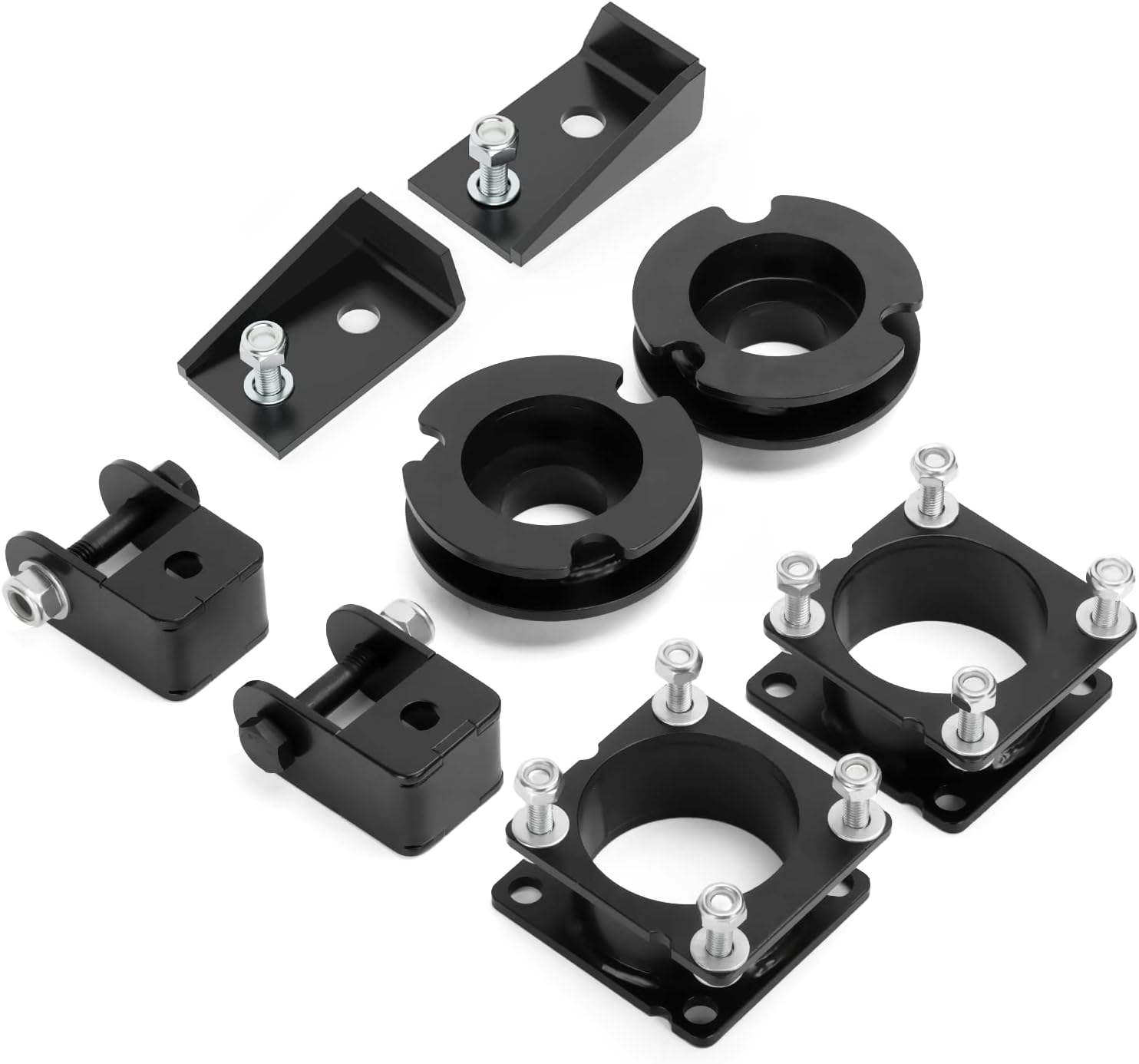
This KSP Performance lift kit is a simple, vehicle-specific solution for Explorer owners who want a noticeable lift without major suspension surgery. The kit includes front coil spacers, rear spacers and a set of shock extenders designed to bolt onto 2011–2019 Explorers that do not have the factory air-ride option. Installation is aimed at DIYers and typically takes a few hours using common tools; the design uses thicker alloy steel plates and special lug bolts for a secure fit and claims to reduce noise and vibration. The result is a modest 2.5-inch front and 1.25-inch rear lift that increases ground clearance and gives a more aggressive stance while keeping stock suspension geometry largely intact. Limitations to consider are the modest rear lift height compared with the front, and the vendor note about possible fender rubbing with tires larger than 33 inches. For owners who want a straightforward bolt-on height increase with minimal additional parts, this kit is a practical option, but those seeking larger lifts or air-suspension compatibility should look elsewhere.
Best for: Hands-on owners who want a clear 2–3 inch front lift that is bolt-on friendly and keeps handling close to stock while allowing a weekend DIY install.
Less Ideal for: Drivers seeking larger lifts, full suspension upgrades, or compatibility with air-ride systems should choose a different kit or a professional suspension overhaul.
- Vehicle-specific fit for 2011–2019 Explorer models without air-ride systems
- Bolt-on components (coil spacers and shock extenders) designed for DIY installation
- Thickened alloy steel construction aimed at improved strength and reduced vibration
- Raises front 2.5 inches for noticeable stance change while preserving much of the stock geometry
- Rear lift is smaller (1.25 inches) which can create a slight rake front-to-rear
- May cause fender rubbing with tires over 33 inches
- Not compatible with Explorers equipped with the air-ride suspension
Verdict: The best 2–3-inch lift kit for DIYers who want a noticeable but manageable height increase that preserves handling and requires fewer major modifications.
Choosing the Right Ford Explorer 4WD Lift Kit: Key Factors to Consider
Lift Height and Intended Use
Decide how much lift you need based on how you plan to use the Explorer. Small lifts in the 1 to 2 inch range are often intended to level the stance or allow modestly larger tires while preserving stock ride dynamics. Taller lifts in the 2 to 4 inch range increase ground clearance and provide room for significantly larger tires, but they also change steering geometry and may require additional modifications.
Consider where you drive most often. If you do mostly street driving with occasional trails, a moderate lift that retains comfortable on-road handling is usually best. For frequent off-road use, prioritize kits that improve suspension articulation and provide robust mounting points for shocks and control arms. Choosing the right height up front reduces the need for corrective parts later.
Suspension Type and Ride Quality
Lift kits come in different suspension approaches, such as coil spring spacers, complete coil spring replacements, or multi-component suspension lift kits that change control arms, shocks, and links. The suspension type strongly influences ride quality. Coil spring spacers are relatively simple and can raise the vehicle without changing spring rates, but they may reduce travel and affect comfort on rough terrain. Full coil spring replacements tuned for the new ride height can preserve spring travel and handling.
Also inspect shock compatibility. Some lifts require longer shocks or remote reservoirs to maintain damping through the extended travel. A kit that pairs springs with suitable dampers will generally give a more controlled ride than a lift that leaves original shocks in place. For a Ford Explorer 4WD, prioritize solutions that address both spring and damping so day-to-day comfort and off-road performance remain balanced.
Steering, Alignment, and Driveline Impacts
Raising ride height alters suspension geometry and steering link angles. Even modest lifts can change toe and caster, requiring a professional alignment to avoid uneven tire wear and compromised handling. Larger lifts may necessitate longer or adjustable control arms, track bar relocators, or steering stabilizers to maintain correct steering geometry and eliminate bump steer.
Driveline considerations are important for the 4WD Explorer. Increased angles at the front or rear driveshaft can accelerate U-joint wear or introduce vibration. Some lift solutions include driveline correction components or recommend limits on lift height to keep angles within safe ranges. Plan for post-installation alignment and verify that the kit includes or recommends any necessary steering or driveline adjustments.
Tire Clearance and Wheel Fitment
One of the main reasons owners install lift kits is to fit larger tires. However, tire clearance depends not only on lift height but also on wheel backspacing, offset, and the tire's width and profile. Verify realistic tire diameters and widths the Explorer can accept with the chosen lift without significant trimming of fenders or suspension components.
Consider whether you will need wheel spacers or different wheels to achieve the desired stance. Remember that wider tires increase scrub and load on steering components, so ensure the chosen kit supports your wheel and tire plans. A good lift kit provides a realistic range of compatible tire sizes and clear guidance on wheel offsets.
Installation Complexity and Service Needs
Installation difficulty ranges from simple bolt-on spacer kits to full suspension overhauls that may require press work, spring compressors, and specialized tools. Assess whether you will install the kit in a home garage or have it professionally installed. More complex installs take longer and can involve additional parts, such as extended brake lines, sway bar end link extensions, or revised bump stops.
Also think about long-term serviceability. Kits that use common fasteners and preserved mounting points are easier to maintain. If the kit changes control arms or steering links, check availability of replacement components and how they affect routine maintenance tasks.
Durability and Corrosion Protection
Lift kits are exposed to road grime, salt, and rocks, so material quality and protective finishes matter for longevity. Look for heavy-duty metal components, sealed bearings where applicable, and coatings such as powder coat or zinc plating to resist corrosion. Hardware quality, like grade-8 bolts and hardened washers, reduces the chance of fastener failure over time.
Consider whether the kit relocates load to existing body mounts. Solutions that concentrate stress on non-reinforced mounting points may require additional reinforcement over time. Durability not only affects safety but also influences long-term ownership cost and how often you might need service.
Understanding Lift Options for the Explorer 4WD
Lift solutions for the Ford Explorer 4WD vary from simple strut or coil spacers to full suspension kits that include springs, shocks, and link replacements. Each approach has tradeoffs in cost, complexity, and performance.
Spacer-style lifts are attractive for budget-minded owners because they keep much of the stock suspension and are relatively quick to install. However, they can reduce available suspension travel and may transfer load to areas not designed for it. Full kits that replace springs and shocks are more work up front but usually deliver better long-term ride quality and handling when matched properly.
- Spacer lifts: quicker install but may reduce travel
- Full spring and shock replacements: better ride and articulation
- Component kits: address steering and driveline geometry for larger lifts
How Lift Height Affects Handling and Safety
Raising the center of gravity changes how the Explorer responds in emergency maneuvers and cornering. Taller lifts increase body roll and can make the vehicle feel less stable if suspension tuning is not adjusted accordingly.
Properly matched shocks, sway bar end-link adjustments, and alignment can mitigate many handling penalties. For everyday driving, choose a lift height that balances clearance needs with predictable handling to maintain occupant safety.
- Higher center of gravity increases rollover propensity in extreme cases
- Correct alignment reduces uneven tire wear and maintains steering feel
- Suspension damping adjustments help control body motion after a lift
Common Installation Add-Ons and Why They Matter
Installing a lift often leads to additional required or recommended parts. Extended brake lines, sway bar link extensions, and bump stop relocation brackets are common. These ensure components are not overstressed and that full suspension travel is available.
In some cases, driveshaft or CV joint angles will need correction. Addressing these proactively prevents vibrations and premature component wear. Factor these add-ons into your planning so the final setup is safe and reliable.
- Brake line extensions maintain safe braking performance through travel
- Sway bar and bump stop modifications restore intended suspension limits
- Driveline corrections prevent vibration and joint wear
Tuning and Alignment After a Lift
An alignment is mandatory after any lift; it restores toe and caster into proper ranges and prevents accelerated tire wear. Depending on the kit, you may need aftermarket adjustable control arms or camber/caster correction plates to achieve correct alignment settings within safe tolerances.
Consider a corner-weighting or ride-height balancing step if you plan to use the Explorer off-road or carry uneven loads. Proper tuning helps the vehicle track predictably and reduces stress on suspension and steering components.
- Alignment addresses steering geometry changes from lift
- Adjustable links can be necessary for larger lifts
- Corner weighting helps with balanced handling for heavy loads
Practical Tire and Wheel Combinations
When selecting tires and wheels to pair with a lift, pay attention to overall diameter, aspect ratio, and wheel backspacing. These factors determine how the tire will interact with fenders and suspension during articulation and steering.
Plan for realistic clearances rather than theoretical maxima. Many owners find a conservative tire size that provides the desired off-road capability while avoiding rubbing under full suspension travel or tight steering lock.
- Measure actual clearance with wheel turned and suspension compressed
- Choose wheels with appropriate offset to center the tire within the wheel well
- Consider narrower tires for more clearance if needed
Maintaining Your Lifted Explorer
Routine inspections become more important after a lift. Check fasteners for torque, inspect boots and joints for wear, and monitor shocks for leaks. Early detection of issues reduces the chance of secondary damage to steering and suspension components.
Retorque critical suspension hardware after the first few hundred miles and during regular maintenance intervals. Keeping detailed records of service steps helps when diagnosing vibration or alignment issues down the road.
- Inspect mounting hardware and coatings for corrosion
- Check driveshaft angles and U-joint condition periodically
- Verify alignment after heavy off-road use or carrying heavy loads
Still looking for the perfect fit?
Select your Ford Explorer configuration to see the most relevant Lift Kits recommendations
How We Chose the Best Ford Explorer 4WD Lift Kit
Our editorial process focused on the attributes that affect performance, safety, and ownership for a Ford Explorer 4WD fitted with a lift kit. We prioritized fitment compatibility with the 4WD configuration, ensuring each shortlisted kit maintains proper steering geometry and does not require unrelated component swaps. Ride quality was assessed by looking at suspension design, shock compatibility, and whether the kit preserves or improves damping and articulation.Durability and materials were another filter. We favored kits that use hardened hardware, corrosion-resistant coatings, and proven mounting points to reduce long-term maintenance. Tire clearance and wheel offset compatibility were evaluated to determine realistic larger-tire fitments without excessive trimming or body modifications. Installation complexity and serviceability also mattered; we considered whether the kit works with common garage tools, requires specialty presses, or needs alignment and driveline adjustments.Excluded items included generic suspension spacers that lack structural reinforcement and any solutions that omit necessary braking, steering, or driveline corrections for the Explorer 4WD. The final selections reflect a balance of suspension types, achievable lift heights, and practical usability for both street and off-road driving.
Our full evaluation process is outlined in our review methodology.
FAQ
How much lift can I safely add to my Ford Explorer 4WD?
It depends on the kit and whether you address steering and driveline geometry. Small lifts around 1 to 2 inches usually require only alignment. Larger lifts often need control arm or track bar changes, and driveline corrections to avoid vibrations and excessive component wear.
Will a lift kit let me fit much larger tires on the Explorer?
A lift provides the vertical clearance needed, but tire fitment also depends on wheel offset, tire width, and suspension travel. Plan for realistic tire sizes the kit specifies and expect to adjust wheel offset or trim as needed for full articulation.
Can I install a lift kit at home, or should I use a shop?
Some spacer-style lifts are straightforward with common tools, but full suspension kits often require spring compressors, alignment, and sometimes specialized presses. If you lack the tools or experience, professional installation reduces risk and ensures correct geometry.
Do I need to change my shocks when installing a lift?
Often yes. Lifts that increase travel or ride height typically require longer or specifically tuned shocks to maintain proper damping. Leaving stock shocks in place can reduce control and accelerate wear on the shock and related components.
Will lifting affect my Explorer's fuel economy?
Lifting the vehicle and fitting larger tires can increase aerodynamic drag and rolling resistance, which usually reduces fuel economy. The degree of impact depends on lift height, tire size, and how you drive after the modification.
Are coil spring spacers a good budget option?
Coil spring spacers are a lower-cost way to raise ride height, but they can limit suspension travel and may not offer the same ride quality as full spring replacements. For light, occasional off-road use they can be acceptable, but weighed against long-term durability and handling.
Final Verdict
When selecting a lift kit for a Ford Explorer 4WD, prioritize the combination of lift height, suspension design, and the corrective parts needed to preserve steering and driveline geometry. Balance your desire for clearance and larger tires with the effects on ride quality and handling.Choose a solution that addresses springs and damping together when possible, plan for alignment and any driveline or steering corrections, and factor in installation complexity. That approach will give you a capable, safe, and well-balanced Explorer for both daily driving and off-road use.
Explore More:
- Check out all Ford Explorer parts & accessories
- Explore Suspension & Steering
- Browse all Accessories
