

Note: This article contains affiliate links. If you click on these links and make a purchase, I may earn a small commission at no extra cost to you. This helps support my research and content. Read my full affiliate disclosure here.
If you own a Jeep Wrangler with the 4.0L engine, the exhaust manifold is a small part that has an outsized effect on drivability and engine health. A warped flange, gasket failure, or crack can cause exhaust leaks, reduced performance, and noisy operation. Picking the right exhaust manifold or replacement option matters because it affects fitment, sealing, and long-term durability specific to the 4.0L layout.This guide looks at a curated shortlist of the top exhaust manifolds for the Jeep Wrangler 4.0L. We evaluate candidates for fit accuracy, material robustness, and sealing reliability so you can choose the option that best addresses symptoms like leaks or cracks. Read on for installation considerations and what to expect from each style of manifold.
Looking for other parts? See all Jeep Wrangler parts & accessories.
Top Picks at a Glance
| Best Overall The best all-around choice for most situations | TRQ Exhaust Manifold for 4.0L Jeep engines |  |
| Best Quality Built to a higher standard if you want something more solid | Omix-Ada Exhaust Manifold 17624.09 (replaces 33007072) |  |
| Best Value The sweet spot between price and what you get | maXpeedingrods Cast Iron Exhaust Manifold Kit for Jeep 4.0L |  |
| Best Budget The cheapest option that still gets the job done reliably | A-DCWMool Stainless Steel Exhaust Manifold & Gasket Kit for 4.0L Jeep Engines |  |
| Highest Rated A top-rated pick with lots of positive feedback | Garage-Pro Exhaust Manifold for 4.0L Jeep (1991–1999) |  |
| Most Popular A crowd favorite that many people choose with confidence | Dorman Exhaust Manifold Kit with Gaskets and Hardware |  |
| Best Seller A high-volume bestseller chosen again and again | JDMSPEED Stainless Steel Exhaust Manifold with Gasket Kit for 4.0L Jeep Engines |  |
1. TRQ Exhaust Manifold for 4.0L Jeep engines

| Compatible engine | 4.0L Jeep engines |
|---|---|
| Reference numbers | 674-196; 33007072; 4883385; 101112; 101212; 101330; 651186; 662691 |
This TRQ exhaust manifold is a direct-replacement unit intended for Jeep 4.0L applications and comes pre-assembled to reduce installation time. It bolts in like a factory-style manifold and is typically used when an original manifold is cracked or leaking and needs a like-for-like repair. Notable features include compatibility with common reference part numbers and TRQ’s focus on DIY support through video guides, which helps homeowners or mechanics follow the install steps. In practice the manifold should restore proper exhaust routing and eliminate leaks that cause noise and drivability issues, and its pre-assembled design reduces the chance of missing pieces during swap-out. Limitations are that this is a replacement manifold rather than a performance header, so it will not increase horsepower or change exhaust tone significantly, and buyers should verify exact vehicle fitment against the provided reference numbers before ordering.
Best for: Buyers who want a dependable, like-for-like repair to fix leaks or a damaged manifold and prefer a straightforward swap with DIY support.
Less Ideal for: Anyone seeking increased performance, improved exhaust flow, or a custom sound should look at aftermarket headers or performance manifolds instead.
- Direct-fit, pre-assembled design simplifies installation and reduces labor time.
- Made to match common replacement part numbers for straightforward compatibility checks.
- Includes access to DIY installation videos to guide less experienced installers.
- Designed as a factory-style replacement so it does not provide performance gains over a stock manifold.
Verdict: Choose this TRQ manifold if you need a reliable, pre-assembled factory-style replacement to restore proper exhaust sealing on a Jeep 4.0L engine.
2. Omix-Ada Exhaust Manifold 17624.09 (replaces 33007072)

| Fits engines | 4.0-liter inline-six (1991–1999 Jeep models) |
|---|---|
| Manufacturer | OMIX |
| Manufacturer part number | 17624.09 |
| OEM part reference | 33007072 |
This Omix-Ada exhaust manifold is a direct replacement for the 4.0L Jeep inline-six found in Wrangler, Cherokee, Grand Cherokee, and Comanche models from the 1991–1999 period. It installs in the stock location and is intended as a factory-quality swap for a cracked or leaking manifold, restoring exhaust routing and preventing header leaks that can hurt performance and idle smoothness. Construction matches the original part so fitment and bolt pattern line up with factory gaskets; the listing calls out the OEM reference 33007072 and recommends a specific gasket part. For a performance-minded buyer this manifold will reliably fix exhaust leaks and maintain drivability but it does not provide tuned scavenging or the flow gains of an aftermarket header. Expect the same thermal behavior and clearance as the factory piece, which simplifies installation but limits any horsepower upside without additional exhaust or tuning changes.
Best for: Buyers wanting a reliable, factory-style replacement to stop exhaust leaks and restore smooth idle and throttle response without modifying the stock exhaust system.
Less Ideal for: If you are building a performance exhaust or seeking measurable horsepower gains from the header area, choose a performance header or tuned exhaust instead.
- Factory-replacement fit and bolt pattern for direct swap into 4.0L Jeep engines
- Built to meet or exceed factory quality for dependable sealing and longevity
- Listed OEM reference and recommended gasket simplify correct installation
- Cast-manifold design does not improve exhaust scavenging or add measurable power
Verdict: Choose this Omix-Ada manifold when you need a dependable factory-style replacement to stop leaks and keep a 4.0L Jeep running like stock.
3. maXpeedingrods Cast Iron Exhaust Manifold Kit for Jeep 4.0L
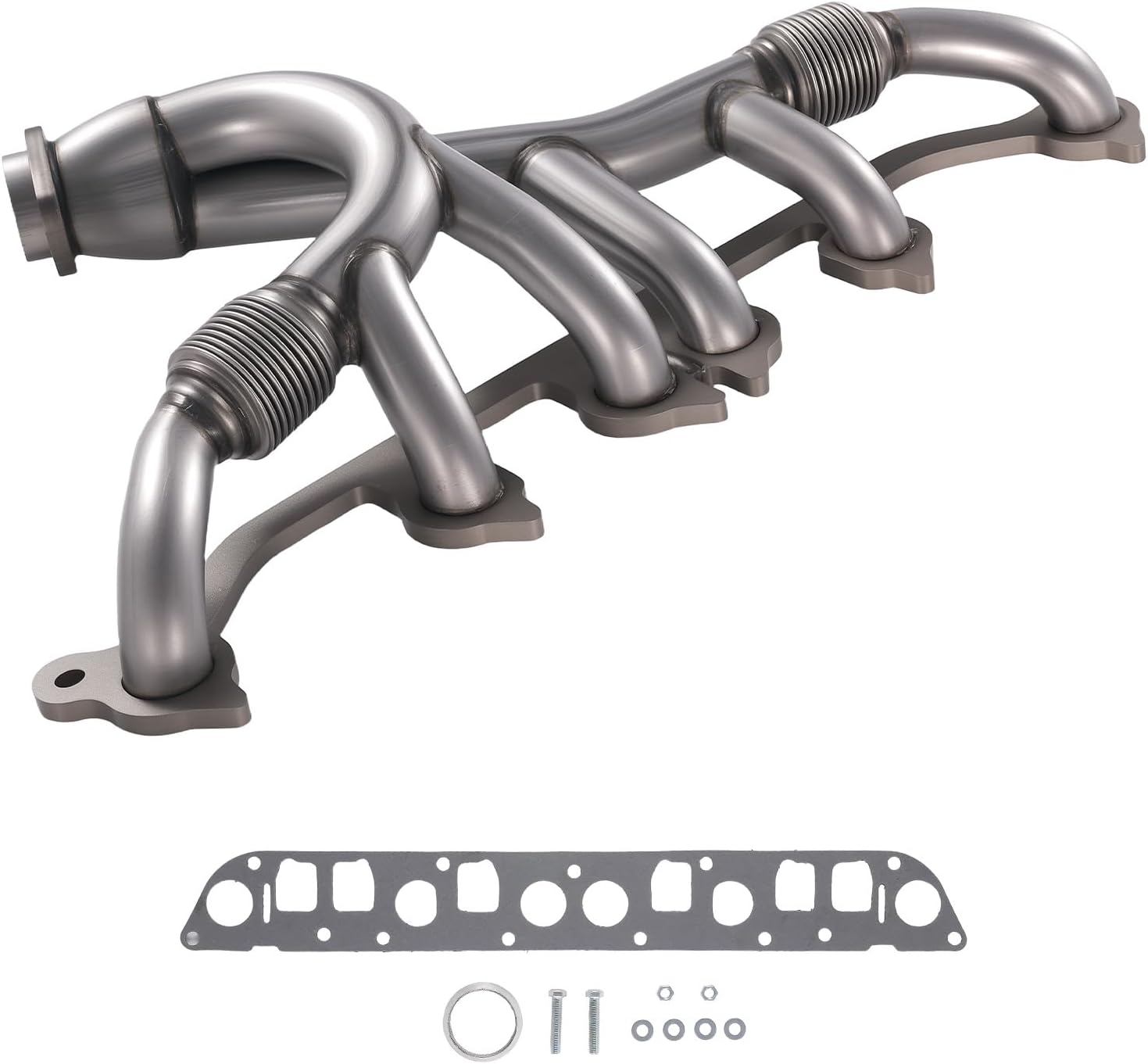
| Fitment | Jeep 4.0L models 1991–1999 (specific models listed) |
|---|---|
| Material | Cast iron |
| Included parts | Manifold with gaskets and mounting hardware |
| Manufacturer | maXpeedingrods |
This exhaust manifold kit replaces the factory manifold on Jeep 4.0L engines from the 1991–1999 era and is intended as a direct-fit replacement. Made from heavy-duty cast iron, the manifold is built to resist heat and corrosion and should withstand normal driving and higher-mileage use better than thinner aftermarket pieces. It ships as a kit with gaskets and mounting interfaces that match the listed factory part numbers, which simplifies installation for a competent DIYer or a shop used to older Jeep exhaust work. In practical terms you can expect restored exhaust routing, elimination of leaks from a cracked or rusted original, and modest improvements in engine smoothness and combustion consistency once leaks are removed. Trade-offs are that cast iron is heavy and will not improve horsepower; this is a durability and fitment upgrade rather than a performance header. Also confirm exact year and body fit before ordering, since fitment covers specific Cherokee, Grand Cherokee, Comanche, and Wrangler model years only.
Best for: Buyers who want a practical, durable factory-style replacement to restore a 4.0L Jeep's exhaust integrity and avoid repeat repairs should consider this kit.
Less Ideal for: If you are seeking a performance header, weight savings, or a modification-focused upgrade, this factory-style manifold is not the right choice.
- Cast iron construction for long-term durability and heat resistance
- Listed to match OEM mounting points and part numbers for straightforward fitment
- Includes gaskets and hardware as a kit to simplify installation
- Designed to stop exhaust leaks and restore engine smoothness
- Heavy cast iron adds weight and does not provide a performance gain
Verdict: A rugged, factory-style cast iron manifold kit that restores exhaust sealing and durability for 4.0L Jeep models without changing performance.
4. A-DCWMool Stainless Steel Exhaust Manifold & Gasket Kit for 4.0L Jeep Engines

| Compatible engines | 4.0L Jeep L6 (1991–1999) |
|---|---|
| Includes | Manifold, gaskets, downpipe hardware, heat shield |
| Construction | Stainless steel primary tubes |
| Design feature | Integrated flex bellows to absorb thermal expansion |
This A-DCWMool manifold kit replaces the factory exhaust manifold on Jeep 4.0L engines and comes as a complete bolt-on package with gaskets, downpipe hardware, and a heat shield. Built from stainless steel primary tubes and polished exterior finishes, it addresses common cracking by using integrated flex bellows that absorb thermal expansion and vibration. Smooth internal mandrels are claimed to improve exhaust flow, which can reduce backpressure and help the engine run a bit smoother and quieter compared with a heavily corroded original. Installation is straightforward for a competent home mechanic since it uses stock mounting points and includes necessary hardware. Expect better corrosion resistance than cast iron manifolds and a lower chance of future cracks thanks to the flex joints. The main limitations are that longevity depends on fitment and installation quality and that performance gains are modest rather than dramatic; this is a practical replacement aimed at restoring reliability rather than increasing power significantly.
Best for: Buyers seeking a budget-friendly, durable factory-style replacement to stop leaks and cracking on older 4.0L Jeep engines and get back to reliable daily driving.
Less Ideal for: Drivers looking for significant horsepower gains, race tuning, or a high-performance header upgrade should consider purpose-built performance manifolds instead.
- Direct bolt-on design with included gaskets and hardware for easier installation
- Stainless steel construction offers improved corrosion resistance over factory cast manifolds
- Integrated flex bellows reduce stress and help prevent the cracking common on older manifolds
- Mandrel-bent internals promote smoother exhaust flow and lower backpressure
- Not a performance header—expect only modest flow improvements rather than substantial horsepower gains
Verdict: A cost-effective, corrosion‑resistant bolt-on replacement that fixes cracking and restores reliable exhaust sealing on 4.0L Jeep engines.
5. Garage-Pro Exhaust Manifold for 4.0L Jeep (1991–1999)

| Manufacturer | Garage-Pro |
|---|---|
| Manufacturer Part Number | JCWJ960708GP |
| OEM Part Number | 4883385 |
| Vehicle Fitment | 1991–1999 Jeep 4.0L (Cherokee, Grand Cherokee, Comanche, TJ/Wrangler) |
This Garage-Pro exhaust manifold is a direct-fit replacement for 4.0L Jeep models from the 1990s and is intended to return a worn or cracked factory manifold to serviceable condition. It installs in the exhaust port to route exhaust gases from the cylinder head into the rest of the exhaust system and is sold individually as a tubular stainless steel unit. Typical use is repair or restoration during engine maintenance or when an old manifold leaks or cracks; the tubular stainless construction helps resist corrosion compared with cast iron replacements and reviewers report good fitment on XJ and TJ platforms. The product comes with a 1-year unlimited mileage warranty and includes the common interchange numbers for easy matching. Limitations are that mounting hardware and high-temperature gaskets or exhaust donuts may need to be sourced separately for a leak-free installation, and buyers should follow recommended torque and installation tricks for bottom bolts to avoid installation frustration. For someone needing a reliable, budget-conscious factory-style replacement, this manifold covers the basics without added performance claims.
Best for: Buyers who prioritize a dependable, factory-style repair to stop leaks and restore normal exhaust routing on a 4.0L Jeep from the 1990s and who value straightforward fitment over performance upgrades.
Less Ideal for: Drivers seeking performance headers, weight savings, or custom exhaust tuning should look at performance-oriented options instead.
- Direct-fit design for 4.0L 1991–1999 Jeep applications for straightforward replacement
- Tubular stainless steel construction offers improved corrosion resistance over older cast pieces
- Multiple customer reports of accurate fitment on XJ and TJ platforms
- Comes with a 1-year unlimited mileage warranty
- May require separate gaskets, exhaust donut, or hardware to ensure a leak-free installation
Verdict: A practical, corrosion-resistant direct-fit replacement that reliably restores exhaust sealing and function on 4.0L Jeep models from the 1990s.
6. Dorman Exhaust Manifold Kit with Gaskets and Hardware

| Compatible vehicles | Jeep 4.0L models (see fitment list) |
|---|---|
| Material Type | Iron |
| Includes | Gaskets and downpipe hardware |
| Manufacturer Part Number | 674-196 |
This Dorman exhaust manifold kit replaces the original manifold on compatible Jeep 4.0L models and comes with the gaskets and downpipe hardware needed for a complete installation. Built from iron with flex joints welded into the design, it aims to reduce the cracking that commonly affects older manifolds and provides a factory-style fit so it lines up with existing exhaust components. Typical use is a direct replacement during an exhaust repair when the original unit is cracked or leaking; the included hardware speeds a one-stop replacement and reduces parts-sourcing trips. Reviewers report generally good fitment and improved durability over tired stock manifolds, though a few note inconsistent quality control and recommend fitting higher-quality gaskets and replacement bolts for best results. Installation can be awkward because of tight bolt access, so plan for contested fasteners and expect to source better flange and donut gaskets if you want a more reliable seal. The kit is a practical option for a solid, mostly plug-and-play repair when you want to restore function without modifying the exhaust system.
Best for: Jeep owners who need a direct replacement for a cracked or leaking 4.0L exhaust manifold and prioritize restoring stock fit and function with minimal modification.
Less Ideal for: If you want a performance header, long-term custom fabrication, or an upgraded high-flow system, this factory-style replacement will not meet those goals.
- Includes required gaskets and downpipe hardware for a single-stop repair
- Cast iron construction with flex joints to resist cracking compared with older rigid manifolds
- Engineered to match factory fit and mounting locations for straightforward alignment
- Trusted aftermarket brand with many buyers reporting good fit and finish
- Included gaskets are reported as lower quality by some buyers, so replacement gaskets are often recommended
- Some units show occasional quality-control issues such as weld or flatness defects
Verdict: A practical, mostly plug-and-play iron manifold kit that restores factory fit and reduces the common cracking failure for Jeep 4.0L models.
7. JDMSPEED Stainless Steel Exhaust Manifold with Gasket Kit for 4.0L Jeep Engines

| Replacement part numbers | 33007072, 4883385, 674-196, 10105812 |
|---|---|
| Compatible engine | 4.0L inline-6 (1991–1999 Jeep models) |
| Material (primary tubes) | Stainless steel |
| Package includes | Manifold, gaskets, heat shield, downpipe hardware |
This JDMSPEED kit replaces a cracked or leaking factory exhaust manifold on 4.0L Jeep engines and arrives as a complete install package with gaskets, heat shield, and downpipe hardware. The primary tubes are upgraded to stainless steel while the flex joints and flange remain standard steel to allow thermal expansion. In use it aims to restore quiet operation, stop exhaust smell in the engine bay, and provide good flow at higher rpm thanks to a smooth internal finish. Buyers report generally good fitment and noticeably reduced ticking from leaks, though weld quality and packaging have been inconsistent across some units. The kit includes flex bellows to help prevent cracking, but a few reviewers recommended swapping the included gaskets for higher-quality aftermarket gaskets. Installation is manageable for someone with basic mechanical skills or a mechanic, and addressing worn motor mounts during the job can simplify the process. This is a pragmatic replacement option that balances value and improved durability over aging stock manifolds.
Best for: Buyers who want a direct-fit replacement that quiets exhaust leaks and restores engine bay sealing without expensive custom work, and who prefer a practical, value-minded repair with generally factory-like fit.
Less Ideal for: Those seeking a premium, worry-free OEM-level part or who need guaranteed perfect quality every unit should consider higher-end branded manifolds or professional-sourced replacements.
- Stainless steel primary tubes resist corrosion better than plain steel
- Complete kit includes manifold, heat shield, gaskets, and downpipe hardware for one-stop replacement
- Smooth internal finish aimed at improving exhaust flow at higher engine speeds
- Flex bellows included to reduce the chance of future cracking
- Many buyers report factory-like fit and noticeably reduced exhaust noise after install
- Some units show inconsistent welding and fitment quality requiring inspection or return
- Included gaskets and packaging have been reported as poor quality by several buyers
Verdict: A cost-effective, direct-fit stainless steel manifold kit that restores quiet sealing and improved exhaust flow for 4.0L Jeep engines without expensive upgrades.
Choosing the Right Jeep Wrangler 4.0L Exhaust Manifold: Key Factors to Consider
Fitment And Bolt Pattern Accuracy
Correct fitment is the most important factor for a Jeep Wrangler 4.0L exhaust manifold because the manifold must mate precisely to the 4.0L cylinder head and align with the stock exhaust routing. Even slight misalignment can cause stress on studs or bolts and lead to gasket failure or flange leaks. When fitment is correct, installation is faster and requires fewer adjustments to the exhaust downpipe or hangers.
Pay attention to whether the part lists explicit compatibility with the Wrangler 4.0L configuration and whether it includes or recommends specific hardware. Replacement manifolds that reuse the stock bolt pattern and oxygen sensor locations will reduce the chance of clearance issues and make the swap or installation less invasive.
Material And Heat Resistance
Materials determine how well a manifold resists cracking and corrosion under repeated heating and cooling. Cast iron has traditionally been used for durability and heat soak properties but is heavier and can crack if subjected to impact or manufacturing flaws. Ductile iron and thicker nodular castings improve resistance to thermal cycling and flange warpage. Some aftermarket options use high-grade stainless steel or coated alloys to reduce rust, but weld seams and bends must be inspected for stress points.
Heat resistance also affects how the manifold interfaces with the exhaust gasket and downstream components. Materials that hold flange flatness keep sealing consistent over time, which reduces the likelihood of leaks developing after repeated heat cycles.
Flange Flatness And Gasket Surface
The mating surface where the manifold meets the head is a frequent source of leaks on the 4.0L engine. A warped or uneven flange will not compress the exhaust manifold gasket uniformly, leading to exhaust manifold symptoms such as ticking at idle or an exhaust smell under the hood. Ensure the replacement manifold specifies machined or ground flanges and inspect for visible irregularities before installation.
Gasket surface design matters too. Some manifolds pair with multi-layer steel gaskets or thicker composite gaskets that tolerate slight imperfections and maintain a seal. Choosing a manifold that recommends a specific gasket type and supports consistent compression will reduce the chance of post-installation leaks.
Crack Resistance And Structural Design
Cracks often form where the manifold changes shape or where stress concentrates, such as around mounting ears or sensor bosses. Look for manifolds with reinforced junctions and smooth transitions in the casting or welding. Designs that avoid sharp corners and that distribute thermal stress reduce the likelihood of exhaust manifold crack issues over time on the 4.0L.
Also consider whether the design keeps exhaust pulses from creating localized hot spots. Manifolds that channel flow evenly and avoid restrictive bends will experience less uneven heating and therefore are less prone to hairline fractures that grow into larger cracks.
Sealing Hardware And Included Components
The quality and completeness of the included hardware can determine whether a repair is a one-trip job or a return visit. Manifolds that come with proper studs, high-temperature bolts, and recommended gaskets eliminate guesswork and reduce the chance of cross-threading or using incorrect fasteners. For the Jeep Wrangler 4.0L, studs are often preferred to bolts because they align components and reduce the risk of thread damage in the head.
If hardware is not included, plan to source high-grade fasteners and replacement gaskets that match the manifold's specifications. Missing or low-quality hardware is a common reason installers end up needing to re-torque or re-install a manifold after the initial job.
Compatibility With Sensors And Exhaust Routing
The 4.0L Wrangler uses specific sensor placements and an established downpipe routing that the manifold must accommodate. A replacement manifold should allow for the proper oxygen sensor position and maintain clearance to heat shields, steering components, and the rest of the exhaust system. Any deviation can complicate installation or cause improper sensor readings that affect engine performance.
Before purchasing, confirm that sensor bosses are present and correctly located and that the manifold does not interfere with factory brackets or nearby components. Compatibility with stock routing lowers installation time and preserves emissions and drivability characteristics.
Common Exhaust Manifold Symptoms On The 4.0L Engine
Exhaust manifold symptoms often start subtly and escalate if not addressed. Typical early signs include a ticking or tapping noise at idle that becomes more pronounced during acceleration, which usually indicates an exhaust leak at the flange or a cracked runner. You may also notice a strong exhaust smell in the engine bay or decreased low-end torque.
More advanced symptoms include rough idle, heat discoloration near the manifold area, or increased underhood temperature that can affect nearby components. Identifying symptoms early helps keep repairs simpler and prevents collateral damage such as melted heat shields or damaged wiring harnesses.
- Tapping or ticking noise at startup or idle
- Smell of exhaust in engine bay
- Reduced low-end power or rough idle
- Visible soot or heat-stained areas around the flange
Diagnosing An Exhaust Manifold Leak
Diagnosing a leak on the Jeep Wrangler 4.0L requires a few low-cost checks. With the engine cold, visually inspect the flange-to-head joint for soot streaks or fresh soot deposits, which are reliable indicators of leakage. Next, start the engine and carefully run a gloved hand near the flange area to feel for escaping exhaust gases, keeping clear of hot surfaces.
A more precise method uses a length of hose or a stethoscope to listen for escaping air while the engine runs. You can also watch for changes in idle when carefully covering then uncovering the flange area; a noticeable change often points to a leak location. Always exercise caution around moving parts and hot components.
- Look for soot marks and heat discoloration at the flange
- Listen with a hose or mechanic's stethoscope for leaks
- Feel for exhaust flow near the seam with proper safety
- Check for idle changes when gently isolating the flange area
When To Replace Versus Repair The Manifold
Whether to replace or attempt a repair depends on the type and location of damage. Small flange warpage or minor surface irregularities can sometimes be corrected by machining or by using a thicker gasket. Hairline cracks in accessible areas might be welded if material and accessibility permit, but welding cast components on the 4.0L carries risk and requires a qualified welder.
Replace the manifold when cracks are extensive, when the flange is badly warped, or when the material is thin and corroded. Replacement is often the more reliable long-term solution for the 4.0L because it restores proper sealing and avoids repeat repairs that stem from hidden fatigue or corrosion.
- Minor flange issues: consider resurfacing if within tolerances
- Localized cracks: welding may be possible but depends on material
- Extensive cracking or corrosion: favor replacement
- Also consider labor and downtime when deciding repair versus replace
Installation Considerations For Home Mechanics
Many Jeep Wrangler 4.0L owners can perform a manifold replacement with common tools, but preparation matters. Ensure you have the correct high-temperature gaskets and the recommended studs or bolts. Use anti-seize on studs where appropriate and follow torque sequences to avoid uneven clamping that leads to leaks.
Work in a cool, well-lit area and allow the engine to cool fully before starting. Replace any corroded fasteners, inspect the head threads for damage, and use thread chasers if needed. When reinstalling, torque fasteners in the proper sequence and to the specified values to maintain flange flatness.
- Have proper gasket and high-temperature fasteners on hand
- Follow manufacturer torque sequence and values
- Replace corroded hardware and inspect head threads
- Allow engine to cool fully before beginning work
Gasket Types And What Works Best With The 4.0L
Gasket selection affects how well a manifold seals over time. Multi-layer steel gaskets are durable and handle thermal cycling well, providing a reliable seal even with minor flange imperfections. Composite gaskets offer thicker sealing surfaces that can compensate for small irregularities but may not last as long under high heat cycling.
For the Wrangler 4.0L, choosing a gasket that matches the manifold material and flange finish helps ensure consistent compression and fewer post-installation leaks. If machining the flange, verify the gasket's recommended compressive thickness and replace the gasket any time the manifold is removed.
- Multi-layer steel gaskets: good for longevity and thermal cycling
- Composite gaskets: useful for compensating small flange imperfections
- Always replace the gasket when removing the manifold
- Match gasket type to manifold material where possible
Still looking for the perfect fit?
Select your Jeep Wrangler configuration to see the most relevant Exhaust Manifolds recommendations
How We Chose the Best Jeep Wrangler 4.0L Exhaust Manifold
We focused our selection on parts and configurations that address the common failure modes and service needs unique to the Jeep Wrangler 4.0L engine. Our evaluation criteria included fitment precision to the 4.0L cylinder head and bolt pattern, flange flatness and warpage resistance, and the heat-tolerance and corrosion resistance of materials used. We also prioritized designs that simplify sealing—either by accommodating a robust manifold gasket or by using integrated sealing features—and that minimize contact points that commonly crack under thermal cycling.Other key factors were ease of installation for typical home-garage repairs, compatibility with stock exhaust routing and sensors, and availability of replacement gaskets or hardware. We excluded components that required extensive modification to the engine bay, altered emissions control beyond typical bolt-on replacements, or had unreliable reported longevity. The list favors options that balance durability, straightforward installation, and correct 4.0L fitment rather than exotic performance conversions.
Our full evaluation process is outlined in our review methodology.
FAQ
What are the first signs of an exhaust manifold leak on a 4.0L Wrangler?
Early signs often include a ticking noise at idle, a noticeable exhaust smell in the engine bay, and visible soot or heat discoloration at the flange. These symptoms usually indicate a seal failure or small crack.
Can a cracked 4.0L manifold be welded reliably?
Welding can be possible for certain materials and accessible cracks, but cast components and extensive damage reduce success rates. A qualified welder should assess the crack and material before attempting repair, and replacement is often the longer-lasting option.
Do I need special hardware to install a replacement manifold on the Wrangler 4.0L?
Using high-temperature bolts or studs and fresh gaskets is recommended. Studs are often preferred because they help align components and reduce thread damage in the head, improving reliability after installation.
How do I check flange flatness before installation?
Use a straightedge and a feeler gauge to check for gaps along the flange surface. Minor gaps can sometimes be corrected by machining if within allowable tolerances; larger warpage usually requires replacement to ensure a proper seal.
Will a leaking manifold affect engine performance on the 4.0L?
Yes, leaks can reduce low-end torque, cause rough idle, and alter oxygen sensor readings in some cases. Addressing a leak promptly helps restore normal drivability and prevents further damage to nearby components.
How long does a typical installation take for a home mechanic?
A straightforward replacement typically takes a few hours for someone comfortable with engine work, though time increases if seized hardware or corrosion is present. Allow extra time for cleanup, hardware replacement, and proper torqueing.
Final Verdict
Prioritize fitment precision, flange flatness, and material durability when choosing an exhaust manifold for the Jeep Wrangler 4.0L. Those factors most directly influence whether the part will seal properly, resist cracking, and maintain consistent performance under repeated heat cycles. Balance ease of installation and the availability of quality sealing hardware against potential longevity tradeoffs.For routine leak repairs or flange issues, select an option that supports machining or includes robust gaskets and high-temperature fasteners. When cracks or extensive corrosion are present, replacement is usually the more reliable long-term choice. Use the decision criteria above to select the right manifold for dependable service on the 4.0L engine.
Explore More:
- Check out all Jeep Wrangler parts & accessories
- Explore Exhaust Manifolds Maintenance & Repair Guides
- Explore Exhaust & Emissions
- Browse all Auto Parts
