

Note: This article contains affiliate links. If you click on these links and make a purchase, I may earn a small commission at no extra cost to you. This helps support my research and content. Read my full affiliate disclosure here.
Choosing the correct engine oil for your Ford Ranger affects daily drivability, long-term engine wear, and maintenance intervals. You want an oil that matches the truck's required viscosity, protects against deposits and wear, and works with your driving conditions.This guide highlights seven shortlisted engine oils selected for real-world use and outlines the criteria we used to evaluate them. Below you will find the top options and the factors to consider when picking the right oil for frequent highway driving, towing, or mixed urban use.
Looking for other parts? See all Ford Ranger parts & accessories.
Top Picks at a Glance
| Best Overall The best all-around choice for most situations | Motorcraft SAE 5W-20 Synthetic Blend Motor Oil, 5-Quart Jug |  |
| Best Quality Built to a higher standard if you want something more solid | Mobil 1 Full Synthetic Motor Oil 0W-40, 5 Quart (Pack of 2) |  |
| Best Value The sweet spot between price and what you get | Castrol GTX High Mileage 5W-30 Synthetic Blend Motor Oil, 5 Quart Bottle |  |
| Best Budget The cheapest option that still gets the job done reliably | Motorcraft 5W-30 Engine Oil (1 qt) |  |
| Highest Rated A top-rated pick with lots of positive feedback | Motorcraft 5W-30 Engine Oil, 5-Quart Jug |  |
| Most Popular A crowd favorite that many people choose with confidence | Valvoline Advanced Full Synthetic 5W-30 Motor Oil, 5 qt |  |
| Best Seller A high-volume bestseller chosen again and again | Valvoline MaxLife Full Synthetic High Mileage 5W-20 Motor Oil, 5 qt |  |
1. Motorcraft SAE 5W-20 Synthetic Blend Motor Oil, 5-Quart Jug

| SAE J300 Viscosity Grade | 5W-20 |
|---|---|
| Container Type | Jug |
| Liquid Volume | 5 Quarts |
| Compatible with Vehicle Type | Car, SUV, Truck, Van |
This Motorcraft 5W-20 synthetic blend is formulated for Ford-family gasoline and flex-fuel engines and is sold in a single 5-quart jug for routine oil changes. It uses hydro-processed base stocks and performance additives to reduce deposits, protect against high-temperature oxidation and turbocharger buildup, and resist foaming and corrosion. The friction-reducing chemistry helps lower wear and can improve fuel economy compared with thicker grades such as 5W-30. It meets WSS-M2C960-A1 and SN PLUS, so it also addresses low-speed pre-ignition concerns in supported engines. For a Ranger owner looking for a dependable service-fill oil, this supplies factory-quality fit and function and simplifies maintenance by matching Ford specifications. The main limitation is that it is a 5W-20 grade only, so it is only appropriate where the manufacturer specifies that viscosity and not for engines that require other grades or heavier-duty, extended-interval synthetics.
Best for: Balanced all-round buyers who prioritize factory-spec reliability and straightforward maintenance for their Ford Ranger and want an oil that matches manufacturer recommendations without chasing extreme performance gains.
Less Ideal for: Owners who need a different viscosity or who prefer full-synthetic oils for extended drain intervals or extreme operating conditions should consider other grades or full-synthetic alternatives.
- Factory-recommended formulation for many Ford, Lincoln, and Mercury gasoline engines
- Synthetic blend base oils and additives that reduce deposits and protect against oxidation and turbo deposits
- Meets WSS-M2C960-A1 and SN PLUS specifications addressing LSPI and modern engine needs
- Sold in a 5-quart jug convenient for a single oil change without transferring from multiple containers
- Only offered in SAE 5W-20 grade so not suitable where other viscosities are required
- Synthetic blend rather than full synthetic, so maximum service interval and extreme-temperature performance are more limited
Verdict: Factory-recommended 5W-20 synthetic blend that delivers dependable, Ford-spec lubrication for routine oil changes.
2. Mobil 1 Full Synthetic Motor Oil 0W-40, 5 Quart (Pack of 2)

| Viscosity | 0W-40 |
|---|---|
| Type | Full Synthetic Motor Oil |
| Liquid Volume | 10000 Milliliters |
| Size | 5 Quart (Pack of 2) |
Mobil 1 0W-40 is a full synthetic motor oil designed to deliver wide-temperature protection and long drain intervals up to 10,000 miles or one year. It flows easily at cold starts for quick lubrication and retains enough high‑temperature viscosity to protect under sustained loads and highway cruising. The formula advertises resistance to oxidation and deposit control, which helps keep internal parts cleaner during spirited driving or towing. It carries approvals for several European maker specifications and is commonly chosen where robust turbocharged engine protection is needed. For a Ford Ranger used in performance or heavy-duty scenarios this oil gives confident start-up protection and steady film strength at operating temperature, though its 0W-40 grade may be thicker than factory recommendations for some Ranger engines that call for 5W-30 or 5W-20, so check the owner's manual before switching and expect a premium cost compared with conventional oils.
Best for: Performance-oriented owners who prioritize maximum thermal stability and protection under load and who are willing to use a higher-viscosity synthetic to protect a built or heavily used engine.
Less Ideal for: Owners seeking strict adherence to Ford factory viscosity recommendations or those who prefer lower-viscosity oils for improved fuel economy should consider alternatives matched to the Ranger manual.
- Full synthetic formula provides strong cold-start flow and high-temperature protection
- Advertised control of oxidation and deposits to help maintain engine cleanliness over long intervals
- Suitable for turbocharged and high-stress engines, supporting sustained highway or towing use
- Long recommended drain interval up to 10,000 miles or one year when following manufacturer guidance
- Viscosity grade 0W-40 may be thicker at operating temperature than factory recommendations for many Ford Ranger engines
Verdict: A high‑performance full synthetic 0W-40 oil aimed at drivers who want strong cold-start flow and robust protection for high-stress or modified engines.
3. Castrol GTX High Mileage 5W-30 Synthetic Blend Motor Oil, 5 Quart Bottle

| Compatible with Vehicle Type | For use in vehicles with over 75,000 miles, Passenger cars, trucks, and SUVs |
|---|---|
| SAE J300 Viscosity Grade | 5W-30 |
| Automotive Fit Type | Universal Fit |
| Container Type | Bottle |
| Liquid Volume | 160 Fluid Ounces |
Castrol GTX High Mileage 5W-30 is a synthetic-blend motor oil designed to protect engines with elevated mileage by reducing wear, controlling sludge, and helping preserve the emission system. In practical use for a Ford Ranger with higher miles, it provides robust detergent action to clean deposits, seal conditioners that can reduce small leaks, and reduced phosphorus chemistry intended to be gentler on catalytic converters. Typical use is a drain-and-fill at scheduled intervals where this grade meets common API and ILSAC specifications and several Ford service specs listed on the label. Benefits include improved engine cleanliness, lower volatility to limit top-offs between changes, and additives aimed at timing-chain and friction wear protection. The main limitation is that it is a synthetic blend rather than a full synthetic, so it may not match the extended drain intervals or the absolute shear stability of premium full-synthetic oils in severe-duty or performance-focused applications. For routine highway and light-duty truck use, it balances protection and cost effectively, but heavy towing or track use may call for a full-synthetic alternative.
Best for: Practical optimizers who want a cost-conscious, protective oil for a higher-mileage Ford Ranger and prioritize engine longevity and maintenance value over maximum synthetic performance.
Less Ideal for: Drivers who run heavy towing, extreme loads, or demand the longest possible oil-change intervals should consider a full synthetic oil designed for severe-duty use instead.
- Formulated for high-mileage engines with additives that help reduce sludge and deposits
- Phosphorus Replacement Technology to reduce catalytic converter stress
- Strong detergent package and dispersants for cleaner internals
- Reduced volatility to limit oil burn-off and top-offs between changes
- Synthetic blend rather than full synthetic, so not optimized for extended drain intervals or extreme-duty use
Verdict: A budget-friendly high-mileage 5W-30 that keeps worn Ford Ranger engines cleaner and better protected without the premium price of full synthetics.
4. Motorcraft 5W-30 Engine Oil (1 qt)

| Container Type | Bottle |
|---|---|
| Compatible with Vehicle Type | Car |
| Liquid Volume | 946 Milliliters |
| Included Components | Funnel |
This Motorcraft 5W-30 oil is the factory-replacement option designed to meet Ford and Lincoln specifications and is packaged with a funnel for easy topping off. It is typically used for routine oil top-ups and oil changes where Ford recommends 5W-30 viscosity, including keeping a spare quart on hand between service intervals. Notable features include Motorcraft branding and a 1-quart bottle size that makes storage and single-quart repairs simple. Practical benefits are straightforward: you get a product engineered to match factory requirements, familiar handling for DIYers, and minimal waste when you only need a small quantity. Limitations are the single-quart packaging if you need larger volumes for a full oil change and the product information does not list specific performance standards or approvals on the label copy provided here, so buyers should verify compatibility with their Ranger year and engine before use.
Best for: Budget-conscious Ford owners who prefer factory-replacement fluids and want an affordable, no-surprises option for topping off or emergency use.
Less Ideal for: Drivers who perform frequent full oil changes and need multi-quart containers for convenience or who require oil with visibly listed aftermarket performance certifications.
- Factory-quality formulation intended for Ford and Lincoln vehicles
- Convenient 1-quart bottle with included funnel for easy top-offs
- Full synthetic base suitable for modern engine protection based on brand positioning
- Sold in 1-quart units which may be inefficient for full oil changes
Verdict: Choose this Motorcraft 5W-30 when you want a budget-friendly, factory-replacement oil option for Ford vehicles in a convenient 1-quart package.
5. Motorcraft 5W-30 Engine Oil, 5-Quart Jug
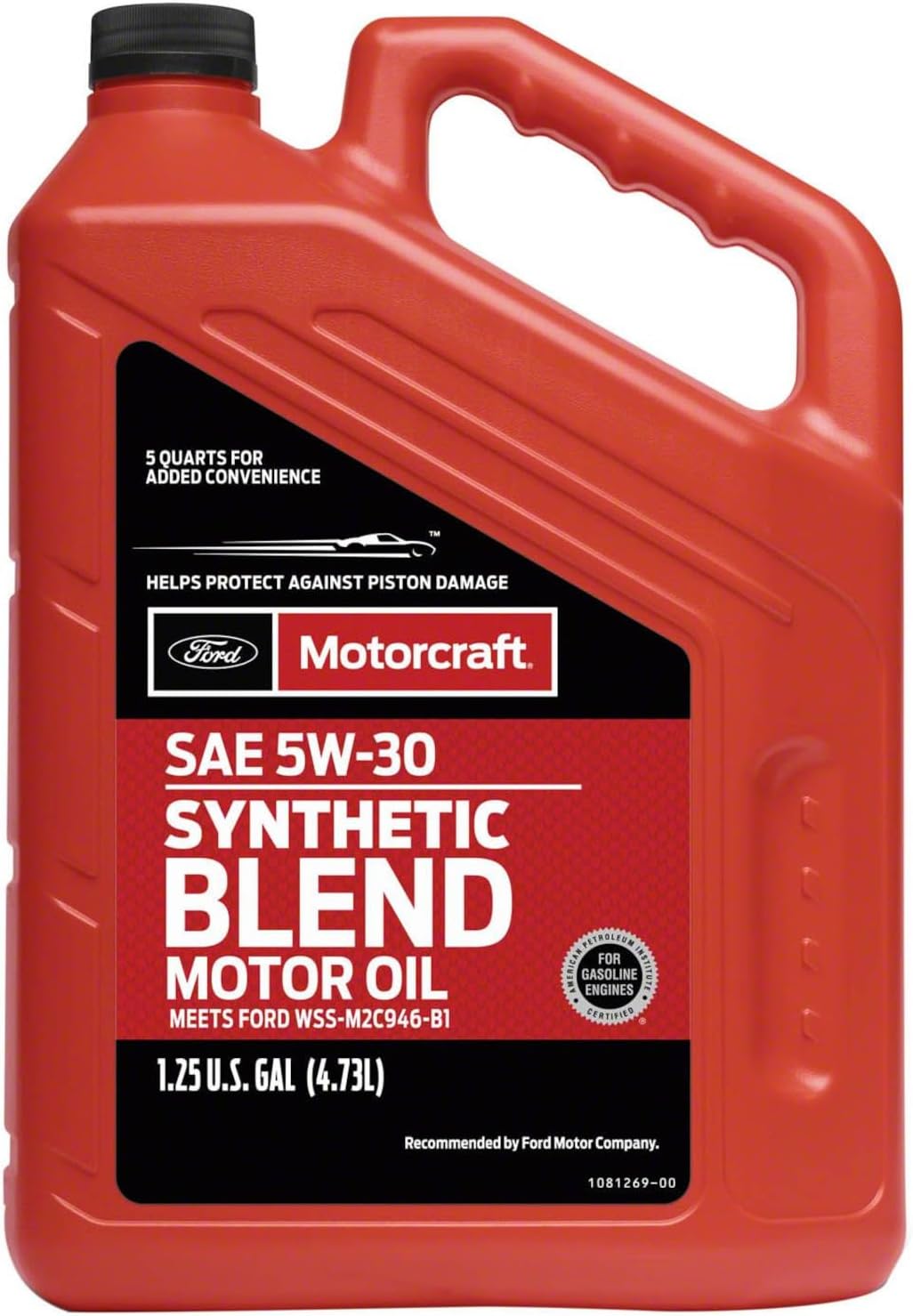
| Viscosity | 5W-30 |
|---|---|
| Size | 5-Quart Jug |
| Vehicle Service Type | Car, SUV, Truck, Van |
| Flash Point | 446 Degrees Fahrenheit |
This Motorcraft 5W-30 comes in a 5-quart jug and is formulated to meet factory-quality expectations for Ford vehicles. It is used as a direct engine oil replacement for routine oil changes to protect moving parts, support cold starts, and help maintain fuel economy. Notable features include a manufacturer-backed formulation tailored for broad vehicle service types and a high flash point that indicates thermal stability under operating conditions. The jug format is convenient for DIY maintenance and the product is presented as a universal fit for many gasoline engines. Practical benefits include consistent cold-weather flow and compatibility with Ford-specified service intervals, which simplifies maintenance for owners who prioritize long-term reliability. Limitations are that this listing does not specify full API or Ford specification numbers on the label and a single viscosity grade may not suit engines that require different formulations such as high-mileage or diesel-specific oils.
Best for: Reliability-focused owners who want a factory-quality, do-it-yourself engine oil that keeps routine maintenance simple and predictable for a Ford Ranger.
Less Ideal for: Drivers seeking specialty oils for high-mileage engines, towing-intensive use, or diesel powertrains should consider purpose-built formulations instead.
- Factory-replacement formulation tuned for Ford and Lincoln vehicles
- 5-quart jug is convenient for full oil changes and DIY servicing
- High flash point suggests good thermal stability during operation
- Consistently good cold-start performance reported by owners
- Listing does not show specific API or Ford specification numbers
- Single-viscosity option may not cover high-mileage or diesel needs
Verdict: A reliable, factory-quality 5W-30 in a 5-quart jug that suits Ford owners who prioritize straightforward, OEM-aligned maintenance.
6. Valvoline Advanced Full Synthetic 5W-30 Motor Oil, 5 qt

| SAE J300 Viscosity Grade | 5W-30 |
|---|---|
| Compatible with Vehicle Type | Car, Truck |
| Container Type | Jug |
| Liquid Volume | 5 Quarts |
| Meets Specifications | ILSAC GF-7A, API SP, API SN |
Valvoline Advanced Full Synthetic 5W-30 is a ready-to-use 5 quart jug of full synthetic motor oil formulated to protect gasoline engines in everyday and severe driving. It is used like any standard engine oil for oil changes and is suitable where a 5W-30 viscosity and the listed industry specs are recommended. The formula emphasizes wear and heat protection, claiming stronger wear resistance, improved deposit control, and better high-temperature stability compared with industry baselines, which helps keep engine internals cleaner and reduces cold-start wear thanks to better low-temperature flow. Practical benefits include fuel economy gains and broad compatibility with many common vehicles when 5W-30 is specified. Limitations are straightforward: buyers must confirm factory-recommended viscosity and approved specs for their Saturn Vue model and trim, and this single jug does not include additives or mixing instructions beyond normal oil change practice.
Best for: Convenience-minded owners who want a widely available, full synthetic replacement that covers routine oil changes and offers strong engine protection without needing specialty blends.
Less Ideal for: Owners who require a different viscosity, vehicle-specific synthetic approved by a dealer, or specialized oils for racing or unusual operating conditions should look elsewhere.
- Full synthetic formula for stronger wear and heat protection compared with standard oils
- Designed for good low-temperature flow to reduce cold-start wear
- Formulated to help prevent deposits and sludge for cleaner engine performance
- Comes in a 5 quart jug suitable for a complete oil change without mixing
- Only available in a single viscosity grade here so it must match the vehicle's required oil viscosity
Verdict: A convenient, full synthetic 5W-30 oil that prioritizes wear and heat protection for routine engine care.
7. Valvoline MaxLife Full Synthetic High Mileage 5W-20 Motor Oil, 5 qt

| SAE J300 Viscosity Grade | 5W-20 |
|---|---|
| Compatible Vehicle Type | Car, Truck |
| Liquid Volume | 5 Quarts |
| Flash Point | 390 Degrees Fahrenheit |
Valvoline MaxLife Full Synthetic 5W-20 is a high-mileage motor oil aimed at vehicles with over 75,000 miles but suitable for any engine requiring 5W-20. In a Scion xD this oil supplies full synthetic protection during normal driving and highway use, helping reduce wear and control sludge while the included seal conditioners can help limit minor leaks common in older engines. Notable features include a formula that Valvoline says improves wear protection, sludge defense, and heat resistance compared with typical industry baselines, and it meets current API and ILSAC gasoline specifications. Practical benefits for an xD owner are longer engine life, steadier oil consumption, and potentially improved fuel economy versus conventional oils. Trade-offs are limited: 5W-20 is a specific grade so you must confirm factory recommendations for your xD year and engine, and high-mileage additives can slightly change oil change intervals or cost compared with basic synthetic blends. The product comes in a standard 5 quart bottle with Valvoline's anti-glug pour design that makes DIY oil changes cleaner.
Best for: Practical owners who prioritize long-term engine health and cost-effective maintenance, looking to extend the life of a higher-mileage Scion xD without overcomplicating service decisions.
Less Ideal for: Drivers who maintain a low-mileage or brand-new Scion xD and prefer a basic synthetic blend or the exact factory-recommended low-viscosity oil without high-mileage additives.
- Formulated for high-mileage engines to reduce wear and help prevent leaks
- Full synthetic 5W-20 provides stronger sludge and heat protection than many conventional oils
- Meets ILSAC GF-7A and current API gasoline standards for broad compatibility
- 5 quart bottle with anti-glug pour design eases DIY oil changes
- Only available in the 5W-20 grade so not suitable if your Scion xD requires a different viscosity
- High-mileage additive package may be unnecessary for low-mileage engines
Verdict: A practical full synthetic 5W-20 high-mileage oil that helps extend engine life and reduce common ageing issues in higher-mileage Scion xD vehicles.
Looking for the perfect fit?
Select your Ford Ranger configuration to see the most relevant Engine Oils recommendations
Choosing the Right Ford Ranger Engine Oil: Key Factors to Consider
Viscosity and Cold-Start Performance
Viscosity determines how easily oil flows at different temperatures and directly affects start-up protection. Lower first number grades improve cold-start flow, reducing wear during initial seconds after ignition, while the second number indicates high-temperature film strength.
Pick an oil with the viscosity recommended for your climate and engine type. If you live in colder regions or make many short trips, prioritize lower cold-weather viscosity to reduce wear. For sustained towing or high operating temperatures, a higher high-temperature viscosity can help maintain hydraulic lift and oil pressure.
Additive Package and Anti-Wear Protection
The additive chemistry governs how well the oil prevents metal-to-metal contact, controls friction, and protects critical components under load. Anti-wear additives such as zinc dialkyldithiophosphate provide a sacrificial layer that reduces wear on camshafts, lifters, and bearings.
Consider oils with robust anti-wear and friction modifiers if you tow frequently or subject the engine to high loads. Look for information about the oil's anti-wear performance and compatibility with modern emission-control hardware to avoid unintended side effects.
Detergents, Dispersants, and Deposit Control
Detergents and dispersants keep contaminants suspended and prevent sludge and varnish buildup that can reduce performance and clog oil passages. Effective deposit control preserves combustion efficiency and extends component life.
If you drive in stop-and-go traffic or perform many short trips, prioritize oils formulated to resist sludge formation. For engines with higher oil contamination risk, stronger detergent systems can maintain cleanliness between drains and protect oil galleries and turbochargers if present.
Thermal Stability and Oxidation Resistance
Thermal stability determines how long oil can maintain its protective properties at high operating temperatures without breaking down. Oxidation resistance limits acid formation and viscosity increase over time, supporting longer drain intervals and more consistent performance.
For heavy use like towing or hill climbing, choose oils with documented oxidation resistance. This factor also matters if you plan extended drain intervals, since poor thermal stability increases sludge and viscosity rise, undermining protection.
Compatibility with Engine Seals and Emission Systems
Some formulations can affect seal swell or shrink and interact with emission-control devices. Compatibility helps prevent leaks and maintain the correct crankcase ventilation behavior. Oils must also meet engine manufacturer specifications to avoid warranty or performance issues.
Confirm the oil is listed as compatible with Ford specifications or equivalent industry standards. If your vehicle has high mileage or older seals, consider formulations designed for seal conditioning to reduce leaks while preserving emission system function.
High-Mileage Considerations and Maintenance Schedule
High-mileage engines may benefit from oils formulated to condition seals, reduce oil consumption, and minimize blow-by by addressing worn components. Such formulations often include higher levels of specific additives to help mitigate age-related issues.
If your Ranger has elevated mileage, weigh the benefits of a high-mileage formulation against your typical driving patterns. Also, consider how oil choice interacts with your preferred maintenance schedule, since some oils support longer drain intervals while others are optimized for more frequent changes.
How We Chose the Best Ford Ranger Engine Oil
We focused on oils that meet Ford-recommended specifications, match common Ranger viscosities, and offer clear lab or manufacturer data on performance. Key evaluation criteria included viscosity range and cold-start flow, anti-wear additive chemistry and zinc/phosphorus content, detergent and dispersant effectiveness for deposit control, thermal and oxidation stability for longer drain intervals, and suitability for high-mileage engines where applicable.We excluded oils without published specifications or those that lack compatibility with Ford engine seals. We also filtered out conventional oils when a modern synthetic formulation was required by specification. The result is a list of products that meet the mechanical and chemical demands of a Ford Ranger engine while addressing common owner concerns such as cold starts, towing stress, and extended service intervals.
Our full evaluation process is outlined in our review methodology.
FAQ
How do I know which viscosity grade my Ford Ranger needs?
Check your vehicle's owner's manual for the manufacturer-recommended viscosity range based on ambient temperature and engine type. If you drive in very cold or very hot climates, choose the grade that matches those temperature ranges to ensure proper start-up protection and sustained film strength.
Is synthetic motor oil necessary for a Ford Ranger?
Many modern engines benefit from synthetic formulations because they offer better cold-flow, thermal stability, and longer service life than conventional oils. Whether it is necessary depends on the engine's design and the manufacturer's recommendation, your driving conditions, and whether you plan longer drain intervals.
Can I switch to a high-mileage oil if my Ranger has over 100,000 miles?
Switching to a high-mileage formulation can help address oil consumption and minor seal leaks by including conditioners and additives targeted at older engines. It often reduces smoke and blow-by, but results vary depending on the engine's condition and maintenance history.
How often should I perform an engine oil change?
Change intervals depend on the oil type, your driving habits, and the engine's condition. Synthetic oils often allow longer intervals than conventional oils, but severe driving conditions like towing or frequent short trips usually call for more frequent changes. Follow manufacturer guidance and monitor oil condition between services.
Does the choice of oil affect towing performance?
Yes. When towing, the engine runs hotter and under greater load, so an oil with strong thermal stability, robust anti-wear additives, and the correct high-temperature viscosity will help maintain pressure and protection. Choosing the right oil reduces wear during repeated heavy loads.
Conclusion
Picking the right engine oil for a Ford Ranger means balancing viscosity, additive chemistry, and intended use. Prioritize the manufacturer's recommended viscosity and an additive package that addresses your typical driving demands, whether cold starts, towing, or high mileage.Accept that tradeoffs exist: oils that excel at cold-start protection may differ from those optimized for tow-heavy use. Use the factors above to match an oil to your driving pattern and maintenance preferences to keep the engine protected and running smoothly.
Explore More:
- Check out all Ford Ranger parts & accessories
- Explore Fluids & Chemicals
- Browse all Accessories
