

Note: This article contains affiliate links. If you click on these links and make a purchase, I may earn a small commission at no extra cost to you. This helps support my research and content. Read my full affiliate disclosure here.
A coolant pressure tester kit helps you find leaks in a vehicle cooling system before they turn into overheating, low coolant warnings, or repeat top-offs. For DIY mechanics, it is one of the most useful diagnostic tools for checking radiators, hoses, water pump areas, heater circuits, reservoir tanks, and cap sealing issues without guessing.The right kit is not just about having a pump and gauge. Adapter fit, pressure stability, readable markings, and overall durability all affect whether testing feels straightforward or frustrating. The picks that follow are aimed at home garage users who want dependable results, broad vehicle coverage, and a kit that makes cooling system diagnostics easier.
Top Picks at a Glance
| Best Overall Coolant Pressure Tester for DIY Mechanics Reliable, accurate, and easy-to-use all-around tester with broad compatibility | Orion Motor Tech 33‑Piece Coolant Pressure Tester & Vacuum Refill Kit |  |
| Best Budget Coolant Pressure Tester for DIY Mechanics Affordable, dependable tester offering basic adapters and satisfactory leak detection | Punmew 18-Piece Radiator Coolant Pressure Tester Kit |  |
| Best Professional-Grade Coolant Pressure Tester Rugged, shop-ready tester with precision gauge and heavy-duty components | Mastercool 43301-A 27‑Piece Radiator Pressure & Vacuum Test Kit |  |
| Best Compact Coolant Pressure Tester Space-saving, portable tester with a small footprint and essential adapters | Orion Motor Tech 7‑Piece Coolant Pressure Tester Kit with 0–30 psi Gauge |  |
| Best Complete Coolant Pressure Tester Kit Comprehensive kit including extensive adapters, hoses, and versatile fittings | Orion Motor Tech 34-Piece Coolant Pressure Tester and Vacuum Refill Kit |  |
| Best High-Pressure Coolant Tester Built to safely reach higher test pressures with clear, durable gauge | OEMTOOLS 24444 Coolant Vacuum Refill and Pressure Tester Kit |  |
| Best Premium Coolant Pressure Tester Top-quality construction, precise instrumentation, and long-lasting accessory set | Mastercool 43306 Heavy-Duty Cooling System Pressure Test & Refill Kit |  |
Orion Motor Tech 33‑Piece Coolant Pressure Tester & Vacuum Refill Kit
Best Overall Coolant Pressure Tester for DIY Mechanics

| Number of adapters | 23 |
|---|---|
| Vacuum pump range | 0-35 psi (0-2.5 bar) |
| Filler gauge range | 0 to -30 inHg |
| Thermometer range | 32-400°F (0-200°C) |
This Orion Motor Tech kit combines a hand vacuum pump pressure tester with a vacuum purge and refill tool to test cooling system pressure and refill radiators without introducing air. Technicians and DIYers use the set to pressurize the cooling circuit, check for leaks at the radiator, hoses, water pump, head gasket, and heater core, then vacuum‑fill the system to eliminate air pockets. The kit stands out for its breadth of adapters and organized molded case so you can quickly match an adapter to the vehicle and keep everything together. The included probe thermometer and clearly marked, color‑coated adapters make diagnosis and refilling more straightforward. Materials are a mix of aluminum alloy, brass, nylon and rubber designed for repeated shop use. Expect a learning curve if you have not done pressure testing before and bulky case weight when carrying it around, but for routine leak checks and clean coolant changes this package replaces several single‑purpose tools and speeds the job.
Best for: DIY mechanics who want a single, durable kit that makes both coolant leak diagnosis and vacuum refills straightforward, with enough adapters and clear organization to handle most passenger cars and light trucks.
Less Ideal for: If you only need an occasional single‑vehicle adapter or prefer a compact tool for rare use, a smaller, simpler tester will be a better fit.
- Includes 23 radiator adapters plus a universal adapter to fit a wide range of vehicles
- Integrated vacuum purge and refill tool removes air pockets for cleaner, faster coolant changes
- Color‑coated, molded case with size markings keeps adapters organized and easy to identify
- Durable mix of aluminum alloy, brass, nylon and rubber intended for repeated workshop use
- Large, heavier kit may be cumbersome to carry for mobile technicians
- Requires basic familiarity with pressure testing and vacuum refill techniques to avoid mistakes
Verdict: The best all-around coolant pressure tester kit for DIY mechanics that balances accuracy, ease of use, durable construction, and included adapters for most vehicles.
Punmew 18-Piece Radiator Coolant Pressure Tester Kit
Best Budget Coolant Pressure Tester for DIY Mechanics
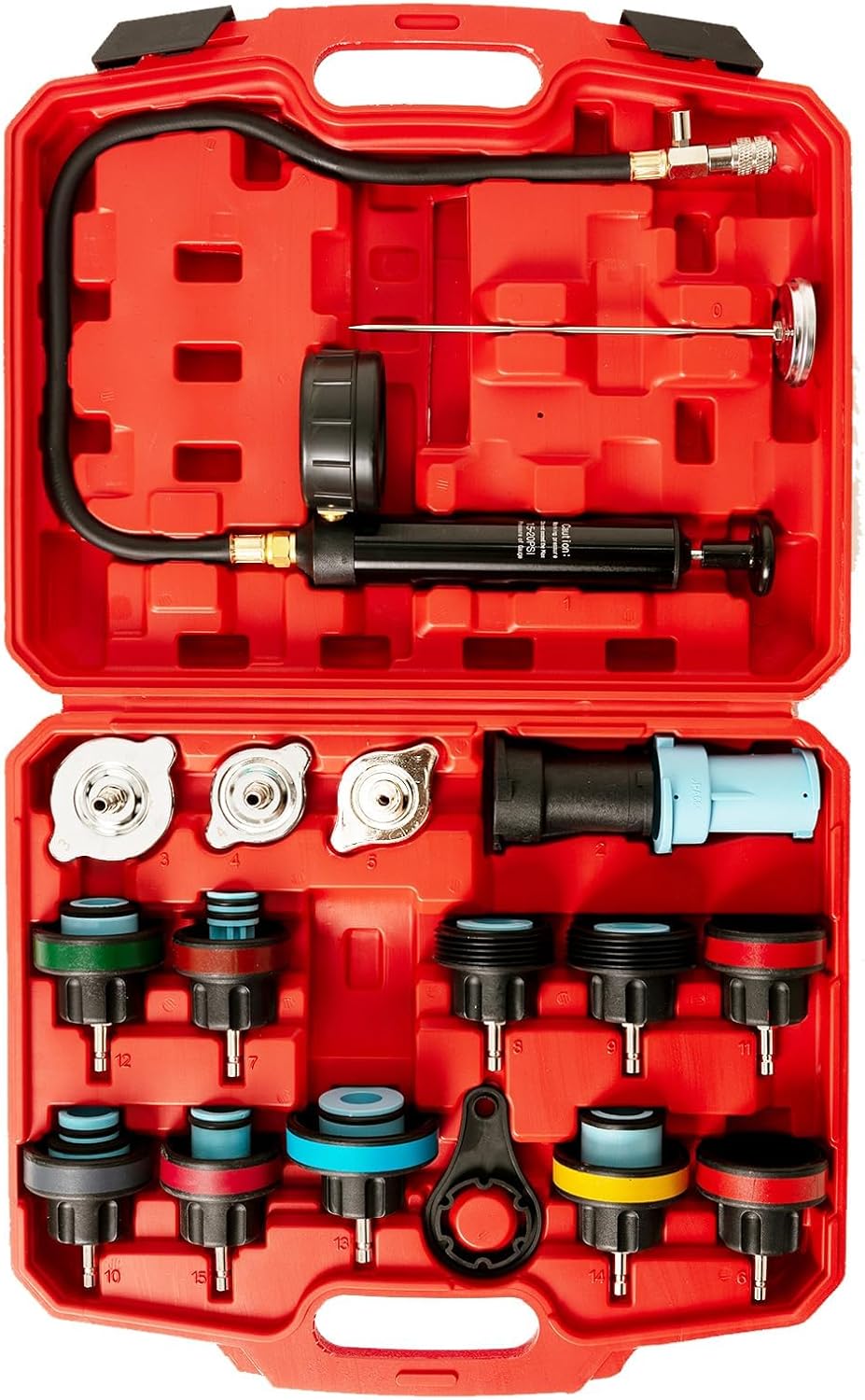
| Pieces included | 18 PCS |
|---|---|
| Gauge range | 0-36 PSI (0-2.5 Bar) |
| Thermometer | Double scale 32-400°F / 0-200°C |
The Punmew 18-piece radiator pressure tester kit provides a practical, all-in-one solution for diagnosing cooling system leaks and testing radiator cap seals. It includes a hand pump with a 0-36 PSI gauge and a variety of cap adapters so you can pressurize the system and observe if the pressure holds, which makes pinpointing leaks in hoses, tanks, and fittings straightforward. The kit also ships with a double-scale thermometer and adapters that aid coolant replacement and air-bleeding tasks. Housed in a molded storage case, the components stay organized and portable for garage or home use. For DIY mechanics this kit offers solid value: it covers most common passenger car radiator openings and delivers readable gauge feedback for quick checks. Limitations are typical for budget tools: the gauge and fittings are functional but not lab-grade, and you may need additional adapters for unusual or specialized filler necks. Expect reliable basic diagnostics rather than professional calibration-level precision.
Best for: A budget-minded DIYer or home mechanic who needs a simple, portable coolant pressure tester to find radiator and overflow tank leaks, verify pressure hold, and perform basic coolant maintenance without buying a professional shop-grade tool.
Less Ideal for: Professional technicians or shops that need calibrated, laboratory-grade instrumentation or guaranteed compatibility with rare or manufacturer-specific filler necks.
- Comprehensive 18-piece set covers most common radiator and reservoir filler necks
- Includes hand pump with 0-36 PSI gauge for visible pressure testing
- Double-scale thermometer helps when flushing or checking coolant temperature
- Compact molded storage case keeps tools organized and portable
- Gauge and fittings are functional but lack professional calibration accuracy
- May require additional or vehicle-specific adapters for some filler necks
Verdict: The best low-cost coolant pressure tester kit that reliably detects leaks and holds pressure while keeping upfront cost and basic adapter coverage minimal.
Mastercool 43301-A 27‑Piece Radiator Pressure & Vacuum Test Kit
Best Professional-Grade Coolant Pressure Tester

| Pressure Range | 0–35 psi |
|---|---|
| Total Pieces | 27 |
| Adapter Count | 19 adapters |
| Applications | Most domestic and import vehicles |
The Mastercool 43301-A is a shop-grade radiator pressure and vacuum refill kit designed for diagnosing external and internal cooling system leaks and for bleeding and refilling coolant without trapping air. The kit includes a hand pump with vacuum refill capability, a workshop-tested 0–35 psi pressure gauge, a universal radiator cap, coolant hose and 19 vehicle-specific adapters to fit most domestic and import radiators. In practice the metal adapters and reinforced fittings give secure, repeatable seals where cheaper kits use loose plastic, and the dual pressure and vacuum function lets you isolate pressure leaks and then pull coolant in under vacuum for a clean refill. The gauge range suits most passenger vehicles and the aluminum and steel construction tolerates frequent shop use. Limitations are that the kit is fairly large and includes many adapters you may never need, and it requires some familiarity with cooling systems to avoid misdiagnosis or overpressurizing delicate components.
Best for: Professional DIYers and independent shop technicians who need a durable, shop-quality coolant pressure and vacuum tester for frequent diagnosis and coolant refills, prioritizing reliable seals, a precise 0–35 psi gauge, and a wide adapter selection for broad vehicle coverage.
Less Ideal for: Casual DIYers who only perform an occasional coolant check or those who prefer a compact, single-function pressure tester.
- Combined pressure and vacuum capability for both leak diagnosis and air-free coolant refilling
- Durable aluminum and steel adapters and fittings built for repeated shop use
- Comprehensive adapter set (19) and universal cap to fit most domestic and import vehicles
- Accurate 0–35 psi gauge suitable for typical passenger vehicle cooling systems
- Large, full-featured kit may be overkill for occasional DIYers who only need a simple pressure tester
- Requires basic cooling-system knowledge to use safely and interpret results correctly
Verdict: A heavy-duty, shop-quality coolant pressure tester kit built from robust materials and precise gauges for frequent use and long-term reliability.
Orion Motor Tech 7‑Piece Coolant Pressure Tester Kit with 0–30 psi Gauge
Best Compact Coolant Pressure Tester

| Pressure range | 0–30 psi |
|---|---|
| Kit pieces | 7-piece kit |
| Materials | Aluminum alloy and die-cast aluminum |
| Includes adapters | 0.4" & 0.6" radiator adapters |
This Orion Motor Tech 7-piece kit combines a manual vacuum/pressure pump with radiator adapters and a 0–30 psi dual-scale gauge to test cooling systems and vacuum-fill radiators. DIY mechanics use it to pressurize the cooling system and find leaks in radiator cores, hoses, water pumps, expansion tanks, and head gaskets, then vacuum-fill the system without introducing air. Notable features include a rotating lever for controlled pressure release, color-coded markings for quick readings, and aluminum alloy and die-cast construction intended for durability. The included 0.4" and 0.6" radiator adapters and multiple fittings make the kit usable on many domestic and imported cars that match the listed fitment. Practical benefits are straightforward leak diagnosis, reduced coolant waste during refill, and a rugged metal pump that stands up to garage use. Limitations are that fitment is vehicle-specific so you must confirm compatibility, and the kit does not replace shop-grade computerized testers or cover every radiator neck size out of the box.
Best for: A DIY mechanic or hobbyist working in tight garages or carrying a compact toolkit who wants a simple, reliable coolant pressure tester that stores easily and covers common radiator and hose connections.
Less Ideal for: Professional shops or technicians who need vehicle-specific calibrated equipment or a broader set of adapter sizes for frequent multi-vehicle service.
- Compact 7-piece set integrates pressure testing and vacuum fill functions
- 0–30 psi dual-scale gauge with color coding for easy readings
- Durable metal construction with aluminum alloy and die-cast components
- Includes common radiator adapters (0.4" and 0.6") for many car connections
- Vehicle compatibility is limited and requires verification before use
- Not a substitute for advanced electronic diagnostic testers
Verdict: A space-saving, easy-to-store coolant pressure tester kit with a minimal set of adapters and a small gauge for mechanics with limited toolbox space.
Orion Motor Tech 34-Piece Coolant Pressure Tester and Vacuum Refill Kit
Best Complete Coolant Pressure Tester Kit

| Manufacturer | Orion Motor Tech |
|---|---|
| Model | Coolant Pressure Tester Kit |
| Adapter count | 23 adapters |
| Item weight | 10.76 pounds |
This Orion Motor Tech kit combines a hand pump pressure tester with a vacuum refill tool and 23 adapters to let a home mechanic test radiators, expansion tanks, hoses, heater cores, water pumps, and head gaskets and then refill the system without trapping air. The kit is used by fitting the correct color-coded adapter to the radiator or reservoir, pressurizing the cooling system to check for leaks, and switching to the vacuum filler to draw in coolant while avoiding air pockets. Notable features include the large adapter set for broad vehicle fitment, a built-in probe thermometer, hose clamp pliers, and a molded carrying case that keeps parts organized. In practice this kit simplifies leak diagnosis and speeds a proper coolant refill, reducing the chance of overheating from trapped air. It is a comprehensive DIY solution, though the case and plastic fittings are typical of consumer kits so careful handling and occasional adapter swaps may be needed for heavy professional use.
Best for: DIY mechanics who want a single, ready-to-use coolant pressure and vacuum refill kit that covers the widest range of vehicles and makes under-the-hood diagnostics and coolant refills faster and more organized.
Less Ideal for: Commercial technicians or shops that need hardened all-metal tools and daily high-volume durability should consider professional-grade testers instead.
- Large adapter set (23 pieces) covers many radiator and reservoir necks for wider vehicle compatibility
- Includes both pressure tester and vacuum refill tool so you can test for leaks and perform air-free coolant fills
- Color-coded adapters and molded case make selection and storage quick and organized
- Includes useful accessories such as hose clamp pliers and a probe thermometer for practical diagnosis and refilling
- Some plastic adapters and components may wear faster under heavy professional use compared with all-metal commercial tools
- Not every vehicle inlet will be covered despite the large adapter count so a missing adapter may require a workaround
Verdict: A coolant pressure tester kit that includes an extensive range of radiator cap adapters, hoses, and fittings to cover the widest variety of vehicles out of the box.
OEMTOOLS 24444 Coolant Vacuum Refill and Pressure Tester Kit
Best High-Pressure Coolant Tester

| Working pressure | 70–110 PSI |
|---|---|
| Includes | 5 bushings and 1 tapered cone adapter |
| Tool type | Coolant vacuum refill and pressure tester |
The OEMTOOLS 24444 kit is a handheld coolant vacuum refill and pressure tester built for DIY service on automotive cooling systems. It creates a vacuum to draw coolant into the radiator or reservoir, removing trapped air that can cause hot spots and overheating, and it can also be used as a pressure tester to check for leaks. The kit includes five bushings plus a tapered cone adapter to fit most filler necks and a transparent hose for monitoring fluid flow. In practical use it speeds up a coolant change or top-off by providing an airtight connection and visible fill, and the pressure capability helps locate leaks before they become serious. The case and fittings make it convenient to store and carry. Limitations are that adapter fitment is generic rather than vehicle-specific so some applications may need creative sealing, and the recommended 70–110 PSI working range requires careful handling and an appropriate shop air source or shop compressor setup.
Best for: DIY mechanics who need a coolant pressure and vacuum fill tool capable of reaching higher working pressures to diagnose stubborn leaks and purge trapped air, and who value clear gauge readings and a kit with multiple adapters for broad fitment.
Less Ideal for: Those who need a vehicle-specific, guaranteed-fit tool or who prefer an entirely manual, non-pressurized filling method should consider other options.
- Combines vacuum refill and pressure testing in one tool for faster coolant service
- Includes five bushings and a tapered cone adapter to seal a variety of filler necks
- Transparent hose lets you watch coolant flow and confirm air-free filling
- Portable storage case keeps fittings organized and protected
- Adapters are generic and may not create a perfect seal on every vehicle without improvised sealing
- Requires careful pressure control and an appropriate air source to stay within the recommended working range
Verdict: A coolant pressure tester designed to safely reach and hold higher test pressures and provide clear gauge readings for stubborn or high-pressure cooling systems.
Mastercool 43306 Heavy-Duty Cooling System Pressure Test & Refill Kit
Best Premium Coolant Pressure Tester

| Pressure Source | Shop-air regulated (90–125 psi) |
|---|---|
| Vacuum Fittings | 4 quick-disconnects |
| Adapters Included | #2, #12, #13, #14, #15 |
| Storage | Blow-molded case |
The Mastercool 43306 is a heavy-duty cooling system pressure test and refill kit built for shop use on large trucks and fleet vehicles. It connects to regulated shop air (recommended 90–125 psi) to apply steady pressure for leak diagnosis, and includes a vacuum refill attachment with four quick-disconnects to eliminate airlocks during coolant top-up. The kit ships with a pressure regulator, spindle, refill hose and a set of color-coded heavy-duty adapters for common large-vehicle fittings, all stored in a blow-molded case for organized transport. For a DIY mechanic working on big rigs or commercial trucks, the biggest practical benefits are faster setup, repeatable pressure application without manual pumping, and a vacuum-assisted refill that speeds bleeding. Limitations are its dependence on a shop-air source and the focus on heavy-duty vehicle adapters, which makes it overkill for small passenger cars and reduces portability for one-off home garage jobs without an air compressor.
Best for: Experienced DIY mechanics and small-shop technicians who want a professional-grade coolant pressure tester that prioritizes durability, precise shop-air operation, and a full set of adapters for servicing heavy-duty truck cooling systems.
Less Ideal for: Casual home users working mainly on passenger cars or hobbyists without a shop-air compressor should choose a simpler, more portable tester instead.
- Uses regulated shop-air for consistent pressure during leak testing
- Includes vacuum refill attachment with quick-disconnects to reduce airlocks when refilling coolant
- Comes with a range of heavy-duty, color-coded adapters for large-vehicle fittings
- Blow-molded case keeps tools organized and protected during transport
- Requires a regulated shop-air source so not ideal for garages without an air compressor
- Designed for heavy-duty truck systems so adapters and performance exceed needs for most passenger cars
Verdict: A top-tier coolant pressure tester kit offering superior build quality, precision instrumentation, and comprehensive accessories for users who prioritize performance and longevity.
How We Chose the Best Coolant Pressure Tester Kit
We focused on the factors that matter most when using a coolant pressure tester kit in a home garage. First, we looked at adapter compatibility, especially how well a kit covers common radiator necks and expansion tank styles across domestic, Asian, and European vehicles. We also weighed gauge readability and pressure consistency, since a tester is only useful if it holds steady pressure and lets you spot small leaks clearly.Build quality was another key filter. We favored kits with sturdy pumps, secure hose connections, well-machined adapters, and storage cases that keep parts organized between jobs. Seal quality mattered too, because weak O-rings and poorly fitting caps can create false results. We also considered ease of use for DIY mechanics, including quick setup, intuitive connection points, and whether the kit supports basic cap testing as well as full system pressure testing.We excluded kits with thin hardware, vague vehicle fitment, hard-to-read gauges, or inconsistent sealing that could lead to misleading diagnoses.
Our full evaluation process is outlined in our review methodology.
What a Coolant Pressure Tester Kit Actually Helps You Diagnose
A cooling system can lose pressure from many points, and not all leaks are obvious when the engine is cold or parked. A coolant pressure tester kit lets you pressurize the system with the engine off so you can inspect hoses, radiator seams, thermostat housings, heater hose junctions, freeze plug areas, water pump weep holes, and reservoir connections in a controlled way.
It is also useful when a vehicle has a slow coolant loss with no visible puddle. In those cases, pressure testing can reveal damp fittings, hairline cracks, or cap sealing problems that only show up once the system is under load. For DIY mechanics, that means less parts swapping and a more methodical diagnosis.
- Helps confirm external leaks before replacing parts
- Can reveal bad radiator or reservoir caps
- Useful for tracing intermittent coolant loss
- Makes visual inspection easier with the engine off
Key Features to Look for Before You Buy
The first thing to check is adapter coverage. Some kits are best for older radiator neck designs, while others include more expansion tank adapters for modern vehicles. If you work on multiple cars, broader compatibility usually matters more than having a large number of duplicate pieces.
Gauge quality is just as important. A clear gauge with easy-to-read pressure markings helps you monitor small drops over time. You also want a hand pump that builds pressure smoothly and fittings that lock on securely without feeling loose or cross-threaded. Good storage matters too, because these kits often include many small parts that are easy to misplace.
- Wide adapter selection for your vehicle types
- Clear gauge with stable pressure readings
- Strong pump body and secure hose connections
- Durable seals and replaceable O-rings if possible
- Organized case layout for faster setup
How Much Pressure Is Enough for Testing
More pressure is not automatically better. The goal is to test the system at a safe level that matches the vehicle's cooling system design and cap rating. Over-pressurizing can create problems instead of diagnosing them, so the smartest approach is to follow the vehicle service information and stay within the intended operating range.
For most DIY users, the value of the tool is not a very high maximum gauge number. It is the ability to reach target pressure smoothly and hold it long enough to spot a leak. A responsive pump and accurate gauge are more important than an inflated spec sheet.
- Use the vehicle's recommended test pressure
- Do not exceed cap or system limits
- Watch for gradual pressure drop, not just sudden loss
- Recheck fittings first if pressure falls immediately
Adapter Compatibility Matters More than Piece Count
Many buyers focus on how many adapters are included, but total count can be misleading. A smaller kit with the right cap styles for your vehicles is more useful than a larger set filled with rarely used duplicates. Before choosing, think about whether you mainly work on older domestic vehicles, newer crossovers, or a mix of platforms with pressurized expansion tanks.
Adapter design also affects confidence during testing. A secure fit reduces the chance of false leaks caused by poor sealing at the tester itself. If an adapter feels awkward to install or does not seat squarely, the reading may not reflect the actual condition of the cooling system.
- Match the kit to the vehicles you actually service
- Check for both radiator and reservoir style adapters
- Good sealing is as important as broad coverage
- Fewer but better-fitting adapters can be the smarter choice
Manual Versus More Advanced Testing Setups
For most home garages, a manual hand-pump coolant pressure tester kit is the right choice. It is simple, portable, and easy to use without extra equipment. Manual kits also make it easier to feel resistance as pressure builds, which can help prevent overdoing the test.
More advanced setups can be useful in busy shops, but they are often unnecessary for occasional maintenance and leak hunting at home. DIY mechanics usually benefit more from a dependable manual kit with good adapters than from extra complexity they may rarely use.
- Manual kits suit most home users
- Simple tools are easier to store and maintain
- A quality pump and gauge matter more than extra complexity
Common Mistakes That Can Lead to False Results
One of the most common mistakes is testing a hot engine. Cooling systems should be checked only when it is safe and cool enough to open without risk. Another issue is using the wrong adapter or failing to fully seat it, which can make the tester itself leak and send you chasing a problem that is not really there.
DIY mechanics also sometimes stop too soon. Some leaks show up immediately, while others take several minutes to appear as pressure slowly exposes a weak seam or gasket edge. A careful visual inspection with good lighting is just as important as watching the gauge.
- Never remove a cap from a hot pressurized system
- Confirm the adapter and cap tester connections are tight
- Inspect the radiator, hoses, pump area, and cabin-side heater circuit
- Give the system enough time to show a slow leak
Who Should Buy a Full Kit Instead of a Basic Tester
If you only maintain one older vehicle with a standard radiator neck, a simple tester may be enough. But if you work on several vehicles, help friends and family, or plan to keep tools long term, a full coolant pressure tester kit is usually the better value in practical terms. It gives you more flexibility as vehicle designs change and reduces the need for extra adapters later.
A full kit is especially helpful for DIY mechanics who diagnose recurring coolant loss, perform cooling system repairs, or service both passenger cars and light trucks. The broader your garage workload, the more useful adapter variety and better organization become.
- Basic testers fit narrow use cases
- Full kits make more sense for mixed-vehicle households
- Broader compatibility supports long-term tool use
FAQ
What is a coolant pressure tester kit used for?
It is used to pressurize a vehicle's cooling system with the engine off so you can look for leaks. This helps identify problems at hoses, radiators, caps, reservoirs, water pumps, and related fittings. It is a diagnostic tool, not a repair tool.
Can a coolant pressure tester kit find internal engine problems?
It is mainly best at finding external pressure loss, but it can still hint at internal issues if the system will not hold pressure and no external leak is visible. That said, confirming internal problems usually requires additional tests. A pressure tester should be part of the diagnosis, not the only step.
Do I need a special adapter for every vehicle?
Not every vehicle needs a unique adapter, but correct fit is essential. Cooling systems use different radiator necks and expansion tank designs, so a kit needs the right style for the vehicle being tested. A poor fit can create false readings or prevent proper pressure build-up.
Is a radiator pressure tester the same as a coolant pressure tester kit?
The terms are often used interchangeably, but some kits do more than just test a traditional radiator neck. Many also include adapters for modern pressurized reservoirs and cap testing. The important part is whether the kit matches your vehicle's cooling system layout.
How long should a cooling system hold pressure during a test?
There is no single answer for every vehicle, but the system should generally hold steady enough to allow inspection without a notable pressure drop. A slow decrease can point to a small leak, while a rapid drop usually suggests a larger leak or a bad connection at the tester. Always verify the tester setup before assuming the vehicle is at fault.
Can beginners use a coolant pressure tester kit safely?
Yes, if they follow basic safety rules and use the tool on a cool engine. Reading the vehicle service guidance, choosing the correct adapter, and avoiding excessive pressure are the main points. The tool is beginner-friendly when used patiently and methodically.
Final Verdict
Choosing the right coolant pressure tester kit comes down to fitment, gauge clarity, sealing quality, and how many vehicle types you plan to service. DIY mechanics usually get the best long-term results from a kit that balances dependable pressure holding with practical adapter coverage, rather than simply chasing the highest piece count.If you want more confident cooling system diagnostics at home, focus on compatibility first, then durability and ease of use. A well-matched kit will help you diagnose leaks faster, avoid false results, and work through cooling system problems with much more confidence.
