

Note: This article contains affiliate links. If you click on these links and make a purchase, I may earn a small commission at no extra cost to you. This helps support my research and content. Read my full affiliate disclosure here.
A compression tester is one of the most useful diagnostic tools a DIY mechanic can keep in the garage. When an engine starts running rough, losing power, burning oil, or becoming hard to start, a proper compression test can help narrow the problem before you spend time replacing parts that are not at fault.The right compression tester makes the job faster, cleaner, and more reliable. Gauge readability, hose length, adapter fit, and consistent sealing all affect how useful the tool will be in real-world engine work. The picks that follow are designed to help you compare the most important features so you can choose a compression tester that fits your vehicles, skill level, and diagnostic routine.
Top Picks at a Glance
| Best Overall Compression Tester for DIY Mechanics Reliable, accurate all-around tester for most DIY engine diagnostics | OTC 5605 Deluxe Compression Tester Kit for Gasoline Engines |  |
| Best Budget Compression Tester for DIY Mechanics Economical tester offering basic accuracy and essential accessories for starters | Gnhydxfe 8‑Piece Engine Compression Tester Kit (0–300 PSI) |  |
| Best Premium Compression Tester Pro-grade tester with precision gauge and long-lasting, high-quality components | Mityvac MV5532 Digital Gasoline Compression Test Kit (12‑cylinder, Backlit LCD) |  |
| Best Complete Compression Tester Kit Comprehensive kit with many adapters, hoses, and ready-to-use accessories | XSTARYE 46‑Piece Compression and Leak‑Down Tester Kit with Dual‑Dial Gauges |  |
| Best Compact Compression Tester Pocket-friendly, lightweight tester built for tight spaces and portability | TUSK Compression Tester Kit |  |
| Best High-Pressure Range Compression Tester High-range gauge and reinforced fittings for testing elevated compression levels | Bicos Diesel Engine Compression Tester Kit with 0-1000 PSI Gauge and Adapters |  |
| Best Heavy-Duty Compression Tester Rugged, shop-rated tester with reinforced hoses and durable metal fittings | Speedway Motors Compression Test Kit with Air Hold Quick Connector and Heavy-Duty Gauge |  |
OTC 5605 Deluxe Compression Tester Kit for Gasoline Engines
Best Overall Compression Tester for DIY Mechanics

| Included Components | Case, Gauge, 3 flex hoses, 3 thread adapters, 7" flex adapter |
|---|---|
| Thread Style | 16mm |
| Material Type | Triton |
| Gauge Range | 0-300 psi / 0-2100 kPa |
The OTC 5605 Deluxe Compression Tester Kit is designed to let DIY mechanics check cylinder compression on gasoline engines with the same basic tools technicians use. It pairs a 2.5 inch dual-scale gauge (0-300 psi and 0-2100 kPa) with extra-long 25 inch flex hose and a quick coupler so you can read results from cluttered engine bays without awkward positioning. The kit includes multiple thread adapters, a deep-well connector for recessed plug wells, and a Ford Triton 16 mm adapter to handle common plug types. Metal parts are nickel plated to resist corrosion and the gauge has a protective boot and chrome bezel for durability. Components store in a blow-molded hard case so parts stay organized between jobs. The kit is practical for routine diagnosis and engine troubleshooting, but it focuses on gasoline engines and does not include specialized diesel fittings or advanced electronic logging features that professionals might want.
Best for: Home mechanics and DIYers who want a reliable, easy-to-use compression tester that covers most gasoline engines and provides clear readings for routine diagnostics and tune-up checks.
Less Ideal for: Professional shops needing diesel engine coverage or technicians who require electronic logging and automated test records should consider more specialized equipment.
- Dual-scale 2.5 inch gauge readable in psi and kPa for clear measurements
- Extra-long 25 inch flex hose with quick coupler for easier viewing in tight engine compartments
- Multiple adapters including deep-well and 16 mm Triton adapter to fit a wide range of spark plug threads
- Nickel-plated metal components and protective gauge boot improve durability and corrosion resistance
- Rugged blow-molded case keeps all components organized and protected
- Kit is intended for gasoline engines and lacks diesel-specific adapters or fittings
- No electronic data logging or storage, so readings must be recorded manually
Verdict: The top all-around compression tester that balances accuracy, ease of use, durable construction, and a useful gauge range for most home automotive repairs.
Gnhydxfe 8‑Piece Engine Compression Tester Kit (0–300 PSI)
Best Budget Compression Tester for DIY Mechanics

| Pressure range | 0-300 PSI |
|---|---|
| Material type | Acrylic, Rubber |
| Unit count | 8 Count |
This compression tester kit gives DIY mechanics a straightforward way to check cylinder pressure on gasoline engines. The kit includes an acrylic dial pressure gauge rated 0–300 PSI, multiple metal adapters, rubber cone ends, and an extension hose, all stored in a compact carrying case for easy transport. In practice it is used by removing spark plugs, threading the appropriate adapter into the spark plug hole, connecting the hose and gauge, and cranking the engine to read peak compression. The large acrylic dial with a rubber cover makes readings easy to see and the included adapter range covers most motorcycle, car, truck, and ATV spark plug fittings. Construction uses acrylic and rubber with corrosion protection claims, so it feels serviceable for occasional garage use. Limitations are that the kit is a budget tool set: the gauge is not laboratory grade, adapters rely on simple fittings that may require care to avoid leaks, and the kit lacks a labeled calibration certificate or advanced accessories for professional diagnostic workflows. For home mechanics who need a fast, affordable way to verify compression, this covers the essentials without professional-level accuracy.
Best for: DIY mechanics and hobbyists who need an inexpensive, portable compression tester to quickly check cylinder pressure and diagnose basic engine issues without specialist tools or expense.
Less Ideal for: Professional shops or users who need laboratory-level accuracy, certified calibration, or advanced diagnostic features should choose a higher-end professional tester.
- Wide 0–300 PSI measurement range suitable for most petrol engines
- Includes multiple metal adapters and rubber cone ends to fit common spark plug ports
- Compact carrying case keeps components organized for transport and storage
- Large acrylic dial with rubber cover makes readings easy to read in a garage environment
- Gauge is an economy-grade instrument and not made for precision lab calibration
- Adapters and hose use basic fittings that can leak if not seated carefully
Verdict: An affordable compression tester that gives reliable pressure readings and basic accessories so DIY mechanics can diagnose engine health without a big investment.
Mityvac MV5532 Digital Gasoline Compression Test Kit (12‑cylinder, Backlit LCD)
Best Premium Compression Tester

| Engine type | Gasoline engines |
|---|---|
| Cylinder capacity | Up to 12 cylinders |
| Display | Backlit LCD |
| Power source | 9V battery |
The Mityvac MV5532 is a digital compression tester built to speed up cylinder compression checks on gasoline engines. It measures and memorizes peak compression for up to 12 cylinders, so you can cycle through a multi-cylinder engine without writing down each reading. The backlit LCD and oil-resistant gauge face make readings simple in dim engine bays and the rubber boot gives added protection during shop use. Included adapters and an air-hold adapter let you test motorcycles, marine units, and small engines as well as cars, while the 9V battery and auto shut-off keep the unit ready without draining power. For DIY mechanics the MV5532 offers professional-style convenience: faster data capture, clearer displays, and a rugged carrying case to keep adapters organized. Limitations are mostly typical of handheld testers: it requires the correct adapter seal for reliable readings and battery replacement for long-term use, and it does not replace more advanced diagnostic equipment for complex engine issues.
Best for: Experienced DIY mechanics and independent technicians who prioritize professional-grade accuracy and durable construction for frequent compression testing on a variety of gasoline engines, and who want a higher-end tool that records peak values and withstands shop use.
Less Ideal for: Technicians who need bench-grade laboratory measurement accuracy or integrated data logging across multiple diagnostic tools should consider higher-end shop equipment instead.
- Digital peak memory for up to 12 cylinders speeds testing and reduces transcription errors
- Backlit LCD and oil-resistant face improve readability in poor lighting and dirty environments
- Protective rubber boot and custom molded case increase durability and keep adapters organized
- Includes multiple adapters and an air-hold adapter for testing a range of gasoline engines
- Requires correct adapter seals for accurate readings which may need replacement over time
- Powered by a 9V battery so you must monitor and replace batteries for consistent operation
Verdict: A higher-end compression tester with superior materials, precision gauges, and refined fittings for mechanics who want professional-grade accuracy and longevity.
XSTARYE 46‑Piece Compression and Leak‑Down Tester Kit with Dual‑Dial Gauges
Best Complete Compression Tester Kit

| Included Components | Compression and Leakage Test Kit |
|---|---|
| Thread Style | 1/4" Npt |
| Material Type | Plastic |
This XSTARYE 46-piece kit bundles a compression tester, dual-dial leak-down gauge, and diesel fuel pressure gauge into a single organized set designed for workshop and DIY engine diagnostics. Technically it lets you measure cylinder compression, quantify leak-down percentage, and check diesel fuel pressure using large, dual-scale dials for clear PSI and BAR readings. The kit includes a wide range of adapters for spark and glow plug ports plus clamp and universal fittings, which makes attaching to gasoline and most diesel engines straightforward. The molded case keeps adapters, gaskets, and tools secure and simplifies field work. Practical benefits are faster fault isolation for worn rings, leaking valves, or head gasket issues and avoiding unnecessary parts replacement. Limitations are that the kit is not compatible with 12V Cummins engines and some highly specialized or manufacturer-specific ports may still need an adapter not included, so professionals servicing rare engines may find gaps in fitment coverage.
Best for: DIY mechanics and home garage technicians who want a single, organized kit to perform compression, leak-down, and diesel fuel pressure tests across a wide range of gasoline and diesel engines without buying separate adapters or specialty tools.
Less Ideal for: Professional technicians who work frequently on 12V Cummins engines or on many uncommon OEM-specific ports and need guaranteed fitment across a wide fleet.
- Combines compression, leak-down, and diesel fuel pressure testing in one kit for comprehensive diagnostics.
- Large dual-scale gauges provide clear PSI and BAR readings for precise measurements.
- Extensive adapter set covers most spark and glow plug ports for gasoline and diesel engines.
- Molded, compartmentalized case keeps tools organized and protected during transport.
- Not compatible with 12V Cummins engines which limits use on some diesel pickups.
- May lack manufacturer-specific adapters for some uncommon or modern engine ports.
Verdict: A compression tester kit that includes a full range of adapters, hoses, and accessories to test multiple spark-plug sizes and cylinder types out of the box.
TUSK Compression Tester Kit
Best Compact Compression Tester

| Material Type | Plastic |
|---|---|
| Thread Style | Metric |
| Maximum Pressure | 300 psi |
The TUSK Compression Tester is a compact kit designed for quick compression checks on small engines and powersports machines. It includes a pressure gauge that reads to 300 psi, a quick-disconnect coupling, a side-release valve for repeated tests without disconnecting, and a set of common metric spark plug thread adapters to fit most motorcycle, ATV, and small-engine plugs. In use the kit simplifies diagnosing low compression or comparing cylinder-to-cylinder values, and the molded carrying case keeps components organized for garage or field checks. The gauge and fittings are plastic-forward, which keeps weight down but means the kit is better suited for occasional DIY troubleshooting rather than heavy daily shop use. The metric thread selection covers the common plug sizes you will encounter on bikes and ATVs, but the kit does not include specialized adapters for some uncommon engines. For a DIY mechanic who wants a portable, easy-to-use tester to spot-check engines, this is a practical, space-saving option; those needing shop-grade durability or broader vehicle coverage may want a heavier-duty alternative.
Best for: DIY mechanics and mobile technicians who need a lightweight, easy-to-store compression tester for quick cylinder checks in tight garages or on the go, prioritizing portability and straightforward setup over heavy-duty workshop tooling.
Less Ideal for: Professional shops or users who need heavy-duty, metal-bodied gauges or wide multi-vehicle coverage should consider a more robust tester.
- Includes multiple metric spark plug thread adapters to fit common powersports engines
- Gauge reads up to 300 psi for standard compression measurements
- Side-release valve and quick-disconnect coupling speed up repeated tests
- Molded storage case keeps hose, adapters, and gauge organized for transport
- Plastic-heavy construction limits long-term durability under frequent shop use
- Does not include non-metric or less common adapters for some specialty engines
Verdict: A small, lightweight compression tester designed for easy storage and quick checks in tight garages or for mechanics who need a portable tool.
Bicos Diesel Engine Compression Tester Kit with 0-1000 PSI Gauge and Adapters
Best High-Pressure Range Compression Tester

| Gauge range | 0-1000 PSI / 0-70 bar |
|---|---|
| Included components | Engine compression gauge tester with adapters |
| Adapter count | 9 glow plug and 4 injector adapters |
| Material type | Metal or High-Strength Plastic |
| Thread style | Npt |
This Bicos diesel compression tester is designed to measure cylinder pressure on diesel cars, trucks, and farm equipment using a 0-1000 PSI (0-70 bar) analog gauge, flexible hose, and a set of glow plug and injector adapters. You use it by fitting the appropriate adapter into the glow plug or injector port, attaching the hose and gauge, cranking the engine, and reading peak pressure — the included release valve makes depressurizing simple. The high pressure range is useful for diesel engines that often exceed the limits of passenger-car testers, and the kit’s multiple adapters increase compatibility across different diesel ports. Construction mixes metal and high-strength plastic which keeps weight down while remaining durable for garage use. Limitations are typical of basic mechanical gauges: readings are analogue so not logged digitally, and adapter selection may still require an extra fitting for uncommon engines. The kit is a straightforward, practical tool for routine diagnostics and pre-repair checks.
Best for: DIY mechanics and backyard technicians who work on diesel engines and need a high-range, durable compression gauge for heavy-duty diagnostics and injector or glow plug troubleshooting.
Less Ideal for: Technicians who need digital data logging, automated testing, or vehicle-specific factory-quality adapters should consider more advanced diagnostic equipment.
- 0-1000 PSI gauge covers high-pressure diesel cylinders that exceed standard tester ranges
- Includes multiple glow plug and injector adapters to fit a variety of diesel engines
- Flexible hose and release valve simplify connection and safe depressurizing after tests
- Metal and high-strength plastic construction balances durability and weight for garage use
- Analog gauge does not record or log readings for later comparison
- May not include every specialized adapter needed for less common diesel engines
Verdict: A compression tester with an extended pressure range and robust gauge suitable for engines that require higher maximum readings or heavy-duty diagnostics.
Speedway Motors Compression Test Kit with Air Hold Quick Connector and Heavy-Duty Gauge
Best Heavy-Duty Compression Tester
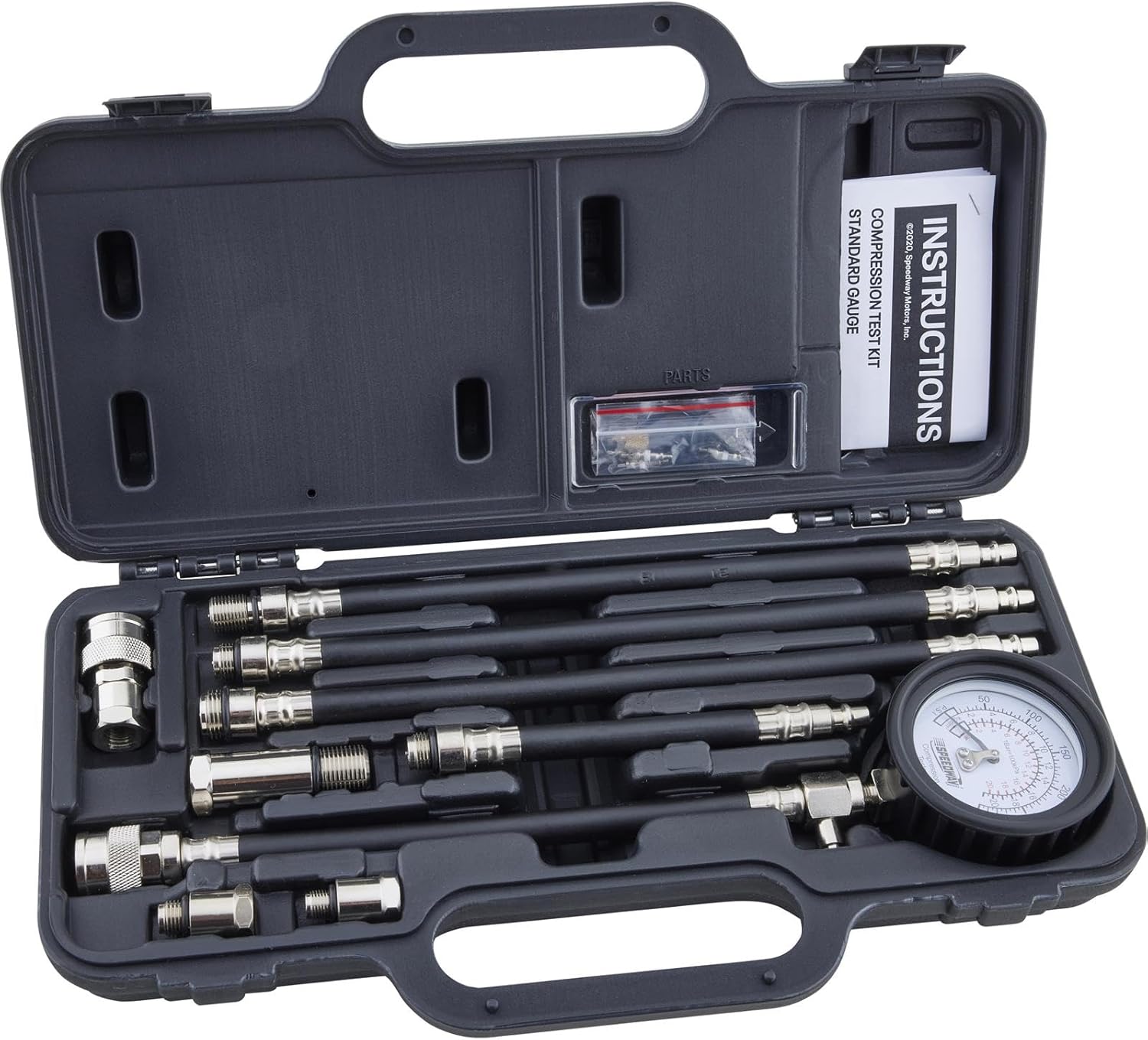
| Gauge size | 2 3/4 inch |
|---|---|
| Includes | Air hold quick connector, 10" whip hose, rubber boot, adapters |
| Applications | Automotive, marine, industrial, small engines |
This Speedway Motors compression test kit is built for DIY mechanics who need a durable, flexible tool for testing a wide range of engines. The kit centers on a 2 3/4" heavy-duty gauge with a 10" whip hose and a rubber boot for easier access and safer readings. It includes an air-hold quick connector that lets you pressurize a cylinder for valve seal checks or to hold pressure while you work without removing the head, plus a set of adapters and hose assemblies for small engines up to larger automotive plugs. The molded case keeps fittings organized and protects the gauge in a garage environment. In real use the kit simplifies routine compression checks, leak-down style valve checks, and troubleshooting across cars, lawn equipment, and marine engines. Limitations are that it is a mechanical gauge rather than digital, so fine graduations and data logging are not available, and the kit assumes basic hand skills for installing adapters and sealing plungers properly.
Best for: Shop-focused DIY mechanics who need a workshop-grade compression tester that holds up to frequent, rough use and supports a wide range of engines from small lawn equipment to automotive and marine applications.
Less Ideal for: Users who want digital recording, fine resolution measurements, or plug-and-play electronic diagnostics should consider a digital tester or diagnostic tool instead.
- Heavy-duty 2 3/4" gauge with 10" whip hose for robust, clear readings
- Air hold quick connector enables pressurizing a cylinder to test valve seals without head removal
- Wide range of adapters and hose assemblies to fit small engines through larger automotive spark plug threads
- Molded case keeps components organized and protected for transport and storage
- Mechanical gauge only, so it lacks digital readout precision and data logging
- Requires user familiarity to fit adapters and achieve leak-free seals on different engines
Verdict: A rugged compression tester built with reinforced hoses, metal fittings, and a durable gauge to withstand frequent shop use and rough handling.
How We Chose the Best Compression Tester
We built this list around the needs of DIY mechanics who want dependable engine diagnostics without turning a simple compression check into a frustrating job. For this category, we focused on gauge readability and repeatable pressure readings first, because a tester is only useful if you can trust the numbers and compare cylinders confidently. We also looked closely at hose length and flexibility, since access around engine bays, deep spark plug wells, and tight transverse layouts can vary a lot.Adapter coverage was another major filter. We favored kits that support common spark plug thread sizes used on gas engines so users can move between multiple vehicles without hunting for extra fittings. Connection style also mattered, especially how securely the tester seals at the plug hole and how easy it is to use with one person. We considered release valve function, storage case organization, and general build quality for repeated garage use. We excluded overly limited kits, hard-to-read gauges, and sets with unclear fitment or weak sealing hardware, because those issues can lead to inconsistent results and wasted troubleshooting time.
Our full evaluation process is outlined in our review methodology.
What a Compression Tester Should Do Well
A good compression tester should give you consistent readings from cylinder to cylinder and from one test session to the next. For most DIY users, the goal is not just finding the highest number on the gauge. It is getting a reliable picture of engine condition so you can spot weak cylinders, compare results, and decide whether the problem points toward valves, rings, or a head gasket issue.
Usability matters just as much as raw measurement. A tester that seals easily, has a flexible hose, and includes the right adapters can save a lot of frustration when working in crowded engine bays. Clear markings on the gauge and a straightforward pressure release valve also make the test easier to repeat accurately.
- Consistent gauge readings across repeated tests
- Secure sealing at the spark plug hole
- Flexible hose for tight engine compartments
- Adapters for common thread sizes
- Easy pressure release between cylinders
Choosing the Right Type for Your Garage
Most DIY mechanics shopping for a compression tester are looking at kits for gasoline engines with spark plug hole adapters. These are the most versatile choice for home use because they can cover several cars, trucks, motorcycles, or small engines if the adapter range is broad enough. If you only work on one vehicle, a simpler kit may be enough, but a wider adapter selection gives you more flexibility over time.
It also helps to think about how you prefer to test. Some users like threaded connections that lock in place for a more dependable seal and easier solo operation. Others may prefer quicker setups when access is simple. In general, threaded fittings are better for repeatability, while the right hose and gauge layout can make the whole process more practical in cramped spaces.
- General garage use usually favors threaded adapter kits
- Multi-vehicle owners benefit from broader fitment coverage
- Solo users often prefer secure hands-free sealing
- Compact storage matters if diagnostic tools are used occasionally
Gauge Range and Accuracy Explained
A compression tester does not need extreme complexity, but the gauge still deserves close attention. A dial that is easy to read at a glance is especially important when you are leaning over an engine bay and watching the needle climb during cranking. Fine graduations can help, but only if the face remains uncluttered. The best experience usually comes from a gauge with a sensible pressure range for gasoline engines and markings that make cylinder-to-cylinder comparison easy.
Accuracy is also about repeatability. Even if a home mechanic is not verifying laboratory precision, the tester should show stable and believable results each time you run the same cylinder under the same conditions. Inconsistent needle movement, hard-to-reset gauges, or vague markings make diagnosis harder because you cannot tell whether the engine changed or the tool did.
- Look for a clear dial face with readable markings
- Prioritize repeatable readings over gimmicky features
- A smooth reset function helps speed up comparison testing
Adapter Fit and Hose Design Matter More than Many Buyers Expect
Many compression test frustrations come from poor adapter fit rather than the gauge itself. If the adapter does not match the spark plug thread correctly or fails to seal well, the reading can look lower than the engine actually is. That is why a useful kit should include the thread sizes you are most likely to encounter and fittings that install cleanly without feeling rough or fragile.
Hose length and flexibility are just as important in practice. Engines with deep plug wells, angled heads, or crowded intake layouts can be awkward to reach. A hose that is too stiff or too short can force you into a poor angle, increasing the chance of leakage or cross-threading. A better hose layout helps the gauge sit where you can actually see and reset it without fighting the engine bay.
- Match adapter threads carefully before tightening
- Use enough hose length to avoid awkward gauge placement
- Flexible hoses help in transverse and tight engine layouts
- A good seal is essential for trustworthy readings
How to Get More Reliable Compression Test Results
Even the best compression tester can give misleading numbers if the test procedure is rushed. For the most useful results, compare cylinders under the same conditions. That means using a fully charged battery, testing with the throttle position handled consistently, and keeping cranking time similar from cylinder to cylinder. Warm-engine testing is often preferred when possible because it reflects normal operating clearances, though there are times when a cold comparison is still useful.
Take notes as you go rather than relying on memory. Absolute pressure matters, but the spread between cylinders is often the bigger clue for diagnosis. If you find one low cylinder, a follow-up wet test can help you learn whether the issue may be ring-related or more likely tied to the valve train or head sealing. The tester is only one part of the job, but a well-run procedure makes its readings much more valuable.
- Keep the battery strong for consistent cranking speed
- Test each cylinder the same way
- Record readings immediately
- Compare cylinder balance, not just peak numbers
- Use follow-up testing when one cylinder stands out
Build Quality and Kit Organization for Long-term Use
A compression tester may not be used every week, but when you need it, you want everything in the case and ready to go. Durable fittings, a hose that does not feel brittle, and a gauge that remains legible after repeated storage all contribute to long-term value. Better kit organization also makes it easier to find the correct adapter quickly, which reduces the temptation to force a near match that can damage threads or distort readings.
For DIY mechanics, practical durability usually matters more than flashy presentation. A sturdy case, clearly separated adapters, and components that thread together smoothly can make the difference between a tool that stays useful for years and one that becomes unreliable after a few jobs. Think about how often the kit will be moved, stored on a shelf, or used on different vehicles over time.
- Choose a case that keeps adapters sorted
- Look for fittings that thread smoothly and securely
- Durable hoses and readable gauges improve long-term usability
- Good organization reduces setup mistakes
FAQ
What does a compression tester actually tell you?
A compression tester measures the pressure each cylinder can build during cranking. That helps you evaluate basic engine sealing and compare one cylinder to another. It does not diagnose every problem by itself, but it is very useful for spotting weak cylinders and narrowing down likely mechanical issues.
Is a threaded compression tester better for DIY use?
In many cases, yes. A threaded connection usually seals more consistently and frees up your hands while cranking the engine, which is helpful for solo testing. It can also improve repeatability, especially on engines where access is awkward or spark plug wells are deep.
Can one compression tester work on all my vehicles?
Not always. Compatibility depends mostly on the adapter thread sizes included in the kit and the types of engines you plan to test. Before buying, make sure the tester supports the spark plug thread sizes used by your vehicles and has enough hose flexibility for the available space.
Do I need a compression tester if I already have a leak-down tester?
They serve related but different purposes. A compression tester is usually faster for basic screening and cylinder comparison, while a leak-down tester can help pinpoint where pressure is escaping. Many DIY mechanics start with a compression tester because it is quicker for first-pass diagnosis.
What is more important, the highest reading or even readings across cylinders?
Even readings across cylinders are often more important than chasing a single high number. An engine can still run poorly if one or two cylinders are notably lower than the rest. The pattern of readings is usually what gives you the most useful diagnostic clue.
Why are my compression readings inconsistent from one test to the next?
Inconsistent results often come from changes in cranking speed, battery charge, throttle position, engine temperature, or poor sealing at the adapter. A worn or low-quality tester can also contribute to unstable readings. Repeating the test with the same procedure on each cylinder usually improves consistency.
Final Verdict
The best compression tester for DIY mechanics is the one that gives repeatable readings, fits the engines you actually work on, and stays easy to use when access is tight. Gauge clarity, adapter coverage, hose design, and secure sealing matter far more than extra bulk or unnecessary complexity.Focus on a kit that supports your common spark plug thread sizes and makes cylinder-to-cylinder comparison simple. If you choose based on fit, readability, and dependable sealing, you will end up with a diagnostic tool that helps you troubleshoot engine problems with more confidence and less guesswork.
